Review: Cocaine Bear

Relying on an almost postmodern meathead premise, Cocaine Bear is mainly notable for how doggedly it tries to pass off patently ridiculous plot points as having enough credibility to survive 90 minutes of complicated exposition. We have cocaine, and we have a bear, the combination of which leads to the kind of bloody carnage that’s meant to tickle the funny bone as opposed to stimulating fright responses. The premise itself is reportedly based on a true story from 1985 about a bag of cocaine dropped from a plane into a Georgia forest that was eaten by what is believed to have been a bear. No one knows what happened to the bear, but rumors were inevitable (most likely it died from toxic shock), and now someone has decided to extrapolate on those rumors to their most ludicrous ends. In a nutshell, our ursine protagonist—a female, which itself becomes a vital plot point—goes ballistic and just has to have more, meaning: instant junkie. Anything between her and more blow gets mowed down with savage efficiency.

So the whole point is to provide human fodder for the bear, and screenwriter Jimmy Warden and director Elizabeth Banks do a respectable job of devising subplots that can be intertwined to that end. After introducing the bear by means of an unlucky couple hiking through the woods, we see, in flashback, the obviously stoned drug courier dumping the coke-filled duffel bags from the door of his small plane and inadvertently knocking himself unconscious. Then we’re presented with the most entertaining of the various subplots: two adolescents (Brooklyn Prince, Christian Convery) who skip school to visit some waterfalls in the woods where the cocaine has landed. On their journey, they happen upon one of the bags and make some pretty good jokes about either selling it or snorting it. Meanwhile, the girl’s single mother (Keri Russell) starts to get worried when she finds out her daughter’s playing hookie and goes looking for her. There’s also a park ranger (Margo Martindale) accompanying a wildlife expert (Jesse Tyler Ferguson) she has the hots for as the latter does some research. Of course, there’s the drug honcho (Ray Liotta, in his last movie appearance) who owns the product sending his dimwitted son (Alden Ehrenreich) and the son’s more sensible friend (O’Shea Jackson Jr.) to retrieve the drugs. Finally, there’s the inevitable police officer (Isiah Whitlock Jr.) who has been tasked with finding out about the plane crash. 

All these vectors eventually come together but not before crossing paths with the bear, who deserves to be called the protagonist even if she’s the creation of motion capture technology. There is a measure of desperation to the bear’s behavior that really does convey inebriated rage. The gore and severed limbs are served up al dente without a lot of sympathy—you actually end up rooting for the bear not because the humans are evil, but because they’re dumb—and on balance the gross stuff doesn’t make an impression either way, probably because Banks doesn’t provide much in the way of suspense. It works better as a comedy than as a horror movie, but one-joke features are really difficult to pull off. 

Opens Sept. 29 in Tokyo at Toho Cinemas Nihonbashi (050-6868-5060), Toho Cinemas Hibiya (050-6868-5068), Toho Cinemas Shinjuku (050-6868-5063), Shibuya Cine Quinto (03-3477-5905), Toho Cinemas Roppongi Hills (050-6868-5024).

Cocaine Bear home page in Japanese

photo (c) 2022 Universal Studios

Posted in Movies | Leave a comment

Review: Piggy

As do many new directors nowadays, Carlota Pereda expands on a previously made short subject for her feature debut. That short was also titled Piggy, and was about a teen living in a provincial Spanish town who is relentlessly teased and bullied by her peers because of her weight. The short focuses on an isolated incident. The girl goes to the public swimming pool during an hour when few people are using it. The only person there is a male stranger (Richard Holmes), who mostly ignores her. However, while she’s in the pool, some classmates sneak in and steal her clothes, forcing her to walk home only in her swimsuit. While escaping some male tormentors she comes across a white van on a side road. Her classmates are locked inside, screaming, the man from the pool at the wheel. He looks at her and gives her her clothes before driving away.

The feature makes a thriller out of this premise—the man in the van turns out to be a serial killer, but only our protagonist, Sara (Laura Galán), knows about this once bodies start turning up and the girls in the van are reported missing. There’s a kind of secret sharer quality to Sara’s behavior that’s a mixture of curiosity and gratitude, which only intensifies when other people in town suspect she knows something about the killings and disappearances but won’t say anything. As it turns out, Sara’s home life is no more tolerable than her so-called social life. Though her equally overweight father dotes on her to a certain extent, her mother is critical to a fault, thus providing a more accessible target for Sara’s incipient rage at the hand life has dealt her. Pereda teases the slasher possibilities of the story by making the family business a butcher shop (Sara always seems to have a bit of blood on her) and hinting that Sara is skilled with a hunting rifle. She also plays up the sexual angle by showing Sara indulging in porn, which seems more a reaction to loneliness than horniness. In the end, she can’t articulate her attraction to the deadly stranger because she’s so caught up in her own resentments, and as a result more people may die.

The local distributor is promoting Piggy as a kind of transgressive horror film, and I went into it thinking that Sara would turn out to be some kind of avenging psychopath, but it’s not that at all. On the other hand, it isn’t the off-beat psychological drama that Pereda obviously intended, and while I appreciated the occasional comic relief (Sara’s attempts to steal her father’s cell phone while he’s drinking beer and watching TV is pretty hilarious), the juxtaposition of the various set pieces is handled clumsily, and as a result the violent payoff, while clever, doesn’t provide much satisfaction. It’s an impressive first feature without being a very suspenseful thriller.

In Spanish. Now playing in Tokyo at Human Trust Cinema Shibuya (03-5468-5551), Shinjuku Musashinokan (03-3354-5670). 

Piggy home page in Japanese

photo (c) Morena Films-Backup Studio-Francesca

Posted in Movies | Leave a comment

Review: Travelin’ Band: Creedence Clearwater Revival at the Royal Albert Hall

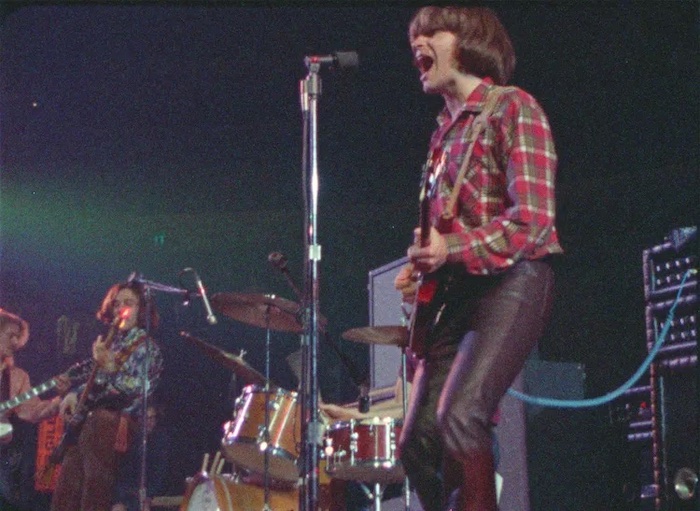
Basically a filmed concert augmented to feature length with a cobbled together bio of the band, this documentary delivers despite its modest ambitions, owing mainly to the fact that CCR was one of the few groups from the classic rock era who hasn’t been visually memorialized to within an inch of its reputation. I assume that’s because of leader John Fogerty’s decades-long refusal to do anything that would make money for his old label Fantasy, which screwed him out of his writing royalties, not to mention the enduring bad blood between him and the other surviving members. None of that enmity is apparent in the footage here, which was filmed in 1970 on the band’s first-ever European tour. As it happens, they played London’s Royal Albert Hall during the same week that the Beatles announced their breakup, a coincidence that prompts the director, Bob Smeaton, to insert comments that compare the two groups, which are not as farfetched as they might seem. Though CCR’s range was narrower than the Beatles and their tenure at the top of charts shorter, within their brief window of popularity at the turn of the decade they couldn’t be beat in terms of sales and quality of product. 

The interviews with the members, which mostly register their impressions of Europe, are perfunctory at best, but the mini group bio is enlightening in its simplicity and hind-sightedness. Some fans may be surprised to learn that three of the members had been playing together since 1959, and while I was aware that two were in the service at the height of the Vietnam War (John Fogerty had some kind of administrative stateside assignment), it didn’t occur to me that the band essentially remade themselves when they got back together after those tours-of-duty. As John says at one point, he wrote “Proud Mary” the day he was discharged. As related in the distinctive Dude-ish cadences of narrator Jeff Bridges, the information feels as authoritative (this is, to be sure, not a movie about the Eagles) as only a fan’s reminiscence could be. I’m also reminded of how ecumenical American TV was at the end of the 60s—one of the best clips is the band performing on “The Andy Williams Show”—because what their story makes clear is that CCR fell fully formed into a market that was perfectly primed for them. Timing was everything, which is why Fantasy could exploit them so mercilessly, though, at this point in their career, they seemed to be fine with that. Less than two years later it would all be over, amazingly enough. 

But the concert is the meat of the movie, and it’s more than satisfying—good sound, good camera placement and editing. The revelation is not so much John’s full-on professionalism and enthusiasm but Doug Clifford’s abandon behind the kit. He really was a great drummer, fluid and funky and minimal, and Smeaton (or whoever put together the concert footage) gives him plenty of exposure. Uncharacteristic for that time, the set is short and there’s no encore, but that, in a way, lends the performance the extra measure of authenticity the band was famous for. It’s no bullshit rock, which is why it remains timeless. 

Now playing in Tokyo at Human Trust Cinema Shibuya (03-5468-5551), Kadokawa Cinema Yurakucho (03-6268-0015).

Travelin’ Band home page in Japanese

photo (c) 2022 Concord Music Group, Inc.

Posted in Movies | Tagged , , | Leave a comment

Review: The Cord of Life

Chinese director Qiao Sixue has said that her debut feature is semi-autobiographical. Qiao studied film in France and intended to remain in Europe, but eventually returned to her childhood home in Inner Mongolia in order to make a movie about her mother, with whom she had always had a fraught relationship. In the movie, her avatar is Alus (Yider), a club musician who has achieved a level of success in Beijing by combining electronics with native Mongolian instruments he mastered as a child. In the big city he has essentially thrown off the trappings of his rural upbringing and remade himself as a vanguard artist, but then he hears from his brother that their mother, Naranzug (Badema), has descended into a state of dementia and has practically “destroyed” his urban household. Given that the brother has a family and Alus does not, Alus feels guilty and goes to his house to address his mother’s fervent desire to return to her real home, though it takes some time for him to determine exactly where this home is.

The film takes the form of a road movie, with the Mongolian steppe providing a dramatic background for Alus’s slow and painstaking reconsideration of his relationship with Naranzug, whose cognitive impairment becomes more acute along the way. The title refers obliquely to the colorful rope that Alus uses to connect him to Naranzug, who mostly doesn’t recognize him as her son, so as to prevent her from stumbling off into the vast, empty plains, but along the way it becomes a metaphor for the ties that bind him to his homeland as he discovers not only what it is about the place that made his mother the person she is, but also how much it has informed his own character. As Naranzug almost reverts to a feral state—at one point delivering a lost lamb back to the corral from which it wandered—Alus has to resort to a more primal form of care, playing his music in order to lure his mother back into his control. 

All the while, the idea of where Naranzug’s “home” is keeps shifting, and as the pair move further into the wilderness it becomes clear that home is more of an idea than a place. It’s the people they encounter, the smells and sounds that connect her with something she can still somehow recall; though in the end it’s a landmark she identifies from her childhood. Though the mysticism invoked by Qiao’s camerawork and sound design, not to mention the romance that Alus encounters along the way, occasionally trespasses into the realm of corn, Alus’s newly generated link to a culture he thought he knew but really didn’t is made palpable. When he joins in a grasslands festival by playing his own music, it doesn’t feel anachronistic or odd. His artistic sensibility has always been rooted in this place, and his mother reacts with pure joy, despite her affliction. The connection is complete, thus allowing them to let go of each other forever. 

In Mongolian and Mandarin. Now playing in Tokyo at Shinjuku K’s Cinema (03-3352-2471).

The Cord of Life home page in Japanese

Posted in Movies | Leave a comment

Review: John Wick: Chapter 4 and Confidential Assignment 2: International

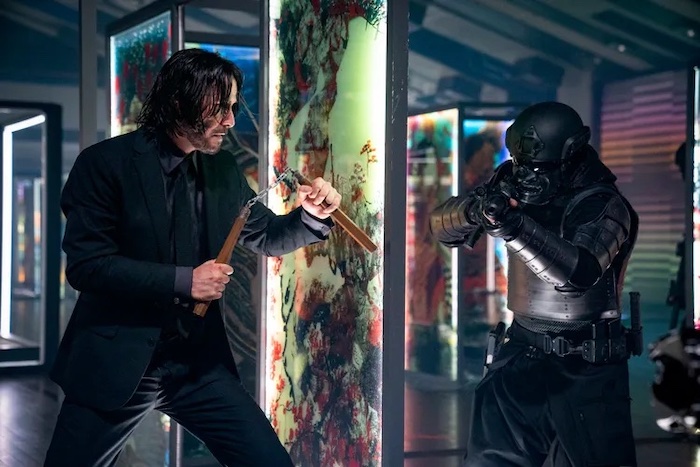
Having missed the third installment of the John Wick series I assumed I would have trouble getting up to speed with the fourth, but given the limited stylistic requirements that the series has set for itself I had no problems. I obviously missed the explication of the worldwide criminal underground cabal called the High Table for which our assassin hero toils, but anyone with any experience in the hit man sub-genre will immediately be able to suss the implications. This back story simply provides a bit more justification for the series’ meat-and-potatoes violent set pieces, each of which involves the slaughter of dozens if not hundreds of anonymous henchmen of whichever bad guy Wick is up against. Though I have my aesthetic-moral principles, I’m as much of a sucker for the old ultra-violence as the next hack, but at close to three hours, this kind of thing, regardless of how “balletically” it’s staged, can start to feel pretty redundant.

The travelogue quality of the series seems to have been prioritized. Wick (Keanu Reeves, more monosyllabic than ever before) has apparently pledged to destroy the Table once and for all in order to gain his freedom, and embarks to the Middle East to take out an “elder” who sits at it. This occasions yet another contract on Wick’s head that every assassin in the world aims to claim. Meanwhile the Continental Hotel in New York is punished because its proprietor, Winston (Ian McShane), helped Wick do something against the Table in the previous film. Winston is left homeless and directionless, while Wick journeys to another Continental franchise in Osaka whose proprietor (Hiroyuki Sanada) is an old friend. By any stretch of the imagination, this is a mistake, since a horde of assassins, most of them led by the blind Table factotum, Caine (Donnie Yen), descendd on the establishment to take him out. Hundreds die, including some characters sympathetic to Wick’s cause, thus making you wonder what Wick hoped to accomplish by traveling to Japan. It’s then off to Berlin, where Wick has to reestablish himself with the estranged “family” that can give him certification as a bona fide assassin (no ronin for the High Table). They require he kill a fat club owner with metal teeth. Then it’s on to Paris—where there are 3-count-em-3 set pieces, only one of which elicited an “ooh” from me—to fight an old-fashioned duel with the duplicitous Table placement, the Marquis (Bill Skarsgård).

Each set piece is characterized by a distinctive motif—in Berlin it’s the boogieing masses being oblivious to the carnage around them; in Paris it’s a car chase with guns on the roundabout surrounding the Arc de Triomphe and a long tumble down the steps leading up to the Sacre-couer. Despite the additions of ringers (Shamier Anderson as a lone-wolf-with-dog assassin who keeps complicating matters; rock star Rina Sawayama as the aggrieved daughter of Sanada’s character) it’s up to Reeves to keep things moving and the extended running time doesn’t help his dour demeanor at all. If the movie is saved by anyone it’s Yen, whose grace is not only economical but witty. It would be nice to see him return for what appears to be a fifth installment, but the requisite stinger seems to indicate otherwise. 

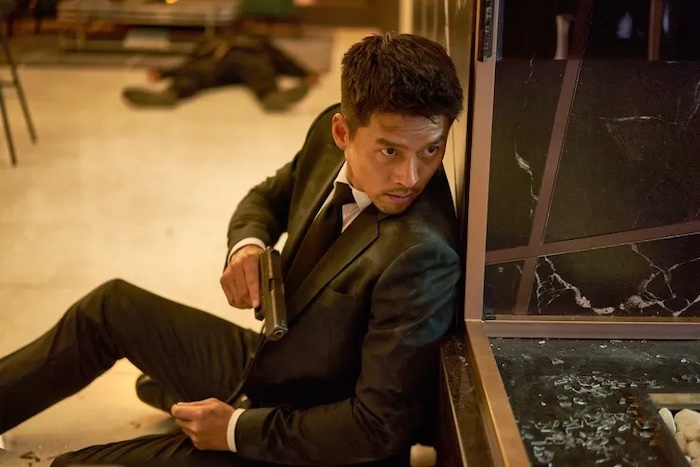
I also didn’t see the first Confidential Assignment movie, in which comic standby Yoo Hae-jin plays an everyman police detective who teams up with a North Korean agent played by Hyun Bin to do something. That movie was released in 2017, before Hyun became an international heartthrob by playing another North Korean in the Netflix hit Crash Landing on You. Consequently, this sequel seems to be targeted more toward a global audience, but the “International” in the title ostensibly refers to the notion that the pair’s action moves have more worldwide repercussions. Also, they are joined by a Korean-American FBI agent (Daniel Henney).

Unlike Wick 4, Confidential is purely plot-fueled: a rogue North Korean agent, Jang (Jin Seon-kyu), has taken his brief as a drug smuggler for the Hermit Kingdom into the US criminal underground, where he’s attracted the notice of the Feds, and after relocating to South Korea becomes the target of the Seoul police, the North Korean military, and the FBI. Hyun’s Im Chul-ryung is tasked with bringing Jang back with his ill-gotten gains, while Yoo’s Kang Jin-tae pushes back against the arrogant American interloper for dibs on Jang’s ass. The three end up working together, but not before a lot of mayhem entails of the John Wick variety, including a very well choreographed shoot-out on the streets of New York. 

This being a blockbuster South Korean actioner, it leaves plenty of room for broad comedy, which is mostly provided by Hyun’s fortified status as a hunk. In the first movie, apparently, Kang’s sister-in-law, Min-young (Im Hoon-ah) had the hots for Chul-ryung and anticipates his return with salacious abandon, but once she gets a gander at the Yank she shifts loyalties, though not really in a convincing way. Still, if I prefer the action set pieces here to those in Wick, it’s not so much because they’re original but because they’re distinct from one another, and the people who die have actual personalities—evil personalities, for sure, but that gives you something to root for. 

John Wick: Chapter 4 now playing in Tokyo at Toho Cinemas Nihonbashi (050-6868-5060), Toho Cinemas Hibiya (050-6868-5068), Shinjuku Wald 9 (03-5369-4955), Toho Cinemas Shinjuku (050-6868-5063), Toho Cinemas Shibuya (050-6868-5002), Toho Cinemas Roppongi Hills (050-6868-5024).

John Wick: Chapter 4 home page in Japanese

John Wick photo (c) 2023 Lions Gate Entertainment Inc.-Murray Close

Confidential Assignment 2: International, in Korean, now playing in Tokyo at Toho Cinemas Hibiya (050-6868-5068), Toho Cinemas Shinjuku (050-6868-5063), 109 Cinemas Premium Shinjuku (0570-060-109), Toho Cinemas Roppongi Hills (050-6868-5024.

Confidential Assignment 2 home page in Japanese

Confidential Assignment 2 photo (c) 2022 CJ ENM Co., Ltd., JK Film

Posted in Movies | Tagged , , | Leave a comment

Review: Teenage Mutant Ninja Turtles: Mutant Mayhem

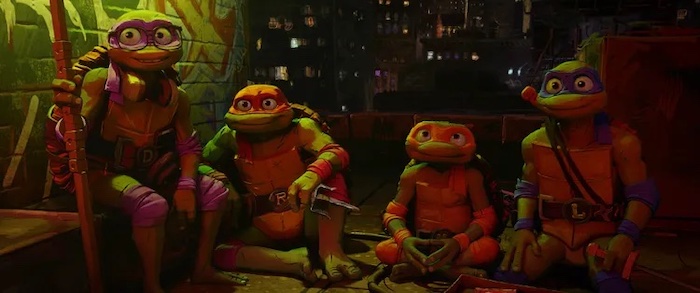
Like the Spider-verse reboot, this new animated take on the Teenage Mutant Ninja Turtles franchise completely reimagines the vibe for a more discerning target audience, namely young people who have a stake in the culture that the source material ostensibly addresses. By bringing in people who have proven ability to appeal to actual teenagers, from soundtrack composers Trent Reznor and Atticus Ross to co-screenwriters Seth Rogen and Evan Goldberg, the producers allow the characters’ adolescent freak flag to fly freely, with the result being a much more entertaining movie than any of the previous ones, which mostly tried to be something for everyone. Rightly, they also went back to the beginning, and the origin story is funnier for the kind of animation used, which looks like stop-motion but seems to be a synthesis of different styles. 

One thing’s for sure, the frantic pace likely matches the brain function of teens who play video games and surf the net at breakneck speeds. If I hadn’t seen the previous Turtle movies I might not have fully appreciated how adept director Jeff Rowe is at telling a story with such economy and precision. We get the weird scientist, Baxter Stockman (Giancarlo Esposito), losing a vial of his mutation agent down a New York City drain, where it gets into the sewage system and creates a whole menagerie of mutants. Our heroes are babies rescued from the sludge by the kung-fu practicing rat, Splinter (Jackie Chan), who has been traumatized by his ventures to the surface world and raises his four boys (voiced by non-famous actors) to shun that world. They do have to occasionally go up top to filch supplies, including their beloved pizza, and so Splinter teaches them Asian martial arts for self-defense purposes. As adolescent boys do, they long for connection to their own cohort and secretly aspire to going to school, things they know about because they spend so much time on the internet, but of course their “father” would forbid it. After they meet April (Ayo Edebiri), a nerdish girl with journalistic pretensions, they can’t get the idea of integrating out of their minds, and together the five take on Superfly (Ice Cube), a mutant fly that plans to use some kind of farout machine to turn all the inhabitants of NYC into mutants.

What’s particularly attractive about the production is how seamlessly it integrates the furious action elements into a typical goofy teen self-expression story. Rogen and Goldberg bring the same spirit of irreverent abandon to the presentation that they did to such classics as Superbad, and the humorous back-and-forth, not only among the Turtles but among the nominal villains, in imbued with a crackling, throwaway wit that never flags. Even the scatology and gross-out stuff (April tends to throw up without much warning) is done with a light touch. Let’s hope there’s more of this to come. 

Opens Sept. 22 in Tokyo at Toho Cinemas Nihonbashi (050-6868-5060), Toho Cinemas Hibiya (050-6868-5068), Shinjuku Wald 9 (03-5369-4955), Shinjuku PIccadilly (050-6861-3011), Toho Cinemas Shinjuku (050-6868-5063), Toho Cinemas Shibuya (050-6868-5002), Toho Cinemas Roppongi Hills (050-6868-5024).

Teenage Mutant Ninja Turtles: Mutant Mayhem home page in Japanese

photo (c) Paramount Pictures

Posted in Movies | Leave a comment

Review: The Lost King

There’s a lot going on in Stephen Frears’ dramatized retelling of the story behind the discovery of King Richard III’s grave beneath a parking lot in Leicester, UK, in 2012. There’s the attempt to revise the accepted historical record surrounding Richard from that of a usurper to that of a responsible monarch. There’s a study of the misunderstood affliction known as chronic fatigue syndrome, which affects Philippa Langley (Sally Hawkins), the woman who locates the grave. And there’s a fascinating but rather dry exposition of how such archaeological projects are funded and carried out. Frears and his screenwriters, Steve Coogan and Jeff Pope, try to bring all these elements together in an entertaining way, and succeed only up to a point.

Early in the movie, Philippa takes a leave of absence from her public relations job after a promotion that should go to her instead goes to a younger colleague. In any event, her illness makes a daily grind difficult and she’s grown frustrated by the job anyway. With nothing to do she attends a performance of Richard III and, intrigued by the controversy over the conventional biography outlined in the play, plunges into research that leads her to a group of literary revisionists who meet regularly in a pub to discuss how to prove that Richard was a legitimate monarch who did not, in fact, murder his nephews—a version of his story rendered canon by the Tudors and, later, Shakespeare. Sympathizing with Richard because his own illness, like hers, was vastly misinterpreted, Philippa sees the revisionists’ point but disagrees with their methods of going about their task. While entertaining visions of Richard (Harry Lloyd), who endeavors to tell her what he’s really like, Philippa throws herself into the search for his actual grave so as to prove once and for all that he wasn’t a hunchback madman. 

A good portion of the movie is given over to bureaucratic and academic hurdles that Philippa is forced to overcome with almost superhuman rectitude and patience, and while I usually enjoy this kind of wonky development, there isn’t enough dramatic substance to create sufficient tension. Though Coogan is on hand as the ex-husband who supports Philippa’s project unconditionally and adds his own characteristically wry humor to the mix, he can’t lift the movie out of its rut of middle-brow respectability. In the end, there’s not enough action to justify a narrative movie rather than a documentary, which likely would have achieved the same satisfying payoff that The Lost King does but with more excitement along the way. 

Opens Sept. 22 in Tokyo at Toho Cinemas Nihonbashi (050-6868-5060), Toho Cinemas Chanter Hibiya (050-6868-5001), Toho Cinemas Roppongi Hills (050-6868-5024).

The Lost King home page in Japanese

photo (c) Pathe Productions Limited and British Broadcasting Corporation 2022

Posted in Movies | Tagged , , | Leave a comment

Media watch: Johnny’s fans complicate matters for advertisers and broadcasters

Travis Japan for Kagome

The main concerns for the media right now with regard to the sex abuse scandal surrounding the male idol production company Johnny & Associates is the loss of advertising gigs for the company. There have already been announcements of certain companies cancelling contracts to use Johnny’s talent, which could have serious ramifications for its bottom line. Though the male stars that Johnny’s represents make money for the company doing many different things, appearing in print and broadcast ads may be the most lucrative. Various reports say that Johnny’s earns ¥80 billion a year from ads. The pay for appearing on variety shows and acting in movies and dramas is notoriously low in Japan because of all the time spent, and concerts involve lots of expenses and extra personnel that cut into profits, but TV commercials can be done in a day or less and the contracts are usually huge. In order to take some responsibility for the sins of their founder and show their seriousness, Johnny’s current management has offered to not take their usual share for advertising contracts, meaning all the money goes directly to the talent themselves. Nevertheless, advertisers are dropping the company.

However, according to an article that appeared in the Asahi Shimbun Sept. 15, there are other considerations at play that complicate the calculus used to determine whether holding on to Johnny’s talent is still worthwile for advertisers and, by extension, broadcasters. In the article, a 27-year-old female fan of an unnamed Johnny’s boy band explains how she has been following some of its members even before they formed the group, when they were members of the company’s stable of idols-in-waiting who basically support the banner stars by being backup dancers and other things. When these young idols finally debuted as a bona fide group, she attended their first concert and felt fulfilled herself that they had realized their dream.

So when the group—Travis Japan, in case you’re interested—did an ad campaign for Kagome vegetable juice, she wanted to “pay them back” for the happiness they had brought her and ordered a case of the beverage. “Now, everybody in my family drinks this juice,” she said. Of course, she has no particular opinion about the quality of the product and doesn’t even mention whether she drank vegetable juice in the past. She simply wants to “contribute to the sales of the juice” so that the members of Travis Japan will “get more jobs in the future.” 

This fan’s succinct rationale for patronizing a company that uses Johnny’s charges in its advertising—she’s doing it to help her idols—is what makes it difficult for advertisers to cut their relationships to Johnny’s. As an executive of a major advertising company points out in the article, it’s very easy for advertisers to project sales increases when they hire Johnny’s idols. And the effectiveness of the ads is exponential, since fans of a particular star not only buy the product or service advertised, but, using social media, spread the word to other fans and potential fans. The executive claims that only Johnny’s idols provide this kind of effectiveness. And as the above-mentioned fan herself said, she essentially infected her own family with her love of Travis Japan. One professor of pop music history told the Asahi that, in fact, advertisers tend to hire Johnny’s talent in order to sell products and services that specifically target families. 

Continue reading
Posted in Media | Tagged | Leave a comment

Review: No Bears

Between the time this movie was shot and its release date in Japan, its director, Jafar Panahi, was jailed and then released by the Iranian government for engendering “propaganda against the establishment”; and this on top of the 20-year ban on filmmaking imposed on him a decade ago for the same charge. During the ban, Panahi has continued to make movies in semi-secrecy, and they have been as formally rigorous and thematically thought-provoking as any movies made in Iran—or the world, for that matter. No Bears, at the very least, is his boldest comment on the role of art under a repressive regime, though it’s also his most plot-dependent story in years, which is a function of the situation he created in making it.

Panahi plays himself making a movie remotely from an Iranian village on the Turkish border. Unable to travel abroad legally, he sends his crew to a town on the other side and, through his MacBook, directs his actors and sets up shots as long as the cell coverage cooperates. The movie he is making is about a dissident couple, Zara (Mina Kavani) and Bakhtiar (Bakhtiar Penjei), who are trying to secure fake passports in order to emigrate to the West. As we eventually find out, the actors are themselves trying to do the same thing, and Panahi is basically fictionalizing their situation to make a dramatic film, a strategy that backfires with unfortunate consequences. Meanwhile, in the village where Panahi is temporarily resident, the locals look at him with a mixture of awe (his reputation as a director proceeded him, but mainly because his mother is from this area) and suspicion that grows to a certain level of contempt when rumors spread that he has accidentally taken a photo during his stay of a couple who are forbidden from seeing each other because the female half has been betrothed to another man ever since she was born. Panahi dismisses this claim by saying he did not take any such photo and gives the village elders his data card to prove it, but the tensions within the community are so strained that he must go the extra mile to convince them that he is telling the truth, and, as with the movie he’s trying so desperately to complete, his sense of righteousness gets the best of him and ends up making the matter much worse.

The central plot thread is Panahi’s cordial but nonetheless defiant approach to local customs that he doesn’t believe in (“I don’t get the rationale”), an attitude that mirrors his defiance of the Iranian government. But the director doesn’t let himself off the hook. His status as an artist who looks at things from a position of objective intelligence has made him arrogant, and just as the poetic license he possesses prompts him to miscalculate what his machinations are actually doing to the couple who portray his principals in the Turkish movie-within-a-movie, his sense of aggrievement at his own circumstances leads to a second tragedy in the village that affects innocent people who have no involvement in his affairs, be they political or professional. Though No Bears has a rambling structure that’s often frustrating to follow—probably owing to the fraught circumstances of its production—it’s one of the most emotionally affecting works in Panahi’s filmography, and that’s saying something. 

In Persian. Now playing in Tokyo at Shinjuku Musashinokan (03-3354-5670), Human Trust Cinema Shibuya (03-5468-5551).

No Bears home page in Japanese

photo (c) 2022_JP Production

Posted in Movies | Tagged | Leave a comment

Review: Gran Turismo

As a studio, Sony Pictures is relatively light on IP product, though the one they do have, Spider-Man, is a heavyweight. I’m not sure if the race driver simulation game Gran Turismo is franchise-worthy, but the whole presentation here is geared toward endurance. In one significant way, however, it’s a one-off: The movie is based on the true story of Jann Mardenborough (Archie Madekwe), a British kid who went from a stone talent for the GT game to an actual career as a racer. And while I’m not sufficiently attuned to gaming lore to understand how close the connection is between GT and Sony’s Play Station, the company that gets the most attention and product placement here is Nissan, one of whose Japanese racers came up with GT as a simulator for drivers and which eventually sponsors an academy that invites the best sim drivers in the world to compete for a chance to drive the real thing. Apparently, Mardenborough’s story has been liberally altered in order to sharpen the movie’s dramatic arc, which is only to be expected, and there’s a rote quality to the storytelling that leaches whatever tension the movie might offer outside of the actual racing scenes, which are the best that money can buy.

Much is made of the disconnect in actual experience between racing sim cars and racing real cars. Jann’s father (Djimon Hounsou), a retired footballer, doesn’t see his son’s pastime as a “real sport,” but even the salty Jack Salter (David Harbour), the old school racing coach who is talked into working with the half dozen sim hopefuls who want to join the Nissan race team, never quite buys the idea that skills on the console can translate to skills behind an actual engine. Jann and the other students in the academy are constantly being told “you’re only gamers” and then, of course, they prove everybody wrong, but director Neill Blomkamp has to show this with a lot of CGI that itself looks like it was designed for video games, like when Jann imagines the real race car around him as a set of separate interlocked parts (one of the features of GT is that racers can design their own cars), though exactly how that translates into victory is not clear. Jann’s obstacles are multivalent. Orlando Bloom’s Nissan factotum, the man who came up with the academy idea, isn’t keen on Jann as the best representative of the brand until, of course, he is; and Jann’s competition, especially a smug McLaren racer (Thomas Kretschmann), refuse to take him seriously. As a result, Jann’s string of victories feels vindicating in a pleasant way, but the sailing, to use a completely different sports metaphor, is way too smooth, despite the fact that Jann at one point is involved in a horrific crash that almost kills him.

If I said the racing scenes make Gran Turismo worth seeing, it’s not going to convince people who are already averse to such sports films to buy a ticket, but Blomkamp, who made his name with the sci-fi curiosity District 9, is a very visceral director, and it’s when Jann and the other characters are in actual race cars on a track that the movie comes into its own. Obviously, the makers of the game Gran Turismo are hoping more people will be turned on by this aspect to join in the fun, but I imagine anyone who has ever had the potential of being a sim gamer is already one. And as for Nissan, no one is going to buy a Skyliner after seeing this movie. Sony Pictures should just be happy they got one decent film from this particular IP.

Opens Sept. 15 in Tokyo at Toho Cinemas Nihonbashi (050-6868-5060), Toho Cinemas Hibiya (050-6868-5068), Marunouchi Piccadilly (050-6875-0075), 109 Cinemas Premium Shinjuku (0570-060-109), Shinjuku Wald 9 (03-5369-4955), Shinjuku Piccadilly (050-6861-3011), Toho Cinemas Shinjuku (050-6868-5063), Toho Cinemas Shibuya (050-6868-5002), Toho Cinemas Roppongi Hills (050-6868-5024).

Gran Turismo home page in Japanese

Posted in Movies | Leave a comment