Review: Pearl

As an origin story, Ti West’s prequel to his hit horror comedy X seems under-conceived, and, according to reports, West and his star, Mia Goth, mostly came up with the idea on the fly not long after X finished shooting, fully confident that they could make it quickly. In X, Goth played two roles, that of a crew member of a porn shoot on a Texas farm in the 70s, and that of Pearl, the sex-crazed old lady who terrorizes the production. X didn’t explain how Pearl had turned into an axe murderer. Pearl the movie attempts to.

And just as X successfully achieved a 70s-era production design look, Pearl achieves an even more retro feel, mimicking mid-century Hollywood Technicolor movies replete with big musical cues and an eye-popping credit sequence. Set in 1918 when World War I and the flu pandemic were happening simultaneously, the movie takes place on the same Texas farm where X took place, with Pearl a teenage bride whose husband is fighting in Europe and who dreams of becoming a professional dancer and maybe even a film star. Her strict mother (Tandi Wright) forbids her to even think about it and orders her to take care of her catatonic, wheelchair-bound father (Matthew Sunderland). But the headstrong Pearl is determined to be on the silver screen, and secretly sneaks away one day to participate in a regional audition for a film studio, encouraged by the local movie house projectionist (David Corenswet), the town’s self-styled “Bohemian,” who also has the hots for Pearl and, at one point, shows her a contraband stag film from France, where he promises to take her someday.

It’s not revealing much to say that all of Pearl’s dreams are dashed and that it’s this disappointment that brings out her  cruelty, which, so far, she’s only visited upon barnyard critters. Though the tone up to this point has been that of a playful pastiche of all the old film cliches you’d expect, the murder scenes lack anything distinctive, either as comedy or horror. And because this is a prequel, the movie also feels truncated, unfinished, even if you’ve seen X. There’s not a whole lot of obvious continuity between teenage Pearl and the crazy old lady, unless you assume, after seeing Pearl, that she’s driven to murder not so much because of the sex she witnesses, but rather because she’s reminded of her stalled show biz career. Still, I’m not curious enough to want to sit through X again just to find out.

Opens July 7 in Tokyo at Toho Cinemas Nihonbashi (050-6868-5060), Toho Cinemas Hibiya (050-6868-5068), Toho Cinemas Shinjuku (050-6868-5063), Shibuya Cine Quinto (03-3477-5905), Shibuya Parco White Cine Quinto (03-6712-7225), Toho Cinemas Roppongi Hills (050-6868-5024).

Pearl home page in Japanese

photo (c) 2022 Origin Picture Show LLC

Posted in Movies | Tagged , | Leave a comment

Media watch: Newspaper reveals that fertility rate isn’t what it’s cracked up to be

While attending a recent symposium sponsored by the Cabinet on Japan’s low birthrate, which the government has pledged to raise by any means possible, a reporter for Tokyo Shimbun discovered that the so-called fertility rate statistic published by the government doesn’t properly represent what people might think it represents. 

During the symposium, a representative made a presentation in which he explained that the projection for Japan’s fertility rate in the year 2070 would be 1.29, which is only fractionally higher than last year’s rate, which was 1.26. These projections were made based on current trends in the birthrate. However, when the staff member explained how the number was calculated, he said that only Japanese women were included and not foreign resident women, while babies born to both Japanese and foreign women were included. According to the reporter, the attendees expressed shock, saying they weren’t aware that foreign resident women were not counted in the statistic. One professor told the reporter he found this revelation “unbelievable,” especially given the fact that the foreign population of Japan is on the rise. 

The fertility rate is supposed to represent the number of children the average woman will give birth to in her lifetime, and a number of around 2.0 is believed to be necessary in order to maintain the population of a given country. However, the calculation is made on a yearly basis to chart trends. To reach the index, the total number of live births in the population within a given time frame—in this case, a year—is divided by the number of females in the population aged 15 to 49, and the resulting quotient is multiplied by 1,000. Obviously, not counting foreign women in this formula while counting the children they produce is going to alter the index, though it isn’t really clear by how much. Mathematically, it would seem that the more women you add to the divisor in the equation, the smaller the quotient and thus the smaller the fertility rate, but the article doesn’t really explain the different numbers offered at the symposium in a comprehensible manner.

A representative of the health ministry told Tokyo Shimbun that population statistics, including those used to chart the fertility rate, only take into consideration Japanese people, and that this has always been the case, so to change it now would throw the whole system out of whack. Children of foreign mothers are included in these calculations if the mother is married to a Japanese national, since a child is considered Japanese if either parent is Japanese. (Though that has only been the case since 1985. Before then a child’s nationality was determined solely through the nationality of the father.)

Another person from the National Institute of Population and Social Security Research told the reporter that the current methods for compiling population statistics go back to the Meiji Era and are based on the Family Register (koseki) Law, which only applies to Japanese people. When the fertility rate statistic was adopted right after World War II, there were few foreigners living in Japan, so they weren’t counted. One wonders about all the resident Koreans who, before the end of the war, were considered Japanese and after the war suddenly weren’t; not to mention all the Chinese who had never been Japanese but had lived in Japan for many years. 

Nevertheless, as more than a few people at the symposium pointed out, the number of foreign women giving birth in Japan is increasing, and it seems misleading, if not downright discriminatory, not to count them when determining the fertility rate, regardless how useful the fertility rate is in the first place. The data researcher put it quite plainly: in other countries of the world, they count all the women who give birth in their statistics and not just citizens.

Posted in Media | Tagged | Leave a comment

Review: The Novelist’s Film

As a formalist, Hong Sangsoo rarely sticks to the same set structure, though, given his stylistic distinctions, many may assume he does. He often plays with time, linearity, and alternate outcomes in order to demonstrate how stories can be told, but his latest film is—at least within his own large filmography—structurally conventional in that it follows a kind of plot. As is always the case with Hong, the story is almost pure whimsy, even if the dialogue and situations come across as quotidian to a fault. For instance, everyone the titular protagonist meets during the course of the movie has read her latest book, which is one of the best jokes Hong—whose sense of humor is underappreciated—has ever hung a storyline on, suggesting either a universe where everyone indulges in fine literature or, more likely, one where everyone deploys a kind of strategic tactfulness.

Jun-hee (Lee Hye-young) has come to a regional city to visit her old friend (Seo Young-hwa), a lapsed writer who now runs a small bookstore. During one of Hong’s patented veiled-but-pointed conversations, it’s revealed that the two parted on less-than-ideal terms, and that Jun-hee is thinking of giving up writing. Though she doesn’t use the term “writer’s block,” as the movie progresses she justifies her decision to others by saying that she doesn’t have the patience to be imaginative any more. This journey to see an old friend, unannounced, comes across as desperate, even though she acts anything but. While in town she takes in a local tourist attraction and runs into a film director (Kwon Hae-hyo) who once tried, unsuccessfully, to adapt one of her novels. Their conversation is as tense as that between Jun-hee and the bookseller, but funnier since the director insists on smoothing out matters that Jun-hee is past forgiving. Nevertheless, the meeting does lead to yet another coincidental encounter in a nearby park with the actress Kil-soo (Kim Min-hee), whom the director berates for having decided to retire at a young age “with such potential.” Jun-hee, recognizing a kindred spirit, not only defends Kil-soo, though they’ve never met before (Kil-soo, of course, has also read Jun-hee’s latest book), but asks her out to lunch, where she proposes they make a short film together with Kil-soo’s film student nephew (Ha Seong-guk), an idea that Jun-hee has apparently came up with on this trip and was probably provoked by the director’s fatuousness. 

From there, the film devolves into Hong’s usual alcohol-fueled free-for-all, as it turns out that Kil-soo knows the bookseller and they all collect at her store for multiple bottles of makgeolli, along with a gregarious male poet (Gi Ju-bong) whom Jun-hee slept with once back in the day. At this point, whatever sparked Jun-hee’s decision to become a filmmaker, it’s too late to turn back, and while I think Hong had already made his point about the self-regard of this circumscribed group of arty types and didn’t need to go any further, he follows up with a screening of the proposed short film, which Jun-hee has successfully completed. A short clip is shown demonstrating only that her visual aesthetic aligns somewhat with Hong’s, which may be the ultimate joke, but one that I needed a second viewing to get. As a matter of fact, I laughed quite a few times the second time I saw it, and that’s saying something. 

In Korean. Now playing in Tokyo at Human Trust Cinema Yurakucho (03-6259-8608), Cinema Qualite Shinjuku (03-3352-5645).

The Novelist’s Film home page in Japanese

photo (c) 2022 Jeonwonsa Film Co.

Posted in Movies | Tagged , | Leave a comment

Review: Marcel the Shell with Shoes On

The obvious outlier among last year’s Best Animated Feature Oscar nominations, Dean Fleisher-Camp and Jenny Slate’s story about a talking seashell never had a chance, which is probably why film cognoscenti tripped all over themselves in a rush to claim it was some kind of work of genius. It isn’t, but its charms are unique. Having started as a series of shorts that quickly developed a following on YouTube about ten years ago, Marcel the Shell with Shoes On has been carefully reformulated as a 90-minute feature by jiggering the titular mollusc’s origin story and using his internet fame as part of the plot-line. But the basic frame of the shorts remains in tact: Fleisher-Camp interviewing Marcel, who is voiced by Slate, after he discovers him living with his slightly senile grandmother, Connie (Isabella Rossellini), in the Airbnb house he’s renting. Apparently, there was a larger shell brood that belonged to the previous tenants, a couple who broke up and moved out taking all the shells except Marcel and Connie, who ever since have been making do as best they can.

Most of the humor is derived from Slate’s purposely cute vocal mannerisms and portrayal of Marcel as a wisecracking, genuinely curious adolescent savant who is constantly dreaming up ways to overcome his very small size by repurposing common items he finds around the house, including detritus (nail clippings as skis—yech!). But there’s also poignancy on display, as Marcel enlists Fleisher-Camp in his hunt for his extended family and addresses Connie’s encroaching dementia in a protective and often defensive way. As Fleisher-Camp’s videos of his interviews with Marcel catch fire on YouTube, Marcel’s fame grows, and while at first he can’t quite process the attention, he tries to exploit it for his family-seeking purposes, agreeing to appear as the subject of a 60 Minutes (his and Connie’s favorite TV show) profile hosted by Leslie Stahl. The scene where the CBS crew takes over the house for the shoot is certainly one of the most trenchant comments on media overkill ever set to film. 

Having not seen the shorts, I can’t say whether the feature is better, but the appeal is obviously centered on the interactions between Marcel and Fleisher-Camp, which have a tension that complicates the childish tone of the whole premise. Tying it all to a plot-like structure doesn’t necessarily spoil this appeal, but it sometimes gets in the way. Visually and conceptually, Marcel has a wondrous simplicity that could have only been achieved through a great deal of effort and thought. It’s endearingly entertaining. 

Opens June 30 in Tokyo at Shinjuku Musashinokan (03-3354-5670), Shibuya Parco White Cine Quinto (03-6712-7225).

Marcel the Shell with Shoes On home page in Japanese

photo (c) 2021 Marcel the Movie LLC

Posted in Movies | Leave a comment

Media watch: Transphobia fueled by hatred, spread by ignorance

June is LGBTQ+ Pride month

On June 3, an anonymous person or persons posted 15 defamatory messages, including death threats, on the home page of Osaka attorney Shun Nakaoka. The poster accused Nakaoka of being a “man pretending to be a woman” and for that reason she should die. During a press conference on June 5, Nakaoka said the posts constituted a hate crime that targeted transgender people and that she had reported the posts to the police.

In a June 23 opinion piece published by the Asahi Shimbun, Nakaoka characterized the kind of transphobia exhibited in the posts as a “monster” that has run amok. Though she doesn’t specifically mention the recent bill passed by the Diet to promote “understanding” of LGBTQ+ persons, which sexual minority activists have labeled dangerous to their cause, she says that the “trend to provoke discrimination and bias toward transgender individuals has spread at an alarming rate” recently, and that some of this provocation has been carried out through political means. 

The aim of hardcore transphobes is to make people who otherwise “have no idea” about transgender people uneasy at the prospect that transgenders will be at large in society. The typical way to do this is to claim that greater rights for transgenders will mean that “men claiming to be women” will be able to access women-only spaces, such as public restrooms, the implication being that men would only do this to molest or take advantage of women in these spaces. Nakaoka says this idea is “preposterous.”

She goes on to explain the definition of the English word transgender. The morpheme “trans-” means to “cross over,” and that the process of someone assigned as being, say, male at birth transitioning to female is ongoing and involves changing one’s appearance and possibly physiology through medical treatment, not to mention changing their relationships with others and their lifestyles. It does not mean simply “saying that one is a woman.” It takes time. A transgender person is in a constant state of becoming. Consequently, each transgender person decides for themself how they interface with society, which means their use of public facilities, such as restrooms, will be measured accordingly. It is wrong to assume every transgender person will act in the same way, but it is safe to assume that, in addressing their own circumstances, they will develop an attitude that causes as little friction as possible with society. The point is to be oneself in the real world, to live with others. There is no reason to be afraid of transgender people.

Continue reading
Posted in Media | Tagged , , | Leave a comment

Review: Calendar Girls

Not to be confused with the 2003 Helen Mirren comedy with the same title, Maria Loohufvud and Love Martinsen’s documentary nevertheless covers similar ground; namely, women of a “certain age” flaunting what they’ve still got to make a point about female vitality. In the former, this theme was played for both laughs and poignancy, while in the latter it’s presented as an aspect of aging that most people would prefer to ignore. The titular dance troupe, whose members are over 60 and some over 70, performs in various public and private facilities to raise money for charity (usually, helper dogs for veterans). They wear colorful, often purposely ridiculous costumes and come in all shapes and sizes, but for the most part they exude a relaxed sexual confidence in their appearance and limited athletic capabilities. Since they’re based in Florida, most of the facilities where they perform cater to people who are even older than they are, but the film claims they put on more than 130 shows a year, and have been doing this for 14 years, meaning they’ve become something of an institution, though, obviously, one with high turnover.

And while the filmmakers do emphasize the troupe’s aspiration to professionalism with extensive scenes of sweaty rehearsals and interviews that highlight their dedication, what distinguishes the documentary is how they convey what this kind of activity means to these women. The variety of backgrounds and attitudes is impressively diverse. Though most seem to have been homemakers, quite a few are retirees who used to have careers (one used to be a Baltimore cop), and a few still have to work to make a living. Almost all suffer to some degree from health problems, and openly share horror stories about medication and bad insurance. Significantly, almost all are married and look upon their dance activities as a respite from connubial responsibilities that they only take seriously insofar as their husbands insist they do—the few men who appear onscreen at best tolerate their wives’ participation in Calendar Girls. And while the members interviewed look as if they lead nice, middle class lives, the movie gives the impression that their activities fulfill a need that they always knew needed to be fulfilled but couldn’t until now. This realization is poignant in and of itself because they crave some sort of meaning at the end of their lives. One woman who has chronic health problems even talks about assisted suicide in a positive way, as if dancing had been the main item on her bucket list. 

It’s difficult to take in these women’s longings and ambitions and not think about the state (in all the word’s meanings) of Florida, which the current governor has turned into a bastion of intolerance and white male grievance. Here, only the personal is political, and since the directors are Swedish I don’t think they tried to avoid anything that smacked of cultural anxiety. The abandon with which their subjects throw themselves into their art, no matter how corny some people may find it, goes to show that women of any age just wanna have fun and, as a corollary of that desire, hope everyone else can live their lives as they please in the moment. There’s no reason to wait until you’re old. 

Now playing in Tokyo at Uplink Kichijoji (0422-66-5042).

Calendar Girls home page in Japanese

Posted in Movies | Leave a comment

Review: Confession

The first minute of Yoon Jong-seok’s convoluted thriller, based on the Spanish movie Contratiempo, neatly sets up the basic story. Powerful IT entrepreneur Min-ho (So Ji-sub) has been arrested for the murder of his mistress but is released due to the machinations of his even more powerful father-in-law and retreats to a family-owned vacation home in the woods to lay low amidst the media furor. To anyone who has seen any crime-related Korean films of the last 20 years the sentiment is immediately recognizable: rich people can get away with anything. However, Yoon intensifies this sentiment by sending in a high-profile criminal attorney named Yang (Kim Yunjin), who drops by the vacation home, at night and in the middle of a blizzard, saying she has been retained by Min-ho’s family to represent him on the case, which just became more complicated after she learns that prosecutors found a witness to the crime. She is sure that she can fend off this threat, but needs Min-ho, who claims innocence, to tell her the truth surrounding the murder as far as he knows it. Once she understands that, she will know how to proceed.

The complication here is crucial to Yoon’s purposes, which is not only to show how the wealthy can do whatever they want, but also how they have the resources to invent their own truths, since Yang clearly states that whatever Min-ho says—even if he admits to having murdered his lover, Se-hee (Nana)—she will come up with a story that guarantees his exoneration. What ensues is a series of 4 narratives, all dramatized as flashbacks, that explain what may have led to the murder in a sealed hotel room and how it was carried out. Though the stories change as the dynamic between lawyer and potential client shifts through the night, Yoon keeps a tight grip on the particulars so that each narrative remains distinct and clear, with its own set of implications and conclusions. It’s a clever balancing act that demonstrates his skills at storytelling, but in the end the entire premise of having not one but two unreliable narrators in the same room working against each other undermines the integrity of the overall plot as it devolves into a mess of implausibilities. 

The obvious purpose is to keep the viewer constantly second-guessing the stories being told, but in the end what I ended up doubting was the characters themselves as characters, whose motives became clear even as the resulting actions became more and more contrived. Nobody demands realistic situations from a thriller like this, but within the world depicted they should at least make internal sense. 

In Korean. Now playing in Tokyo at Cine Switch Ginza (03-3561-0707), Cinemart Shinjuku (03-5369-2831), Yebisu Garden Cinema (0570-783-715).

Confession home page in Japanese

photo (c) 2022 Lotte Entertainment & Realies Pictures

Posted in Movies | Leave a comment

Review: To Leslie

Andrea Riseborough’s surprise Best Actress Oscar nomination, reportedly the result of a concerted campaign on the part of her and her PR team, will likely draw a lot of movie fans who might have overlooked To Leslie otherwise. It’s an earnest portrait of an alcoholic woman from a small Texas town who once won a large sum of money in the lottery and then burned through it quickly in a blur of partying. Seven years later she hits bottom and, broke, gets kicked out of the motel where she lives. Dragging along a pink suitcase with all of her belongings, she shows up at the apartment of her 19-year-old son, James (Owen Teague), hoping to crash, and, of course, makes a mess of it. Understanding his mother’s weaknesses intimately, James has moved on and is attempting to make something of his life. He ends up kicking her out, too, and she has nowhere to go but back to her hometown, where, as she admits to herself and others, everyone thinks she’s “shit.”

It’s perhaps a backhanded compliment to say that director Michael Morris elevates all the cliches associated with this kind of story. Since it takes place completely within a specific milieu we are spared the kind of condescension toward people who live day-to-day that you often see in movies where inter-class friction sparks whatever drama is generated. Everyone Leslie comes into contact with is only a step or two further along economically than she is, but the difference between an addict and one who isn’t, even in such an environment, can be dramatic in its own way. In this case, two of Leslie’s old friends (Allison Janney, Stephen Root), who, we are led to believe, had no small part in helping her spend her winnings, treat Leslie with the suspicion she deserves but go the extra cruel mile to humiliate her in public, despite the fact that their own lives practically scream, “there but for the grace of God…” At the other end is Sweeney (Marc Maron), a good-natured motel manager who employs Leslie as a housekeeper against his better judgement, because, as we eventually learn, he’s been there himself, but also because he’s attracted to her. His trust is the only thing she has to hold on to, and the two actors make the most of this spiky dynamic.

Much of what makes To Leslie interesting to watch is the way Riseborough and her co-stars, not to mention Morris’s empathetic direction, rise above the mediocre material. Screenwriter Ryan Binaco was aiming for something simple and affecting, but the arc of the story lands nowhere surprising or enlightening. At times, these people are as real as any you’ll find in a fiction film, but by the end they’re wedged into a situation that could only happen in a movie. 

Opens June 23 in Tokyo at Kadokawa Cinema Yurakucho (03-6268-0015), Shibuya Cine Quinto (03-3477-5905).

To Leslie home page in Japanese

photo (c) 2022 To Leslie Productions, Inc.

Posted in Movies | Tagged | Leave a comment

Media watch: Local politicians ask for crackdown on foreigners

A group of politicians belonging to the ruling Liberal Democratic Party recently submitted a “letter of opinion” to the city assembly of Kawaguchi in Saitama Prefecture. In the letter, the group demands tighter police surveillance of immigrants in the city, some of whom are “committing crimes.” According to official statistics, Kawaguchi is home to some 40,000 foreign national residents, though not all possess resident cards (juminhyo) and some are said to be on “provisional release,” meaning their applications for residence or asylum are under review. 

The letter states that “many of these foreigners” have “good intentions,” but they tend to spend much of their time around “storage facilities for construction materials” and that some “drive recklessly.” Sometimes their actions result in property damage or personal injury. Fortunately, according to the opinion, the people who are injured have their own insurance, the implication being that they don’t need to demand that the people responsible for their injuries pay for their medical care. However, the letter also says that at least one of these incidents resulted in death. 

The solution, says the politicians, is increased police presence in the area. News outlets also report thefts and assaults in the area, and residents “who are not foreign nationals” are becoming fearful for their safety. These bad elements, says the letter, taint the image of foreign residents in general, so the city assembly should discuss the matter in earnest, specifically: increase police presence and crack down on criminal elements; increase patrols around construction materials storage sites; and boost citations of traffic violations and reckless activities. 

On May 12, the Asahi Shimbun published an article stating that the foreign resident population of Kawaguchi has increased 80 percent in the last 10 years, and as of April 1 it stood at 40,124 representing 104 countries or regions. That number accounts for 6.6 percent of the city’s total population. And while the overall number of foreign residents in Japan decreased during the pandemic, the number in Kawaguchi increased. The Justice Ministry says that in 2020, Kawaguchi had the highest number of foreign residents of any municipality in Japan after it surpassed Shinjuku and Edogawa Wards in Tokyo. 

In terms of nationality, the highest portion of foreign residents is from China (56.5 percent), followed by Vietnam, the Philippines, South Korea, and Turkey. Most of the people from Turkey are Kurds. Along with the number of Kurds living in nearby Warabi and Saitama city, there are some 2,000 Kurdish residents in Japan. However, Asahi assumes that there are more Kurds in Japan than the number registered with local governments. As pointed out in another recent Asahi article, one of the reasons for the relatively high number of Kurds is that the government of Turkey has cracked down on its Kurdish minority, forcing many Kurds to seek asylum abroad. And while these political refugees may prefer going to Europe or elsewhere, Japan is one of the few countries they can enter without a visa. As has been reported many times on this blog, refugees are not welcome in Japan, and even less so now with the passage of the revision to the Immigration Law

Regardless of the demands of local LDP politicians, Kawaguchi is addressing the needs of its foreign community. The city office employs 11 staff who speak Chinese, Korean, English, Vietnamese, Filipino, or Turkish. It also provides Japanese language classes run by citizen volunteers, including a self-run junior high school that has offered classes at night for at least 40 years. In addition, last August, the city established a website for mobile devices that explains the living situation in Kawaguchi in multiple languages, with videos demonstrating how to separate refuse and pay taxes.

Posted in Media | Tagged , | Leave a comment

Review: The Blue Caftan

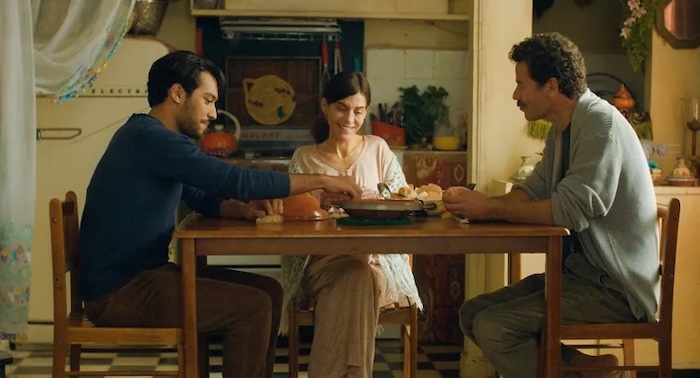
Maryam Touzani’s Moroccan drama is all about beauty: Beautiful people making beautiful things in the pursuit of beauty for its own sake. The opening credit sequence features billows of colorful satin fabric shot with eye-popping attention paid to the tactile and light-reflecting gorgeousness of the textures. These fabrics are the wares in the shop of Halim (Saleh Bakri), a maalem, or master tailor who makes traditional clothing. His customers are mostly women who need expensive garments for special occasions, and while the movie presents him as the last of his ilk, these customers don’t necessarily appreciate his patient craft, demanding that he speed up processes that have taken him a lifetime to perfect. But Halim, completely wrapped up in this craft, is not a salesman. That task falls on his wife, Mina (Lubna Azabel), who defends her husband’s care and deliberateness to impatient customers, going so far as to tell them to take their business elsewhere if they can’t wait, knowing that no one else in the medina can do this kind of work. Halim and Mina are an inseparably complementary team. 

Into their world comes Youssef (Ayoub Missioui), a young man with some experience in tailoring, who wants to apprentice with Halim. Having had bad luck in the past with assistants, Halim is desperate for someone who really wants to learn, but somehow Mina questions Youssef’s dedication. “He’ll be just like the others,” she says, and you sense a resentment underlying her words that goes deeper than professional pessimism, and which, in fact, prefigures the viewer’s own realization of why she may find Youssef a threat. She already senses that Halim is falling in love. 

Touzani doesn’t veil Halim’s desires. She follows him to the local public bath, where he rents private stalls for assignations with men to whom he says nothing. Mina, who married Halim when they were very young, naturally knows of these desires, and in one powerful scene she asserts her connubial privilege by seducing her husband in bed. He responds accordingly, though the reluctance is palpable. Meanwhile, relations between Mina and the new apprentice remain icy, and at one point there’s a breach. In youthful petulance Youssef makes an ultimatum that would seem to prove Mina’s point. But he can only stay away so long.

The plot arc that Touzani traces is also beautiful in its integrity. The various ways the story threads, like the threads in the silk fabric, resolve themselves in the end is almost too perfect, and much of the emotional power of the film is built on realizing expectations. All three principals turn out to be more complicated than first suggested, and the way they come together as characters borders on the contrived. Nevertheless, no one can deny the beauty of the film’s construction, just as no one can deny the beauty of Halim’s handiwork. It’s the ideal combination of craft and intention. 

In Arabic. Now playing in Tokyo at Human Trust Cinema Yurakucho (03-6259-8608), Shinjuku Musashinokan (03-3354-5670). 

The Blue Caftan home page in Japanese

photo (c) Les Films du Nouveau Monde-Ali n’ Productions-Velvet Films-Snowglobe

Posted in Movies | Leave a comment