Andrea Riseborough’s surprise Best Actress Oscar nomination, reportedly the result of a concerted campaign on the part of her and her PR team, will likely draw a lot of movie fans who might have overlooked To Leslie otherwise. It’s an earnest portrait of an alcoholic woman from a small Texas town who once won a large sum of money in the lottery and then burned through it quickly in a blur of partying. Seven years later she hits bottom and, broke, gets kicked out of the motel where she lives. Dragging along a pink suitcase with all of her belongings, she shows up at the apartment of her 19-year-old son, James (Owen Teague), hoping to crash, and, of course, makes a mess of it. Understanding his mother’s weaknesses intimately, James has moved on and is attempting to make something of his life. He ends up kicking her out, too, and she has nowhere to go but back to her hometown, where, as she admits to herself and others, everyone thinks she’s “shit.”
It’s perhaps a backhanded compliment to say that director Michael Morris elevates all the cliches associated with this kind of story. Since it takes place completely within a specific milieu we are spared the kind of condescension toward people who live day-to-day that you often see in movies where inter-class friction sparks whatever drama is generated. Everyone Leslie comes into contact with is only a step or two further along economically than she is, but the difference between an addict and one who isn’t, even in such an environment, can be dramatic in its own way. In this case, two of Leslie’s old friends (Allison Janney, Stephen Root), who, we are led to believe, had no small part in helping her spend her winnings, treat Leslie with the suspicion she deserves but go the extra cruel mile to humiliate her in public, despite the fact that their own lives practically scream, “there but for the grace of God…” At the other end is Sweeney (Marc Maron), a good-natured motel manager who employs Leslie as a housekeeper against his better judgement, because, as we eventually learn, he’s been there himself, but also because he’s attracted to her. His trust is the only thing she has to hold on to, and the two actors make the most of this spiky dynamic.
Much of what makes To Leslie interesting to watch is the way Riseborough and her co-stars, not to mention Morris’s empathetic direction, rise above the mediocre material. Screenwriter Ryan Binaco was aiming for something simple and affecting, but the arc of the story lands nowhere surprising or enlightening. At times, these people are as real as any you’ll find in a fiction film, but by the end they’re wedged into a situation that could only happen in a movie.
Opens June 23 in Tokyo at Kadokawa Cinema Yurakucho (03-6268-0015), Shibuya Cine Quinto (03-3477-5905).
A group of politicians belonging to the ruling Liberal Democratic Party recently submitted a “letter of opinion” to the city assembly of Kawaguchi in Saitama Prefecture. In the letter, the group demands tighter police surveillance of immigrants in the city, some of whom are “committing crimes.” According to official statistics, Kawaguchi is home to some 40,000 foreign national residents, though not all possess resident cards (juminhyo) and some are said to be on “provisional release,” meaning their applications for residence or asylum are under review.
The letter states that “many of these foreigners” have “good intentions,” but they tend to spend much of their time around “storage facilities for construction materials” and that some “drive recklessly.” Sometimes their actions result in property damage or personal injury. Fortunately, according to the opinion, the people who are injured have their own insurance, the implication being that they don’t need to demand that the people responsible for their injuries pay for their medical care. However, the letter also says that at least one of these incidents resulted in death.
The solution, says the politicians, is increased police presence in the area. News outlets also report thefts and assaults in the area, and residents “who are not foreign nationals” are becoming fearful for their safety. These bad elements, says the letter, taint the image of foreign residents in general, so the city assembly should discuss the matter in earnest, specifically: increase police presence and crack down on criminal elements; increase patrols around construction materials storage sites; and boost citations of traffic violations and reckless activities.
On May 12, the Asahi Shimbun published an article stating that the foreign resident population of Kawaguchi has increased 80 percent in the last 10 years, and as of April 1 it stood at 40,124 representing 104 countries or regions. That number accounts for 6.6 percent of the city’s total population. And while the overall number of foreign residents in Japan decreased during the pandemic, the number in Kawaguchi increased. The Justice Ministry says that in 2020, Kawaguchi had the highest number of foreign residents of any municipality in Japan after it surpassed Shinjuku and Edogawa Wards in Tokyo.
In terms of nationality, the highest portion of foreign residents is from China (56.5 percent), followed by Vietnam, the Philippines, South Korea, and Turkey. Most of the people from Turkey are Kurds. Along with the number of Kurds living in nearby Warabi and Saitama city, there are some 2,000 Kurdish residents in Japan. However, Asahi assumes that there are more Kurds in Japan than the number registered with local governments. As pointed out in another recent Asahi article, one of the reasons for the relatively high number of Kurds is that the government of Turkey has cracked down on its Kurdish minority, forcing many Kurds to seek asylum abroad. And while these political refugees may prefer going to Europe or elsewhere, Japan is one of the few countries they can enter without a visa. As has been reported many times on this blog, refugees are not welcome in Japan, and even less so now with the passage of the revision to the Immigration Law.
Regardless of the demands of local LDP politicians, Kawaguchi is addressing the needs of its foreign community. The city office employs 11 staff who speak Chinese, Korean, English, Vietnamese, Filipino, or Turkish. It also provides Japanese language classes run by citizen volunteers, including a self-run junior high school that has offered classes at night for at least 40 years. In addition, last August, the city established a website for mobile devices that explains the living situation in Kawaguchi in multiple languages, with videos demonstrating how to separate refuse and pay taxes.
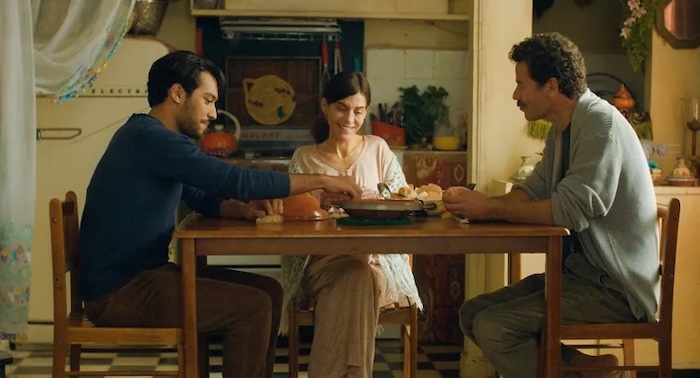
Maryam Touzani’s Moroccan drama is all about beauty: Beautiful people making beautiful things in the pursuit of beauty for its own sake. The opening credit sequence features billows of colorful satin fabric shot with eye-popping attention paid to the tactile and light-reflecting gorgeousness of the textures. These fabrics are the wares in the shop of Halim (Saleh Bakri), a maalem, or master tailor who makes traditional clothing. His customers are mostly women who need expensive garments for special occasions, and while the movie presents him as the last of his ilk, these customers don’t necessarily appreciate his patient craft, demanding that he speed up processes that have taken him a lifetime to perfect. But Halim, completely wrapped up in this craft, is not a salesman. That task falls on his wife, Mina (Lubna Azabel), who defends her husband’s care and deliberateness to impatient customers, going so far as to tell them to take their business elsewhere if they can’t wait, knowing that no one else in the medina can do this kind of work. Halim and Mina are an inseparably complementary team.
Into their world comes Youssef (Ayoub Missioui), a young man with some experience in tailoring, who wants to apprentice with Halim. Having had bad luck in the past with assistants, Halim is desperate for someone who really wants to learn, but somehow Mina questions Youssef’s dedication. “He’ll be just like the others,” she says, and you sense a resentment underlying her words that goes deeper than professional pessimism, and which, in fact, prefigures the viewer’s own realization of why she may find Youssef a threat. She already senses that Halim is falling in love.
Touzani doesn’t veil Halim’s desires. She follows him to the local public bath, where he rents private stalls for assignations with men to whom he says nothing. Mina, who married Halim when they were very young, naturally knows of these desires, and in one powerful scene she asserts her connubial privilege by seducing her husband in bed. He responds accordingly, though the reluctance is palpable. Meanwhile, relations between Mina and the new apprentice remain icy, and at one point there’s a breach. In youthful petulance Youssef makes an ultimatum that would seem to prove Mina’s point. But he can only stay away so long.
The plot arc that Touzani traces is also beautiful in its integrity. The various ways the story threads, like the threads in the silk fabric, resolve themselves in the end is almost too perfect, and much of the emotional power of the film is built on realizing expectations. All three principals turn out to be more complicated than first suggested, and the way they come together as characters borders on the contrived. Nevertheless, no one can deny the beauty of the film’s construction, just as no one can deny the beauty of Halim’s handiwork. It’s the ideal combination of craft and intention.
In Arabic. Now playing in Tokyo at Human Trust Cinema Yurakucho (03-6259-8608), Shinjuku Musashinokan (03-3354-5670).
Since Liam Neeson has reinvented himself as an action star so successfully in his old age, it shouldn’t be surprising that he is the oldest person to ever play Raymond Chandler’s iconic mid-20th-century L.A. private eye on the big screen, and yet there’s absolutely nothing distinctive about his Philip Marlowe. The same can be said for the movie, except maybe that, with Neeson, Colm Meaney, Ian Hart, and Danny Huston in the cast and Neil Jordan at the helm, not to mention James Joyce as a sore-thumb plot device, it’s the most Irish-identified take on Chandler you’ll likely ever see. But then, it isn’t based on any of Chandler’s stories, but rather on a Marlowe novel approved by the Chandler estate. Nevertheless, that lack of the master’s imprimatur isn’t the problem. It’s the fact that everyone involved seemed to take for granted that they knew exactly how this kind of genre project is supposed to go when they actually didn’t.
The plot is pure pastiche. A woman (Diane Kruger) walks into Marlowe’s office and hires him to find her errant lover (Francois Arnaud), who works as a props master at a Hollywood studio. In carrying out his task Marlowe interacts with the usual underworld types and crooked cops who variously beat him up and treat him disrespectfully, and while we expect these kinds of indignities, they don’t do anything to illuminate the character. The cynical humor and self-deprecating manner that made Marlowe so special to readers is mostly provided in response, as other characters remark on Marlowe’s moral sense. One even calls him “Sir Lancelot,” which paraphrases Chandler from one of his most famous essays about the art of fiction. Moreover, the vernacular sounds suspiciously post-millennial and self-aware (“I’m too old for this.” You think?). It thus takes even more effort than usual to follow the convolutions of the mystery. The only thing worthy of attention is Jessica Lange as a semi-retired movie star who doesn’t seem to be modeled on anyone we might know. It’s actually an original character, and one, I assume, Lange invented herself.
Now playing in Tokyo at Toho Cinemas Chanter Hibiya (050-6868-5001).
Maryna Er Gorbach started filming Klondike in 2020, before Russia invaded Ukraine, but it’s obvious where her loyalties lie. Set in the Donbas region of Ukraine in 2014, when local separatists aided Russian forces in taking over the area, the film focuses on Irka (Oksana Cherkashnya), a pregnant woman who runs a smalll farm with her husband, Tolik (Sergey Shadrin), who ostensibly is seen as an ally by the separatists but doesn’t really act like one, mainly because Irka is Ukrainian and hates them. A certain comic tone is struck in the first scene when the couple is awakened by an explosion: a stray mortar from the separatists has blown a hole in the side of their house. The next day an old friend of Tolik’s apologizes for the “mistake” and promises to fix the wall, but at the moment a war is brewing and they need Tolik’s car, not to mention his farm for quartering when the inevitable mercenaries show up. This absurdist setup is taken to its most tragic conclusion later that day when the separatists shoot down Malaysia Airlines flight 17 and a dead passenger still strapped to her seat lands next to Irka’s shed.
Er Gorbach dedicates Klondike (no explanation of the title is ever provided) to women, and Irka plays the role of the angry antiwar female to the hilt, badgering her husband to rebuff his separatist friends and trying to maintain the semblance of a normal life among the chaos that’s churning in their village. Irka’s pro-Ukraine brother, Yaryk (Oleg Shcherbyna), arrives to persuade her to evacuate to Kyiv, where he now lives, and she refuses, because this is her family home; Yaryk’s, too, for that matter, and the tension between him and Tolik is not just political in nature. While their bickering adds a touch of the ridiculous to what is essentially a terrifying situation, it also epitomizes in miniature the conflict brewing at large, even if Tolik is no hardliner. When Yaryk discovers a Russian uniform that has been forced upon Tolik by his friends, Irka loses it, even though Tolik doesn’t have any intention of putting it on. Stuck between two immovable forces, he may come across as weak and vacillating, but he obviously loves Irka and knows what would happen to him if he refuses the separatists’ entreaties.
As Irka’s pregnancy reaches term and the mercenaries arrive in full occupation mode, Klondike‘s absurdist component switches into overdrive, with horrifying results. Women, Er Gorbach tries to show, will always suffer more during war because their vulnerability is taken for granted. Even someone as firm and defiant as Irka can’t stem the tide of bellicosity that rules this divided borderland, but she’s determined to survive, and probably will.
In Ukrainian and Russian. Now playing in Tokyo at Theater Image Forum Aoyama (03-5766-0114).
Though it was often called something different, the multiverse has been a fixture of science fiction novels and superhero comics for many years, and at the moment it seems to be an inescapable feature of any sort of fantasy feature film. Nevertheless, it still requires some mental effort to understand how these extra-dimensional realms fit into whatever yarn the creators of the Marvel or DC cinematic universes are trying to spin. Maybe it’s just me and my total lack of experience with roll play video games, but I usually exit these movies with conflicted feelings: high from the adrenalin rush of the SFX and action set pieces while frustrated with the attempt to make sense of the worlds depicted.
DC’s latest effort to catch up with Marvel’s extraordinarily successful output, The Flash feels even more desperate, since it tries to make the multiverse fresh for viewers. Directed by Andy Muschietti, whose brief so far has been in the horror genre, The Flash, true to its title, tries for a big, bold impression through rapid-fire humor and action sequences that don’t mind looking ridiculous. The hero, as played by Ezra Miller, would be described by Marvel freaks as a cross between a callow Peter Parker type and Paul Rudd’s wise-ass Antman character. In the opening scene, Barry Allen (Miller) jousts with a difficult barista on his way to work when he’s called to action by fellow Justice Leaguer Batman (Ben Affleck) and has to zoom elsewhere to save a bunch of people falling out of a collapsing high-rise. Though the sequence provides the proper presentation of the Flash’s powers—super speed married to super strength—it assumes the viewer knows something more about both Allen and the Flash, and so when the story moves swiftly to the main theme, which is how the Flash discovers his speed capabilities can not only freeze time but make it go backwards, we may feel similarly left in the dust. Barry decides to go back in time and save his mother (Maribel Verdu) from being murdered and his father (Ron Livingston) from being punished unjustly for the crime, and he finds himself not only back in the day, but in an alternate version of back-in-the-day where he has to help himself as a younger, more jaded Barry to learn how to use his new superpowers. It’s a lot to process, especially as the frat boy jokes arrive at a fast and furious pace. In breaking up the storied space-time continuum, Barry inadvertently unleashes a whole array of crises, including an earth invasion by General Zod (Michael Shannon) from the planet Krypton, thus occasioning the appearance of Supergirl (Sasha Calle), not to mention this particular dimension’s version of Batman (Michael Keaton, whose portrayal of the Caped Crusader was from an entirely different franchise that I had thought the actor no longer took seriously). The usual unspeakable violence ensues before the multiverse is set right again, though I’m still not sure what that involved.
It shouldn’t have been that difficult, because the more complex multiverse described in the animated sequel, Spider-Man: Across the Spider-Verse, didn’t hurt my brain as much, mainly because the characters are so vivid and distinct that they convey these complexities more through the force of their personalities than through the separate narratives they represent. The directors, Joaquim Dos Santos, Kemp Powers, and Justin K. Thompson, also keep things straight by animating each universe with its own visual style, as was done in the first Spider-Multi movie. So while I couldn’t quite remember all the particulars from the previous installment (When did Gwen Stacy become a Spider-Person?) I caught up with the story’s zeitgeist fairly quickly. The overarching conflict that roots the film is between the 15-year-old Brooklyn native Spider-Man, Miles Morales (Shameik Moore), and a villain called Spot (Jason Schwartzman), who can open portals to other dimensions at will. Initially, Miles teams up with Gwen, who’s from another version of New York City, to contain Spot, but the latter’s improprieties bring in at least four other web-spinners, including an Indian and a London punk. Their main work is to prevent the various dimensions from intruding on each other, and if I’ve forgotten exactly why that’s a bad thing, it didn’t stop me from enjoying the action, which in addition to being meticulously rendered is eye-poppingly inventive in its use of color and motion. I did, however, pick up on the idea that events shared by the various universes—like the deaths of particular parental figures—had to be maintained in order to preserve the integrity of the multiverse in general, and in that regard it did less of a number on my head then the same problem in The Flash. By the next Spider-Multi installment—which is supposed to come out next spring—I should have it all figured out.
The Flash is now playing in Tokyo at Toho Cinemas Nihonbashi (050-6868-5060), Toho Cinemas Hibiya (050-6868-5068), Marunouchi Piccadilly (050-6875-0075), 109 Cinemas Premium Shinjuku (0570-060-109), Shinjuku Wald 9 (03-5369-4955), Shinjuku Piccadilly (050-6861-3011), Toho Cinemas Shinjuku (050-6868-5063), Human Trust Cinema Shibuya (03-5468-5551), Toho Cinemas Roppongi Hills (050-6868-5024).
The Flash photo (c) 2023 Warner Bros. Ent. TM & (c) DC
Spider-Man: Across the Spider-Verse is now playing in Tokyo at Toho Cinemas Nihonbashi (050-6868-5060), Toho Cinemas Hibiya (050-6868-5068), Marunouchi Piccadilly (050-6875-0075), 109 Cinemas Premium Shinjuku (0570-060-109), Shinjuku Wald 9 (03-5369-4955), Shinjuku Piccadilly (050-6861-3011), Toho Cinemas Shinjuku (050-6868-5063), Toho Cinemas Shibuya (050-6868-5002), Toho Cinemas Roppongi Hills (050-6868-5024).
Spider-Man: Across the Spider-Verse home page in Japanese
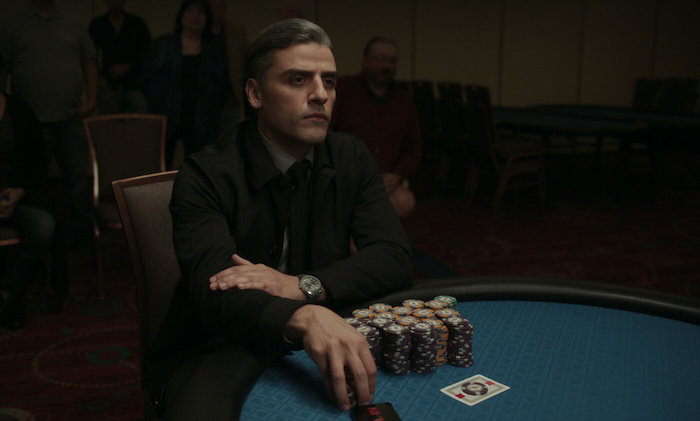
In a recent New Yorker profile The Card Counter was described as the second work in a trilogy of films by Paul Schrader about “the man in the room.” As the article points out, almost all of Schrader’s scripts, whether or not he directed them himself (Taxi Driver and Raging Bull are the most famous ones he didn’t), are about men in rooms, which is to say they are about men who, left to their own devices, dwell on their sorry situation to the point of near madness. As to what makes The Card Counter, its predecessor, First Reformed, and its successor, Master Gardener, just released in the U.S., a trilogy we can only guess, but the writer of the article suggests that Schrader himself saw these films as his last (he is 76 and not particularly well) and conceived them as of a piece, though he also says he now intends to make at least one more movie.
The thematic similarities between First Reformed, in which Ethan Hawke plays an alcoholic clergyman whose quest for redemption hasn’t worked out as planned, and The Card Counter, in which Oscar Isaac plays an ex-con professional gambler who goes through pretty much the same thing, are easy to parse, even if the two protagonists are markedly different in attitude. Hawke’s pastor struggles just to get through the day in one emotional piece, while Isaac’s casino habitué is opaque with self-possession, a man who thinks he knows what he wants and how to get it. As with many Schrader leads, William Tell, as he introduces himself, narrates much of the film in voiceover, and right at the start he informs us that he “adjusted to prison quite well,” due to its monotony and lack of surprises. It was the perfect environment in which to read a lot (something, apparently, he never did before) and learn how to count cards, a memory trick used by gamblers who play poker and blackjack. At first, we don’t know why Tell is in prison, but it slowly comes out that he was one of the unfortunate soldiers assigned to Iraq’s Abu Ghraib prison who was photographed torturing POWs. Though this experience must have scarred him, Tell maintains an icy front, and his narration makes it sound as if he’s learned his lesson, even if that lesson seems to be to lay low. Gambling is thus the perfect profession: keep moving from casino-to-casino, avoid human contact, and play for relatively low stakes, since management will flag and eject you if they catch you counting cards. To reinforce this image of the meticulous perfectionist, the first thing Schrader has Tell do when he moves into a new motel room is wrap all the furniture in white sheets. He survives on his single-mindedness.
In the movie’s one contrived descent into serendipity, Tell finds himself in a resort hosting a convention for the security industry and comes across the military contractor, Major John Gordo (Willem Dafoe), who taught him how to torture. Also on hand is a young man, Cirk (Tye Sheridan), who is shadowing Gordo. Cirk says Gordo was responsible for the suicide of this father, who suffered the same fate at Tell. In fact, Cirk recognizes Tell and tries to recruit him for his plan to exact revenge on Gordo. Tell has a different idea: Cirk, to him, is his chance for atonement, and he takes the boy under his wing, confident that he can make his life mean something.
Though it’s Schrader’s dialogue that commands attention, the film’s ace in the hole is the way the story develops tension without resorting to the usual suspense mechanisms. The number of characters, including Tiffany Haddish as a woman who stakes gamblers for rich backers, are kept to the bare minimum, and Schrader avoids any show of overt drama—until the very end, when circumstances conspire to create nothing but drama. If I found the catharsis at the end of First Reformed more emotionally compelling, the climax of The Card Counter made for more visceral, vital cinema.
Opens June 16 in Tokyo at Cinemart Shinjuku (03-5369-2831), Human Trust Cinema Shibuya (03-5468-5551).
Dehumanizing by design, Kitty Green’s debut fiction feature (she has already directed a number of documentaries, mostly on Ukraine) about the punishing workload foisted upon a young female employee of a movie production office in downtown New York doesn’t necessarily feel autobiographical, despite its convincing milieu. Green has extrapolated on the trappings of the #MeToo movement as a means of interrogating post-millennial work culture, and while there is a generic quality to the indignities the titular, unnamed factotum (Julia Garner) has to suffer, the details are so carefully wrought that you sometimes wonder if this couldn’t have been a documentary itself. The big producer boss of the office, undoubtedly based on Harvey Weinstein, is never depicted but his threatening presence hovers over every scene, mostly in the way his bullying demeanor is filtered through the layers of supervision under which the assistant toils.
The opening scene is the kicker: the assistant is woken up in the wee hours of the morning, picked up by a hired car, and driven to work while it’s still dark and no one has yet arrived at the office. She’s already performed almost a full day’s work before any of her colleagues show up. The explanation for this slavish behavior is revealed as the movie progresses, but any sentient being will understand right away. The young woman has had the great fortune of being hired by this reputable company and will work her way up through the hierarchy into a powerful position in the movie business—or, at least, that’s what she’s led to believe. The indignities are the price she has to pay now, but only months into what is obviously a poorly paid internship she is already beaten down. It’s not just the constant flow of drudge work. It’s the way she’s jerked around by those who need her to cover for them, including the mogul himself, who, while never seen, is definitely heard, especially when the assistant fails to deflect his angry wife, who may have caught on that her husband is sexually abusing aspiring female actors and office staff in the not-so-soundproof privacy of his office. (The assistant, we come to realize, is “not his type.”) That everyone in the office knows this but it’s only the assistant who is charged with actively hiding it is the movie’s emotional lynchpin. The pivotal scene has the assistant visiting the company’s HR chief (Matthew Macfadyen, using the same American accent he sports in Succession but without the smarm), who subtly but effectively informs her that she’ll be washed up in this business if it gets out she’s telling on the boss.
Green plays it like a thriller, a gambit that undermines some of the movie’s realism but emphasizes its point about the predatory nature of the entertainment world. The assistant herself is not ostensibly a victim of sexual abuse—sexism, yes—but the overall vibe you get from the environment being dramatized is that sexual abuse was (and perhaps still is) considered part of the creative process, a point proven by Harvey Weinstein’s career.
Opens June 16 in Tokyo at Human Trust Cinema Yurakucho (03-6259-8608), Shinjuku Cinema Qualite (03-3352-5645), Yebisu Garden Cinema (0570-783-715).
The government’s scheme to get everyone in Japan, Japanese national and foreign resident alike, to apply for a My Number card has been plagued by problems. The aim of the My Number system is to assign a unique number to every person in Japan that the government can use for all national bureaucratic functions, much like the U.S. social security number, and the cards will be digital instruments that can connect to these functions. Though there had been a certain level of resistance to the scheme owing to citizens’ mistrust of the way the government handles personal data, a majority of people have signed up, many after the government started rewarding points for doing so that could be used for limited purchases. But as it happened, the original fear was realized: Many of the problems with the actual usage of the cards are related to the inadvertent leaking of personal information to the wrong people, though the number of actual cases has been low.
The one problem that has been enormous, however, has to do with bank accounts that were linked digitally to My Number cards. Almost 55 million people registered their bank accounts with their My Number cards, and about 130,000 of these were registered to the wrong bank accounts, but not because of a glitch in the system or mistakes by government functionaries. In almost all the cases, the bank accounts were registered to a parent of the card-holder, not the card-holder themself. According to the rules, the bank account registered for a specific card must be in the name of the card-holder, because it will be used by the government to deposit funds—tax refunds, government handouts, etc.—to the card-holder as an individual. According to an editorial in the Japan Times, “Digital Minister Taro Kono has called on persons who have linked their accounts to those of their children…to change the registration by the end of September, noting that payments will not be made to bank accounts of people other than registered recipients.”
If you are like me, this particular problem is confusing, since it not only presupposes that a child of any age is expected to apply for their own My Number card, but that they are also expected to have their own individual bank account. Of course, children can have bank accounts set up for them by their parents or guardians, as is often the case, but under what circumstances would the government transfer funds to these accounts? Minors don’t file tax returns and government handouts usually go to households, not individuals. Most likely, the parents who registered their children for My Number cards did so to take advantage of the reward points offered to promote the system, since making an application would earn the applicant 20,000 points. But while these points can be used to purchase goods and services from participating retailers and local business groups, they are not cash, and thus cannot be deposited into a bank account. Another aspect of this problem is the effectiveness of making a My Number card for a child. Even infants can apply for a card since they are assigned numbers, but if you have one you know that not only do you have to create a password to use the card, but that it contains a photo of the holder and also seems to require a signature. In principle, the cards are renewed once every ten years, but apparently the renewal period is much shorter for a child, which makes sense with regard to the photo but also sounds like a pain in the neck.
Though hardly significant, Gerard Johnstone’s comic horror film arrives at a moment when the debate about the meaning of artificial intelligence is finally getting a serious airing, owing mainly to the emergence and popularity of ChatGPT. M3GAN has nothing to say about jobs lost or even the possibility of AI usurping human agency in the world. It’s more a cautionary tale about lazy parenting. The titular android’s murderous tendencies are simply a function of its programmed utility to protect a child from what it senses as harm.
Horror veteran Akela Cooper’s screenplay, however, is almost as lazy as the parenting on display. Eight-year-old Cady (Violet McGraw) is orphaned when her parents are killed in a car accident that she survives. Severely traumatized, she is left in the care of her unmarried Aunt Gemma (Alison Williams), a robotics expert who works for a very competitive toy company trying to come up with virtual and mechanical pets. Hounded at work by superiors who don’t think she’s trying hard enough (“Let’s kick Hasbro in the dick!”), Gemma has barely enough time to deal with this new addition to her household, let alone provide her with the psychological comforts that she needs to overcome her PTSD, which is exactly what a court-appointed psychiatrist says to Gemma. So she improvises in a way that also helps her with her work load, modifying a prototype humanoid robot that is designed to hold and analyze large amounts of input data and creating a playmate for Cady, one that, in addition to amusing her, sets her on the correct path for socialization by reminding her to do things like wash her hands before a meal. Though the technology is still in development, Cady quickly takes to her new companion so thoroughly that she doesn’t seem to care much for human companions her own age. Meanwhile, Gemma’s slimy boss sees the possibilities of a M3GAN rollout and badgers Gemma even more to get the thing ready for mass production.
The most interesting aspect of M3GAN is the doll itself, which is dressed like doper’s idea of a 1970s Catholic schoolgirl and manifests movements that suggest a nerd with a lot of self-confidence but no real world experience. These attributes add to the creepy humor of the horror sequences once M3GAN identifies what it senses as threats to Cady’s well-being, including a bullying preteen male and, climactically, the CEO who is the main villain of the movie, but these sequences turn out to be unsatisfying as horror. M3GAN would have been much better had it simply went all-out as a comedy. AI-based horror movies are so 2010.
Now playing in Tokyo at Toho Cinemas Nihonbashi (050-6868-5060), Toho Cinemas Hibiya (050-6868-5068), Shinjuku Piccadilly (050-6861-3011), Toho Cinemas Shinjuku (050-6868-5063), Shibuya Cine Quinto (03-3477-5905), Toho Cinemas Roppongi Hills (050-6868-5024).








 philipbrasor.com