Media watch: Feminist icon outed as…a wife

Chizuko Ueno (Toyo Keizai)

The March 2 issue of the weekly magazine Bunshun contained a bombshell scoop of a sort. One of the articles is about Chizuko Ueno, a University of Tokyo sociology professor (graduate of Kyoto University) whose specialty is feminist theory, in particular how patriarchal societies like Japan’s systematically discriminate against women and limit their choices. One of her constant themes is that the institution of marriage as it’s conventionally defined in Japan  is “the root of all evil,” so Bunshun’s scoop was noteworthy since it reported that Ueno was married.

The past tense is important here because Ueno’s purported husband died in September 2021 at the age of 96. Ueno is 74 right now. Her husband was Daikichi Irokawa, a renowned historian who chronicled the lives of ordinary Japanese people in the context of “freedom and human rights.” He was also an activist whose experience during World War II prompted him to study how the state wielded control over the Japanese populace. 

Though Bunshun doesn’t actually produce a marriage certificate or family register, the reporter uses other documentary evidence to show how the two scholars were wed, though it’s not clear exactly how long they were wed. Irokawa’s first wife died in 2017, and last June an application to transfer property he owned in Yamanashi Prefecture was carried out. Further investigation revealed that the registration for the land was passed on to Ueno on the date of Irokawa’s death the year before. According to a legal expert interviewed by Bunshun, such a property transfer could not be carried out had the recipient not been related to the deceased, because only an “heir” can receive an “inheritance,” which is how the application was processed. Had Ueno and Irokawa not been married, she would have only been able to receive the property as a “gift” through a will. So that means Ueno was either legally married to Irokawa or had been adopted by him. As the expert put it, being in the same family register as the deceased makes the process of liquidating property very easy. Otherwise, a lot of paperwork would be required, and that doesn’t seem to be the case in this instance. 

Irokawa’s son told Bunshun that he is not concerned about Ueno’s image, only his father’s memory. But the article implies that Irokawa’s previous wife knew about his relationship with Ueno. As for Ueno’s legal name, had she been either Irokawa’s legal wife or legally adopted heir, she would have to have the same name, and there is no indication that Irokawa changed his name to Ueno. However, there is also no evidence of her changing her name since, following a spouse’s or adopted guardian’s death, a person can easily reclaim their previous name. 

Ueno has not commented on the article so far, and certain elements on the internet who find her pronouncements objectionable have been quick to label her a hypocrite by keeping her wedded status a secret even as she rails against the sexist aspects of traditional marriage. But while one could probably make a case that keeping that relationship a secret detracts from Ueno’s reputation as a self-sufficient single person, it by no means detracts from her work, which is centered on the inherent dignity and rights of the individual. In recent years, a subtheme of her writing has been aging and dying alone, whether the individual is a man or a woman, and as it turns out, this was also one of Irokawa’s activist interests in his twilight years. Living in the home he bequeathed to Ueno, Irokawa formed a neighborhood group called Neko no Te Club whose members took care of one another as they grew older, regardless of whether they had family. In the end, it’s nobody’s business but hers if Ueno was married, but from all appearances she practiced in that marriage what she preached in public. 

Posted in Media | Tagged , | Leave a comment

Review: Paper City

One of the salient points that Edward Seidensticker made in his history of Tokyo was that, in the Shitamachi area of the capital—the “low city” where the hoi polloi lived—the carpenters’ guild was congruent with the fire brigade; meaning that the people who built all those wooden structures were the same people who had to put out the fires when they burned, which they did in a big way every decade or so. This cycle of construction-destruction evolved into Tokyo’s infamous scrap-and-build urban development policy, and though Seidensticker doesn’t mention it, it also likely had something to do with Gen. Curtis Lemay’s decision to firebomb the Shitamachi area during World War II, since he knew it contained densely arranged wooden dwellings that would light up like matchsticks, despite the fact that it contained few facilities that were strategically important. The whole point was to create casualties that would “disrupt production.” During the night bombing raid that started just after midnight on March 10, 1945, American B-52s dropped more than 1,500 tons of bombs, destroying one-fourth of the city. About 100,000 civilians died, with another 125,000 wounded. Lemay considered it a great success.

Australian filmmaker Adrian Francis’s documentary, Paper City, is less about the raid itself than about how it has been memorialized. For the most part, only those persons with a direct link to the terrible event have kept its memory alive. As one elderly witness explains, young Japanese today don’t even know that the U.S. was Japan’s enemy during World War II, much less that Americans massacred tens of thousands of men, women, and children indiscriminately in the course of one night. Francis focuses on three people who survived the firebombing and subsequently worked to get the Japanese government to set up a permanent memorial to those who died, though, in truth, what they are after is to get the government simply to acknowledge officially that it happened. Most of the footage was filmed between the 70th anniversary of the raid in 2015, when the memorial association submitted a 300,000-signature petition to the ruling Liberal Democratic Party demanding they create a permanent memorial, and the following year, when the government effectively killed the petition by ignoring it. 

Consequently, the memorial activists have had to set up their own memorials piecemeal, raising money privately to pay for them. As they go about this business, the three principal subjects relate the horrors of that night: How the Sumida River filled with dead bodies and, as children, they were forced by soldiers to pull the bodies out of the water; how all the public parks “from Asakusa to Oshiage” contained “mountains” of charred, unidentifiable corpses; how the residents couldn’t do a thing since the volume of incendiaries was so great it caused firestorms that blew flames through the streets with hurricane force, and yet these residents were prohibited from leaving the area by the military authorities because they were supposed to put the fires out somehow. 

At one point, Francis films a demonstration outside government offices and a sound truck from a rightist organization drives by and scolds the demonstrators for “begging the government for money” when they should be picketing outside the U.S. embassy. In a sense, they are right—the U.S. has never apologized for the wholesale carnage, the same way it has never recognized Hiroshima and Nagasaki as being inherently genocidal military actions—but as one association member puts it, the “pre-war establishment still controls Japan,” which means the government will never acknowledge its own part in the destruction caused by the firebombing until that faction is removed somehow. Getting them to at least recognize the horrors of March 10, 1945, is the only way to begin that process, which, at the moment, is more vital than ever as these establishment forces prepare the country to accept a larger and more offense-oriented military. 

Addendum: A reader has pointed out that Lemay received the First Class Order of Merit of the Grand Cordon of the Rising Sun, one of Japan’s highest honors, in 1964, which only adds insult to injury and further explains why the current government would rather not talk about the Tokyo firebombing.

In Japanese and English with English and Japanese subtitles. Now playing in Tokyo at Theater Image Forum Aoyama (03-5766-0114).

Paper City home page in Japanese and English

photo (c) 2023 Feather Films Pty Ltd.

Posted in Movies | Tagged | Leave a comment

Review: Worth

Worth is solidly in the cinematic tradition of lawyer-as-Sisyphus real-life dramas, of which Todd Hayne’s Dark Waters is probably the most pertinent of recent examples. If Worth doesn’t quite match up to the slow burn frustration of Dark Waters it has less to do with the presentation than with the underlying legal questions. Dark Waters was a standard little-guys-vs-big corporation tale that kept the technical matters in focus without allowing them to overtake the dramatic elements. The frustration was visceral because what made the case frustrating—Dow Chemical’s avoidance of its responsibility in poisoning the drinking water of an entire West Virginia town—was clearly and intelligently explained. The legal particulars of Worth are not so clear, since they pivot on questions that are almost philosophical in nature. How much, exactly, is a human life worth, especially in relative terms, which is what the case was all about?

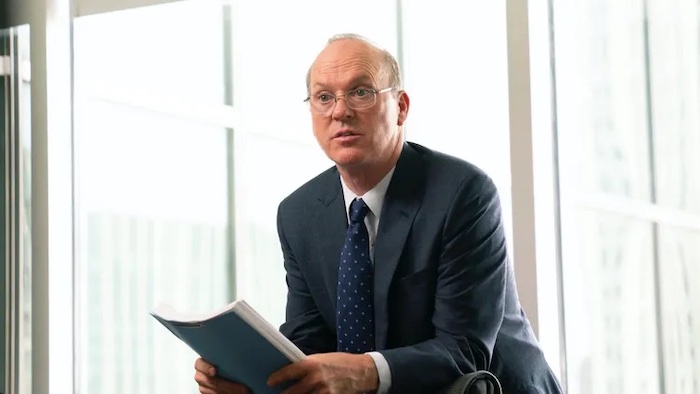
The lives in this instance were those lost in the 911 attacks. The U.S. government has decided to compensate the families of the victims so as to preempt the certain likelihood of huge lawsuits being filed against the airlines involved and sinking the economy in the process. The problem is how much to pay, and that job is assigned to private attorney Kenneth Feinberg (Michael Keaton, dusting off his trusty Boston accent), who happens to witness the Twin Towers collapse while commuting into the city and listening to opera on his CD Walkman. Though Feinberg knows that “no one wants this job,” which is to crunch the numbers and figure out who gets how much, he lobbies for it anyway, because “I’m good at this.” And for the most part, Keaton and director Sara Colangelo show off Feinberg’s juridical and bookkeeping acumen to excellent effect. The purpose, however, is to elucidate what an impossible task he has taken on, and while most of the emotional heavy lifting is handled by Feinberg’s colleague, Camille Biros (Amy Ryan), who deals directly with the families, it’s the bureaucratic niceties of the case that claim center stage. In that regard, it is Stanley Tucci’s Charles Wolf who provides the foil to all the well-meaning common sense that Feinberg endeavors to wield. Wolf is the spouse of one of the victims and the leader of a movement to “fix the fund” in order to make sure that dead CEOs don’t receive a hundred times more in compensation than the people who mopped the floors or, for that matter, the first responders who lost their lives while saving those of others. 

Inevitably, Feinberg’s insistence on “objectivity” is defeated by the realization that there is no perfect solution to his problem, since it forces him to place a monetary value on something that is, by definition, priceless. Hayne had it much easier. Dark Waters ended not with a clear legal victory against the bad guys, but with a moral victory in that there was an understanding the lawyers for the plaintiffs would continue being an effective thorn in the side of Big Chemical for years to come, thus making sure laws would change for the better. Worth tries to make a similar claim but fails to be as convincing, because while it doesn’t scan as a typical feel-good Hollywood legal drama, it does try to fit the Sept. 11 Victim Compensation Fund into a pat narrative that can’t possibly contain it.

Now playing in Tokyo at Toho Cinemas Nihonbashi (050-6868-5060), Toho Cinemas Chanter Hibiya (050-6868-5001), Toho Cinemas Shinjuku (050-6868-5063), Euro Space Shibuya (03-3461-0211).

Worth home page in Japanese

photo (c) 2020 WILW Holdings LLC

Posted in Movies | Tagged , | Leave a comment

Review: Triangle of Sadness

The main problem with movies that try to be up-to-the-minute is that they invariably feel dated by the time they are actually released, even if “dated” is a problematic construct. The main two characters in Swedish director Ruben Ostlund’s second Palme d’Or winner are internet influencers, a concept that seems tired since it’s a vocation that’s already been endlessly sent up in popular culture. Nevertheless, Ostlund gets a lot of comic mileage out of the idea at the outset. Carl (Harris Dickinson) is a model who, despite being young and buff, already appears to be past his sell-by date according to a casting director who recommends he have some Botox work done on the titular real estate between his eyebrows. Actually, it is Carl’s significant other, Yaya (Charlbi Dean), a former model, it would seem, who is the influencer, and as such makes more money than Carl does, a situation that results in one of the most poignantly hilarious precoital transactions ever recorded for the screen. If Ostlund’s purpose is to deride post-millennial capitalism as the ultimate sex game, then he could have just stopped filming after the couple’s charged conversation in their expensive hotel room following dinner in an equally expensive restaurant where the two argue over which of them will pick up the tab.

The rest of the movie is all anti-climax, and while it maintains Ostlund’s cynical outlook with a wry attention to detail it never reaches the same kind of insight. Yaya and Carl join a cruise on a big yacht for free as influencers with a horde of rich older folk from various countries and professions. The dynamics are provided by the interface between these assholes and the below-deck crew, who represent various developing countries but mainly the Philippines. Yaya and Carl are somewhere in the middle—arrivistes in the old concept of the word but with a winking knowledge of class tension, since they most likely grew up under less than middle class circumstances. The scenes on the ship basically comprise black comic sketches predicated on certain national stereotypes: wealthy Russians are stupid, British retirees are good-naturedly racist, Americans don’t give a shit about anything except their own passions. And while some of these episodes achieve a level of jokey discomfort that would be the envy of Ricky Gervais, they don’t amount to anything beyond their own gross pedantry. But Ostlund knows how to make each of them bigger in emotional impact than the last one, and by the time we get to the now infamous seasick scene he’s more than made his point.

Unfortunately, that isn’t the end of the movie, because Ostlund’s opinion about all uses of power is made literal and explicit in the final chapter, which reorchestrates the one-on-one premise of Swept Away into a symphony of survival kitsch. The image I have of the well-dressed elite at Cannes laughing their asses off at all this is funnier than anything in the movie. 

In English, Russian, Filipino, German, French and some other languages I didn’t catch. Now playing in Tokyo at Toho Cinemas Hibiya (050-6868-5068), Bunkamura Le Cinema Shibuya (03-3477-9264), Toho Cinemas Shinjuku (050-6868-5063).

Triangle of Sadness home page in Japanese

photo (c) 2022 Platform Produktion AB, Film i Vast AB, Sveriges Television AB, Essential Filmproduktion GmbH, Coproduction Office Ltd., Societe Parisienne de Production SARL, Coproduction Office ApS, British Broadcasting Corporation, The British Film Institute, Arte france Cinema

Posted in Movies | Tagged | Leave a comment

Review: Empire of Light

Having worked in a movie theater shortly before those years in which Empire of Light is set, I can attest to the accuracy of its depiction of how films were presented to paying customers at the time, not to mention the peculiar aspects of the work environment. And while this recognition sparked a gratifying feeling of nostalgia that I hadn’t expected, it didn’t necessarily intensify my appreciation for the movie as a movie, probably because the matters it was most concerned with had little to do with movies, or movie theaters. The setting was just that—a setting. It could have just as easily told the same story had it taken place in a Denny’s. 

Except, of course, this is England, the coastal resort town of Margate, to be exact, and the year is 1980, when punk had given way to two-tone ska and National Front goons were asserting their right to make trouble for anyone who wasn’t white, working class, and incoherent like them. Within this fraught social environment, the Empire theater, a former movie palace that can’t seem to decide if it wants to be a multiplex, stands for certain old-fashioned values that are reflected in the somewhat defeated air of the place. Olivia Colman plays the middle aged manager, Hilary, who personifies this mood: outwardly genteel, fair but firm with both staff and customers, but eminently distracted. Eventually, we come to understand that Hilary is in what can only be described as a one-sided sexual affair with her married boss, Mr. Ellis (Colin Firth), meaning he summons her to his office when he feels like it and has his way with her. And yet, while Hilary obviously dislikes these trysts, they don’t seem to be the central source of her melancholy. Enter Stephen (Micheal Ward), a new employee who himself seems unmoored, though more in a material fashion. Stephen aspires to be an architect, but hasn’t made enough of an effort. Then again, Stephen is Black, which means he has to make more of an effort when it comes to material gain.

Enticed by his youth and relative nonchalance, Hilary takes to Stephen and brightens up a bit. Stephen, in turn, is attracted to Hilary’s candor and kindness, which fail to mask a mental illness that eventually manifests in an outburst of recrimination that leads to her institutionalization, and not, we learn, for the first time. If this sounds like a spoiler, there’s much more to come, and Mendes, who wrote the script, meticulously weaves Hilary’s and Stephen’s respective situations into the historical tapestry of that very specific time and place. Thanks to Roger Deakins’ evocative cinematography and the careful production design, the story Mendes wants to tell feels completely of a piece with this milieu, even if his conception of the characters never takes hold. It isn’t until the last scene that we learn Hilary has never even watched a movie in the place where she works, and as she sits down to take in a new feature called Being There, you think to yourself: This is where the story should have begun.

Opens Feb. 23 in Tokyo at Toho Cinemas Nihonbashi (050-6868-5060), Toho Cinemas Hibiya (050-6868-5068), Shibuya Wald 9 (03-5369-4955), Toho Cinemas Shinjuku (050-6868-5063), Shibuya Parco White Cine Quinto (03-6712-7225), Toho Cinemas Roppongi Hills (050-6868-5024).

Empire of Light home page in Japanese

photo (c) 2022 20th Century Studios

Posted in Movies | Tagged , | Leave a comment

Review: Three Thousand Years of Longing

George Miller may be our prime cinematic fantasist if only because his fantasies cover such a wide range of subject matter. Known mainly for the Mad Max series, he’s also responsible for the two Babe movies and the animated penguin romp Happy Feet. But while he’s noted for indulging his inner child, his movies always have an adult component that most people under the age of 18 probably wouldn’t appreciate. It’s this peculiarly adult yearning for something ideal that motivates his latest film, based on a novella by A.S. Byatt, that reimagines the Arabian Nights as a conversation between two brainy people with way too much time on their hands.

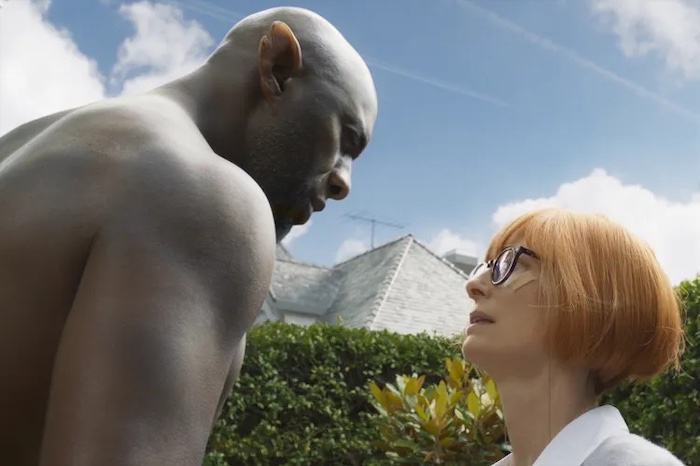
Tilda Swinton plays Alithia Binney, a dyed-in-the-wool academic whose field of study, narratology, seems so arcane that you wonder how she can possibly make a living, but she seems quite comfortable, jetsetting around the world, attending literary conferences and visiting museums and bazaars for stories. In Istanbul, she buys an old glass container in a market and when she gets back to her beautifully appointed hotel room discovers that it contains a djinn (Idris Elba), who, naturally, offers to grant her three wishes. But before he does that he has to tell her his story, because he’s been cooped up in the container for 3,000 years and is just dying to have a nice, long chat. This should be right up Alithia’s alley, but all through these rangey episodes about kings and harems and doomed betrothals Alithia maintains the attitude of an informed skeptic, which isn’t to say she doesn’t believe him, but that she’s heard enough stories in her life to take every pronouncement, regardless of how passionately it’s presented, with several grains of salt. But the greatest insult to the djinn’s self-esteem is her total indifference to coming up with three wishes. She wants for nothing, which explains the picture perfect but highly improbable production design.

Despite Swinton’s and Elba’s intense, idiosyncratic performances, these conversations never quite get on a track that would keep the movie on a steady course. Every tale the djinn tells is vividly recreated but thematically and emotionally inert; there’s no through-line for the two interlocutors to grab onto, no overarching narrative. So what you get is an intelligent colloquy about the meaning of love and how power, whether granted by magic or lineage, is inherently corruptible. And while there is a certain romantic frisson between the two principals, Miller doesn’t really know what to do with it. It’s essentially a children’s movie that would put most children to sleep.

In English, Greek, Turkish, German and French. Opens Feb. 23 in Tokyo at Toho Cinemas Nihonbashi (050-6868-5060), Toho Cinemas Hibiya (050-6868-5068), Toho Cinemas Shinjuku (050-6868-5063), Shibuya Cine Quinto (03-3477-5905), Toho Cinemas Roppongi Hills (050-6868-5024).

Three Thousand Years of Longing home page in Japanese

photo (c) 2022 Kennedy Miller Mitchell TTYOL Pty Ltd.

Posted in Movies | Tagged , , | Leave a comment

Media watch: Availability of abortion pill beset by obstacles

On Jan. 27, the health ministry approved public sale of the so-called abortion pill in Japan. As pointed out by Asashi Shimbun in its coverage of the news, Japan is one of the last developed countries to approve what is usually referred to as “medication abortion.” The U.S., for example, approved the pills in 2000. In France and China, they’ve been available since 1988. Nevertheless, there will still be many obstacles for people who wish to use the abortion pill in Japan.

Asahi reports that 126,000 abortion procedures were carried out in Japan in 2021. Of these, between 80,000 and 90,000 cases could have been treated with abortion pills, since the procedures were performed up to the ninth week of pregnancy, which is the deadline for prescribing the drugs. In actuality the abortion pill is two pills. One is mifepristone, which halts the pregnancy. The second pill, taken up to 48 hours after the first one, is misoprostal, which initiates bleeding to empty the womb within 8 hours after ingestion. In 90 percent of cases, the proper use of the two pills will lead to the end of the pregnancy. The amount of bleeding that results is said to be greater than the amount of bleeding that accompanies a surgical abortion, but the other possible side effects that attend a procedure, such as those related to anesthesia, are greatly mitigated with the abortion pills. Individuals who do not completely abort the pregnancy will have to undergo the procedure. 

In this regard, one of the possible obstacles for obtaining abortion pills will be the places where it is distributed. Most early term abotions take place at clinics that do not have hospitalization facilities in case of emergency medical situations. According to the health ministry, the second pill should be taken in the morning of a weekday so that the bleeding occurs in the afternoon, when clinics are still open, so if a procedure is needed the patient can have it done right away. However, if the reaction to the pills is more serious, the clinic must have a system in place to respond to such reactions, such as an affiliation with a hospital, so the Japan Society of Obstetrics and Gynecology is recommending that at least for the first six months after the abortion pills become availalbe, their use should be limited to hospitals or clinics that have access to hospital services.

Continue reading
Posted in Media | Leave a comment

Review: Benedetta

Though it may seem too obvious, I’m still surprised Paul Verhoeven has never made a women’s prison movie given the potential for steamy clinches under pressure of violence. With Benedetta he does what I would assume to be the next best thing—a story set in a convent, and in the 17th century, no less. When we first meet the title character she is a pre-adolescent who is all excited about “taking the veil” because she already has an understanding with her future husband, Jesus Christ, and demonstrates that connection to a bunch of scurvy rogues who encounter her and her rich family on their way to the symbolic betrothal. These punks are about to have their way with the entourage and then she performs what seems like a miracle. The Verhoeven touch here is that instead of going prostrate, the rogues laugh and say that’s a good one and leave them alone.

Based somewhat on a book about lesbian antics in a Renaissance Italy convent, Benedetta essentially tells the story of how this little girl grows up to be a formidable power shifter (now played by Virginie Efira), using her zealotry to outmaneuver the convent’s reverend mother, Felicita (Charlotte Rampling), whose main motivations are not spiritual but capitalistic, thus making her vulnerable. Cultivated to believe that “your body is your worst enemy,” Benedetta’s visions eventually take on a lurid quality that manifest as stigmata. Felicita, as well as the audience, can’t help but think, “Does she or doesn’t she?”, but Benedetta ends up convincing the powers that be—at least those in the small fortified town where they live—that she deserves to run the joint, and Felicita high tails it to Florence where she inveigles the local nuncio (Lambert Wilson) to investigate her usurper. Meanwhile, Benedetta is free to ramp up her sexual affair with fellow nun Bartolomea (Daphne Patakia), who “knows” this stuff because she sought protection in the convent after being raped by her father and brothers. The shenanigans don’t disappoint, and involve religious icons whittled into dildos and every position imaginable.

Though Verhoeven does a good job of sending up Catholic dogma and showing how men have used it to subjugate women, his main purpose is to present a rip-roaring tale about sexual abandon, and if he succeeds too well it has less to do with his cinematic skills than with his utter disregard for finer sensibilities. It’s not as rip-roaring as Showgirls, but anyone who appreciated that classic for whatever reasons, including the “wrong” ones, will find a lot to like here, and get a fairly insightful history lesson in the bargain.

In French. Now playing in Tokyo at Human Trust Cinema Yurakucho (03-6259-8608), Shinjuku Musashinokan (03-3354-5670), Human Trust Cinema Shibuya (03-5468-5551).

Benedetta home page in Japanese

photo (c) 2020 SBS Productions-Pathe Films-France 2 Cinema-France 3 Cinema

Posted in Movies | Tagged , | Leave a comment

Review: Ant-Man and the Wasp: Quantumania

One of the saving graces of the Marvel Cinematic Universe is that neither the characters nor the filmmakers take it all that seriously. The Ant-Man series is probably the least serious of the various franchises, owing mainly to the casting of Paul Rudd, Hollywood’s favorite everydude, as the titular superhero who can shrink to the size of a raisin without losing his strength. However, the third installment takes place entirely in a sub-atomic corner of the multiverse, which has come to dominate recent Marvel scripts, and there isn’t much of the real world to react humorously against and so, despite a surprising extended cameo by Bill Murray, Corey Stall as a big head, and some throwaway lines, the overall production feels heavy-handed and over-extended dramatically. Maybe that’s because the whole purpose of Quantumania is to introduce a new villain, Kang (Jonathan Majors), to the MCU. As such, the movie is more about brand-bulding than storytelling.

Again, family ties is the theme that holds it all together, with Michelle Pfeiffer reprising her role as Janet, the mother of Ant-Man’s romantic partner, Hope, alias the Wasp (Evangeline Lilly). Janet spent some 30 years in this pipsqueak universe and is sucked back into it along with Ant-Man, the Wasp, Ant-Man’s daughter (Kathryn Newton), and the inventor of the shrinking suits that the two superheros wear, Hank Pym (Michael Douglas), who is also Hope’s father, after another of Pym’s inventions goes on the fritz. Why they’re there isn’t entirely clear, but I assume it’s to give Pfeiffer another role worthy of her heritage. However, once they are there, the generic sci-fi character of the landscape and the “creatures” that inhabit it just compound the viewer’s confusion since there’s nothing recognizable on which to hang your relative understanding and provide Ant-Man with tools to ride and wield as weapons. True to the PR spirit of the production, Kang is the most important screen presence, and while he does little more than act threatening and speak in stentorian tones, the movie only captures your attention when he’s on hand. But the seriousness of Majors’ performance also acts as a huge drag on the story, which itself is so poorly extrapolated that I couldn’t find it among the loud, busy action set pieces. Something about “destroying timelines”?

Which isn’t to say that Ant-Man and the Wasp: Quantumania is not my kind of movie—in fact, it isn’t, but I enjoyed the earlier two more than I usually enjoy MCU films. Also, I wasn’t necessarily disappointed, which just goes to show how low my expectations were. Mostly, I just felt perplexed, because you know the next one will have something to do with saving humanity and I will be lost as to motivation, so low expectations are called for again.

Now playing in Tokyo at Toho Cinemas Nihonbashi (050-6868-5060), Toho Cinemas Hibiya (050-6868-5068), Marunouchi Piccadilly (050-6875-0075), Shinjuku Wald 9 (03-5369-4955), Shinjuku Piccadilly (050-6861-3011), Toho Cinemas Shinjuku (050-6868-5063), Toho Cinemas Shibuya (050-6868-5002), Toho Cinemas Roppongi Hills (050-6868-5024).

Ant-Man and the Wasp: Quantumania home page in Japanese

photo (c) Marvel Studios 2023

Posted in Movies | Tagged , , , | Leave a comment

Review: Decision to Leave

Though it feels timeless, the narrative concept of the femme fatale seems peculiarly suited for the movies, and many film enthusiasts will probably locate its peak utilization during the heyday of Hollywood in the 40s and 50s in works like Double Indemnity and Vertigo, crime thrillers that almost doubled as Greek tragedies. Nowadays, the idea of the femme fatale, the woman who brings down a good-but-flawed man, may seem dated and perhaps sexist to some, and yet the dramatic appeal remains inescapable as evidenced by Park Chan-wook’s delirously enticing Decision to Leave. Park and his co-scenarist, Jeong Seo-kyeong, have created a pair of would-be lovers to rival any in cinematic history. Kim Hae-joon (Park Hae-il) is the ultimate obsessive police detective, the kind of guy who can’t function properly unless he has a murder to solve, approaching his often grisly task as a kind of ecstatic vocation. Seo-rae (Tang Wei) is the ultimate seductive murder suspect, cooperative but cold initially, yielding but opaque eventually. 

The two are brought together by the death of Seo-rae’s husband (Yoo Seung-mok), who fell off a cliff while doing what he loves best, climbing mountains by himself. Was it an accident? A suicide? To Hae-joon’s younger, clumsier partner, it was murder, and Seo-rae is almost immediately the likely killer in his eyes, since she demonstrates no sense of grief over her husband’s death. Because he is analytical by nature, Hae-joon is less certain. Seo-rae is much younger than her husband, a retired immigration official whom she married after she was caught trying to enter South Korea illegally from China. A vital theme is Seo-rae’s incomplete command of Korean, which gives her a certain dispensation for verbal slips that Park exploits fully to advance the mystery component: Hae-joon’s initial attraction to Seo-rae is compounded by his biased conclusions regarding her innocence. This motivation is deepened by a rich array of contextual elements, including Hae-joon’s precarious marital situation (for her job his wife lives in a different town that he visits only on the weekends), a parallel murder case whose romantic underpinnings echo his feelings, and his chronic insomnia, which is aggravated by stress brought on by too much self-doubt. But the femme fatale aspects of the movie really come into their own in the second, more convoluted half of the story, when it is Seo-rae’s motivations that are examined, turning everything on its head.

As with the best noirs, Decision to Leave reserves the right to keep the viewer in the dark, even at the end, and Park’s mastery of visual indirection and comic sidelining makes it impossible to guess where the story is going while at the same time intensifying the viewer’s investment in the characters. Femme fatales are characterized as being initially devious for selfish purposes and ultimately tragic when their machinations inadvertently lead them to love. Park’s reinvention of this formula is a mutual romantic obsession that literally can’t survive outside the police-suspect dynamic. These are two people who can never be satisfied without the push-pull of suspicion and betrayal. It’s about being “wanted” in all idiomatic iterations of the word.

In Korean and Mandarin. Opens Feb. 17 in Tokyo at Toho Cinemas Nihonbashi (050-6868-5060), Toho Cinemas Hibiya (050-6868-5068), Toho Cinemas Shinjuku (050-6868-5063), Bunkamura Le Cinema Shibuya (03-3477-9264), Toho Cinema Roppongi Hills (050-6868-5024).

Decision to Leave home page in Japanese

photo (c) 2022 CJ ENM Co., Ltd., Moho Film

Posted in Movies | Tagged | Leave a comment