
In November, Liberal Democratic Party lawmaker Yasuhiro Hanashi was compelled to quit his post as justice minister after he made a careless remark at a political gathering. Hanashi said that he felt the job of justice minister was “low-key” and whoever held the position only merited headlines after he put his seal to an order for carrying out the death penalty. Prime Minister Fumio Kishida told Hanashi to resign as minister because, as Kyodo News put it, the remark was “seen as making light of his role in authorizing executions of death-row inmates,” and Kishida’s public support rate didn’t need to go any lower. However, to anyone who follows Japan’s policy regarding capital punishment, the very fact that Hanashi mentioned that policy without being prompted was probably enough to invite critical scrutiny from his peers. You’re just not supposed to talk about it.
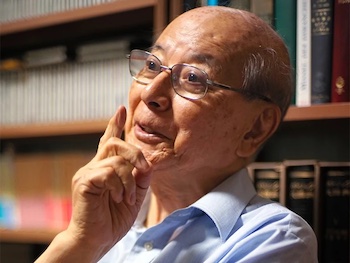
One person who did talk about it a lot was Otohiko Kaga, a psychiatrist and prison chaplain who died at the age of 93 last week. Kaga was very active as an anti-capital punishment advocate and worked to change Japanese detention methods, which he claimed violated international human rights standards. He was especially critical of the way the trial of Chizuo Matsumoto, otherwise known as Shoko Asahara, the leader of the death cult Aum Shinrikyo, was conducted, since he believed all the court proceedings were geared to guarantee a death sentence despite Matsumoto’s diminished capacity.
Coincidentally, just before Kaga died, Asahi Shimbun ran two interviews on its Koron page about Hanashi’s gaffe and its implications. One of the inteviewees was writer Keiko Horikawa, who herself interviewed Kaga many times and has written several books on Japan’s capital punishment system.
In the interview, Horikawa was asked to comment on Hanashi’s remark, and she said the first people she thought of were the prison employees whose job it is to carry out executions. They are the ones who have to face the reality of the system and thus the people who “carry the burden”—not the bureaucrats and politicians who make the decisions about who dies and when they die. Hanashi, she said, obviously never thought about those people. If he had, he would never have made such an offhanded comment. For that reason alone, he “doesn’t deserve to be a political leader.”
She went on to say that the indifference inherent in Hanashi’s remark reflected the general attitude among the public toward capital punishment. It’s something they accept without really understanding it. In surveys, the public overwhelmingly supports the death penalty for a simple reason: someone who has carried out a heinous crime must pay for that crime in kind, with their life if necessary. Those who are against the death penalty generally start from the belief that no one has the right to take another life, including the state. But as the interviewer pointed out, these two sides end up talking past each other, and nothing comes of it.
Continue reading





 philipbrasor.com