Review: Parallel Mothers/The Human Voice

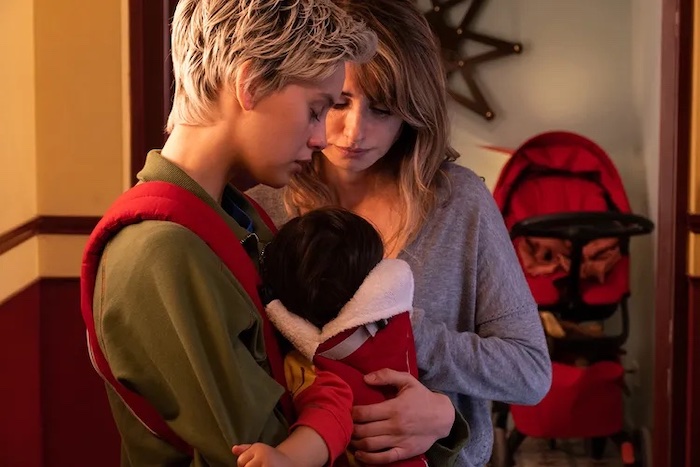
Though Pedro Almodovar is rightly lauded for his sense of style and control of visual tone, he doesn’t really get enough credit as a storyteller, probably because many of his films seem to be heavily indebted to older films by other directors. In Parallel Mothers, he weaves a melodramatic tale of two women who’ve had motherhood thrust upon them into a meditation on national memory—or, more correctly, the erasure of national memory when it comes to the Spanish Civil War, a subject that is still very sensitive in Spain. A fashion photographer named Janis (Penelope Cruz) meets a forensic anthropologist, Arturo (Israel Elejalde), through her work, and she asks him about his own work, which involves digging up bodies from unmarked burial grounds throughout Spain. Janis and her family have always wanted to exhume the remains of her grandfather, who was murdered by Franco’s troops during the civil war, but didn’t know how to go about it. Arturo offers to help her seek approval and carry out the exhumation. But before that, as fitting an Almodovar story, they sleep together.

Janis, who is the daughter and granddaughter of single mothers (she was named after Janis Joplin), doesn’t insist that Arturo take responsibility for raising the daughter she eventually bears, since he is already married. While preparing to give birth in the hospital, she befriends another expectant mother, a teenager named Ana (Milena Smit), who has her daughter the same day Janis has hers. At this point, the original story about the hidden graves is subsumed by the fraught tale of Janis and Ana’s friendship, which involves the awful story of how Ana became pregnant, Ana’s problematic relationship with her neglectful actor mother (Aitana Sanchez-Gijon), and Janis’s prickly feminism, which sometimes rubs Ana the wrong way despite the fact that Janis is twice her age. 

What’s conspicuously missing from much of the story is men. Though Arturo comes and goes throughout the film’s two-hour running time, his value to the story is utilitarian in more ways than one. As the title suggests, it’s the two women’s parallel experiences as first-time mothers that provide the dramatic impetus for a story that, per Almodovar’s m.o., isn’t surprising but nevertheless more deeply affecting than his usual tales of heartbreak. As Janis and Ana move in and out of each other’s emotional orbit, their lives change in consequential and provocative ways. But what makes the movie so moving is Almodovar’s sympathies for everyone involved. Janis is probably the most appealingly realistic character he’s ever created, and even Ana’s mother, who first comes off as a selfish careerist, is revealed to be about much more than her conservative values. So in the end, when the film comes full circle to address the tragic legacy of the Spanish Civil War, it does so with (female) characters who expand on the film’s central theme of being honest not only with oneself and others, but with history as well.
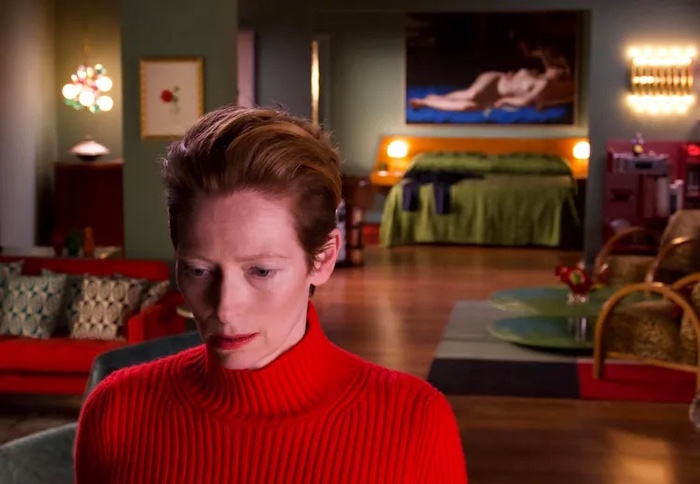
Being released simultaneously is Almodovar’s first English language film, The Human Voice, a “free” adaptation of Jean Cocteau’s play. It’s basically a one-woman-and-a-dog-show featuring Tilda Swinton as an aging model waiting in a stew of rage and despair in her apartment for her ex-lover to come and pick up their things. Filmed on a characteristically colorful sound stage set, this efficient, monologue-driven production is pretty much Swinton’s gig, as her character swings wildly between suicidal longing, violent anger, and contemplative resignation. Her telephone conversation is one-sided in that we don’t hear the lover at all, so Swinton has her work cut out for her. She makes it work, but the film’s success may also be due to its 30-minute run time. Anything longer and the viewer might end up as emotionally exhausted as Swinton’s character. 

Parallel Mothers in Spanish and The Human Voice in English (separate admission). Now playing in Tokyo at Human Trust Cinema Yurakucho (03-6259-8608), Shinjuku Cinema Qualite (03-3352-5645), Bunkamura Le Cinema Shibuya (03-3477-9264).

Parallel Mothers/The Human Voice home page in Japanese

photo (c) Remotamente Films AIE & El Deseo DASLU
Posted in Movies | Tagged , , | Leave a comment

Review: Ticket to Paradise

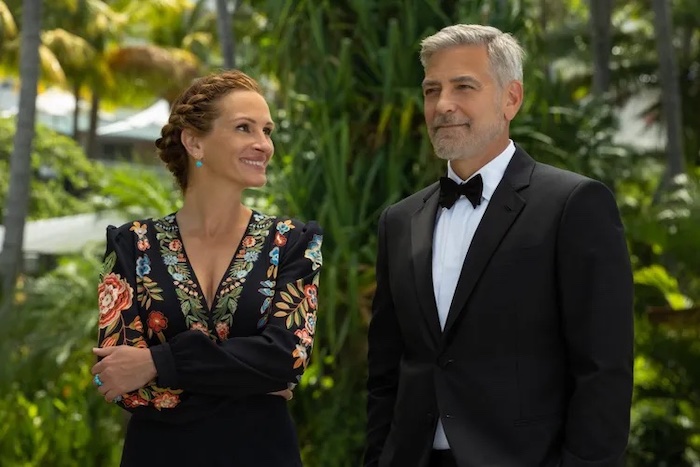
There’s a certain species of Hollywood movie that seems designed to please those who work on it more than those who will eventually watch it. I’m not talking about movies where the stars are simply guaranteed huge amounts of money, but rather projects they can get through with the minimum amount of effort, have fun in the process, and make huge amounts of money. This middling romcom’s only reason to exist is to bring George Clooney and Julia Roberts together again to laugh at each other and their situations, and viewers susceptible to that kind of come-on will likely find the experience of sitting through it painless, maybe even enjoyable. But does that really mean it has a reason to exist?

The two stars play a long-divorced couple, David and Georgia, who conspire to wreck the wedding of the only thing their brief marriage produced that still means anything, their daughter, Lily (Kaitlyn Dever), who has apparently decided to toss her law degree and impulsively wed the local seaweed farmer, Gede (Maxime Bouttier), she met on vacation in Bali following her graduation. David and Georgia, who, naturally, each have high-powered, high-paying careers, decide to bury the hatchet for the time being in order to prevent their daughter from rushing into a marriage she will later regret, just like they once did. Avid romcom fans will be predisposed to react positively to the various comic and sentimental devices used throughout the script: the carefully timed bickering interludes between the two stars, Lily and Gede’s demonstration that true love is a greater power than career ambition (thus confounding her parents’ own life choices), and the various funny bits contributed by supporting players, including Lily’s requisite best friend (Wren Butler). 

It’s not saying much that Clooney and Roberts create “chemistry” while Dever and Bouttier don’t. In fact, I would guess that this dynamic was built into the production, because the only thing that seems to be more vital to the filmmakers than making sure the two stars are happy and loving every minute of their time together on (and off) screen is presenting Bali as the perfect post-COVID travel destination. Clooney and Roberts, in addition to the big paychecks, get actual free tickets to paradise for what amounts to a working vacation.

Opens Nov. 3 in Tokyo at Toho Cinemas Nihonbashi (050-6868-5060), Toho Cinemas Hibiya (050-6868-5068), Toho Cinemas Shinjuku (050-6868-5063), Toho Cinemas Shibuya (050-6868-5002), Toho Cinemas Roppongi Hills (050-6868-5024).

Ticket to Paradise home page in Japanese

photo (c) 2022 Universal Studios

Posted in Movies | Tagged , | 2 Comments

Review: Recalled

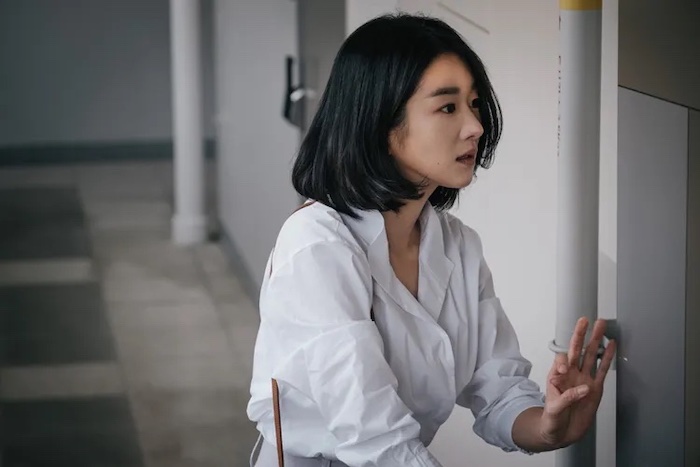
An acquaintance who is very much into Korean TV dramas thinks that every single one has to contain either an amnesiac or incest. This twisted mystery sort of has both, but even if you go into it knowing that it’s still quite surprising. A woman named Soo-jin (Seo Yea-ji) is involved in a serious accident and when she wakes up in the hospital her husband, Ji-hoon (Kim Kang-woo) is there beside her; or, at least, he says he’s her husband. She can’t remember much of anything before the accident, but in any case Ji-hoon is preternaturally devoted and over time his efforts to help her recover seem almost superhuman. However, Soo-jin keeps having hallucinations of what seem to be future events, and the viewer is led to believe that she now possesses some kind of psychic power, but what’s actually happening is even stranger.

As usual, it takes a police detective to bring certain matters to light that point to the truth behind the hallucinations, and the script is structured in such a way that these truths are revealed in layers so as to project what seemed to be future events into the past, and, of course, the first casualty of these revelations is Ji-hoon, who Soo-jin soon suspects is not really her husband. Certainly, the cleverest idea has to do with where Soo-jin actually lives, since it plays into current news stories about overpriced, undersold condominiums in Korea. But it also involves migrating to Canada, adoptive parents, patricide, and domestic violence. Director Seo Yu-min has to maintain an iron grip on the story. One slip and the whole premise, which is constructed not so much as a puzzle box but rather like a house of cards, will come tumbling down. It’s a cute trick, but considering the build-up some may find the payoff a little disappointing.

In Korean. Now playing in Tokyo at Cinemart Shinjuku (03-5369-2831).

Recalled home page in Japanese

photo (c) 2021 CJ ENM

Posted in Movies | Leave a comment

Review: Songs For Drella

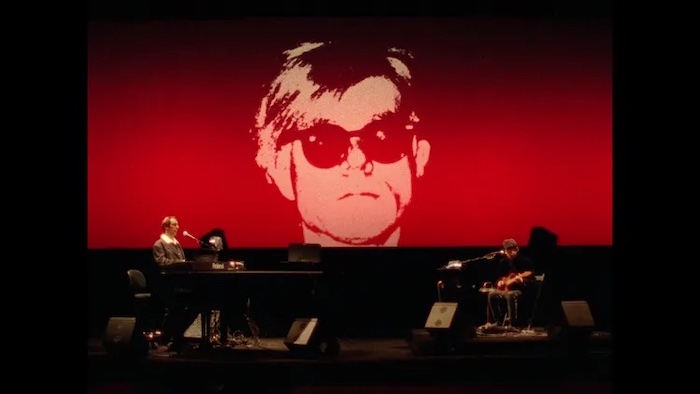
The skinny on this concert document is that it was lost shortly after it was recorded and broadcast in 1990 and then found in the director’s attic while Todd Haynes was putting together his Velvet Underground documentary. Lou Reed and John Cale, the men who created the Velvet Underground and then parted ways after the group’s second album, reconvene to honor their patron, Andy Warhol, in the wake of his death with a bunch of songs that directly address Warhol’s effect on the New York downtown scene, which launched their own respective careers as professional musicians. Though I have owned the album for almost three decades, I’ve never thought of it as being so emblematic of the two men’s art as I now think it is, having seen them perform the songs live.

Though the music is stark—Reed on guitars, Cale on keyboards and viola—it’s also more expressive than a lot of the music that each man produces on his own. It’s obvious who wrote what by who sings what, and Reed’s songs are more incisive about the kind of man Warhol was. They’re prosaic and direct. He talks about Pittsburgh and gets into personal particulars about Andy’s peccadillos, especially with regard to money and the well-documented obsession with his self-image, something Reed found off-putting. Though there’s a measure of sentimentality in his recitations, there’s also that certain species of New York bitterness, which only sounds half-kidding (about would-be Warhol assassin, Valerie Solanas: “I would have pulled the switch on her myself”). Cale’s songs are more impressionistic and ironic—riffs on the images that Reed treats clinically—but they are also more musically affecting. And, surprisingly, given the two men’s fraught relationship, Cale has the last word. 

Though production notes say that this was performed for an audience, no audience sounds can be heard, thus lending the whole affair a sad finality, as if the songs had been composed for a wake and were never meant to be played again. Director Edward Lachman keeps things simple, honoring the songs as songs rather than performances, and the back projections that illustrate some of the ideas put forth in the lyrics are redundant but not distracting. In any case, I’ll definitely be listening to the album more from now on. 

Now playing in Tokyo at Human Trust Cinema Shibuya (03-5468-5551).

Songs For Drella home page in Japanese

photo (c) 1990 Initial Film and Television/Lou Reed & John Cale

Posted in Movies | Tagged , , , | Leave a comment

Review: The Policeman’s Lineage

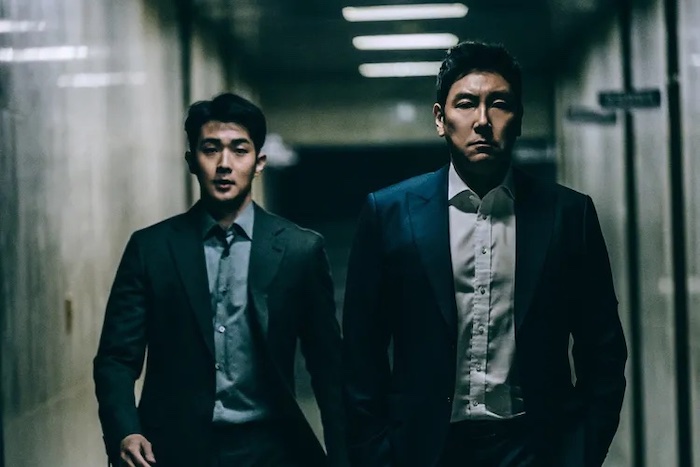
Ever since Serpico, the idea of a cop betraying colleagues who have broken the law themselves has always been catnip for filmmakers, since the whole premise is fraught with conflicting notions about the meaning of loyalty and integrity. This South Korean police procedural, adapted from a Japanese novel that took place just after World War II, opens by maintaining the so-called integrity of its protagonist, Min-jae (Choi Wooshik), a rookie who testifies against an older partner who used illegal means to capture a criminal and is quickly blackballed by other cops as a result. Just as quickly he’s summoned by Internal Affairs, who then ask him to go undercover to nail another veteran cop whom IA thinks is taking bribes from a prominent underworld figure. The setup is almost too pat—Min-jae is the son of a famous cop who died on the job, and thus has a certain reputation to maintain. At first, he isn’t interested in the assignment, until he learns that the target of the investigation may have killed another cop in the service of the underworld figure. In addition, IA says that if he successfully brings down the targeted cop, they will let him see the sealed report of the investigation into who killed his father.

What makes The Policeman’s Lineage more interesting than your average crooked cop movie is the way this particular police organization works. Basically, Kang-yoon (Cho Jin-woong), the police supervisor under suspicion, is in charge of his own team, which carries out investigations separate from other police stations and also has to raise money for expenses on their own. This arrangement sounds outlandish given how easy it would be for the members of the team to compromise their own integrity, but the historical context, involving insufficient budgets during South Korea’s pre-democracy era, makes it all the more fascinating and credible. In any case, once Min-jae has inserted himself into Kang-yoon’s team as a key member, he notices that the chief lives the high life—expensive suits, a penthouse condo, BMWs for squad cars. Moreover, Kang-yoon’s obsession is a young drug dealer from a well-to-do family whose rival seems to be Kang-yoon’s main “sponsor,” which is what IA is concerned about, but soon Min-jae also learns that IA itself may be compromised. 

It’s not revealing anything to say that Kang-yoon is under the sway of gangsters, but, as is often the case in this kind of action thriller, things are never that simple, and Min-jae’s loyalties are in a constant state of flux. Much less interesting is the action prerogatives which are doled out at such an even pace you can set your watch with each fistfight. I don’t normally come out of a cop thriller having learned something new and intriguing, so The Policeman’s Lineage at least has that to distinguish it from the rest of the lot. 

In Korean. Opens Oct. 28 in Tokyo at Shinjuku Wald 9 (03-5369-4955).

The Policeman’s Lineage home page in Japanese

photo (c) 2022 Acemaker Movieworks & Leeyang Film

Posted in Movies | Leave a comment

Media watch: Kishida will only go so far in denouncing anti-Korean hate

Sakura Uchikoshi

Whenever North Korea launches another missile in the general direction of Japan, you can bet that anti-Korean behavior among certain Japanese people will increase, especially against residents who are perceived to be North Korean sympathizers, such as students who attend North Korean-affiliated schools. The mainstream media, however, almost never mentions these incidents, so the only way you would know they happen is through marginal media, like Buzzfeed Japan, which on Oct. 18 ran a story about how a student of a North Korea-affiliated junior high school was verbally and physically attacked by a man in his 50s on the JR Saikyo Line in Tokyo in relation to a North Korean missile launch. It wasn’t the only incident of anti-Korean hate. Since September, nationwide there had been 11 cases of verbal and/or physical assault or threats against students of North Korean schools or the schools themselves reported to police. One such school in Kobe received a telephone threat saying that the school would be “destroyed” if the students and faculty didn’t leave Japan. Grafitti on walls near a North Korean school adjacent to Akabane Station in Tokyo advocated for the death of all Koreans in Japan. 

During a regular press conference a representative of the Ministry of Justice was asked about these incidents, and the representative replied that the ministry “does not tolerate discrimination” and would “study the matter” (kento suru), which, in bureaucrat-speak, usually means that nothing will be done. That’s par for the course since these sorts of incidents have been fairly common for many years and nothing has been done, despite new laws that have subsequently gone into effect condemning hate speech. The mood surrounding the matter, both in the media and among some sectors of the general public, seems to be that, while the students themselves are not responsible for North Korea’s aggressive actions, they shouldn’t expect to be let off the hook unless they verbally denounce those actions themselves, and many don’t. But these sorts of threats and acts of violence are illegal, and it is the government’s responsibility to address them as illegal acts that should be prosecuted, and the authorities don’t really treat them as if they were.

Sakura Uchikoshi, a member of the Constitutional Democratic Party of Japan, talked about anti-Korean hate during a Q&A session in the Diet on Oct. 19. She said that while she deplored North Korea’s actions, she also said that the resulting abuse of Japan-resident Koreans was “intolerable” and cited specific examples of hateful deeds and speech directed at Koreans in Japan, including the arson incident last year where a memorial to Korean residents of the Utoro district of Kyoto was set on fire. She then mentioned former prime minister Yoshihide Suga’s visit to Washington where he met with U.S. President Joe Biden and the two condemned anti-Asia hate speech and deeds in the U.S. during a joint press event. Suga even added that denouncing such behavior proved the resilience of the “democratic spirit” in America. Uchikoshi then asked Prime Minister Fumio Kishida if he would denounce these sorts of hate crimes in Japan in the same way that President Biden did in the U.S., adding that Biden also met with Asia victims of hate to show his solidarity.

Kishida replied “again” that he and the government condemned such hate speech and discrimination, and that in the event such discriminatory acts take place he would take “appropriate action based on legal evidence.” As for showing some sort of support for victims of hate, he said he would “study” the matter.

Uchikoshi, understanding what “studying the matter” really meant, pressed Kishida further, directly asking him if he intended to “meet with victims and listen to them.” Kishida answered that he “understood” that the government has to “hear [the victims’] opinion,” but that setting up such a meeting is difficult given “my position as prime minister.” In other words, the most important consideration regarding support for these particular victims is how it would make him look, the implication being that he thinks it would make him look bad. 

Posted in Media | Tagged | Leave a comment

Media watch: Revision of 300-day law isn’t all it’s cracked up to be

As we’ve said here many times before, one of the main purposes of Japan’s family register system (koseki) is to determine paternity for the sake of bureaucratic convenience, which means that it is the authorities who have the last word on who the father of a child is. Over the years this function has caused grief to some families whose circumstances veer from the norm. The most infamous component of this system is the Civil Code statute that states if a child is born to a woman within 300 days after her divorce is finalized, the child’s father is automatically deemed by the government to be the woman’s previous husband, regardless of whether she has remarried or, if she has, any claim of paternity the new husband may want to make. The idea behind this odd rule is simple and almost cynical: Since the authorities can’t prove beyond a reasonable doubt that the child is not the issue of the previous husband, given that it is entirely possible that the couple could have had sex on the eve of their divorce, it’s easier to just assume he is rather than fret over other possibilities. Such arbitrary attention to detail would not be necessary if the family register weren’t so focused on a head-of-household, but that, to the authorities, at least, is the beauty of the family register since it defines a family the way the authorities want it to be defined. 

The problem, of course, is that marriages and families don’t always align with this model, and many women who find themselves giving birth during this 300-day connubial lacuna refuse to register the child because they don’t want their ex to be designated as the father, for various reasons. The Ministry of Justice says that there are 793 people in Japan who do not have family registers (the number sounds quite low to us, but for the sake of this blog post we’ll take their word for it), and 70 percent don’t have them because of this 300-day rule. In Japan, it is difficult to live without a koseki, because you need one to apply for social services and a passport, and many employers require them as well. So while 793 is not a particularly big number, the rule has always proved to be an obstacle, and an unnecessary one because of its aformentioned arbitrary character.

Continue reading
Posted in Media | Tagged , | Leave a comment

Review: Creation Stories

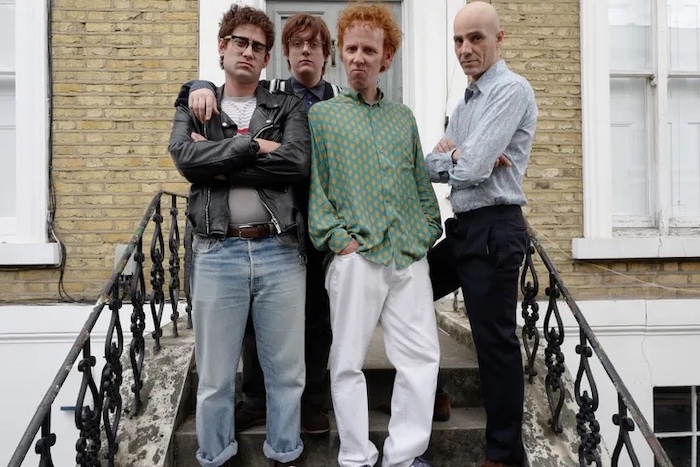
I’m too lazy to check, but I’m pretty sure there’s already been at least one documentary made about Creation Records, the incongruously successful indie label that catapulted some of the biggest British acts of the 80s and 90s to world fame. Creation Stories is more of a comic biopic of founder Alan McGee, though it’s structured as a doc in that it tries to stuff everything of consequence regarding the history of Creation into its frantic 100 minutes. I admit that I learned some interesting things, mainly about how My Bloody Valentine essentially destroyed the label financially before Oasis gave it a second wind, but generally the live-fast-and-die credo that underpins most rock music stories is milked for more than it’s worth, and by the time McGee is a walking, talking cliche of show biz excess, holding court beside a Beverly Hills swimming pool, of all places, you’re tired of the whole thing. 

Part of the problem is that the filmmakers, which include Irvine Welsh as script contributor and Danny Boyle as producer, cruise on their love of this era and thus neglect to find anything in McGee’s tale that’s distinctive for those of us who didn’t grow up in it. It’s the classic story of a poor lad who’s obsessed with music but harbors no innate creative talent of his own (though he did front a semi-successful band for a time), channeling his energy into the promotion of people he instinctively recognizes as great. In McGee’s case his impulses were more correct than those of others of his ilk. As played by two actors (Leo Flanagan, Ewen Bremner), McGee is all manic idiosyncrasy and no discernible personality, so when the drugs and booze quickly take over the viewer isn’t sure what’s actually fueling his success. It all seems so accidental, and when the initial triumph managing the Television Personalities leads to the revolutionary discovery of the Jesus and Mary Chain, you don’t get any sense of McGee using his wits to make the cognitive leap. The movie makes it seem as if he was just in the right place at the right time, which could have made for something funny and ironic, but it’s mostly just confusing.

By the time McGee discovers Oasis (played by bad actors) in the basement of a club during a talent showcase, the trite attempts to cultivate nostalgia have curdled over into cynical boredom. Even the end game, where the label’s disastrous financial follies finally defeat McGee, who then marshals his marketing proclivities in the service of politics, lacks the dramatic intrigue that should bring the story full circle. I have no doubt much of this is true, but it all plays as farce, and not very funny farce at that. 

Now playing in Tokyo at Shinjuku Cinema Qualite (03-3352-5645), Shibuya Cine Quinto (03-3477-5905).

Creation Stories home page in Japanese

photo (c) 2020 Creation Stories Ltd.

Posted in Movies | Tagged , | Leave a comment

Busan International Film Festival 2022: Other movies

In my daily reports on this blog I reviewed movies I had seen in screenings at the festival, but I also saw other films online and in the Video Library. Here are observations of those movies. Festival section names in parentheses. 

A Wing and a Prayer (Jiseok): This is the first feature I’ve seen by former Hong Sang-soo assistant Lee Kwang-kuk, and while it follows the general Hong template of seemingly aimless conversations that only add up in hindsight, it also has more of a conventional structure. Two female BFFs in their 20s make an impromptu night bus trip to the coastal town of Donghae to watch the sun rise over the sea, only to fall asleep on the beach and miss it. Predictably, the pair bicker and go their separate ways, each making a new friend in the process. Lee trusts his instincts insofar as the resulting action doesn’t go where you might expect it to go, but although I liked the characters and found everything plausible, it didn’t offer enough dramatic substance to make a deep impression, except, that is, for one scene of bullying that really got my blood pressure up. Contrast, or just that Lee really know how to depict cruelty?

Universe Department Store (Wide Angle: Documentary Showcase): Not so much a documentary as a personal exploration of memory, Wong Tae-woong’s expressionistic film was sparked by the news that a teahouse he’d once frequented had closed because the department store that contained it was being demolished for a redevelopment project. The news revived memories of the Universe Department Story, which stood on the same spot for only three years in the 1980s before the department store with the teahouse was built, but Wong’s recollection of the store (he was in elementary school) are fuzzy to the point where he wondered if it even existed. Soliciting others with memories of the place he finds that most of what he remembered was true, but everyone favors different details—for instance, the “space ship ride” that stood in front of the building seemed to have different functions for different witnesses. Wong also patronizes a hypnotist to better plumb his own brain reserves. In the end, what emerges is a capsule summary of the Korean middle class of that era, but the mystery of the place remains a mystery, if for no other reason than that it’s difficult to believe that there are no records about the store, but Wong does a good job of describing his own feelings about it.

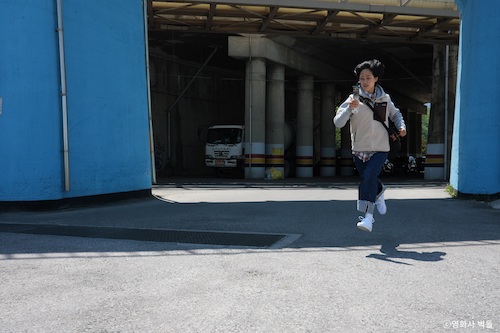
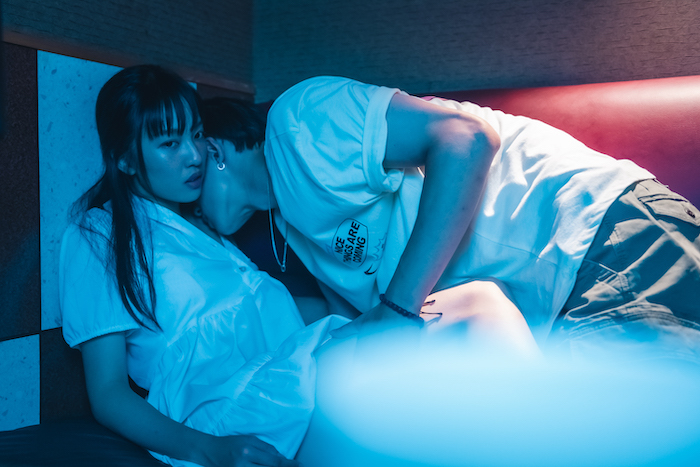
Little Blue (A Window on Asian Cinema): This Taiwanese movie is yet another look at how social media has affected—or, in this case, twisted—young people who seem to have no other outlet for self-expression. Director Lee Yifang conveys it completely through a teenage girl’s awkward and desperate sexual awakening, a risky move that only partially pays off. Xiao Lan is introduced as a model student with a streak of cynicism, especially with regard to friends and acquaintances who are already sexually active. Part of the reason for her attitude is her single mother, a realtor who readily sleeps around, even with clients, though it isn’t apparent in the beginning how much Xiao Lan knows about this. When a popular, somewhat disreputable boy in her class hits on her she eventually gives in and, of course, falls in love, which is not something he’s willing to reciprocate, and as a result she goes off the deep end by sleeping with everyone who swipes her on Tinder (or whatever the dating app they use in Taiwan). Lee depends way too much on coincidence and plot short cuts to make a case. The movie is well made but it seems to describe a situation that could only happen on screen. 

Continue reading
Posted in Uncategorized | Leave a comment

Review: Spencer

Just as he did with his 2017 portrait of Jackie Onassis, director Pablo Larrain fixes his gaze on another famous female partner of an important man, Diana Spencer (Kristen Stewart), during a specific period of his subject’s life. In Onassis’s case, it was the period of mourning following the assassination of her husband, John F. Kennedy, a situation that posited the first lady as the most famous widow in the history of the Western world. Larrain’s point—that Jackie used this opportunity to not only advance the idea that JFK was one of the greatest leaders of all time despite his short time in office, but also to sell her own brand—seemed painfully reductive for a full-length feature whose main characteristic was its period-detail production design (not to mention star Natalie Portman’s bizarre mid-Atlantic accent). 

Spencer is similarly reductive in that the period depicted—Christmas 1992, shortly before the announcement that Princess Diana would separate from Prince Charles (Jack Farthing)—was chosen to highlight Diana’s struggles with mental illness, an aspect of this already over-studied history that was mostly absent from Ed Perkins’ recent documentary, The Princess. But that doesn’t necessarily mean the two movies complement each other. Perkins was concerned with the media’s obsession with Diana, while Larrain takes such obsession with famous women for granted and, again, tries to analyze his subject’s temperament through a study of her behavior, which he often fabricates in ways that seem beholden to that obsessive coverage. It’s not so much that he projects a revisionist biography, but rather than he highlights one aspect of the conventional narrative to the point of distortion. Right from the start we know there’s a serious problem when Diana, driving her own car, gets lost on her way to the estate where the royals will be celebrating the holidays, despite the fact that it’s where she grew up. After she arrives, she is mostly left to her own devices, since Charles had yet to show up and everybody else has already cultivated a dismissive attitude toward the troubled princess. 

Larrain conjures up what very well may be the nastiest Christmas anyone has ever had to suffer through, and Diana’s own abject fear of having any contact with her in-laws and their minions—including Timothy Spall in a diverting turn as the factotum in charge of keeping the press at bay—is treated like something out of Dario Argento. The only person she halfway trusts is her maid, Maggie (Sally Hawkins), whose idiosyncrasies are all bound up in her loyalty to the one person in the household who, it’s implied, doesn’t deserve to be there. Though Diana’s demise is five years away, the viewer can see doom at every turn from one hallway to another in this massive manor house. Larrain’s stylistic choices almost overwhelm Diana’s story. It’s as if the whole idea of this monarchy was dictated by the Devil. Had Roman Polanski directed the screenplay it couldn’t have been more oppressive. 

Now playing in Tokyo at Toho Cinemas Nihonbashi (050-6868-5060), Toho Cinemas Hibiya (050-6868-5068), Toho Cinemas Shinjuku (050-6868-5063), Bunkamura Le Cinema Shibuya (03-3477-9264), Toho Cinemas Roppongi Hills (050-6868-5024).

Spencer home page in Japanese

photo (c) 2021 Komplizen Spencer GmbH & Spencer Productions Limited

Posted in Movies | Tagged , | Leave a comment