Review: A Serbian Film

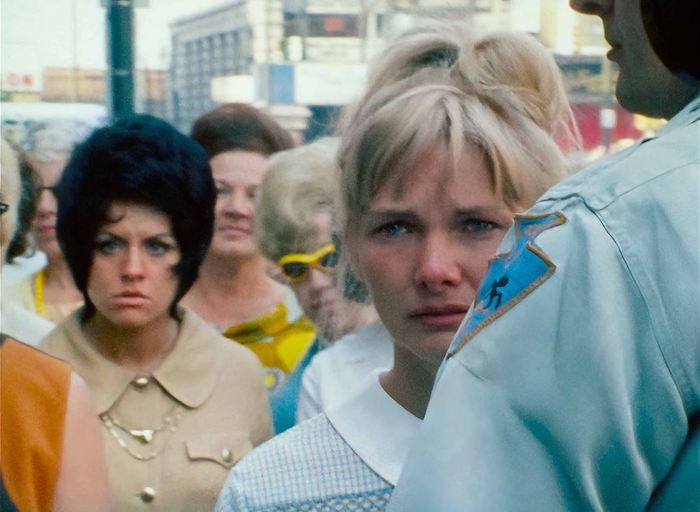
Originally released in 2010, Srdan Spasojevic’s purposely repulsive meditation on his country’s spiritual rot is being rereleased in Japan in a sparkling renovated 4K version that seems hardly necessary given what the viewer has to watch, and yet much of A Serbian Film‘s transgressive energy relies on the way its visual tone changes from one medium to another, since much of what takes place on screen is something recreated either on old tape, new tape, or within the mind of the protagonist, a semi-retired porn star named Milos (Srdan Todorovic). Moreover, the parts of the film that are supposed to be taking place in the cinematic “present” are carefully lit for maximum effect so as to throw the viewer off the scent of where the story is going.

That story starts out simply enough. Retirement for Milos, considered the greatest porn actor of his generation, at least in Serbia, isn’t quite as relaxed as he had hoped. He finds it difficult to support his wife, Marija (Jelena Gavrilovic), a freelance translator, and young son, and when an offer comes through an old associate to do one last film with a shadowy but hilariously pretentious director named Vukmir (Sergei Trifunovic) for a lot of money, he reluctantly takes it, even though he doesn’t really know what the movie will entail except that, as Vukmir explains, it will be a work of art like nothing ever produced in Serbia, which he describes as being “one big shitty kindergarten.” But once production of the movie starts in earnest, A Serbian Film abandons its linear development for a more patchwork structure that seems to be dictated by Milos’s drug-addled consciousness, or lack thereof. The film is being shot in an institution for orphans and abused children, who end up figuring heavily in many scenes, and not just as witnesses to the violent debauchery that Vukmir stages and Milos, pumped up with cattle aphrodisiac, partakes in with little of the professional nuance he brought to his more conventional work. In fact, he sometimes wakes up bloody and doesn’t remember what he did, and thus has to clandestinely secure the tapes and watch the horrors on a camcorder screen. 

What most viewers take away from A Serbian Film is Spasojevic’s willingness to push every taboo way past its acceptable limit, which is to say that while it gets really disgusting you never entertain the notion that these scenes are anything more than ingeniously staged slices of horror, and thus lack the truly disturbing element that Gaspar Noe brings to his own peculiar brand of transgressive cinema. But while the movie doesn’t impress as much as Spasojevic—who, I suspect, used himself as Vukmir’s scummy model—likely thinks it does, its jaundiced portrayal of a larger society through a very circumscribed subculture is convincing. I imagine Serbians don’t appreciate Spasojevic’s title, which implies the film is some sort of last word, but even if I don’t have firsthand experience with his country, I understood exactly what he was trying to say. (Note: The press screener I saw was the uncut version, which is banned in most countries. The new Japanese version for public consumption may be altered somewhat, but no scenes will be taken out.)

In Serbian. Now playing in Tokyo at Cinemart Shinjuku (03-5369-2831), Human Trust Cinema Shibuya (03-5468-5551.

A Serbian Film home page in Japanese

photo (c) 2010 Contrafilm 201
Posted in Movies | Leave a comment

Review: Be Natural: The Untold Story of Alice Guy-Blache

Because of its function as a recording medium, cinema’s entire history is fairly well represented. Pamela B. Green’s documentary purports to bring to the public’s attention a woman filmmaker whose pioneering accomplishments, because she was a woman, have mostly been ignored, though if you run a cursory Google search you’ll find lots of information about Alice Guy-Blache, including extensive collections of her works available for sale and streaming. This isn’t to say that Guy-Blache has received her due at the same level as her male contemporaries and heirs, but only that if her story is approached from the standpoint of the development of cinema, she’s already, relatively speaking, something of a star. Even Hitchcock was a fan.

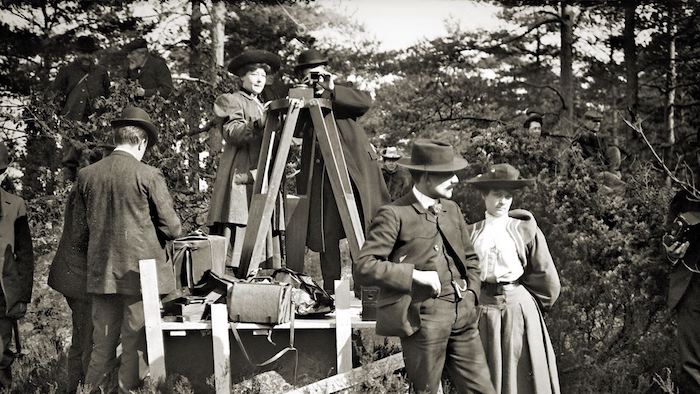
Her tale is certainly fascinating. Born in France to Chilean parents, Alice Guy was hired as a secretary in 1894 for a camera company that was eventually bought out by four men, including the early entrepreneur Leon Gaumont, who started using the company to produce films. Guy worked her way up to the production side of the business and, frustrated by the company’s fixation on film as a novelty, she became one of the first visionaries to see it as a story-telling medium. She started directing films, but Gaumont neglected to give her proper credit for her contributions, even after she ascended to head of production after the turn of the century. She eventually moved with her husband, Herbert Blache, to the U.S. to head Gaumont’s American operations, but in 1910 they struck out on their own and set up Solax Studio, first in Flushing, New York, and then in Fort Lee, New Jersey, which, thanks to her efforts, became the center of film production in America, well before the emergence of Hollywood. Her success as both an artist and a businessperson was notable, though her husband took much of the credit for her work. By the time she divorced him and the studio became insolvent in the 1920s, she had made about 1,000 movies and in the process invented many of the narrative film techniques that we now take for granted.

Much of Green’s film is narrated by Jodie Foster, whose command of French, especially while reading the epistolary materials, gives the doc a gravity it might not otherwise have. Green manages to talk to almost every scholar who has a stake in Guy-Blache’s legacy, but she also talks to well-known actors and filmmakers whose input mostly comes down to, “Wow, I never knew about this woman!” She also frames the development of the second half of the film around her detective work in tracking down relatives of Guy-Blache who may still have relevant artifacts hidden in boxes in the attic. None of this is boring, but it tends to reduce Guy-Blache’s story to a mystery that, in fact, was solved years ago, even if Green’s own sleuthing uncovered several film fragments that were thought to be lost. Of course, any movie nut who knows nothing about Guy-Blache will definitely want to check out Be Natural, but it sometimes feels a bit cluttered, like one of those attics. 

In English and French. Opens July 22 in Tokyo at Uplink Kichijoji (0422-66-5042)

Be Natural home page in Japanese

photo (c) 2018 Be Natural LLC

Posted in Movies | Leave a comment

Media watch: Politicians’ association with the Unification Church shouldn’t be surprising

Shinzo Abe offering a pre-recorded message for an event affiliated with the Unification Church

A week or so before the recent Upper House election, my partner, M, received a call from a neighbor who asked her to vote for the ruling Liberal Democratic Party. M said she had already voted by pre-election ballot for another party. Then the neighbor invited her to a seminar about “making your family stronger.” M expressed little interest, though the neighbor kept explaining the benefits of the seminar and other details. M repeated she wasn’t interested, but afterwards she did some research based on what the neighbor had revealed about where the seminar was taking place and realized that it was being held by the Family Federation for World Peace and Unification, which is more commonly known as the Unification Church. 

At this point there seems little we don’t know about the grudge that Tetsuya Yamagami, the man arrested for killing former prime minister Shinzo Abe during a campaign stop in Nara on July 8, held for many years against the Unification Church. Though some people still describe Abe as a martyr, the murder appears to have been motivated by purely personal enmity rather than anything political or ideological. Yamagami said the church had cheated his mother out of ¥100 million in the past, thus bankrupting his family, and Abe was one of the most prominent Japanese figures he associated with the church, though the former prime minister was not a member himself. Apparently, Yamagami didn’t always have Abe in his sights, though he’d been planning to do something against the church for a while. The Upper House election campaign made Abe more accessible and Yamagami took his shot—literally. At first, the media was more interested in how Yamagami built his primitive shotgun, since it’s almost impossible to own a firearm in Japan, but eventually they grew tired of the topic and concentrated instead on the church angle, which has turned out to be a bottomless source of tabloidy gossip and intelligence.

Continue reading
Posted in Media | Leave a comment

Rage Against the Machine, July 2000, Makuhari Messe, Chiba, Japan

Rage Against the Machine is now in the midst of their long-delayed comeback tour in the U.S., so I’m taking the opportunity to post a review I wrote for the Japan Times in 2000 of one of their shows. For reference, I had seen them a year previously when they headlined at Fuji Rock. That performance remains the best I’ve ever seen in the 20+ years I’ve attended the festival.

Continue reading
Posted in Music | Tagged , , | Leave a comment

Review: Boiling Point

For those of us who never go out to indulge in haute cuisine, the desperation that director Philip Barantini brings to this study of a particularly bad night-in-the-life of a restaurant owner-chef isn’t going to make as much of an impression as he might expect, but we can definitely appreciate that the protagonist is, despite his culinary talents, in way over his head as a businessman, and that’s what keeps the movie intriguing rather than its technical virtuosity (supposedly all done in one take) and relentless pace. Andy Jones (Stephen Graham) is an excellent chef who started out at the bottom and doggedly worked his way up. He has a keen understanding of how you get people in a kitchen to do what you want because he was once in their place. But he is heavily in debt to the backers of his relatively new restaurant, a situation that, apparently, has destroyed his marriage and his peace of mind. As we first encounter Andy, hustling through the streets of London on his way to work, he is trying to communicate with his ex-wife over his cell phone about a problem involving his young son that needs attention immediately, but since he’s late and it’s the Friday night before Christmas, the work takes priority.

What follows is a whirlwind of circumstance and crossed signals, as Andy supervises a full staff of people who trust him as one of theirs but who also know what the food service business requires of you. Consequently, every small problem snowballs into a catastrophe, especially when passing through the interface between the kitchen and the dining area. The latter realm is populated by a careful selection of the types that give “dining out” a bad name: smarmy self-important critics, influencers who overestimate their actual influence, and persons with money who think of service as being absolute and unconditional. The maitre’d is thus more than the face of the establishment. He’s the negotiator-in-chief, and while Barantini places too much of a dramatic burden on the wait staff in their dealings with a fickle clientele, he successfully shows how their frustrations are transferred to the kitchen, where Andy has to translate specific orders into meals. And while a chef is really more of an organizer than an artist, Andy is so put upon by the demands of both customers and employees that you can see him fail in real time.

Boiling Point is not a movie for anyone with acute anxiety issues, even if some of its most important plot points—a food allergy screwup turns into a disaster of Biblical proportions—feel contrived. But both Barantini and Graham generate an atmosphere where the personal and the professional are inextricably linked in a visceral way. This really is Andy’s life, and while some of us who think of food as sustenance first wouldn’t normally take the monumental struggles depicted here that seriously, there are real people of lesser means who depend on this kind of business to maintain their existence, and Barantini gives them his full attention. The fact that the production is all too-much-too-fast is probably the point: This is what front-line workers have to put up with, so you should abide.

Opens July 15 in Tokyo at Human Trust Cinema Yurakucho (03-6259-8608), Shinjuku Musashinokan (03-3354-5670).

Boiling Point home page in Japanese

photo (c) MMXX Ascendant Films Limited

Posted in Movies | Tagged | Leave a comment

Review: Wanda

American actress Barbara Loden’s directoral feature debut was released in 1970 to a handful of theaters and disappeared quickly, but over the years it has retained an odd notoriety for its frank depiction of a poor woman’s lot in middle America. There’s absolutely nothing sentimental about this depiction, but Wanda also doesn’t qualify as what we now conveniently categorize as docudrama. It’s a solidly conventional social drama, with an easy-to-follow line of development that accrues a certain measure of neo-realist cred along the way. Some have compared it to what Cassavetes was creating at the time, but Loden avoids those touches that telegrammed Cassavetes intentions as an artist. Loden has a story to tell, and she doesn’t want anything to get in the way.

The titular character is first seen sleeping on the couch in her married sister’s ramshackle house in Pennsylvania’s coal country. In fact, there are side loaders transferring coal right outside the window. Wanda (Loden) is obviously not welcome here, as evidenced by her brother-in-law’s angry, quick departure for work. A subsequent scene in a courtroom, where Wanda’s soon-to-be-divorced husband is asking for full custody of their two young children, shows just how unmoored she is. She puts up no fight, saying the kids “would be better off with him,” and leaves the courtroom in a fog of depression. She then shows up at a textile factory where she used to work, demanding back pay and asking for her former job. The back pay is mostly consumed by taxes and the foreman refuses to hire her again, saying she’s “too slow.” Wanda is, for all intents and purposes, not just rudderless but homeless.

Though not technically a prostitute, Wanda gets by the only way she knows how. She goes to familiar bars and hangs around until she’s picked up by some philandering bald guy in a seedy suit and goes to bed with him. The guy invariably leaves before she wakes up. Though the situation smacks of cliche, Loden invests these scenes with a melancholic tone that points up the desperation of everyone involved, as well as the listless atmosphere of the entire milieu in which they take place. More significantly for someone watching this film today, the sexual transactions are purely materialistic. As a woman from a semi-rural region in 1970, Wanda does not necessarily possess the wherewithal to react to her exploitation at the hands of men—Loden herself grew up in Appalachia—but she surely recognizes her position and can’t help but resent it. It’s there in her voice when she tries to make her one-night stands feel more comfortable, and even more pronounced the next morning in her defeated demeanor. 

Eventually, one hookup changes the stakes. Stopping into a bar after it’s closed to use the toilet, Wanda stumbles upon a robbery, and the thief, whom she calls Mr. Dennis (Michael Higgins, appropriately stiff in his own seedy suit, masking spectacles, and sad mustache), takes her on as his accomplice after spending the night together. Though the movie’s storyline begins to take on the trappings of a lover-outlaws on the lam tale, Loden concentrates on the relationship rather than the bank heist Mr. Dennis is planning. He brings her to Korvettes to buy a dress because it won’t do for her to wear slacks, a ruefully sexist touch that’s couched as a professional practicality, since she’s going to act as a diversion when he takes a bank officer’s family hostage. But the thriller aspects are lacking in thrills, perhaps intentionally, and Loden didn’t sufficiently think through the plausability of Mr. Dennis’s scheme. However, for a short stretch Wanda seems to have purpose, even if it’s at the service of a deluded criminal. 

What’s appealing about Wanda is that while it looks squarely at a woman who can no longer play by the rules of civil society, it isn’t a depressing slog. There’s a liveliness to the direction that’s not only stimulating, but unique. Loden, who, for what it’s worth, was married for a while to Elia Kazan, died about 10 years later in her late 40s and never made another feature, which is a shame. Even Cassavetes could have learned a thing or two. 

Now playing in Tokyo at Theater Image Forum Aoyama (03-5766-0114).

Wanda home page in Japanese

photo (c) 1970 Foundation for Filmmakers

Posted in Movies | Tagged | Leave a comment

Review: The Alpinist/The Summit of the Gods

The Alpinist

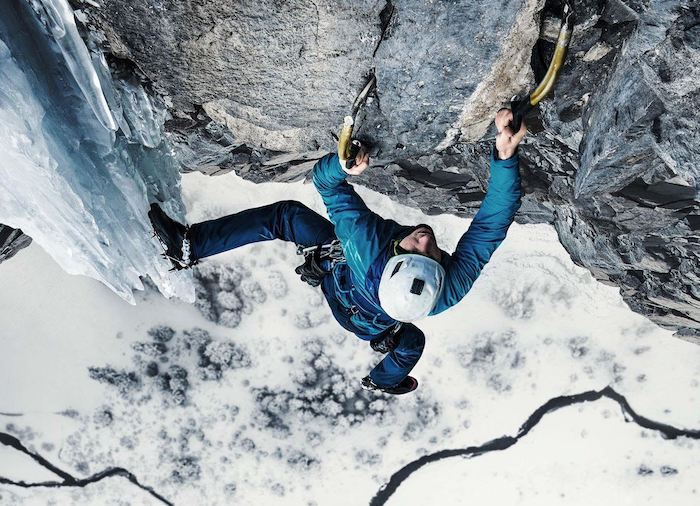
The appeal of mountain climbing, even to those who have absolutely no interest in partaking themselves, is special. The old colloquy of why one would want to scale a peak and then the intended interlocutor coming back with “because it’s there” both accentuates and disregards the mystery behind the climber’s obsession. In recent years there has been a sudden surfeit of climbing movies, both fiction features and documentaries, and the reason they’ve become so ubiquitous is twofold: climbers themselves have become skilled at the art of filmmaking; and drones. This combination definitely comes into its own with The Alpinist. The directors, Peter Mortimer and Nick Rosen, are both seasoned alpinists and they take as their subject a figure that, until the pair decided to make a movie about him, would have likely remained just another legend within a cognoscenti delineated by a fixation on a rare and infamously dangerous sport. Canadian Marc-Andre Leclerc was considered the best of the best, and not just because his rock and ice climbing skills were next to superhuman. Like all great artists he shunned anything that fell outside his specific art. When he climbed, he climbed solo and didn’t tell anyone about it, so his greatest feats were known only to him. Nevertheless, he did have friends, invariably part of the climbing community, and word got out. Mortimer and Rosen finally approached him about making a movie when he was barely into his 20s and he agreed as long as they didn’t get in his way. The Alpinist is suitably, fascinatingly wonky, because the directors are pleasing themselves first, but this attention to detail is what makes The Alpinist superior to the Oscar-winning documentary Free Solo, which was also directed by a pair of climbers, and is intrinsically linked to Leclerc’s m.o. of being tight-lipped and unflappable, whereas the subject of Free Solo, climber Alex Honnold, was more of a raconteur-philosopher, and thus a less naturally charismatic focus for a movie about an athlete, which should be about the doing, not the explaining.

What Mortimer (who also narrates) and Rosen provide in addition to the thrills and awe-inspiring visuals expected of mountaineering movies is a portrait of a loner that transcends the usual cliches about loners. Leclerc, who reportedly had ADHD, left high school at a young age simply to pursue mountain climbing and fell into the drug and alcohol scene that tends to materialize around people who live on the edge. The directors never let you forget that half of leading solo climbers die while pursuing their dream, but that Leclerc’s almost bizarre sense of self-containment while climbing (“filming him was terrifying, but he always seemed so relaxed”) was what made the production so irresistible. It also makes for drama that’s almost inexplicable. Leclerc was the son of working class parents who spent most of his youth just walking through the forests of British Columbia. That he eventually fell in love and spent time with a permanent girlfriend, also a climber, is seen as something of an anomaly since he wasn’t just a loner by temperament. He was preternaturally unconnected. The purpose of The Alpinist is to film him doing something he didn’t care about anyone else knowing—a climb up an impossible rock or ice face that Honnold would have likely trumpeted to the media because he needed the exposure for fund-raising. One of the uninvestigated mysteries of The Alpinist was how Leclerc supported himself. He was, in essence, a bum who lived day-to-day in order to climb. In one of the most poignant scenes, after a successful, treacherous climb in South America, he has to negotiate with a cab driver—in fluent Spanish—to get him to the airport because he’s broke. 

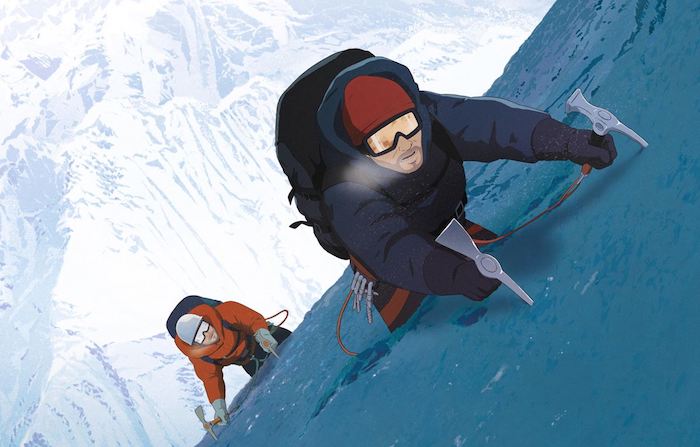
Patrick Imbert’s The Summit of the Gods is a more conventional mountain climbing movie since it’s based on a work of fiction written almost 30 years ago, the award-winning manga by Jiro Taniguchi and Baku Yumemakura. Imbert, a French animator, adapted the manga as a French-language ode to classic anime, but local distributors have wisely redubbed it with Japanese dialogue, since all the characters are Japanese. The basic plot is a detective story. After covering an unsuccessful climb of Mt. Everest by a Japanese mountaineering club in the 1980s, photographer Makoto Fukamachi is approached by a local in a Katmandu bar offering to sell him the small camera that was supposedly lost by British climber George Mallory in 1924. Mallory didn’t make it back and his body not found until 1999, well before the action of Summit, so it was never clear if he actually made it to the peak. Fukamachi brushes off the local and then, outside the bar in an alley, he sees the local being shaken down by a man with a missing finger. Later, he suspects that the man was Joji Habu, who, like Leclerc, was a legend within local mountaineering circles for his daring solo climbs, but after he takes on an apprentice who dies during an ascent, Habu disappeared. 

The Summit of the Gods

Unfortunately, the movie never really gets back on track with the Mallory mystery and wastes a lot of narrative time speculating about what happened to the British climber. Mostly, it follows Fukamachi’s pursuit of Habu, who in the meantime has been laying low in Nepal attempting his own solo ascent of the world’s highest mountain and, again like Leclerc, is not interested in anybody knowing about it. Fame isn’t in it. It’s all about the doing, and in that regard the platitudes come fast and thick and bog down the story, but Imbert’s animation is as stunning as the footage that Mortimer and Rosen achieved in The Alpinist, and because he can more readily manipulate these images, Imbert works them for maximum dramatic effect. Though I’m not a big fan of anime, what Imbert accomplishes here is stunning. To lay persons like me, the idea of climbing a mountain under the conditions depicted in The Alpinist and The Summit of the Gods is akin to fantasy of the most extraordinary type, and Imbert captures that quality perfectly.

The Alpinist is now playing in Tokyo at Toho Cinemas Chanter Hibiya (050-6868-5001), Cinemart Shinjuku (03-5369-2831), Shibuya Cine Quinto (03-3477-5905).

The Alpinist home page in Japanese

The Alpinist photo (c) 2021 Red Bull Media House

The Summit of the Gods in Japanese now playing in Tokyo at Human Trust Cinema Yurakucho (03-6259-8608), Shinjuku Piccadilly (050-6861-3011), Shibuya Cine Quinto (03-3477-5905).

The Summit of the Gods home page in Japanese

The Summit of the Gods photo (c) Le Some des Dieux – 2021/Julianne Films/Folivari/Melusine Productions/France 3 Cinema/Aura Cinema

Posted in Movies | Leave a comment

Media watch: Former idol candidates face the music

Akiko Ikuina

It’s common for show biz celebrities to run for public office in many countries, and in Japan they usually run under the ruling Liberal Democratic Party banner, for whatever reason. In this weekend’s Upper House race there are two candidates aiming for seats with the LDP who were idol singers in their youth—38-year-old Eriko Imai, who is set to retain her proportional seat and who used to belong to the female idol group Speed, and 54-year-old Akiko Ikuina, a first-timer gunning for a Tokyo constituency seat who long ago belonged to the first Japanese female idol collective Onyanko Club. 

On July 6, tabloid Nikkan Gendai reported that four music industry associations—the Japan Association of Music Enterprises, the Federation of Music Producers Japan,  the Japan Concert Promoters Association, and the Music Publishers Association of Japan—were throwing their combined weight behind the two candidates, pledging to “organize gatherings” to show their support. According to Gendai, representatives of the four groups visited LDP headquarters on June 30 to talk about their support. The chairman of JAME released a statement saying that Japan’s entertainment sector needs to gain more “political power,” and hopes that Imai and Ikuina can act as “conduits” between the music business and Nagatacho.

The news caused an immediate uproar among other music-related people in Japan, who said that the four associations do not represent their views. On July 2 the hashtag website #SaveOurSpace, which was originally organized to help concert halls and clubs survive during the COVID pandemic, released a letter of protest stating that “many kinds of people work in the music industry who hold differing viewpoints” and that these people are free to endorse whomever they wish. The fact that these four music industry associations, which are “very influential” in the music business, have banded together to publicly support two candidates without receiving consent from musicians and other music-related workers is “exceptional,” and they are demanding answers. As of July 4, more than 2,000 music-related people had affixed their names to the letter. Gendai noted that on July 2, even Keiichi Suzuki, the 70-year-old leader of the veteran group the Moonlighters tweeted that he in no way supported the four associations’ actions, adding that Suzuki had never talked about politics in the past. His tweet received 37,000 likes.

One music critic told Gendai that no one in the music business had any idea this was going to happen, and that the announcement caught everybody by surprise. It was beyond the pale that these associations didn’t survey members to find out what they thought of the endorsement. They just went ahead and made the decision on their own. Gendai sent an email to JAME asking for an explanation but had received no response by the time the article went to press. 

For what it’s worth Ikuina belongs to Ogi Productions while Imai is represented by Rising Productions, both heavyweight talent management production companies in JAME.

Posted in Media | Leave a comment

Review: X

The idea of blending porn and slasher pic has surely been thought of before, but as far as I know it hadn’t been realized as a feature film, and director Ti West deserves credit for thinking through the concept with more care than others might have. First of all, he sets it in the late 70s, when porn had finally reached commercial viability and slasher films were coming into their own in a big way. He’s also quite technical about the making of the film within the film, a quickie stroker called The Farmer’s Daughter, showing how these things are actually put together, and grounds the various characters motivations in behavior that feels of and about its time. The producer, Wayne (Martin Henderson), knows his small crew well, but West makes sure his sexism shows through, even if he thinks he’s not a sexist. His girlfriend and business partner, Maxine (Mia Goth), seems to have more together as a filmmaker than he does, but, of course, she’s relegated to lesser billing both in the credits and on the set. The cameraman, RJ (Own Campbell), pretends toward being an artist, while his girlfriend, Lorraine (Jenna Ortega), who is also the sound engineer, is the only person on hand who seems to have a clear head about things in general, and at one point she asks to appear in the film performing sex, mainly to bug RJ, who clearly isn’t into it. 

The setting is the key. Wayne finds an old boarding house attached to a farm on a backroad in Texas where he plans to make the movie. The couple who own the farm are old and know nothing about the purpose of the crew’s visit, and while they’re a strange pair they don’t seem that interested in finding out at first. But when the wife, Pearl (also Goth, heavily made up), who is clearly not well, stumbles on the set and sees the actors getting it on something is triggered in her—at one point she starts moaning about how her husband can’t get it up—and she starts stalking the crew members with various farm implements. There’s also an alligator involved.

All the action takes place during one long night, but once the killings start the film loses whatever distinction it had initially offered through the porn connection. The suspense is rote and the bloodletting conventional. Even the subtext that sex can provoke murderous impulses—something that undergirds probably 90 percent of the slasher genre—seems pretty weak here, which seems like a missed opportunity. Maybe West should have just made a regular movie about creating quickie porn in the late 70s. It certainly would have been more interesting that what he ended up with. 

Opens July 8 in Tokyo at Toho Cinemas Nihonbashi (050-6868-5060), Toho Cinemas Hibiya (050-6868-5068), Toho Cinemas Shinjuku (050-6868-5063), Shibuya Parco White Cine Quinto (03-6712-7225), Toho Cinemas Roppongi Hills (050-6868-5024).

X home page in Japanese

photo (c) 2022 Over the Hill Pictures LLC

Posted in Movies | Leave a comment

Media watch: How do Japan’s and Korea’s economies compare?

Shopping in Seoul

Japan’s diplomatic relations with South Korea are probably the worst they’ve ever been, a situation that invariably affects press coverage of what goes on between the two countries. For the most part, these difficulties are grounded in different perspectives on their historical relationship, but, in any case, one has to take Japanese coverage of anything related to South Korea with a grain of salt—and vice versa. The most obvious disconnect in this regard is the way K-pop is covered. Japan is by far the foreign country where K-pop has made the most money over the years, and yet the Japanese media only gives it perfunctory coverage and almost never goes into detail about how K-pop bands routinely sell out arenas and stadiums here, while in Korea the press trumpets the success of K-pop in Japan, even more so than in Western countries where the penetration could be considered more culturally and economically significant.

Lately, however, another disconnect has become a topic of conversation among certain experts: South Korea’s overtaking Japan as a world economic force. In the June 20 evening edition of the Asahi Shimbun, reporter Takashi Kamiya wrote about his leaving South Korea after three years as the newspaper’s Seoul correspondent. Before departing he made the rounds of his regular sources in Seoul and told them he was being reassigned to Fukuoka in Kyushu, which has a special relationship with Korea because of its good reputation as a tourist destination. Everybody congratulated him and said they always enjoyed going to Fukuoka before the pandemic made it impossible. When he arrived in Fukuoka and told people he had been in Seoul for three years, he was expecting them to say something similar—that Korea was a nice country to visit and South Korean tourists were always welcome, or something like that. But instead all they talked about was how South Korea was beating Japan in almost every sector, including the economy. And they seemed seriously concerned by this development.

Continue reading
Posted in Media | 1 Comment