Review: Introduction/In Front of Your Face

Introduction

Hong Sang-soo continues his relentless pace without seeming to break a sweat, and here we have two new features opening the same day in Japan, both manageably short enough to qualify as a succinct and stimulating double feature. Hong’s films are so much alike, thematically, stylistically, and formally, that some may find the distinctions between these two academic. One is in B&W, the other in color; one has a strict tripartite structure, the other a linear development; one is minimalist to the point of almost non-existence, while the other explores a weighty existential situation–or maybe it doesn’t.

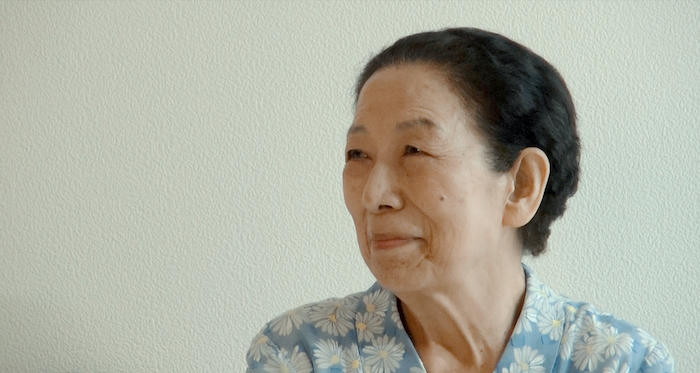
Introduction, the shorter and less effective of the two, is one of Hong’s exercises in narrative indirection. The first part takes place in an acupuncturist’s office, as the doctor (Kim Young-ho) treats a famous actor (Ki Joo-bong) for a chronic problem while a young man (Shin Seok-ho) sits in the waiting room for what feels like a very long time. The relationships of these three, as well as the young man’s with the receptionist, are teased out until the end of the segment, when the most important one is finally revealed. The second segment focuses on a young woman (Park Mi-so) who is moving to Berlin to study with help from her mother’s friend (Kim Min-hee), a resident of the city, but her discussions with the friend are interrupted when her boyfriend, who turns out to be the young man waiting in the first segment, shows up unexpectedly because he says he misses her. This kind of awkward situation is something Hong is particularly good at, though the viewer’s patience may be strained by the odd dynamic that develops as the lovers try to make sense of their relationship. As in the first section, the young man acts as if he’s being ignored and is hurt by his girlfriend’s move, which he takes personally. The young man shows up again in the third section, which seems to be taking place some years later at a hotel where his mother (Cho Yun-hee) and the actor from the first section are lecturing him, sometimes violently, about his lack of direction in life. Hong may seem to be challenging the viewer to fill in the plot lacunae between the three sections, but each one is filled with false starts and often hilarious non sequiturs so taking the “story” at face value would probably be a mistake. The young man’s rudderless life is more indicated than shown, but that doesn’t make it less compelling. It does, however, make it less believable. It’s as if Hong were challenging himself to say something interesting about a patently boring, annoying character, but he’s done that before, and better.
In Front of Your Face

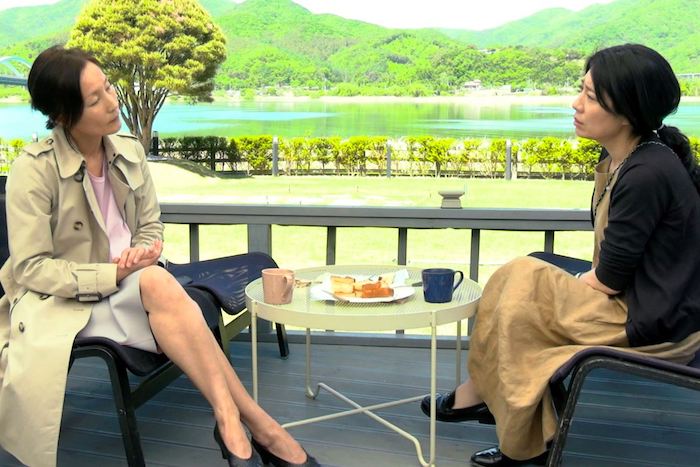
As slyly suggested in the title, the indirection in In Front of Your Face is more cinematically conventional. First of all it takes almost fiften minutes before the viewer realizes that the protagonist, San-gok (Lee Hye-young), is a famous actress who has spent the last several years of her life in the U.S., to which she followed a man she has now left. Presently, temporarily, she is sleeping on the couch in the Seoul high-rise apartment of her sister, Jeon-gok (Cho Yun-hee), with whom she spends a leisurely day drinking coffee in a shop with a breathtaking view, strolling through a park where she is recognized by some young fans, revisiting the house where she grew up, and meeting her nephew (Shin Seok-ho, yes the actors play out the same familial relationship as in Introduction), who runs a successful restaurant. The conversation is quotidian and less voluble than it is in most Hong films. San-gok seems to rue anything that smacks of small talk. Late in the afternoon, however, she meets a movie director (Kwon Hae-hyo) who wants her to be in his new film, which he will write just for her, thus making it clear that she has been out of the game for a while. For once in a Hong film, the dialogue is clearly expository, as the director says he knows her work “intimately” and, in fact, has always had a crush on her. San-gok blithely asks him if he had been planning on sleeping with her, and he frankly replies that, yes, it had crossed his mind. Then San-gok tells him something that changes not only the whole mood, but the whole movie. 

In a sense, the viewer never quite recovers from this revelation, though the movie continues on as if nothing has happened, and I, for one, really wondered if what I was understanding was actually what was going on. In many ways, In Front of Your Face may be Hong’s most emotionally affecting film since it shows how phony cinematic melodrama is when played out in situations that are closer to how we live day to day. Then again, he could be taking the piss. I saw it several weeks ago, and I’m still wondering what hit me.

In Korean. Both films open June 24 in Tokyo at Human Trust Cinema Yurakucho (03-6259-8608), Shinjuku Cinema Qualite (03-3352-5645).  

Introduction and In Front of Your Face home page in Japanese

photos (c) 2020 & (c) 2021 Jeonwonsa Film Co.  

Posted in Movies | Tagged | Leave a comment

Review: 100 Years and Hope

The release of this documentary about the Japanese Communist Party, which, as the title indicates, has been around for a century, is meant to coincide with the Upper House election taking place July 15, and while it does a fair job of presenting the JCP platform its main thrust is conveying a political sensibility that voters may not be familiar with. JCP needs this kind of publicity, since its very name alone is probably its greatest liability. Both the ruling coalition and fellow opposition parties can easily demonize the JCP because they are communists, though they abandoned the aim of world revolution many years ago, and no longer work toward the demise of the emperor system. However, they do see themselves as the party of the people in that they espouse social and economic policies designed to lift those at the bottom, and are strictly anti-militaristic. As one woman explains, she joined the party because her mother has always had a hard time getting by and the JCP was the only party in Japan that understood her mother’s situation. Nevertheless, once she joined and became involved in party activities her mother lamented, “I didn’t think I raised you to be a red.”

The movie’s loose structure focuses on a few individuals and the workings of the party organ, Akahata, which is a legitimate newspaper in that it has an investigative staff that often digs up stories the mainstream press doesn’t. The purpose, of course, is to provide fodder for party members who hold legislative office, whether at the local or the national level. Oddly, the movie doesn’t dwell on the fact that Akahata is almost the sole revenue-producing source for the JCP, which doesn’t take political donations from organizations or even the usual political susbsidies from the government. Perhaps they assume everyone already knows this, but it seems more like a case of refusing to boast about a policy they think every political party should follow.

Director Takashi Nishihara follows two election campaigns. The first is that of Yuichi Ikegawa, a young member of the Tokyo assembly running for reelection, mainly on a platform advocating that “students are citizens.” Though the casual viewer may find his focus on high school students being unfairly punished for their hairstyles rather trivial, Nishihara gets a lot of thematic mileage out of the issue, as it points up the JCP’s insistence that common sense should rule politics. When school officials are asked why a certain haircut is deemed “dangerous,” they can’t really answer. It’s just their feeling. Ikegawa wins, but the other candidate profiled, Saori Ikeuchi, who is running for a Lower House seat in Tokyo, isn’t as fortunate. Ikeuchi’s brief is recognition of rights for women and sexual minorities. She runs a web radio program with the provocative title, “Feminists are Communists,” and attracts a passionate following of mostly young women whose reaction to her defeat is quite devastating. Ikeuchi and Ikegawa were obviously chosen as subjects to highlight JCP’s self-determined image as a party of young people and women, two demographics that traditional Japanese politics has ignored. (The fact that Ikegawa has four kids is probably his strongest claim as someone who deserves to be listened to.) The JCP’s agenda is solidly liberal-progressive, even if some of the planks, like their anti-Olympics stance, seem reflexively so. But the point is that the demonization that has always kept the party down is at the service of a status quo which shuts out a good portion of the Japanese public. The movie tries to show what the JCP stands for, though it’s so low-key in spots you may wonder how much their heart is really into it. Some will call 100 Years and Hope propaganda. If only it strove for that kind of stark effect.

In Japanese. Now playing in Tokyo at Shibuya Eurospace (03-3461-0211).

100 Years and Hope home page in Japanese

photo (c) ML9

Posted in Movies | Tagged | Leave a comment

Media watch: You’re not in Kuroda’s league. You’re not even on the same planet

Japan’s weekly magazines and tabloids may not be bastions of journalistic integrity, but you can definitely count on them to stick it to the elites, especially those who toil in the public sector. On June 6, Bank of Japan Governor Haruhiko Kuroda, who controls the country’s money supply, commented during a lecture on the inflation that has taken over the world this summer. Unlike central banks in other countries, the BOJ has decided not to increase interest rates in order to counter price rises, and he dismissed people’s concerns by saying that Japanese households were capable of “absorbing these price increases.” Though there is apparently some academic-derived statistic used in the BOJ to chart “family-to-price-index tolerance,” the comment caused quite a stir in the media, especially in light of another remark Kuroda made several days earlier during an Upper House budget committee meeting. In response to a question of how he personally viewed these price increases, he admitted that he has had the experience of actually going to a supermarket and purchasing something, “but basically that’s my wife’s job.”

Later he apologized for both comments without denying that they reflected his thinking, thus proving, according to the weekly Josei Jishin, that he doesn’t really care about the Japanese public’s pain. The magazine wanted to know how he turned into such a cold fish, a somewhat academic question given the notion that, while the BOJ is, structurally, an independent entity, the government has indicated that it is very much a member of the team, so to speak, and thus Kuroda could be seen as one of the old boys in the ruling Liberal Democratic Party who thinks they’ve been charged by God to run Japan forever. 

But, in fact, he’s not a member of the team. He’s so much more. According to Josei Jishin, Kuroda was born in 1944, the oldest of three children, to an officer in the coast guard, who moved around a lot to different port towns because of his job. When Kuroda was in 5th grade the family moved permanently to Setagaya Ward in Tokyo. In interviews, his sister has described him as a “calm” child who was not much into sports but good in school. A voracious reader, he allegedly read all 10,000 volumes in his local library. Consequently, he was able to get into a prestigious Tokyo high school whose students could often count on getting accepted to the University of Tokyo, and, in fact, he passed the entrance exam on his first try in 1963.

Continue reading
Posted in Media | Tagged | Leave a comment

Review: Plan 75

Chie Hayakawa’s debut feature is a longer version of a short she directed for the 2018 omnibus movie Ten Years Japan, where her basic idea was explicated with the utmost economy. This idea imagines a Japanese system wherein people who reach the age of 75 can opt for euthanasia, thus saving themselves from a senescence of impoverished irrelevance and the state from the obligation of having to support them. The short was cold and to the point, a terrifying projection based on indications of where Japan’s aging society was headed. The feature necessarily has to not only expand on the basic government plan but show more convincingly how such a plan could be implemented and accepted, and, at first I felt the premise took too much for granted with regard to Japanese seniors’ easy acceptance of death and the Japanese bureaucracy’s cynical neoliberal tendencies. Such a dystopian “solution” to a real problem could never happen and so it seemed impossible to convince a viewer that it might. The short was more effective because it simply posited “What if?”

But once the movie enters into a more conventionally dramatic mode its premise feels more integrated. The three main characters occupy circles within the system that intersect in ways that allow them to represent more believably what’s possible. Michi (Chieko Baisho) is the senior who decides to take advantage of the plan, a lonely, single woman whose housekeeping job has been made redundant by an ironic twist of fate and can’t bring herself to apply for welfare (the insufficiency of the national pension system is assumed without being explained) after she’s evicted and runs up against the truth that landlords won’t rent to older people. Himura (Hayato Isomura) is the government functionary who recruits willing seniors to submit to the plan and receive the “gift” of ¥100,000 to enjoy as they seem fit. And Maria (Stefanie Arianne) is a Filipino temporary guest worker who cleans up after applicants go through with the process because the gig pays well and her daughter needs special medical care back home. Exposition-wise, Hayakawa has to explain the plan itself without seeming to do so, and gets more mileage than I would normally think possible with simple sub-plots, such as Himura’s discovery that an uncle he was once close to has opted to enroll in the plan, and Michi meeting with her Plan rep, Yoko (Yuumi Kawai), to talk about herself and go bowling, even though such interactions are not allowed. These moments counteract the queasy repulsion of watching seniors eagerly buying the plan’s claim of a neat and painless end to the burden of existence. 

The inescapable point of the film is that the Japanese authorities have failed its citizens, and I felt some resentment with the implication that, the sentimentally charged ending notwithstanding, it is society itself that is at fault. Much can be said about the basic hypocrisy of Japanese social engineering, which honors old people in the abstract while discarding them once they become economically inconvenient, but it’s the government that has institutionalized this hypocrisy and, in its starkest sense, Plan 75 illustrates how they have gotten away with it. The premise still feels beyond the pale, but the official impulse behind it is manifest in the headlines every day.

In Japanese and Filipino. Now playing in Tokyo at Shinjuku Piccadilly (050-6861-3011), Shibuya Eurospace (03-3461-0211).

Plan 75 home page in Japanese

photo (c) 2022 Plan 75 Film Partners/Urban Factory/Fusee

Posted in Movies | 1 Comment

Review: Three Sisters

Perhaps because Lee Seung-won’s family melodrama stars two of Korea’s most respected actors, there’s a feeling that the tail is wagging the dog here, and often in the film these actors, Kim Sun-young and Moon So-ri, are saddled with scenes that seem to have been conceived as acting showcases, which, when it comes to Korean melodramas, can come off as showboating. However, the excessive emoting peaks with the third side of the titular triangle, played by Jang Yoon-ju, a model and singer who has only recently turned to acting, and as is frequently the case in such situations her attempt to keep up with her more experienced colleagues results in histrionics.

Though Lee’s script and direction show a real flair for exposition, the structure is schematic to a fault, as if it had been carefully cobbled together from half-ideas that couldn’t be developed satisfactorily on their own—a little Bergman here, a little Cassavetes there. Each sister has her own peculiar spiritual problem. For the eldest, Hee-sook (Kim), it’s the tentative life of a single mother struggling with a business she has neither the enthusiasm nor the skills for, as well as a post-adolescent daughter who hates her for her wishy-washy attitude toward everything. For middle sister Mi-yeon (Moon), it’s a bold front of social confidence and a strong religious faith that hides the dysfunction in her marriage. As for the youngest, Mi-ok (Jang), it’s an overextended belief in her future as a writer that manifests in drunken episodes of calling Mi-yeon at the most inopportune moments to pester and plead. For the first half of the film, Lee follows each thread separately without making much effort to intertwine them, but once the connections are made and lead back to the sisters’ troubled childhoods with a violent, sexually irresponsible father, the movie makes almost too much sense in hindsight, as if it had been charted on a white board during a conference call. This isn’t to say the movie as a whole isn’t dramatically intriguing or emotionally affecting; only that the artful presentation is stretched thin on the skeleton of the plotting. 

As with all such melodramas, the viewer expects a satisfying resolution, and Lee’s is underwhelming while being very loud; but it’s not because the premise is rigged. If anything, the three actors manage to build a strong sense of sisterhood when they finally all end up in the same scenes together. The message seems to be that childhood trauma renders its victims unsuitable for family life as adults—all three sisters are either mothers or step-mothers, and can’t manage their domestic affairs without failing their children emotionally—but what else is new? Someday, I’d like to see a movie where a character transcends childhood trauma and becomes someone who enriches their family as an adult because their experience has taught them what is important, but such a movie probably wouldn’t qualify as a domestic melodrama. 

In Korean. Opens June 17 in Tokyo at Human Trust Cinema Yurakucho (03-6259-8608), Shinjuku Musashinokan (03-3354-5670).

Three Sisters home page in Japanese

photo (c) 2020 Studio Up

Posted in Movies | Tagged | Leave a comment

Media watch: Are school-based sports clubs on the way out?

photo: Asahi

As the debate heats up on the government’s desire to increase Japan’s defense budget, some people on social media have been posting a quote by ruling Liberal Democratic Party lawmaker Tomomi Inada from 2016 when she was the defense minister. Inada proposed transferring funds used for the children’s allowance (kodomo teate) to defense, which she reasoned would solve the problem of perceived shortfalls. The children’s allowance is a form of welfare that is available to any household with children that makes up to a certain amount of money, and obviously Inada thought it could be sacrificed on the altar of national security. The people who have posted the meme say that Inada thinks children are less important than Japan’s ability to purchase expensive military hardware from the U.S., and, as a matter of fact, of all the G7 governments, Japan’s spends the least on children and their education. Meanwhile, if the defense budget is increased to 2 percent of GDP, Japan will then be number 3 in the world of all countries in terms of defense spending.

Even when the government addresses issues that directly affect children their priorities can seem skewed. A June 6 article in the financial magazine Toyo Keizai talked about a symposium carried out by a group of scholars and former athletes at the behest of the Japan Sports Agency about the future of junior high school sports. As everyone knows, the birth rate continues to drop year after year, which means school enrollment in most places is also dropping. Dwindling enrollment has already started to affect extra-curricular activities, of which sports is the most prominent. Already, some junior high schools cannot muster enough students to field teams, and so the agency has been trying to come up with solutions. On May 27, the symposium proposed that school sports be moved from schools themselves to regional sports associations. The idea is that individual junior high schools with insufficient enrollment to form sports teams pool their sports-minded students together in regional sporting associations to form regional sports clubs rather than school-based sports clubs. One scholar said that by 2048, on average a boys junior high school baseball team will only have 3.5 members, thus making baseball as a school sport unviable.

According to Toyo Keizai, there are already some 3,600 regional sports associations throughout Japan that have been cultivated by the JSA, as well as other regional clubs operated by private companies. The agency has asked the symposium participants to further discuss the matter of transferring sports clubs from junior high schools over the next three years. The first phase of their work would be a summary of the transfer proposal. The second phase will presumably be coming up with concrete ideas to carry out the transfers. The group admits that such a move will fundamentally change the whole concept of how to develop athletes in Japan, an endeavor that has centered on the school system. Consequently, the third phase, which would be the actual transfer, can only be carried out after problems already facing school sports, mostly of a financial nature, are addressed.

Continue reading
Posted in Media | Tagged , , | Leave a comment

Review: Soup and Ideology

Filmmaker Yang Yonghi’s career has been in the service of explaining why her family is what it is, and as with many such endeavors the family itself hasn’t always seemed happy with the attention. Most of this work has been in the documentary field, but she did do one narrative feature, 2012’s Our Homeland, that used actors and a dramatic script to tell the story of her family, perhaps in a bid to make the explanation more accessible to average viewers, who may be less intrigued by the documentary form. Actually, Our Homeland was less intriguing than her documentaries, mainly because it dramatized a situation that had built-in drama, especially for Japanese viewers. Yang and her family are Japan-resident Koreans. Moreover, they identify with North Korea, thus making them pariahs, not only to Japanese people but to other Japan-resident Koreans who identify with South Korea. The story that Yang tells in all her films is played against this background. Her father, born in South Korea, came to Japan during the colonial era and, disillusioned with his lot and that of other Koreans after the war, offered his loyatlies to North Korea with its claims of being a paradise on earth. Moreover, he worked for Chongryon, the conduit association between Japan and North Korea, while his wife ran a restaurant in Osaka. In the early 1970s he even sent all three of his sons to North Korea to live. Yonghi is the much younger daughter who didn’t go to North Korea and in the meantime became a filmmaker. Two of her docs take place principally in North Korea where she filmed her relatives’ lives there. Though her father, who has since died, never abandoned his faith in North Korea, Yonghi herself has always taken a more pragmatic, if not skeptical, view of her family’s path. At the same time, as the member of an ethnic minority in Japan, the country of her birth, she maintains a true outsider’s view of her situation and that of her family.

Soup and Ideology is meant to be a kind of concluding chapter, though she has said there may be room for further exploration. It is about Yang’s mother, Kang Jung-hee, who survived her husband with her loyalty to Pyongyang intact. She continues to send most of the money she makes to her children in North Korea, as if it is not only a necessity but her mission. Yang’s film is rangier than her earlier works, built with footage shot over the course of a decade or so. But in another sense it is her most concise film since it involves a discovery placing her family’s dilemma in a context that is more immediate for the viewer, not to mention more dramatic. In the opening scene, Kang, hospitalized, starts talking about the time she spent on South Korea’s Jeju Island between 1945, when she fled Osaka as a teenager to escape the US firebombing, and 1948. While on Jeju she became engaged to a Korean doctor who was also a member of the local resistance, which objected to the eventual partition of the peninsula. The Americans and the provisional South Korean government brutally repressed the resistance, killing 30,000 people in the process, and Kang had to escape the island under cover of darkness to return to Osaka, where she eventually met the man who would become her husband.

Yang knew nothing of this story until her mother told her in 2015, and most of the movie involves how she comes to grips with it. Using her mother’s first-person recollections, narrative explications by South Korean historical activists, and animated sequences illustrating parts of the tragedy, Yang finds a means of putting into perspective the confusion she has always felt regarding her family’s politics, which she recognized as being impelled by anger and frustration rather than by ideology. Having always wondered why her family had to suffer for their beliefs—a situation that she blames as much on her father’s intransigence as she does on the anti-Korean sentiments held by Japanese society—the over-arching horror of the Jeju Uprising gives her not only a convenient back story to that suffering, but a narrative frame over which to stretch the canvas of her mother’s final days as she sinks slowly into a fog of dementia (she died in January, after filming of the movie was completed).

Which isn’t to say Soup and Ideology is a dark experience. During the time when she was lucid, Kang is a much more convivial film subject than Yang’s father was, a fountain of folk wisdom and cynical, off-color humor who is charming and approachable. Yang also gets valuable support from her new, much younger husband, a Japanese man whose close relationship to Kang is the jumping off point for many of the scenes that reveal more about Yang’s relationship with her mother than anything else she filmed. The results transcend the ostensible journey of self-discovery that culminates in Kang returning to Jeju to face her demons, painting a picture of life for Japan-resident Koreans that was not as raw and vivid in Yang’s previous movies, whether documentary or feature. During a post-screening press conference at the Foreign Correspondents’ Club of Japan, Yang mentioned Pachinko, the bestselling novel by Korean-American writer Min Jin Lee that is currently creating millions of new fans worldwide as a TV series. Much of the novel covers the exact same milieu that Yang’s work does and she expressed frustration that such a multi-generational epic has never been tackled by a Japanese director, since it represents a foundational story of postwar Japan that most Japanese probably know nothing about. It was difficult not to sense behind the remark the feeling that Yang herself thinks she should have been given the opportunity to make such an epic, which says more about Japan’s squeamishness toward its own modern history (not to mention the parochial nature of Japan’s film industry) than Yang’s obvious talents as a director. 

In Japanese and Korean. Now playing in Tokyo at Eurospace Shibuya (03-3461-0211), Polepole Higashi Nagano (03-3371-0088).

Soup and Ideology home page in Japanese

photo (c) PLACE TO BE, Yang Yonghi

Posted in Movies | Tagged , , | Leave a comment

Review: The Story of Film: A New Generation

British film scholar and filmmaker Mark Cousins takes the notion of fan service to its most obvious ends in that, as a fan himself, he only seems intent on satisfying his own needs, which turn out to be quite specific. Best known for his 2011 15-hour history of movies, The Story of Film: An Odyssey, Cousins expands on his personal idiosyncrasies while addressing film as both an art form and a commercial imperative, and yet the series is reportedly as ecumenical a study of movies as you’re likely to ever encounter (I’ve only seen a handful of individual episodes over the years), which isn’t to say he doesn’t offer opinions, but rather that he can both honor and transcend his tastes in order to make points that may have greater meaning to his perceived audience.

Clocking in at two-hours-and-forty-five minutes, his latest study, A New Generation, takes into consideration the state of international cinema in the years since his opus opened, and, unfashionably perhaps, he is optimistic about the future of the medium and approves resoundingly of all the technical advancements that the movies have acquired in that time. For sure, Cousins’ means of explaining how movies have developed in the last decade—he opens by comparing two blockbusters, Joker and Frozen, for their depiction of outsiders—takes some time to get used to, not to mention his narrative habit of describing in detail exactly what you’re seeing. But the point of this discursive methodology is to show how filmic forms have changed in the 21st century in adapting to these new technologies as well as to deeper engagement with themes that were once either forbidden or simply out-of-mind. In Cousins’ purview every shot is deliberate and revelatory, but not necessarily of something story-related. The first half of the doc is titled “Extending the Language of Film,” which presents movies as a type of communication with its own grammar, and like all languages film is constantly evolving. The movie he cites as the one that pushed this language further than others is Sean Baker’s Tangerine, because it not only highlighted the onset of affordable high-quality visuals through the use of iPhones, but did it by focusing on trans women, who were never the center of attention before: A new technology for a new kind of protagonist.

Cousins’ liberal use of superlatives can be annoying but they point up his investment in the films he’s exhibiting, many of which are almost too familiar, but he’s equally enamored of international titles that you probably have never heard of. He’s especially taken with Indian and Southeast Asian films, but seems less versed in Korean works except for Parasite. And while he has nothing pointed to say about the emergence of streaming, he includes films that are now mostly known through their exposure on smaller screens. He’s also very good at outlining the way genre has become a tool of expression rather than just a stylistic choice—the sections on horror and comedy are particularly fascinating since they delineate in plain terms how different cultures exploit these genres for their own purposes. “Horror is always new,” he says in a hushed tone, marveling at how much good will you can engender out of promising viewers a proper scare. 

But to assume that Cousins likes everything short-changes the documentary’s accomplishments. In the second half, titled “What Have We Been Digging For?”, he makes the case that film is still the most immediate art form for artists who want to convey their own sensibility directly, even if they are discovering how to do it along the way. Of course, this capability is transferred to the audience, which both incorporates the viewed experiences into their consciousness while projecting themselves onto the screen. I was almost shocked that I had seen most of the 111 films he discusses, including Aleksey German’s Hard to Be a God, which he claims is the most striking movie made in the last 10 years while being one of the least viewed. However, I wasn’t surprised that he taught me a brand new way of looking at them, which means I should probably see them again. If I came away with one incontrovertible truth after sitting through A New Generation is that there will never be enough time for you to see all the films you want. 

Opens June 10 in Tokyo at Shinjuku Cinema Qualite (03-3352-5645).

The Story of Film: A New Generation home page in Japanese

photo (c) Story of Film Ltd 2020

Posted in Movies | Leave a comment

Review: Nomad: In the Footsteps of Bruce Chatwin

In many ways every film is about its filmmaker, even when the ostensible subject is a different person. A viewer who approaches Werner Herzog’s documentary about the British travel writer Bruce Chatwin expecting a biography will likely be disappointed since the clearest purpose of the film is to explore Herzog’s relationship with Chatwin, which started in the early 1980s. Consequently, the aspect of Chatwin’s career that I myself find most interesting is mostly ignored. Chatwin is often credited with reviving the art of travel writing with his bestseller In Patagonia, but that wasn’t his aim, which was to make himself useful as a citizen of the world. An office worker whose first few attempts at being published failed due to lack of focus, he became the nomad of Herzog’s title because he was always in search of something he couldn’t grasp until he actually found it. His travel writing is different because it isn’t really about travel. It’s about going to a place and discovering everything there is to know about it, right down to the geology and the natural history. 

It’s this latter facet of Chatwin’s work that overlaps with Herzog’s, whose own movies are often anthropological in conception. However, he doesn’t examine Chatwin’s work itself, and, for that matter, rarely even quotes from his books. He essentially reminisces about the times he spent with Chatwin and then tries to build parallels between Chatwin’s thoughts and his own movies, which are referenced at least as much as Chatwin’s words. Herzog is straightforward about how Chatwin directly influenced his own movies, but we learn nothing about the writer’s frustration as a young corporate factotum, or, for that matter, much about his sexual conflicts (Chatwin died of AIDS in 1989 at the age of 48, still in the closet though his wife of many years was aware and tolerant of his relationships with men). Instead, we get a lot of ruminative narration about Chatwin’s “obsession with prehistory” and his conclusion that “all history is myth.” Though these ideas are interesting in and of themselves, it is up to the viewer to forge the proper connections in order to make some kind of linear sense out of Chatwin’s life. Herzog’s patented English voiceover, at once clipped in tone but grandiose in style, can often sound like a parody of itself, especially when expanding on such abstract matters. 

The movie, which itself travels all over the world, is beautiful, but because it is essentially a compilation of footage shot over many years for other projects, it’s easy to get the impression that Herzog was simply looking for a means of putting that disparate footage to use, and Chatwin, the ultimate peripatetic writer, became the ideal subject. At one point, Herzog tells an interlocutor that Chatwin is the subject of their conversation and the movie we are now watching, as if to remind himself what he should be doing. As erudite and probing as Nomad is, a more honest title would have been Bruce and Me

Now playing in Tokyo at Iwanami Hall Suidobashi (03-3262-5252).

Nomad home page in Japanese

Posted in Movies | Tagged | Leave a comment

Review: Crock of Gold: A Few Rounds With Shane MacGowan

The centrality of “authenticity” comes and goes in the annals of music criticism. In its most common usage it represents an artist’s commitment to music as craft, which is why hip-hop and techno were originally dismissed by self-serious, trad-oriented types. But in the sense of being authentic to one’s beliefs, the term really came into its own during the punk revolution of the late 70s and 80s, when artists themselves dismissed music that felt unrepresentative of the human condition. As a rock documentarist, Julien Temple has made this notion his metier, and his two-hour-plus study of the music and career of Pogues frontman Shane MacGowan is more successful in this regard than his docs about the Sex Pistols and Joe Strummer, if mainly because MacGowan himself sets both the pace and the tone of the film by being front and center for most of the movie.

MacGowan was authentic in an unusual way: An Irishman who celebrated his Irishness as a native Londoner. Already a drunk and hellion as a teen, he appeared to his family and friends to be on the short road to oblivion until he saw the Sex Pistols and adapted the punk image for his own purposes. What’s interesting is this image should have rightly put him on the even shorter road to self-destruction, as MacGowan, speaking from a wheelchair and with an often difficult-to-understand slur in the present to Temple, as well as to friends such as Johnny Depp (one of the film’s producers) and Sinn Fein leader Gerry Adams, recalls how punk helped him find what can only be termed a constructive outlet for his self-destruction. And while he did start out as a rocker he quickly transmogrified the punk attitude to celebrate and expand on Irish traditional music forms with the Pogues. 

“I was put here by God to save Irish music,” he says without irony. More essentially, he used Irish music to talk about those things that have always been explicit in Irish literature, such as the Irish diaspora and the idea of exile. Though he claims Brendan Behan as his poetic soulmate, he sees James Joyce, who lived his life abroad and was, he points out, a great singer, as his true model for how to live as an artist. Though Temple makes much of MacGowan’s oft-repeated line that he purposely acted the drunken Irish stereotype in order to throw it back in the face of British racists, MacGowan’s romantic streak, as illustrated by songs like “A Pair of Brown Eyes” and his classic Christmas song “Fairytale of New York,” is fully explicated as a means of putting his bad-boy reputation and demolished physical form into proper perspective. 

What’s most remarkable about the film, aside from the staggering array of source material that Temple got his hands on, is how MacGowan, who has railed not only against the establishment over the years but also against his bandmates (whom he’s “divorced” twice) and mentors like Elvis Costello (whom he fired once), now finds himself rock royalty and one of the giants of 20th literature, as Strummer (his replacement in the Pogues, don’t forget) once called him. The movie ends with a 60th birthday party on stage where he’s feted as an original for the ages, and while the movie emphasizes his physical deterioration it also celebrates the sharpness of his mind in the witty and cutting comments that seem so effortless for him. Crock of Gold is hagiography as a presentation of stark contrasts, which is why you can’t accuse it of being inauthentic. 

Now playing in Tokyo at Shibuya Cine Quinto (03-3477-5905).

Crock of Gold home page in Japanese

photo (c) The Gift Film Limited 2020

Posted in Movies | Tagged , | Leave a comment