Media watch: Bicycle accidents receive extra scrutiny from public, police and media

On Jan. 26, Tokyo District Court began hearing a case in which a bicycle delivery person is accused of riding recklessly and causing the death of a 78-year-old man in Itabashi Ward last April. Prosecutors are demanding a 2-year prison term for Junya Iwano, the rider who, at the time he struck the man, was carrying out deliveries for Uber Eats, the app-based service contracted by food establishments for their meal deliveries. Reportedly, Iwano was in the middle of a “quest,” which is a kind of challenge offered by Uber Eats and other companies to its delivery persons to complete a certain number of deliveries in a given period of time for extra money. It was raining when Iwano struck the victim, and Iwano did not have a bike light, though the accident happened around 7 p.m. Quests are usually offered during peak demand periods, such as when the weather turns bad. 

The coverage of the trial, which is expected to end on Feb. 18, was widespread and mostly focused on the quest aspect, since it is assumed that such incentives are what caused Iwano to ride recklessly in the first place. However, there are other factors that have received less attention and which Iwano’s defense may use to get him a suspended sentence (he’s already admitted his guilt and apologized). One is, of course, the rain. Iwano wears glasses and constantly had to wipe the moisture from his lenses while riding. Such an excuse by itself wouldn’t normally mean anything in court, but combined with the Uber Eats’ incentive and its attendant implication that delivery persons only make as much money as the number of deliveries they can achieve, there is a good chance the judges could be swayed that it was the system that caused the accident rather than the rider. Iwano, it should be noted, has a full-time office job and works for Uber Eats to make enough money to live on. It’s an old story and doesn’t excuse his actions, but it may have an effect. What’s particularly sad about the story is that bonus Iwano was working for was only ¥1,200, and it required him to make 12 deliveries in the space of 4 hours.

Continue reading


Posted in Media | Tagged | 2 Comments

Review: Crescendo

German-Israeli co-productions have emerged as an almost distinct subset of middlebrow art house cinema. Invariably, all the movies in this category deal either directly (Plan A) or indirectly (The Cakemaker) with the two countries’ fraught relationship owing to history, but they also use this dynamic to explore fairly problematic issues in the world at large. This 2019 film initially comes across as daring in this regard since it takes on the Israeli-Palestinian question, an issue the Germans would, understandably, approach delicately. Though perceived Israeli oppression of their Palestinian minority would likely alarm conscientious Germans who know from their own history what oppression of a minority can lead to, the fact is that the state of Israel rose from the ashes of the Holocaust, which was caused by the German nation. 

Crescendo couches its presentation of this problem in a fictional act of restitution: a German-lead orchestra made up of both Israeli and Palestinian musicians. The almost flip motto of the international project—Make music not war—would seem to signal a somewhat cynical attitude toward such endeavors on the part of the filmmakers, and, at least in the beginning, the project seems to be more of a PR gesture than a concerted effort to bring people together. However, director Dror Zahavi favors melodrama over seriousness of purpose, a contradiction that is best represented by the German conductor chosen to lead the ensemble, Eduard Sporck (Peter Simonischek), whose first utterance is that his country should be forgiven for its past sins. In any case, he is strictly a man of the arts, and will not tolerate any political hanky-panky on his watch. Such a character is central to Zahavi’s canny dramatic strategy: Depict all the various ways that people attempt to come to grips with international strife as a means of showing how institutions need to address person-to-person matters first.

It’s a cliche born out by the tense subplots that keep the movie interesting. The Germans audition musicians in both Israel and the occupied territories, with Zahavi focusing on  several players with markedly different backgrounds. There’s the Palestinian clarenetist who learned his instrument playing weddings and has never seen a French horn in his life falling in love with an Israeli who plays that instrument. Then there’s the proud, German-educated Israeli master violinist who bristles at the notion that he will have to compete with a proud female Palestinian violinist who he assumes has never studied as hard as he did. The maestro thus has to amend his normal working methodology against his will to account for these tensions, and he’s not always successful. Zahavi makes Sporck out to be a borderline asshole, which provides room for his own hackneyed redemption, but there’s an overdetermined quality to the dramatic arc as suicide bombings happen in the background and internecine conflicts wax and wane within the orchestra, which ends up relocating to Italy once the auditions end. One tends to wonder if the choice of program—Dvorak’s “New World”—is itself a cynical joke, but Crescendo is nothing if not forthrightly earnest, which is why it’s such a frustrating movie overall. 

In English, German, Hebrew, Arabic and Italian. Now playing in Tokyo at Shinjuku Piccadilly (050-6861-3011), Human Trust Cinema Yurakucho (03-6259-8608). 

Crescendo home page in Japanese

photo (c) CCC Filmkunst GmbH

Posted in Movies | Leave a comment

Review: Rockfield: The Studio on the Farm

If you assess music documentaries by how many interviews with rock stars it contains, Rockfield, which is about the titular Welsh recording studio built on the premises of a working farm, will probably be right up there at the top of your list. The only caveat I would offer is that almost all of these musicians are British, and while Brit rockers are often more erudite and coherent than their American counterparts, they also tend to be more full of themselves, owing, I would imagine, to the special relationship they’ve had over the years with the British music press. Another caveat: An inordinate amount of screen time is given to Liam Gallagher.

In and of itself, Rockfield the recording studio is worthy of a documentary. The family farm, owned by two brothers, Kingsley and Charles Ward, rarely broke even as an agricultural enterprise but the idea of converting some of the facilities into a studio mainly sprang from the Wards’ own unsuccessful bid to become pop stars in the late 50s. They even did a demo for George Martin, but after it was rejected they decided to try and record their music themselves and set up a makeshift recording studio in one of the barns. It didn’t make a difference with regards to their musical dreams, but the studio attracted local talent who wanted to record and take their own shots at the big time. And then the brothers had a brilliant idea that just happened to dovetail with the ascendance of corporate rock in the late 60s: Make Rockfield a residential studio, a place where groups could work and live at the same time, thus allowing them to put all their efforts into the recording. Labels were shelling out good money at the time to attract and keep best-selling bands, but with the usual distractions, including drugs and groupies, getting in the way, it was often difficult to maintain their presence at London studios on an everyday basis. At Rockfield, they were not only ensconced in a beautiful, bucolic place where they could jam and record whenever they wanted to without interference, but they could party as much as they wanted to, as well, without interference. (The pub in the nearest village became a notorious watering hole for celebrity rockers.) 

Black Sabbath was one of the first major bands to record there, and Ozzy Osbourne (subtitled, of course) spins some colorful tales about how the focus afforded by the isolation made them think for the first time that they could create something great, all the while getting stoned and drunk to the extent where memories are pretty cloudy. In fact, one of the charms of the movie is that a lot of the stories sound like rubbish, but director Hannah Berryman doesn’t seem to be a stickler for detail. The woolier the story, the better, since it only goes to enhance the farm’s special aura. After all, while these groups were laying down tracks that would become stone classics, the Wards and their families were tilling the fieldss and milking the cows, and often the two missions would cross and blend. Robert Plant, always a brilliant raconteur, is particularly fluent about the pastoral effect the farm had on Led Zeppelin’s third album. 

However, Rockfield didn’t really come into its own until the 90s and the emergence of Britpop (after a relatively fallow 80s, when the Wards had trouble keeping up with the new technology). Everyone from Stone Roses to Coldplay recorded their best work there and the survivors are effusive about their admiration for the Wards and their little rural empire. There’s also the requisite drama: Rob Collins of the Charlatans famously died in a car crash on the road that connected the farm to the village. And for a good stretch, Kingsley and Charles didn’t speak to each other due to differences about the future of the farm, which was mostly run by Kingsley’s wife, Ann, and daughter, Lisa, anyway. Charles ended up setting up his own studio on the other side of the farm, though Berryman doesn’t delve into it very deeply. She seems to be considerate to a fault, allowing her interlocutors to say whatever they want and withhold whatever they want, as well. Fortunately, there are enough good stories to make Rockfield an entertaining if somewhat fawning documentary about British rock’s peculiar self-absorption. 

Now playing in Tokyo at Shinjuku Cinema Qualite (03-3352-5645), Human Trust Cinema Shibuya (03-5468-5551).

Rockfield home page in Japanese

photo (c) 2020 le le Rockfield Productions Ltd. 

Posted in Movies | Tagged , , , , | Leave a comment

Media watch: High court “forgives” trainee convicted of abandoning baby, but only up to a point

Vietnamese trainees in Japan

Technical trainees who come from overseas to work in Japan are subject to conditions that don’t necessarily apply to foreign workers who come to Japan with conventional work visas. There are many people who feel these conditions are unreasonable, especially given the general understanding that the technical trainee system, whose ostensible purpose is to “transfer technology” from Japan to so-called developing countries, was mainly put in place to provide Japanese employers with cheap labor. 

One such perceived condition is that trainees cannot be pregnant while they are in Japan. Any trainee who is found to be pregnant may be subject to deportation. This rule became headline news in December 2020 when the Kumamoto district prosecutor indicted a Vietnamese trainee on suspicion of abandoning not one, but two dead bodies. The trainee, a 21-year-old woman named Le Thi Thuy Linh, worked on a tangerine farm and had given birth to twin boys in mid-November 2020. The indictment says it was likely the twins were stillborn, and she placed the bodies in a cardboard box and put it on a shelf in the house where she lived in the town of Ashikita. A Dec. 29, 2020, Mainichi Shimbun story described Le’s situation and said she tried to hide her pregnancy from others by wearing loose clothing, afraid that if her condition was discovered she’d be sent back to Vietnam. She earned about ¥150,000 a month, of which ¥120,000 she sent back to family in Vietnam. She had arrived in Japan in Aug. 2018 and was hoping to stay and work until Aug. 2021.

Le gave birth by herself after working half-a-day in the fields. Two days later she was brought to a hospital where “the abandonment of the babies’ bodies came to light.” She was subsequently arrested and, according to Mainichi, said that she was afraid of being fired and sent back home, but there was no one she could talk to about it. Even when she had fallen sick a month earlier, she refused treatment due to fear that the pregnancy would be discovered.

Continue reading
Posted in Media | Tagged , | Leave a comment

Review: Silk Road

Writer-director Tiller Russell’s highly dramatized recreation of the rise and fall of the darknet website Silkroad.com takes a novel approach to the classic protagonist-antagonist dynamic in that the two main characters are really antagonists. In fact, it’s safe to call both Ross Ulbricht (Nick Robinson), the 20-something cyber genius libertarian creator of the website, and Rick Bowden (Jason Clarke), the seriously limited DEA agent who tries to bring Ulbricht down, assholes, since they tend to treat loved ones and confidantes like shit and decide early on that they’re special enough to be above the law in their respective ways.

Ulbricht’s idea is pretty simple, and immensely profitable in 2013. Create a space on the alternative web where people can buy and sell anything they want, though what makes him insanely rich is drugs, which can be delivered anywhere, including postal boxes, and remain undetected since the payment is in cyber-currency. The idea as presented, however, doesn’t interest Ulbricht because of the money he can make, but rather due to the fact that it completely sidesteps the authorities, which is kind of his life’s work. Ulbricht’s adventures in cyberspace are conveyed in parallel with Bowden’s saga, which starts with his release from a psychiatric facility in Baltimore where he was treated for addiction. He’s welcomed back into the agency but given a desk job in cybercrimes, an area he not only knows nothing about, but for which he has no affinity since he barely knows how to send a fax. 

What unites the two men is their obsessiveness, and while Russell does a fair job of showing how their parallel trajectories eventually come together, while charting those trajectories he needs to maintain a kind of dramatic tension that’s difficult to do when the crimes in question are taking place in the ether. So he gooses the story with, on Bowden’s part, a sub-tale about his estranged daughter’s difficulties in getting into a good school (which require more money than he makes); and on Ulbricht’s part, the notion that SilkRoad.com is growing beyond his control. For sure, the latter story is more interesting and the reason the movie was made in the first place, but for some reason Russell privileges Bowden’s, and the movie sputters as a result. As a movie about wannabe alpha males pissing all over themselves, Silk Road delivers a certain edgy Schadenfreude, but if you want to learn about the actual affair, you’ll have to read a book. 

Now playing in Tokyo at Shinjuku Wald 9 (03-5369-4955), Shibuya Human Trust Cinema (03-5468-5551).

Silk Road home page in Japanese

photo (c) Silk Road Movie, LLC

Posted in Movies | Leave a comment

Review: Third Time Lucky

When it premiered at the Locarno Film Festival in 2015, Ryusuke Hamaguchi’s Happy Hour revived interest in Japanese art house cinema among those who had mostly given up on it since the dawn of the 1990s. A long, intimate portrait of the current state of interpersonal relations in Japan, it struck a nerve by delving into matters that couldn’t be conventionally articulated. Hamaguchi, who is now hot stuff due to the award-winning Haruki Murakami adaptation, Drive My Car, co-wrote Happy Hour with Tadashi Nohara, a noted scenarist (he also collaborated with Hamaguchi and director Kiyoshi Kurosawa on Wife of a Spy) who is finally making his directoral debut with Third Time Lucky

Comparisons to Happy Hour are inevitable, and not just because Third Time Lucky is also set in Kobe and features many of the same actors. It’s a domestic drama with interwoven plot threads involving connubial relationships. The central character, Haru (Rira Kawamura), is a divorced woman living with a divorced doctor (Yasunobu Tanabe) whose own daughter has recently moved to Canada to attend university. Haru has no children of her own, and feels abandoned after the move. When the doctor confesses to an affair, she leaves him and, feeling desperate, “adopts” a young homeless man (Tomo Kawamura) she stumbles upon who says he has no memory of who he is or where he’s from. She calls him Naruto, which was the name she chose for the baby she miscarried almost ten years earlier.

Her adoption of Naruto disturbs her extended family, including her mother, with whom she now lives; her brother, Takeshi (Katsuyuki Kobayashi), an aspiring rapper; and Takeshi’s emotionally unstable wife, Mikako (Hiromi Demura). None of these family units stay together for long, and the development of the story has to do with the various pieces recombining to create new relationships. However, Nohara doesn’t present it as a tidy whole. He understands that relationships are messy by definition, and much of the motivations behind the characters’ actions are not clear. Haru, for instance, spends an inordinate amount of time trying to explain her strange affinity for Naruto, whose own provenance isn’t made entirely clear either, despite an opening scene that would seem to explain a lot. Later, when a man enters the picture claiming to be his father, the viewer wonders if Naruto is really suffering from amnesia at all, but in any case by this point Haru doesn’t care. More than a substitute son (which he is too old to be, anyway), Naruto is a project, and one her friends and relatives resent. Nohara seems to be saying that what is a family if it doesn’t require a great deal of emotional investment?

There’s no doubt that Nohara can write very affecting scenes. The most potent involves Takeshi confronting Mikako’s illness as it has impacted their married life, and she rebuffs his professions of love by essentially saying that he will never understand her. The indelible truth of the argument as it applies to their specific circumstances is devastating, but Nohara doesn’t always seem keen on developing it, and we’re often left with powerful moments that never connect with one another, as if messy relationships are inherently impossible to convey. He may actually be too ambitious for his own good. 

In Japanese. Now playing in Tokyo at Theater Image Forum Aoyama (03-5766-0114).

Third Time Lucky home page in Japanese

photo (c) 2021 NEOPA Inc.

Posted in Movies | Tagged | Leave a comment

Review: Riders of Justice

Danish director Anders Thomas Jensen’s revenge film manages to hit all the expected beats in terms of violent actions and righteous payback while undermining most of the narrative justification necessary to get the audience rooting for said violence. But unlike a lot of other unconventional Danish genre films, it’s not as subversive as it thinks it is, owing mainly to its uneven comic tone. But it is quite clever, and it’s the cleverness of the central plot idea that draws you in.

The tightly structured opening ends in a train accident that kills several people, including Emma, the wife of professional soldier Markus (Mads Mikkelsen), who is already guilt-ridden over how much time he puts into his work at the expense of his family. His teenage daughter, Mathilde (Andrea Heick Gadeberg), who was with her mother and survived the wreck, has never been particularly close to Markus, and now resents his presence even more as he arranges for the funeral and seethes silently because he has no one to blame for his wife’s death. Soon, however, he will have someone to blame. As it turns out, a statistician named Otto (Nikolaj Lie Kaas) was also on the train. In fact, he gave up his seat for Emma right before the crash. But he also noticed on the train a rather fearsome looking man and later found out that the man was on his way to testify against a notorious right-wing biker gang, Riders of Justice. After Emma’s funeral, Otto shows up at Markus’s door with a theory based on the odds that such a crash could not happen naturally. Otto thinks that maybe the crash was planned in order to kill the witness, meaning it was carried out by the Riders of Justice.

This is exactly the kind of news Markus, who is in the military because it’s the kind of life that suits his temperament, wants, and thus he embarks on a project to get revenge against the Riders, but he isn’t alone. Not only do Mathilde and Otto join in the carnage, but two other associates of Otto’s, probability expert Lennart (Lars Brygmann) and computer hacker Emmenthaler (Nicolas Bro), neither of whom are what you would call action figures but who have, buried in their respective pasts, sources of trauma that gives them reasons to take their frustrations out on the notorious Riders, even if the Riders themselves had nothing to do with those traumas. What sticks in the back of the mind of the viewer is, of course, the very real possibility that the Riders had nothing to do with the train crash, but as they say, once you start on a course of action that involves killing people, you just have to keep killing people.

What keeps the movie interesting is its unpredictability, not in terms of action, which is pretty rote, but rather in terms of motivation. Markus isn’t simply a rage-filled killing machine and Mathilde isn’t simply a rebellious teen who would rather punish her father than the Riders. More interestingly, the trio of eggheads are more than the sum of their resentments, but as noted above, the comical contours of their interactions sometimes lead to puzzling outcomes, and much of the intended humor falls flat as a result. But you have to hand it to Jensen: He has a weird way of telling a story. 

In Danish and Estonian. Now playing in Tokyo at Shinjuku Musashinokan (03-3354-5670).

Riders of Justice home page in Japanese

photo (c) 2020 Zentropa Entertainments3 ApS & Zentropa Sweden AB/Rolf Konow

Posted in Movies | Tagged | 1 Comment

Review: CODA

After reading the synopsis for the American film CODA (Children of Deaf Adults) but prior to seeing it, I felt as if I’d seen this movie before, and, as a matter of fact, it is based on a 2015 French film called La famille Belier. However, when I looked through my files and then online to check out my suspicions I realized I hadn’t seen the original (which, for what it’s worth, doesn’t seem to have received distribution in Japan or, for that matter, in any English-speaking countries). Nevertheless, the  high concept hook of the story—the only hearing member of a family of deaf people decides to pursue her love of singing—seems so readymade for a certain species of domestic drama that I’m sure variations on the theme are rampant. It’s the way the international movie industry works.

The American film takes place in Gloucester, a fishing town on the Massachusetts coast. Our hero, Ruby (Emilia Jones), works with her father, Frank (Troy Kotsur), mother Jackie (Marlee Matlin), and older brother Leo (Daniel Durant), on the family’s fishing boat. Ruby is the only member who can hear and speak, and thus is stuck with the job of interpreting for her family with the world of the hearing. She has a rough time of it, mainly because her parents have fully manifested the kind of Yankee bullheadedness ascendant in this part of the country, and they not only make great demands on the buyers and distributors they deal with, but have developed a kind of passe working-class attitude that embarrasses Ruby. (Farting and having loud sex are the questionable shorthand the film uses to convey this particular predicament.) For the most part, the familial relationships depicted have a natural appeal that the writer-director, Sian Heder, handles with care and imagination, but the movie is about much more; perhaps too much more.

Ruby loves to sing, and in early scenes on the boat we hear her humming and giving full voice to some familiar R&B lines, which her family can’t hear. So when she decides to join the high school chorus club as an extracurricular activity, her mother looks at her askance: Are you doing this just because your parents are deaf? It’s not an unreasonable question, and one the viewer has likely already asked themself. More problematic is how Ruby proves herself to not only be up to the challenge, but on top of it. At first, her self-consciousness gets in the way, but then the feisty, arrogantly confident, Motown-obsessed choirmaster (Eugenio Derbez), sensing something “unique,” essentially bullies Ruby into revealing her native talents, which the viewer may or may not buy since there is no prior indication that she’s had any musical or vocal training at all. 

The rest of the movie writes itself, and by stressing Ruby’s musical triumphs—a public performance in which she shines, an audition for the Berklee School of Music—over her conflicts with her family, which need her to participate in their troubled business, the movie produces a conflict that is so automatic it could have been concocted by AI. Nevertheless, the family scenes maintain a healthy naturalism even in their sentimentality, thanks mainly to Kotsur, whose expressive range is formidable. Frank is by far the film’s most complicated character, a proud man who knows his deafness makes him a mark but is determined not to be taken advantage of. This pugnaciousness extends to his role as paterfamilias, and Heder has the good judgment to led him carry the movie, or, at least, carry it during those scenes where he’s on screen. The rest, which dabbles in first-love cliches and the inevitable heartbreak of leaving one’s home, is pretty trite.

In English and ASL. Opens Jan. 21 in Tokyo at Toho Cinemas Hibiya (050-6868-5068), Toho Cinemas Shinjuku (050-6868-5063), Shinjuku Wald 9 (03-5369-4955), Toho Cinemas Roppongi Hills (050-6868-5024), Toho Cinemas Shibuya (050-6868-5002), Toho Cinemas Nihonbashi (050-6868-5060).

CODA home page in Japanese

photo (c) 2020 Vendome Pictures LLC, Pathe Films

Posted in Movies | Leave a comment

Review: Stillwater

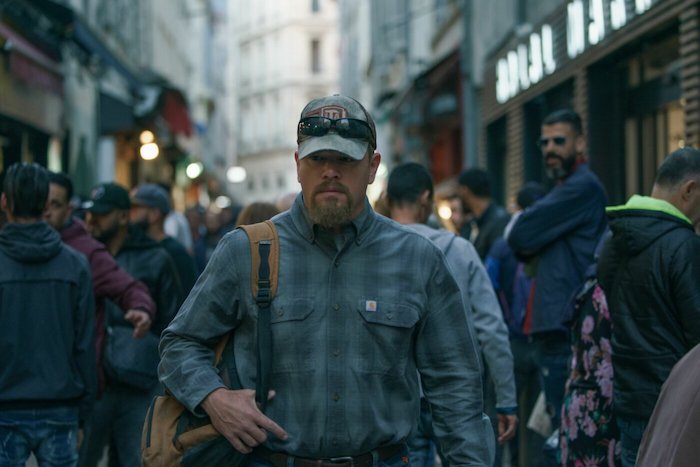
Director Tom McCarthy gives the viewer every opportunity to offer his painfully thoughtful movie every benefit of the doubt, especially in the beginning when he introduces his protagonist, Bill Baker (Matt Damon), a laid-off oil worker from Oklahoma who wears the exact same working-class, middle-American garb every day. Based on messages dispatched through the movie’s overzealous marketing campaign, Baker could be easily pegged as a MAGA maniac, though the actual portrait is more nuanced. For one thing, Baker confesses he didn’t vote in the elections of 2016, and his troubled past as an addict and felon (the reason he couldn’t vote), which destroyed his family, gives him a tragic cast that overshadows whatever sociopolitical modifiers you are tempted to attach to his personality. So when Baker goes to Marseilles to visit his daughter, Allison (Abigail Breslin), who is in prison for murdering her girlfriend, your expectations have not necessarily been set up to be subverted. 

If that were only the case. Matt Damon’s supposed turn as a red state neanderthal isn’t the only pre-release PR that misguides potential viewers. The idea that Allison’s situation is based on the Amanda Knox affair misses the mark by a mile. Though there are surface similarities, they have less to do with the actual crime than with the attendant tabloid publicity, and, in any case, the story is not about Allison, it’s about Baker and his redemption. Realizing a long time ago that he failed his daughter and perhaps drove her out of the U.S. with his neglect, he feels he needs to make amends by being there to help her with her appeal. The fact that he doesn’t speak French and looks like the kind of American who wouldn’t know a baguette from a bratwurst is used against him while simultaneously forming the bedrock of his self-determined identity, and Damon pulls it off.

But a movie that tries to get by on this kind of ironic scrutiny inevitably needs a ringer to prove its point, and so we have Virginie (Camille Cottin), a dyed-in-the-wool progressive single mother who works with immigrants and constitutionally refutes everything we are supposed to assume Baker stands for. They meet serendipitously, when Baker suddenly needs an interpreter and she just happens to be standing there. McCarthy practically ties himself in knots trying to bring these two together without resorting to outlandish contrivances, and it’s the obvious effort that makes the match less than credible. If you end up ignoring your better nature and find the resulting romance affecting, it’s because Damon and Cottin make it work despite the cliches built into their characters, and not because of the subsequent detective story to find out the truth behind Allison’s conviction. Whatever you want to say about Damon as a clueless representative of Hollywood wokeness, he nails the melancholy at the base of Baker’s lack of self-awareness, so when he comes alive to the possibilities of—for want of a better word—diversity, it’s almost touching. McCarthy counts on that revelation to deliver the bittersweet denouement, but I still had my doubts about the convoluted plot. If it was just about Baker and Virginie, I might have even choked up a bit. 

In English and French. Now playing in Tokyo at Toho Cinemas Chanter Hibiya (050-6868-5001), Shibuya Cine Quinto (03-3477-5905), Toho Cinemas Roppongi Hills (050-6868-5024).

Stillwater home page in Japanese

photo (c) 2021 Focus Features, LLC

Posted in Movies | Tagged | Leave a comment

Review: I’m Your Man

Ostensibly a romantic comedy about android love, this subversively heartbreaking German feature, written (with Jan Schomburg, based on a published short story) and directed by Maria Schrader, makes too much sense for a tale that, while remaining stubbornly cerebral to the end, is entirely speculative. It also remains consistently funny until its mid-point, when the ramifications of creating happiness inorganically overwhelms the lighter aspects of the plot. The opening scene is a corker: Archaeologist Alma (Maren Eggert) goes to a singles bar where she is formally introduced to Tom (Dan Stevens), a handsome, agreeable man whose flawless German has a slight British accent. He seems to already know Alma, though they’ve never met, and Alma becomes suspicious, not of his intentions but rather of his very being and starts plying him with ridiculously difficult mathematical problems that he solves with fluent ease. However, when he asks Alma to dance he starts repeating himself aimlessly: a glitch, because Tom is an android.

Alma knew this from the beginning and only agreed to meet Tom as a condition for receiving funding for her program to investigate cunieforms in the U.S. Her supervisor at the museum where she works, Roger (Failou Seck), is working on the android program that Tom is the product of, and needs a single woman to test Tom’s romantic capabilities. The requirement is that Alma spend the next three weeks with Tom. Only then will she get the money for her research. The setup is patently ludicrous, but within the context of the android-boyfriend dynamic, it opens up all sorts of possibilities that Schrader exploits to the max. The rub is that Alma is not that young and her romantic history is mostly taken up by one man, a fellow archaeologist named Julian, with whom she broke up only recently and who is now about to marry someone else. Later, it is revealed that Alma and Julian’s relationship was fraught with tragedy, which affected Alma much more than Julian. Tom’s programming and, by extension, his algorithms are specifically attuned to Alma’s biography and psychological profile, circumstances that form the basis for much of the comedy. The genius of this conception is that Tom’s AI immediately adjusts to changes in Alma’s mood and outlook, and he corrects himself in order to adapt to what he “thinks” pleases her, but, of course, Alma, understanding always that he is a “robot” (a term that seems to offend Tom), also understands these adjustments. (As a side note, Stevens’ German dialogue sounds post-dubbed, though it also sounds like his actual voice, and this slightly meta detail adds greatly to Tom’s credibility as a sympathetic machine.)

But halfway through, the emotional weight of Alma’s personal tribulations overwhelms her steely, anlytical resolve. Compounding her inner rage at Julian’s smooth ability to move on, she has to address her father’s encroaching dementia and a serious functional matter that may upend her research, which, after all, is the whole reason for her agreeing to be with Tom, who “comprehends” exactly what is going on but cannot approach these problems organically. Ironically, this inability to “cope” makes him more endearing to Alma, who eventually looks upon him not only as the kind of friend she needs (based, perhaps, on a childhood friend also named Tom that may have been imaginary) but also a sex partner. 

Thoughout the film, even as it turns melancholy and slightly predictable, Schrader maintains a strictly utilitarian structure that never shortchanges the characters, no matter how peripheral they are to the story. Even when the nameless woman in charge of facilitating the android project turns out to be an android herself, she retains her individuality as a character. It’s just that she’s not a human being any more, and for some reason, you don’t feel there’s anything strange about that. 

In German and English. Now playing in Tokyo at Shinjuku Piccadilly (050-6861-3011), Bunkamura Le Cinema Shibuya (03-3477-9264).

I’m Your Man home page in Japanese

photo (c) 2021 Letterbox Filmproduktion, Sudwestrundfunk

Posted in Movies | Leave a comment