Review: Hard Truths and The Roses

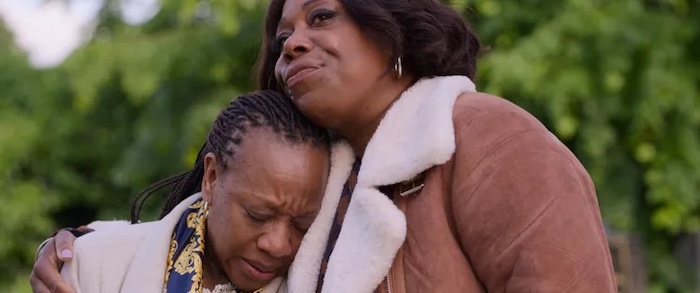
One of the many refreshing things about Mike Leigh’s cinema is the way he disregards certain prejudices in terms of plotting and characterization. There are moments during his movies when viewers may ask themselves why a certain character acts a certain way or why something happened out of the ordinary without an explanation, and Leigh won’t provide an answer. He’s got a story to tell and such considerations are beside the point in the larger scheme of things. His latest is about two Black middle aged sisters. The younger one, Chantelle (Michele Austin), has two adult daughters who are shown at work experiencing various work-related problems that aren’t developed and so feel like non sequiturs. They are also shown ineracting intimately with their mother and it seems natural to wonder where their father is. Leigh doesn’t tell you and doesn’t seem to care. Meanwhile the other sister, Pansy (Marianne Jean-Baptiste), is also shown with her family—a plumber husband, Curtley (David Webber), and an unemployed son in his early 20s, Moses (Tuwaine Barrett)—and the intrafamily dynamics there are essentially what the movie is about, but the contrast with Chantelle’s arrangement is important, and immediately brings to mind Tolstoy’s famous line in Anna Karenina about families. Whatever contributed to Chantelle and her brood’s happiness isn’t Leigh’s concern. It’s what brought Pansy and hers to such a state of abject misery.

As usual in the director’s domestic life movies, the quotidian details are paramount. Pansy lives in middle class comfort in a London suburb, but she is far from comfortable. She is, in fact, mad at everything, all the time. She wakes up in the morning as if from a horrible nightmare and faces the day as if that nightmare has followed her. Her beefs are both unassailable and pointless. She berates Moses for laying around enveloped in headphones, only leaving his room for walks to nowhere. Curtley, who is shown working hard at his job with his voluble assistant, returns home to a constant barrage of needling and fierce bitching. Pansy often naps during the day, a sign of depression, and complains bitterly of aches and pains that may or may not be psychosomatic. Leigh and Jean-Baptiste make it difficult to suss Pansy’s mindset because her behavior is so taxing to watch. In a pharmacy she aims her venomous attention at anyone who looks at her the wrong way, which seems to be everyone. She antagonizes medical personnel and insults sales staff. Her rants might be hilarious if they weren’t so relentless. In the movie’s funniest scene she trades barbs with another rager in a parking lot over a space, a cliche that Leigh handles as a kind of joke on itself, but the punch line is exhausting. Chantelle, on the other hand, lives a life of quiet accommodation, working as a hair dresser in a salon she runs. She listens patiently to her customers gossip about their love lives (“Give him ideas? I’ve got 6 kids!”) and offers sane advice when solicited for it. More significantly, she’s the only person who puts up with Pansy’s insufferable anger, and while some of the source of that anger is explained when the sisters visit their mother’s grave together, it’s obvious Pansy’s inner demons are provoked by another, more contemporary and ongoing tribulation.

Leigh eventually gets to the point, but reveals it in such a plain fashion that the viewer may not get it at first—and not without having to interrogate the central relationship, which is that between Pansy and Curtley, an even more patient being than Chantelle despite the fact that he has to put up with the storm on a daily basis. Pansy’s depression springs from a deep loneliness, but not because Curtley is abusive or neglectful. Far from it. It’s something more fundamentally irreversible and inherently tragic, and it knocks the wind out of you when you understand its provenance. It’s a very hard truth indeed, and not a particularly rare one. What’s rare is Leigh’s insightful approach.

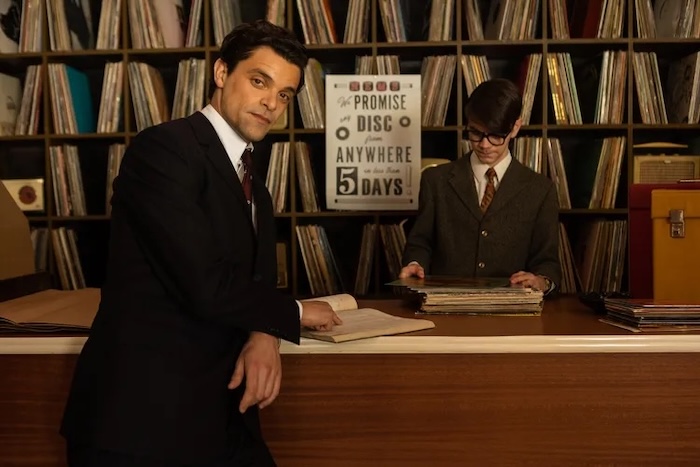
The strife that has visited the marriage of Ivy and Theo Rose (Olivia Colman, Benedict Cumberbatch) is played for laughs in a more conventional way in The Roses, even when its physical manifestation turns potentially deadly. Though clearly British, the pair live in a coastal Northern California paradise with two smart, all-American children. He’s an up-and-coming architect and she’s a world-class cook with unrealized ambitions, but Ivy’s latent frustration isn’t the reason for the couple’s mounting frictions. Theo pushes through an adventurous design for a local museum that ends up ruining his reputation, and while serendipity had much to do with the disaster, his towering ego can’t be discounted in the calculus that determines his firing. Ivy has just opened a seafood restaurant that, due to her lack of aggressive self-promotion, isn’t doing so well, but once she realizes she’s the only paycheck in the family, she doubles down and, voila!, the place becomes the toast of the Bay Area. Theo, who has taken on the double mantle of househusband and stay-at-home dad as he plots his comeback as a master builder, is thus sidelined even more as Ivy’s star rises in the hospitality trade, and therein lies the rub.

It’s also the reason why the movie doesn’t work the way its writer, Tony McNamara, and its director, Jay Roach, intend it to. Based on the same novel that Danny Devito’s caustic 1989 comedy, The War of the Roses, came from, McNamara’s script tries to contend with the changes that middle class marriage has undergone in the last 30+ years. In Devito’s movie (and presumably the novel) the wellspring of the spousal disaffection is the wife’s overflowing resentment after she concludes that she will be stuck at home for the rest of her life dependent on her husband’s financial largesse but only if she tolerates his non-negotiable emotional whims. McNamara has transferred the resentment to the husband: Theo hates that his manhood has been diminished by his wife’s success, a trite situation that the writer attempts to upend by allowing Ivy her own resentments, which are based on the notion that Theo’s effective disciplined parenting methods have turned her children into virtual strangers. 

These resentments come to a head after Theo returns to his craft by designing a gorgeous seaside mansion with Ivy’s burgeoning riches. Intramarital hatred at the service of comedy can often be liberating, but despite McNamara’s facility with the kind of witty dialogue that school-trained English thesps like Colman and Cumberbatch throw off with aplomb (after all, McNamara wrote The Favourite, the movie that gave Colman an Oscar), the situations are strained and unnatural. It doesn’t help that the supporting players, which include the usually reliable Kate McKinnon and Andy Samberg, are all American actors working in a comic vernacular that makes for painful dissonance when they come in contact with the two non-American leads, as if they couldn’t really figure out what they were supposed to be doing in the same room together. I assume the Roses are meant to be unsympathetic characters, which is why their vitriol is played so monumentally, but I’m not sure if the actors know that.

Hard Truths now playing in Tokyo at Shinjuku Cinema Qualite (03-3352-5645), Cine Switch Ginza (03-3561-0707).

The Roses now playing in Tokyo at Toho Cinemas Nihonbashi (050-6868-5060), 109 Premium Cinemas Shinjuku (0570-060-109), Shinjuku Piccadilly (050-6861-3011), Shibuya Parco White Cine Quinto (03-6712-7225), Toho Cinemas Roppongi Hills (050-6868-5024).

Hard Truths home page in Japanese

The Roses home page in Japanese

Hard Truths photo (c) Untitled 23/Channel Four Television Corporation/Mediapro Cine S.L.U.

The Roses photo (c) 2025 Searchlight Pictures

Posted in Movies | Tagged , , , , , | Leave a comment

Media watch: Citizens demand end of immigration policy that doesn’t exist

Tokyo Immigration Services building

One of the two women that Japan’s first female prime minister, Sanae Takaichi, has appointed to her cabinet is Kimi Onoda, who will be in charge of promoting “orderly coexistence with foreigners.” Onoda, who was born in the U.S. to a Japanese mother and an American father, has adopted as the motto of her ad hoc portfolio “Zero Illegal Foreigners,” which means she will work to deport any non-Japanese person who is in Japan without authorized permission to be here. 

As anyone who has read a Japanese newspaper or watched a Japanese newscast since the campaign for the Upper House election last summer knows, foreigners in Japan has been the issue du jour, whether the foreigners are tourists or de facto residents. The reason is the ascendancy of Sanseito, whose campaign slogan was “Japanese first,” implying that they would work to regain the primacy of native people in a country where foreigners have supposedly been granted special privileges. Some of these privileges could more accurately be described as loopholes that a small subset of foreigners have indeed taken advantage of, but for the most part Sanseito’s campaign fed off the latent anxiety across the population, which was caused by the huge influx of foreign tourists over the past few years, a situation that has been exacerbated by uniformly negative media coverage, mainly about rude foreign tourists. This anxiety was seized upon by anti-foreigner elements who wish to curb the introduction of low-paid foreign workers to make up for acute labor shortages and deport people who came to Japan to escape persecution in their own countries. Misleading news stories were reposted ad nauseum through social media, much of it by Russian bots, about problems caused by foreigners and government programs that were believed to be encouraging immigration though they did not, such as the long-standing hometown exchange program devised by the Japan International Cooperation Agency to promote cooperation between Japanese municipalities and places in Africa. But the ruling Liberal Democratic Party did not clear up the misinformation and, in fact, adopted the Sanseito credo as its own after the upstart party performed better than expected in the election, believing that it reflected the sentiments of the people. Newly enlightened members of the public who came out vociferously against Japan’s immigration policy did not realize that, in fact, there is no immigration policy. If anything, immigration became stricter two years ago when the LDP revised the relevant law. 

An article in the Oct. 10 Asahi Shimbun discussed the Zero Illegal Foreigners plan, which started in May after Sanseito’s campaign demonstrated real forward momentum. Deportations have indeed increased in the subsequent three months, though not anywhere near the levels achieved by the current Trump campaign in the U.S. to deport undocumented foreigners. From June through August, 119 foreign nationals, accompanied by immigration agents, were deported from Japan, all of it paid for by the state. During the same period in 2024, 58 foreign nationals were deported. By nationality, the June-August 2025 deportations included 34 Turks, 17 Sri Lankans, 14 Filipinos, and 10 Chinese. Thirty percent of these people had applied for refugee status, thus marking a significant change from the past, when deportations could not be carried out while a decision on refugee status was pending. Two years ago the government revised the Immigration Law to allow deportation after 3 unsuccessful bids for asylum even if a new application had been submitted. An applicant can also be deported if they have been found guilty of a crime. During the entire first year after the revision went into effect, a total of 25 people whose applications were still pending were deported, whereas 36 whose applications were still pending were deported between June and August of this year. 

Continue reading
Posted in Media | Tagged , , , | Leave a comment

Review: The Conjuring: Last Rites

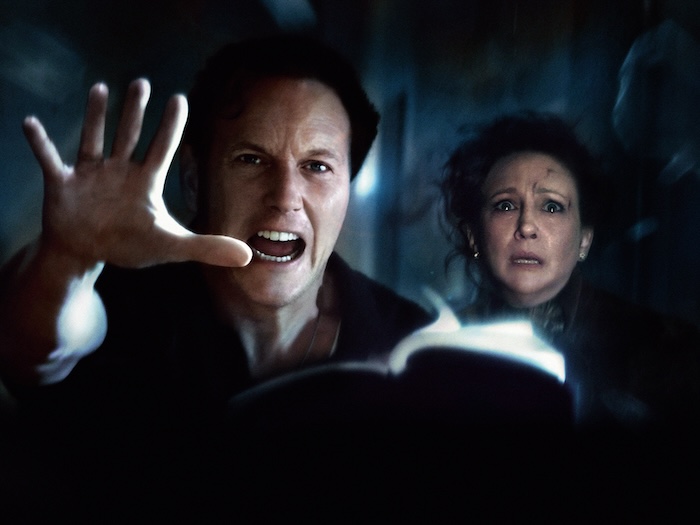
I have not followed the Conjuring franchise so far and was taken aback by the conceit that it is based on the adventures of a real life married couple, Lorraine and Ed Warren, who performed exorcisms starting in the 1950s and wrote books about it. Paranormal skeptic that I am, I felt somewhat intimidated by Last Rites‘ attitude that the viewer should take it for granted that the Warrens were the real deal, something that other movies of this ilk never really did, even the original Exorcist, which, while based on a novel, was grounded in Catholic dogma, and so its portrayal of supernatural phenomenon had a certain structural integrity to it. I was expecting something similar from this supposed final installment in the Warren saga (it would appear the franchise itself will continue with other characters), but in the end I failed to locate any kind of rationale that would make sense of what happened in the story.

And the story is comprehensive, starting in 1964 during an exorcism of a possessed mirror that sends the pregnant Lorraine (Vera Farmiga) into labor and nearly kills her and her baby daughter. Of course, the mirror reappears in the couple’s life many years later after that daughter, Judy (Mia Tomlinson), has grown into an adult and Lorraine and Ed (Patrick Wilson) have basically retired from the “ghostbusting business,” a term used derisively by some college students who attend their lecture. One of the reasons for quitting their vocation is that Ed has developed a serious heart condition that could trigger a massive heart attack during, well, contact with evil spirits, and, from the look of things, the spirits are always evil. The mirror comes into play when it’s bought by an extended working class family in the industrial heartland of Pennsylvania in the 80s as a graduation present for one of their daughters, who promptly starts having troubling visions. As the visitations become more intense and affect other family members, a priest is called in to investigate. He subsequently commits suicide under suspicious circumstances, and the Warrens receive a phone call (the priest was an acquaintance, since Ed is the only non-Catholic to whom the Church has granted exorcist credentials) for their assistance in the matter. Though at first they decline, once they are forced to confront the family they realize that the demons in the mirror are causing mischief expressly to get to the Warrens so that they can finish what was started in 1964. 

Whatever real life story is behind this plot, the director, Michael Chaves, does a decent job of laying it out in a way in which all the disparate elements converge so that the Warrens and their ectoplastic nemeses reunite, but after that point things become narratively dodgy. The frights, which have so far been few and far between, increase in frequency and intensity once the Warrens produce their bag of tricks and get to work, but the reasoning behind their methods never come across the way the two priests’ methods did in The Exorcist and its cinematic progeny. At least William Peter Blatty conveyed the historical and religious concepts behind the Church’s means of fighting evil forces that manifest as existential threats. It’s hard to know what sort of rule book the Warrens are following as they try to draw out and banish the spirits of the mirror, which are determined, it turns out, to kill Mia. Consequently, I derived no real satisfaction in their somehow figuring it out, and that’s always the problem with supernatural horror: Writers and directors can do anything they want in order to produce disturbing images and sounds because the supernatural, by definition, does not follow plausible laws. But thrillers, also by definition, must in some way follow an internal logic, and Last Rites had none that I could discern. It’s a lot of sound and fury directed toward an outcome where Mia and her new husband are poised to take over the family business and, thus, the franchise. 

Now playing in Tokyo at Toho Cinemas Hibiya (050-6868-5068), Marunouchi Piccadilly (050-6875-0075), 109 Cinemas Premium Shinjuku (0570-060-109), Shinjuku Piccadilly (050-6861-3011), Toho Cinemas Shinjuku (050-6868-5063).

The Conjuring: Last Rites home page in Japanese

photo (c) 2025 Warner Bros. Entertainment Inc.

Posted in Movies | Tagged , , | Leave a comment

Review: Eephus

Because of Hollywood, American movies are considered the default cinematic form, meaning any other kind needs to be qualified first; but there are enough American movies that fall outside the perceived Hollywood norm to constitute their own collective genre. This odd indie film about two amateur baseball teams playing the last game on a hallowed community field that’s about to undergo redevelopment sometime in the 1990s is so American in vibe and look that it feels like an outlier. Even I, who was born and raised in a milieu not much different from the movie’s Massachusetts setting, experienced some discomfort in my acknowledgment of the way it accurately depicted a certain by-product of American manhood, an acknowledgment that was mainly felt in the bones. 

Eephus, which refers to a pitch that’s so slow as to be almost supernaturally imbued, is a comedy with a lot of jokes but no punch lines, unless you consider the notion that the men on display, most of them middle aged and in bad health, have nothing to look forward to after Soldier’s Field is torn up for the sake of a new middle school is a truth that’s more comical than bitter. The thick atmosphere of small town New England is immediately manifest with the help of a local radio station (whose announcer’s voice is provided by no one less than documentary god Frederick Wiseman) and its surfeit of ads for local restaurants and auto parts stores. The first person we meet is Franny (Cliff Blake), the guy who keeps score for the games seemingly for his own amusement, though eventually he’s called on to umpire when the longhair who’s being paid to officiate walks off because the game has gone on longer than his agreement allows. The two teams, one seemingly unaffiliated, the other sponsored by a paint store, chug beer throughout the day, with one team’s pitcher doing his stuff while becoming increasingly inebriated. There’s one player who is actually nominally qualified to be a pro since he’s on a college team somewhere, but his youth automatically makes him not only an exception but a ringer. The guys use these games less as a means of physical recreation than as an excuse to get out of the house and away from the sublimated pressures of raising families and holding down jobs they hate; and what becomes clear as the very long game proceeds through the afternoon, past twilight, and into the night is that, despite their constant bellyaching, they don’t want it to end because once it does they will have no outlet with which to release their frustrations about what their lives have become. The jokes are all on them, and as darkness descends their situation turns from comically quotidian to comically desperate, and in a very American way. 

That’s because director Carson Lund’s script, written with two other men, taps directly into that unique form of American male loneliness. These guys bitch and moan and get on one another’s case for being fat and out-of-shape, but the forced enmity exposes the feeling that they know they likely won’t have any reason to see one another again after this game because they can’t admit that their lives are somehow incomplete. They could always just call and get together for a beer, you think to yourself as they leave the field for the last time in their respective vehicles, but this is the decade before the ubiquity of the cell phone, a technology that kept everyone connected but contrarily encouraged social atomization. Without the premise of an organized excuse, they have no impetus for contact. Eephus shows, albeit indirectly, just how we got to that point spiritually and culturally.

Opens Oct. 17 in Tokyo at Shinjuku Piccadilly (050-6861-3011), Human Trust Cinema Shibuya (03-5468-5551). 

Eephus home page in Japanese

photo (c) 2024 Eephus Film LLC

Posted in Movies | Tagged | Leave a comment

Review: Holy Cow and Brand New Landscape

Work, as the Nazis used to say, will make you free, though it depends on which end of the whip you’re on. A lot of it has to do with milieu. Louise Courvoisier’s continually surprising coming-of-age tale, Holy Cow, is set in the present-day agricultural region of eastern France, specifically among dairy farmers. Work isn’t so much punishing as it is merely less rewarding than the effort would seem to promise. Consequently, the characters are unsophisticated in a stereotypically rural way but hardly hicks or pushovers. They live even harder than your typical urban blue collar drone, drinking to excess nightly, brawling with gusto, and rutting, literally, til the cows come home. Eighteen-year-old Totone (Clément Faveau) is almost a steel-hardened example of the species. We first view him at a fair playing a drinking game that he loses, thus forcing him to strip naked in front of a crowd, which he does gleefully. The gambit works in the sense that he goes home with a girl but is too drunk to get it up and ends up sleeping on the street. It isn’t clear at this point whether Totone is in school or working, but it doesn’t matter because in short order his father dies in a car crash—not a shock, since the father was drunk himself—and he is forced to find work to support himself and his 7-year-old sister, Claire (Luna Garret). He gets offered a job at a cheese factory, which, unfortunately, is managed by the father of two boys who recently had a violent run-in with Totone and who make his work life miserable.

It’s difficult to assess whether Totone’s occupational screwups are intentional or come down to willful incompetence, but given his combination of native intelligence and short temper it’s likely both, and he’s soon out of a job, after which he cooks up a plan to make his own Comte cheese in a bid to win a local contest and a mess of euros that will keep him and Claire solvent for an indefinite period. From the beginning, it’s a naive expectation and turns into a desperate one when he runs up against a fundamental problem: He doesn’t have the cows to produce the milk and no money to buy it. So, of course, he steals it from his former employer with the help of his two partners-in-crime, Jean-Yves (Mathis Bernard) and Frances (Dimitri Baudry), while using sex to distract his old boss’s daughter, Marie-Lise (Maïwéne Barthélemy), who performs the dairy’s grunt work. Though there’s a farcical quality to the storytelling, Courvoisier dispenses with the predictable virtue arcs in terms of Totone’s attitude toward hard work and even sexual love. There’s something admirably real world about his trajectory, and you grow to respect him not because of what he learns, but because of what he endures. In a corny sense, he takes it like the man he has finally become.

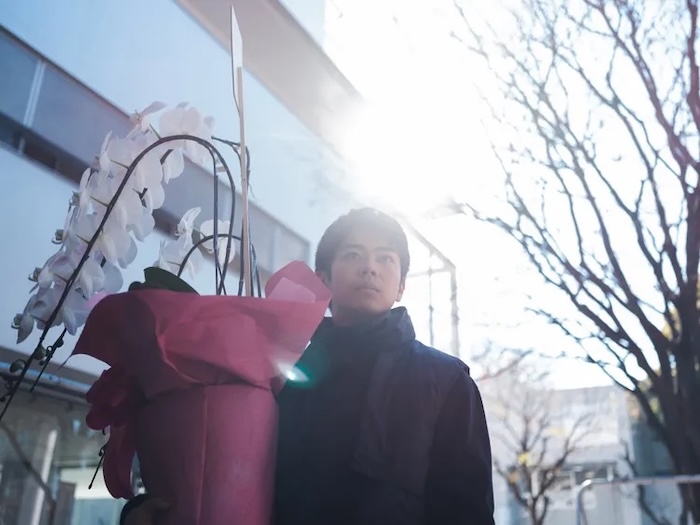
Work of a less taxing nature sets the theme for the Japanese film Brand New Landscape. Ren (Kodai Kurosaki) works for a Tokyo florist delivering arrangements to businesses throughout the city. During one delivery to an awards function, he discovers that his estranged father is back in the capital and about to open a landscape design office. In the opening sequence, we witness the event—a family getaway to the mountains—that caused the rupture between Ren’s parents which led to the estrangement: Ren’s father put work above family, and moved to Singapore to make his name. In the meantime, his mother has died and his sister is moving toward marriage while Ren remains stuck in a state of inertia that is shaken by his father’s reappearance. 

The first-time director, Yuiga Danzuka, mining reportedly autobiographical material, does a neat job of incorporating every character’s approach to work into what is essentially a family potboiler. We soon learn that the father (Kenichi Endo) has moved to Tokyo to supervise the controversial razing of a park in Shibuya that is being replaced by a commercial redevelopment project, thus displacing a number of homeless people, and that he is receiving pushback not only from the community but from one conscientious employee; a dynamic that emphasizes the self-aggrandizing attitude that destroyed his family. Ren and his sister contentiously discuss reconciling with their father and can’t quite come to terms with their lingering resentments, but more out of a lack of commitment—Ren has already been fired for what can be described as a terrible attitude—than any kind of trauma-based angst as a result of what they went through as abandoned children. There’s a lot going on in Brand New Landscape that’s interesting, especially its depiction of Tokyo’s ever-changing environment, but the story never fulfills its potentials. It’s as indecisive as its central character.

Holy Cow, in French, now playing in Tokyo at Human Trust Cinema Yurakucho (03-6359-8608), Cinema Qualite Shinjuku (03-3352-5645), Human Trust Cinema Shibuya (03-5468-5551). 

Brand New Landscape, in Japanese, now playing in Tokyo at Bunkamura Le Cinema Shibuya Miyashita (050-6875-5280), Shinjuku Musashinokan (03-3354-5670). 

Holy Cow home page in Japanese

Brand New Landscape home page in Japanese

Holy Cow photo (c) 2024 – Ex Nihilo – France 3 Cinema=Auvergne-Rhone-Alpes

Brand New Landscape photo (c) 2025 Siglo/Repro Entertainment

Posted in Movies | Leave a comment

Review: Grand Tour

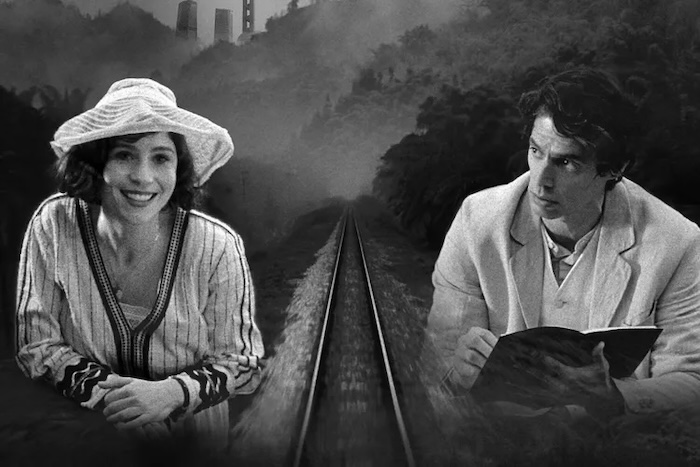
Portuguese critic-turned-director Miguel Gomes is comfortable with anachronism. It was the most obvious narrative device in his era-splitting breakthrough Tabu, and in his latest movie it’s essentially a theme. The title refers to a famous travel itinerary available to Europeans who wanted to see Asia in the early part of the 20th century, when much of the continent was still under colonial control. The tour covered all the major capitals, from Singapore and Manila to Osaka and Shanghai. Gomes uses the tour structurally in telling a story about a British colonial factotum who flees the arrival of his fiancee and does the tour, albeit informally and on the cheap, with the fiancee following close behind. Gomes alternates black-and-white recreations of the drama with 21st century documentary footage of the locations covered, thus offering a kind of comment on what the colonials never got about the places they ruled. 

It’s never entirely clear why Edward (Gonçalo Waddington) decides he can’t face his betrothed, Molly (Crista Alfaiate), from whom he’s been separated for some time. The easy answer is that he’s simply a coward who can’t face up to commitment, but with each step of his journey he goes further into a kind of black pit of no return. Traveling from Singapore to Bangkok, his train derails and instead of waiting for help he hires a native to take him through the jungle. In Manila, where we are treated to real modern cock fights, he remains in a constant state of inebriation, and after arriving in Osaka escapes the Japanese authorities by hiding out in a rural temple with a bunch of monks, one of whom happens to speak his language (though the white characters are all supposed to be British, they converse in Portuguese). This mood of fatality is enhanced by the voiceover narration, which is all presented in the language of the place being depicted, and in a kind of heightened literary tone, as if written by an overarching novelist. The second half of the film traces Molly’s pursuit of Edward along the exact same route, but her journey is not desperate. It’s more sympathetic, as she encounters souls who try and usually fail to make her understand the places she visits. 

Because Gomes treats the basic melodrama as farce, the colonial comments don’t always hit with as much force as they could, and a lot of Grand Tour comes off as a kind of paste-up travelogue. He doesn’t attempt to mediate the sensibilities of natives and colonists—the latter complain of the smells and inscrutability of the locals, and none think that any of the latter are there to be anything other than disposable servants. It is this aspect that the documentary elements are meant to contrast, by showing the people who live in these cities at home in an environment the colonialists abandoned out of frustration rather than conscience. In its own odd way Grand Tour is a lushly beautiful production about European stupidity, because in the end both Edward and Molly are lost to their hubris. They venture too far into a universe they don’t understand and which doesn’t want them. 

In Portuguese, Burmese, Vietnamese, Mandarin, French, Spanish, Japanese and English. Opens Oct. 10 in Tokyo at Toho Cinemas Chanter Hibiya (050-6868-5001), Bunkamura Le Cinema Shibuya Miyashita (050-6875-5280).

Grand Tour home page in Japanese

photo (c) 2024-Uma Pedra No Sapato-Vivo film-Shellac Sud-Cinema Defacto

Posted in Movies | Tagged | Leave a comment

Review: One Battle After Another

Though I’ve little use for wholesale creative comparisons, the critical observation that Paul Thomas Anderson is this century’s Stanley Kubrick makes a certain kind of sense, if only because no other contemporary director comes close to Kubrick’s playful eclecticism, especially in terms of story material. Though one could make a case for a commmon theme or mood that dominates Anderson’s oeuvre, he never repeats himself when it comes to subject matter, until now. One Battle After Another is Anderson’s second Thomas Pynchon adaptation, a feat in itself since Pynchon’s wild and woolly fiction seems all but impervious to adaptation. Moreover, Inherent Vice and Battle (based “loosely” on Vineland) are both what you would call genre exercises—the former a detective mystery, the latter a large-scale action movie complete with big explosions, gunplay, and car chases. In the end they are totally different in style and effect, but they retain Pynchon’s penchant for the absurd in ways that show how much work Anderson put into them. 

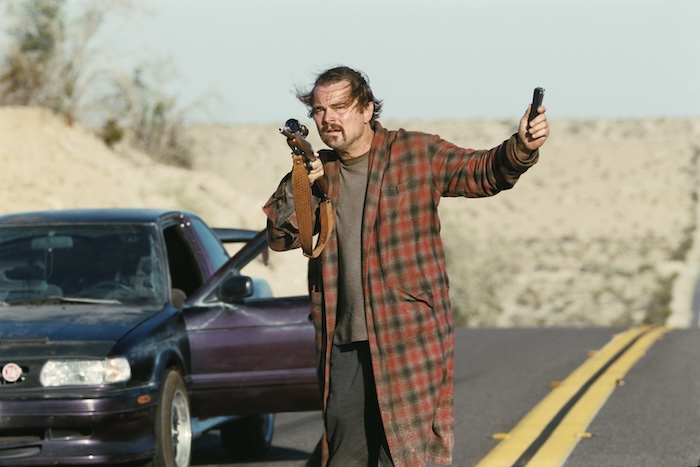
And as a genre exercise, Battle may well be Anderson’s most conventional film in that its plot, while not entirely predictable, follows the formulaic development of an action flick. The prologue, as it were, is the best and most exciting part. Opening in the middle of a raid on an immigrant holding facility in what looks like the southwest U.S. by a radical left wing group called the French 75, the story injects us directly into what looks like an extreme partisan struggle for the soul of America, and you’ll have to decide for yourself if it looks at all like the struggle America is going through now. The two members of this group Anderson is most interested in are Perfidia Beverly Hills (Teyana Taylor), a no-holds-barred Black antifascist warrior with a thing for humiliating her enemies, and the white explosives operative called Ghetto Pat (Leonardo DiCaprio). These two are in what at first feels like an unlikely romantic relationship. However, during the raid, Perfidia comes across the super-macho Col. Steven Lockjaw (Sean Penn), whom she mocks sexually for fun and, inadvertently or not, turns him on. Before the title credit is even shown, there’s a rapid-fire montage showing Perfidia and Lockjaw in an occasional wild affair unbeknownst to Pat, Perfidia giving birth to a daughter, and Perfidia getting caught and ratting on her associates before disappearing into Mexico. 

The movie proper takes place 16 years later, when the child has grown into a teenage firecracker taking care of Pat, now passing as Bob Ferguson, who has turned into a stoned slacker. Lockjaw has in the meantime endeavored to join a super secret white supremacist cabal, and has been doggedly looking for the fugitive remnants of the French 75 for years, though not for the ostensible reason of wiping out antifa elements (though he very much wants to) but rather because he suspects Bob’s daughter, Willa (Chase Infiniti), may actually be his. For the most part, Anderson presents this premise without a lot of stylistic elaboration, and his action set pieces are brilliantly rendered with a cockeyed verve that plays off the various invented Pynchonisms (the white supremacist group is called the Christmas Adventurers; a convent that shelters undocumented immigrants and leftist fugitives goes by the name of Sisters of the Brave Beaver) and distinctive characters, like Benicio Del Toro’s coolly resourceful karate instructor, who keep the action moving at a rapid but coherent pace. As an action movie, One Battle After Another is extremely satisfying.

And as countless media profiles have already pointed out, it’s also thematically rich, though that would seem to go without saying given the times we live in and Anderson’s choice of updating Pynchon’s story from the 80s to a kind of hyperventilating now. There’s no way a director as thoughtful and imaginative as Anderson would not take advantage of this material to comment on our current predicament, no matter how much he downplays the notion in interviews. So for me, at least, the immediate appeal of the movie is as a genre exercise, and as such it doesn’t quite stick the landing. There’s a two-pronged post-climax coda that feels superfluous and long-winded, as if Anderson felt beholden to certain genre requirements he couldn’t in good conscience subvert. As a director who always identified closely with the people who sit in a movie theater, he seems to have gone a step further by attempting to please everyone, which is, of course, impossible.

Now playing in Tokyo at Toho Cinemas Nihonbashi (050-6868-5060), Toho Cinemas Hibiya (050-6868-5068), Marunouchi Piccadilly (050-6875-0075), 109 Cinemas Premium Shinjuku (0570-060-109), Shinjuku Wald 9 (03-5369-4955), Shinjuku Piccadilly (050-6861-3011), Toho Cinemas Shinjuku (050-6868-5063), Human Trust Cinema Shibuya (03-5468-5551), Toho Cinemas Roppongi Hills (050-6868-5024).

One Battle After Another home page in Japanese

photo (c) 2025 Warner Bros. Ent.

Posted in Movies | Tagged , , , , | Leave a comment

Review: Julie Keeps Quiet

Sports movies usually have a common narrative arc about overcoming adversity, one which this Belgian film refuses to follow almost constitutionally. The title character, played by Tessa Van den Broeck, is a teen tennis prodigy. Everyone knows she’s on the road to greatness and is about to be accepted by the Belgium Tennis Federation, but then her coach, Jeremy (Laurent Caron), disappears amid whisperings of inappropriate behavior toward his younger charges and an investigation that eventually snags on Julie, who refuses to talk about him. That’s pretty much the plot.

The main impetus for the investigation is the suicide of another of Jeremy’s students, but even this story is surrounded by hushed innuendo rather than anything that can be definitely determined. Consequently, Julie’s silence becomes all the more irksome to the people whose job it is to keep the Belgian professional tennis mechanism humming, and she is soon a kind of pariah, forced to train with a new coach (Pierre Gervais) whose methodologies are different from Jeremy’s. She doesn’t like working with him at first and mostly practices on her own. Her grades suffer and even her relationship with her supportive parents is strained to the breaking point. Meanwhile, we come to understand that she is actually in contact with Jeremy, who urges her to stay silent. He is still coaching her in a sense, and yet the viewer doesn’t get the idea that Julie is being manipulated. If anything, her reticence is another facet of the singular discipline that has made her a tennis star: She won’t talk because she has decided she isn’t going to be told what to do. In one revealing scene, she drops her guard to a friend and says she feels persecuted, that the federation’s pressure for her to talk is all about class, since she is a scholarship case rather than a kid from a well-to-do family, which describes most of the other budding pros her age. To people outside and, to a certain extent, the audience Julie seems to be protecting a sexual predator, which, of course, poses questions about the nature of Julie’s and Jeremy’s relationship, questions that become more pointed when the two secretly meet in a cafe and Jeremy’s desperation becomes apparent. Whether he is a serial abuser is still up in the air, but he’s obviously a creep. “I stopped,” he says defensively. Stopped what? 

What makes Leonardo van Dijl’s feature debut so arresting is the skillful way he juggles the politics of managing a sports scandal with one athlete’s refusal to engage in those politics while staying true to her athletic ambitions. As Julie’s silence deepens, the tension becomes unbearable, until you wonder if even a hard case like Julie won’t break. But the movie doesn’t necessarily go where you expect it to. The new coach eventually breaks through Julie’s self-regard, and while the movie loses momentum in the process, it feels more naturalistic, as if van Dijl knew he had to sacrifice a measure of drama in order to stay true to Julie’s own arc of self-discovery.

In Dutch, French and German. Opens Oct. 3 in Tokyo at Shinjuku Cinema Qualite (03-3352-5645), Human Trust Cinema Yurakucho (03-6259-8608).

Julie Keeps Quiet home page in Japanese

photo (c) 2024, De Wereldvrede

Posted in Movies | Tagged , | Leave a comment

Review: Midas Man and Becoming Led Zeppelin

Midas Man, a biopic about Beatles’ manager Brian Epstein, received a qualified rave review from veteran rock critic Greil Marcus this summer. Marcus saw the movie at a film festival in California, and at the time it had not been released in theaters in the U.S.; nor did it seem to have a streaming deal. It had only been shown on Prime Video in the U.K. A month or so later, a reader wrote to Marcus saying that the movie was available in the U.S. on YouTube, but Marcus countered that the YT version was only 90 minutes and the real movie was almost two-and-a-half hours long, so you couldn’t compare the two. The version being released in Japan is 112 minutes, the same length that’s listed on the film’s IMDb page, so I’m not sure if what I saw is the real deal, but Beatles’ fans will probably not be sorry if they search it out, wherever they are. It’s by no means a great film, but it’s got some great sequences that add something to the mythos which doesn’t feel like fronting.

Jacob Fortune-Lloyd plays Epstein as a preternatural epicure, a choice that emphasizes those stereotypical qualities often associated with a certain type of gay man. And it’s this aspect that the filmmakers focus on in Epstein’s interest in the Beatles as something he wanted to be part of, despite the fact that their group sensibility was so opposite of his own. Epstein is from a good, middle class Jewish family in Liverpool and he manages the family’s furniture shop with a keen eye not only for the aesthetic attributes of his merchandise but a level-headed business sense that makes the shop profitable. One of his ideas is to carve out a section of the store for records, since he recognizes in the tastes of his fellow young people a yearning for foreign music. One day, he happens on a crude single from Hamburg by a quartet of Liverpudlians and buys as many copies as he can for his store. Then he goes to see the group at a local club and instantly understands their appeal. He begs them to dump their current, ineffectual manager (played by Eddie Izzard with a kind of growling cynicism) and take him on. They do, grudgingly. He may be too posh for their tastes, but he’s definitely in their corner. The contrast is thus set—the brash, irreverent Beatles versus the businessman with an eye for beauty and a certain predatory facility. (His negotiation with Ed Sullivan is brilliant, though Jay Leno wrecks the scene by portraying Sullivan as a mafia don) From there, the movie scans the well-known points of development—the fitful search for a record company, the replacement of Pete Best by Ringo, the flowering of Beatlemania, the conquering of America—while showing explicitly how it affected Epstein the closeted gay man with a gambling jones, who suffered blackmail and depression when his father (Eddie Marsan) rejected who he really was. In the meantime, the Beatles themselves grew to not only respect his guidance, but came to love him as a kind of older brother figure.

Due to the production’s budgetary or permission issues, the fake Beatles do not play any of the group’s original songs, but they perform a bunch of covers the Beatles made famous and do a creditable job of it. The version of “Money” may not be definitive, but it’s played at full length, punctuating the importance of the milieu the group was working in: They made honest, enjoyable music for young people whose parents couldn’t stand what they stood for, at least initially. Midas Man itself often feels as if it could learn something from this example. It’s too rooted in Epstein’s emotional landscape, even though it often makes fun of that landscape in its visual choices, thus trivializing the tragedy his life became. 

There is a minority critical opinion that Led Zeppelin was the only other band whose artistic contributions to rock were as momentous as the Beatles’. The authorized documentary Becoming Led Zeppelin makes this case up to a point by chronicling in detail how the group came into being, but the contrast with the Fab Foud couldn’t be starker. The Beatles invented themselves as a group from scratch, and with the exception of Ringo each member learned his craft in the band. Led Zeppelin’s members were all fully formed musicians when they got together in 1968 under the auspices of Jimmy Page, who had replaced Jeff Beck as lead guitarist of the Yardbirds in that group’s final incarnation. When the Yardbirds folded, Page needed a new gig and recruited bassist/arranger John Paul Jones, whom he knew from session work. Terry Reid, Page’s first choice for vocalist, had other plans and recommended Robert Plant, who brought along John Bonham, whom he had played with in a short-lived R&B band. 

The doc interviews all three surviving members separately and uses snippets of old interviews with Bonham, who died in 1980. It’s all so positive and peppy, and since it only goes as far as 1970 after the release of their breakthrough album, Led Zeppelin II, you get none of the drugs and sex stuff (with underage girls, no less) they were famous for. In fact, it’s all about business, another aspect that distinguishes them from the Beatles. As Page explains it unironically, the formation of the group was more a matter of commercial calculation than creative endeavor. They set their sights on America even before their native UK, specifically Atlantic Records. When they negotiated with Jerry Wexler they already had a finished album to give him. Page was intrigued by the burgeoning FM radio culture, “which played whole sides of albums.” He was sick of the idea of having to come up with hit singles, which is what manager Mickey Most insisted on with the Yardbirds. Consequently, Led Zep conquered America first—and easily, according to the doc—before they even played England. 

The only really interesting thing about the band’s early trajectory is that the first album was roundly panned, though because of the hagiographic nature of the production no one bothers to try and figure out why. It’s not a movie that’s interested in analysis. It’s merely self-congratulatory. 

Midas Man now playing in Tokyo at Toho Cinemas Chanter Hibiya (050-6868-5001), Cinemart Shinjuku (03-5369-2831), Human Trust Cinema Shibuya (03-5468-5551).

Becoming Led Zeppelin now playing in Tokyo at Toho Cinemas Hibiya (IMAX, 050-6868-5068), 109 Premium Cinemas Shinjuku (0570-060-109), Toho Cinemas Shinjuku (IMAX, 050-6868-5063), Shibuya Cine Quinto (03-3477-5905), Toho Cinemas Roppongi Hills (050-6868-5024). 

Midas Man home page in Japanese

Becoming Led Zeppelin home page in Japanese

Midas Man photo (c) Studio Pow (Epstein) Ltd. 

Becoming Led Zeppelin photo (c) 2025 Paradise Pictures Ltd. 

Posted in Movies | Tagged , , , | Leave a comment

Review: I Saw the TV Glow

Now that he’s dead, all us habitual moviegoers live in the shadow of David Lynch if only because Lynch was the predominant filmmaker of the last 40 years or so whose vision was not only unique but impossible to get away from. It wasn’t his style so much as his particular view of the world as a scary place, which informed even those scenes that conveyed his child-like appreciation of creative endeavor. Jane Schoenbrun, in their second feature, I Saw the TV Glow, gives off a similar vibe, not in the material or even in the creepy atmosphere they create, but in the way they explore possibilities no one has thought of before. Set in the 90s, Schoenbrun’s movie fixates on that point in time when video had become not just an alternative world for some people, but the whole world, a transition that would eventually morph into the screen obsessions we currently can’t avoid. The Japanese title of Schoenbrun’s film is more descriptive of the movie’s intent: I Want to Enter the Television.

The narrative is nothing more than a life trajectory that rejects self-analysis. We first see Owen as a teenager who is so obsessed with a certain late-night TV series called The Pink Opaque that he sneaks out of his house at night to watch with an older, disaffected girl named Maddy (Brigette Lundy-Paine). The series is never explained in any thorough way, and the viewer only sees snippets, but it seems to be a Lynchian production in that it has occult doings and insecure young people figuring out their sexuality. Owen (Justice Smith) becomes so smitten that over the course of adolescence and beyond he continues watching the show long after it’s cancelled and he himself has started contemplating his own gender fluidity. As a teenager, Owen uses The Pink Opaque to come to terms with his boring, conventional suburban milieu, a situation that apparently had already defeated Maddy, who becomes cynical in the process. The pivotal moment in the film has Maddy asking Owen if he prefers girls or boys, and Owen answers matter-of-factly that he prefers TV shows, meaning he recognizes in TV characters those insecurities he feels himself but lacks the capacity to deal with in a natural, organic way. He can only identify and feel them, so when he gets older they’re still there, gnawing at his soul.

Though Schoenbrun successfully puts across the emotional turmoil of Owen’s life, the scary stuff—meaning the touches that Lynch seemed to pull off by instinct—often feels forced, and as the movie progresses Owen’s disconnections become less distinct. I understood that Owen felt his life had run up against a wall, but couldn’t make sense of it. Perhaps I Saw the TV Glow requires multiple viewings in order for any sense to come into it, but Lynch famously rejected sense, which is one of the qualities that made him great as a filmmaker. I think Schoenbrun hasn’t achieved the kind of inherent confidence that comes with a mindset that’s as free as Lynch’s was, but they’re on their way. 

Opens Sept. 26 in Tokyo at Human Trust Cinema Yurakucho (03-6259-8608), Kino Cinema Shinjuku (03-5315-0978), Human Trust Cinema Shibuya (03-5468-5551).

I Saw the TV Glow home page in Japanese

photo (c) 2023 Pink Opaque

Posted in Movies | Tagged | Leave a comment