BIFF 2021: Oct. 9

(c) BIFF

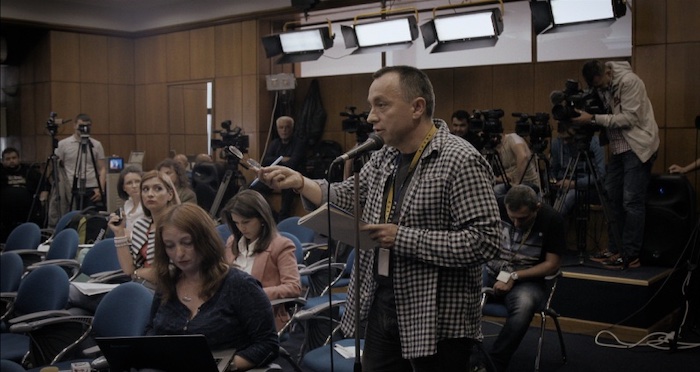
The 26th edition of the Busan International Film Festival started last Wednesday with the usual red carpet ceremony and opening film extravaganza, and according to the organizers the festivities this year are back up to speed after last year’s severely curtailed doings owing to the COVID-19 pandemic. Nevertheless, I am not there because there are still restrictions regarding foreign visitors to South Korea, not to mention restrictions on Japanese residents returning home from overseas for whatever reason. So I’m stuck in my little office in Inzai trying to follow the festival (my first was in 2001). Unlike last year, I was not offered access to the online market screenings to which the non-attendant press are entitled with a special code. I informed the press office of this oversight and they were kind enough to set up a system so that I could receive screeners of whatever films I wanted to see that happened to be available, which means not all of them. I feel bad because it obviously required more work on the part of the foreign press office (NDAs, contacting each film’s distributor for permission, etc.), but so far they’ve sent me links to four films with, I hope, more to come. 

To say the least, I feel strange not being there. This time of year I’m always there, and I feel even more disappointed than I did last year, probably because I know the festival this time is almost back to full strength. Moreover, since the last time I was at the festival, Parasite won the Best Picture Oscar and Squid Game has taken over the world (there’s even a new section this year dedicated to new TV dramas). Those of us who’ve always known how special Korean cinema is have finally been vindicated, and it would have been great to share in that sense of achievement after all these years. I’ve been in touch with a few people who are also regulars of BIFF and who feel the same way, so we’re all hoping that next year things are back to “normal,” if such a thing is possible in a post-COVID world. 

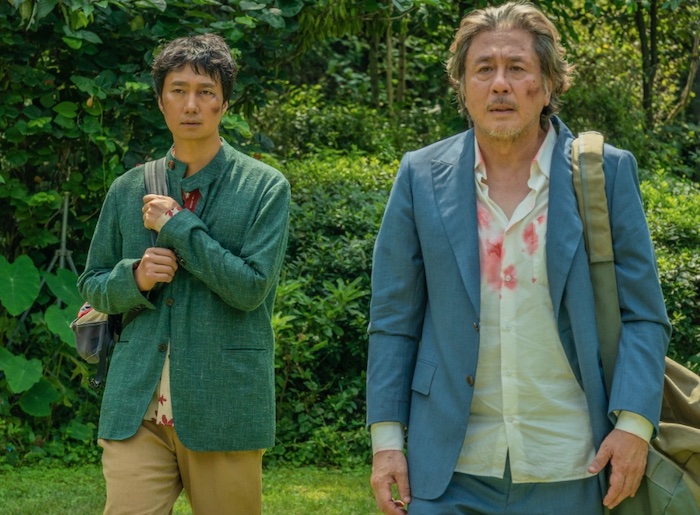
Today I managed to watch the opening film, Heaven: To the Land of Happiness, a mainstream entertainment whose somewhat redundant English title sums up its eagerness to please. BIFF openers, especially if they’re Korean movies, often split the difference between somber high-mindedness and big-budget high-mindedness. This year’s offering leans so heavily toward the latter that it tilts over into genre excess, but what intrigued me was the director. Im Sang-soo is responsible for two of the most memorable Korean movies I saw at BIFF in the 2000s: A Good Lawyer’s Wife and The President’s Last Bang. He followed these acid-laced, cynical comedies with the pleasingly stylized but wholly unnecessary remake of Kim Ki-young’s classic 1960s erotic thriller The Housemaid, and then dabbled in commercial films that never displayed the kind of distinctive wit that characterized his earlier work. Heaven continues this pattern. It’s a buddy road movie whose only distinguishing feature is that the buddies are both really ill—one terminally so—and yet they get beat up so much that you wonder if they aren’t superhuman in some way. In other words, it’s a pretty conventional Korean popcorn movie, replete with the requisite melodramatic family subtext and a balance of honest and crooked members of the establishment. There are also a lot of things that don’t make sense, but that’s par for the course with this kind of movie. I would have been interested to see the reaction at the opening night screening since Korean audiences tend to be quite demonstrative while watching if you know what to look (and listen) for. It wasn’t the most auspicious opener, despite the high-caliber cast: Choi Min-sik playing to his strengths as a middle aged loser, and Oscar-winner Youn Yuh-jung in a small, delectable role as a dying mob boss. 

As is usually the case with the opening film, Heaven was a world premiere, though the opening title card indicates it was slated to be shown at Cannes in 2020. Last year, BIFF had a special section devoted to films that were supposed to play at famous international film festivals but didn’t owing to the pandemic, and in a sense this year’s edition continues to clean up the mess that COVID has made of the film industry’s schedule for the past 18 months. A casual perusal of this year’s program (more movies than last year, but still fewer than normal) shows a higher percentage of world and international premieres, so obviously BIFF is doing its part to help the world heal. Let’s hope it’s completely better again by next October. 

Posted in Movies | Tagged | Leave a comment

Review: Pity

The second feature by Greek director Babis Makridis has been compared to the work of his more famous countryman, Yorgos Lanthimos, which could be considered unfair given that Makridis’s first feature was released in 2012 and was thus co-extant with Lanthimos’s early work. For sure, both filmmakers trade in a Beckettian absurdity that often froths over into mild horror–not due to conventional scare tactics (which they mimic more or less ironically), but rather because their stories depend on an extremely bleak understanding of human frailty to put across their dramatic intentions. Besides, both directors co-wrote their scripts with the same partner, Efthymis Filippou, so the comparison isn’t entirely unwarranted.

But the 8 or so years separating Makridis’s debut from his sophomore film, Pity, only seems to intensify the comparison, seeing how much work Lanthimos has done during that time—not to mention how much progress he’s enjoyed as an artist and professional. If anything, Pity seems almost regressive in its embrace of the pointlessness of existence and the nihilism at the core of its humor. Yannis Drakopouls plays a mousy, affectless, nameless lawyer whose wife lingers in a coma after an accident that happens off screen. What at first looks like depression over the state of a loved one reveals itself as a kind of sick contentment. The lawyer actually revels in the sympathy he receives from colleagues and acquaintances, and, in Makridis’s telling, becomes “addicted” to being pitied. For a good portion of the film, however, this mindset is played for laughs, as the lawyer manipulates his surroundings and situation to gain as much pity as possible. The laughs, however, become more uncomfortable as the lawyer’s voiceover conveys not only his self-delusion, but his almost evil regard for the people who actually think he’s suffering. He resents them at the same time he desires their attention.

Eventually, this need becomes insatiable, and when the unexpected happens, the proverbial rug is pulled out from under our protagonist, at which point things really do get weird and scary. Makridis’s deadpan style, reminiscent of those Scandinavian directors who work in monochrome and fixed camera placements to highlight the comic dreariness of being, successfully contrasts the lawyer’s narcissism with the more conventional socialized behavior of everybody else. If the movie isn’t quite as horrifying as it should be, it may be due to the fact that the effect of all this lack of affect is that the main character just isn’t that engaging. When he does truly horrible things you just shrug it off. 

In Greek. Now playing in Tokyo at Human Trust Cinema Shibuya (03-5468-5551), Shinjuku Cinema Qualite (03-3352-5645).

Pity home page in Japanese

photo (c) 2018 Neda Film, Madants, Faliro House

Posted in Movies | Leave a comment

Review: Mainstream

Though Gia Coppola’s Mainstream presumes to address the way online culture has highjacked culture in general, its flashy, colorful style and pretensions to quick wit reveal an eagerness to appeal to the same kind of jaded sensibilities that the movie lampoons. Coppola’s proxy is Frankie (Maya Hawke), a struggling video artist who can barely attract 100 people to view her work on the internet, and thus makes a living as a bartender in the kind of place that uses her videos as wallpaper. Frankie’s life is presented as a cautionary tale, a means of sending up media trends as fashion trends as lifestyle trends ad nauseum. The idea that there’s no substance to Frankie’s life can be taken to mean that there’s no substance to Coppola’s movie, but then Link shows up.

Link (Andrew Garfield) is first seen wearing a stuffed animal costume outside a Los Angeles mall that Frankie is incorporating into one of her videos. Link has the chutzpah in selling his sorry ass that Frankie can’t muster to sell her art, and a kind of bond is formed. Link’s shtick is to reject “all that,” meaning the phone, the internet, all the trappings of our “connected society.” The viewer immediately pegs him as a  crank, but Frankie sees a “project.” Link becomes the star of a new series of videos that Frankie produces with her partner, Jake (Nat Wolff), called “No One Special,” which encourages people to do as Link does and unplug.

What follows is entertaining enough despite its utter predictability as a rise-and-fall tale of celebrity. Just because Coppola is using the formula to explore the work of influencers doesn’t make it necessarily fresh, though it does offer Garfield a chance to act out in some amazing ways. Since I am not an avid YouTube watcher, many of the jokes that accompany the improvement in production values of Link’s videos likely flew over my head, but I got the point: content is overrated for the terminally engaged. “I don’t get people’s tastes any more,” someone says about, seemingly, everything. It’s too general a complaint to base an entire movie on. 

Now playing in Tokyo at Shinjuku Piccadilly (050-6861-3011), Shibuya Cine Quinto (03-3477-5905).

Mainstream home page in Japanese

photo (c) 2020 Eat Art LLC

Posted in Movies | Leave a comment

Review: Stardust

As rock star biopics go, this somewhat fictionalized account of David Bowie’s first trip to the U.S., before he broke big even in the UK, is encouragingly circumscribed, since it addresses only that formative period before the drugs and money did their worst (and best, for that matter). And in some ways, it feels important in the sense that Bowie at the time had yet to create any of the professional personae that made him unique in the realm of popular music. However, writer-director Gabriel Range is sorely limited by not only his budget but his lack of access to Bowie’s catalogue, and while he does get a lot of mileage out of the period production design, his portrayal of the man who would soon become Ziggy Stardust feels pale and compromised by caution.

It’s difficult to remember a time in his professional life when Bowie was insignificant, but as Range conceives it in 1971 the singer-songwriter born David Jones (Johnny Flynn) barely knew what he was as an artist. He had one solid hit in England, “Space Oddity,” but it was such a strange song that even his own record company thought of it as a one-off. Nevertheless, his management decides to send him to the states for a solo tour to see if he can get a record contract. It isn’t until he arrives that he learns he should have gotten a work visa beforehand. The local publicist who meets him at the airport, Ron Oberman (Marc Maron), tells him that means he can’t play legally for money, and so Oberman books him into private parties where, it is hoped, the right industry people will show up. Performance-wise, Bowie at this point thought of himself as a mod-era Anthony Newley, a showman with a cold, arty image, but he had yet to translate this idea into something that made sense to an audience. Though he had started to explore the androgynous style that eventually defined his initial star power, musically he couldn’t put across the real appeal of his unusual songs with just his voice and an acoustic guitar, and the “shows” he played in the U.S. were mostly ignored by people who attended them. 

Had Range stuck to this concept of Bowie figuring out his image under extreme duress, all the while learning about America from the voluble, earthy Oberman (the best scene is when Bowie crashes for the night at Oberman’s mother’s house), the movie could have at least been a valuable curiosity, but Range wants to psychoanalyze Bowie as well, throwing in long, involved passages related to his half-brother Terry (Derek Moran), who suffered from a mental illness that Bowie was afraid would befall him as well. Having studied theater and mime—Bowie’s show biz ambitions were, if anything, hilariously conventional—the future star cuts a flamboyant figure but without the trappings of confidence that are necessary to put it across to the average pop fan. He would leave the U.S. broken and disappointed but with a better idea of what he needed to do to break through. These are all interesting ideas to explore, but Stardust is dull, simply because it’s incomplete. Flynn is a good singer but his performance is attenuated by the fact that he can’t use any of Bowie’s songs. How can we believe he’s a genius with this kind of material? Moreover, Range tries to pump up the drama by making his wife, Angie (Jena Malone), into a harridan, a woman who only thinks about money and fame. It’s a cheap cliche, even in big budget rock biopics.

Opens Oct. 8 in Tokyo at Toho Cinemas Chanter Hibiya (050-6868-5001).

Stardust home page in Japanese

photo (c) Copyright 2019 Salon Bowie Limited, Wild Wonderland Films LLC

Posted in Movies | Tagged | Leave a comment

Media Mix, Oct. 2, 2021

Scene from D.P.

Here’s this week’s Media Mix, which is about bullying and abuse in the South Korean military and Japan’s Self-Defense Forces. As pointed out in the column, all militaries throughout the world have this problem, and though it isn’t necessarily covered up in Japan, the severity of the problem may be. The reason I mentioned the Netflix drama D.P. is that it shows how popular culture in South Korea addresses the problem in a very direct and accessible way. The same is true in the U.S. (think of movies like Jarhead). I can’t imagine a Japanese TV drama or even movie doing the same thing with regard to the SDF, though part of the reason has mainly to do with what I see as complacency. The Japanese public doesn’t seem to be that interested in the SDF or what happens within its ranks. South Koreans do simply because of the draft and the threat of North Korea, but their movie and TV industries are also more developed and thriving than Japan’s, and they confront social problems as a matter of course. The worldwide popularity of Squid Game isn’t just due to the violence and gore inherent in its bizarre premise. Though it’s total fantasy, the show gets at the heart of the wealth gap in South Korea and how it has twisted society, and this theme, I believe, resonates in other countries even if the specific plot points that deliver the theme are peculiar to South Korea. D.P. does something similar and, in my mind, is a better series, not so much because, as Miran Tanaka says in the article I cite, it’s realistic. Actually, it doesn’t seem that realistic since its entertainment requirements call for lots of thrills and complex detective work. What makes it relevant is the idea that military culture brings out whatever cruelties are latent in male personalities, and that it isn’t an unfortunate side effect. It’s on purpose, because the goal of military service is to prepare men to kill if necessary. At one point in D.P., the lead character says as much, except he’s not talking about killing a theoretical enemy, but rather a flesh-and-blood comrade who has become a monster under such circumstances. The genius of D.P. is the way it shows how this attitude ripples out into the larger society with dire consequences. These kinds of themes are very common in South Korean movies and TV shows, and while certain directors deal with them directly, most incoporate them into works that are ostensibly entertainments. As I said near the end of the column, D.P. is filled with exciting chases and fight scenes. In that regard, Squid Game and even Parasite are not exceptions. They’re representative of what South Korean narrative art regularly delivers because, we have to assume, it’s what South Korean audiences demand. 

Posted in Media | Tagged , , | Leave a comment

Review: Kanarta

Akimi Ota, a doctoral candidate at Manchester University in ethnology, made this intimate film when he lived in the Ecuadorean rain forest with the Shuar, a group of native people with their own unique language whose indigenous territory covers a large land mass that extends over most of the Amazon countries. Ota lived in one village and recorded the footage himself, since he had no crew. The result is highly professional to the point where it not only transcends its ostensible purpose of documenting the daily lives of its subjects, but realizes a cinematic narrative structure and aesthetic that conveys its own sensibility apart from that of its subject. Strictly speaking, I’m not sure if that’s what ethnologists are supposed to do, but it also may explain why the movie has been shown at several international film festivals and is receiving a theatrical release in Japan. 

In any case, Ota tried to stay out of the picture as much as possible, and though you hear his voice once or twice, there is no narration. The main subject is the Tsamarain family, whose patriarch, Sebastian, takes up most of the screen time, acting as a guide to the forest and a kind of professorial lecturer on Shuar culture. Though much of what he says will probably go over the viewer’s head, Sebastian is often a riveting presence: funny, articulate if not always coherent, and genuinely photogenic. The reason he seems out of reach most of the time is that he is a shaman, and while Ota, owing to his long-term contact with the village, seems to understand the spiritual world Sebastian expounds upon, I, for one, became fidgety with all the metaphors and vague descriptions that came with the lectures. The main focus is his use of two psychotropic plants that have a wide range of purposes in the village, though it’s not clear from the exposition if anyone on screen has partaken of the drug during filming. There’s also a lot of imbibing of something called “chicha,” a fermented drink that seems to accompany almost every activity, including those partaken for survival, such as building huts and searching for food. In fact, halfway through, I came to the conclusion that much of footage depicts people who are constantly stoned, which is a pointless observation, of course, since if they are always stoned then that is their “normal” state of being, which means I may never really be able to appreciate the mindset that seems essential to understanding Sebastian’s discursions about the universe. 

Still, it isn’t all exotic ephemera. The family buys clothing from the outside world and there’s even a TV. At one point Sebastian’s wife (at least, I think she’s his wife) talks about running for office, so it’s not as if the people being observed are completely off the grid, so to speak, and in that regard, I wish Ota has pointed his camera farther afield to capture how the Shuar fit into the larger scheme of Amazon society, but that’s perhaps asking too much of an anthropologist. Nevertheless, I wonder what his doctoral advisor thought of the movie. 

In Shuar. Now playing in Tokyo at Theater Image Forum Aoyama (03-5766-0114).

Kanarta home page in English

photo (c) Akimi Ota

Posted in Movies | Leave a comment

Review: Collective

In the past decade-plus, a handful of Romanian directors (Christian Mungiu, Corneliu Porumboiu, etc.) have created a body of dramatic work that is perhaps unmatched in its ability to come to grips with the way official actions (i.e., bureaucratic behavior) undermine the institutions that are supposed to support a workable society. From abortion to educational opportunity, the topics these films tackle have a universal relevance even if the particular horrors exposed are specific to Romania. Collective, a documentary by Alexander Nanau, provides insight into the kind of obstacles truth-seekers are up against in Romania because it addresses a real-life tragedy by following the players whose aim is to expose the corruption that not only led to that tragedy, but exacerbated it afterwards. 

At the center of the story is a fire that broke out at the titular Bucharest nightclub in 2015 at a heavy metal concert that killed 27 on the spot and injured 180. The club had no fire exits, and while such a lapse in public safety protocols is enough to warrant its own hardline investigation, the movie’s real target becomes something larger and more insidious. In hospital, many of the survivors ended up dying anyway, but not because of the burns they suffered in the fire. They died of bacterial infections they contracted while in intensive care. The government as represented by the health ministry puts up what looks like the usual PR stonewall to hide the fact that the company that imported the disinfectants diluted them to one-tenth their normal strength in order to increase profits, and a small group of journalists (mostly working for a sports tabloid), activists, and victims advocates refuse to allow the coverup to proceed without pushback. Nanau covers it all in real time, keeping his cameras in the thick of the fight rather than summing up the story through retrospective interviews with principal players, the way most documentaries would handle it. Consequently, the movie is not only relentlessly compelling as drama, it’s edifying in the way it treats each element of the tale as its own unique factoid. When a health official uses language to obfuscate some deeper truth, we see the statement given and then the immediate reaction from a journalist who tells the camera that it’s all bullshit. As the authorities try to play down the ensuing disinfectant scandal, we see the key reporters doggedly keeping it in the public sphere even while the mainstream media, especially TV, paint their journalism as mere scaremongering to sell more papers. 

Though Nanau also reserves sufficient time to spotlight the victims and their suffering, the gist of the movie is its slow, methodical revelation of the rot that permeates the entire health infrastructure. And while the viewer may find it heartening that the reporting on display brings down much of this infrastructure (one official commits suicide), thus paving the way for a new health minister who was once a victims’ advocate himself, the idea of “resistance” is so prevalent on every side that it’s easy to wonder what kind of effect the new man will have on a system in which doctors cannot be expected to get ahead in their profession without taking bribes to make sure the “old ways” stay the way they are. Nanau is blessed with almost unbelievable access, not only to the people fighting the system but to those defending it, and yet his movie doesn’t feel like a happy accident of being in the right place at the right time. It’s a fully engaged work of truth-telling, deliberate and fiercely intelligent. 

In Romanian. Opening Oct. 2 in Tokyo at Image Forum Aoyama (03-5766-0114), Human Trust Cinema Yurakucho (03-6259-8608).

Collective home page in Japanese.

photo (c) Alexander Nanau Production, HBO Europe, Samsa Film 2019

Posted in Movies | Leave a comment

Media Mix, Sept. 25, 2021

Here’s this week’s Media Mix, which is about Sanae Takaichi’s candidacy for the leadership of the Liberal Democratic Party and, by extension, the prime minister’s office. Since I wrote the column, her chances of achieving that post have increased greatly. Though she is still way behind Taro Kono in polls of LDP members–the only people who get to vote (and not all of them)–she’s now neck-and-neck with Fumio Kishida, meaning she could be the contender if there is a runoff. So the possibility that Takaichi could be Japan’s first female prime minister is very real, and, as pointed out at the end of the column, something that many women may find disappointing due to Takaichi’s conservative bent. Still, some women have said that although they don’t agree with Takaichi’s policies they still hope she wins because they think that having a woman in such a powerful position is enough to change the environment for the better. (Strangely, these women don’t bring up the fact that Takaichi once did an internship in Washington for representative Patricia Schroeder, a famous liberal Democrat, though it’s obvious why other LDP members don’t mention it.) The things that bother feminists, such as Takaichi’s opposition to elective surnames for married couples, are not uppermost in the electorate’s list of interests, and while she has not made any distinct comments about addressing the wealth gap, an issue that does interest the electorate, she would have to say something about it if she became LDP president and had to lead the party in the upcoming lower house election. Given the usual disarray among the opposition, the LDP will likely hold on to its majority in the lower house and thus continue to control the government, so, in a sense, it may not matter what she says about the wealth gap, an issue that was also sidelined by her mentor, Shinzo Abe, when he was prime minister. It says much about Japanese politics that the perception among the public is that there is a huge difference in policy outlook between Kono and Takaichi, who both belong to the same party. Kono is seen as someone who, despite the compromises he has made since announcing his candidacy, stands for change, while Takaichi is considered an LDP hardliner, meaning she won’t veer too far off the path that Abe and Suga have trod. Real life has a way of mixing things up, especially in politics, but whether Takaichi’s being a woman will make any difference is anyone’s guess. Still, it would be a shame if it didn’t. 

Posted in Media | Tagged | Leave a comment

Review: Dinner in America

There seems to be a certain type of indie film that only premieres at the Sundance Film Festival. Ostensibly black comedies with quirky, often disagreeable protagonists, they usually take place in the US heartland, but what makes these movies distinctive is that they vanish immediately afterwards. And one more thing: they always seem to find a Japanese distributor. 

Adam Rehmeier’s Dinner in America is set in Lincoln, Nebraska, sometime in the 90s. It’s likely semi-autobiographical since the protagonist is the leader of a local punk rock band and Rehmeier had a hand in writing the songs performed. Simon (Kyle Gallner) isn’t just a punk rocker. He’s an anarcho-nihilist who is unabashed in his hatred for everything conventional, a sensibility that comes to a head during the titular family ritual, of which there are three extended examples in the film. Two of the three end up in very violent free-for-alls sparked by Simon’s provocative mouth. The third results in his receiving an invitation to stay the night. Unbeknownst to his hosts, he needs a place to hide from the police, who want him for arson and assault. While on the lam, he comes across Patty (Emily Skeggs), a college dropout and social misfit who has just been fired from her job in a pet store, and gets himself invited to dinner at her house with her clueless parents and hormonally confrontational teenage brother. Acting saintly, he fools the folks and then later, in Patty’s room, realizes she idolizes the masked punk singer John Q. Public, who happens to be Simon. He doesn’t reveal his identity, but is intrigued because Patty has been sending John Q. love letters with dirty pictures and song lyrics he finds compelling despite himself.

Whatever else Rehmeier intended his movie to be it’s basically a romantic comedy: two totally mismatched personalies meet cute and then find ways around their differences to fall in love. In that regard, Gallner and Skeggs make a nice couple but the humor relies too much on the viewer’s capacity to be shocked by Simon’s misanthropy and Patty’s gullibility. There’s also an unfortunate tendency to use the 90s setting as an excuse to forego any attempt at PC responsibility. Homosexuals and people with developmental disabilities get a lot of grief (Patty is repeatedly called the “r” word by her peers), and while the characters who wield these slurs are clearly assholes, after a while the device feels forced. More to the point, the requisite fulfillment of gross revenge fantasies provides no satisfaction. The difference between scrappy and crappy is only one letter. 

Now playing in Tokyo at Human Trust Cinema Shibuya (03-5468-5551), Shinjuku Musashinokan (03-3354-5670).

Dinner in America home page in Japanese

photo (c) 2020 Dinner in America LLC

Posted in Movies | Leave a comment

Review: Minamata

Probably one of the most fraught American movie releases of recent years, Minamata opens in Japan with its own set of caveats for people interested in both the truths it attempts to address and those who just want to enjoy an engaging film for its own sake. It’s already had its requisite major festival premiere followed by a limited release schedule worldwide, but the U.S. remains closed to the film owing to North American distributor MGM’s squeamishness over star Johnny Depp’s recent notoriety as an alleged wife-beater. In Japan, the city for which the movie is named has effectively disowned it because, according to local media, its “content is unclear,” a rather roundabout way of saying that there are too many sensibilities at risk of being offended, though ostensibly it is the victims of Minamata disease the city is worried about, since they are still targets of discrimination. Nevertheless, anyone who sees the film will conclude that the victims are really victims of corporate greed and official negligence, since it deals forthrightly with the discrimination issue. 

Director Andrew Levitas tries to make the film work on two levels. On the one hand, he wants to explain what has since become known as perhaps the seminal example of industrial pollution in the history of environmental degradation, and on the other he wants to explore the personality of the man, photographer W. Eugene Smith (Depp), who brought the disaster to the world’s attention. Minamata is a fishing town in Kumamoto Prefecture where the Chisso chemical company had a factory that spewed methylmercury into the sea, contaminating the fish that the local people ate. Starting in the 1950s, more and more cases of nerve-related illnesses appeared among residents, but for two decades the company denied that its operations had anything to do with it. The people affected could not find relief from either local or national officials who were in thrall to large companies like Chisso that were spurring Japan’s postwar economic miracle. Long story short, Aileen Mioko (Minami), a Japanese national living in New York, approaches Smith on behalf of the small group of Minamata activists fighting Chisso, because Smith had a reputation for socially relevant work and, more importantly, that work was published in Life magazine, which in 1971 was still an influential publication. (Another reason Aileen approached Smith was that he had some kind of promotional deal with Fujifilm, a factoid I wanted to know more about.) As the film portrays him, Smith by this point had become the stereotypical suffering artist who turned down guaranteed money-making offers in order to follow his whims, which weren’t very distinct, though his drinking problem was acute. In any case, Levitas tries to get too much thematic mileage out of Smith’s problematic relationship with Life editor Bob Hayes (Bill Nighy), who loves the guy’s work but hates the stubborn personality and has people to please who have no use for a dinky fishing village on the other side of the world. 

The heart of the film, and what makes it work better than it should, is Smith’s eventual relationship with the people of Minamata. Understanding his mission they help him obtain cameras, film, and whiskey and set up a dark room for him without really trusting him. Because Smith is a fairly outsized character, Chisso knows he’s there and tries to stonewall him at every turn. Smith has to be snuck into the hospital by Kiyoshi (Ryo Kase), an activist of the victims’ group, in order to take photos of patients, but due to Smith’s exacting aesthetic standards, he isn’t satisfied, and, in any case, it’s unlikely that Life will buy photos of people lying in hospital beds, regardless of what put them there. Still, Chisso is spooked enough that the company’s president (Jun Kunimura) offers Smith bribes and, when that doesn’t work, sicks hired goons on the house he’s staying in to destroy the dark room.

But the movie really comes into its own with the scenes outlining the activities of the victims’ support group, whose leader (Hiroyuki Sanada) at one point gives a speech about how the tragedy needs to be acknowledged by the world because he’s sure that big companies take advantage of local communities everywhere. “It’s happened before,” he says, “and it will happen again.” Though it’s very likely that Levitas fictionalized this component of the film in order to, as they say, make it more dramatically potent, it takes the focus off of Smith long enough to drive home the real meaning of the movie. Quite possibly it is also this component that bothers the city of Minamata now, but from what I’ve read the people with any say in the matter haven’t even seen the film. 

In any case, this grassroots movement to bring their case to the world and Smith’s dogged, somewhat selfish approach to photojournalism dovetail effectively into the movie’s centerpiece scene, in which Smith produces the photograph that made Minamata famous, the “pieta” shot with victim Tomoko Uemura and her mother in the bath. The movie is quite up front about how this shot was not only staged, but essentially planned out. The victims’ group knew that they needed something dramatic and simple to make their case, and after many months of pleading from Aileen, Tomoko’s mother agrees and Smith is ready (though Aileen seems to be the one who choreographs the image). 

The rest, as they say, is history, though Levitas doesn’t send Smith off into the sunset a hero. He doesn’t really know what to do with him any more, which is a negative function of Depp’s star power. Depp has always relished playing iconoclasts, and when they’re odd enough to disappear into (Willy Wonka, Edward Scissorshands), he can be phenomenal, but Smith’s idiosyncrasies are mostly treated as cliches, and what we come away with is basically Johnny Depp on a bender. As with many A-lister turns in unconventional movies, he’s more distracting than enlightening. The real star of the film is the Japanese ensemble—including Tadanobu Asano and Akiko Iwase—which juxtaposes the fierceness of the victims’ anger and disappointment against the smallness of their community. Levitas can’t possibly bring forth the enormity of their struggle, which continues to this day and is more comprehensively covered by Kazuo Hara’s documentary Minamata Mandala, which comes out later this year and mostly addresses the issue of discrimination that Minamata city is so worried Levitas’s film will somehow aggravate. Personally, I think the two films complement each other well, but be warned: Hara’s film is more than six hours long.

In English and Japanese. Now playing in Tokyo at Toho Cinemas Nihonbashi (050-6868-5060), Toho Cinemas Hibiya (050-6868-5068), Shinjuku Wald 9 (03-5369-4955), Toho Cinemas Shinjuku (050-6868-5063), Shibuya Cine Quinto (03-3477-5905), Toho Cinemas Roppongi Hills (050-6868-5024).

Minamata home page in Japanese

photo (c) 2020 Minamata Film LLC (c) Larry Horricks

Posted in Movies | Tagged | Leave a comment