Media Mix, July 3, 2021

Sari Kaede

Here’s this week’s Media Mix about the LDP’s LGBTQ “understanding” bill that stalled and what it really represented. One implication of the incident is that it’s difficult to legislate people’s opinions and feelings, and that popular culture and media exposure are more effective in changing people’s minds. The Japanese documentary mentioned, You Decide, is still playing in Tokyo as I write (it opened June 19) and will be released in more Japanese cities over the course of the summer. It’s a fairly straightforward profile of a transgender woman named Sari Kaede Hatashima, who decided to lay her life out for everyone to see in a bid to show the world that not only is she no different from anyone else, but that she’s really no different from what she was before she made the decision to live as a woman. What’s important to note is that in her mind she has always been a woman, and essentially what has changed is the trappings—the clothes, the makeup, and, yes, the hormones and the surgery. The title refers to a rhetorical rejoinder to the imagined question of whether another person would think of her as a woman. It’s up to that person to decide for themself. 

What makes the movie more complicated than it’s presumed intention is Sari’s own transformation. Though she has always thought of herself as female in the conventional sense, she is still working out what that means in a social context. A good portion of the documentary is taken up with her participation in the Japan edition of the Miss International Queen beauty contest for trangender women. Her coach is Steven Haynes, who is also an executive producer of the movie, and he approaches the preparation sessions as if she were auditioning for one of RuPaul’s reality TV shows. It’s all about conveying confidence and pride, and when he becomes annoyed with Sari’s seeming lack of either he says she must become a “star” on stage. Later, during the actual contest, we see Sari’s performance, a classic drag club musical number featuring two buff men as backup dancers, and she’s still pretty awkward. The awkwardness is not due so much to a lack of confidence, however. She just doesn’t seem cut out to be a performer, but she sees the contest as a kind of rite of passage, something that other trans women have done in order to show the world their commitment. 

She seems much more at home working with her students (she is a licensed architect) and doing volunteer services for LGBTQ employment opportunities. These scenes support the film’s theme much better than the contest footage or, for that matter, the interview with her father, who seems accepting of Sari’s decision but doesn’t really have a lot to say about it. Similarly, when the filmmaker interviews Sari herself and the conversation turns to love and sex, she seems reluctant to go there, not because it’s an embarrasing topic but because it’s not really that big a deal; which is a revelation, and a refreshing one. Because many people think transgender people have “changed sexes” they may also think that sex itself is a very important part of their lives, but it may not be. And, contrary to what popular culture and mass media tell you, it probably isn’t for a lot of people.

You Decide home page in Japanese

photo (c) 2021 Musuko no Mama de, Joshi ni Naru
Posted in Uncategorized | Leave a comment

Review: The Asian Angel

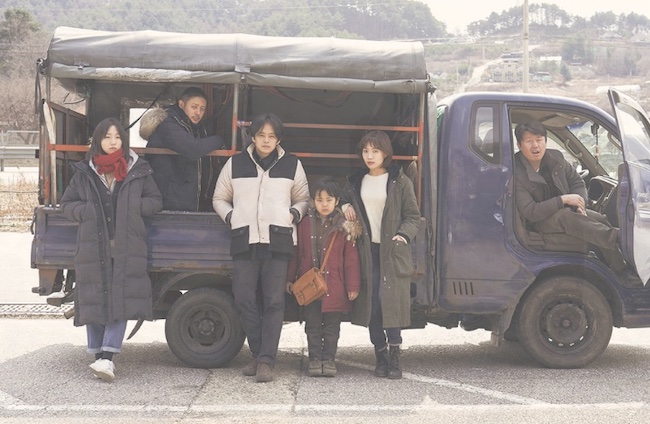
Quality-wise, cross-border co-productions are rarely as good as their intentions. This Japanese-South Korean film is a case in point, a true hybrid in that it combines Japanese writing-directing styles with Korean production values while presenting a mixed cast that mostly acts on instinct. The writer-director is Yuya Ishii, who’s earned an enviable reputation outside of Japan with idiosyncratic but low-stakes indie films like The Tokyo Night Sky Is Always the Densest Shade of Blue and The Vancouver Asahi. Here he’s working on location in Korea with a local crew, and his script often evokes the kind of sentimental road movies that are common Korean indie fare, especially for novice filmmakers. 

The plot, however, constantly strains for relevance, if not credibility. Takeshi (Sosuke Ikematsu) travels to Seoul with his young son (Ryo Sato) not long after his wife has died of cancer. He has accepted the invitation of his expat brother, Toru (Joe Odagiri), a ne’er-do-well gladhander who has some sort of get-rich-quick scheme he wants Takeshi to help him with. Predictably, the job, or whatever, falls apart almost as soon as Takeshi shows up, and the three light out for the south in order to try their hand at seaweed exports. On the train, however, they accidentally meet up with Seol (Moon Choi), a pop singer whose career has stalled in second gear and whom Takeshi met in Seoul. She is traveling with her siblings in the same direction to visit their parents’ graves. 

Ishii drapes the usual cross-cultural misunderstandings—both comical and wince-inducing—on this barest of plot structures, and when it works it’s because the Korean actors understand how to effectively interact with both the setting and the dramatic protocols that Ishii provides. The Japanese actors, especially Odigiri, have less success owing to the sketchiness of their character development. Moreover, so much is implied about the underlying political tensions between Japan and South Korea that the sentimental resolutions, which are designed to dispel those tensions, feel contrived. In a sense, The Asian Angel actually highlights the differences between current Japanese cinema and Korean cinema. Technically, it’s an impressive work, but Ishii’s writing and conceptualization lacks the baseline rigor that makes even low-key Korean movies so compelling these days. 

In Japanese, Korean and English. Now playing in Tokyo at Theatre Shinjuku (03-3352-1846), Human Trust Cinema Shibuya (03-5468-5551).

The Asian Angel home page in Japanese

photo (c) 2021 The Asian Angel Film Partners

Posted in Movies | Leave a comment

Media Mix, June 26, 2021

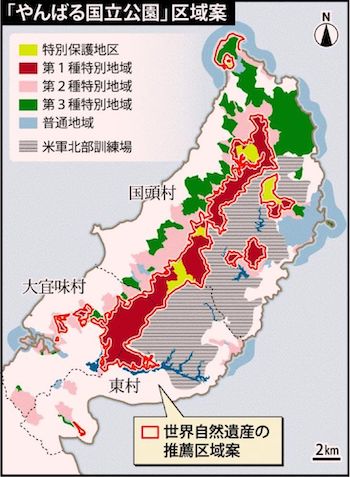
Map of Yambaru National Park

Here’s this week’s Media Mix, which is about the bill passed on June 16 in the Diet to monitor property sales to foreign entities. As pointed out in the column, over the last several months the bill’s wording was made more ambiguous to the point where its proscriptions and conditions can apply to almost anyone and any situation. I used the police raid on entomologist Akino Miyagi’s home in Okinawa as an example of what might become more common once the law is fully implemented, but Miyagi’s case is indicative of so many other things related to the way “national security” is carried out in Japan that it’s worth exploring further.

First of all, Yambaru Forest, the area that Miyagi was researching when she found all the trash, including live blanks and irradiated materials, left behind by U.S. forces that used the forest for training exercises in the past is on track to become a UNESCO World Heritage site. It’s why Miyagi was there. A number of animal and plant species are considered unique to the area and presumably need to be studied in order to qualify for the designation. It’s not clear if Miyagi was there on her own or in some sort of official capacity, but, in any case, all news reports have said that the UNESCO designation is a foregone conclusion, so inspecting the area is nothing more than a formality. Nevertheless, it would be logical to assume that the area needs to be in some sort of pristine condition for it to qualify for a World Heritage nature site, and though the central government asked the U.S. military to stop using the forest for drills for that purpose, they didn’t demand they leave it the way they found it, which is usually the rule in Japan for people (i.e., renters) who use other people’s property. This fact was made clear by journalist Isoko Mochizuki on one of the Democracy Times’ programs cited. Apparently, there is a little known article in the Status of Forces Agreement that says the U.S. military doesn’t have to clean up after itself in such situations; that the Japanese government will do it for them. Miyagi may not have known about this term of SOFA, but in any case she dumped some of the trash at the gate of the Northern Training Center in April in protest after being ignored by local police when she complained about the litter as early as last fall. It was only then that the police acted—but against Miyagi, allegedly for “interfering” with the center’s business (reportedly, vehicles couldn’t pass through the gate for 50 minutes, though the amount Miyagi deposited was rather small and witnesses said any vehicle coud easily go around it). Why they needed to raid her home and confiscate her phone and computer, however, has never been properly explained. And here’s where the inevitable Catch-22 comes into play. When Asahi Shimbun asked the police why she was being investigated—after all, she admits to dumping the garbage—they said they couldn’t talk about it because it would violate Miyagi’s right to privacy. 

Is this Kafka or Keystone Kops? Here we have a national forest that the central government wants a world cultural organization to authorize as something special, likely for economic reasons, even though it’s been desecrated by a foreign military presence with the blessing of the central government; and the world cultural organization doesn’t seem to care since they’ve already approved the authorization. Then, when a person qualified to inspect the forest in order to determine its uniqueness as something special actively complains about the above-mentioned set of contradictions to the parties responsible, she is treated as a possible threat to national security. Where is Terry Southern when you need him?

Posted in Media | Tagged , | 2 Comments

Review: The King’s Letters

The last we saw of King Sejong, he had completed a map of the stars with the help of former slave Jang Yeong-sil. Given that King Sejong is one of the most commonly portrayed historical figures in Korean cinema, I wonder if there is anything left of his illustrious life that hasn’t been interrogated, but, as the title indicates, The King’s Letters caps his career with perhaps his greatest accomplishment, which was helping create the unique script called Hunminjungeum, now better known to the outside world as Hangul, thus giving the hoi polloi a tool to communicate and participate more readily in society. 

Sejong this time is played by Song Kang-ho, whose inherent gruff style highlights the king’s less-than-regal background and points to his identifying with the people rather than the court, who are in thrall to China and thus can read and write Chinese characters, which they intend to keep to themselves. This fealty also results in the outlawing of Buddhism in favor of Confucianism, and when Sejong goes to a local Buddhist monk, Shinmi (Park Hae-il), to help him with devising an alphabet, the court is enraged to the edge of insurrection. At first, Shinmi, who is unusually proud for a Buddhist, seems unimpressed with the king’s request, but eventually sees the task as a means of helping to bring Buddhism back into some kind of favor. (It helps that the queen is a closet Buddhist.) He and his assistants, aided by the king’s two sons, work in secrecy, basing their research and development on Sanskrit, which uses phonetic characters rather than ideographs. 

Though Jo Chul-hyun’s direction lacks tension and dramatic momentum, he makes the scenes where the writing system emerges compelling. He does this by directly conveying the idea of a world where there is no writing system based on phonemes, and then working from there through a series of small but potent Eureka moments that bring home just how phenomenal the process was. Obviously, much of the humor and pathos attendant to such a process is lost on someone who isn’t Korean, but the ingenuity of the writing system itself is ably extrapolated. 

I have no idea if the movie is historically accurate, and the final scenes feel as if Jo is trying to make up for lost emotional traction with something a bit too sentimental, but, then, I’m not a Buddhist, so maybe it means something profound to viewers of a certain sensibility. 

In Korean, Japanese and Sanskrit. Now playing in Tokyo at Cinemart Shinjuku (03-5369-2831). 

The King’s Letters home page in Japanese

photo (c) 2019 Megabox Joong Ang PLUS M. Doodong Pictures

Posted in Movies | Tagged | Leave a comment

Media Mix, June 19, 2021

Yuka Saso

Here’s this week’s Media Mix, which is about the local press reaction to Naomi Osaka’s withdrawal from the French Open tennis tournament. Though Osaka is still well regarded as both an athlete and a celebrity in Japan, the media seems to have given up trying to claim her as its semi-exclusive property owing to her Japanese nationality. Often when a Japanese person gains fame abroad their name is prefaced with the term “sekai no…”, meaning that the person now belongs to the “world” as well. Osaka’s case is slightly different since she mostly grew up in the U.S. and while she is very comfortable with and knowledgeable about Japan and Japanese things, she doesn’t make a big deal out of it. When she was first coming into her own as a world-class athlete, reporters would try to get her to talk about Japan, and she was forthcoming about her relationship to the country where she was born. Things became more difficult when reporters tried to get her to filter her replies about matters in general through a Japanese point-of-view, because she doesn’t seem to think that way, and eventually the press gave up on this gambit. 

That’s why it’s important that she is definitely coming to the Olympics to play for Japan. If she had decided to sit out the Games, it is likely greater attention would have been directed to emerging golf star Yuka Saso, who will also be at the Olympics. However, Saso will be playing for the Philippines. Like Osaka, Saso is of mixed parentage. She was born in Japan but has lived a good part of her life in the Philippines, where her mother is from. Also like Osaka, it was her father who strongly encouraged her to become a professional athlete, and there lies a fundamental difference. Saso’s father is Japanese, and thus much of her training as a golfer included a strong Japanese component. Osaka’s father is Haitian-American, so, at least when it came to tennis she developed less of a Japanese sensibility toward the sport. From what I can gather, Saso, who is a teenager and thus still has double nationality, is playing for the Philippines at the Olympics because she wants to give something back to the country. After all, it was in the Philippines that she learned golf, since, as her father himself admitted, it is much, much cheaper to play golf there than in Japan. However, he has also said that when Yuka turns 22 she will, like Osaka again, choose Japanese nationality. But unlike Osaka, she’s comfortable speaking to the press in Japanese (reportedly, she is fluent or conversant in four other languages) and isn’t shy at all. Had Osaka chosen not to play in the Tokyo Olympics for her “home fans,” the Japanese media could have easily fixed their gaze on Saso as the prime Japanese participant with a world standing, except that she’s representing the Philippines. You can’t have everything.

Posted in Media | Tagged , | 1 Comment

Review: Greed

At one point, Michael Winterbottom was perhaps the most irreducible major movie director working. Despite the fact that the guy’s output was regular as clockwork—at least one production a year, in addition to TV work—the range in style and genre was impressive, from serious literary adaptations to pot-boilers to art house porn, and with no appreciable drop-off in quality. Since the dawn of the millennium, however, his work has congealed into a mass of capable middle-brow entertainment whose main claim to iconoclasm is a kind of practiced cynicism. One of the reasons for this verdict is that, since 2002’s 24 Hour Party People, the actor he’s used the most is Steve Coogan, the king of British self-abasement. Coogan stars as the grotesquely narcissistic fast fashion billionaire Sir Richard McCreadie in the unsubtly titled Greed, which I predict will be deemed Winterbottom’s most characteristic work when he’s taught in film school a century from now; which isn’t to say it’s a great film, only that it does the job it sets out to in a way that Winterbottom has perfected with his popular Trip to… series starring Coogan and comedian Rob Brydon.

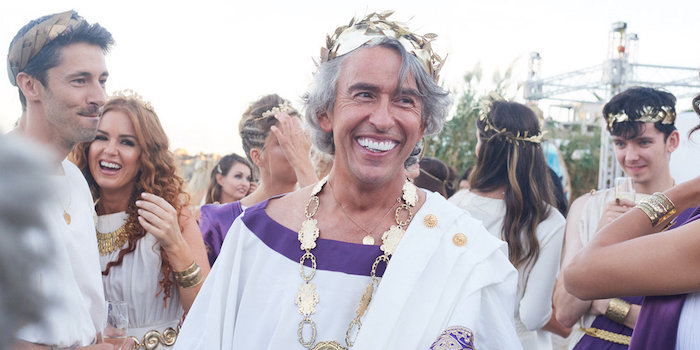
McCreadie is essentially an exaggerated version of the pompous jerk that Coogan plays—as himself, mind you—in the Trip movies and TV show. Since fast-fashion as a concept is more about business savvy than fashion sense, McCreadie has reached the summit through mercenary methods that are beyond questionable, and the movie’s sendup of British hypocrisy when it comes to rich celebrities is highlighted by the fact that while McCreadie has been knighted for his service to UK business interests he’s being investigated for fraud and other white collar crimes. Meanwhile, he grudgingly enjoys his wealth by throwing Roman Empire-themed birthday parties for himself and persecuting staff and contractors with the glee of someone whose self-hatred is presented as a form of recreation. He is so beyond redemption that he attempts to fire a lion for not doing exactly what it was rented for. When Syrian refugees inadvertently wash up on the shore of his birthday bash he insists they did so on purpose to spoil his fun. 

There’s a lot here that is funny, and Coogan has become so adept in his portrayal of base assholes that the viewer’s resentment of his character is both assured and painless, and as a result the movie as a whole has no purchase as a satire. Much of the stuff related to unethical business practices and the exploitation of practically everyone in the retail industry is well-researched and would be blisteringly relevant if this were a documentary. As it is, it feels wasted in the service of destroying a character who’s earned our derision as soon as he appears on screen. 

Now playing in Tokyo at Toho Cinemas Chanter Hibiya (050-6868-5001).

Greed home page in Japanese

photo (c) 2019 Columbia Pictures Industries, Inc. and Channel Four Television Corporation

Posted in Movies | Tagged , | Leave a comment

Review: Mortal Kombat

The benefit of reviewing a game-based movie without being a gamer is that there are no impossible expectations that need to be met; but, then again, not being a gamer usually means expectations are low to begin with when addressing game-based movies. What I know about Mortal Kombat is that it’s infamously violent and stalled during its lucrative cinema adaptation franchise back in the 90s (it essentially launched Paul W.S Andersen’s career, for what that’s worth). This is by every definition a reboot, so philistines like me get to see it all from the beginning.

And the beginning, at least, holds up. Set in 17th century Japan, the movie starts with a warrior named Hanzo Hasashi (Hiroyuki Sanada), living the pastoral life with his family when he’s attacked by a bunch of Chinese-speaking assassins led by Bi-Han (Joe Taslim), who freezes Hanzo’s wife and child to death before dispatching Hanzo himself, though, as fans of the game probably know, it doesn’t mean he’s actually “dead,” since death is a relative concept in this cosmos. But the battle of Hanzo is merely a preface—and a rippingly good one, filled with some clever, though grisly, swordplay and kung fu-type shit—and the movie then picks up where the game takes off, meaning the eternal war between Outworld and Earthrealm, the latter of which centers on an MMA fighter named Cole (Lewis Tan), whom Bi-Han seems to be gunning for since there’s some kind of blood connection between him and Hanzo that I could never figure out. After some fierce one-on-ones the movie bogs down into character exposition as Cole meets up with familiar faces from the MK universe and each has to “learn” their “special power,” an idea whose randomness always makes superhero movies that much more difficult to take seriously, even as fantasy, though this world seems to be dictated by prosaic American military cliches. And, of course, with every new character we have to muddle through a backstory that probably wasn’t necessary in the game. 

Director Simon McQuoid obviously was hired for his action chops, but he seems to have no patience for story development or continuity. Even when the action gets back to full-time fighting the movie had lost me. Obviously, the point here is to gather in a new audience for a new franchise, but I can’t help but feel that a real gamer is going to be even more frustrated by the lackluster storytelling. There’s only so much spine-tearing and head-smashing you can tolerate vicariously without a plot when you’re sitting in a movie theater with nothing to do with your hands except fumble with popcorn. Gamers rather be gaming. 

Now playing in Tokyo at Toho Cinemas Nihonbashi (050-6868-5060), Toho Cinemas Hibiya (050-6868-5068), Marunouchi Piccadilly (050-6875-0075), Shinjuku Wald 9 (03-5369-4955), Shinjuku Piccadilly (050-6861-3011), Toho Cinemas Shinjuku (050-6868-5063), Toho Cinemas Shibuya (050-6868-5002), Toho Cinemas Roppongi Hills (050-6868-5024).

Mortal Kombat home page in Japanese

photo (c) 2021 Warner Bros. Entertainment Inc.

Posted in Movies | Leave a comment

Review: The Clovehitch Killer

Probably the only narrative story device more hackneyed than the serial killer is the paid assassin. Neither are as tenth as ubiquitous as the movies would have us believe, and yet there’s obviously something about them that appeals to our ability to suspend disbelief because there sure are a lot of films that, pardon the expression, keep trying to pump new blood into the genres. As its very title makes clear, The Clovehitch Killer is not here to disabuse the viewer of any pretensions to being anything other than a serial killer movie, and for the most part it’s pretty straightforward in terms of plotting and elements of suspense, but it’s also weirder than that title lets on, and I’m not sure the weirdness was entirely intentional.

The title refers to the m.o. of a serial killer who terrorized a small Kentucky suburb ten years prior to the “present day” action: he would always leave a rope tied in a clovehitch knot at the scene of the crime. The story centers on one family, the Burnsides, and for most of the first half the POV is that of teenage son Tyler (Charlie Plummer), whose adherence to God, in the form of the family’s rock-solid evangelical beliefs, and Country, in the form of his membership in the local chapter of a religion-affiliated scouting organization, is wavering due to the usual mix of adolescent hormones and healthy pre-adult skepticism. One night he secretly “borrows” his landscaper father Don’s (Dylan McDermott) pickup truck for a rendezvous with a girl he has a crush on, and while they make out the girl finds a ripped out page from a bondage magazine under the seat. Tyler denies it belongs to him but the discovery definitely ruins the mood, and over the next couple of days through the power of rumor Tyler earns a reputation as a “pervert” at his high school. Forget that in the age of the Internet (a plot point that is constantly confounded with the appearance of flip phones alongside GPS apps) it seems strange that bondage magazines are still a thing, but in any case Tyler understands that the page must belong to his father. The fact that Tyler is shocked by this only reinforces the viewer’s conviction that he’s way too naive to be the protagonist of a serial killer movie, since Don is pretty much your classic example of the serial killer type: creepily outgoing, severely limited in terms of worldly interests and knowledge, and phonily candid about the sins he does admit to. Quickly, Tyler begins to wonder if his father, in fact, is the Clovehitch Killer, and enlists the help of a shadowy outcast girl, Kassi (Madisen Beaty), who is the town’s resident expert on the case, since she happens to live with a woman who wrote a book about it. 

There isn’t much of a mystery to solve, and in rapid succession clues turn into hard evidence, so the story’s most compelling aspect is what Tyler and Kassi decide do with this evidence. Director Duncan Skiles actually does well with the little he has to work with, creating a genuinely paranoid mood thanks mainly to McDermott’s uncharacteristically absorbing performance. Skiles is also not afraid to throw in comical non sequiturs to break up this mood in order to rejigger the emotional stakes, though at times you might think to yourself: That’s some really B-grade David Lynch shit. But once the POV moves away from Tyler you understand what Skiles is up against, and the movie strains at your desire to keep suspending disbelief for the sake of the movie. It all becomes just too much, which is a shame since McDermott and Plummer at times really seem to have something great going on. 

Now playing in Tokyo at Shinjuku Musashinokan (03-3354-5670).

The Clovehitch Killer home page in Japanese

photo (c) Clovehitch Film LLC 2016

Posted in Movies | Tagged | Leave a comment

Review: The Woman Who Ran

The English titles of Hong Sang-soo’s stilted comedies are always interesting. Sometimes they simply describe a situation in the plainest terms: Hotel by the River or The Day He Arrives. Other times they seem to be taking the piss: Like You Know It All or Right Now, Wrong Then. The title of his latest, The Woman Who Ran, would seem to qualify for the former category, except that the protagonist is a woman who doesn’t seem to be running at all, either towards something or away from it. Or maybe she is but we probably wouldn’t realize she is without Hong telling us that upfront. A common characteristic of Hong’s films is that they often address formalism as an end in itself, and sometimes the plots are simply there to prove a point about how stories can be told. The Woman Who Ran has its own unique formalist aspects, but since Hong has said repeatedly that he doesn’t know what he wants to do with a film until after he starts making it, it may be reading too much into his latest movie to say that the strict tripartite structure has more to say about the characters than the dialogue does.

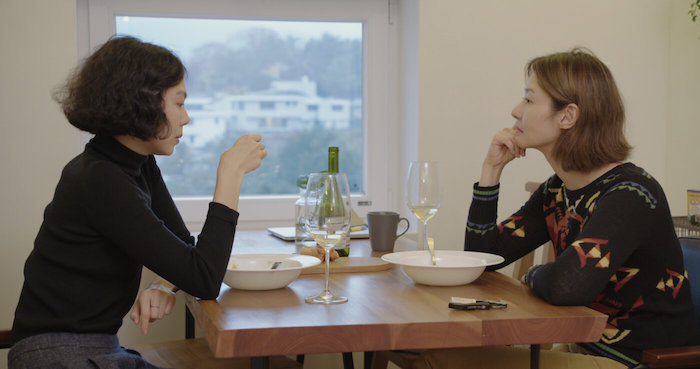
Gam-hee (Hong regular Kim Min-hee) visits three friends during the course of the 77-minute movie whom she hasn’t seen since she married five years ago. In fact, as she tells all three, she hasn’t been separated from her spouse for even one day during the last five years, but he had to go on a short business trip so she thought she’d catch up on some old acquaintances. The first visit is to Young-soon (Seo Young-hwa), who, having divorced her own husband, is now living with a female companion on the outskirts of Seoul where she grows vegetables and raises chickens (“roosters are mean”). The second visit is to Su-young (Song Seon-mi), who teaches Pilates and has recently moved to an upscale apartment with her savings. The last visit is unintended, or, at least, it seems to be. Gam-hee takes in a movie at a small art house cinema and upon leaving discovers that it’s managed by Woo-jin (Kim Sae-byuk), whose husband was once Gam-hee’s lover. In fact, their reuniting is fraught with awkward tension, since the romantic changeover led to bad blood between them. 

Most of the dialogue throughout the three encounters is purposely anodyne, the usual boilerplate topics between old acquaintances like real estate, family situations, and work issues. Gam-hee, in fact, rarely betrays any problems in her life, and thus it’s implied that she’s taking the opportunity of her husband’s absence to re-explore the idea of freedom. But that’s not the real point of the movie, which mainly comes into its own when men literally enter the picture. After each of the three chats, a man intrudes on the women and makes demands. In the case of Young-soon, it’s a neighbor who objects to Young-soon feeding neighborhood stray cats, which he says “scare my wife,” and though the exchange is polite, the man’s insistence is very creepy. In Su-Young’s case, the intruder is a young poet who has been stalking her after meeting her in a bar one night. He insists on knowing why she keeps rebuffing his advances. In the last scene, Gam-hee runs into Woo-jin’s husband, meaning Gam-hee’s old lover, a successful but somehow disillusioned writer who doesn’t believe that Gam-hee encountered his wife “by accident.” 

In all three cases the meetings are comically contentious and point up the kind of male petulance that Hong has reserved as his own cinematic bailiwick. In all three scenes, the men are filmed from the back, as if their very existence is unwanted. The Woman Who Ran may be Hong’s most female-centered movie in that men are not only unnecessary, but insufferable in the greater scheme of female companionship. It’s a theme he’s explored before but never this plainly or, dare I say, hilariously. 

In Korean. Now playing in Tokyo at Human Trust Cinema Yurakucho (03-6259-8608), Shinjuku Cinema Qualite (03-3352-5645).

The Woman Who Ran home page in Japanese

photo (c) 2019 Jeonwonsa Film Co.

Posted in Movies | Tagged | Leave a comment

Review: The Comeback Trail

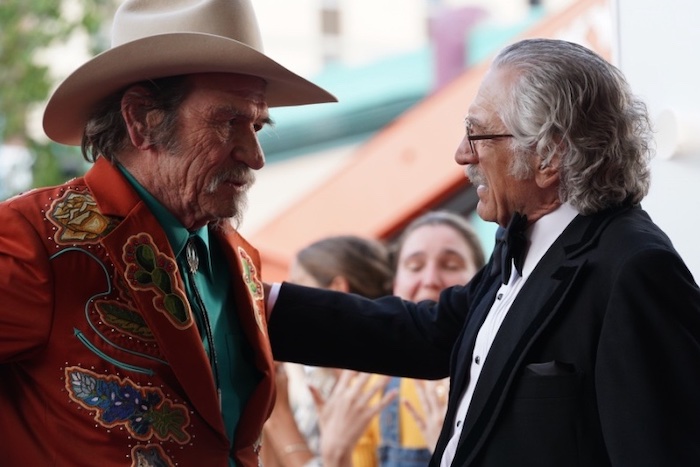
Boomer entitlement rears its ugly head once again with this overwrought comedy starring three aging A-listers—Robert De Niro, Tommy Lee Jones, and Morgan Freeman—who seem predisposed to ruining whatever recent memories we have of them keeping up their end of the Hollywood star bargain. Though the premise is hardly promising, I was more intrigued by the pedigree behind the camera. The Comeback Trail is written and directed by George Gallo, who wrote the screenplay for one of De Niro’s only worthwhile ventures into comedy, Midnight Run. Suffice to say that Gallo’s cynicism has only sharpened over the years, but his ability to form and frame a joke seems a lot patchier these days. And the fact that the film is set in the 70s makes me wonder if it’s been sitting around in Gallo’s drawer since then.

De Niro plays sinking film producer Max Barber, who, along with his hapless nephew-assistant, Walter (Zach Braff), is in debt to the tune of several hundreds of thousands of dollars to local crime king Reggie Fontaine (Freeman), who’s pretty much at the end of his rope. De Niro, desperate to not only save his skin but also the only property he owns that means anything to him (another producer, played by Emile Hirsch, offers him top dollar for it), comes up with a scheme that Gallo probably thinks is worthy of Mel Brooks: a classic Western starring washed-up horse opera star Duke Montana (Jones), one of Reggie’s all-time heroes. Knowing that the movie couldn’t possibly make back what it would cost, Max takes out a huge insurance policy on Duke and plots his demise during the filming of the rather rugged action scenes, which Duke thinks he can still handle. You can predict what happens. 

For the most part, everyone hits their marks and seems to be having a rip-roaring good time, especially De Niro, who may see Max as revenge against all the assholes in Hollywood he’s had to put up with over the years; but those kinds of vendettas tend to work both ways. And while there’s some pretty good down-and-dirty slapstick and the aforementioned cynicism is, at times, sharp enough to keep you awake, Gallo really doesn’t have anything worth going over and the movie limps to a conclusion that anyone could have written. 

Now playing in Tokyo at Shinjuku Wald 9 (03-5369-4955), Shibuya Cine Quinto (03-3477-5905).

The Comeback Trail home page in Japanese

photo (c) 2020 The Comeback Trail LLC

Posted in Movies | Tagged , , | Leave a comment