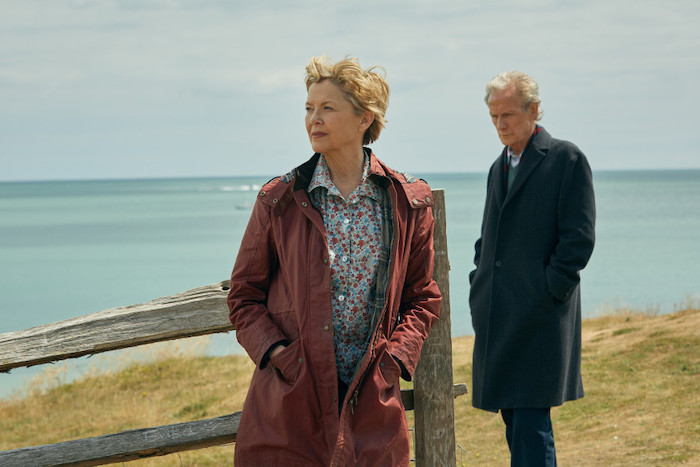
Review: Hope Gap

Given the generic late-middle-aged divorce drama premise of the story, the various publicity campaigns for Hope Gap focus on casting. Annette Bening, apparently, seems to have some sort of dedicated fan base in Japan, since that’s what the local PR is pushing. Internationally, the money is on Josh O’Connor, who skyrocketed to global fame as Charles in the third season of The Crown in 2019. That leaves the third wheel in the central family triumvirate, Bill Nighy, who, in contrast to his co-stars, seems sorely miscast.

Nighy and Bening play Edward and Grace, a British couple of middle class erudition who are coming to the end of a 30-year marriage. Edward appears to have resigned himself to its demise long ago, and mostly suffers his wife’s withering critiques of everything he does in reserved resignation. Despite her resentments, Grace is hell bent on making the marriage work even after all this time and doesn’t seem cognizant of her effect on Edward. Eventually, the other shoe drops and Edward confronts her with the ugly truth: he is in love with another woman, and has been for several years.

Though writer-director William Nicholson knows how to stage these contentious confrontations for maximum discomfort, he fails to engage the viewer by actually probing what it is about the marriage that failed in the first place. Later in the proceedings, he brings up something about how Edward fell in love too fast when he met Grace and then was too timid to back out once he had misgivings, but by that point there are too many other questions that this explanation simply can’t answer. In the meantime we’ve been introduced to Jamie (O’Connor), the couple’s 27-year-old son who has finally moved away from this idyllic seaside town to London, where he is gamely attempting to make a life of his own. Grace insists he come to visit and act as mediator in order to convince Edward to stay, even though he is already moved in with his mistress, Angela (Sally Rogers), an unassuming homemaker-widow who was the mother of one of Edward’s high school students. 

O’Connor manages to convey Jamie’s conflicted attachments to both his parents in a dramatically compelling way, but the plot, based on a stage play also written by Nicholson, has no forward momentum. It sits there on the screen spinning its wheels until it just runs out of gas. Bening brings depth to a character that often feels tediously over-determined, but Nighy, a comedian at heart whose typecasting as a hangdog phony has made him a star, seems as miserable in the part as Edward is in the company of Grace. It’s all very perplexing given the couple’s great jobs (she’s a poetry compiler–nice work if you can get it), gorgeous house, unchallenging fiscal circumstances, and a son who is clearly an intelligent, caring individual. I resent their incompatibility. 

Now playing in Tokyo at Kino Cinema Tachikawa Takashimaya (042-512-5162).

Hope Gap home page in Japanese

photo (c) Immersiverse Limited 2018

Posted in Movies | Tagged , , | Leave a comment

Media Mix, June 5, 2021

Here’s this week’s Media Mix about a recent Supreme Court ruling that found in favor of construction workers who were suing the government over their exposure to asbestos. As pointed out by a reader, Christina Tsuchida, the UK and the U.S., among others, abide by the concept of sovereign immunity, which means, in principle, you can’t sue your government (though in the U.S., at least, there are circumstances where you can sue for negligence or bodily harm, apparently). So the question is: What makes Japan different? Obviously, the idea that one has a right to make a claim against the government is not something the plaintiffs in the cases I cite will find much comfort in, but it must have been discussed when Japan was finalizing its legal system years ago. Tsuchida ventures that “to discourage minorities’ revenge on majority rule, countries like Japan must have such a possibly long process for success.” In other words, the government leaves itself exposed to retribution for some perceived wrong but makes sure that any liability it is forced to bear as a result will be very hard won. This opens a huge can of worms, since it not only touches on the bureaucratic workings of such lawsuits, as explained in the column, but the way the judicial branch of the Japanese government operates. Japanese judges, after all, are hired to be judges out of law school; which could explain the often arbitrary nature of the decisions they hand down. Critics tend to say that since Japanese judges are beholden to the government for their livelihoods (in terms of promotion, etc.), they tend to side with the authorities, but in the asbestos cases they tended to side with plaintiffs, and though the merit of the plaintiffs’ complaint seemed obvious—the government for many years did not completely ban asbestos even after it was found to be carcinogenic—such clear-cut arguments often run up against technicalities, such as the government’s assertion that only construction workers who work as company employees can receive relief for asbestos harm in the form of workman’s compensation. In the end, it was only the Supreme Court’s decision that made a difference for the (surviving) plaintiffs because the government would always appeal, so in a sense it didn’t matter what the lower judges said at all. People have the right to sue their government, and in the end they may likely win, but they have to be angry enough in order to survive the judicial process. The process itself seems to guarantee that anger.

Posted in Media | Tagged | Leave a comment

Review: Denise Ho, Becoming the Song

Given that this weekend marks the 32nd anniversary of the Tiananmen Square massacre, and that the Chinese government has prohibited any memorial of the incident in Hong Kong for the first time, the opening of Sue Williams’ documentary about pop star/democracy activist Denise Ho in Japan seems opportune for a variety of reasons, not least of all that it may help Japanese viewers focus on what’s at stake in the territory. Even before she threw her lot in with the city’s young pro-democracy contingent, Ho was a controversial figure, mainly because she came out as a lesbian at the height of her popularity as a singer—a revelation that did nothing to dent that popularity—but mainly because she’s forged a path as both an entertainer and a public person that has remained true to her ideals and veers away from those ideals for no one, including the show biz powers-that-be in China. 

As it happens, Ho’s upbringing was seriously affected by Tiananmen. Her parents were teachers and always suspicious of the Chinese Communist Party, and Tiananmen made them rethink their priorities for their children. When Denise was in junior high school, her parents moved the family to Montreal, where the school system, not to mention the Canadian mindset in general, instilled in her a fierce sense of individuality. However, the pull of her home town was always there, and in 1996, encouraged by her older brother (who would eventually become her music director), she entered a Cantopop singing contest and won, which set her up with various music production endeavors in Hong Kong. Her dream was to follow in the footsteps of her idol, Anita Mui, who became her mentor, but she bridled at the trappings of conventional stardom: the focus on glamor, the artistic prerogatives of (mostly) male managers and fans, and a resistance to her desire to tell her own story in song. In fact, it was her implacable will to tell that story that led to her coming out after a decade of playing mainly by the rules and being rewarded handsomely for it. In Williams’ telling of this story, it’s difficult not to imagine that Ho just happened to be the right person at the right time, and in that regard her gravitation to the pro-democracy movement was inevitable, since her own insistence on freely expressing herself as an artist sprang from a native fear following the 1997 handover of Hong Kong to China that such freedoms were no longer guaranteed. 

Once the movement shifted to active participation, Ho had no choice but to shift with it, even though she knew it was destroy her career. This is the meaning of the title, “becoming the song.” She had to make real the idealism she sang about. In 2014 she was arrested on camera for taking part in an Umbrella Movement demonstration, and could no longer perform in China, where she had millions of fans. Consequently, many international brands, most notably L’Oreal, which stood by her after she came out, dropped their endorsement deals with her in order to placate the Chinese authorities. 

As powerful as the documentary is, it’s already dated since it ends with the riots over the extradition bill that was eventually overturned. All that seems so long ago, now that the government is cracking down even more ruthlessly than before. Though the movie expresses some hope for Ho by showing how she’s managed to stay solvent by playing concerts for overseas Chinese fans, there’s a bittersweet flavor to these performance vignettes that points to some kind of ending. Denise Ho may not be defeated, but it remains to be seen if her tirelessly potent example as a beacon of personal freedom will survive the current political situation. 

In English (mostly) and Cantonese. Now playing in Tokyo at Theater Image Forum Aoyama (03-5766-0114).

Denise Ho: Becoming the Song home page in Japanese

photo (c) Aquarian Works LLC

Posted in Uncategorized | Leave a comment

Review: True North

Several minutes into this second feature by Eiji Han Shimizu, a Japanese of Korean descent, it’s easy to understand why he decided to make it an animated film. Though there isn’t anything depicted that couldn’t also be depicted easily with real actors and location/studio settings, the nature of the story being told would have probably been pretty expensive. For sure, the computer animation style Shimizu uses, and which he resourced out to a company in Indonesia where he once lived, looks inexpensive, and while the crudeness sometimes defeats the melodrama built into the story, it also makes Shimizu’s plot decisions easier to pull off and, thus, easier to understand.

The story centers on a family of four living in Pyongyang in the mid-1990s. The father seems to be involved in an underground network of people communicating with relatives in Japan, mainly to procure goods that are likely difficult to come by in North Korea. The fact that Shimizu keeps this aspect a bit murky is an obvious way of pointing out that whatever it is these people are doing it is at best quasi-legal, but that hardly matters because before long state security is knocking on the family’s door and searching through their apartment. The whole family is dragged off to a concentration camp, with the father preceding the mother and the two children and disappearing, seemingly forever. The focus is on the son, Yo-han, who grows into a man while spending what will likely be his entire life in the camp. Reportedly, Shimizu spoke with dozens of North Koreans who have escaped from such camps, and the physical and psychological indignites pile up relentlessly: rape, torture, starvation (both purposeful and not), withheld medical care, and a constant barrage of humiliation. When children visit the camp from outside in what appears to be a kind of educational field trip, they make their peers on the other side of the fence kneel and grunt like pigs. However, the most degrading aspect of this kind of captivity is that anyone who displays anything approaching compassion to their fellow inmates faces punishment and even death.

As with most such stories, a little of this kind of suffering goes a long way, and the cardbooard villainy of the guards plays off the stock stoicism of the prisoners in awkward ways that undermine the dramatic component. Yo-han is the only character who’s allowed anything approaching development, and even his arc is pretty predictable, from sniveling, scared child to defiant teen to turncoat factotum to scheming introvert. But while the movie offers little in the way of new information about these camps, Shimizu does manage to inject some suspense into the proceedings and the story itself ends up in a place that you might not expect. Shimizu has said that he made this film in order to show the world what goes on in North Korea—it’s why he decided to make the dialogue in English, which is a little too colloquial, I think—but I doubt anyone will be shocked by what they see here, even though much of it is truly appalling. A documentary of the people Shimizu interviewed might have been more illuminating.

In English with Japanese subtitles. Now playing in Tokyo at Toho Cinemas Chanter Hibiya (050-6868-5001).

True North home page in Japanese

photo (c) 2020 sumimasen

Posted in Movies | Leave a comment

Media Mix, May 29, 2021

Here’s this week’s Media Mix, which is about coverage of local governments’ handling of the vaccine rollout. The main theme would seem to be that, while each municipality is running things their own way, they all have to deal with the same issues as determined by the central government. As pointed out in the column, some localities have had trouble addressing glitches in the overall program, but for the most part it seems they’ve managed to keep their eyes on the prize, so to speak, and have a done a capable job considering the difficulties forced upon them by the various government ministries administering the rollout. 

Thus it might be useful to explain my own experience. Having turned 65 last December, I was in the third designated group in the city of Inzai, Chiba Prefecture, where I live, population about 100,000. The first group was, of course, medical workers, and the second was people over 75. I received my packet in the middle of April informing me that I could start making reservations for shots on May 6, either at a designated clinic or at the city’s mass vaccination center, which would be located in an empty storefront in one of the malls that line route 464 (Inzai has quite a few malls with empty storefronts). The packet contained the “coupons” with my name printed on them in katakana. These coupons, based on my resident card data, are mandated by the central government so that only those who belong to the designated cohort can get vaccinated first. The problem with this system, as pointed out in the column, is that it doesn’t account for exceptional circumstances, such as people not showing up for reservations or not even making reservations in the first place. From what I understand, municipalities are given a set amount of doses depending on their population (though, right at the beginning, apparently, every municipality got the exact same number of doses regardless of population—about 1,500) and have to make do on their own, so they need to be creative with regard to cancellations and no-shows. 

Continue reading
Posted in Uncategorized | Leave a comment

Review: David Byrne’s American Utopia

Japanese fans of David Byrne may count themselves lucky, or they may not. The preternaturally optimistic rock star’s Broadway show, adapted to the screen by Spike Lee, will initially be shown here in theaters rather than on TV, to which, in the U.S., at least, it was relegated thanks to the pandemic. As with the Aretha Franklin film, Amazing Grace, which I reviewed yesterday, American Utopia should be seen in a theatrical setting if for no other reason than that’s where you can appreciate the full effect of the music, but more than the Aretha doc, Byrne’s and Lee’s production is visually rich, probably even more so than the stage production it’s directly taken from (it was filmed during a regular performance in front of a full house shortly before lockdown).

In fact, the care that went into not only the stage production but the filming can be distracting in terms of a viewer giving themself completely over to the musical exuberance on display. Most of Byrne’s aesthetic choices are, as they were when he led Talking Heads, so simple as to be almost meaningless in terms of subtext, but they dominate, nonetheless, especially his sartorial decisions: matching grey suits on all the people on stage and no shoes or socks. Similarly, while the music is characteristically loose in the rock style, the choreography is schematic. The musicians are arrayed as a marching band would be, with their instruments deployed mainly for portability so that everyone on the bare stage can move. Byrne is one of the few artists in the world who can afford to entertain his expansive idiosyncratic notions and he has assembled a first-class contingent of musicians, singers, and dancers from all over the world (a point he emphasizes during the requisite closing introductions). Moreover, Lee’s celebrated penchant for forcing camera angles and tricks in places where they wouldn’t normally seem to belong works well here, highlighting the physical intricacies of a production that is based almost solely on human bodies and the sounds they make. 

The result is a full manifestation of the promise of the title: this is an ecstatic work, and even more indicative of Byrne’s peculiar professional mission than Stop Making Sense, which many consider the apex of concert films solely for its ability to spark joy. Nevertheless, the obsessive attention to detail makes you wonder if you’re really getting the message when, probably, there isn’t any. Until the end, when the ensemble performs Janelle Monae’s “Hell You Talmbout,” the only song Byrne didn’t have a hand in writing, the movie never sets foot in the shadows. Monae’s song is about Black people being killed by police, and the screen shows faces and names of victims. Byrne encourages greater voting participation, but not in a nagging or pleading way. A few reviewers have compared Byrne’s approach to rock music, as well as to activist participation in changing things you don’t like, to Mr. Rogers’ approach to his own specific professional mission, which is why it’s difficult to find a theme in the production outside of “life is great so let’s have a good time.” Throughout the show, Byrne occasionally explains a song or a reason for doing what he’s doing, and the most characteristic line, as well as the most anodyne, is “Everybody is a miracle.” When the stage show is over, Lee even films the cast and staff going home by bicycle.

American Utopia is as good as Stop Making Sense, but the theme of lifting spirits was better served by Jonathan Demme, who was simply celebrating the uniqueness of America’s most unusual rock group. Byrne may or may not have something concrete to say about the state of American happiness in the 21st century, but his production is so attuned to his sensibility that you often wonder how much you’re missing. Best to just sit back and let the music take you away; or, if you are watching it at home, just get up and boogie.

Now playing in Tokyo at Toho Cinemas Nihonbashi, (050-6868-5060),Toho Cinemas Chanter Hibiya (050-6868-5001), Shibuya Cine Quinto (03-3477-5905), Shibuya Parco White Cine Quinto (03-6712-7225).

David Byrne’s American Utopia home page in Japanese

photo (c) 2020 PM AU Film, LLC and River Road Entertainment, LLC

Posted in Movies | Leave a comment

Review: Amazing Grace

The story goes that Aretha Franklin didn’t want this movie released. It was filmed in the New Temple Missionary Baptist Church (formerly a movie theater) in Southern California in 1972 in front of a congregation and quite a few industry people (Mick Jagger and Charlie Watts can be seen boogeying in the back). The soundtrack was released as a double album under the same name and went on to become the biggest selling gospel album of all time. It’s not entirely clear what about the film Franklin objected to. The opening credits said something about technical difficulties and several reviews have mentioned syncing problems, but Aretha was always a bit contrarian when it came to her gifts, and likely there were elements here where she revealed things that only she understood but probably thought every viewer would pick up on. 

In any case, after she died in 2018, an independent producer acquired the rights to the footage and put it together. Ostensibly, it was directed by Sydney Pollack, who can be seen darting around with a handheld camera, but the overall film’s makeshift structure and lack of planned-through narrative shows that, in the end, the producer just wanted to get this stuff out there, and you should be very glad he did, because it will make you a believer, if not in God and the redeemer than definitely in the truth that Aretha Franklin was the greatest singer of our lifetime. 

What needs to be said up front is that Aretha decided to go back to her roots and make a full-on gospel record at the height of her fame as a pop singer, and while the camera and the audience on hand treat her as the diva she was, there’s an anxiety underlying her performance that gives it a tension that’s difficult to describe. Accompanying herself on piano she opens with Marvin Gaye’s pointedly secular, and relatively new, “Wholy Holy,” and, pulling the exceptionally prescient Southern California Community Choir behind her, shows exactly how gospel informs her pop sense. From then on she almost never engages with the congregation, and lets her mentor, Rev. James Cleveland, act as both master of ceremonies and pastor of the hour (two nights were filmed). And though the movie doesn’t follow the dramatic development of the album, it creates its own fireworks through the juxtaposition of fiercely inspired witness, technically accomplished musicianship, and the spontaneity that is the hallmark of a stirring Sunday morning assembly. At one point, the great Clara Ward, sitting in the front seat next to Aretha’s father, the Rev. C.L. Franklin, is so moved by Aretha’s reading—just her and piano—of “Never Grow Old,” that she gets into a kind of tussle with her elderly mother, who has stumbled to the front to express her approval. During the performance of the title song, Cleveland himself, accompanying Aretha on piano, is so overcome, he has to be spelled by choirmaster Alexander Hamilton. Meanwhile, the choir in back, seated through most of the movie, falls all over themselves trying to urge Aretha on to greater heights of spiritual reckoning. 

At times, the business around Aretha almost threatens to make her presence incidental. The crowd and the other participants are agitated while she remains the eye of the storm, so to speak. If the album is more of a continuous immersion than the movie is, it’s because all the vocal drama is calculated in post-production. But as you watch her break through on one impossible note after another and the accompanying visceral reaction in the venue, the movie transcends its pokey production values. It’s not a great film; it’s not even a great concert film in the way, say, Stop Making Sense is, but it captures the essence of musical performance like no concert movie ever has. It is a genuinely transporting experience; pure emotion on screen. If you can see it in a theater with good sound (the mixing is superb) then by all means don’t miss it. 

Now playing in Tokyo at Bunkamura Le Cinema Shibuya (03-3477-9264)

Amazing Grace home page in Japanese

photo (c) 2018 Amazing Grace Movie LLC

Posted in Movies | Tagged | Leave a comment

Media Mix, May 22, 2021

Here’s this week’s Media Mix about how the national newspapers are talking about the scheduled discharge of irradiated ground water from the stricken Fukushima No. 1 reactor into the surrounding sea. One of the purposes of editorials is to put the news into some kind perspective that will have meaning to readers, and in the case of the discharge many people don’t know if it’s a good idea or a bad idea. For the most part, the media has taken the government line, which is that the discharge will not harm the environment, but it’s not really certain that the public is convinced, which is why the general tenor of the editorial content of all five national newspapers is that the government has to explain more, though, realistically speaking, it’s difficult to imagine what exactly the government could do to bring everyone over to their way of thinking. Obviously, someone like Hiroaki Koide, the physicist mentioned at the end of the column, is going to be against the discharge because he is fundamentally opposed to commercial nuclear energy, but his main beef is with Tepco rather than the government, since he believes the utility approaches the whole matter from an economic standpoint, which means safety and other concerns are secondary. 

With climate change an ever-increasing threat to everyone on the planet, nuclear energy has become a focus of attention because it doesn’t produce CO2, so Japan, which has spent decades building up its nuclear capacity, has an obligation to see how viable nuclear power is as a means of mitigating its contributions to global warming, but it can’t ignore the public’s anxieties about nuclear power, not after what happened in Fukushima ten years ago. Tepco and the government have had a decade to put into place credible safety guidelines that take into account the proximity of power stations to residential areas and Japan’s geological situation, and they haven’t done enough. Various courts have blocked power station restarts because evacuation plans have been found to be insufficient, and in the past several months violations of security arrangements at two of Tepco’s power plants were discovered. It’s as if Tepco and the government don’t really care, so they can’t complain about “damaging rumors” if they themselves are party to creating them. 

Posted in Uncategorized | Leave a comment

Milva in Tokyo, 1998

The great Italian singer Milva died on April 23. For a while in the 90s and 00s she was an annual visitor to Japan, kind of like the Ventures of canzone, and I caught several of her concerts because Masako at the time did a lot of work for the promoter who brought her to Japan. The following is a review of her joint concert with the bandoneonist Daniel Binelli that I wrote for the Japan Times.

It’s not unusual for an artist’s reputation to soar after his death, but in the case of Astor Piazzolla, the Argentine bandoneonist and tango music composer who died in 1992, the legacy has taken on a separate life of its own. Though successful while he was alive, Piazzolla has in the past several years entered the classical canon as one of the late 20th century’s most significant composers, thanks not only to the current “tango boom,” but also to superstars like cellist Yo-Yo Ma and violinist Gidon Kremer, both of whom recently released best-selling albums of Piazzolla compositions.

As Kremer said in an interview on TBS’s “News 23” last year while he was in Japan for a concert tour, Piazzolla’s newfound popularity as a composer among the classical elite can be attributed to a sudden fin de siecle realization: For better or worse, most of the “serious” music composed in this century has been aimed at other composers. Piazzolla, on the other hand, wrote music for people — music that was not only challenging to play but enjoyable to listen to.

The Italian singer Milva, never one to pass up a chance to exploit a cultural trend, has dedicated her latest “Dramatic Recital” to the music of Piazzolla. Former Dramatic Recitals included programs dedicated to Brecht and Weill, songs that were popular in Europe between the wars, and the music of Edith Piaf. But while some people may raise their eyebrows at the canzone diva’s blatant opportunism, she has more of a right to take advantage of Piazzolla than, say, Ma or Kremer does since she actually toured with the great man back in the 80s.

What’s more, on her current Japan tour, entitled “El Tango de Astor Piazzolla,” she is being accompanied by bandoneonist Daniel Binelli, a musician who, since he spent three years playing alongside and studying with Piazzolla, can lay justifiable claim to the master’s musical legacy, not only as a musician but as a composer.

Though Milva’s name was at the top of the bill, Binelli and his excellent quintet were equal creative partners when they performed at the Tokyo International Forum on June 11. Alternating between Piazzolla compositions (including two written expressly for Milva) and Binelli compositions (including one written expressly for Milva), the recital was as much a tutorial on the musical life of Buenos Aires as it was a showcase for the oversized theatrical expressionism of the saucy, red-haired chanteuse.

In fact, Binelli and his group held forth by themselves on half the numbers. The peculiar genius of Piazzolla’s work is the way it extrapolates the rhythmic fundamentals of the tango into a new kind of formalism that is as compelling to listeners as it is to dancers. Binelli has taken this idea further. His compositions are more angular, more self-consciously “modern” than his teacher’s were. If in concert these works do not sound particularly danceable, that may only be because there were no dancers around to prove otherwise, but my guess is that tangoers would have had a tough time with the time signature changes in a work like Binelli’s “Fugue & Resurrection.”

Milva dances, in a fashion, but what she really does is sing, very loudly and very broadly, in a rich contralto complemented by a thick, juicy slice of Mediterranean ham. There’s some debate as to whether Piazzolla’s music, as melodic as it is, really lends itself to lyrics (his second wife was a singer and he wrote a number of songs for her), but don’t tell that to Milva, who threw herself into the material with the abandon of a Holy Roller.

Dressed in a series of daringly strapless gowns that clashed rather obviously with director Filippo Crivelli’s purposely impoverished-looking set (an unpainted wooden fence meant to represent…what? Some Buenos Aires back alley?) as well as with the musicians’ customary black shirts and slacks, Milva is such a gone showwoman that you can’t help but admire her total disregard for theatrical congruity, even when she kicks off her high heels (as she does at every performance) in a fit of planned impetuousness.

She can even be forgiven for putting lyrics (English, no less) to Piazzolla’s brief gem-perfect instrumental “Libertango” for an encore. After all, this was not a classical concert; it was essentially a cabaret show. And despite his clear acknowledgment of Piazzolla’s highbrow legacy, Binelli was more than happy to match Milva’s campy excesses with some wonderfully ostentatious accompaniment. As the saying goes, it takes two.

Posted in Music | Tagged , | Leave a comment

Media Mix, May 15, 2021

Yuki Kitazumi

Here’s this week’s Media Mix, which is about the Japanese government’s “channels” to the Myanmar military that staged a coup earlier this year. The point of the column is to ask whether the government has the wherewithal to confront the Myanmar military and persuade it to negotiate in good faith with the civilian government it removed from power under the charge that the civilians’ overwhelming victory in last November’s general election was fraudulent, though third party observers said it was free and fair. The fact that the military has freed Japanese freelance journalist Yuki Kitazumi after arresting and indicting him for allegedly spreading “fake news” about the protest movement against the military proves that the Japanese government does have some sway over the generals because of all the aid it gives the country—much of which likely goes directly into the generals’ pockets—but so far there has been no indication that the Japanese government will use this influence to help the people of Myanmar and its shaky democracy, which has now collapsed. Though the Japanese mass media hasn’t said so overtly, the mood on social media leans toward an acknowledgement that there seems to be little will in the government to try and broker some kind of agreement between the military and the civilian government. The President Online article cited in the column goes into detail about the financial stakes involved, and though these stakes definitely come into play (many Japanese companies are heavily invested in Myanmar), as time stretches on and the military seems determined to just wait things out in a bid to wear down the protesters, the relative inaction on the part of the Japanese government seems to show that it doesn’t have the stomach to take on the generals in this regard. In other words, maybe money has less to do with it than we think it does. It may simply be a matter of the government telling itself that this is an issue that only the people of Myanmar can solve, and you can make of that what you will. 

Posted in Media | Tagged | Leave a comment