Review: The Father

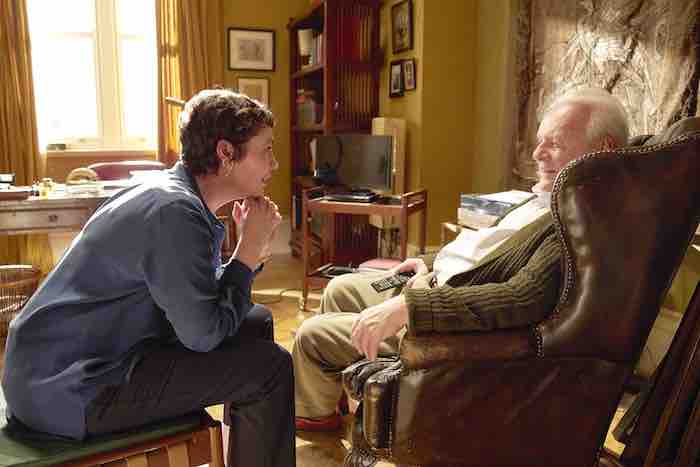
I had no problem with Anthony Hopkins winning the Best Actor Oscar for his performance in Florian Zeller’s screen adaptation of his own play. I saw all the other nominated performances, and only Hopkins’ stood out. Everyone else, including odds-on favorite Chadwick Boseman, did exactly what they were supposed to do in their respective movies. Hopkins, however, not only transcended Zeller’s occasionally gimmicky dramatization of a man confronting dementia, but he brought out his character’s true personality, something the script didn’t necessarily support. If the point of Zeller’s realization was to place the viewer in the main character’s mind, there was always going to be the danger of feeling doubly estranged from the character, but Hopkins’ careful focus on the kernel of the role’s humanity gave the viewer something to grasp, and once you were in his grip, it was difficult to avoid the horror of the situation.

Hopkins plays Anthony, so named because Zeller wrote the screenplay with Hopkins in mind. Unfamiliar with the original French play or the subsequent French movie version that, according to various reviews, seems very, very different from this English version (co-adapted by Christopher Hampton, himself an acclaimed playwright), I have no idea what kind of adjustments Zeller made in order to accommodate Sir Anthony, but the character is firmly within the actor’s wheelhouse: a retired engineer-cum-civil-servant who lives in a lovely London flat surrounded by objects of good taste and doted upon by a daughter, Anne (Olivia Colman), who clearly adores him and only wants him to be happy. In the opening scenes, she tries to set him up with a new home helper (Imogen Poots) in the hopes that he will be easier with her than he was with past helpers. Though this premise is fairly standard for stories that address the indignities of growing old, the various tensions at play—the hushed anxiety beneath Anne’s polite veneer, Anthony’s overbearing flirtatiousness, and the new recruit’s difficulty in navigating between them—is handled so adroitly that you leave the sequence in a state of acute unease that Zeller and Hopkins then exploit to the fullest.

Borrowing from the horror-suspense playbook, Zeller’s direction forces the viewer to question what’s reality and what isn’t, though even that fairly trite approximation doesn’t quite get a handle on the emotional complexities at play. At almost every step, we have to wonder not only whether the people Anthony encounters are really who they say they are, but if this place that seemed so comfortably his really is his. It’s not so much that Zeller masters the art of meaningful contradictions, but that he understands how the human mind naturally reacts to them. He and Hopkins evoke terror and sadness by denying us the comfort of continuity. What’s really horrifying is how inevitable it all seems.

Now playing in Tokyo at Toho Cinemas Chanter Hibiya (050-6868-5001), Toho Cinemas Shinjuku (050-6868-5063), Bunkamura Le Cinema Shibuya (03-3477-9264).

The Father home page in Japanese

photo (c) New Zealand Trust Corporation as Trustee for Elarof Channel Four Television Corporation Trademark Father Limited F Comme Film Cine-@ Orange Studio 2020

Posted in Movies | Tagged , | Leave a comment

Media Mix, May 9, 2021

Ban’ei race

Here’s this week’s Media Mix about a viral video showing a jockey kicking a horse. The point of the piece is that the media tends to be passive about anything that might be perceived as animal abuse, and that pertains to livestock as much as it does to race horses and other animals bred and raised for entertainment purposes. As mentioned in the column, after the video drew criticism, some people involved in the racing business defended the jockey and the sport by saying that it isn’t as bad as it looks, and that line of argument has continued, with the media picking it up but never getting to the other aspect of horse racing that I brought up later in the column—that as soon as a horse becomes unproductive it is killed, because they aren’t bred for anything other than racing or creating other race horses. Granted, ban’ei race horses are draft horses, so they could presumably be put to work, but I really wonder how many farmers, even in Hokkaido, still use horses to pull plows and transport crops. The same thing goes for cockfighting. In one old article I read about Kyoko Honda, the woman who rescues maimed and discarded roosters, one man was interviewed who stages “safe” cockfights in that the birds’ claws are trimmed and the fights do not end in injury or death. Needless, to say, however, this man’s example is the rare exception and it didn’t sway Honda away from her mission to get the sport banned in Okinawa.

Though the Japanese media seems to go out of its way to avoid the obvious about animals raised for sport or food, generally speaking media all over the world do the same thing, even if it’s only a matter of degree. That, in fact, is the moral of the story, so to speak, of two similar documentaries now available on Netflix, Cowspiracy and Seaspiracy, which happen to be from the same production house. Ostensibly, both films address mass food production from the standpoint of the environment and sustainability—the former about livestock farming and the latter about industrial fishing. Both are incredibly destructive to the environment. However, both also end up in the same place where the narrator-directors conclude that eating flesh, whether it be that of mammals, birds, or fish, is morally indefensible for all the suffering it causes. This is, of course, a highly personal determination, but it is a truth that anyone who lives in the world today has to confront on their own terms, and while the media does talk about inhumane conditions for livestock, it usually comes down to the idea that we leave the dirty work to people at the bottom of the economic pyramid or those lingering at the margins of society. One could make the argument that catching and killing your own meat is defensible from a primal standpoint, but like the humane cockfighting presenter mentioned above, it’s the exception that essentially proves the rule, which is that we make other species suffer needlessly for our own sustenance. In that light, making them suffer for our own entertainment seems beyond the pale. 

Posted in Media | Tagged , | Leave a comment

Media Mix, May 2, 2021

Yoshiaki Yoshida

Here’s this week’s Media Mix about bigoted comments made by Yoshiaki Yoshida, the chairman and founder of the cosmetics/health supplement company DHC, and the media reaction. Some marginal matters that didn’t make it into the column but are nevertheless relevant: Originally, I had written the anti-Korean slur in the article because it has appeared in other English-language coverage of the matter but was told by an editor that the word is considered extremely derogatory, on par with the N-word. This would seem to indicate that recognition of anti-Korean hate speech has yet to permeate the culture at large, since even the BBC used the word. Also, last year the magazine Shukan Bunshun reported that Yoshida, reacting badly to the news that his company was no longer the sales leader in the industry, urged employees to blanket fake-post on consumer bulletin boards using pseudonyms to boost the image of DHC’s products while at the same time blasting his own advertising department’s work, saying the ads were “childish.” As pointed out in the column, his beef with Suntory was prompted by his losing market share to the liquor giant, which also sells health supplements, and this brought out his bigoted side more prominently. Bunshun, which seems to have a grudge against the company, also interviewed an employee in January who was fired for having openly criticized Yoshida for his anti-Korean rants and gave Bunshun a recording of a human resources person asking him to quit, which he refused to do, thus forcing the company to dismiss him. In the recording, the human resources person said that hate speech “is not a problem” in the company. The fired employee is suing DHC, seemingly to get his job back. 

One more side note: DHC started out as a translation company that also offered lessons in translating. When Masako and I were first starting out as translators we entered a contest that DHC was running as a means of drumming up students. The winner would receive ¥50,000 and a chance to work for the company as a freelancer. The winning translations (there were two — one for Japanese to English, another for English to Japanese) would also be published. As it happens we won the J to E prize, and while we did receive the money they never asked us to do any work after that. Also they never published our translation, which was of an interview in Japanese with scholar Douglas Lummis, an American who is famous for defending the rights of native Okinawans, which seems ironic now given Yoshida’s reactionary proclivities, including his bigoted feelings toward Okinawans. Less pertinent but still interesting and slightly ironic, Masako’s late father was a Korean immigrant, though there was no way that DHC would have known this because Masako doesn’t bear his name. In any case, a company that deals in translation as a business should be expected to be more tolerant of other cultures, I would think. So maybe Yoshida’s bigotry was something that developed over time; or just became more apparent as he got older and richer.

Posted in Media | Tagged , | Leave a comment

Review: Along the Sea

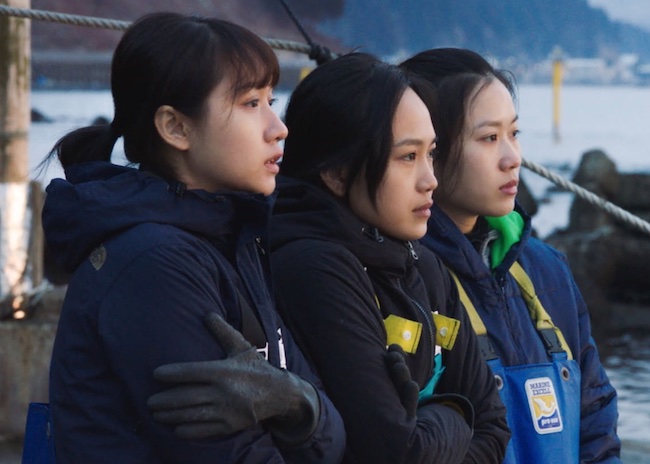
Akio Fujimoto’s Along the Sea does a good job of describing Japan’s arcane technical intern training program without actually explicating its rules and procedures. As such, it also goes a considerable distance in providing an idea of Japan’s attitude toward immigration in general, though for those of us non-Japanese who live here it may feel insufficient given the rank hypocrisy at the heart of the country’s immigration policies. By now, everyone who has ever read about the technical trainee program knows that it is basically a cover for the provision of cheap overseas labor to Japanese businesses without any reciprocal protections for the laborers themselves. Cloaked by the meaningless and anodyne concept of development assistance, the program can’t help but create a kind of parallel universe of brokers and criminal agents who exploit the system for themselves, thus making its supposed beneficiares double victims.

Along the Sea focuses on three trainees, all young Vietnamese women (Vietnam provides approximately half the trainees) who came to Japan with the express aim of making money rather than “learning a skill,” which is the ostensible purpose of the program. When we first meet the women, Phuong (Hoang Phuong), Nhu (Quynh Nhu), and An (Huynh Tuyet Anh), they are already escaping from their assigned positions, where they work 15-hour days in a factory under horrible living conditions, including unpaid overtime. The underground nature of their escape, however, means they leave behind their documentation, which their “employers” withhold in order to keep them hostage, and are thus not only illegally resident in Japan, but unable to return properly to Vietnam.

Their escape is assisted by a broker who has already secured  employment for the women at a fish-packing factory in Aomori Prefecture. For a while the women are happy with their decision, mainly because the pay is better and more secure, which means they can easily send money back to their families in Vietnam; and they have more freedom of movement and actually seem less conspicuous in this sleepy seaside town. However, Phuong eventually falls ill and believes she may be pregnant, a development that puts all three women at risk. Because they have no documentation they cannot access public health care and Phuong turns to a Vietnamese fixer who exploits her situation more brutally than the Japanese authority, which can mostly hide behind bureaucratic layers of cyncism. Eventually, the general paranoia festers, destroying the women’s relationship. 

Fujimoto treats the story with  documentary precision, and thus the viewer may want more information, such as the availability of abortions in Japan (Phuong thinks the father is her boyfriend back home, and pregnant trainees are forbidden from entering Japan) and the distinction between brokers and fixers in terms of what kinds of underground networks they belong to. Such unanswered questions do not detract from the dramatic impetus of the movie, and while the overall production is purposely drab and as contrast-free at the overcast pallor of Aomori, the movie is thought-provoking in an immediate way, which is unusual for a recent Japanese narrative film.

In Vietnamese and Japanese. Now playing in Tokyo at Polepole Higashi Nakano (03-3371-0088).

Along the Sea home page in Japanese

photo (c) 2020 E.x.N K.K./ever rolling films

Posted in Movies | Leave a comment

Media Mix, April 24, 2021

Nagoya torch relay (Chunichi Shimbun)

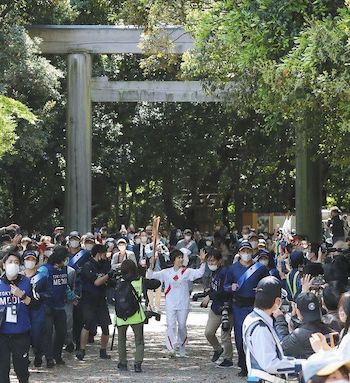
Here’s this week’s Media Mix about coverage related to the Olympics that doesn’t sit right with the organizers, whether they be local officials or the IOC. I should say more about the Tokyo Shimbun article and video that covered the start of the torch relay in Fukushima. Though I use it in the column as an illustration of how IOC rules vis-a-vis the media sidestep local laws and practices in order to privilege those outlets that have entered into exclusive deals with the Olympics, to the newspaper’s reporters the restrictions in place could have real negative consequences. When locals in Fukushima complained about the “festival atmosphere” during the torch relay event, they weren’t just talking about the “bad taste” aspect, but also the health risks, which has been the main focus of Tokyo Shimbun’s coverage. On April 7, the paper ran another feature about the torch relay as it passed through Nagoya and Aichi Prefecture, reporting on how crowds of spectators were dangerously dense. In this case, a video would have made a particularly strong impact in line with the reporting, but since Tokyo Shimbun couldn’t keep any visuals on its home page for more than 72 hours per IOC rules they had to make do with verbal descriptions about crowds standing “shoulder-to-shoulder” along public roads “3-persons deep,” and how local security teams were having trouble maintaining social distancing guidelines. Needless to say, no TV stations covered the torch relay in this way since most of the networks have some kind of stake in the Olympics, and even if a station doesn’t have a sponsorship deal they still are hesitant to get on the wrong side of the organizers lest they get shut out of future coverage. 

But even if that weren’t the case, would TV stations cover the torch relay and other Olympics promotional events with a critical eye? When NHK broadcast a livestream of the torch relay as it passed through Nagano city on April 1, some viewers noticed that the sound was cut out for about 30 seconds after it was apparent that protesters in the background were chanting anti-Olympics slogans. A wave of indignation swept through social media, accusing NHK of shutting out dissident voices and distorting its news coverage. One explanation is that security stopped the demonstration due to the loud chanting, which goes against COVID-prevention protocols, but it’s obvious from the resulting footage that somebody muted the sound itself. Organizers responded by saying that the presentation of the video was NHK’s concern and the organizers had nothing to do with it. When Mainichi Shimbun, which, as pointed out in the column, has been the most conscientious of the sponsoring daily newspapers in its coverage of the Olympics in general (Asahi has, too, but mostly in its editorials), asked NHK why it cut out the sound, the publicity person referred to “various circumstances” without elaborating, though they didn’t deny that the sound had been altered. NHK, of course, will be one of the main broadcasters of the Games, but, given their history of avoiding certain controversies for the sake of decorum, it seems just as likely that NHK’s decision to cut the mic mid-protest was more reflexive than cautionary. 

Posted in Media | Tagged | Leave a comment

Review: Caught in the Net

The clever, almost flippant title of this Czech documentary betrays its slightly self-congratulatory tone. Though the topic is a very serious one—pederasts stalking children online—the focus on superior production values and the game-like execution counteracts the seriousness to a certain extent. For all the disgust certain scenes will surely provoke in viewers, the movie seems almost beside the point, and I can’t help but feel that a more effective documentary about the sexual victimization of children could have been made without the reality show trappings.

Granted, the enterprise concocted and recorded by filmmakers Vit Klusak and Barbora Chalupova is presented as an “experiment” that mostly investigates the permeability of social media and how those without proper defenses due to lack of maturity can be taken advantage of. Right at the start of the film we are shown statistics stating that 41 percent of Czech children have received unsolicited pornographic images online from other people. The parameters of the experiment are explained clinically and also in a slightly conspiratorial fashion. The directors put out a casting call for young female actors over the age of 18 to arrive wearing children’s clothing. Twenty-three show up and each is told her task if selected: she will impersonate a 12-year-old girl who joins a number of social networks with the purpose of attracting men who stalk pre-teen girls for sexual gratification. Those auditioning for the part explain, often in lurid detail, some of their own experiences with sexual abuse. Three are selected, and then an elaborate set is constructed on a soundstage consisting of three bedrooms that simulate the individual actors’ respective spaces when they themselves were 12 years old, complete with actual artifacts from their childhoods. Computers are set up and connected to video recording equipment that will be monitored by a large staff, including psychologists, lawyers, social workers, and sexologists, who are on hand to make sure things don’t get too intense for the actors, which, of course, they do.

The experiment lasts for ten days, during which the three women are contacted by a total of 2,548 men, who mostly interact with the women through Skype. Their faces are creepily masked, and they often freely admit that they are masturbating as they talk to the women, who are clearly distressed by the fact though they’ve been warned this will happen. In almost all the cases recorded, the men not only show the women their penises, but request that they remove articles of clothing themselves or demand they send nude photos of themselves. In fact, in order to extend the experiment, the producers hire outside models to act as body doubles for the women so that they can send the nude photos requested. In at least one case, an interlocutor uses the photo for blackmail purposes. (As a kind of antidote to the queasy mood, they include one young man who goes online just to talk and then commiserates so honestly with one of the women about the horridness of most men that the interaction brings tears to the eyes of everyone listening.) The whole endeavor is capped by in-person meetings in a cafe with 21 of the men and then a contentious encounter with one outside his home where the filmmakers reveal their project and accuse him of illegal acts. 

The film does explicate how shockingly widespread child stalking is on the internet, and many of the encounters reveal the mindset behind such actions, which often come down to simple misogyny (in his defense, the man confronted at the end of the movie blames the girls for coming on to him); and a final title card mentions that the data collected during the experiment was eventually handed over to the police, who are now “investigating” the men depicted. But the overall impression is of a very sophisticated stunt that produced interesting results that probably could have been produced in a way that was less sensational. 

In Czech. Now playing in Tokyo at Human Trust Cinema Shibuya (03-5468-5551), Shinjuku Musashinokan (03-3354-5670). 

Caught in the Net home page in Japanese

photo (c) Milan Jaros, 2020 Hypermarket Film, Czech Television, Peter Kerekes, Radio and Television of Slovakia, Helium Film

Posted in Movies | Leave a comment

Review: The Booksellers

D.W. Young’s engrossing documentary attempts to make a case for the physically printed word as the most viable means of extending culture into the future, but  because it focuses on rare booksellers it invariably makes that case as a construct of capitalism, and I don’t think that was Young’s intention. At one point near the end of the movie an expert comes out and says that young people, or, at least, young New Yorkers, are rejecting digital reading platforms for paper and theorizes that technology like Kindle was developed and used mainly by boomers whose eyesight was starting to go. It’s a quaint but rather difficult idea to defend empirically (he seems to base this theory on observations he made on the subway), and, in any event, contrasted with the narrative that Young presented prior to this assertion, simply sounds like the conclusion of someone with a vested interest in trade paperbacks.

The main subject of the movie is books as artifacts–as works of art distinct but not separate from the art of the writing they contain. Revived New York essayist/iconoclast Fran Lebowitz puts it best when she says saltily that she would kill anyone who dared place their drink on a book, any book. Books are living things, she says, which is why she can’t countenance anyone “throwing them away,” no matter what kind of literature they deliver. In that regard, Young might have gained a lot of traction by reporting on regular book stores that are going out of business (or coming back, as some media have reported) due to or despite digital pressure, but instead he hangs out with the fringe of the business, those who collect books obsessively and then trade the rarest of them for ever-increasing amounts of money. As such, the movie has the kind of musty, low-lit atmosphere that antique book stores give off. The sellers themselves are, for the most part, quiet and serious, though Young makes a point of interviewing members who don’t fit the stereotyped majority, meaning middle aged men in tweedy outfits with bad haircuts. There are women and people of color, who point out how hard a time they have doing business with the leaders in the field. There’s also a brief shout-out to rare magazine fans, which at least brings the business into the 20th century.

Unfortunately, Young seems to assume that the viewer cares more about the state of books than the state of literature, and consequently it feels like it’s aimed at a niche audience that already has its mind made up. For one thing, he often neglects to identify the person on screen or the place where the interview is taking place, which is odd for a documentary about documentation. In a sense, he’s more interested in conveying the excitement of the physical world of books than he is in the act of reading, and, in my mind, at least, the two are inseparable. 

Now playing in Tokyo at Human Trust Cinema Yurakucho (03-6259-8608), Shinjuku Cinema Qualite (03-3352-5645). 

The Booksellers home page in Japanese

photo (c) 2019 Blackletter Films LLC

Posted in Movies | Leave a comment

Media Mix, April 17, 2021

Kei Komuro

Here’s this week’s Media Mix, which is about the latest development in the coverage of Princess Mako’s and Kei Komuro’s bumpy road to everlasting happiness. “Coverage” is the operative word here since it’s not clear how much of what the media says about this fraught love affair is rooted in reality. Even the way the press pounced on the cited Shukan Asahi survey that found 97 percent of respondents “disapproved” of Mako and Komuro marrying showed how much the publications with a stake in such stories (tabloids, weeklies, and women’s magazines, mainly) want to think the worst of Komuro. But, in fact, if you look at the results of the survey more carefully you find that while 52 percent of the respondents said Komuro needs to explain the money issue, 48 percent said it wasn’t necessary. The media harps on the money that Komuro’s widowed mother supposedly owes her former lover, funds she claims were given to her son to help with his education and with no strings attached, and thus the reason for the public’s enmity toward Komuro is assumed to be this money. That’s why Komuro said last week that he is keen to pay it all back, regardless of the ex-lover’s original intentions, but that there is still some sort of failure to communicate with the man, or at least with the people representing him.

What needs to be remembered is that it was this ex-lover who originally brought the story to a weekly magazine several years ago, and who has effectively, not to mention anonymously, controlled the narrative ever since. Komuro and his mother, for the most part, have tried to keep quiet in order to save Mako and her family as much embarrassment as possible, so in the end the whole scandal is something that was brewed up between the ex-lover and whichever media outlets he has talked to; which isn’t to say Komuro and his mother are off the hook, but the story plays into established prejudices about single mothers and the men they take up with, presumably for financial reasons. Based on what small amount of real information is available (as opposed to the rank speculation fueling most media reports), Komuro should actually be commended for defending his mother, who may have made a bad choice of a romantic partner, but then why does the media take that romantic partner at his word in everything he says? 

Of course, nothing of this story would matter if the imperial family weren’t somehow involved, but it says something about the media’s priorities that they can provoke negative public opinion so easily with the dangerous cliche that single parents, especially those whose deceased spouses committed suicide, are, by definition, not good parents at all. 

Posted in Media | Tagged , | Leave a comment

Review: Cheerful Wind

K’s Cinema in Shinjuku is presenting a two-month retrospective of Taiwan cinema centered mainly on the work of Hou Hsiao-hsien that includes a lot of films from the 1980s which rarely get shown here any more, despite Hou’s close relationship with Japan. Among these is Hou’s second feature from 1981, the digitally remastered Cheerful Wind, providing what is probably the master’s most conscientious stab at a conventional crowd-pleaser, though there are enough peculiarities in both the story and the presentation to satisfy fans of his more distinctive work. Basically a romantic comedy made during a time when Asian directors were only mildly familiar with the genre, the movie offers up a unique female lead in a setting whose circumstances are deceptively anodyne (Taiwan was under martial law until the late 1980s).

Working with two established stars, Hong Kong idol Kenny Bee and Taiwanese pop singer Fong Fei Fei, Hou subverts the usual male-female dynamic of idol movies by making the female lead an aggressively self-possessed career woman and the male an introvert by necessity, since he is blind. Moreover, he sets up the requisite meet-cute moment with an almost ridiculous plot premise: a location film shooting on a city street for a TV commercial. Hsing-hui (Fong) is the ad agency’s photographer working on the shoot, whose client is a company that makes laundry detergent. The shoot is a chaotic affair, a seeming comment on the “movie-within-a-movie” concept on display, with the director trying all sorts of bizarre ideas, including exploding cow shit, to prove the worth of the subject product. Hsing-hui spots blind harmonica player Chin-tai (Bee) and ropes him into appearing in the commercial based on the very un-PC premise that, even as a sightless person he can appreciate the quality of the detergent just by reputation.

A kind of crush is developed on Hsing-hui’s part, despite the fact that she is informally engaged to a colleague, Lo (Anthony Chan Yau), who is keen for her to meet his mother in Hong Kong. Her reluctance to carry through this obligation indicates, in classic rom-com style, that Hsing-hui’s attachment to Lo is anything but fast, and when she keeps running into Chin-tai on the street she endeavors to place herself in an orbit he can’t quite comprehend, though the audience does. Eventually, we understand that Hsing-hui’s interest in Lo is entirely self-serving, since he is from a family of means and her real desire is to travel extensively on his dime. As with many entertainments of that time, a lot of story time is given up to show the characters’ middle class aspirations, invariably represented by Western encroachments. When Hsing-hui’s father arrives from the sticks to meet Lo, they take him for pizza and Coca Cola, a meal that he finds somewhat repugnant.

Counterintuitively, the romance with Chin-tai is so low-key as to be practically demure, a quality that Hsing-hui herself never embodies. If anything, her casual insubordination at work and rather callous method of dumping Lo come across not as the actions of a selfish individual but rather that of a true free spirit. She pretty much charms everyone she comes into contact with, so her choosing Chin-tai, a blind man with no prospects, as a potential life partner seems particularly subversive; that is, until the happy ending, which is perhaps a bit too fantastic to take at face value. Since rom-coms didn’t really exist in Chinese-language cinema at the time, it’s not as if Hou were standing an established genre on its head. It’s as if he were already having fun with it, and that’s an aspect of his art that applies throughout his work. 

In Mandarin and Taiwanese. Starts April 17 in Tokyo at K’s Cinema Shinjuku (03-3352-2471).

Taiwan/Hou Hsiao-hsien Retrospective home page in Japanese

photo (c) 1982 Kam Sai (HK) Company (c) 2018 Taiwan Film Institute

Posted in Movies | Tagged | Leave a comment

Media Mix, April 10, 2021

Kensei Mizote

Here’s this week’s Media Mix, which is about various theories on why former justice minister Katsuyuki Kawai changed his plea in the middle of his trial for buying votes for his wife, Anri, during the 2019 Upper House election. The journalists and others I mention are knowledgeable and serious, but there were other theories floating around from less reputable sources, the most interesting one being that of Asahi Geino, a weekly magazine known for its salacious content, especially with regard to celebrity sex scandals. In the April 1 issue the magazine interviewed a former “executive” of a yakuza organization who said that prior to the election campaign for the Hiroshima seat in question, he was asked to dig up dirt on Anri’s main opponent, Kensei Mizote, who, like her, belongs to the Liberal Democratic Party. Mizote has often been touted as the main reason for the alleged vote-buying spree, since former prime minister Shinzo Abe reportedly hates his guts owing to some unflattering things Mizote said about Abe in the past. The ex-gangster interviewed by Asahi Geino, Tokihide Hirota, didn’t mind revealing his own name but he wouldn’t reveal that of the person who asked the favor. However, he did say this person was the chairman of a powerful “corporate group” in Hiroshima Prefecture. Also, Hirota got the impression that this chairman himself had been asked to find some compromising intelligence about Mizote. Hirota boldly speculates that it was probably a sitting member of the prefectural assembly and that this person was probably solicited to carry out the dirty work by none other than LDP secretary-general Toshihiro Nikai, since Anri belongs to Nikai’s faction in the party. 

Hirota couldn’t resist throwing his own two yen into the discussion, saying that it’s all about the enmity between Abe and Mizote and “factional in-fighting within the LDP.” The fact that this intramural donnybrook has been “exported” to the Hiroshima electorate shows just how “shameful” Japanese politics has become. “It’s terrible for the local citizens,” he said, thus reminding us that yakuza are citizens, too.

Posted in Media | Tagged | Leave a comment