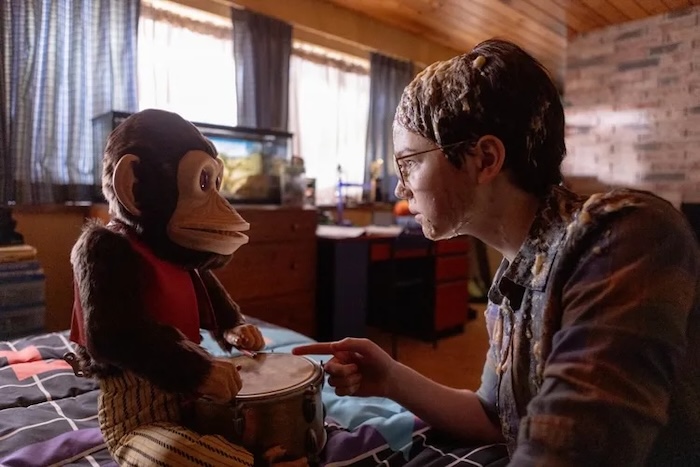
The best thing about Osgood Perkins’ adaptation of the Stephen King short story is the titular toy, whose malevolent intentions are obvious just by looking at its sick grin and wide-open eyes. Unlike the windup monkey you’re more likely to imagine, this one doesn’t play crash cymbals, but rather a drum, and as soon as it starts striking those skins someone in the vicinity dies a comically horrible death. Perkins, who made the deliciously demented but dramatically uneven serial killer movie, Daddy Longlegs, knows how to get the viewer’s motor running, and opens with what amounts to an origin story, with a U.S. military officer played by Adam Scott desperately trying to return the toy to some Southeast Asian emporium and, in the process, causing the disembowelment of the proprietor, who apparently didn’t know what his merchandise was capable of. It’s the first of many crass jokes and a pretty effective one.
This officer is married and has twin sons (Christian Convery), and for reasons unexplained he abandons them. Inevitably the boys discover the toy in the closet and turn the key, which leads to a number of deaths. As it turns out, one of the twins hates the other for the bully that he is and thinks he can use the monkey to get rid of him, but that’s not the way things work (“It doesn’t take requests”), and in the process it’s the boys’ mother (Tatiana Maslany) who dies. Skip ahead two decades after the twins, adopted by their aunt and uncle, a pair of swingers, throw the cursed simian down a well and we find them estranged and still suffering separately for what happened. The more sensitive one, Hal (Theo James), is divorced and trying to forge a relationship with his adolescent son, Petey (Colin O’Brien), whom he sees only once a year so as to keep him as far away from the monkey’s telepathic attention. Right on cue, his toxic brother, Bill (also James), calls him and says he has learned that the monkey has somehow returned and plans to get rid of it once and for all. As it turns out, the toy has come into the possession of a weirdo named Rick (Rohan Campbell), who knows it’s something special but unaware exactly how special. When Bill steals it from him, Rick attempts to get it back and, literally, all hell breaks loose.
It would be easy to dismiss The Monkey as a piss-take on the Final Destination series, but King’s characteristically clever plotting and Perkins’ witty direction combine to emphasize the nihilism at the core of the best horror movies. We all will die, after all, hopefully not as spectacularly as the unfortunate people in this movie, but random death is more of a fact of life than we would like to believe. That is basically Hal’s and Bill’s curse, which is why they are so monumentally and permanently traumatized. Osgood, the son of Tony “Norman Bates” Perkins, who died of AIDS, and actress Berry Berenson, who perished in the September 11 terrorist attacks, knows whereof he directs.
Opens Sept. 19 in Tokyo at Shinjuku Piccadilly (050-6861-3011, Human Trust Cinema Shibuya (03-5468-5551), and from Sept. 26 at Kadokawa Cinema Yurakucho (03-6268-0015).
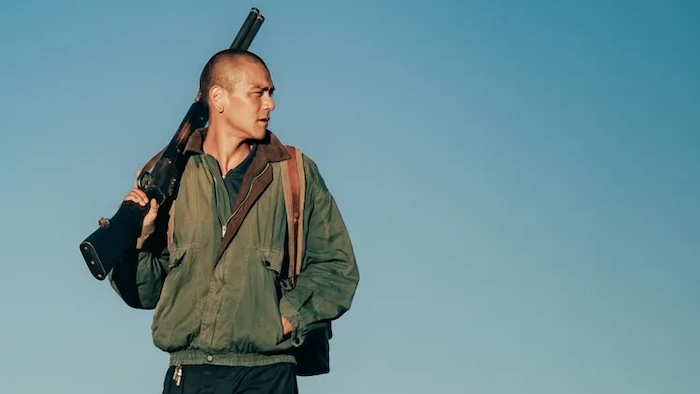
Lots of cliches move the emotional gears of this Chinese film, which won the top prize in the Un Certain Regard section of the 2024 Cannes Film Festival. The titular canine is an extreme outcast in a former mining town fitfully undergoing redevelopment on the eve of the 2008 Beijing Olympics. The main character, an almost mute ex-con who has returned to the town, finds a job rounding up the numerous strays that get in the way of the redevelopment, and then bonds with a nameless, impossibly skinny black mutt: Two souls who find in each other a kindred spirit by default. Director Guan Hu demonstrates a genuine talent for framing action, though he gets an inordinate amount of assistance from the setting. This gray, disintegrating burg is perhaps the most depressing municipality in a Chinese movie since those communities abandoned to the Three Gorges dam project in Still Life by Jia Zhangke, who appears in Black Dog as the local extralegal fixer.
Lang (Eddie Peng) isn’t hated by everyone in town; only the butcher who blames him for the death of his nephew, the act that landed him in prison, though from what we learn it was mainly the nephew’s fault. Most residents remember Lang as a once-promising rock musician and stunt motorcyclist who worked in a local circus. With his father dying in a hospital and a sister who moved away, Lang has no family for support but gets by on the goodwill of good people, of which there seem to be many in this blighted place. The black stray has no such support, since he tends to bite people and everyone thinks he has rabies. At first, Lang tries to catch him in order to claim the reward but the stray’s wily intelligence impresses him and after the inevitable capture he grows fond of the animal and even fashions a custom-made motorcycle sidecar for him. Meanwhile, his father asks Lang to help him die in peace as the town is slowly torn down. The animals in the zoo Lang’s father used to manage are set free and join the strays in taking over the ruined neighborhoods while everyone is out in the Gobi Desert watching the solar eclipse. Though it’s a motif that’s eye-rollingly obvious, Guan pulls it off with some incredibly staged tableaux.
Black Dog is the kind of neorealist melodrama that’s constantly preparing you for an epiphany, and while a lot of the devices feel worn—Lang’s extreme reticence adds nothing to the story and feels more like a gimmick for garnering sympathy—the movie’s uniform tone of despair works in the end by not overplaying the sentimentality. One reason is how intensely natural the dogs are. Even in packs they seem more disciplined as actors than the humans.
In Mandarin. Opens Sept. 19 in Tokyo at Shinjuku Cinema Qualite (03-3352-5645).
Alma (Sara Luna Zoric), who appears to be around 20 years old, is a Bosnian national raised in the Netherlands by her single mother, who brought her to Northern Europe with her father. At some point, however, the father decided he was “homesick” and went back to Bosnia permanently. As Ena Sendijarevic’s movie opens, Alma is also about to go back to Bosnia, a country she doesn’t know, in order to visit her father, who is in the hospital. Her mother (Sanja Buric), who confesses to having given up on her husband a long time ago (it’s not clear if they ever actually divorced), will not accompany her, and so puts her in touch with Alma’s cousin, Emir (Ernad Prnjavorac), to meet her at the airport. So begins a peculiar road movie that doesn’t offer much in the way of surprises, even if, like me, you know little to nothing about Bosnia except that it was embroiled in a horrific war in the 90s.
That’s probably because movies that take place in Eastern Europe and are made by Eastern Europeans tend to have the same sort of semi-ironic tone. The Bosnia that presents itself to Alma is itching to be European and failing miserably. Emir, an intense beanpole of a guy, doesn’t have a job, per se, though he claims to get by on “odd jobs” that are not described to Alma, who is left to wander the tacky malls and old streets of Sarajevo while Emir is off on some errand. Locked out of his apartment, she meets Denis (Lazar Dragojevic), who claims to be Emir’s “intern,” in the hallway of Emir’s building, and they eventually make out like teenagers, even though at this point the viewer may wonder what’s in it for Alma, who so far has come off as supremely cynical and dry in her pronouncements about what it is she likes. In any event, neither of these two male specifmens are any help in getting Alma to the hospital where her father is, since it’s in another town, and she eventually takes a bus and gets lost without her suitcase, a predicament that feels trite in that it offers Sendijarevic the opportunity to introduce Alma to some weird, slightly dangerous characters from whom Emir and Denis rescue her, much to her chagrin. Further adventures ensue, including a final reckoning with Alma’s father, the pillaging of his property, the reclamation of a suitcase that isn’t Alma’s but is nevertheless filled with illicit drugs, and an unfortunate encounter with some impolite thugs.
Sendijarevic maintains the ironic tone with brio, but her admirable style doesn’t overcome the problem of the main character. Alma feels more like a vehicle than a protagonist, and in contradiction to the sunny title—perhaps the central irony?—she never expresses anything that might indicate she has the capacity to enjoy herself. When she snuggles up to Denis or even Emir in a bit of incestuous hanky-panky it seems to be more for our delectation than for any reasons having to do with character development. Througout the movie Alma is dressed provocatively in mini-dresses and T-shirts, a portrait of nubile lassitude with no inner life. The optimistic ending doesn’t make us hopeful for Alma, because she hasn’t grown during the time we’ve spent with her.
In Bosnian, Dutch and English. Now playing in Tokyo at Theater Image Forum Aoyama (03-5766-0114).
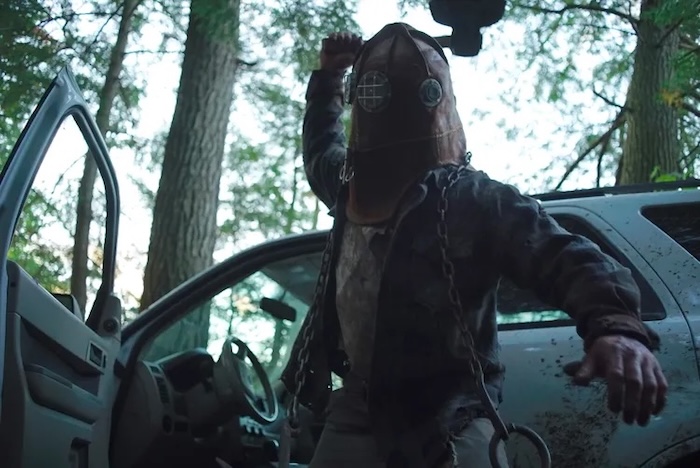
Horror movies are often predicated on ridiculously simple ideas usually having to do with not-so-innocent civilians intruding on the space of malignant forces. In Chris Nash’s debut feature, which picks and chooses its ideas from a number of well-known splatter series, the premise is a locket that hangs from a shelf in an abandoned fire tower in a remote Canadian forest. We hear the voices of feckless young men, one of whom apparently snatches the locket as a souvenir. This action effectively unleashes a demon named Johnny (Ry Barrett), who emerges from the earth to retrieve the locket, which has some kind of sentimental value. During the course of this very bloody movie, Johnny’s back story comes together and it’s about internecine small-town prejudices in the distant past that led to unspeakable violence and slaughter, but much of this exposition is as unnecessary as the locket itself. Nash is more about Johhny as a presence, even a protagonist, since almost the entire movie is shot from his point-of-view.
Johnny doesn’t talk, and for most of the time his face is hidden behind a fire-fighter’s oxygen mask. His tools are also those of the logging trade—grappling hooks, chains, saws, axes, all of which are put to creative use in decapitating, disemboweling, and pulverizing anyone who comes between him and the locket. What makes the experience unique as a horror feature is the almost leisurely pace, the total lack of suspense (no jump scares), and the breathtaking scenery in which the atrocities take place. It’s as if Johnny is standing in for a natural world that has decided it’s had enough of humans. Several characters imply that this isn’t the first time Johnny has wreaked havoc, a feint that could allow Nash to revisit Johnny in a future project—or not. The movie is literally open-ended but not necessarily begging for continuation. One girl (Andrea Pavlovic) in the initial targeted group manages to escape, and as we await her comeuppance in a final reckoning, the movie just sort of peters out with a conversation between the girl and her clueless rescuer (Lauren-Marie Taylor), who philosophizes about the reality that eveything in nature dies anyway, including us. I’m not sure if I’m looking forward to further adventures of Johnny, but it will be interesting to see what Nash does next.
Now playing in Tokyo at Shinjuku Cinema Qualite (03-3352-5645), Human Trust Cinema Shibuya (03-5468-5551).
This is the third Korean thriller I’ve seen in the last year wherein a male novelist and a book he wrote figure significantly in the mystery, except that in the case of Nocturnal (also the title of the fictional book) the novelist plot thread is utterly superfluous and seems to have been dropped into the script just to make it more complicated, because the basic story is a boilerplate gangster revenge procedural with nothing distinctive to offer.
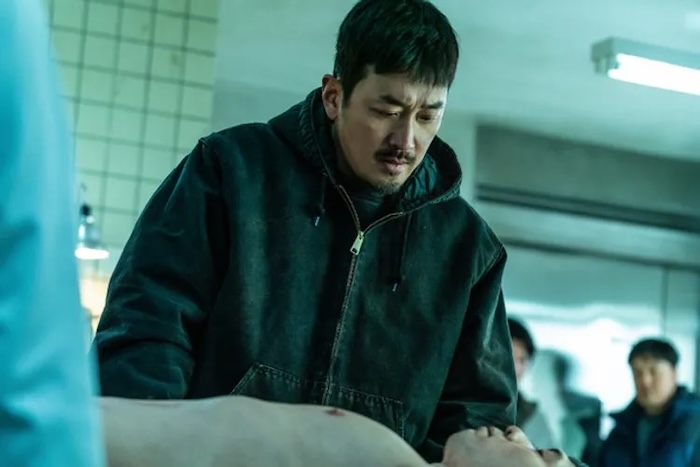
Ha Jung-woo plays Min-tae, a former gang enforcer who does a prison stint after violently defending his ne’er-do-well younger brother from other gangsters. After release he does “odd jobs” for others, including a bunch of laborers who are being stiffed by their employer. Through carefully inserted flashbacks we learn how, prior to being sent up river, Min-tae got his brother, Seok-tae (Park Jong-hwan), a job in the gang he was working for, though the gang boss, Chang-mo (Jung Man-sik), seems to have taken him on more as a favor to Min-tae than for any confidence he has in Seok-tae’s talents, which are minimal. Even worse, Seok-tae’s a junkie, and the movie starts with elliptical scenes of his escaping a house where he apparently killed the son of a police chief he was selling drugs to. Shortly thereafter, Seok-tae’s body is found in a pond. Min-tae puts on his detective cap and brushes off his trusty lead pipe—his weapon of choice—and goes about trying to locate Seok-tae’s live-in girlfriend, Moon-young (Yoo Da-in), who was said to have been with him when he died. Also on Moon-young’s trail is the novelist Kang Ho-ryeong (Kim Nam-gil), whose bestseller is based on interviews with Moon-young that predicted Seok-tae’s demise at her hands. And, of course, the police are also looking into the murders, so as these three elements pursue the missing girlfriend and her young daughter, Min-tae keeps running up against gangsters with vested interests in the matter, thus occasioning several Old Boy-style one-against-many fight scenes, not to mention the requisite car chase and pursuit-on-foot through narrow alleyways.
The only compelling aspect of the movie is Min-tae’s conflicted purposes: Will he really kill Moon-young if he thinks she killed Seok-tae, and why would he want to get revenge for a brother who, by all reports, was a lowlife scumbag in the first place? Writer-director Kim Jin-hwang isn’t very generous with the explanations on these counts, and with the pointless novelist subplot constantly intruding on the action, eventually the movie becomes incoherent as an action thriller. Granted, Kim can stage fights and chases that are as good as anyone’s, but that stuff has become so conventional it’s hard to be impressed any more.
In Korean. Opens Sept. 12 in Tokyo at Cinemart Shinjuku (03-5369-2831).
A dramatic device that I have become less patient with as it is more frequently wielded is the final-act plot twist, which often feels like an end in itself. In the case of Kei Ishikawa’s adaptation of Nobel Prize-winner Kazuo Ishiguro’s debut novel, A Pale View of Hills, the big reveal near the end probably wasn’t intended as a plot twist but rather was necessitated by the demands of adaptation. Though I haven’t read the book, my understanding is that the structure, especially with regards to POV, is purposely vague so as to allow the reader to draw their own conclusions about where the story is going and what it actually means. Such a mechanism is common in literature, which honors ambiguity, while cinema tends to be more literal, thus forcing Ishikawa to go through all sorts of contortions to make the same impression and, of course, in the end he doesn’t.
The framing story takes place in the early 80s in London as Etsuko (Yoh Yoshida), a woman who moved to the UK from Nagasaki in the 50s with her daughter Keiko when she married a British man, prepares to move house. Etsuko’s second daughter, Niki (Camilla Aiko), is helping her tidy up her possessions and certain items prompt her to ask Etsuko about her past, thus conjuring up an extended flashback about Etsuko’s (Suzu Hirose) first marriage to Keiko’s father and her friendship with a woman, Sachiko (Fumi Nikaido), a single mother bent on accompanying a G.I. to the U.S. Sachiko strikes her neighbors and acquaintances as antisocial, a label she wears with a certain amount of perverse pride. As it turns out, Etsuko herself is also treated as something of a pariah because she is a survivor of the atomic bombing, and the two women’s stories intertwine in various thematic ways.
Ishikawa does fairly well describing the period milieu and the cultural atmosphere that created it, especially when it comes to the postwar mood of a citizenry that felt betrayed by its leaders. He’s less capable with the interpersonal relationships and their tragic outcome, which feel schematic and over-determined. Obviously, some source material is harder to interpret than others, no matter how dramatically irresistible it appears on the surface.
The final act plot twist in the Korean weepie While You Were Sleeping—not to be confused with the Sandra Bullock vehicle or, for that matter, the 2017 Korean TV drama, both of which were nominally comedies—is more conventional than the one in Pale Hills and in that regard more successful, but the movie is such a bummer that you may not care. As in the Bullock movie, the main female character, Deok-hee (Choo Ja-hyun), ends up in a coma after an accident that also kills one of her twin children. After she awakes with amnesia her husband, Joon-seok (Lee Mu-saeng), a novelist, attempts to help her regain her memory. So far, so conventional, but the director, Jang Yoon-hyeon, covers it all with a scrim of disorientation that makes you wonder who is really suffering from brain fog.
As Deok-hee’s memory gradually returns we learn, in flashback, how her relationship with Joon-seok developed and that he is trying to write it all down in an erratic flurry of desperation. By the time the reasons for his behavior become clear there are more questions that aren’t being answered. We find out everything when Deok-hee does, but the revelation does not bring closure. On the contrary, it just makes the misery more miserable. If you love to have your sympathies completely manipulated, this is the movie for you.
A Pale View of Hills, in Japanese and English, now playing in Tokyo at Toho Cinemas Hibiya, Toho Cinemas Shinjuku, Shinjuku Piccadilly, Shinjuku Wald 9, 109 Cinemas Premium Shinjuku, Toho Cinemas Shibuya, Toho Cinemas Nihonbashi, Toho Cinemas Roppongi Hills.
While You Were Sleeping, in Korean, now playing in Tokyo at Cinemart Shinjuku (03-5369-2831).
Not sure what it is about the Norwegian capital that inspires work that comes in threes. We already have filmmaker Joachim Trier’s Oslo Trilogy, but those movies were released over a period of ten years. The three feature-length films that comprise Dag Johan Haugerud’s Oslo Stories were all produced in 2024, though they’ve been released in various territories separately and in different orders. In Japan, they’re being released theatrically all at the same time, and I’ve chosen to review them in the order I saw them, though if you want to be anal about it they were released in Norway in the following order: Sex, Love, Dreams. What ties them together is their quiet tone and unfussy visual style, not to mention their heavy reliance on dialogue. Many critics have already noted that fans of other dialogue-crazy directors, like Rohmer and Hong Sangsoo, would likely appreciate Haugerud’s films more readily, but Haugerud’s have stronger plot structures, which is probably a function of the director’s other profession, published novelist. And lumping them together as Oslo Stories isn’t just a convenient marketing conceit. Haugerud’s loving interscene shots of the city skyline and streets work to ground the action in a place with a real personality that is inseparable from those of the characters.
The protagonists of Sex are two chimney sweeps, which apparently is a ubiquitous vocation in Norway. We meet the two unnamed men in media res, finishing lunch in their offices and talking about a dream that the supervisor (Thorbjørn Harr) had the previous night, in which he was mistaken for a woman by David Bowie. The surpervisor reveals that he found the attention stimulating. This admission prompts his subordinate (Jan Gunnar Røise) to confess that the day before he had sex with a man, and not in a dream. The supervisor is shocked because he was not aware his subordinate was homosexual, a remark that further prompts a denial from the subordinate that he is gay. The other man just suggested the tryst and, being flattered, he thought “Why not?” and found the experience pleasant.
The remainder of the film addresses the repercussions of this act in both men’s relationships with their respective families. As it turns out, the subordinate tells his wife (Siri Forberg) of twenty years about the sexual encounter and she is understandably upset, a reaction the surbordinate seems not to have expected, and much screen time is given over to the couple debating the moral niceties of his decision. He insists that sex isn’t love and that he’s completely committed to his marriage (“Having one beer doesn’t make you an alcoholic”), an opinion that sounds defensive and is treated as such by the wife. In the meantime, the supervisor describes his dream to his wife (Birgitte Larsen), who doesn’t think it’s a big deal but worries that it is a big deal to her husband, who, especially in the wake of his subordinate’s act (with a client, by the way, which should provoke some sort of disciplinary action), has become obsessed with it to the point where the dream keeps recurring.
Though all three movies are comedies to a certain extent, Sex is obviously designed to be the funniest, an attribute highlighted by the score, which seems to parody the fusion-disco of 70s jazzbos like Chuck Mangione. And while the story is involving up to a point, it’s the least successful of the three because it feels like a one-joke idea stretched beyond its thematic limits.
Dreams is the only film that centers on one protagonist, in this case a high school girl named Johanne (Ella Øverbye) who develops an insurmountable crush on her new French teacher, Johanna (Selome Emnetu). Haugerud initially takes the crush as seriously as Johanne does. She’s a typical adolescent, susceptible to the romantic notions rife in classic novels, interpreting her infatuation as an indication she is capable of true love, but frets that it will remain unrequited. Her studies suffer, and her single mother, Kristin (Ane Dahl Torp), and published poet grandmother, Karin (Anne Marit Jacobsen), become concerned without understanding the reason. Then Johanne gets up the nerve to visit Johanna’s apartment in the ritzy part of town uninvited and what happens between them is banished to a cinematic ellipse.
In the next scene, the “affair” has been over for some time and Johanne has recorded it all in a kind of memoir that she shows Karin, who finds its candor disturbing but the writing uniformly excellent. Up to now, the story has been a kind of purplish take on teenage obsession, like Endless Love, but now it wanders into more amorphous territory. Karin insists on showing the manuscript to Kristin, who at first wonders if she shouldn’t report Johanna to the school or even the police since Johanne is still a minor. But she, too, is impressed with the writing and both she and Karin wonder if this couldn’t be a major work if published.
Dreams is the best of the three movies if only because its navigation of muddy ethical waters is so carefully thought out. Just as Johanne turns out to be a predictably unreliable narrator, Johanna turns out to be both more and less forthright in her approach to dealing with the troubled emotional trajectories of her female students (Johanne, it turns out, isn’t the first to fall for her charms). Likewise, the mother’s and the grandmother’s dreams of celebrity are both self-serving and overblown in the end. The deflation of expectations—both the characters’ and the viewer’s—is the script’s most delicious aspect, and one that deserves much more discussion than I can give it here.
Love returns to the bipartite structure of Sex in that it’s really two movies that are only lightly connected to each other. The protagonists are hospital employees, Marianne (Andrea Bræin Hovig), a urologist, and Tor (Tayo Cittadella Jacobsen), a nurse who often works on her service. Much of Marianne’s job is explaining to men that they have prostate cancer and what that means. After one explanation, Tor chides Marianne on her bedside manner—or lack of it, since the man who now has to undergo the removal of his prostate didn’t seem to completely understand what’s in store. It’s not so much that Marianne is a woman talking about a man’s most intimate fears (later, Tor, a gay man, also comments on how Marianne neglects to take into consideration what her explanations miss when the interlocutor is homosexual), but that her professionalism extends to her emotional sphere. Marianne is not interested in marriage or having children, but likes sex, a combination that her best friend, Heidi (Marte Engebrigsten), a historian who works for the city, means to satisfy by fixing her up with a charming divorced geologist, Ole (Thomas Gullestad).
Tor’s story is less fraught, though, like the subrodinate’s in Sex or Johanna’s in Dreams, more ethically problematic. Tor likes to pick up men on the ferry that takes him between Oslo and the suburb where he lives, and one night he encounters an older man through Grindr who isn’t into sex, which is fine by Tor, who is happy just to talk. Later, Tor spies this man, Bjørn (Lars Jacob Holm), at his hospital, where he has just received a diagnosis of prostate cancer from a different urologist. When Tor attempts to comfort him, Bjørn angrily turns him away, but Tor is insistent in the long run.
In a sense, Love is more about sex than Sex is. At first, Marianne resists Ole’s entreaties to stay the night and, on a whim, picks up a random guy on the ferry herself and has casual sex with him, a sequence that’s probably the funniest of the trilogy. Heidi is, of course, scandalized, which tests their friendship and makes Marianne realize how unmoored her own decision-making apparatus is. Tor’s nominal nurse-patient relationship with Bjørn allows Haugerud to explore the niceties of homoerotic love in ways more nuanced and edifying than in Sex or Dreams, including an emotionally devastating monologue by Bjørn about what he went through as a gay man from the AIDS epidemic through to his loss of sexual capacity due to his surgery. If Haugerud is worthy of accolades for anything it is this amazingly empathetic biographical snippet.
Sex, Dreams and Love, in Norwegian, open today in Tokyo at Human Trust Cinema Yurakucho, Bunkamura Le Cinema Shibuya Miyashita.
Filmmakers create alternative worlds in their work by both design and necessity, but often in their endeavor to recreate naturalism they do the opposite and show us things we’ve never seen before. It’s difficult to determine what Andrea Arnold’s intentions are in the somewhat fanciful Bird, which is centered on a community of squatters in an English suburb. The central family consists of a young single father, Bug (Barry Keoghan), and his two children, 12-year-old Bailey (Nykiya Adams) and 17-year-old Hunter (Jason Buda), who are products of two different women. Bug was obviously a teen when Hunter was born, and now Hunter, it seems, is about to be a father himself. Moreover, Bug has just gotten engaged to a woman he met 3 months ago, a prospect Bailey finds repugnant. Nevertheless, Bug insists she be a bridesmaid and asserts his admittedly dodgy parental authority, a turn that at first feels borderline abusive but, as it turns out, is more along the lines of Bug trying to be responsible in his own way. The dynamics here are both naturalistic and tragic, though Arnold’s purposes are murky.
Bailey is the movie’s center, and her view of the world is characteristically wondrous. She dreams of flying and seems attracted to birds in ways that have a magical quality to them. At one point she helps Hunter communicate with his pregnant girlfriend, who has been confined to her bedroom by her parents in an attempt to discourage Hunter. Bailey enlists the help of a crow, which delivers Hunter’s message to the girl by flying to her window. Bailey’s affinity for animals, especially feathered ones, is not primal but intuitive, as if she knew something about them other people didn’t, but it’s also easy to guess that it’s all in her young head. Still, she’s not a fantasist. She sees the awfulness of the situation across town at her mother’s apartment, which the mother shares with Bailey’s half-sisters and a truly abusive boyfriend who makes Bug look like St. Francis. But what to make of the title character, a man-child (Franz Rogowski) whom Bailey stumbles upon while walking in a field and who says he’s looking for the wastrel father who abandoned him as a child. Bird has learned he lives nearby, and Bailey offers to help him, though the viewer may wonder at times if Bird isn’t also at least partly a product of her imagination, even when he saves her life.
Maybe it doesn’t matter, because it’s essentially Bailey’s movie. We’re just invited into those episodes that Arnold thinks are important for understanding how a girl living under such circumstances copes with those circumstances. Hunter copes by becoming a vigilante against the kind of serial abusers this environment engenders. Bailey is not so proactive, but she is honest, which is why she bristles at Bug’s striving for domestic normality amidst a life of economic and emotional chaos, even if she loves him in spite of the chaos. The world Arnold describes is both believable and confounding, and vivid to the max.
Though it may be unnecessarily reductive to point out right off the bat that actor and novice director Ariane Labed is married to Greek provocateur Yorgos Lanthimos, such intelligence makes it easier to understand the weirdness of her first feature, September Says, which, like Bird, envisions a world conjured by adolescent sensibilities. Based on a novel, the story centers on two sisters who are inseparable due to their total self-isolation from conventional society, not to mention from their confused single mother (Rakhee Thakrar), who, as the movie opens, seems to have decided long ago that the world her daughters inhabit is unassailable.
September is the name of the older sister (Pascale Kann), who lords it over the younger one, July (Mia Tharia), with the latter’s full consent. Often communicating in a language that consists of animal noises, the girls are summarily shunned at school as weirdos. Consequently, July counts on September to protect her from reality and thus submits to her sister’s every whim, no matter how strange it may be. Violence ensues, not out of necessity but rather as a function of inevitability given the odd universe these girls move through. Their mother moves them from what appears to be the English countryside to a cabin in rural Ireland, where things become even stranger.
Effectively creepy and dramatically fascinating, September Says isn’t very coherent. The set pieces have power but feel like a series of non sequiturs—they don’t hang together in a way that would make sense of this rarefied world and the people who inhabit it. Had Labed attempted something like a horror movie, she might have found a more consistent tone and some relevant theme to latch on to. This is mostly mood in search of an idea.
Bird opens Sept. 5 in Tokyo at Shinjuku Piccadilly (03-5367-1144), Bunkamura Le Cinema Shibuya Miyashita (050-6875-5280), Cine Switch Ginza (03-3561-0707).
September Says opens Sept. 5 in Tokyo at Human Trust Cinema Yurakucho (03-6259-8608), Cinema Qualite Shinjuku (03-3352-5645), White Cine Quinto Shibuya (03-6712-7225).
Bird photo (c) 2024 House Bird Limited, Ad Vitam Production, Arte France Cinema, British Broadcasting Corporation, The British Film Institute, Pinky Promise Film Fund II Holdings LLC, FirstGen Content LLC and Bird Film LLC
September Says photo (c) Sackville Film and Television Productions Limited/MFB GmbH/Crybaby Limited, British Broadcasting Corporation, ZDF/arte 2024
One of the disadvantages of advanced age is that the past is increasingly telescoped, and when it came to my attention that DreamWorks had made a semi-live version of its animated hit How to Train Your Dragon, I immediately thought, “Didn’t the original just come out a few years ago?”, only to soon discover it was released in 2010. Not sure if 15 years justifies a new version that is, story-wise and, from what I dimly remember, visually almost exactly the same except that maybe a new generation of kids is ripe for something like this—if they didn’t actually see any of the sequels, the most recent of which came out in 2019. What I also remember is that the original Dragon, dreamt up by the guys who created Lilo & Stitch for Disney, was as close as DreamWorks got at the time to Pixar’s potent mix of character self-actualization and viable humor, but only by a stretch. It’s still closer in feeling to Shrek.
To recap for those who live on a remote island like the characters in the story, a colony of Vikings is constantly terrorized by dragons who swoop out of the sky and kill their cattle and burn their houses, so over the centuries a dragon-hunting culture has evolved. The leader, Stoick (Gerard Butler, who voiced the same character in the original), is a dyed-in-the-wool dragon hater who hopes his adolescent son, Hiccup (Mason Thames), takes up his mantle, but Hiccup is a bit of a wuss, and while bumbling through his dragon-slaying lessons he happens upon a wounded lizard he nurses back to health and names Toothless. Of course, you see where this is going and it ends up exactly where you’d expect it to end up. The director, Dean DeBlois, slightly skews his interpolation of Hiccup’s romantic interest, Astrid (Nico Parker), who is the total opposite of Hiccup—a kickass dragon killer in the making who has to have her mind blown in order to understand why dragons have been harrassing the islanders for centuries and that they shouldn’t be slaughtered.
The fact that everyone puts their all into this cash grab gives it more heart than it probably deserves, and because CGI has improved by leaps and bounds in the years since the original came out, in a way it’s an improvement. After all, you come for this kind of fantasy to be viscerally impressed, and the dragons are not only ridiculously cute, but pretty lifelike. The same can’t be said for the human characters, who are perhaps even more cartoony than the ones in the original.
Opens Sept. 5 in Japanese subtitled and Japanese dubbed versions in Tokyo at Toho Cinemas Nihonbashi (050-6868-5060), Toho Cinemas Hibiya (050-6868-5068), 109 Cinemas Premium Shinjuku (0570-060-109), Shinjuku Wald 9 (03-5369-4955), Shinjuku Piccadilly (050-6861-3011), Toho Cinemas Shinjuku (050-6868-5063), Toho Cinemas Shibuya (050-6868-5002), Toho Cinemas Roppongi Hills (050-6868-5024).
Online meeting of education ministry July 10 (Mainichi Shimbun)
In early July, the education ministry called an emergency meeting with local school superintendents asking them “to strictly enforce teacher discipline and eradicate sexual violence against students.” The meeting was called in the wake of media reports that two public elementary school teachers, one from Nagoya and the other from Yokohama, had been arrested for allegedly secretly recording female students and sharing the videos and images with other teachers via a group chat. Later, teachers in Hiroshima and Fukuoka were also arrested for the same offense.
It’s believed that these individuals and others belong to a group of about ten male teachers who share upskirt photos of elementary school girls and videos of girls with emphasis on their undergarments. On June 30, the Nagoya municipal education committee revealed that a 34-year-old teacher who worked at an elementary school in the city had been arrested for multiple counts of “vandalism” after he “deposited” a bodily fluid on the backpack of a 15-year-old girl in Nagoya Station. It should be noted that it wasn’t the first time this teacher had been accused of such behavior. He’d already been suspected of doing the same thing twice before, with a musical instrument and then a school lunch bowl being the targets of his bizarre folly. He is also believed to be a member of the aforementioned teachers group.
If it sounds odd that the teacher may have gotten away with his act twice before being arrested, prior to the meeting on July 10, Education Minister Toshiko Abe called on any teachers in Japan who were carrying out such offenses to come forward and identify themselves. Obviously, it took time for the ministry to develop a sense of crisis over the matter. In any case, media have indicated that whatever the police and prosecutors do, the ministry will definitely punish the teacher this time.










 philipbrasor.com