
Sebastian Meise’s prison movie jumps around between 1945, 1958, and 1968, but starts near the end with a trial in which prosecutors use clandestinely shot film of male-on-male couplings in a public toilet to convict Hans Hoffman (Franz Rogowski) of violating Germany’s Criminal Code Paragraph 175, which prohibits “homosexual acts,” and sentences him to 24 months in prison. Hans’s unperturbed reaction to the court’s decision indicates he’s been through this before, and when Meise subsequently flashes back to 1945, we learn that Hans was a concentration camp inmate, and went directly from Nazi hell to an Allied detention center, solely due to his sexual orientation. Meise provides very little background for Hans—no job history, no family—focusing completely on Hans’s life as a recidivist sodomite, a description that would seem to reduce him to someone whose entire existence is dictated by appetites, but in fact the movie makes a broader, much more moving case for Hans’s character.
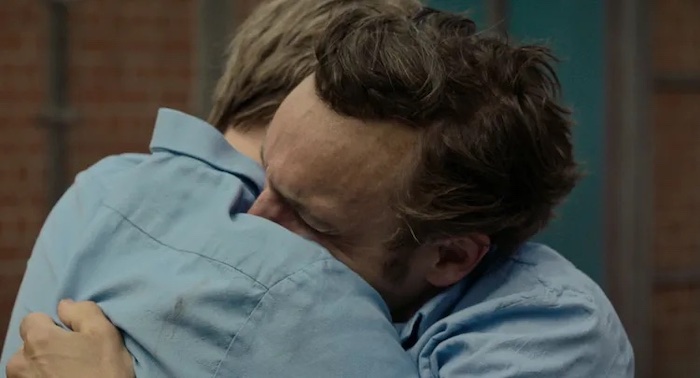
During his first prison stint, his cellmate is Viktor (Georg Friedrich), a junkie initially disgusted by Hans when he hears of his crime, but once he discovers Hans was in a camp, Viktor’s attitude changes and he offers to cover up Hans’s number tattoo with a larger design. Inking is forbidden in the prison, and so the work is done secretly at night, but eventually it is found out and both are punished with beatings and solitary confinement. Nevertheless, a bond has been formed. Hans encounters Viktor again during his subsequent stints, and while both are depicted as “addicts,” Meise is insistent that there is a big difference between Viktor’s chemical cravings and Hans’s need for love, because that’s how it’s portrayed. During his imprisonment, Hans has relationships with two other prisoners, one a young school teacher named Leo (Anton von Lucke) who was caught with Hans in the aforementioned toilet. Through carefully coded messages that Viktor helps deliver, the two actually carry on a physical affair and in the end Hans deepens his own criminal record to help win Leo a pardon. But Hans’s motives aren’t always easy to understand. He almost seems to take pleasure in the cruelty of the state, since it reinforces his self-image as a man outside of society who can only deal with other human beings in a direct, honest way; otherwise they are simply unknowable. His relationship to Viktor is practical, until it isn’t. When Viktor demands a blowjob in return for passing Hans’s message to Leo, Hans at first refuses, saying, “I don’t do it for just anybody.” He has to feel something.
Throughout Great Freedom the state hovers above like a dark, permanent cloud, depriving Hans—and Viktor, too—of hope for any kind of life free from its disapproving shadow, and in the end, when Paragraph 175 is suddenly rescinded and Hans visits a gay bar (also called Great Freedom), he seems not so much liberated as confused by the irony of it all. “Can they just abolish a law?” says Viktor, utterly at a loss to comprehend such an act, even though it doesn’t affect him. Given Hans’s measured reaction, maybe he believes it doesn’t affect him either. After all, the law never prevented him from loving whom he wanted to love before, it just made it more difficult.
In German. Now playing in Tokyo at Bunkamura Le Cinema Shibuya (050-6875-5280).
Great Freedom home page in Japanese
photo (c) 2021 FreibeuterFilm-Rohfilm Productions

