
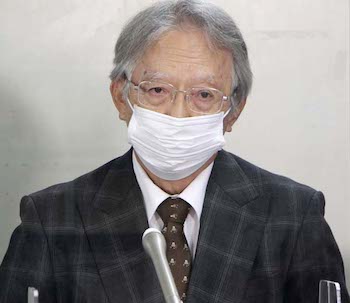
The long legal saga of the government’s case against equipment manufacturer Okawara Kakoki Co., Ltd. has turned into a stark illustration of how Japan’s law enforcement agents work within a bubble of self-justification. At present, two of the company’s executives, President Masaaki Okawara and former director Junji Shimada, are suing the government to the tune of ¥565 million because police and prosecutors pursued a case against them that was a “fabrication,” according to various media.
A report posted on Daily Shincho July 12 detailed a July 5 session in Tokyo District Court where two prosecutors were cross-examined by the plaintiffs’ lawyers about their handling of the case. The head prosecutor, Takako Tsukabe, testified that she indicted the two men, along with a company advisor who is now dead, “based on the evidence we heard and saw,” and which she believed was proper. However, after the men were indicted and had spent almost a year in detention the prosecutors dropped the case when they realized that their evidence would not hold up in court. When the the lawyer asked if she thought the prosecution should have “confirmed this negative evidence” before bringing an indictment, Tsukabe said, “There was no feeling that there was any negative evidence,” and that even if she had known about the negative evidence she would have proceeded with the indictment because of other evidence. When prompted to offer an apology for improperly “building a case” against the plaintiffs, Tsukabe replied that the prosecution did nothing wrong and therefore there was nothing to apologize for. After the session, the attorney told the Shincho reporter that, based on how she reacted during cross examination, he thought that there was a good possibility Tsukabe would again fabricate cases in the future, because she obviously thought of it as being part of her job.
The entire case warrants close scrutiny because of how cavalierly the police and prosecutors approach laws they don’t really understand. In this case, it was the foreign exchange and foreign trade law. Okawara Kakoki, which is headquartered in Yokohama, makes various devices used in the manufacture of substances and materials. In question was a spray-dryer that was mainly used by food companies to turn liquids into powder, such as instant coffee and instant ramen, though it can also be used to make pharmaceuticals. In October 2018, Okawara was stopped by members of the public security police while he was leaving his house for work. They presented him with a warrant, though they didn’t reveal what it was for. They proceeded to search his home and, later, 50 officers went to his company and searched the premises, hauling away loads of documents, storage devices, and computers. They also searched three other business locations and the homes of seven employees. According to a long report in the Asahi Shimbun, the company’s lawyer, Tsuyoshi Takada, showed up but could not get any information about the purpose of the raid from either Okawara’s employees or the police. In any case, he advised the company’s executives and employees to cooperate and answer all questions sincerely.
However, the company could not carry out their normal work because all their usable data was on their computers. It was a full week before the police returned the computers after having copied all the data on them. Nevertheless, the company could not return to full operations because they also needed the confiscated documents, which included planning charts and diagrams for field repairs, which was a big part of their work since long-time customers often needed rapid maintenance of Okawara equipment. These documents were not returned in full for two years.
Later, the charges were revealed. Okawara had violated export laws by selling spray-dryers in certain countries that had been sanctioned by the Japanese government for sales of devices that could be used to make bio-weapons. Apparently, the police believed the spray-dryer devices applied. Since the 1990s, Okawara had sold equipment to companies in China, which was on the list of prohibited destinations according to the trade ministry. However, when Okawara checked their sales records they could not conclude that they had sold this particular spray-dryer to anyone in China, and wondered if the device had made it to China via another company they had sold it to. After tracking down all the spray-dryers they had sold overseas, they couldn’t find any that had ended up in banned countries.
Matters became even more puzzling once police started interrogating employees, who expected to be asked about where they exported their products. Instead, they were asked about technical details, mainly whether the spray-dryers had the capability of “sterilizing” substances. Apparently, when it comes to devices of this nature, METI has three criteria to determine whether or not their export should be banned. One is that the device can “sterilize or eliminate bacteria” in a stationary state. Such a capability is necessary for making biological weapons, since dangerous stray microbes have to be neutralized so as not to infect workers. The Okawara employees said that the spray-dryer they made was not capable of neutralizing bacteria because the heat needed to do so was not uniform throughout the entire device. In fact, Okawara had contacted METI in 2013 to confirm that the device did not sterilize sufficiently, and METI agreed that the export ban did not apply to the device, meaning Okawara was free to sell it anywhere in the world.
But the police did not buy this explanation, and continued to insist that the particular functions of the spray-dryer made it illegal to export them. The interrogations went on for a year, usually comprising two 4-hour sessions a week, and always with the same questions, for a total of 291 sessions. Employees and officers were compelled to sign documents that they were not allowed to read sufficiently. The police were obviously fishing for confessions, since they kept telling the employees that if they admitted to the charges their punishment would be very light. They told the president that if he confessed he probably would not be detained or imprisoned, and his legal costs would be slight. Okawara refused.
Then, on March 11, 2020, Okawara was arrested and placed in detention. Two other executives were subsequently arrested and detained. Takada was shocked, because the three had cooperated fully with the police, so he changed his advice and told the men not to answer any questions from now on, since the police and prosecutors were obviously working in bad faith. The interrogations of the three men intensified to 2 or 3 two-hour sessions a day, and on March 31, they were indicted for selling the devices in China.
The company’s situation only got worse. Once the media had caught wind of the arrests and publicized them, Okawara’s operations fell off precipitatively. Employees of the company were harassed by strangers. Banks refused to finance their operations and parts makers voided their contracts, making it almost impossible to carry out normal business. The interim CEO did the best he could to make sure the company survived, and when exporting any devices double- and triple-checked with the relevant authorities that such sales were allowed. In every case, he found that the law didn’t apply to Okawara’s devices, even the spray-dryers. METI always said there was no problem. Fortunately, most of Okawara’s domestic customers stuck by the company, telling Asahi Shimbun that they didn’t believe the police’s case and just assumed they did not possess the technical knowhow to understand how these devices worked. Nevertheless, just to be careful, the interim CEO advised customers not to resell their equipment to anyone. During the course of the investigation, Okawara estimates it lost ¥500 million a year in business, a huge deficit for a company whose annual revenues range between ¥2 billion and ¥3 billion.
Meanwhile, Takada tried to secure the three men’s release on bail, but the court refused, citing fear that they would destroy evidence, which didn’t make sense since the police had already confiscated or copied every piece of data the company possessed. On May 26, the men were rearrested on a new allegation of selling the spray-dryer to a company in South Korea, which had been placed on the no-export list after the Japanese government sanctioned Seoul for not throwing out its Supreme Court’s conviction of Japanese companies for using forced Korean labor during World War II.
Takada demanded that the prosecution disclose its evidence, and the police gave him the results of experiments they had conducted on the spray-dryer to prove its export was illegal, saying that their tests showed the device could neutralize bacteria. Okawara employees claimed the police’s methodology was flawed since it didn’t take into consideration the fact that the heat necessary to kill the bacteria wasn’t uniform throughout the entire device.
Eventually, the court allowed bail for the third executive, Shizuo Aijima, in order to receive treatment for stomach cancer. However, by the time Aijima was released his cancer had advanced to an inoperable stage and he died not long afterwards. Okawara and Shimada, however, did not receive approval for bail until February of 2021, almost a year after their arrest. The trial was set for early July, but on June 30 prosecutors suddenly withdrew the indictment, saying, according to Kyodo News, that there were “doubts…as to whether they are guilty of a crime.” In later revelations, it was discovered that throughout the early part of the investigation, METI repeatedly insisted to police that the export law did not apply to the spray-dryer device, but the police would not listen and wouldn’t stop badgering METI until they could get an indictment. As a result, METI caved and started to cooperate with prosecutors. Things continued in that vein until just before the trial was to start and the judge demanded all records of discussions between the police and METI. Understanding that such records would expose their case as being meritless, the prosecution quit it.
Since then, Okawara and Shimada have been awarded more than ¥11 million in compensation under the criminal compensation law for false accusation, but the two men insist on bringing the whole criminal justice system out in the open with their larger lawsuit, which is ongoing. Though the Shincho reporter implies they will likely win, it’s just as likely that the defendants in the case—both the central and Tokyo Metropolitan governments—will appeal, thus drawing the whole sordid mess out for years to come.
With regard to Takada’s statement that head prosecutor Takako Tsukabe’s lack of regret over the case indicates she’d probably fabricate another just to score a win, the reporter adds an interesting footnote. Tsukabe is already famous in legal circles for being the whilstleblower in one of the most notorious legal scandals of recent memory. In 2010, welfare ministry bureaucrat Atsuko Muraki was accused of welfare fraud by Osaka prosecutors, and Tsukabe produced proof that one of her colleagues had manufactured evidence against Muraki. How, the reporter mused, did she proceed from that courageous act of official responsibility to this unrepentant demonstration of unscrupulous tactics?
 philipbrasor.com
The government will drag this case out until both the remaining plaintiffs are dead in order to protect the reputation of the cops and prosecutors involved. One down, two to go. The Hakamada Iwao case was reopened for the same reason, so that he can die with the case pending and the govt can then claim the cops and prosecutors have themselves been exonorated because he was still on trial…despite having been released in 2014 with a tacit implication he was never guilty. Hostage justice, enhanced interrogation techniques and fabricated evidence are at the heart of far more cases than the Japanese public will ever know. But Carlos knows…
This is great!
I am wondering one thing; do you have any sources to substantiate some of the times and events you list? I get it’s a long shot since I’m kind of necroing the article, but I’m writing a massive essay on hostage justice as a whole, and this wordpress is one of the few I can find that go into Ohkawara’s case with explicit details. Unfortunately, academia won’t let me cite a potentially unsubstantiated wordpress article. If you have sources, please let me know at your earliest convenience!
It’s mainly taken from articles that appeared in the Asahi Shimbun and Daily Shincho. Hot links are provided in the text, highlighted in blue.