
I wrote an overview for the Japan Times of the history of the Fuji Rock Festival to commemorate its 25th anniversary at the Naeba ski resort. In it I mentioned the second edition of the festival, which was held in Tokyo. I wrote a review of that event for the JT but it is not available on the JT website so I’m posting it here, warts and all. I’ve already posted my review of Fuji Rock 1999, the first one to be held at Naeba, here, which I also mentioned in the article.
Fuji Rock ’98: The sky above, the mud below
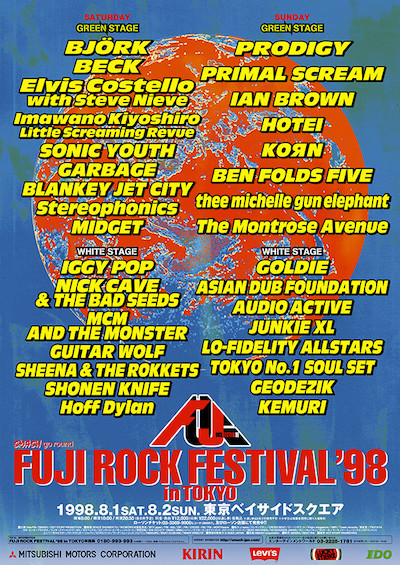
You go to these things for the music, but the only thing you hear about is the logistics. “It’s really well organized,” somebody in the press tent commented when asked what he thought of the festival.
It better be, considering the criticism the promoter, Smash, received last year for the inaugural Fuji Rock Festival. Slammed into the ground by a hurricane, the festival only lasted one day. Most of the complaints boiled down to a single indefensible gripe: Why didn’t you prepare for the possibility of such a big storm? That’s like asking a lion tamer, Why didn’t you prepare for the possibility that the lion would actually rip off your arm? You do what anyone does in the face of a possible calamity: You make sure your insurance premiums are paid.
So when people say it’s “well organized,” they mean that those who did the organizing thought of every eventuality, and not just the weather. Since we’re talking about 35,000 bodies contained in an open area of about one kilometer square, there’s a lot of eventualities to consider.
And yet, once again, it was the weather that gave rise to the one eventuality that best characterized the first day of the festival. It was hot, but for the most part the sky was overcast, thus cutting down on sunstroke cases.
But it rained the night before and the landfill that constitutes the curiously named Tokyo Bayside Square was waterlogged. With 70,000 feet churning up what little vegetation had survived the previous weekend’s Reggae Japansplash, the mud stayed thick and sticky all day. By the early evening, intersections between the roped off “blocks” had turned into giant pigsties that could no longer be circumnavigated.
You could tell the serious partiers by the grime that coated the lower two-thirds of their bodies and their lack of footwear. They hadn’t simply removed their mud-soaked sneakers and sandals, they’d tossed them. The slightly less serious festival-goers (read: girlfriends who wanted to keep their shoes) utilized the plastic bags being distributed by the various ecology-minded NGOs as feet coverings.
That night, everyone had tramped the two kilometers back to Toyosu Station and left a brown smudge all the way into the station, onto the platforms, and even into the trains themselves. It was as if a huge slug had crawled out of the mire and decided to check out the Ginza.
–Saturday morning cartoons–
When the Stamford, UK power pop trio Midget hit the Green Stage a little after ten on Day One the area directly in front of the stage had yet to become a congealed mass of humanity. Early birds full of worms responded with uncommon enthusiasm to music they probably had never heard before.
Midget, as their name may suggest, is obsessed with childish matters, not just in their song lyrics, which are about bullies, spies, and superheroes, but in their jokes as well. This made sense on a Saturday morning. At one point, the bass player donned a pair of oversized gag specs and pretended he was “gaijin tarento” Kent Derricott. One couldn’t help but wonder who on earth had slipped him that intelligence.
It seemed natural to follow kiddie rock with kitty punk, and, passing over the Stereophonics, I went over to hear Shonen Knife at the White Stage, which overlooked a much smaller field than the Green Stage did. In fact, you couldn’t really call it a field. It was more like the ruins of some Paleolithic parking lot: patches of concrete apron interspersed with weeds and rocks and the unavoidable muck. Surrounded by makeshift fencing and temporary tents, the area looked like the back lot at a Midwestern fairground.
Naoko, Michie, and Atsuko were dressed in day-glo pantsuits. Naoko perpetuated the fairground atmosphere by wearing a white cowboy hat throughout the entire 40-minute set, most of which was derived from their new album “Happy Hour.”
The girls’ music was intermittently interrupted by the rumble spilling over from the Green Stage, but no one seemed to mind. Shonen Knife are tougher musicians than most people give them credit for, but the good vibes produced at their concerts has as much to do with the values they share with their fans as it does with the music. The fans not only know the words, they’ve already worked out the unison gestures beforehand. “Next year, let’s have Fuji Rock Festival in Osaka!” Naoko cried, referring to the band’s home town. Everyone magnanimously approved.
–They called it rock–
Elvis Costello, one of our age’s great pop composers, was also one of the few musicians on display who could be called an old-fashioned rock artist. By appearing with only his guitar and pianist Steve Nieve, however, he implied that he wanted to be accepted only as a singer-songwriter — which he has always been, but in a venue as big as a Welsh mining town you tend to want something more substantial, like a band.
What’s more, Costello actually played his hits, meaning most of the songs were from the 1970s. Even when he introduced “Blue Chair,” a song recorded in the mid-80s, he jokingly described it as a song he put out “35 years ago,” thus making his appearance the festival’s token nostalgia act; and I’m not forgetting that Iggy Pop played over on the White Stage on the same day.
Garbage, a group whom I had previously mistaken for a techno band, put on the most credible rock show. Lead singer Shirley Manson is exactly the kind of big-voiced singer who makes sense in this setting, and she would have thrived except that her fair skin and red hair were no match for the mid-day sun. The chunky guitar parts pushed the audience to a hazardous level of stationary motility, and with the landfill (made of, appropriately, garbage) still holding all that water, the simultaneous pogoing of several thousand bodies triggered a weird geological phenomenon. The ground jiggled as if it were a giant slab of tofu.
Sonic Youth made like a rock band by playing the most structured songs from their latest album, but by now the group’s interests are so beyond rock’s scope that their set seemed more like a showcase than a performance. Dressed like preppies and acting as if they were snide 16-year-olds (“It’s wonderful to play in front of beautiful Mt. Fuji”), the quartet burned white hot for the hour they were on and a palpable electric current ran through the audience whenever the group fell into a groove.
Anglo rock was represented by Ian Brown, the former lead singer of the Stone Roses, and Primal Scream. Brown cruised on his rep, delivering an enervated collection of unfunky pseudo-psychedelia and ethnic music references (he wore a peaked straw hat stereotypically identified with peasants).
Primal Scream, on the other hand, served up an appropriate blend of old and new, meaning 60s rock and 90s sample-based dance grooves, wisely foregoing the purely Memphis sound they sidetracked onto several years ago. The band, augmented by horns and tapes, cooked, and lead singer Bobby Gillespie looked more like a classic rock star — emaciated, detached, hanging on the mike stand for dear life — than anyone else I saw at the festival.
–Proxy music–
Minute for minute, the most exciting act of the weekend was Dutch DJ Junkie XL. Assisted by a guitarist, a drummer, and an MC, the DJ let loose with break beat after perfectly timed break beat that drove the audience into a state of hysteria. It was beyond music; it was behavior modification.
The MC, an American, was the only certified rapper I saw all weekend, which was interesting since, despite the festival’s designation as a “rock” concert, a strong hip-hop component informed much of the music on stage as well as most of the fashions in the audience.
There was some of what you might call traditional black music; it just wasn’t being played by black people. Japan’s great soul iconoclast, RC Succession founder Kiyoshiro Iwamano, put on a gospel-tinged revue in his shaky, heartfelt voice on the Green Stage, done up like a freaked-out Elvis and getting down like a physically challenged James Brown.
Kiyoshiro, however, did not do the best JB impression. That was accomplished by Beck, whose twilight show on Day One was probably the most anticipated set all weekend (if one goes by the number of T-shirts; according to my observation, the only group better represented than Beck on young Japanese chests was Nirvana). Fronting an expanded show band, the skinny bi-coastal bedroom rocker even got the phalanx of heretofore glum-looking brothers who acted as stage security smiling and shaking their heads in amazement. Was this guy for real, with his falsetto love songs, his break dancing, his bad blues harmonica (“That was the ‘Sonny Terry Is Now Spinning In His Grave Blues'”), his Jackie Wilson splits, and his Curtis Mayfield enunciation? It would have been merely embarrassing if he were a tad less possessed, but as it was he held the entire audience in the palm of his hand, thus proving what everyone has said for years: that we all can get along, black, white, and yellow, if we all listen to the right music. Lenny who?
–Brains and booty–
Day Two took a greater toll on the revelers. Some were into their second day of partying, the sun was out, and the roster was dominated by techno and dance-oriented acts. After Junkie XL’s preternaturally manic set, I witnessed two dozen shirtless ravers collapse into heaps of skin and bones right there on the rocky ground.
The following act, Japan’s own Audio Active, slowed the pace only slightly with their dub grooves and hard-core thrash: less pogoing, more actual dancing. The lead singer exhorted the crowd to “smoke that skanky weed” without specifying where we could actually get any of that skanky weed. (At this point it was even difficult to score a Coke.)
UK’s Asian Dub Foundation took the stage as the sun set over the Tokyo waterfront. Plagued by technical problems at first, it took them a while to hit their stride, but once they did their irresistible vibe reached all the way over to the Green Stage and pulled quite a few stragglers who’d grown disenchanted with Ian Brown’s musical equivocations. ADB’s music is upbeat, intoxicating, politically engaged, and inclusive, and the audience clearly appreciated the internationalist sentiments as much as they dug the beats. When the band did a cover of a Nusret Fateh Ali Khan chant, the crowd erupted in cheers of pan-Asian solidarity.
It became obvious, however, about ten minutes into Goldie’s jungle set that most of the people who’d waited so long for his crew to set up (all those lights) had simply done so out of curiosity. Goldie started out with a piercingly dissonant soundscape that seemed to be what these kids wanted, but he soon brought out his vocalist, soul singer Diane Charlemagne, and from there the music settled into a rhythmic gridlock of percussion effects and woozy melody lines. It was music for chilling, for a club with comfortable chairs, and though the sweaty zombies in front of the stage looked as if they could use a good chill, they were filled with too much beer owing to the fact that the soft drink vendors ran out two hours earlier. The Prodigy beckoned.
–Y’all come back now, y’hear–
The eventualities were covered. Something like 700 people were treated for dehydration and heat exhaustion, but only seven had to be hospitalized. As far as I know there were no fights and I’m almost positive there were no drug overdoses. The toilets worked. People for the most part cleaned up after themselves. Those are pretty good percentages for rock’n roll.
I would even venture to guess that the vast majority of ticketholders enjoyed themselves. This might seem a strange thing to say since we are talking about an entertainment event, but think about it. Why would anyone pay twelve thousand yen to stand for hours on end under a hot sun on soggy ground cheek-to-jowl with thousands of strangers just to listen to music that would sound much better on their stereo at home?
Rock’n roll has always been an extreme form of recreation, maybe not as extreme as climbing Mt. Everest, but really good music takes something out of you. And according to the law of cognitive dissonance, the farther the extremes you go to in order to enjoy something, the more you will enjoy it. Which means I’ll probably go to the next Fuji Rock Festival, even if it’s in Osaka.
 philipbrasor.com