
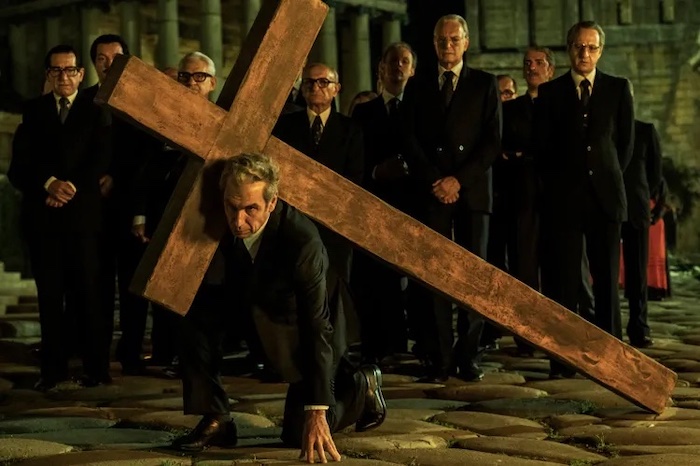
Though Marco Bellocchio’s second film about the kidnap/murder of former prime minister Aldo Moro by radical leftists in 1978 was obviously intended as a six-part TV series, it premiered at Cannes and was featured at other international film festivals before it was aired or streamed in Europe. Japan has also decided to release it in theaters (I have no idea if there are plans to broadcast it here as a series), and while six hours is a lot to sit through and the structure is definitely that of a multi-part work, the film builds a relentless momentum that carries the viewer without much drag time, even if the outcome is known to anyone familiar with its famous story. Bellocchio, often cited as the last great Marxist filmmaker, already addressed this material in his standard-length 2003 film, Good Morning, Night, but obviously wasn’t through with it; or maybe he wasn’t satisfied with what he had made. (I haven’t seen it.) The mini-series format allows him to delve deeper into the various personalities involved in the tragedy to show how and why events turned out the way they did, suggesting that they could have turned out differently if only certain political sensibilities weren’t so entrenched. Each episode of the series focuses on one person—Moro (Fabrizio Gifuni); the newly installed minister of the interior, Francisco Cossiga (Fausto Russo Alesi); Pope Paul VI (Toni Servillo); a female “terrorist” who starts to have second thoughts (Daniela Marra); Moro’s wife, Eleonoro (Margherita Buy)—except for the last, which sums up the story in the bleakest way possible. As a portrait of European volatility in the 70s, it rivals Olivier Assayas’s Carlos (2010) as the most informative and gripping study of how perceived political and personal necessity inevitably conquers social ideals.
The one established concept that holds throughout the series is that Moro was a decent man. Though he was president of the conservative Christian Democratic Party at the time of his abduction, his values were more ecumenical. In fact, he was causing great consternation not only within his party but in Washington for his willingness to work with Italy’s Communist Party in forming a government. It should be emphasized that the communists were not any kind of ally of the Red Brigades, who carried out the kidnapping (or, at least, one faction of it did). If anything the radicals held the Communists in even more contempt than they held the CDP or even the avowedly fascist Italian military. And it seems also clear from the beginning that while the kidnapping was ostensibly carried out to force the CDP’s hand, there was never any intention on the part of the Brigade to release Moro. As one member admits, no one within the group really believes that those in power would ever “negotiate” with them, so the only thing they can do is “make life miserable for those with authority,” thus perpetuating the Red Brigade’s image as a bunch of “heroic losers.” Similarly, the CDP’s leadership, especially Prime Minister Giulio Adreotti (Fabrizio Contri), fear what kind of sentimental reaction Moro’s release would trigger in the citizenry and, while they don’t wish for his death, use every excuse at their disposal to put off talking with the Red Brigade. Meanwhile, the pope, sensing his powerlessness as a force for “good,” flails about trying to make the terrorists, as well as the world, see him as doing something.
Bellocchio orchestrates these various lines by adding fugue notes on the news media, American pressure, Catholic dogma, radical chic, and, perhaps most cleverly, the creeping influence of psychological newspeak, especially in the treatment of Cossiga’s approach to the investigation, which is hampered by his nascent bipolar condition. Bellocchio even teases an alternate happy ending to the story as a means of showing what the CDP would have been up against if Moro survived his ordeal. In the end, of course, Italian society was upended—but only for a short period. The players who had to leave the stage in disgrace eventually made their way back onto it, and the people punished for the crime weren’t necessarily those who actually carried it out. Of course, the biggest tragedy is that Italy was deprived of Moro’s intelligence and moral certitude at a time when it needed him the most. I’ve never been a big fan of Bellocchio’s work—though a master craftsman, his themes are too operatic for my taste—but Exterior Night is compelling as a historical document, regardless of how much “license” its makers took with the actual facts.
In Italian and English. Opens Aug. 9 in Tokyo at Bunkamura Le Cinema Shibuya Miyashita (050-6875-5280).
Exterior Night home page in Japanese
photo (c) 2022 The Apartment-Kavac Film-Arte France

