
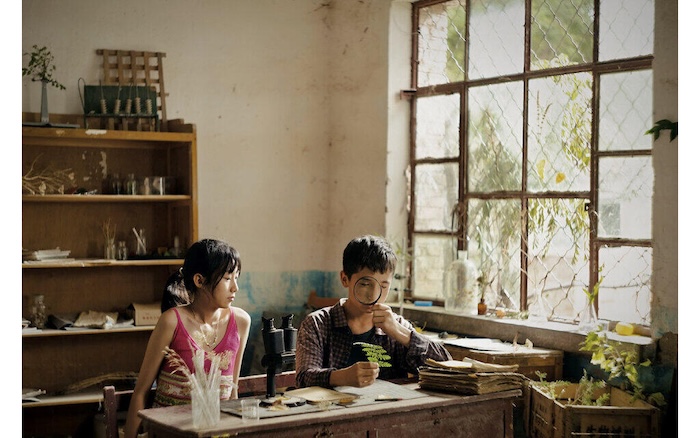
When most people hear of Xinjiang they probably think of the Uyghur people, who make up a sizable portion of the Chinese province’s population. In that case, they may also think about how the Chinese government has suppressed their culture and their religion. However, the sparsely populated northern edge of Xinjiang borders Kazakhstan, and many of the people who live on the Chinese side speak Kazakh and still follow Kazakh customs. This community is the focus of director Yi Jing’s debut feature The Botanist, whose titular protagonist is a 13-year-old Kazakh boy who studies local plants under a microscope and keeps copious notes about them in his native hand. Occasionally, Yi inserts dramatized Kazakh folk tales and legends into the story in order to illustrate certain plot points, but for the most part he follows the boy, Arsin (Yesl Jahseleh), on his daily rounds as he walks through the forests and fields collecting samples, tends to his grandmother’s flock of sheep alongside his distracted older brother (Jalen Nurdaolet), and plays with the Han Chinese girl Meiyu (Ren Zihan), whose family runs the village’s only grocery store.
Yi dispenses with a conventional storyline, but there are dramatic developments that accumulate in an organic way to form a portrait of Arsin’s milieu. The brother, it turns out, has recently returned from Beijing, where he apparently got into trouble with the law. He still has a girlfriend there and is often seen on his cell phone talking to her. The brothers’ mother arrives one day unannounced but abruptly leaves after she herself receives a phone call, saying that she has to go back to “the city” in order to attend to some “paperwork.” Arsin’s wayward uncle, the man who turned him on to plants, has slipped from the grace of nature into alcoholism and disappeared, but his presence in Arsin’s thoughts (at one point a horse tells him what his uncle is up to) is almost constant. And while Arsin’s and Meiyu’s relationship is close when they’re together on their own, they are never together in the village; and after Meiyu informs Arsin that she is being sent to boarding school in Shanghai, he realizes, by calculating the distance and the time needed to visit her, that he will likely never see her again. When he tries to say goodbye at her family’s store, her brother pushes him away and calls him a “weirdo.” Arsin’s brother, having drunk the Kool-Aid called Beijing, can no longer stay away and is spirited off one day in a car.
Yi’s pastoral visuals and sounds are pleasantly lulling, so when the modern world breaks in it can be startling. The movie proceeds at Arsin’s leisurely pace, which can shift from thoughtful to confused in the blink of an eye. Better attuned to nature than he is to human interaction, he looks at life holistically. “If history were an herbarium,” he muses, “it could be preserved forever.” His love for Meiyu is pure until he realizes that their relationship is frowned upon by others. Then the relationship itself is history, something he can write down in his journal and ponder the meaning of; or make a beautiful, heartbreaking movie about.
In Kazakh and Mandarin. Opens May 15 in Tokyo at Human Trust Cinema Yurakucho (03-6259-8608), Cinemart Shinjuku (03-5369-2831).
The Botanist home page in Japanese
photo (c) 2025 Monologue Films

