
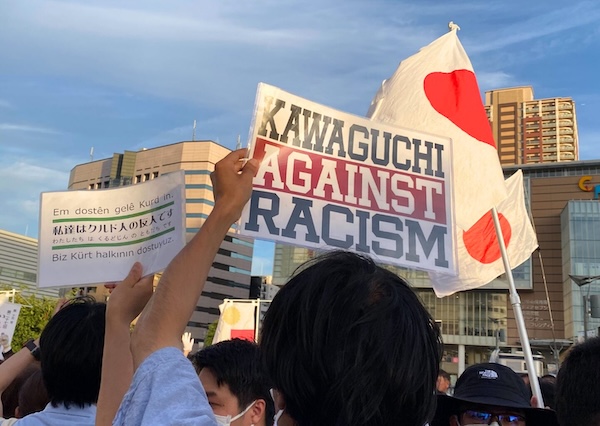
On May 20 Saitama District Court began hearing a defamation lawsuit brought by a lawyer named Kim Yeong-gong against someone he says directed “hate speech” at him in a blog post in 2024. Kim is demanding ¥7.2 million in damages. During the first court session, the defendant rejected Kim’s claim in oral arguments.
According to the Asahi Shimbun, the suit stems from Kim’s work trying to prevent demonstrations outside the offices of his client, the Japan Kurdish Cultural Association (JKCA), in Kawaguchi, Saitama Prefecture, which had been planned for November 2024. Kim claimed that the demonstrators were going to use hate speech in their denunciation of the group, which the demonstrators say is a front for undocumented Kurdish workers from Turkey who claim to be seeking asylum from ethnic persecution in their home country. The government has mostly rejected Kurdish refugees’ request for asylum on the grounds that there is no demonstrable persecution against Kurds in Turkey, and some Japanese right wing activists are saying that the Kurds’ real reason for coming to Japan is economic self-enrichment. Kim, as a representative of the group, requested local authorities stop the demonstration.
Consequently, Kim’s name circulated among the demonstrators, many of whom belong to organizations that oppose immigration. Kim says that the defendant posted on his own blog in November 2024 false and misleading information about Kurds while also mentioning that Kim is a Zainichi Korean, meaning a Japan-resident of Korean background who is not a naturalized citizen of Japan. Like the Kurds, wrote the defendant, Zainichi Koreans are in Japan “illegally” and exploiting Japan’s welfare system. Both Kurds and Zainichi Koreans are also committing crimes against Japanese citizens, according to the blog post. In addition, the post said that Kim is a “Chosen-related” left-wing lawyer and included a photo of Kim next to the phrase “Retaliation against the Japanese.” “Chosen” is a common term in Japan for North Korea.
In March 2025, Kim asked the portal site that hosts the blog to reveal the name of the author. When contacted by Kim, the author apologized for the post but did not offer anything in the way of compensation for it. Kim insisted that the information contained in the post undermined Kim’s position in society by promoting discrimination against him due to his background. Such discourse constitutes defamation based on racist language, both against the Kurds whom Kim is representing and Kim himself. In court, Kim said the blog post used hate speech in an attempt to silence “those who defend minority groups in Japan.”
Asahi explains that Kim’s law office is in the city of Warabi, which is adjacent to Kawaguchi. Kim says he offered to defend the JKCA because they are his neighbors and he believes they are being persecuted unfairly. The fact that Zainichi Koreans are also targeted by right wing groups in Japan made Kim think that it was his moral duty to help the Kurdish group. In a discussion of the case on the web program No Hate TV, journalist Koichi Yasuda, who has covered Kurdish immigrants in Japan extensively, said that other lawyers who have helped Kurds in Japan have also received “bashing” from right wing groups, but not nearly as much as what Kim has received.
The vast majority of Zainichi Koreans were born and raised in Japan, and most do not speak Korean. Japan is all they know, but if their parents are not Japanese citizens, they are not Japanese citizens either unless they apply for naturalization and are granted Japanese nationality. Many do, but just as many do not because they believe that taking Japanese nationality automatically means they have to abandon their Korean heritage. The government has granted Zainichi Koreans permanent residency under a special law. If they want a passport they can apply to the South Korean government or the North Korean government, but since Japan does not have diplomatic relations with North Korea, Zainichi Koreans who declare their affiliation with the North must specially apply to the Japanese government for permission to leave Japan and return to Japan.
Zainichi Koreans were unable to practice law in Japan until 1979, even if they passed the Japan bar exam. The main reason is that, as foreigners technically, they could not be legal interns, which is required in order to get a law license. A Zainichi Korean named Kim Kyeung-deok petitioned the Supreme Court six times in the 1970s to remove the nationality provision from the certification process, and in 1977 the court finally accepted the petition. Following Kim’s internship he became a full-fledged attorney in 1979, the first “foreign” person to do so, even though he was born in Wakayama Prefecture. In the 80s his main issue was fighting the government requirement for all Zainichi Koreans to submit to fingerprinting. He also worked to assure that Zainichi Koreans were eligible for Japanese social security.
Zainichi Korean lawyers do a lot of work helping other Zainichi Koreans, though, as Kim Yeong-gong’s case illustrates, they also do a lot of work for foreigners in Japan who believe they are being discriminated against. In 2005, a group called the Lawyers Association of Zainichi Koreans (LAZAK) was established with 28 members. The group now boasts about 140 members. The group openly says that their purpose is to “fight” for “their own people,” meaning Japan-resident Koreans, whether they are affiliated with the South or the North. Interestingly, the man who founded LAZAK was not born in Japan. He was born in Seoul in 1962 and came to Japan in 1974, following his father, who emigrated to Okinawa in 1972 several weeks before Okinawa reverted from the U.S. to Japan, at which point he became a Zainichi Korean. Consequently, the son was deemed “issei” (first-generation Korean). The son learned Japanese from scratch, became a permanent resident, and then passed the bar exam in 1990.

