
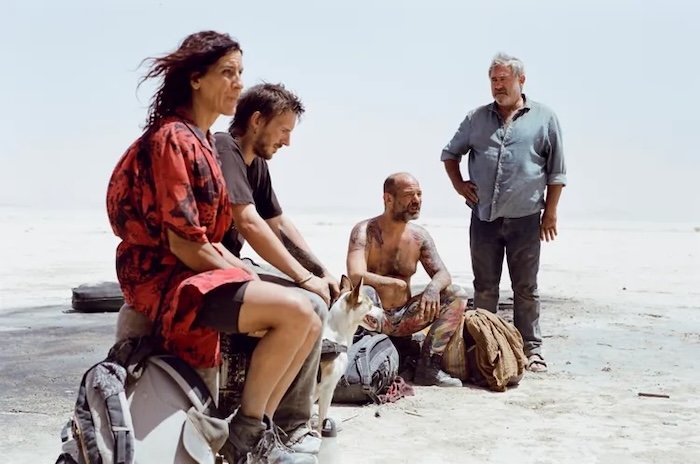
Much of the power of Oliver Laxe’s Sirât comes from its disorienting intentions. The viewer is dropped fully into an alien, forbidding environment that is nevertheless programmed, at least temporarily, for pleasure, and the feeling of being out of one’s depth can be overwhelming, especially if you’re watching the movie in a theater. The forbidding environment is the Moroccan desert, initially a sun-baked valley surrounded by high brown cliffs. The situation is a moveable rave, a contrived musical experience wherein severe, anonymous techno music is pumped out from stacks of speakers at ear-splitting volumes that envelope the dancing hordes. The ringer is a middle aged Spaniard named Luis (Sergi López), who walks among the entranced, drug-addled revelers with a confused look on his face. He is here with his preteen son, Esteban (Bruno Núñez Arjona), looking for his daughter, Ana, a rave aficionado who has been missing for several months. A friend of hers said she might be pursuing her obsession in North Africa.
Luis’ fish-out-of-water predicament drives what passes as a plot, though most of the action is dictated by forces beyond the control or, for that matter, comprehension of humans. It’s not just the harsh weather and impossible terrain. It’s the exigencies of a world where order has no purchase. The rave where Luis and Esteban, not to mention their little dog, Pipa, search for Ana is eventually broken up by government troops who endeavor to escort the participants, most of them European, to someplace else due to an unexplained military action that one person chillingly describes as “the start of World War III,” though it’s impossible to know. When two trucks full of seasoned rave nomads whom Luis has casually befriended—they haven’t seen Ana but think she could be at another ad hoc rave happening soon in Mauritania, where they may be heading—break out of the convoy, Luis impulsively follows them in his Citroen station wagon into the desert for an adventure he has no business embarking on. This caravan must stick to unpaved roads to avoid government troops, and most of the movie is simply about survival even as Luis is grudgingly accepted by the quintet of ravers as an outsider they are willing to tolerate. Laxe has hired non-professionals to play these wanderers, scouted at real raves, and they’re a suitably ragged bunch who carry their iconoclasm as convincingly as they do their visible scars (two members are missing limbs).
Despite the attempt to conjure up an emotional atmosphere of mutual empathy, Sirât is unrelentingly a downer, mainly because the viewer can never quite get a handle on what Luis thinks he can accomplish on this ad hoc rescue mission, which seems desperate and doomed from the start. And because he drags the others down with him, the empathy can be questioned as well. By turns gorgeous and terrifying, the movie’s visual effect is exhausting and in the final stretch feels downright nihilistic. A movie that tries to plumb the spirit of outlaw community ends up just punishing those who fall for its hallucinating charms.

The quest in the Belgian hospital drama Adam’s Sake is similarly quixotic, maybe even pointless, but driven by a sense of moral certainty. Léa Drucker plays Lucy, the head pediatric nurse in an overburdened urban public hospital. Immediately we’re shoved into the issue at hand. A young mother, Rebecca (Anamaria Vartolomei), is trying to comfort her 4-year-old son, Adam (Jules Delsart), who has fractured both his arms while playing, a situation the doctors say was caused by weak bones brought on by malnutrition. Social services has become involved and restricted Rebecca’s access to the hospitalized Adam. She disapproves of the diet the hospital has prescribed and insists on feeding him what looks like baby food. Lucy, from the start, seems to sympathize with Rebecca’s position, being a single mother herself, and constantly tries to intervene on her behalf, thus setting up her own opposition to the law and her immediate superiors.
The director, Laura Wandel, doesn’t try to hide the impression that Rebecca is suffering from some kind of pathology. Her refusal to feed her son what the doctors recommend is clearly based on nothing other than resentment for being told how to be a mother, but the film’s portrayal of anyone in authority other than Lucy is that of manual-toting technocrats. Wandel follows Lucy around the halls of the bustling hospital with the doggedness of a Dardenne, showing her selfless devotion to her patients and giving us pointed examples of topical concerns—an African immigrant family who sees the hospital as a convenient housing solution; a Muslim girl undergoing an abortion that will be recorded as an appendectomy. It’s like a greatest hits of the P.R. downside of universal health care. When Rebecca is injured trying to abduct Adam from the hospital, Lucy calls his father, and you get some idea of where Rebecca’s misanthropic attitude comes from. The father, who already has a new partner and a new baby, claims that Rebecca rejected him as a co-parent from the get-go, but there seems to be something else at play in his disaffected attitude, hinting not at domestic enmity but rather a kind of terminal incompatibility. Rebecca’s mantra is that she is the only person who can take care of Adam and that without him she is nothing, which convinces Lucy that to ignore her demands is to condemn her to death.
Tension is generated by the notion that Lucy herself may be going too far, which begs the question: What to do about a problem like Rebecca? The story resolves itself in a satisfying way but leaves her fate open to interpretations that aren’t necessarily happy ones. Wandel poses a compelling argument that she can’t really win in the end.
Sirât, in Spanish, French, and Arabic, opens June 5 in Tokyo at Shinjuku Piccadilly (050-6861-3011), Marunouchi Piccadilly (050-6875-0075), Human Trust Cinema Yurakucho (03-6259-8608), Bunkamura Le Cinema Shibuya Miyashita (050-6875-5280).
Adam’s Sake, in French, opens June 5 in Tokyo at Shinjuku Musashinokan (03-3354-5670), Cine Switch Ginza (03-3561-0707).
Sirât home page in Japanese
Adam’s Sake home page in Japanese
Sirât photo (c) 2025 Los Desertores Films, A.I.E., Telefonica Audiovisual Digital, S.L.U., Filmes da Ermida, S.L., El Deseo Da, S.L.U., Uri Films, S.L., 4A4 Productions
Adam’s Sake photo (c) Dragons Films – Les Films du Fleuve – Les Films de Pierre – Lunanime – France 3 Cinema – Be TV & Orange – Proximus – RTBF (Television Belge) – Shelter Prod.

