
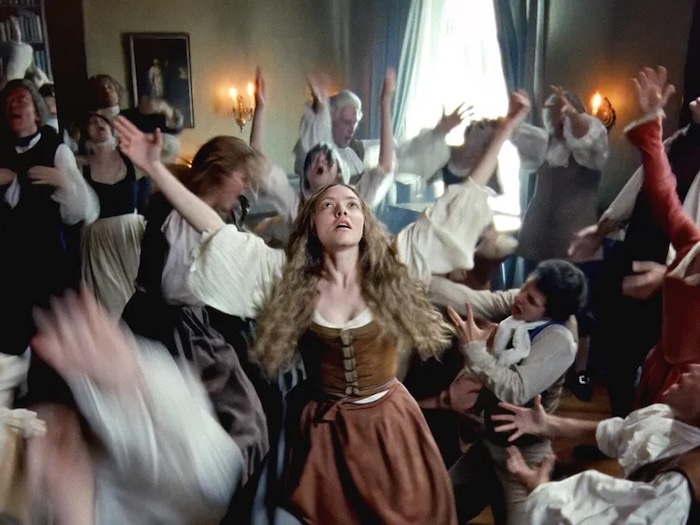
At first, director Mona Fastvold’s decision to fashion a biopic of Ann Lee, one of the founders of the Evangelical Christian movement Shakerism, into a musical sounds willfully counterintuitive, but, in fact, the Shakers were quite a musical bunch. As their name suggested, the act of worship was accompanied by a physical manifestation of their devotion that could, at least to the modern sensibility, look like avant garde dance. Daniel Blumberg’s original songs aren’t quite catchy enough to make an impression—they aspire half-heartedly to Laurel Canyon pop—but Celia Rowlson-Hall’s choreography incorporates the exalted tremulousness of religious ecstasy in inspiring ways, making for several moving production numbers.
Fastvold’s script, written in collaboration with her partner, fellow filmmaker Brady Corbet (The Brutalist), seems to stick faithfully to Ann Lee’s (Amanda Seyfried) life story, which is fascinating in and of itself since the scenario does such an excellent job of couching that story in a vivid historical milieu. Ann is born into a strictly religious family in the city of Manchester, where everyone of lower birth works for the wool trade. As evangelicals her parents by definition oppose the Church of England, and while their belief in the second coming of Christ comes with an abhorrence of “fleshly cohabitation” they breed freely and often, much to young Ann’s disgust. This negative attitude toward sex will color her general outlook on human existence as she grows and becomes a powerful force within the fledgling Shaker faith, especially after she marries the blacksmith Abraham (Christopher Abbott) and bears four children, none of whom make it to their first birthdays. Though Abraham is nominally as devout as Ann, he is also callous about his sexual appetites, and after the Shakers emigrate to New England to escape persecution, Ann denies him what he claims are his conjugal rights and he feels justified in taking a new wife. Now free of the obligations of the flesh, Ann can concentrate all her energy on building a church, not to mention a culture built on the idea that God is, to use the appropriate term right now, non-binary. The Shakers not only had their eye on the prize—Christ’s eventual return to earth—but foresaw the inevitability of feminism and the commercial appeal of practical design (Shaker furniture, etc.).
Structured in chapters and narrated by one of Ann’s acolytes, Sister Mary (Thomasin Mackenzie), the movie displays an old-fashioned adherence to narrative convention that sometimes gets the better of Fastvold in that it tends to wallow in exposition, and the themes get lost in the extended ending, which feels more like a coda than a climax. But if you like historical films for the history, this is for you.

History is much more immediate in the self-styled mockumentary The Moment, though, to me, Charli XCX’s Brat Summer seems much longer ago than 2024. Director Aidan Zamiri’s concept for the movie splits the difference between shameless self-promotion and a satirical bringdown of so-called pop-cultural moments. To its credit, the movie doesn’t make some kind of inflated case for the artistic importance of the Brat album, though it does insist that Charli herself is a dedicated musician with valid artistic intentions. The point is that the record company and other interested parties have agenda that are naturally at odds with those intentions, and Zamiri aims to show how as a result conflicts arise that inevitably make everyone miserable, a theme that is a lot more conventional that either he or Charli probably thinks it is.
The sticking point is pure meta: a movie about the Brat Summer concert experience to be directed by a hotshot filmmaker who isn’t really that interested in Charli or her music. This filmmaker, a Swedish blowhard named Johannes (Alexander Skarsgård), is portrayed from the start as having pretensions that outstrip Charli’s influence over her fate in terms of her relationship with management, which is represented by a stereotypical cold fish (Rosanna Arquette) who only listens to Charli’s desires when it suits her professional prerogatives. Caught in the middle is Charli’s creative director and close friend, Celeste (Hailey Gates), who works with the artist to realize her “vision” and is second-guessed every step of the way by Johannes, whose amiable bro vibe becomes creepier with each compromise he demands. Johannes wants a more “family-friendly” concert experience, a proposal that eventually terrifies Charli when she realizes how much sway he has with her management.
It’s difficult to deny The Moment‘s snarky entertainment value, but the movie basically doubles down on the kind of anti-corporate sentiment that has been central to the business of pop music since Colonel Parker engineered Elvis’s military service. Bizarrely, the music is given short shrift in favor of supersaturated dramatic episodes that are almost comical in their seriousness. That’s not what satire is.
The Testament of Ann Lee opens June 5 in Tokyo at Toho Cinemas Chanter Hibiya (050-6868-5001), 109 Cinemas Premium Shinjuku (0570-060-109).
The Moment opens June 5 in Tokyo at Shibuya Parco White Cine Quinto (03-6712-7225).
The Testament of Ann Lee home page in Japanese
The Moment home page in Japanese
The Testament of Ann Lee photo (c) 2025 Searchlight Pictures
The Moment photo (c) 2026 Rights By Lloyd LLC

