
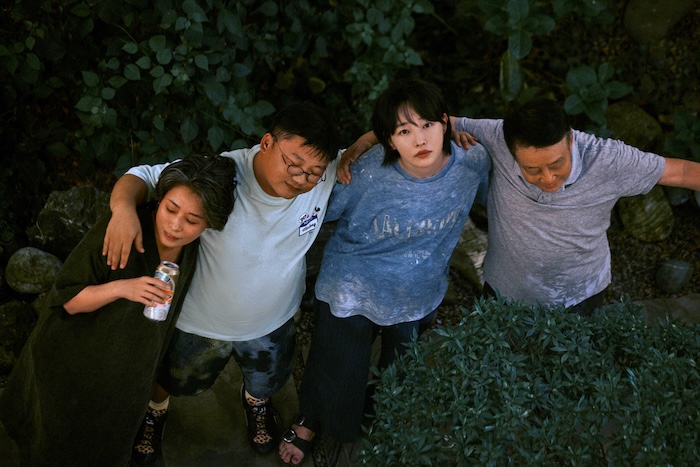
Korean-Chinese director Zhang Lu’s Gloaming in Luomu won the inaugural Busan Prize in the Competition section of last year’s Busan International Film Festival. Zhang, a mainstay at the festival for two decades, is a master of characterization and setting, though he’s a bit weak when it comes to plotting, even if fans will likely counter that storylines are not his main concern. His previous film, The Shadowless Tower, however, which delved into one man’s middle age dilemma in a wholly believable way, proved that he can fashion a solid narrative when he puts his mind to it.
The protagonist of Gloaming is Bai (Bai Baihe), a former dancer who visits the titular tourist spot in Sichuan Province because a boyfriend who ghosted her 3 years ago once sent her a postcard from there. Bai spends a lot of time drinking with the natives and wandering around the leafy town, which is striated with lovely, pristine canals. Bai’s purpose for being there—her visit stretches out into what some would call a long residence—seems to shift from one conversation to another, with the town’s beautiful ambient light providing a kind of counterpart to her constantly changing mood. Though the viewer is meant to think that Bai is searching for her old lover, or, at least, trying to find out what happened to him, not much detective work is accomplished, and not just because she tends to get drunk before any plausible answers can be discovered. Most of Bai’s conversations are with another day drinker, Liu (Liu Dan), who’s more cynical than Bai though her love for her ineffectual husband seems to provide a measure of inspiration for the newcomer.
The viewer will likely not share in this inspiration, mainly because so many scenes are repetitive and pointless. The slow rhythms point up Luomo’s attraction as a destination, which, in the end, may be the movie’s most salient selling point. It would be a great place to visit, but you wouldn’t want to live there unless you were an alcoholic.
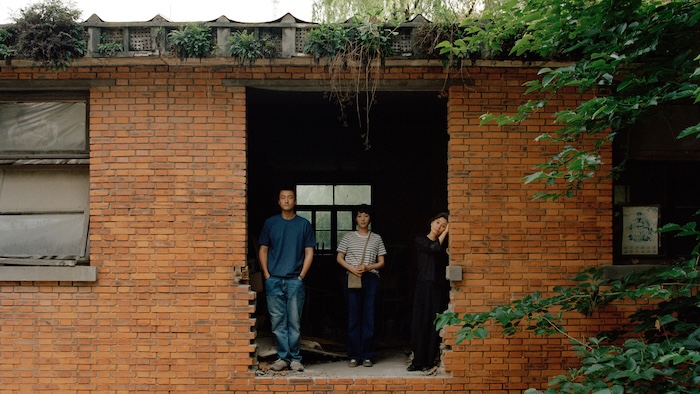
Zhang’s even more recent film, Mothertongue, screened in the Competition section at last year’s Tokyo International Film Festival, where Zhang shared the Best Director prize with two other filmmakers. Bai again stars, this time as a struggling actor named Chunshu who manages to land a choice role in a major motion picture because the character she will be playing is from Chengdu, which is Chunshu’s hometown. However, when the producers learn that she has lost her facility with the local dialect in the years since she left, they drop her. Dejected, she returns to Chengdu to reconnect with her past, in particular the acting coach (Liu Dan again) who convinced her to lose her regional accent in the first place, telling her “only actors who speak standard Mandarin” can get work these days.
As with Gloaming, the purpose of Mothertongue seems mainly to be to promote its setting as a desirable tourist spot. Chengdu’s main claim to fame is the defunct Emei Film Studio, where many notable Chinese films of the past were made. Zhang was able to shoot the movie on the premises, which were abandoned and, by now, have probably been demolished, so the film has an intentionally marked sense of nostalgia. This sense is heightened by Liu’s retired acting coach, one of the few people who still live in the studio’s residential complex and who claims to be suffering from dementia, meaning she has forgotten much of the studio’s history, just as China has, Zhang suggests.
Mothertongue feels more coherent that Gloaming in Luomo if only because Zhang seems more engaged in the things he’s showing. It’s a more personal movie, which, to an instinctive filmmaker like Zhang, means everything.
Gloaming in Luomo and Mothertongue, both in Mandarin, open July 3 in Tokyo at Cine Switch Ginza (03-3561-0707).
Home page in Japanese

