
Horror movies have been ascendant for decades, but in the last few years, certainly since the end of the pandemic, they’ve become even more commercially viable since they seem to be the only genre outside of children’s animated films that can bring young people into movie theaters; which means, of course, that horror in and of itself is saving world cinema for the future. And it’s worth pondering just what it is about current horror films as opposed to horror films of, say, 30 or even ten years ago that make them appealing to Gen Z, and one inescapable factor is how independent-minded directors like the young men who made Obsession and Backrooms on shoestring budgets have refashioned horror cliches to reflect their own insecurities in ways that resonate with their cohort. The Outwaters, a horror movie by Robbie Banfitch, who not only wrote and directed it, but stars and did the editing and cinematography (not to mention most of the music), may actually be too subjective for the new generation of horror fans, and certainly lacks the narrative rigor that the most striking horror usually has to deliver, but that doesn’t mean it isn’t scary as shit.
The main narrative issue is that The Outwaters is another found-footage film in the style of The Blair Witch Project. The movie opens with audio from a 911 call against a black screen of a woman screaming hysterically while the operator tries to calm her down to find out what is going on. The call is being made in 2017, and this sequence is followed by a title card explaining that police found memory cards in the Mojave Desert in 2022. So what we subsequently watch is the content of these cards, which were from the camera or phone of amateur L.A. filmmaker Robbie (Banfitch), who plans a trip to the Mojave with his friend Michelle (Michelle May), a budding indie singer who wants to make a music video, and so, of course, Robbie thinks “desert.” To turn the job into a kind of jaunt, Robbie invites his older brother, the quiet, thoughtful hunk Scott (Scott Schamell), and another female friend from the east coast, Angela (Angela Basolis), to do hair and makeup, since she’s never been west. Most of the footage in the first half of the film is rote setup—what kind of people these characters are—and it’s obviously Banfitch’s intent to show them as not being particularly interesting. Once the movie gets into the desert, where the quartet will be camping as they make the video, things initially progress without incident as the characters adapt to the weird, forbidding environment. And then at one point the weather gets strange, odd noises emerge from the night, and everything goes seriously south without let-up.
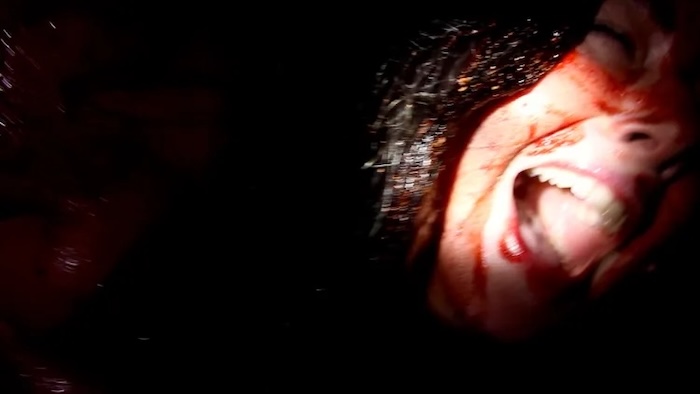
Visually, Banfitch doesn’t stray from the found-footage template. The horrors are mostly suggested, especially since much of the action in the extremely disturbing last 45 minutes takes place in total darkness, with only Robbie’s iPhone flashlight illuminating tiny patches of seeming reality. However, the accumulation of disquieting images within these patches—frightened faces, insects, weird snakelike creatures, and lots and lots of blood—have the effect of forcing the viewer to draw conclusions that are very unpleasant but impossible to verify based on what’s available. Banfitch seems more interested in this effect than in telling a coherent story, since many of the images clearly could not have been recorded on the memory cards that the video is ostensibly taken from; which sets up Robbie, who is operating the camera, as the ultimate unreliable narrator, making us wonder if maybe he isn’t the perpetrator of these atrocities. For sure, he is definitely going mad without any indication in the beginning that he had the potential for madness, but the disconnect between his point-of-view and the content of the found footage is a problem that Banfitch the director doesn’t even attempt to solve, and perhaps for that reason alone The Outwaters—what does that title even mean?—is a new kind of horror movie, one in which logic itself becomes a terrifying uncertainty.
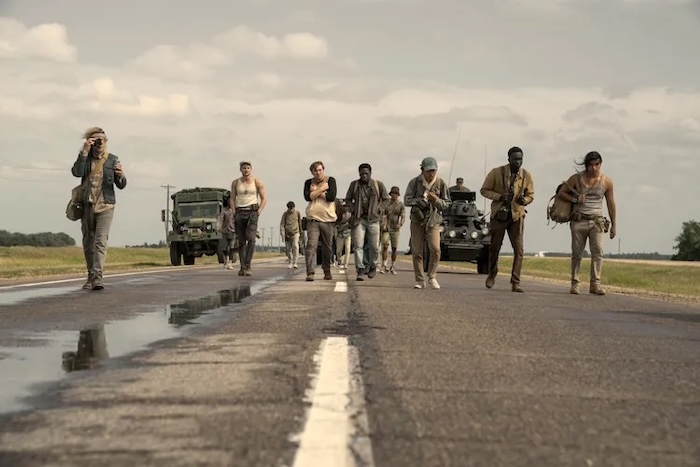
The Long Walk is a horror movie in the old school sense, since it is based on a Stephen King story, one he wrote in 1979 under the pseudonym Richard Bachman. Like The Running Man, another Bachman story that’s been turned into a movie (several times), The Long Walk is premised on a game of life-and-death survival staged to distract a disenfranchised populace from the indignities of the dystopia they live in. The movie, as directed by Francis Lawrence, is more class-conscious than The Running Man, with most of the action actually focused on discussions among the contestants regarding social theory and the like, though couched in King’s peculiarly spiky vernacular.
The titular contest is one of eugenics. Fifty boy volunteers from across the U.S. take part in an endurance walking race until only one remains. Anyone who falls behind the established pace is warned to keep up and if he doesn’t is shot dead. That’s pretty much it, so what you have is various characters illuminated as to their mental state and backstories as they talk to one another while walking along an empty highway followed by truckloads of armed men and TV cameras. Predictably, the principals are a colorfully varied bunch: a kid with serious emotional problems (Charlie Plummer), a weak boy with an amazingly big heart (David Jonsson), and the obvious leader type (Cooper Hoffman) whose goal seems not to be winning but rather to prove to the powers that be that they can be beaten by the solidarity of defiance.
Lawrence means to comment on the current political climate, and not just in America, and so The Long Walk, for all its dramatic effect and excellent acting, often feels over-extended, lacking in the kind of subtlety that would make it thoughtful rather than merely provocative. And as a horror movie it adheres faithfully to one facet of the genre that is unavoidable, which is fantasy. It has compelling things to say about the terrors of authoritarianism and the power of resistance, but the fantastical trappings automatically make it less scary than the purely visceral terrors of The Outwaters.
The Outwaters now playing in Tokyo at Human Trust Cinema Shibuya (03-5468-5551), Cinemart Shinjuku (03-5369-2831).
The Long Walk now playing in Tokyo at Shinjuku Wald 9 (03-5369-4955).
The Outwaters home page in Japanese
The Long Walk home page in Japanese
The Outwaters (c) Outwater Road X, LLC. 2022
The Long Walk (c) 2025 Lions Gate Films Inc.

