
Much less tedious than the only other Nuri Bilge Ceylan movie I’ve seen, Winter Sleep, this typically long award-winner proceeds leisurely into a narrative that mostly stays on course aside from a few detours into philosophical muckraking. The protagonist, middle school art teacher Samet (Deniz Celiloglu), is, like the protagonist in Winter Sleep, a sourpuss who alienates many of those he interacts with, but unlike that other character, a landlord, he has no station in life that affects his interlocutors, who are free to dismiss his bitchy ramblings without consequence. And he does have something to bitch about: being stuck in the mountains of Anatolia for four years on assignment, which he likens to penal exile. Soon he will finish his sentence, so to speak, and can put in a transfer to Istanbul, where he believes his spiky intellect will have more of a purchase, but then he gets embroiled in a scandal that threatens to derail his plans.
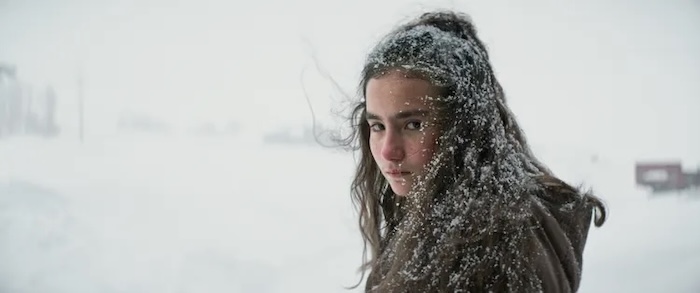
Samet and a colleague, the more complacent Kenan (Musab Ekici), are accused by several students of “inappropriate behavior,” and while this behavior is not elaborated upon by either the accusers or the administrators who put the two teachers on notice, the audience has already seen how Samet acts in the presence of his star pupil, the admiring 14-year-old girl Sevim (Ece Bagci), whose tacit overtures to Samet are frustrated when he essentially throws her under the bus during a particularly unnecessary surprise search of school bags by the principal. Though Samet’s previous attentions don’t register overtly as pedophilia, the accusation brings out his petulant, defensive side in the worst ways. He now not only has a reason to dismiss and badger his pupils more, but greater emotional ammunition with which to take pot shots at the culture that informs this particular corner of Turkey. Fortunately, Ceylan has balanced his misanthropy with the more worldly attitude of another teacher, Nuray (Merve Dizdar), a woman who lost a leg in an explosion that may or may not have been a terrorist attack, and whose political consciousness has been raised as a result. In a wonderfully written and performed long conversation between the two, Nuray takes Samet to task for his nihilism, accusing him of having no foundation of moral certitude to judge the rest of the world, which he wants nothing to do with. The conversation is sparked by Samet’s implications that Kenan, who is sweet on Nuray, may really have behaved inappropriately around his students, though the viewer knows it is just a jealous reaction to Nuray’s acceptance of Kenan’s attentions. Samet doesn’t really know himself, though, in the end, he always seems to get what he wants, even if it isn’t what a dick like him needs. Nuray attempts to give it to him, but can’t penetrate his carapace of entitled resentment.
Ceylan fortifies this vision of personal desolation with natural light playing off a perpetually snowy landscape, and ends with a tentative truce between teacher and students, including Sevim. But we know in the end there is no hope for a guy like Samet. In a way, he’s the perfect anti-hero for our blighted age, a man who doesn’t appreciate the advantages he has compared to others because his self-importance is so monolithic.
In Turkish. Opens Oct. 11 in Tokyo at Human Trust Cinema Yurakucho (03-6259-8608), Shinjuku Musashinokan (03-3354-5670).
About Dry Grasses home page in Japanese
photo (c) 2023 NBC Film.Memento Production/Komplizen Film/Second Land/Film I Vast/Arte France Cinema/Bayerishcer Rungfunk/TRT Sinema/Playtime

