
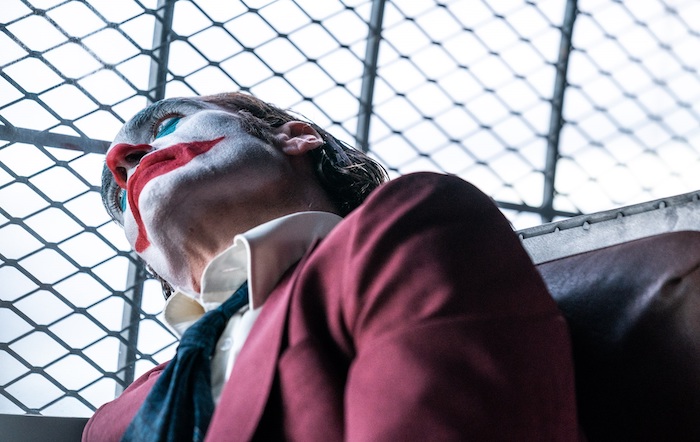
I’m not sure what to make of this genre of movies and TV shows that exists simultaneously within a superhero universe and without it. In the first Todd Phillips Joker movie the only real narrative connection, besides the setting, to the world of Batman, where the Joker originated, was that brief scene near the end when the parents of Bruce Wayne are mugged by a bunch of thugs who’d been inspired by the antics of the Joker in the movie we were watching. That conceit is completely gone in the sequel, which concerns itself only with the character of Arthur Fleck and his problems. In fact, I see no possibility of Fleck’s villainous alter-ego moving on to the kind of organized criminal activity in which the Joker of the comic book/movie series partakes. And that’s fine, since it allows Phillips’ movies to more or less stand on their own, but, unfortunately, that also means they will fail or succeed completely on their own.
The plot core of Joker: Folie à Deux is the trial of Fleck (Joaquin Phoenix) for the murders he committed in the first movie, and as such relies on courtroom cliches that overshadow the main aims of the story, which is to show Fleck as a psychologically damaged individual whose peculiar brand of extroverted sociopathy (though by nature he is an introvert) infects others who have something against society. At this stage in Fleck’s development, he can clearly distinguish between his own personality and the invented character of the Joker, and it is this dichotomy that attracts the equally intense but qualitatively different form of sociopathy exhibited by fellow psychiatric prison inmate, Lee Quinzel (Lady Gaga). In the rarefied context of captivity, for these two it’s love at first sight, and obviously they can’t spend as much time together as they’d like, so they join a music activity program, which Phillips uses to make the movie itself into a jukebox musical filled with standards from the Great American Songbook and AM radio pop hits from the 60s-80s. The numbers as performed by Phoenix and Gaga work well enough in isolation, but they are supposed to be in service to the love story, which is predicated on Quinzel’s infatuation with the Joker persona rather than Fleck himself. In that regard, Fleck’s real personality, that of a self-conscious, self-torturing victim, is a turnoff for Quinzel, which means if he wants to hold on to her, he has to be the Joker full time, and that means doing the violent deeds the Joker does and saying the misanthropic things the Joker says 24/7.
Needless to say, none of this works within the larger story of the trial, which quickly descends into farce, but farce with a purpose, which is to show that the Joker, and not so much Fleck, deems himself above the petty demands of “justice.” He just wants to set shit on fire. And that’s not only what Quinzel wants, it’s also what his incel fans out in the real world insist upon, and while Phillips gets his big loud finish accordingly, it feels as if there’s nothing at stake except a temporary breakdown in law-and-order, for whatever that’s worth in this hellhole called Gotham City. And since we’ve already see how corrupt and sadistic the guards in the psychiatric prison are, not to mention how venally the court system operates during the trial, all the mayhem feels deserved. If that isn’t how nihilism operates in narrative fiction, then I’m Samuel Beckett.
Now playing in Tokyo at Toho Cinemas Nihonbashi (050-6868-5060), Toho Cinemas Hibiya (050-6868-5068), Marunouchi Piccadilly (050-6875-0075), 109 Cinemas Premium Shinjuku (0570-060-109), Shinjuku Wald 9 (03-5369-4955), Shinjuku Piccadiy (050-6861-3011), Toho Cinemas Shinjuku (050-6868-5063), Toho Cinemas Shibuya (050-6868-5002), Toho Cinemas Roppongi Hills (050-6868-5024).
Joker: Folie à Deux home page in Japanese
photo (c) & TM DC (c) 2024 Warner Bros. Ent.
 philipbrasor.com