

Though Eleanor Morgenstein is only the second leading film role that the 94-year-old American actor June Squibb has ever done, the novelty of such an aged person playing the titular character in a major motion picture like Eleanor the Great—the directing debut of Scarlett Johansson, no less—draws attention to Squibb’s ubiquity on TV, screen, and even stage (she was recently nominated for a Tony) as a supporting player since her breakthrough in Alexander Payne’s 2013 road movie Nebraska. There’s a naturalness to Squibb’s screen presence that doesn’t feel gratuitous or phony, which means she can flow from comedy to poignancy and back without changing much in the way of dramatic gravity. She’s the perfect person to play Eleanor, a woman who rediscovers her Jewish background (though, in fact, she’s a convert) through a lie that is more of an urge than an act of purposeful deceit.
In her old age, Eleanor has made what seems to be her best life in Florida, where she shares an apartment with BFF Bessie (Rita Zohar), a victim of the Holocaust who sometimes wakes from nightmares at 3 in the morning and relates her PTSD-triggered memories to an always receptive Eleanor. These early, establishing scenes set up Eleanor as a natural dissembler, quick with a clever made-up story to get what she and Bessie need from naive younger people who don’t always know their place in the generational scheme of things. Eleanor clearly sees herself as Bessie’s protector and rises to each occasion fearlessly. So when Bessie dies suddenly, Eleanor is left adrift, without purpose, and moves back to New York City, where she raised a family with her husband and where she met Bessie, in order to be with her divorced daughter, Lisa (Jessica Hecht), and college age grandson, Max (Will Price). Bored and constitutionally out-of-sorts, she constantly annoys Lisa with her complaints and bitter asides, and Lisa signs her up for a singing class at the local Jewish Community Center. There, she accidentally wanders into a support group of former concentration camp inmates who mistake her for a fellow survivor. Intrigued by the attention, she tells them Bessie’s story as if it were her own, and from there the lie just snowballs, with a young journalism student (Erin Kellyman), who recently lost her own Jewish mother, adopting Eleanor as a class project and, in the process, attracting the interest of her famous journalist father (Chiwetel Ejiofor).
Tory Kamen’s script follows these developments to exactly where you expect them to go, and Johansson’s workmanlike direction only plays up the obviousness of the depicted dilemmas, which are not limited to Eleanor’s expanding falsehood. The contrivances are practically flown in by courier, thus undermining not only the film’s questionable use of the Holocaust as a plot device, but the various domestic melodramas it engenders. Which isn’t to say that Eleanor the Great doesn’t succeed in evincing sympathy for Eleanor and her situation, but rather that without Squibb it would have been insufferable.
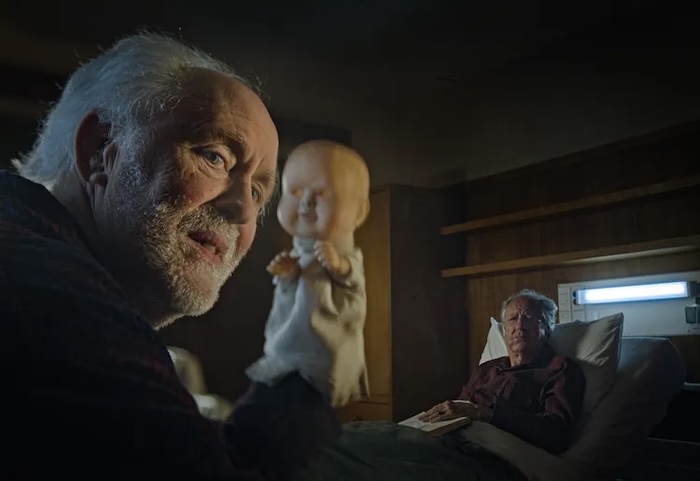
John Lithgow is another elderly actor who was just nominated for a Tony and, in fact, won it for playing British author Roald Dahl as a raving anti-semite. The old man he plays in The Rule of Jenny Pen is also raving, but to different ends. Dave Crealey lives in an assisted living facility in New Zealand where he terrorizes the other residents, much the way a playground bully would terrorize fellow children who he senses are weaker than he is. The script’s allusion to one’s dotage as a return to childishness limits its scope to the most destructive adolescent impulses, an aspect of the story that Lithgow really gets into.
Though Dave is fairly indiscriminate in his domineering misanthropy, he reserves his cruelest intentions for Stefan Mortensen (Geoffrey Rush), a judge who has suffered a stroke that has left him partially paralyzed but in full possession of his mental faculties. Though confined to a wheelchair, Stefan still acts like a judge, haughty towards other residents and condescending to the staff, who mostly ignore him because they’ve seen it all before. Stefan really isn’t much different from Dave in terms of attitude except that while Dave’s megalomania may be a side effect of dementia, Stefan’s intolerable pride is born of professional conditioning as someone whose word has always literally been law. As a result, Dave’s unspeakably crude persecutions, which are carried out by Jenny Pen, a plastic baby doll that Dave wields like a hand puppet, sometimes come across as being deserved, especially by other residents who hate Stefan only slightly less than they hate Dave. It also renders the staff less helpful when Stefan tries to get them to do something about Dave’s threats, which become deadlier by the day.
Director James Ashcroft, working from a novel, knows how to develop an atmosphere of ever-heightening dread of what Dave is capable of, but he never provides a reason for all the horrible behavior except that this is what old people can be like. The most terrifying aspect of the story is that none of the residents acknowledge the truth that they are in this place for the rest of their lives, since they all claim to be there “temporarily,” including the judge. Dave seems to be the only person who understands he ain’t goin’ nowhere, which in a way makes him as sympathetic a figure as Eleanor Morgenstein, something I wish Ashcroft had paid closer attention to.
Eleanor the Great opens June 12 in Tokyo at Cine Switch Ginza (03-3561-0707), Shinjuku Wald 9 (03-5369-4955), Euro Space Shibuya (03-3461-0211), Yebisu Garden Cinema (0570-783-715).
The Rule of Jenny Pen opens June 12 in Tokyo at Shinjuku Musashinokan (03-3354-5670), Human Trust Cinema Yurakucho (03-6259-8608).
Eleanor the Great home page in Japanese
The Rule of Jenny Pen home page in Japanese
Eleanor the Great photo (c) 2025 Eleanor Invisible Film, LLC, and Tristar Productions
The Rule of Jenny Pen photo (c) 2024 Hyenas Rule Ltd.

