
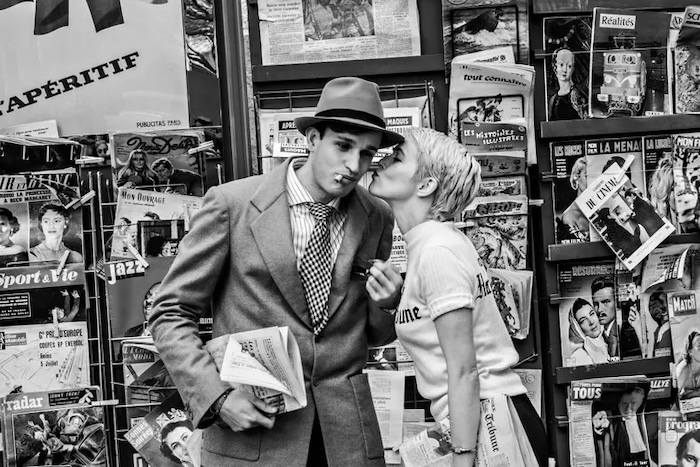
Richard Linklater is much too practical a director to make a movie that doesn’t attempt to entertain, regardless of the subject matter or mode of expression. As the title of his latest film attests, he means to address the French New Wave of the late 50s-early 60s and gets a lot of visual and aural mileage out of cliches attached to the cinematic movement—cool jazz, chain smoking, epigrammatic line readings, monochrome palette—but presents it all in a playful way, as if he’d studied the trend as a graduate student would for a thesis and then just goofed on it. The film is breezy and non-confrontational, even when the characters aren’t. Cinephiles who might prefer something more scholarly or nuanced should still find the movie a pleasure to sit through regardless of whether it tells them anything new.
Linklater doesn’t try to explain the movement. The movie simply focuses on the making of the film that capped the New Wave and, in doing so, defined it from then on: Jean-Luc Godard’s Breathless. By the time Godard finally made it in 1960, all the other French film critics who wrote for Cahiers du Cinema had already directed their debut films. The sunglass-sporting Godard (Guillaume Marbeck) is presented as a stereotype, constantly speaking in aphorisms that betray a condescending attitude toward his peers. He has no use for conventions as professed in what amounts to his creative motto: “Make your own mistakes.” His confidence in his untried methodology is disarmingly magnetic. Getting Belmondo (Aubrey Dullin) to play the small-time crook in his movie is no big deal, since the struggling B-actor is perfectly willing to commit “career suicide”: It’s not the challenge he’s interested in but the freedom Godard offers. Securing the services of Jean Seberg (Zoey Deutch) is more difficult, since she’s been tainted by Hollywood success, but thanks to her marriage to a Frenchman who, as her manager, wants to broaden her professional horizons, she takes the role of the American expat without really knowing what she’s getting into. Then again, given Godard’s willfully experimental creative rationale, nobody does, including his producer, Georges de Beauregard (Bruno Dreyfurst), who becomes increasingly frustrated by Godard’s structureless shooting schedule and penchant for hiring people (stuntmen, makeup artists) he later decides he has no use for. The production becomes a series of non sequiturs. No one involved has any idea of what the movie is about or what it might look like in the end, including Godard.
As a comedy, Nouvelle Vague feeds off Godard’s intended flouting of cinematic rules, but it also gains considerable traction from Linklater’s obvious tribute to the period and its attendant self-consciously artistic sensibility. Perhaps the most emblematic scene in that regard is the one where Rossellini, while being feted by the cream of the French movie industry at an event in his honor, hoards sandwiches from the buffet for later consumption. Whenever Linklater wants to drop a name, he simply hauls up the famous filmmaker, sets them squarely in front of the camera, and provides their name in bold typography on the screen. The French New Wave thus becomes a kind of running joke, all these pompous men (except for Agnes Varda) acting pompously…but all for a noble purpose! Linklater defends his thesis admirably, if not necessarily seriously, and everyone has a good time in the process.
In French and English. Opens July 10 in Tokyo at Human Trust Cinema Yurakucho (03-6259-8608), Shinjuku Piccadilly (050-6861-3011), Human Trust Cinema Shibuya (03-5468-5551).
Nouvelle Vague home page in Japanese
photo (c) 2025 ARP – Detour Development LLC


I just wonder what’s the point of a movie like that ? Why not watch the original?
It’s not a remake at all. It’s a movie about how Breathless was made, as well as the surrounding “cinema culture” that created it.