
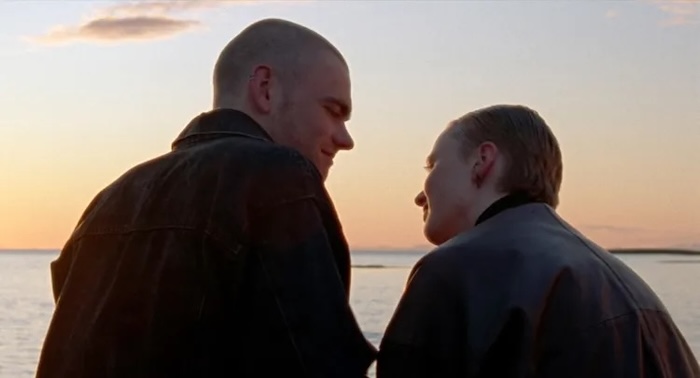
Often when tragedy strikes we are unprepared for it. The work of addressing it thus becomes fraught with circumstance and time seems to press in like a great weight. There’s no time to stand back and collect your faculties. The Icelandic director Rúnar Rúnarsson knows how to convey this feeling, though he’s greatly helped by his actors, who miraculously remain in the cinematic moment, presumably take after take after take. Unfolding from one dusk to another, the movie pegs its temporal effect on the way Iceland’s sky changes color and mood over the course of a full day. We open with university students Una (Elín Hall) and Diddi (Baldur Einarsson) sitting at the edge of the water watching the sun set, their affection for each other palpable and deep. “Let’s make babies together,” Diddi says offhandedly, but the intent is clear, and strikingly tender. They walk home and fall asleep in each other’s arms.
There is already a measure of discomfort in the interaction, because in the morning Diddi is fly to his home town, where he will break up with his girlfriend. Over the course of this eventful day, we will learn that Una and Diddi’s romance has been long gestating; that they started out as bandmates at their school and eventually fell in love. But because he has maintained a long-distance relationship with his girlfriend, Klara (Katla Njálsdóttir), the tryst is hidden from almost all Diddi’s and Una’s acquaintances except Diddi’s brother, Gunni (Mikael Kaaber). On the way to the airport, Diddi’s taxi is involved in a tunnel fire that kills many motorists, including him. By the time Una wakes up it has become a national tragedy. Now, she is yet another member of the mourning party of people who knew Diddi. When Klara arrives later that day, devastated, how is Una to handle it? At first she avoids the other woman as if by instinct, but it’s no use. Klara knows that Una was close to Diddi without understanding the true nature of that closeness, and she is intractably drawn to her.
Through a day of compensatory but somehow celebratory drinking, Diddi’s friends deal with his loss while Rúnarsson keeps his focus on Una. The viewer is privy to how each emotionally charged human response to the tragedy affects her and her hesitantly budding friendship with Klara, and the development offers both tension and release, usually at the same time. The movie is all amorphous feeling, like something conceived through the filter of a hangover, and by the next sunset Una and Klara have forged a connection born not of grief but of spiritual kinship. They know things about Diddi his other friends and family never could, and thus they know each other.
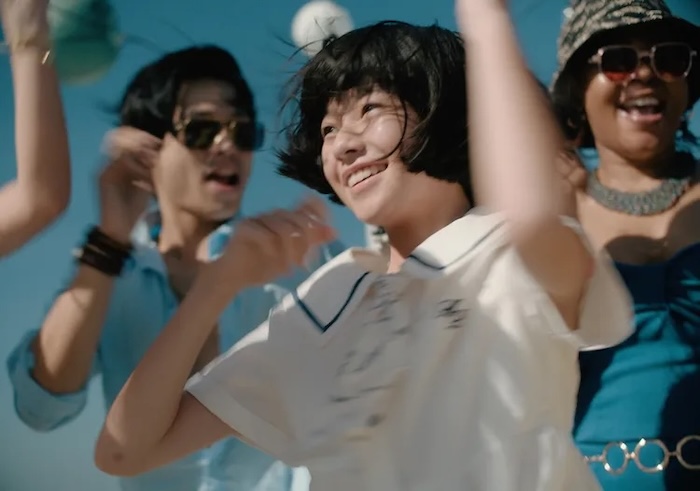
The death of someone close to the protagonist also figures prominently in Chie Hayakawa’s second feature, Renoir. The protagonist is an 11-year-old girl, Fuki (Yui Suzuki), and the death is that of her father, Keiji (Lily Franky), though it is slow and drawn out since he has terminal cancer. Just as Rúnarsson tried to show how people react to a loved one’s sudden death, Hayakawa explores how people get used to the idea of a known impending one. As it stands, Fuki is left to pursue her own interests, regardless of how frivolous they are, as her working mother (Hikari Ishida) is busy moving her father in and out of the hospital. Death is not an abstraction to Fuki, but something that must be gotten through, and Renoir is essentially a study in adolescent distraction.
The movie is at least partly autobiographical and set during the heady days of the 80s bubble, but unlike a lot of Japanese directors Hayakawa doesn’t rub your nose in it. Nostalgic touches are kept to a minimum so as to concentrate on a young girl’s keeping her head as her family loses theirs. Set against her mother’s need for emotional stability and her father’s desire for physical stasis, Fuki is free to form her own connections, whether through a potentially dangerous dating hotline, a rich classmate with family problems of their own, or her English teacher, who recognizes something special in the girl, something the audience is meant to recognize as well. She is also free to fantasize about better things, but that goes without saying for someone her age.
Though the movie is eventful in an episodic way, its slow pacing stalls the overall momentum. When death arrives it’s a relief, a response that’s natural given how tortuous Keiji’s treatment had become, but one that leaves Fuki in a conundrum Hayakawa can barely conjure. Unlike her debut work, the chillingly prescient Plan 75, which confronted death from a much different perspective, Renoir feels overly cautious and tentative, as if the director doesn’t entirely trust what she remembered.
When the Light Breaks, in Icelandic, opens June 20 in Tokyo at Bunkamura Le Cinema Shibuya Miyashita (050-6875-5280), Shinjuku Musashinokan (03-3354-5670).
Renoir, in Japanese, opens June 20 in Tokyo at Toho Cinemas Chanter Hibiya (050-6868-5001), 109 Cinemas Premium Shinjuku (0570-060-109), Shinjuku Piccadilly (050-6861-3011), Shibuya Euro Space (03-3461-0211).
When the Light Breaks home page in Japanese
Renoir home page in Japanese
When the Light Breaks photo (c) Compass Films & Halibut, in coproduction with Revolver Amsterdam, MP Filmska Produccija, Eaux Vives Productions, Jour2Fete, with The Party Film Sales
Renoir photo (c) 2025 Renoir Seisaku Iinkai + International Partners




 philipbrasor.com