Busan International Film Festival 2025, Sept. 20

I spoke to two people yesterday who have been working with and within the Korean film industry for a number of years, and both pretty much thought the new Competition Section of the festival is not going to achieve what the festival hopes it will. This is the first year that BIFF has had a Competition Section outside of the New Currents Award, which is for indie art films by emerging filmmakers. The idea of a Competition Section is mainly to gain attention from the media, who like nothing better than a battle. I’ve always admired BIFF because it took itself seriously as the premiere Asian film festival and didn’t bother with stunts like competitions. It just showed quality films. But apparently the festival has hit a wall after COVID and the film industry itself is crumbling, so they have to do something. The trouble is, all the highest quality Asian films try first to get into competitions at the big Western festivals, so there are few left for Busan. Consequently, the films in the BIFF Competition are mostly also-rans, which isn’t to say they aren’t good, but rather that, like the movies that are in the Tokyo International Film Festival Competition Section, nobody really cares that much about them. The two people I talked to said as much.

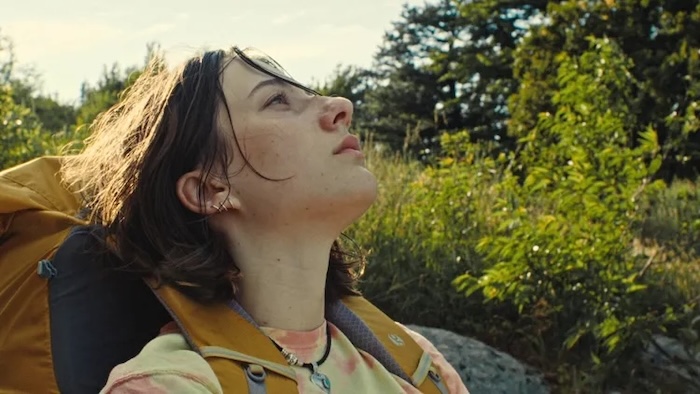
One of the Competition films I saw yesterday may be a case in point. En Route To is an earnest Korean indie youth film that tackles some weighty issues with a distinctive dramatic flair, but it’s probably not original enough to make a bid impression. A girl attending a boarding high school is knocked up by her teacher, who then disappears after he learns the girl is pregnant. The girl decides to get an abortion, thinking if she does, the teacher will come back, but she has no money for the pills she has to buy illegally on the internet, so she steals money from her roommate, who sells vape liquids to fellow students under the table. This series of events leads to a kind of bitter friendship between the two girls, especially since the roommate is the daughter of a single mother—an illegitimate child who thinks the other girl is better off getting rid of the baby, but then the other girl changes her mind. Besides dealing with its tricky themes frankly and honestly, the movie is always surprising in the choices it makes, though in the end the story becomes a bit too contrived. Everything doesn’t have to fit into place so perfectly.

Continue reading
Posted in Uncategorized | Leave a comment

Busan International Film Festival 2025, Sept. 19

Been plagued by technical problems ever since I arrived. I bought a Wow card, which you can charge with any denomination of currency and use pretty much everywhere in Korea, including public transportation, which is what I bought it for. The first day it wouldn’t work and I had to go to the station office and they explained to me that I had to set up part of the card just for transportation. It took me a while to figure out how to do that but I finally did. Then, one of my email accounts doesn’t work at all here, not on my phone nor on my computer. It’s always worked here before, so I don’t know what the problem is. Then there’s the ticketing system, which was changed. I haven’t had too much trouble getting the tickets through the online system, though the first day I felt like one of those K-pop fans trying to get a ticket to their favorite idol’s concert. The problem came when I had to pull up the mobile ticket on my phone at the entrance to the theater. It just wouldn’t come up. Fortunately, a volunteer who spoke English believed my story and let me into the theater after the movie started. I had no problem at the next screening, but this morning it happened again, though I was finally able to produce the ticket by logging out and turning off my phone and then starting the whole procedure again. I got in with a minute to spare.

I attended the press conference for Jafar Panahi, who won this year’s Asian Filmmaker Award. As he pointed out a number of times, he was at the first BIFF in 1996 and has been here a half dozen times since, but there was a long gap when he couldn’t attend because he was either in jail or forbidden to leave Iran. The press conference took place before the press screening of his latest film, the Palme d’Or winner It Was Just an Accident, so he didn’t talk much about the film. He talked at length about the movie being submitted for an Oscar the day before yesterday. None of his movies have ever been in Oscar contention because the Academy receives nominations from countries, not individuals or producers, and in Iran Panahi is persona non grata. But this year, France was gracious enough to submit his film because it’s one of the producing countries. I don’t know what that means for France’s submission of a French-language film, because it didn’t come up. He also talked at length about the regime’s ban on his filmmaking activities and how he resisted. “My co-writer was put in jail and just got out,” he said. “He’s spent one-fourth of his life in prison. Under a dictatorship, you must find a way to make the films you want to make; you have to pay for this struggle.”

Continue reading
Posted in Movies | Tagged | Leave a comment

Review: The Phoenician Scheme

As a comic filmmaker, Wes Anderson often doesn’t seem to be in on his own jokes. His overly fussy sets and precise camera movements feel so intense that it’s the intenseness that evinces laughs rather than what’s actually going on in the story. In his latest concoction, Benicio del Toro plays Zsa-zsa Korda, a very rich international arms merchant who is constantly the target of assassination attempts, which he just barely escapes. Despite the character’s name and del Toro’s somewhat exotic makeup, not to mention the extreme globetrotting that takes place throughout the film, Korda seems American through and through. With each additional brush with death, he gets closer to religion, a position Anderson has fun with by inserting what he calls a “Biblical troupe,” including F. Murray Abraham, Willem Dafoe, Charlotte Gainsbourg, and Bill Murray as God, judging Korda for his mortal and venal sins. It’s obvious these sketches are all in his head, but guilt is a powerful thing and the plot revolves around his scheme to achieve redemption, presumably for all the suffering he’s caused through his business dealings.

However, in order to do this he has to finalize those business dealings still in play and appoint an heir. Though he has nine sons who live in close proximity, he chooses his estranged daughter, Liesl (Mia Threapleton), who is about to take her vows as a nun. She goes along with his morally dodgy scheme because she somehow thinks she can change his evil ways during the process, which is so hurriedly explained as to be meaningless in terms of plot motivations. What it does is set in motion a series of encounters centered on transactions with other shady characters who Korda wants to finance his scheme, most of whom he has dealt with in the past. And while the individual set pieces are also funny, they feel so dramatically cut off from one another that their only real purpose seems to be to allow another A-list star to take part in the film, a methodology that has become synonymous with Anderson. These stars include Tom Hanks, Bryan Cranston, Mathieu Amalric, Jeffrey Wright, Scarlett Johansson, and Benedict Cumberbatch looking like someone you would never imagine him playing. 

Anderson’s films are always a cornucopia of colorful characters and odd sequences, but it’s difficult to sort out what exactly is going on in the movie because there’s just so much stuff, and the whole theme of regaining one’s soul gets lost in the highjinks. In order to make sense of it you have to keep your eye on Korda—or, more precisely, del Toro playing Korda—in order to determine just how seriously he takes all this soul-searching. My estimate is: not very much. One of Anderson’s strong points is creating characters with distinctive personalities that stay with you, and Korda, while clearly an intelligent man who knows the real price of his impact on the world, is obviously out to cheat fate and get into heaven without actually changing his evil ways. That Anderson can get us to not only understand this impulse but actually grow fond of the guy during the course of the movie is a rare accomplishment. 

Now playing in Tokyo at Toho Cinemas Nihonbashi (050-6868-5060), Toho Cinemas Chanter Hibiya (050-6868-5001), Toho Cinemas Shinjuku (050-6868-5063), Kino Cinema Shinjuku (03-5315-0978), Shibuya Parco White Cine Quinto (03-6712-7225), Toho Cinemas Roppongi Hills (050-6868-5024).

The Phoenician Scheme home page in Japanese

photo (c) 2025 TPS Productions LLC & Focus Features LLC

Posted in Movies | Tagged , , | Leave a comment

Busan International Film Festival 2025, Sept. 18

Fairly smooth trip from Narita to Busan yesterday—except when I got to Korean immigration, which was packed. I’ve never waited that long before, and consequently, I wasn’t able to get to the Cinema Center before the badge desk closed to pick up my press credentials. They close at 3 pm, which seems pretty early for the first day of the festival, but I guess it’s because they need everyone to work the opening ceremony.

Which I attended. Naturally, the red carpet introductions went on way too long and the ceremony itself was pretty boring. Lee Byung-hun was the emcee, and he was affable and all, but the script was terrible, just filled with cliches about the glory of cinema. I can appreciate how far the festival has come in 30 years, but there was this whole subtext to the speeches that implied Busan was a lowly backwater in 1996, and maybe it was, but they should have mentioned that once and let it be.

The only reason I endured the ceremony was to watch the opening film, which stars Lee: Park Chan-wook’s No Other Choice. This was the Korean premiere (the World Premiere was Venice, where it got raves), so it was a big deal. The movie opens wide in Korea next week, I think, and pre-sales have hit a record. It’s very good. And very strange. I was expecting a black comedy but not one as convoluted as this. In a sense, it’s about how a man can be driven insane by his reliance on routine. Lee’s character loses his job at a paper manufacturer and can’t countenance working for any other industry. As it happens, several other “pulp men” have also lost their jobs at other paper companies and are looking for work, so he endeavors to knock them off in wild and woolly ways. They all can’t imagine toiling for anything except paper, which is a great metaphor that Park plays up brilliantly. It’s also about the fragility of Korean masculinity, a common enough theme in Korean movies but the twist that Park and Lee give it here is unique. I’ll have to see it again.

It didn’t end until almost 11:30, so I had to rush back to the beach for the Opening Reception, which wasn’t as crowded as it usually is. There was way too much food. I hope they didn’t throw it all away.

Posted in Uncategorized | Leave a comment

Review: The Monkey

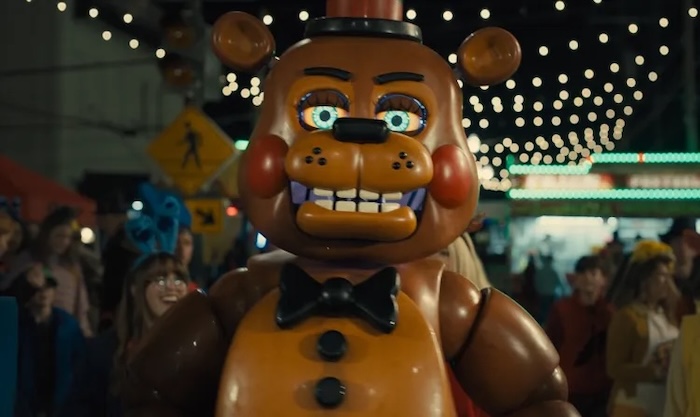
The best thing about Osgood Perkins’ adaptation of the Stephen King short story is the titular toy, whose malevolent intentions are obvious just by looking at its sick grin and wide-open eyes. Unlike the windup monkey you’re more likely to imagine, this one doesn’t play crash cymbals, but rather a drum, and as soon as it starts striking those skins someone in the vicinity dies a comically horrible death. Perkins, who made the deliciously demented but dramatically uneven serial killer movie, Daddy Longlegs, knows how to get the viewer’s motor running, and opens with what amounts to an origin story, with a U.S. military officer played by Adam Scott desperately trying to return the toy to some Southeast Asian emporium and, in the process, causing the disembowelment of the proprietor, who apparently didn’t know what his merchandise was capable of. It’s the first of many crass jokes and a pretty effective one. 

This officer is married and has twin sons (Christian Convery), and for reasons unexplained he abandons them. Inevitably the boys discover the toy in the closet and turn the key, which leads to a number of deaths. As it turns out, one of the twins hates the other for the bully that he is and thinks he can use the monkey to get rid of him, but that’s not the way things work (“It doesn’t take requests”), and in the process it’s the boys’ mother (Tatiana Maslany) who dies. Skip ahead two decades after the twins, adopted by their aunt and uncle, a pair of swingers, throw the cursed simian down a well and we find them estranged and still suffering separately for what happened. The more sensitive one, Hal (Theo James), is divorced and trying to forge a relationship with his adolescent son, Petey (Colin O’Brien), whom he sees only once a year so as to keep him as far away from the monkey’s telepathic attention. Right on cue, his toxic brother, Bill (also James), calls him and says he has learned that the monkey has somehow returned and plans to get rid of it once and for all. As it turns out, the toy has come into the possession of a weirdo named Rick (Rohan Campbell), who knows it’s something special but unaware exactly how special. When Bill steals it from him, Rick attempts to get it back and, literally, all hell breaks loose.

It would be easy to dismiss The Monkey as a piss-take on the Final Destination series, but King’s characteristically clever plotting and Perkins’ witty direction combine to emphasize the nihilism at the core of the best horror movies. We all will die, after all, hopefully not as spectacularly as the unfortunate people in this movie, but random death is more of a fact of life than we would like to believe. That is basically Hal’s and Bill’s curse, which is why they are so monumentally and permanently traumatized. Osgood, the son of Tony “Norman Bates” Perkins, who died of AIDS, and actress Berry Berenson, who perished in the September 11 terrorist attacks, knows whereof he directs. 

Opens Sept. 19 in Tokyo at Shinjuku Piccadilly (050-6861-3011, Human Trust Cinema Shibuya (03-5468-5551), and from Sept. 26 at Kadokawa Cinema Yurakucho (03-6268-0015).

The Monkey home page in Japanese

photo (c) 2025 C2 Motion Picture Group, LLC

Posted in Movies | Tagged , , | Leave a comment

Review: Black Dog

Lots of cliches move the emotional gears of this Chinese film, which won the top prize in the Un Certain Regard section of the 2024 Cannes Film Festival. The titular canine is an extreme outcast in a former mining town fitfully undergoing redevelopment on the eve of the 2008 Beijing Olympics. The main character, an almost mute ex-con who has returned to the town, finds a job rounding up the numerous strays that get in the way of the redevelopment, and then bonds with a nameless, impossibly skinny black mutt: Two souls who find in each other a kindred spirit by default. Director Guan Hu demonstrates a genuine talent for framing action, though he gets an inordinate amount of assistance from the setting. This gray, disintegrating burg is perhaps the most depressing municipality in a Chinese movie since those communities abandoned to the Three Gorges dam project in Still Life by Jia Zhangke, who appears in Black Dog as the local extralegal fixer. 

Lang (Eddie Peng) isn’t hated by everyone in town; only the butcher who blames him for the death of his nephew, the act that landed him in prison, though from what we learn it was mainly the nephew’s fault. Most residents remember Lang as a once-promising rock musician and stunt motorcyclist who worked in a local circus. With his father dying in a hospital and a sister who moved away, Lang has no family for support but gets by on the goodwill of good people, of which there seem to be many in this blighted place. The black stray has no such support, since he tends to bite people and everyone thinks he has rabies. At first, Lang tries to catch him in order to claim the reward but the stray’s wily intelligence impresses him and after the inevitable capture he grows fond of the animal and even fashions a custom-made motorcycle sidecar for him. Meanwhile, his father asks Lang to help him die in peace as the town is slowly torn down. The animals in the zoo Lang’s father used to manage are set free and join the strays in taking over the ruined neighborhoods while everyone is out in the Gobi Desert watching the solar eclipse. Though it’s a motif that’s eye-rollingly obvious, Guan pulls it off with some incredibly staged tableaux.

Black Dog is the kind of neorealist melodrama that’s constantly preparing you for an epiphany, and while a lot of the devices feel worn—Lang’s extreme reticence adds nothing to the story and feels more like a gimmick for garnering sympathy—the movie’s uniform tone of despair works in the end by not overplaying the sentimentality. One reason is how intensely natural the dogs are. Even in packs they seem more disciplined as actors than the humans. 

In Mandarin. Opens Sept. 19 in Tokyo at Shinjuku Cinema Qualite (03-3352-5645).

Black Dog home page in Japanese

photo (c) The Seventh Art Pictures (Shanghai) Co., Ltd.

Posted in Movies | Leave a comment

Review: Take Me Somewhere Nice

Alma (Sara Luna Zoric), who appears to be around 20 years old, is a Bosnian national raised in the Netherlands by her single mother, who brought her to Northern Europe with her father. At some point, however, the father decided he was “homesick” and went back to Bosnia permanently. As Ena Sendijarevic’s movie opens, Alma is also about to go back to Bosnia, a country she doesn’t know, in order to visit her father, who is in the hospital. Her mother (Sanja Buric), who confesses to having given up on her husband a long time ago (it’s not clear if they ever actually divorced), will not accompany her, and so puts her in touch with Alma’s cousin, Emir (Ernad Prnjavorac), to meet her at the airport. So begins a peculiar road movie that doesn’t offer much in the way of surprises, even if, like me, you know little to nothing about Bosnia except that it was embroiled in a horrific war in the 90s.

That’s probably because movies that take place in Eastern Europe and are made by Eastern Europeans tend to have the same sort of semi-ironic tone. The Bosnia that presents itself to Alma is itching to be European and failing miserably. Emir, an intense beanpole of a guy, doesn’t have a job, per se, though he claims to get by on “odd jobs” that are not described to Alma, who is left to wander the tacky malls and old streets of Sarajevo while Emir is off on some errand. Locked out of his apartment, she meets Denis (Lazar Dragojevic), who claims to be Emir’s “intern,” in the hallway of Emir’s building, and they eventually make out like teenagers, even though at this point the viewer may wonder what’s in it for Alma, who so far has come off as supremely cynical and dry in her pronouncements about what it is she likes. In any event, neither of these two male specifmens are any help in getting Alma to the hospital where her father is, since it’s in another town, and she eventually takes a bus and gets lost without her suitcase, a predicament that feels trite in that it offers Sendijarevic the opportunity to introduce Alma to some weird, slightly dangerous characters from whom Emir and Denis rescue her, much to her chagrin. Further adventures ensue, including a final reckoning with Alma’s father, the pillaging of his property, the reclamation of a suitcase that isn’t Alma’s but is nevertheless filled with illicit drugs, and an unfortunate encounter with some impolite thugs.

Sendijarevic maintains the ironic tone with brio, but her admirable style doesn’t overcome the problem of the main character. Alma feels more like a vehicle than a protagonist, and in contradiction to the sunny title—perhaps the central irony?—she never expresses anything that might indicate she has the capacity to enjoy herself. When she snuggles up to Denis or even Emir in a bit of incestuous hanky-panky it seems to be more for our delectation than for any reasons having to do with character development. Througout the movie Alma is dressed provocatively in mini-dresses and T-shirts, a portrait of nubile lassitude with no inner life. The optimistic ending doesn’t make us hopeful for Alma, because she hasn’t grown during the time we’ve spent with her. 

In Bosnian, Dutch and English. Now playing in Tokyo at Theater Image Forum Aoyama (03-5766-0114).

Take Me Somewhere Nice home page in Japanese

photo (c) 2019 (Pupkin)

Posted in Movies | Tagged | Leave a comment

Review: In a Violent Nature

Horror movies are often predicated on ridiculously simple ideas usually having to do with not-so-innocent civilians intruding on the space of malignant forces. In Chris Nash’s debut feature, which picks and chooses its ideas from a number of well-known splatter series, the premise is a locket that hangs from a shelf in an abandoned fire tower in a remote Canadian forest. We hear the voices of feckless young men, one of whom apparently snatches the locket as a souvenir. This action effectively unleashes a demon named Johnny (Ry Barrett), who emerges from the earth to retrieve the locket, which has some kind of sentimental value. During the course of this very bloody movie, Johnny’s back story comes together and it’s about internecine small-town prejudices in the distant past that led to unspeakable violence and slaughter, but much of this exposition is as unnecessary as the locket itself. Nash is more about Johhny as a presence, even a protagonist, since almost the entire movie is shot from his point-of-view.

Johnny doesn’t talk, and for most of the time his face is hidden behind a fire-fighter’s oxygen mask. His tools are also those of the logging trade—grappling hooks, chains, saws, axes, all of which are put to creative use in decapitating, disemboweling, and pulverizing anyone who comes between him and the locket. What makes the experience unique as a horror feature is the almost leisurely pace, the total lack of suspense (no jump scares), and the breathtaking scenery in which the atrocities take place. It’s as if Johnny is standing in for a natural world that has decided it’s had enough of humans. Several characters imply that this isn’t the first time Johnny has wreaked havoc, a feint that could allow Nash to revisit Johnny in a future project—or not. The movie is literally open-ended but not necessarily begging for continuation. One girl (Andrea Pavlovic) in the initial targeted group manages to escape, and as we await her comeuppance in a final reckoning, the movie just sort of peters out with a conversation between the girl and her clueless rescuer (Lauren-Marie Taylor), who philosophizes about the reality that eveything in nature dies anyway, including us. I’m not sure if I’m looking forward to further adventures of Johnny, but it will be interesting to see what Nash does next. 

Now playing in Tokyo at Shinjuku Cinema Qualite (03-3352-5645), Human Trust Cinema Shibuya (03-5468-5551). 

In a Violent Nature home page in Japanese

photo (c) 2023 Zygote Pictures Inc. 

Posted in Movies | Leave a comment

Review: Nocturnal

This is the third Korean thriller I’ve seen in the last year wherein a male novelist and a book he wrote figure significantly in the mystery, except that in the case of Nocturnal (also the title of the fictional book) the novelist plot thread is utterly superfluous and seems to have been dropped into the script just to make it more complicated, because the basic story is a boilerplate gangster revenge procedural with nothing distinctive to offer. 

Ha Jung-woo plays Min-tae, a former gang enforcer who does a prison stint after violently defending his ne’er-do-well younger brother from other gangsters. After release he does “odd jobs” for others, including a bunch of laborers who are being stiffed by their employer. Through carefully inserted flashbacks we learn how, prior to being sent up river, Min-tae got his brother, Seok-tae (Park Jong-hwan), a job in the gang he was working for, though the gang boss, Chang-mo (Jung Man-sik), seems to have taken him on more as a favor to Min-tae than for any confidence he has in Seok-tae’s talents, which are minimal. Even worse, Seok-tae’s a junkie, and the movie starts with elliptical scenes of his escaping a house where he apparently killed the son of a police chief he was selling drugs to. Shortly thereafter, Seok-tae’s body is found in a pond. Min-tae puts on his detective cap and brushes off his trusty lead pipe—his weapon of choice—and goes about trying to locate Seok-tae’s live-in girlfriend, Moon-young (Yoo Da-in), who was said to have been with him when he died. Also on Moon-young’s trail is the novelist Kang Ho-ryeong (Kim Nam-gil), whose bestseller is based on interviews with Moon-young that predicted Seok-tae’s demise at her hands. And, of course, the police are also looking into the murders, so as these three elements pursue the missing girlfriend and her young daughter, Min-tae keeps running up against gangsters with vested interests in the matter, thus occasioning several Old Boy-style one-against-many fight scenes, not to mention the requisite car chase and pursuit-on-foot through narrow alleyways. 

The only compelling aspect of the movie is Min-tae’s conflicted purposes: Will he really kill Moon-young if he thinks she killed Seok-tae, and why would he want to get revenge for a brother who, by all reports, was a lowlife scumbag in the first place? Writer-director Kim Jin-hwang isn’t very generous with the explanations on these counts, and with the pointless novelist subplot constantly intruding on the action, eventually the movie becomes incoherent as an action thriller. Granted, Kim can stage fights and chases that are as good as anyone’s, but that stuff has become so conventional it’s hard to be impressed any more.

In Korean. Opens Sept. 12 in Tokyo at Cinemart Shinjuku (03-5369-2831). 

Nocturnal home page in Japanese

photo (c) 2025 Barunson E&A, Eulji Creative, Sanai PIctures Co. Ltd.

Posted in Movies | Tagged , | Leave a comment

Review: A Pale View of Hills and While You Were Sleeping

A dramatic device that I have become less patient with as it is more frequently wielded is the final-act plot twist, which often feels like an end in itself. In the case of Kei Ishikawa’s adaptation of Nobel Prize-winner Kazuo Ishiguro’s debut novel, A Pale View of Hills, the big reveal near the end probably wasn’t intended as a plot twist but rather was necessitated by the demands of adaptation. Though I haven’t read the book, my understanding is that the structure, especially with regards to POV, is purposely vague so as to allow the reader to draw their own conclusions about where the story is going and what it actually means. Such a mechanism is common in literature, which honors ambiguity, while cinema tends to be more literal, thus forcing Ishikawa to go through all sorts of contortions to make the same impression and, of course, in the end he doesn’t.

The framing story takes place in the early 80s in London as Etsuko (Yoh Yoshida), a woman who moved to the UK from Nagasaki in the 50s with her daughter Keiko when she married a British man, prepares to move house. Etsuko’s second daughter, Niki (Camilla Aiko), is helping her tidy up her possessions and certain items prompt her to ask Etsuko about her past, thus conjuring up an extended flashback about Etsuko’s (Suzu Hirose) first marriage to Keiko’s father and her friendship with a woman, Sachiko (Fumi Nikaido), a single mother bent on accompanying a G.I. to the U.S. Sachiko strikes her neighbors and acquaintances as antisocial, a label she wears with a certain amount of perverse pride. As it turns out, Etsuko herself is also treated as something of a pariah because she is a survivor of the atomic bombing, and the two women’s stories intertwine in various thematic ways.

Ishikawa does fairly well describing the period milieu and the cultural atmosphere that created it, especially when it comes to the postwar mood of a citizenry that felt betrayed by its leaders. He’s less capable with the interpersonal relationships and their tragic outcome, which feel schematic and over-determined. Obviously, some source material is harder to interpret than others, no matter how dramatically irresistible it appears on the surface. 

The final act plot twist in the Korean weepie While You Were Sleeping—not to be confused with the Sandra Bullock vehicle or, for that matter, the 2017 Korean TV drama, both of which were nominally comedies—is more conventional than the one in Pale Hills and in that regard more successful, but the movie is such a bummer that you may not care. As in the Bullock movie, the main female character, Deok-hee (Choo Ja-hyun), ends up in a coma after an accident that also kills one of her twin children. After she awakes with amnesia her husband, Joon-seok (Lee Mu-saeng), a novelist, attempts to help her regain her memory. So far, so conventional, but the director, Jang Yoon-hyeon, covers it all with a scrim of disorientation that makes you wonder who is really suffering from brain fog. 

As Deok-hee’s memory gradually returns we learn, in flashback, how her relationship with Joon-seok developed and that he is trying to write it all down in an erratic flurry of desperation. By the time the reasons for his behavior become clear there are more questions that aren’t being answered. We find out everything when Deok-hee does, but the revelation does not bring closure. On the contrary, it just makes the misery more miserable. If you love to have your sympathies completely manipulated, this is the movie for you. 

A Pale View of Hills, in Japanese and English, now playing in Tokyo at Toho Cinemas Hibiya, Toho Cinemas Shinjuku, Shinjuku Piccadilly, Shinjuku Wald 9, 109 Cinemas Premium Shinjuku, Toho Cinemas Shibuya, Toho Cinemas Nihonbashi, Toho Cinemas Roppongi Hills.

While You Were Sleeping, in Korean, now playing in Tokyo at Cinemart Shinjuku (03-5369-2831). 

A Pale View of Hills home page in Japanese

While You Were Sleeping home page in Japanese

A Pale View of Hills photo (c) 2025 A Pale View of Hills Film Partners

While You Were Sleeping photo (c) 2024 Studio Killerwhale & Logline Studio

Posted in Movies | Tagged , , , | 1 Comment