Media watch: The spouses’ tax and pension exemption faces its reckoning

Every five years the government reviews the national pension system, which, like national health insurance, is roughly divided into two plans: one for regular salaried employees and another for everybody else. However, the pension system for salaried employees, known as kosei nenkin, has an attached feature for a salaried employee’s spouse, which is known as the “number 3” system. Spouses of salaried employees get their own pensions without having to pay premiums, as long as they don’t make above a certain level of income. Essentially, it applies to spouses who qualify as full dependents on the breadwinners’ tax returns.

Though the system has only been in effect since the 1980s, it was obviously fashioned at a time when many wives of salaried male employees were so-called full-time homemakers, meaning they kept house and raised children on their own. But since the high asset bubble burst in the early 90s and the employment structure changed, many wives have had to go out and work in order to make ends meet. Nevertheless, the number 3 system has been maintained by the government, and the long-term result has been a perversion of the original purpose of the program. Because of the income ceiling for number 3 dependents, the women who benefit (and they are all women) limit the amount of work they do so as not to exceed that limit and thus remain qualified for the pension and other benefits enjoyed by dependents. 

As everyone knows, Japan is going through a labor shortage right now, with employers desperate for workers, especially at the lower end of the income pyramid. One result is that wages have gone up for this demographic, and since a lot of part-time workers are number 3 dependent wives, they are reluctant to work as many hours as their employers want them to work. Moreover, because their pay has actually increased in recent years, they feel they have to work even less since they reach their ceiling for the year more quickly than they did in the past. 

On May 5, the Asahi Shimbun ran a fairly long article about this dilemma, since the government plans to submit pension-related bills during the current Diet session. The income ceiling has become a topic of discussion in the media lately due to its influence on the employment situation, so Asahi profiled several women who are affected. One woman in her 40s from Mie Prefecture, raising two secondary school-age children, told Asahi that she is “bitter” about the income ceiling. She married in 2007 and worked some temp jobs for a while until she became pregnant. Home finances were tight and she wanted to go back to work and put her child in daycare, but her husband disapproved. He said he would provide for the family and wanted her to remain home doing housework and looking after their child, adding that these were tasks he would never do. Nevertheless, once the child and a second one had entered kindergarten she started working part-time at a construction company. She calculated that she couldn’t make more than ¥80,000 a month, otherwise she would lose her tax exempt dependent status and have to start paying into the pension system. The income ceiling was ¥1.6 million a year for the tax exemption and ¥1.3 million a year for the number 3 pension status. 

At the time, she felt these exemptions were “benefits,” but now she feels differently. Firstly, she recognized how the system effectively enforced gender roles, which her husband strongly supported. This became a point of contention between them, and eventually they separated and then divorced, with her gaining custody of the children. She is now looking for work that she can do from home so that she still has time for taking care of her children. But as she points out, because she “had to consider my husband’s feelings,” she did not work continuously in the past and thus accumulated no bankable job experience. Deep into middle age, she is only qualified for low paying jobs that have no chance of advancement. 

Continue reading
Posted in Media | Tagged , | Leave a comment

Review: Queer and Lee

Daniel Craig doesn’t look anything like William S. Burroughs, the Beat Generation author whose autobiographical novel is the source for Luca Guadagnino’s sweaty drama, but he does attempt to mimic Burroughs’ laconic Midwestern drone, albeit with a slight lisp. The effect is both disconcerting and slightly titillating, since both actor and subject have such distinctive images in whatever public imaginations they reign over. Having never read the book, I don’t have any particular investment in the story as Guadagnino adapts it, but his casting, at least, feels inventive in a kind of make-or-break way. Jason Schwartzman is also on hand as someone I hear is supposed to be Allen Ginsberg, and neither Schwartzman nor Guadagnino tries to make the connection clear, so Schwartzman is free to do what he wants with the character, and he’s certainly the most entertaining thing about Queer, if entertainment is something Guadagnino is trying to achieve. The script’s main hurdle is convincing the viewer that these guys are expat writers; the expat part is easy, since they are so obviously ugly Americans taking advantage of Mexico City’s rough trade in the years after the war (Burroughs wrote the novel between 1951 and 1953, though it wasn’t published until 1985), and Guadagnino has to make a concerted effort to show us how dedicated a scribe Burroughs’ alter ego, William Lee, is with long, languorous shots of his messy apartment, filled with chaotic notebooks and two-count-em-two typewriters. There’s also the startlingly out-in-the-open drug paraphernalia, which plays more of a role in the story than pens and pencils do.

If the title is meant to sound transgressive, Guadagnino reinforces the intention by making the sexual politics coarse and exploitative. The homosexual Americans in town express their privilege in the grossest ways, thus contrasting Lee’s romantic longings with the object of his desire’s more passive defiance. Fellow American Eugene Allerton (Drew Starkey) arrives rippling with allure, a handsome young man who obviously has class and position—he was an intelligence officer during the war—and while Lee picks up on his homoerotic vibes early on, Allerton plays hard to get in an almost Hollywood way. Consequently, when sparks eventually fly and the pair hits the sheets, the sex runs hot, as if it were all being filtered through Lee’s literary sensibility, meaning the graphic grappling looks more like an aesthetic choice than a depiction of some kind of realism. What makes it all suspect is how easily Allerton gives in despite his acknowledgment of Lee’s addiction and tendency toward the fatalistic and fantastic. When Lee suggests a road trip to the jungle to find some kind of mind-altering plant, Allerton goes along as if it were a jaunt. Of course, it turns out to be anything but, and as the stakes get hairier at the lair of a Kurtz-like mountain botanist named Dr. Cotter (Lesley Manville, definitively unrecognizable), the movie takes on its most Burroughs-like attributes. But it’s become a different movie by that point, less a study in decadent lassitude than an exercise in psychedelic style. 

Guadagino keeps the atmosphere ripe with anachronistic music (Sinead O’Connor singing Nirvana, that sort of thing) and supporting characters that you love to deride—or feel sorry for. The Mexicans, in particular, are treated like victims of their northern neighbors’ withering whims. I’ll admit I was moved by the melodramatic ending, where Lee, having lost everything he believes he loved, including his penchant for prose, breaks down big time. If only it weren’t James Bond doing the wailing I might have given myself up to it completely, but some impressions just can’t be overcome.

The titular protagonist of Lee (no relation) is also based on a real life libertine, though the intentions here are strictly biographical, which means you’re encouraged to take the implied veracity with a handful of salt. American Lee Miller (Kate Winslet) was a fashion model in Europe before World War II who worked with surrealist photographer Man Ray and herself became a noted photographer. She managed to talk the editor of British Vogue, Audrey Withers (Andrea Riseborough), into sponsoring her as a battle photographer after the war started, an assignment that produced some of the most indelible images of that conflict, including coverage of the opening of the death camps and intimate views of Hitler’s bunker. 

The latter included a stunt, a famous photo of Miller herself taking a bath in Der Fuhrer’s tub, which did much to feed into her reputation as an iconoclast with questionable taste, and the movie takes its measure of her pursuit of sensual satisfaction in all things she put her mind to, including a number of high-profile but strictly casual affairs. Framed as an interview with Miller in 1977, the movie sets itself up as an autobiography, which makes the aforementioned veracity even more suspect, but there’s plenty of witty dialogue and risqué behavior to offset the brutal carnage that Miller witnessed. Winslet is convincing as always, but it’s the supporting players, including Andy Samberg as Miller’s closest reporter pal, Marion Cotillard as the editor of French Vogue, and Alexander Skarsgard as Miller’s often confused British husband, who bring the verisimilitude. It really looks like what you imagine mid-century Europe was. 

Queer now playing in Tokyo at Shinjuku Piccadilly (050-6861-30119, Human Trust Cinema Yurakucho (03-6259-8608), White Cine Quinto Shibuya (03-6712-7225), Shibuya Cine Quinto (03-3477-5905), Yebisu Garden Cinema (0570-783-715).

Lee now playing in Tokyo at Toho Cinemas Chanter Hibiya (050-6868-5001), Toho Cinemas Nihonbashi (050-6868-5060), Toho Cinemas Roppongi Hills (050-6868-5024).

Queer home page in Japanese

Lee home page in Japanese

Queer photo (c) 2024 The Apartment S.r.L., Fremantle Media North America, Inc., Frenesy Film Company S.r.L./Yannis Drakoulidis

Lee photo (c) Brouhaha Lee Limited 2023

Posted in Movies | Tagged , , , , , | Leave a comment

Review: Caught by the Tides

Made during the pandemic, Jia Zhangke’s latest is a clever collage of used and unused footage from previous features, as well as new footage that was shot under strict circumstances. The result is a film that attempts to review the last 20-odd years of Chinese economic development through Jia’s typically skeptical perspective and structure it as a kind of romantic tragedy. Jia’s partner, Zhao Tao, plays Qiaoqiao, a dancer-model in the northern city of Datong in 2001, the same character she played in perhaps Jia’s best film, Unknown Pleasures. Her boyfriend, Bin, a ne’er-do-well played by Li Zhubin, who was also in Unknown Pleasures and other Jia films, decides to leave town and try to take advantage of the projected economic boom. Eventually, Qiaoqiao goes looking for him, visiting various places that Jia covered in his intervening body of work, in particular Still Life

The story is about how these two people, whose love affair in Datong is depicted as being tempestuous, drift apart over the years without actually ever forgetting that they were once in love. Jia doesn’t go deep into their lives, something he rarely does with his characters anyway, but he gets more momentum out of his peculiar retread methodology than you might expect. When Qiaoqiao arrives in Fengjie, a city undergoing huge changes in 2006 due to the construction of the massive Three Gorges Dam, she uses the local authorities to track down Bin as a “missing person,” a gambit he doesn’t appreciate because he’s working semi-legally as a demolition project manager for a developer who has to leave town because she’s embezzled her investors’ money. Jia doesn’t make much of this intrigue, but nevertheless uses it effectively to show how Qiaoqiao’s mission to reconnect is a nuisance for Bin under present circumstances. But given the makeshift mechanism of the plotting, the device also tells us more than we need to know about Bin without revealing much about Qiaoqiao, who is definitely the more interesting character.

The film’s structure is necessarily loose and free-form, moving from documentary realism to semi-staged dramatic tableaux and impromptu musical numbers. The music, in fact, whether incidental or central to the action, is impressively utilized, adding a more complete sense of time passing as the movie updates to 2022 by the end. But while I’ve seen it twice now and think Jia succeeded admirably in what he set out to do, Caught by the Tides didn’t move me as much as some of his previous films have, probably because the ongoing narrative lacks an organic consistency that’s necessary to pull the viewer into its world. In the end, when Bin returns to Datong because he’s run out of hustles and disabled by a stroke, it feels anticlimactic, even after he reconnects with Qiaoqiao, who seems to prefer jogging to catching up with an old lover. Naturalism was never so matter-of-fact. 

In Mandarin. Opens May 9 in Tokyo at Bunkamura Le Cinema Shibuya Miyashita (050-6875-5280), Shinjuku Musashinokan (03-3354-5670).

Caught by the Tides home page in Japanese

photo (c) 2024 X Stream Pictures

Posted in Movies | Tagged , , | Leave a comment

Review: Paddington in Peru

It would be difficult to outdo Paddington 2 for comic inventiveness, especially since the third installment of the series doesn’t feature Hugh Grant (spoiler: he shows up in a brief post-credits bit) or Sally Hawkins, who has so far played the soft-spoken marmalade-scoffing bear’s adoptive materfamilias, Mrs. Brown, and here is replaced by Emily Mortimer. In addition, director Paul King, who helmed the first two movies, has given up the chair to big screen neophyte Dougal Wilson. The most important change, however, is that the movie doesn’t take place in England, whose special cultural atmosphere and, more significantly, manners were so integral to the jokes and warm feelings that are central to Paddington’s story. But the brand is so indelible that all the filmmakers really need to do is trust their instincts: What would Paddington (voiced by Ben Whishaw, as always) do if his beloved Aunt Lucy (Imelda Staunton) started acting very peculiar at the Home for Retired Bears back in Paddington’s native Peru? Of course, he would go there to make sure everything is all right, and bring the whole Brown clan with him for the adventure.

It’s the adventure that poses the biggest challenge, and Wilson and his three screenwriters keep things even lighter than they were in the first two movies. Musical cues and Olivia Colman’s way with a smirk hint that the Reverend Mother who runs the retirement home, which the British crew soon learns Aunt Lucy has disappeared from, can’t be trusted; but it’s the other big name guest, Antonio Banderas, as Hunter Cabot, the gold-obsessed river boat captain who offers to take Paddington and the Browns up the Amazon to follow Aunt Lucy’s trail, that keeps the humor chugging. Like Grant’s faded movie star in the last movie, Cabot is a narcissist, but not a toxic one. His most obvious failing is a deluded confidence in his own ability to overcome any obstacle, including violent river rapids and ghostly visitations from his treasure-hunting ancestors (all played by Banderas). Since clues left behind at the retirement home indicate Aunt Lucy may be on the way to the fabled city of El Dorado, Cabot’s involvement seems pre-ordained, and that’s the mystery that Paddington and the Browns have to unravel in order to locate the old girl. 

Since everyone, including Mortimer and Hugh Bonneville as her husband Henry, is encouraged to act out in a big way, Paddington in Peru never lacks for the kind of silliness that the series counts on to contrast with the stiff upper lipisms it so energetically lampoons, and Paddington/Whishaw’s measured unflappability keeps it all grounded in what can only be called the comfort of polite behavior. The rub is we don’t see any Peruvians in Peru nor hear a lick of Spanish, so, in a sense, moving the setting out of the U.K. was never going to be a big deal. Wherever Paddington goes, he brings his adopted home and its idiosyncrasies with him. 

Opens May 9 in Tokyo at Toho Cinemas Nihonbashi (050-6868-5060), Toho Cinemas Hibiya (050-6868-5068), Shinjuku Wald 9 (03-5369-4955), Toho Cinemas Shinjuku (050-6868-5063), Kino Cinema Shinjuku (03-5315-0978), Toho Cinemas Shibuya (050-6868-5002), Toho Cinemas Roppongi Hills (050-6868-5024).

Paddington in Peru home page in Japanese

photo (c) 2024 Studiocanal Films Ltd.-Kinoshita Group Co., Ltd. 

Posted in Movies | Tagged , , , , | Leave a comment

Review: Cesium Fallout

It says something about the ambitions behind China/Hong Kong’s most recent developments as a commercial movie power that this star-studded actioner is being promoted as the territory’s first “radiation disaster blockbuster,” as if it were a kind of requisite milestone on the road to becoming Hollywood’s equal in terms of box office stature; and who am I to say it isn’t, even if the box office in question is domestic only? The money is all there up on the screen, mainly in the form of special effects that were already considered passé in the U.S. after Independence Day. What’s more interesting is how the disaster itself is treated. Beijing would probably balk at the idea of depicting a nuclear radiation incident in Hong Kong because of what it might suggest about the responsibility of the Communist government, but by setting the action between 1996, the year before the British handed over the city to China, and 2007 the movie lets the current authorities off the hook. Consequently, the filmmakers can go hog wild throwing blame for the mess at any number of evil or corrupted actors who have nothing to do with the Party. 

The movie opens at the fictional Asian Financial Forum, where the finance minister, Simon Fan (Andy Lau), celebrates the passage of a new law that will ease inspections of cargo coming into the port of Hong Kong so as to boost its appeal to international shippers. On hand are a pack of well-groomed foreigners representing multinationals who obviously have nefarious intentions for this new access, and the bad results are almost immediate. A fire breaks out in the cargo yard where illegal materials have somehow made it into the territory thanks to laxer inspection protocols, and several firefighters die in the conflagration, including Fan’s wife, whose brother, fellow firefighter Kit (Bai Yu), never forgives his brother-in-law for her death. Fan, accepting his responsibility, quits politics and throws himself into the study of environmental science, in particular the effects of nuclear radiation, because he knows that those nefarious actors are using Hong Kong port to smuggle more illegal waste from the so-called Developed World to the so-called Undeveloped World, which recycles such waste at a much cheaper rate. Ten years later, the expected disaster takes place, when a storage container holding medical equipment is threatened by another fire in a recycling yard and Fan is called upon by the government for advice on what to do. Once he finds out the problem—the medical equipment contains Cesium-137, one of the most toxic substances on the planet—he calls on the government to evacuate almost the entire city, lest everybody be wiped out. Meanwhile, Kit is on site with his faithful crew fighting the fire up close.

A lot happens in Cesium Fallout, and at a breakneck pace. Sticking to true disaster movie formulas, the writers keep following up one terrible situation with an even worse one, until it gets to the point where the viewer can’t see any possible outcome except mass death and destruction. There are various subplots in addition to the bad blood between Fan and Kit, including two romantic intrigues among the firefighters, the acting chief executive’s (Karen Mok) husband’s under-the-table connections to the multinational that is doing the smuggling, and Fan’s troubled relationship with his own teenage daughter. There are also undocumented foreign worker victims, self-sacrificing first responders, and duplicitous bureaucrats whose own hastily sketched stories are rendered in the starkest terms, so as a disaster blockbuster Cesium Fallout provides a sufficient measure of thrills and spills while highlighting a problem that is still a huge threat to anyone who lives near such ports and recycling yards. The production is too simplistic to make much of an impression as a cautionary tale, but it doesn’t take a huge leap of imagination to see that this kind of catastrophe is well within the range of possibility.

In Cantonese and English. Now playing in Tokyo at Cinemart Shinjuku (03-5369-2831).

Cesium Fallout home page in Japanese

photo (c) 2024 Edko Films Limited and Beijing Alibaba PIctures Culture Co., Ltd. 

Posted in Movies | Tagged , | Leave a comment

Review: Youth (Hard Times) and Youth (Homecoming)

Earlier this week, in a review for another movie, I wrote that Chinese fiction films rarely tackle work as a central theme. In a sense, Wang Bing’s monumental three-part documentary, Youth, says probably everything that needs to be said about the situation surrounding labor in today’s China. Wang’s incredibly long and detailed films have so far mostly dealt with historical matters, in particular the long-term social consequences of the Cultural Revolution; but Youth, which he filmed in the industrial city of Zhili from 2014 to just before the pandemic, feels up-to-the-minute. Part one, Spring, was released in Japan last year, and acted mainly as a primer for how to watch the whole series. It showed the textile workers in Zhili, almost all people in their early 20s, trying to get by in an incredibly competitive environment, since they work on a piece-rate basis without contracts. We saw how they relaxed, what they spent their money on, their romantic intrigues, their fights and rivalries; and in doing so we acquired a real sense of young people’s values in China at the moment.

Part two, Hard Times, goes deeper into the occupational dynamic of Zhili, with its myriad workshops run by marginally solvent entrepreneurs, some of whom disappear in the middle of the night when their debts become too much. Once you get past how skilled these workers are—the most exciting scene in Spring was a contest between two men to see who could sew the fastest—you marvel at how easily they are exploited. Quotas are difficult to meet when machinery breaks down and the slightest mistake is grounds for withholding pay. Wang hangs around various workers who are having cash-flow problems because of delayed paydays. When they confront their employers in their various ways they are met with resistance. One irresponsible young man has apparently mislaid his pay book, a matter his boss uses against him—no pay book, no pay. When another worker gets pushy in his demand for compensation, he is physically attacked by the shop manager and the employer himself ends up in jail, a situation that directly affects the aggrieved worker’s colleagues since they won’t get paid either. Moreover, if the government labor office gets involved the shop may be shut down and they will lose their lodgings, so they try to organize, a somewhat hapless enterprise that leads to incoherent bargaining sessions and the incursion of opportunists who try to buy the shop’s machinery at cut-rate prices. Even some of the workers break into their workplaces to see if they can sell loose parts just to make up their lost pay.

Wang’s completist approach to his subject means focusing on so many individual situations that he can’t properly cover all of them with the thoroughness they deserve. And because none of these young people can articulate their hopes and dreams beyond satisfying their most immediate needs, he doesn’t provide any analysis of what is wrong with the system and how it could possibly be fixed. An exception is one worker who describes a personal history of protest that involved being railroaded by the authorities—he barely escaped a prison term—all for the sake of workers’ rights, which should be guaranteed in a nominally socialist country. Everybody else is just thinking of their next meal or iPhone, the money they need to get married, or how they’re going to get back to their home towns when the holiday arrives, because almost all are migrant workers, a truth that dominates the labor market in China, as Wang so clearly points out in his selection of subjects.

In fact, the transient nature of Chinese labor is the theme of the concluding part of the trilogy, Homecoming. At the end of Hard Times we see several workers, some with their significant others (many married couples work together in Zhili) making the arduous journey back to their home towns and villages for the New Year’s break. At the beginning of Homecoming Wang sticks close to several of these workers as they reconnect with family and friends and ponder what their lives have become and whether the work they do has any meaning for their future. Some of these workers haven’t been paid in months and have to scrounge off elderly parents they had hoped to support. 

Unlike the drudgery of Zhili, provincial life affords a level of freedom that some of these young people can’t handle. Gambling is a constant distraction, at least for the men, whose partners seem to have given up on them in that regard. In a rare instance where Wang actually talks to one of his subjects, a young woman, she explains with abrupt frankness that she’s come to realize her husband is “worthless.” In another scene, a woman berates her spouse for being ineffectual, meaning he leaves all daily matters to her. “Marry a man with an education, they said,” she screams as she throws something at him, thus implying that his time in university has just made him a discouraged layabout. In contrast, Wang records an elaborate wedding ceremony in which the couple is exhausted by the rituals. It’s easy to wonder how their marriage will survive once they return to Zhili and have to rely on each other. 

Wang doesn’t let us off the hook, since he returns to Zhili and the uncertainty of these people’s lives. The first thing many have to do is scramble for work, since they quit in a huff when they left, perhaps hoping they wouldn’t have to come back; but they do. After nine hours of watching the youth of China trying to make sense of a semi-capitalist system of hand-to-mouth industrial exploitation, you may feel more enlightened than you want to be about the Chinese textile business. The only thing that keeps you from despairing is the natural energy of Wang’s subjects, which he captures with extraordinary skill and sensitivity. 

In Mandarin. Both films now playing in Tokyo at Theater Image Forum Aoyama (03-5766-0114).

Youth (Hard Times) and Youth (Homecoming) home page in Japanese

photos (c) 2023 Gladys Glover-House On Fire-CS Production-Arte France Cinema-Les Films Fauves-Volya Films-Wang Bing

Posted in Movies | Tagged , | Leave a comment

Review: The Beast and It’s Not Me

Though Bertrand Bonello only borrows part of the title and the basic dramatic premise of Henry James’ 1903 novella The Beast in the Jungle, in which many literary experts believe the author was describing his own personal fear of intimacy, it’s impossible not to keep thinking of James’ story as Bonello’s two-and-a-half hour fantasy unfolds since anyone who has read it will be constantly on the lookout for the titular, metaphorical monster the protagonist thinks will someday lay him low with tragic finality. The director has even switched up the gender, turning James’ John Marcher into three French women named Gabrielle Monnier (Léa Seydoux), each of whom inhabits a separate era in time. The earliest coincides most closely with James’, Paris in 1910, when the French capital was visited by a catastrophic flood. Is this natural disaster the “beast” that will bring down Gabrielle? In the first scene, during a visit to an art salon with her husband, Georges (Martin Scali), an industrial dollmaker, Gabrielle is approached by a man named Louis (George MacKay), who says he met her some years earlier in Italy where she, unprompted, told him of her lifelong fear of unspecified doom. Apparently, it is a secret she has shared with no one else, not even Georges. The secret makes these two co-conspirators and would-be lovers in the mind of the viewer as they continue to meet clandestinely until the flood tears their world apart.

Bonello intersperses episodes of Gabrielle and Louis meeting with scenes from 2044, where Paris and, presumably, the world is now inundated by AI, which has rendered most of humanity its servants. Here Gabrielle is trying to secure a better sort of job, but needs to undergo a “purifying” process wherein she is cleansed of her emotional detritus so as to make her a more efficient worker according to the machine logic of her digital overlords. Bonello plays up the irony of this socioeconomic milieu rather than its inherent terror, and reintroduces another incarnation of Louis, who is undergoing a similar process in order to get a civil servant job. Like their namesakes in 1910, these two play out a nascently erotic game shaped by Gabrielle’s still incipient fear of the future. In both ages, Louis takes the stereotypically male position that female trepidation can be conquered by romantic illusion. “Anxiety inspires,” he says to her, thus pointing up something fundamental in Bonello’s narrative methodology, since I can’t tell from my notes if it was 1910 Louis who said this or 2044 Louis. But there’s more. After the 1910 story is concluded, and as the 2044 one continues, a third tale taking place in 2014 Los Angeles unfolds. This time Gabrielle is a wannabe French actress house-sitting an enormous split-level mansion for an architect as she tries to gain a foothold in Hollywood. Louis is now an American incel YouTuber who carries a deadly grudge against all female pulchritude, and starts stalking Gabrielle after he spots her leaving a late night disco by herself. Is he the beast? Or is it the earthquake that suddenly pushes them into a weird confrontation?

Though Bonello’s situations and the arch dialogue delivered in both French and English (British and American, no less) keep the drama at arm’s length for much of the movie, there’s a cumulative power to the interactions between the principals of the three pairs of would-be lovers that finally comes to a head in suitably devastating fashion. In some ways, the repetition of images and motifs from one era to the next—dolls become models and then robots, a 1910 clairvoyant turns into an online fortune teller in 2014—feels cheap at first, but Bonello uses them to maintain a focus on the inevitable terrible outcome while distracting us from the most obvious source of that unease: Gabrielle’s snowballing insecurity. Bonello’s philosophical gamesmanship does not in any way diminish the power of her desolating realization, which, given how calculated it is, proves the director’s real talent as a storyteller; perhaps not the equal of James, but one who has learned his literary lessons very well. 

The noted French director Leos Carax is compelled to confront his own future, as an artist no less, in the 42-minute curiosity It’s Not Me. Asked by a museum what he’s up to these days and where he’s going, Carax says in voiceover right at the beginning of his film collage, “I don’t know,” and then endeavors to prove it. Obviously cribbing from the work of late-career Godard, Carax fashions a wry, often cynical visual essay on the value of creative self-examination that uses a lot of found footage; scenes from movies that mean something to him, including his own; documentary and news clips; and a few original things he came up with just for this project. 

Though there’s a lot of commentary on the meaning of cinematic form, what gives the movie its unique allure is its humor. Carax has a grand old time pulling the viewer’s leg, as when he keeps throwing old shots of men in public places onto the screen, trying to remember which of them is his father, and you soon realize none of them are; or when he starts talking about Roman Polanski as someone who might “be like me” because he is also a filmmaker, but one who survived the Holocaust and eventually “raped a child.” Carax’s muse, Denis Levant, shows up as Monsieur Merde, a purposefully offensive character who we’re encouraged to believe represents Carax’s values, though as the film reaches its apotheosis those values curdle into rage at the basic indecency of the world, punctuated by a title card that exclaims definitively, “Fuck God!” The compositions are better than Godard’s, the writing funnier than Mel Brooks, the sentiments more infuriating (and thus more inspiring) than The Essential David Bowie, which Carax also samples. And it’s got one of the best end-credit sequences ever conceived. 

The Beast, in French and English, now playing in Tokyo at Human Trust Cinema Yurakucho (03-6259-8608), Shinjuku Cinema Qualite (03-3352-5645), Human Trust Cinema Shibuya (03-5468-5551).

It’s Not Me, in French and English, opens April 26 in Tokyo at Euro Space Shibuya (03-3461-0211), Kadokawa Cinema Yurakucho (03-6268-0015), Shinjuku Musashinokan (03-3354-5670).

The Beast home page in Japanese

It’s Not Me home page in Japanese

The Beast photo (c) Carole Bethuel

It’s Not Me photo (c) 2024 CG Cinema-Theo Films-Arte France Cinema

Posted in Movies | Tagged , , , | Leave a comment

Review: Heretic

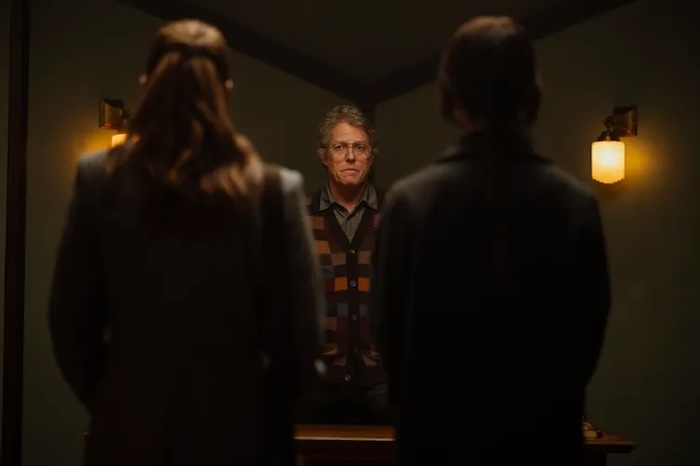
Hugh Grant further solidifies his post-rom-com resurgence as the extremely creepy Mr. Reed in this fairly intellectual horror movie that puts religious belief on trial. Though not particularly scary as modern-day horror movies go, there’s enough substance in the elaborate buildup of murderous pretense in the opening hour that the requisite reveals feel more earned than they probably would upon closer scrutiny. God knows the premise is half-baked. Mr. Reed lives in a dark, old house set back from the street in an unnamed American town, and he purposely invites representatives of the Church of Latter-day Saints to his lair to hear their proselytizing spiel. The church dispatches two fairly young women, Sister Barnes (Sophie Thatcher) and Sister Paxton (Chloe East), whose own relationship is going to be tested once things get hairy, but for the time being they are innocent enough to believe they might have a chance of bringing Mr. Reed around to Mormonism. But, seriously, girls, who proactively calls a religious organization to request a bid for being converted?

Predictably, it’s a dark and stormy afternoon when the women arrive at Mr. Reed’s door, where they confirm that his wife is around, since they’re not allowed to be alone with a man. He politely assures them that his spouse is in the kitchen baking blueberry pies, a ruse they believe because they can smell them. It’s not a spoiler to say that the wife never shows up because the writer-directors, Scott Beck and Bryan Woods, count on the viewer having more insight into human nature than the two Mormons do. The question thus becomes: What is Reed up to? Some stone horror buffs will likely become impatient with the debate that follows, since it’s predicated on Reed’s advantage in terms of having done his homework about the history of religious philosophy, as well as a solid grounding in logical argumentation, pursuits the two women, who are only grounded in dogma, have trouble keeping up with. Reed’s main thesis is that there are many “iterations” of monotheism, so why should one have more value than another if all have the same purpose, which is to lash the human mind to God’s will? Reed’s strongest assertion is that organized religion is simply a panicked reaction to the fear of death, which is hardly original, but Grant puts it across with fresh determination owing to his natural charm, which is undergirded by Mr. Reed’s increasingly convincing allusions, especially with regard to Mormonism’s built-in moral hypocrisy. According to interviews, Beck and Woods wanted Reed to represent the kind of confident atheism that has emerged on the left in the past few decades and then make it malevolent, and the idea works quite well. The initial smug liberal reaction is that these women, though naive, are getting righteously schooled, but as soon as Reed’s profusions turn harrowing—he clearly isn’t going to make it easy for the two women to leave the house—the viewer’s sympathies shift 180 degrees. 

And once that happens and Reed’s real intentions come to light, Barnes and Paxton have to work out for themselves how they’re going to get out of the house alive. The changing emotional dynamic between the two is more stimulating than the elaborate horror contrivances that the directors set in motion. Reed’s malevolence is never explained as anything more than the usual God-like prerogatives of the lonely, self-important male ego, and Grant can’t quite sell the character as the monster he’s meant to be. The two women are more interesting for the kinds of mental resources they have to tap in order to survive, and while that kind of difference may not be enough to satisfy a genuine horror buff, it’s compelling enough for a two-hour thriller that’s more brain than blood. 

Opens April 25 in Tokyo at Toho Cinemas Nihonbashi (050-6868-5060), Toho Cinemas Hibiya (050-6868-5068), Marunouchi Piccadilly (050-6875-0075), 109 Cinemas Premium Shinjuku (0570-060-109), Shinjuku Piccadilly (050-6861-3011), Toho Cinemas Shinjuku (050-6868-5063), Shibuya Humax Cinema (03-3462-2539), Toho Cinemas Roppongi Hills (050-6868-5024).

Heretic home page in Japanese

photo (c) 2024 Blueberry Pie LLC

Posted in Movies | Tagged , , , , | Leave a comment

Review: All Ears and Joika

For a communist country, the Peoples’ Republic of China produces relatively few non-documentary feature films that focus on work. The theme that has dominated post-Sixth Generation cinema is the personal and psychological costs of a social system that has been in turbulent flux since the economy was liberalized in the 1980s. Director Liu Jiayin’s bittersweet comedy All Ears follows this trend but seems more concerned with how a career defines one’s worth, and since reports claim that the movie is at least partially autobiographical, I paid close attention to how the protagonist approached the idea of creativity. Apparently, Liu, a respected filmmaker in China, hasn’t made a movie in some time, and it’s easy to glean from the spiritual self-examination that the central character, wannabe screenwriter Wen Shan (Hu Ge), undergoes over the course of the story that Liu has been questioning her purpose as an artist. 

Wen, who will turn 40 soon, has yet to have any of his scripts produced, though his old writing professor says he was his most promising student, even if the style and topics that matter most to Wen are not the kind of things that will interest TV producers. “You are good at realistic subjects,” says his teacher admiringly after lamenting how incurious his current crop of pupils are. The implication is that realism doesn’t sell. Nevertheless, Wen makes a pretty good living as a writer. He pens eulogies on a freelance basis, and through an established Beijing funeral home has garnered a reputation for moving, effective tributes. The recently bereaved seek him out. Wen’s methodology, however, often has an unsettling effect on his clients. A successful businessman hires Wen to write a eulogy for his father, and Wen spends an inordinate amount of time interviewing family members, including the client’s elementary school-age son, who is obviously neglected by his very busy parents. Wen’s eulogy tacitly contrasts this neglect with the how the client himself never really knew his father. If it seems a bridge too far for what Wen is being paid for, Liu suggests that this is how Wen justifies himself as a writer-for-hire. However, when this dedication to “truth,” as he calls it, is applied to another client, a restaurant owner whose brother has just died, a preliminary draft is read by the brothers’ sister who disagrees strongly with Wen’s assessment. The writer then finds himself in the middle of a family drama that has been simmering for years. Wen’s own life is ascetic and undramatic. His parents, who live far away, think he’s a successful TV writer, and he spends most of his free time tinkering with a script that he knows will never be seen by anyone. It takes the viewer a while to realize that his roommate, the affectless, seemingly unemployed Xiaoyin (We Lei), is one of Wen’s characters, a figure constantly in the process of being rewritten.

Liu’s humanistic bent can sometimes feel precious, especially when Wen is called upon to elaborate on his philosophy of life, which he does rather awkwardly with a woman who travels a great distance to argue about his depiction of a man she knew who committed suicide, even though they never met in person. But Liu also avoids the kind of sticky sentiments that this kind of material usually yields, particularly in Asian cinema. Nothing is solved in All Ears, but everything is laid out for easy inspection. 

The creative work of the titular character in Joika (titled The American in some markets) is exclusively physical, often brutal, and therein lies the drama. Based on the experiences of ballet dancer Joy Womack, the first American to ever be accepted at the Bolshoi Academy in Russia, the movie interprets the school’s infamous work ethic as xenophobia, though the way this conflict is framed by the director, James Napier Robertson, it’s often difficult to determine if Womack, as played by Talia Ryder, is a victim of the school’s anti-Yankee prejudices or her own self-doubt. The cruelty is at large in the academy but mainly personified by the fiercely sibilant chief instructor, Tatiyana Volkova (Diane Kruger). Womack claims that the persecution she receives is “not about ballet, but about politics,” as her obvious talent is considered second-rate to her Russian classmates’; the implication being that Volkova has to bend over backwards, literally, to deny that talent. In the end, of course, Womack makes it into the Bolshoi company, practically killing herself in the process, and even gets a chance to solo, which, if you know anything about the world of professional ballet, is almost impossible to achieve in any world class ballet company.

Joika romanticizes the physical and emotional struggle that’s expected of a great ballerina while neglecting whatever happiness the dancer might derive from that struggle. The name of the main character, who left the Bolshoi some time ago and was a consultant for the film, is sadly ironic since the movie exhibits almost no joy in its depiction of artistic endeavor. 

All Ears, in Mandarin, opens April 25 in Tokyo at Shinjukuu Musashinokan (03-3354-5670), Cine Switch Ginza (03-3561-0707).

Joika, in English and Russian, opens April 25 in Tokyo at Toho Cinemas Chanter Hibiya (050-6868-5001), Kino Cinema Shinjuku (03-5315-0978), Human Trust Cinema Shibuya (03-5468-5551).

All Ears home page in Japanese

Joika home page in Japanese

All Ears photo (c) Beijing Benchmark Pictures Co., Ltd.

Joika photo (c) Joika NZ Limited/Madants Sp. z o.o. 2023

Posted in Movies | Tagged , | Leave a comment

Media watch: Archive named for Korean independence fighter not appreciated by anyone

Yun Bong-gil

Movie distributor Kadokawa just announced that the Korean movie Harbin, which topped the South Korean box office for several weeks after it opened on Christmas Day, will be released theatrically in Japan on July 4, which is great news for the many fans of the movie’s star, Hyun Bin, who became an international heartthrob when he starred in the hit Netflix drama Crash Landing on You some years ago. It will not come as great news to Japan’s right wing stalwarts—or, then again, it might very well be great news since they seem to like nothing better than to drive their big Hinomaru-festooned trucks to the lairs of perceived enemies they can heckle with loudspeakers and patriotic war songs. In Harbin, Hyun Bin plays Ahn Jung-geun, an historically significant figure as a member of the anti-Japanese resistance just prior to Japan’s annexation of the Korean peninsula in 1910. The year before, Ahn assasinated Prime Minister and former Resident General of Korea Hirobumi Ito in the titular Chinese city, where Ito was meeting with the Russian finance minister to discuss the future of Korea. Ahn was captured and executed by the Japanese before being tried (he apparently had a way of evincing considerable sympathy from his jailers and thus had to be disposed of as quickly as possible). Consequently, Ahn is one of Korea’s national heroes, a status the movie plays up, while being described in Japan as a despicable terrorist, so you can be sure that when the film opens here those trucks will be out in force making it as difficult as possible for Hyun Bin’s fans to enjoy their idol’s performance. 

Coincidentally, another Korean independence martyr has been in the news lately, though you could be forgiven if you missed it. Yun Bong-gil was a resistance fighter during the colonial period who carried out a bombing at a park in Shanghai on the Japanese emperor’s birthday in 1932 that killed two Japanese officials and several civilians. Scholars say that Yun’s intention was to spark a war between Japan and China, a situation that came true later, though it’s difficult to blame or credit Yun for it. He was arrested almost immediately after the bombing, tried by a military court, and sentenced to death. Later that year he was executed in Kanazawa, Ishikawa Prefecture, because it was the Ishikawa Division of the Imperial Army that occupied Shanghai at the time. In 1992, a group of Japan-resident Koreans erected a monument to Yun on the spot where his remains were supposedly buried, so, like Ahn, he is considered a hero in Korea and a terrorist in Japan, which still refuses, officially at least, to acknowledge that its colonial rule of the peninsula was improper or brutal. 

Earlier this year, residents of Kanazawa learned that a “memorial archive” dedicated to Yun would open in their city. The organizer of the archive has no links to the city or to any Korean groups who operate in the vicinity. The man behind the archive is Kim Gwang-man, a former documentarian for KBS, one of South Korea’s public broadcasters, who lives in South Korea. In interviews with Korean media he says that the facility is not so much a memorial to Yun as it is a resource center for information about the Hokuriku region’s connections to Korea. However, the Yun name guarantees that it will attract attention from anyone who knows who he is, and so far none of those parties, regardless of which side of the political divide they stand on, want the archive to open on its scheduled launch date of April 29, which happens to be the 93rd anniversary of the Shanghai bombing, meaning it’s also the late Showa Emperor’s birthday. If Kim really didn’t want people to associate his project with Yun, then he couldn’t have picked a worse day to start it.

Continue reading
Posted in Uncategorized | Leave a comment