Review: The Maiden

This debut by Canadian director Graham Foy has been compared to the work of David Lynch, though it lacks Lynch’s sense of the absurd. The script, however, does feature metaphysical situations that may throw some viewers off since they are presented so matter-of-factly. The action centers on three high school students who mostly wander around the edges of their nascent suburban development. One of them, Kyle (Jackson Sluiter), leaves graffiti on train underpasses and the like—the title refers to his tag, which is never explained. Most of the time he’s accompanied by his quieter friend Colton (Marcel T. Jimenez). Their exploits don’t amount to much—skating, rummaging through houses under construction, swimming. At one point they find a dead cat and send it down the river on a small makeshift raft. Their conversations are naturalistic to the point of meaninglessness. They sound like things adolescent boys really say to each other.

Eventually, Kyle is removed from the proceedings, leaving Colton bereft, as if Kyle were the only person he knew. His mood turns caustic before leveling out with the passage of time, at which point Foy picks up the story with the third character, a very nervous girl named Whitney (Hayley Ness), who herself is left bereft when her own inseparable friend, June (Siena Yee), breaks up with her in a sudden way. Like Colton without Kyle, Hayley feels abandoned and, to a certain extent, betrayed. She works off her anger and fear by exploring the same landscapes we saw Colton and Kyle visiting in the first half of the movie. At one point we see a search party and posters on trees stating that Hayley is missing. As far as we’re concerned she isn’t, and then she stumbles upon Kyle and they form an alliance of the dispossessed.

The Maiden works best when you don’t think too carefully about it. Shot on grainy 16mm, it has a timeless quality that’s reinforced by the vintage cassette recorder that figures prominently in the exposition, not to mention the old songs that occasionally waft through the soundtrack. A second viewing might reveal more of Foy’s intentions—the typical teenage ennui on display seems to have a deeper meaning as the movie progresses, and when Kyle says to Whitney that “everyone thinks they’re lonely,” he sounds practically philosophical, whereas when he was talking to Colton in the first half of the film he sounded merely incoherent. What the three characters have in common is an artistic side that they mostly hide from their peers. Kyle’s tagging is a form of self-amusement, while Colton’s drawings and Hayley’s notebooks are the only means they have of coming to terms with feelings they don’t yet understand. The Maiden does a good job of expressing the inchoate longing of youth without presenting anything concrete. As you watch it you can’t help but recall your own wasted high school days. It evokes emotions that are so familiar they’re scary.  

Opens April 19 in Tokyo at Theater Image Forum Aoyama (03-5766-0114).

The Maiden home page in Japanese

photo (c) 2022 FF Films and Medium Density Fibreboard Films

Posted in Movies | Tagged | Leave a comment

Review: My Dearest Fu Bao

You have to hand it to China for its so-called panda diplomacy. Because everything about the animal is “rare and difficult,” according to a zookeeper quoted in this sentimental South Korean documentary, a certain delicacy is built into its process of loaning the animal to countries throughout the world. In 2016, China sent one male and one female panda to a Korean zoo for the purposes of mating, under the condition that any cub produced would be “sent back” to China when the offspring turned 4. This is the situation for all pandas loaned to foreign countries, and it’s been an exceptional PR boon for the People’s Republic because it suggests that the country does its best to prevent pandas from being exploited while also allowing the world to enjoy the unique charms of the animal, which are all tied into its uniformly adorable appearance and awkward behavior. A less remarked upon trait is the panda’s seeming ability to adapt readily to the conditions of confinement without manifesting outward signs of stress, something that other zoo animals tend to exhibit more obviously, even though, as the “rare and difficult” attribute implies, pandas are notoriously difficult to breed in captivity.

So when the two Korean loan pandas had a cub in 2020, it was huge news in Korea, since it was the first time in the country’s history that pandas in their care had produced a cub “naturally,” meaning without assisted reproductive procedures. Moreover, the female panda, named Fu Bao, arrived right in the middle of the COVID epidemic and thus provided palliative relief for the Korean public, who flocked to the Everland zoo in droves to observe the cub. This documentary thus has a built-in dramatic hook, because Fu Bao’s popularity just continued to grow as her time in Korea dwindled: Everyone knew that once she was 4 years old, she would go back to China. Everland’s breeder, Kang Chul-won, and keeper-in-charge, Song Yong-kuan, do most of the talking in the film, and the viewer only understands Fu Bao through their experience of tending to her as part of their jobs. In the end, we know a lot about these two men, including their family lives and personality tics, and very little about Fu Bao, or even pandas in general, which is odd because the two loan pandas subsequently give birth to twins, thus extending the miracle; though, for some reason, these two new additions aren’t half as beloved as Fu Bao, a fact that is mentioned but never explained. Maybe it’s because the movie was made for a specific cross-section of Koreans who would automatically understand the social dynamics at work, but in any event it isn’t interested in explaining panda behavior beyond the observation that the two loan pandas were “good parents,” whatever than means in panda lore. The animals’ special appeal to humans is taken for granted without the merest sop to empirical curiosity. “They are so much like a family,” says Kang at one point about Fu Bao, her parents, and her siblings, “because they all look alike.” Well…yeah.

The last third of the documentary is a slow, ponderous descent into maudlin anticipation as the date of Fu Bao’s departure approaches. In an especially cruel twist of serendipity, Kang’s 88-year-old mother dies two days before the removal, and the breeder decides to accompany the animal back to Sichuan while in full mourning. “Do what you have to do,” says his brother. From there it’s just one weepy montage after another, though through it all Fu Bao maintains her composure in typical panda fashion. Maybe that’s what really makes them so attractive: Nothing fazes them, even the over-zealous attention of smitten, well-meaning humans. 

In Korean. Opens April 18 in Tokyo at Toho Cinemas Nihonbashi (050-6868-5060), Human Trust Cinema Yurakucho (03-6259-8608), Shinjuku Musashinokan (03-3354-5670).

My Dearest Fu Bao home page in Japanese

photo (c) 2024 ACOMMZ and Everland Resort

Posted in Movies | Tagged , | Leave a comment

Review: Sing Sing

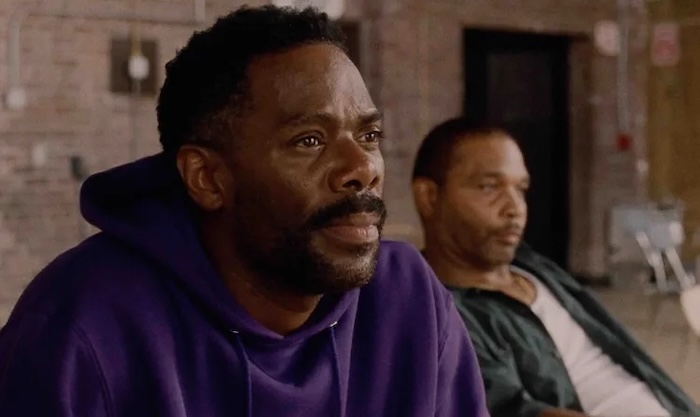
Certainly the most daring thing that director Greg Kwedar did in adapting an old magazine article about the titular prison’s Rehabilitation Through the Arts (RTA) program, which allows inmates to stage plays, is the way he disregards the crimes of his characters. Though we eventually learn that one of the protagonists, John “Divine G” Whitfield (Colman Domingo), is in for a murder his didn’t commit, it’s because he goes before a cynical parole board that seems to have already decided to refuse his bid. The other protagonist, Clarence “Divine Eye” Maclin, is in the slammer for dealing drugs and the kinds of mischief that comes with that occupation, but we know that mainly because in an early scene we watch him intimidate a fellow prisoner using methods he obviously cultivated in his business career. Maclin, like all the other RTA inmates depicted except Whitfield, plays himself, and is obviously much older than the figure described in the article, which was published in 2005; and because Kwedar wants us to understand these men’s situations primarily from the inside, he downplays that aspect of their lives that’s usually uppermost in the viewer’s mind when it comes to characters in a prison drama—what are they in for?

This decision is admirable since it helps remove stigma that would likely affect our appreciation of other qualities, but except for the two Divines, Kwedar doesn’t get as deeply into these characters as he should, so all we see is their attempts to make something of whatever thespian skills they’ve acquired. Whitfield, we also learn, is the only inmate with experience in theater and the literary arts in his background, and he relishes the chance to show off those skills every chance he gets in service to the program, which he practically runs. Maclin, an unabashed gangsta who happens to know lines from King Lear, eventually joins the troupe and challenges Whitfield’s prima donna status by auditioning for the lead in the next production, a science fiction musical written by the troupe’s outside director, Brent Buell (Paul Raci), at Maclin’s urging, since Maclin thinks the troupe should do a comedy for a change, thus subtly commandeering the RTA from under Whitfield’s nose. He even lands the part with the Hamlet soliloquy, which Whitfield has been rehearsing for ages in the hope that Shakespeare’s most famous tragedy would cycle in to the troupe’s repertoire (apparently, they just did A Midsummer Night’s Dream). Most of the film focuses on Whitfield swallowing his pride and helping Maclin with his role in Buell’s production and, along the way, coaching Maclin in preparation for his own parole hearing, which Whitfield rightly describes as being a performance. That Whitfield is using his own recollections of failure in this regard to help a fellow incarcerated individual gain his freedom is another admirable aspect that feels slightly off. Both Divines are men whose sentences have much to do with the fact that they are Black, even if one is innocent and the other self-admittedly guilty of the crimes they were sent up for, a salient matter that Kwedar doesn’t seem to want to address.

But the movie’s authenticity of spirit is quite moving and never short-changes the viewer’s intelligence. It’s often difficult to make sense of the two Divines’ motivations, not to mention the shambolic script of the play-within-the-movie. It’s enough that we can guess at what makes these men act, as well as “act,” the way they do through interactions whose main purpose is to expose their vulnerabilities. It’s often said that art will set you free, a platitude that has a starker meaning when applied to people in prison, and if Kwedar’s smart, frustrating movie proves anything, it’s that the impulse to be creative is foundationally human. 

Now playing in Tokyo at Toho Cinemas Chanter Hibiya (050-6868-5001), Shibuya Cine Quinto (03-3477-5905), Toho Cinemas Roppongi Hills (050-6868-5024), Kino Cinema Shinjuku (03-5315-0978), Toho Cinemas Nihonbashi (050-6868-5060).

Sing Sing home page in Japanese

photo (c) 2023 Divine Film, LLC

Posted in Movies | Tagged | Leave a comment

Review: Bridget Jones: Mad About the Boy

Though not my cup of tea, the first three installments of the Bridget Jones series made for pleasantly unforced entertainment, probably because the British have developed a better understanding than Hollywood has of what’s charming about romantic comedies, namely a playfully cynical approach to the sentiments involved. This attitude is compromised by the newest installment’s descent into sentiment for sentiment’s sake. I hope it’s not a spoiler to say that Mark Darcy (Colin Firth), who married our Bridget (Renee Zellweger) in the last movie, has died in the meantime, thus casting an undispellable pall over the proceedings, even when Hugh Grant, who himself returns from the dead as Darcy’s one-time rival for Bridget’s affections, does his insufferable but irresistible stupid cad thing to general hilarity in his brief scenes. Grant’s built-in cynicism is counteracted by the purport of his opening reintroduction, when his playboy character, Daniel Cleaver, breaks a date with a hot model so that he can babysit Bridget’s two young children, thus allowing her to enjoy a rare night out with her friends.

The dilemma posed by the movie is how Bridget can still act like the horny, frustrated, wise-cracking diarist everyone loves from Helen Fielding’s books when she’s a widowed mom with more “important” things to do, and the makers of this very careful franchise product seem to think they can have their cake and shag it, too. The movie’s through line is Bridget going back to work as a TV producer after a period of mourning and seeing her children grow to school age. Naturally, once the work angle is settled—she slides naturally back into her old bumblingly effective methods—love is next on the rebound menu, and the requisite meet-cute moment takes place in a London park when a hunky park attendant (Leo Woodall), who’s much younger than Bridget, rescues her and her two kids from a tree. The age gap is fodder for the bulk of the jokes in the middle part of the movie while Bridget’s guilt over whether she can afford a lively fling with this kid, who is definitely crazy about her, at the expense of any attention she should be directing toward her children. The title seems purposely ambiguous, since the “boy” could either refer to her son, Billy (Casper Knopf), who still misses his father terribly, and her new beau, who eventually “ghosts” her out of a sense of being inadequate to her needs. In the meantime, a more traditional rom-com relationship is forming between Bridget and one of Billy’s teachers, the flustered and over-serious Mr. Wallaker (Chiwetel Ejiofor), who in principle objects to Bridget’s parenting decisions, thus causing much comic friction between them.

In addition to Grant, other familiar faces make return trips to the series—Emma Thompson, Shirley Henderson, Sally Phillips, Gemma Jones, Jim Broadbent—to guarantee that the sentimental hogwash has a foundation in a community, which is not necessarily a blessing. It’s always been difficult to accept Bridget’s lack of self-esteem when she’s surrounded by so many people who love her deeply, including the men she sleeps with. I don’t have half as many friends as Bridget does and you don’t see me bitching to my diary about how inadequate my social life is.

Opens April 11 in Tokyo at Toho Cinemas Nihonbashi (050-6868-5060), Toho Cinemas Hibiya (050-6868-5068), Toho Cinemas Shinjuku (050-6868-5063), Toho Cinemas Roppongi Hills (050-6868-5024).

Bridget Jones: Mad About the Boy home page in Japanese

photo (c) 2024 Universal Studios, Studiocanal and Miramax/Jay Maidment

Posted in Movies | Tagged , , | 3 Comments

Review: I, the Executioner and In the Land of Saints and Sinners

Though I see a lot of Korean movies, I don’t know much about the situation surrounding Korean cinema outside of South Korea or Japan, but I think I understand why this successful sequel to the 2015 cop-action comedy Veteran did not retain its Korean title, Veteran 2, for overseas distribution, opting instead for I, the Executioner. Non-Korean audiences, even those who saw the original Veteran 10 years ago, may not be drawn to the idea of a sequel, though they may be attracted by the name of the director of both, Ryoo Seung-wan, one of Korea’s most reliable action filmmakers; so I, the Executioner could possibly entice a few people who have a passing interest in Korean action and are intrigued by the awkward title. But that’s not the only nationally contextual aspect of the movie that foreign audiences could miss. Like Veteran, the sequel features a popular Korean heartthrob cast counter-intuitively as the heavy, thus guaranteeting the huge box office that Veteran 2 achieved easily, sitting at the top of the Korean money-making list for 5 weeks last year. Besides those points, the movie offers little that’s distinctive.

Including lead actor Hwang Jung-min, who returns as detective Seo Do-cheol, a hotheaded old school cop with a core of moral fortitude, meaning, in the Korean sense, that he isn’t averse to beating up bad guys for information but it’s all in the service of saving innocent people. That core is challenged by a vigilante killer dubbed Haechi, who is dispatching criminals, usually murderers, who’ve been released from prison early due to lax judiciary standards or loopholes. As with many recent Korean genre blockbusters, internet culture is heavily represented in I, the Executioner by hordes of social media users cheering on Haechi’s fatal exploits while Seo and his crack team of goofballs, including new MMA-savvy recruit Sun-woo (Jung Hae-in), hunt him down. Much of the initial tension is derived from Seo being charged with preventing a particularly nasty parolee from getting lynched by the public or eliminated by Haechi, and you can pretty much predict the outcome of that assignment. Ryoo injects the requisite measure of social commentary regarding irresponsible social influencers and Korea’s notoriously cruel bullying culture into the mix, but his main concern is navigating a script that shifts drastically from one dangerous scenario to another without derailing the viewer’s train of comprehension.

Ryoo’s skills as an action director make all the difference. The first Veteran was famous for its elaborate fight scenes, especially the climax where Seo and his nemesis battle it out in the middle of a Seoul intersection after a spirited and extremely violent car chase. Here there are several set pieces that defy description, but the result is less satisfying because they seem divorced from the story. The initially interesting vigilante theme is replaced by a standard psycho-killer setup that seems designed to justify the mayhem for its own sake. Moreover, the very bankable Hwang, who has recently ventured outside his comfort zone into more challenging, complicated roles, falls back on his usual comic everyman persona with mixed results. The real veterans of I, the Executioner, Ryoo and Hwang, merely cruise on their reputations. 

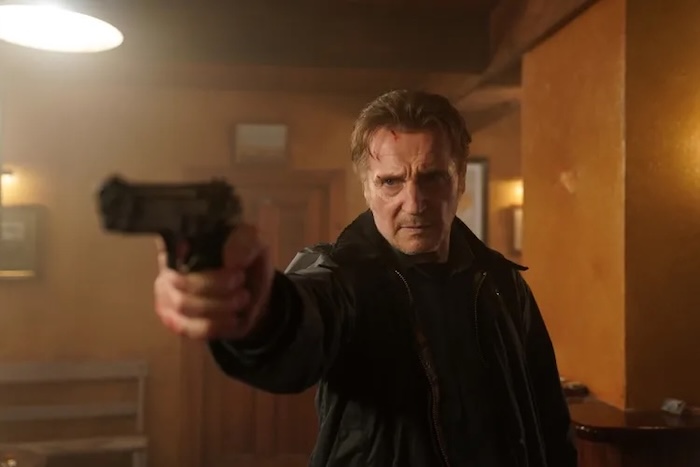
Liam Neeson’s fruitful second-wind career as an action star would seem to be the reverse of Hwang’s, since Neeson made his name initially as a “serious” actor in “serious” movies. Since then he’s been defined by the overdrawn Taken series (and its replicas), in which he played a former American intelligence maven using extreme methods to protect his family from evil internationalists. In the Land of Saints and Sinners carries this image back to Neeson’s native Ireland. He plays Finbar Murphy, a part-time executioner for a Donegal mobster (Colm Meany) in the early 70s. The story takes place as Murphy contemplates getting out of the whacking business to become a simple farmer (His cover is that of a second-hand book dealer, a conceit director Robert Lorenz plays for comic effect), plans that are put on hold by the Troubles going on in neighboring Northern Ireland, which spill over into Murphy’s bailiwick when IRA fugitives from a Belfast bombing-gone-wrong hide out on the property of a friend. 

The cast is a who’s who of Irish character actor royalty—Kerry Condon as the vicious leader of the IRA crew, Ciaran Hands as the clueless local Garda and Murphy’s best friend, Niamh Cusack as the middle aged neighbor on whom Murphy is sweet, and Jack Gleeson as Murphy’s over-enthusiastic wannabe replacement—and Lorenz gives them plenty to do within the rather narrow scope of the movie’s purview. In the end, he settles for standard action movie stuff, with shootouts in crowded places and ridiculously contrived standoffs. Since Neeson doesn’t have to contend with an American accent, he seems more relaxed than usual, but Murphy is pretty bland porridge compared to the more anxious characters he portrayed in previous action movies, which, granted, were often terrible, but not because of him. 

I, the Executioner, in Korean, opens April 11 in Tokyo at Kadokawa Cinemas Yurakucho (03-6268-0015), Shinjuku Piccadilly (050-6861-3011), Shibuya Cine Quinto (03-3477-5905).

In the Land of Saints and Sinners opens April 11 in Tokyo at Toho Cinemas Hibiya (050-6868-5068), Toho Cinemas Shinjuku (050-6868-5063), Toho Cinemas Nihonbashi (050-6868-5060).

I, the Executioner home page in Japanese

In the Land of Saints and Sinners home page in Japanese

I, the Executioner photo (c) 2024 CJ ENM Co., Ltd., Filmmakers R&K 

Posted in Movies | Tagged , , | Leave a comment

Media watch: Inmate testimony describes execution day horror show

Osaka Detention Center

Given the air of secrecy that has always surrounded Japan’s system of capital punishment, it’s still likely that many Japanese people are not aware of the methodology used to carry out an execution, even though it’s been revealed time and again by the media. The Asahi Shimbun reiterated the cold cruelty of the procedure with an exceptionally disturbing piece that appeared March 29, in which an inmate of the Osaka Detention Center described in detail what he saw and heard when guards came to collect a death row prisoner for his hanging. For those who are unaware, inmates awaiting capital punishment are not made aware of the date and time of their execution until the exact moment when detention center personnel open their cell doors to take them to the gallows. The kind of terror these prisoners live with on a day-to-day basis is difficult to imagine, and the testimony of this 36-year-old inmate, Takahiro Imanishi, whose cell was across the corridor from that of a condemned man, puts it into perspective without making it any less horrifying.

The narrative, as written down in Imanishi’s diary, gets very specific. At 7:30 am on Dec. 21, 2021, the wake-up chime sounded in the detention center. Imanishi dutifully got up, folded his futon, tidied his cell, washed his face, and waited for breakfast to be delivered. However, he noticed that the corridor outside his cell was “quieter than it usually was” at this hour of the morning. The silence was suddenly and violently shattered by the sound of the doors to the exercise yard being opened. Several guards entered, their footsteps echoing down the corridor. Looking out the small window of his cell, Imanishi fixed his gaze on a small plaque on the wall next to the door of a cell saying, “Do not open door while unaccompanied.” This plaque was next to all the cells that housed death row inmates, which numbered 7 or 8 at the time. 

Continue reading
Posted in Media | Tagged , | Leave a comment

Media watch: Nobody takes the evacuation plans for Sakishima seriously

Last week, the government released a plan to evacuate the residents of the Sakishima archipelago, which comprises the outlying islands of Okinawa Prefecture, in the event of a Chinese invasion of Taiwan. Since the U.S. has pledged to defend Taiwan against any such attack, Japan would be drawn into the conflict in accordance with the U.S.-Japan security agreement. Those Japanese islands geographically closest to Taiwan would likely be affected, so the government came up with a plan to move civilians from the region to mainland Japan.

Japanese media have reported these plans with an air of skepticism. Tokyo Shimbun‘s explanation, which appeared in its March 29 edition, included a comment that the scheme does not take into consideration the real situation surrounding the islands targeted for evacuation. 

The entire operation would endeavor to move about 120,000 people from the islands, including any tourists who happened to be present at the time, to 32 municipalities in 8 prefectures, 7 of which are on the island of Kyushu. The 55,000 residents of Miyako Island would be moved to 4 prefectures. Ishigaki’s 49,000 residents would go to 3 prefectures, including Yamaguchi on Honshu. The 4,000 people of Taketomi would be taken to Nakasaki; Yonaguni’s 1,600 people to Saga; and so on. All the evacuees would be flown to two airports, Kagoshima and Fukuoka, and from there bussed to the various municipalities that have been assigned to accept them. Some, such as those going to Yamaguchi, would use the Shinkansen part of the way. 

Continue reading
Posted in Media | Tagged , , | Leave a comment

Review: Tuesday

The debut feature by Croatian director Daina O. Pusić seems purposely designed to throw the viewer off-guard. A ratty CG parrot with wolf-like attributes encounters humans in various states of distress, after which the action cuts to an American woman named Zora (Julia Louis-Dreyfus) sitting impatiently in her nice London home waiting for someone—a young nurse (Leah Harvey), as it turns out. There’s another quick cut to a taxidermist’s shop where Zora tries to sell the proprietor a set of stuffed rats done up as Catholic bishops. What is going on here? Eventually, the action returns to the house and Zora’s bedridden teenage daughter Tuesday (Lola Petticrew), who we quickly learn is dying from some wasting disease after the parrot shows up and she realizes his purpose. “Please don’t kill me,” she pleads. “I must,” he replies in a guttural voice. 

Cinematic fantasies about confronting death are not uncommon, but Pusić’s approach feels almost improvisational. Louis-Dreyfus’s characteristically anxious comic effect masks Zora’s underlying despair, and Tuesday’s negotiations with Death the bird (voiced by Arinzé Kene) involve the cleaning of centuries of soot and grime from his feathers, the playing of Ice Cube’s “It Was a Good Day” (a song Death admits he has always liked), and the sharing of medical THC via vape cartridge. “I love sarcasm,” the bird says at one point after Tuesday makes a joke, and he grants her a brief delay from her descent into eternal nothingness, but only so that she can prepare her mother for it. By this point, the viewer has realized that Zora’s actions are all in the service of her full-on denial of Tuesday’s fate, and the movie becomes a kind of battle of wills regarding what it means to “let go.” Pusić maintains the surreal tone with magical bits showing an apocalypse taking place out in the real world, characters changing size for no discernible reason, and Zora herself becoming an angel of death upon acquiring the bird’s powers through literal ingestion. The random quality of these story details turns them into non sequiturs, making it difficult to grasp the director’s intentions, even when, in the end, Zora comes to terms with her own fears after Death tells her that the only afterlife for Tuesday is “in your memory.”

As someone who doesn’t believe in the afterlife, I found this pronouncement to be weak tea, especially after sitting through such fantastical audio-visual exertions. Perhaps the movie requires more than a single viewing to appreciate the odd allegorical richness of Pusić’s ideas, but they felt undercooked to me; which isn’t to say Tuesday isn’t moving. Louis-Dreyfus ably embodies the heartbreaking reality of Zora’s refusal to accept that her daughter is going to die very soon. “What am I without you?” she asks, and all the otherworldly stylistic inventions constructed by Pusić fall to the wayside in the light of Zora’s incomprehension. Louis-Dreyfus alone carries the terror and conviction that the movie struggles so hard to convey. 

Opens April 4 in Tokyo at Toho Cinemas Nihonbashi (050-6868-5060), Human Trust Cinema Yurakucho (03-6259-8608), Human Trust Cinema Shibuya (03-5468-5551).

Tuesday home page in Japanese

photo (c) Death on a Tuesday LLC/The British Film Institute/British Broadcasting Corporation 2024

Posted in Movies | Tagged , | Leave a comment

Review: Here

Robert Zemeckis’s career has been built on gimmicks, usually of the technical kind but also conceptual ones. Though most of the attention focused on his latest has to do with the extensive use of de-ageing/ageing AI software and the curious deployment of picture-within-picture devices for the purpose of scene changes, the main gimmick is promotional: Reassembling the cast and crew responsible for Zemeckis’s most famous project, Forrest Gump, on the occasion of its 30th anniversary, to once again celebrate American boomer exceptionalism as a historical given. The entire movie is set up to depict a certain space in the universe over the course of millennia, though the vast bulk of the film’s running time covers mid-20th century Pennsylvania, specifically the living room of a suburban house built in 1900 that is across the street from the original home of Benjamin Franklin’s illegitimate son, which has become a memorial. From this vantage point we sample the lives of the various families who occupied the living room over the course of a hundred years, including a budding aviator and his nervous wife, the randy couple who invented the La-Z-Boy recliner, a post-millennial Black couple and their son, and, most extensively, three generations of the Youngs: a WWII veteran, his frustrated artist son and put-upon wife, and the son’s own children, all living in the same house.

This last subplot stars Tom Hanks and Robin Wright as the second generation scions, Richard and Margaret, who are stuck in the house their entire married life with Richard’s parents, the alcoholic Al (Paul Bettany) and passive Rose (Kelly Reilly), due to post-60s economic stagnation. Though I haven’t read the graphic novel upon which Here was based, I would say Zemeckis missed a major opportunity to say something interestng and pointed about how Boomers were given all the resources and advantages to outperform the Greatest Generation and blew it by embracing capitalist consumerism in a death grip. Mostly what’s offered up are cliches—Richard abandons his draftsmanship talents for a career in insurance, Margaret crawls toward spiritual despair on having missed out on life (exemplified by “never seeing Paris”) because of her obligations as wife and mother—presented in a garishly theatrical way, complete with over-extended declamatory dialogue that is meant to carry all the way to the audience sitting up there in the top balcony. And because this main plot is punctuated with time-slipping asides to the other family stories over the century there’s no dramatic buildup. The hackneyed humdrum nature of the storytelling exacerbates the lack of flow, leaving only the technical flash to engage interest.

How much more engaging the movie might have been if the details, like the aviator wife’s involvement in the nascent sufragette movement, or the Black couple’s concern for their son’s welfare in a decidedly white environment, were elaborated upon, thus giving us more to chew on than the usual parade of pop music nostalgia and stumblings toward sexual awakening. I’m not necessarily one of those moviegoers whose memory of Forrest Gump is overwhelmed by revulsion, but Here makes the same miscalculations for the same tired reasons, and I wonder who still cares for this kind of showy but empty demonstration of cinematic wherewithal.

Opens April 4 in Tokyo at Toho Cinemas Nihonbashi (050-6868-5060), Toho Cinemas Hibiya (050-6868-5068), Toho Cinemas Shinjuku (050-6868-5063), Kino Cinema Shinjuku (03-5315-0978), Toho Cinemas Roppongi Hills (050-6868-5024).

Here home page in Japanese

photo (c) 2024 Miramax Distribution Services, LLC

Posted in Movies | Tagged , , , | Leave a comment

Media watch: Tokyo ward reminds citizens that they aren’t members of the royal family

We’re number one!

One of the peculiarites of Japan’s family registration (koseki) system is that a citizen can designate any address in the country as their main domicile, or honseki, regardless of where they actually live. A person’s residential address must be registered as such with the proper local government and indicated on the residence certificate, or juminhyo, but the koseki, which delineates one’s family relationships, isn’t so strict. Consequently, a significant number of Japanese people have designated Tokyo, Chiyoda Ward, Ichi-ban (number 1) as their honseki, because that is the address of the imperial palace. Of course, registering as such does not make one a member of the royal family, but, apparently, a lot of people like to dream, as it were.

According to Asahi Shimbun, this trend is becoming a problem for the bureaucrats of Chiyoda Ward. The number of people who live in the ward is about 68,000, but the number of Japanese people who have registered their honseki there is presently 210,000 and rising. Only about 3,000 people have registered the palace as their honseki, but for some reason Chiyoda Ward is the single most common jurisdiction in terms of honsekis nationwide. A lot of people also register Tokyo Station as their honseki, which is in Chiyoda Ward. 

The reason it’s a problem is that the koseki is needed for many procedures and transactions, which means the local government designated as the honseki of an individual must assist in these procedures and transactions—taking out insurance policies, applying for loans, registering at schools—by providing copies of the koseki and amending its attachment, the fuhyo. One of the basic functions of the koseki is registering one’s marriage, since those who enter into a marriage are, by definition, “leaving” their parents’ koseki and creating a new one with their partners, and that means choosing a honseki. Though most newlyweds use either their current address or their home town, others prefer something more exotic or romantic, and choose a famous place, like the palace or Tokyo Station. Though registrants are not required to give a reason for using a particular address as their honseki, Chiyoda Ward staff told Asahi that a lot of people who call to inquire about registering their honseki in Chiyoda Ward say that “it’s easier to remember.” 

The result has been a huge burden for Chiyoda Ward workers, who now handle on average about 30,000 koseki-related actions a year. These services cost money, which means that actual residents of Chiyoda Ward are paying, through their taxes, for procedures that benefit non-residents. The problem became so severe that last August the ward placed a notice prominently on its home page asking people not to use Chiyoda Ward as their honseki unless they actually lived there. The notice has no legal force. It is merely a desperate plea.

Someone who is new to the discussion will rightly ask: What is the purpose of the honseki if it doesn’t actually indicate the address of the registrant? The Asahi could not come up with a definitive answer. The honseki seems to confirm some sort of attachment to a place, which was more important in the past than it is now. After the juminhyo system was implemented in 1967 to administer public services through one’s local government, the honseki became merely symbolic, since most people only used it as a link to their past or heritage. That’s why Japan’s so-called untouchable class, the burakumin, are difficult to identify today, because the only indication of belonging to the class was one’s address—burakumin tended to be restricted to certain neighborhoods. It was the only aspect of their identity that made them burakumin other than their occupations. Nowadays, it’s almost impossible for someone without specific arcane knowledge to tell who supposedly or historically belongs to the burakumin class.

So why retain the honseki? Asahi doesn’t go that far, but likely the reason is force of habit; or, more precisely, the notion that dismantling any single component of the koseki undermines the rationale for the whole system. Proponents of the koseki see it as the perfect administrative embodiment of what makes Japan unique, and those elements which no longer have any meaning in the current social and cultural environment should nevertheless be kept so as to maintain that uniqueness. It’s why many people can’t countenance separate names for married couples. That would contradict the whole logic of a “family register.” 

We’ve even heard that some older people still list “Manchukuo” (the part of northeastern China that’s commonly referred to as Manchuria) as their honseki, since their families emigrated there before World War II, when it was briefly a colony of Japan, but it may be an urban legend. What we’re sure isn’t an urban legend is the intelligence there are still Japanese people who list the Russian-held “northern islands” off Hokkaido as their honseki, something we assume the government encourages since it keeps the dream that those islands still belong to Japan alive, albeit only in some people’s imaginations.

Posted in Media | Tagged , , | Leave a comment