Media Mix, April 29, 2012

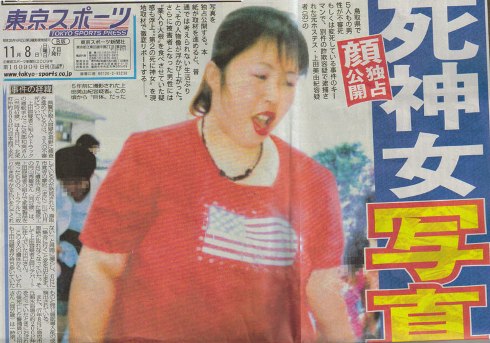
Tabloid calling Kijima "goddess of death"

Here’s this week’s Media Mix about the recent lay judge trial of Kanae Kijima, who was found guilty of murdering three men and sentenced to death. The piece focuses on the trial itself and NHK’s attempt to recreate what may have been going on in the lay judges’ minds during the proceedings in order to discuss the whole question of having non-professionals condemn people to death. NHK’s purpose was to understand whether or not capital cases are too much for non-professionals given the emotional burden of having someone’s life in your hands, though they skirted the larger question of whether or not prosecutions of capital crimes, not to mention the executions themselves, are carried out in a way that is appropriate to their gravity. As I pointed out in the first paragraph, owing to political realities the decision to hang is arbitrary, subject to the whim of whoever happens to be the justice minister at a given moment. But even sentencing is arbitrary, as pointed out by the Japan Bar Association, which says that if you’re going to have a team of judges decide on a person’s life, the decision should be unanimous.

Complicating these issues is the special nature of the Kijima case. As I mentioned, the media had already tried and convicted her before she was served a warrant for murder. They had used their own resources to look into her background once the police started investigating her connection to the deaths of two men who committed suicide using the exact same method and who were said to be her former lovers. This was just catnip to the tabloids and wide shows, which discovered a whole trail of lovers from whom she made her living, so to speak. The primary fascination of such a “black widow” case was intensified by a blatantly sexist position that asked how such a homely woman could possibly be this successful as a murderous golddigger. The circumstantial evidence presented by the media pointed to only one conclusion, that she killed at least three of her lovers because she was afraid that once she broke off their respective relationships they would ask her to return money they had paid her. Part of Kijima’s defense was that two of these men, the ones police first ruled as suicides (the third died accidentally in a fire), were so heartbroken that they killed themselves. In the context of how the media had already presented the case, this defense strategy sounded desperate at best, ludicrous at worst.

But the fact remains that the prosecution’s only evidence was circumstantial, and they had to surmise a motive since Kijima didn’t talk during interrogations. Though the sum total of this circumstantial evidence was certainly damning, it was difficult to separate the mostly speculative points the media has made and what the prosecution was allowed to present in court. Consequently, the prosecution’s case seemed mostly based on common sense, a highly problematic foundation on which to base a death sentence. In a way that no one found disconcerting, the prosecution used a metaphor to say that despite the lack of material evidence the judges should easily understand Kijima’s guilt: When you wake up in the morning and see snow on the ground where there was none the day before, you know for a fact that it snowed during the night. In other words, you know just by looking at what happened, and don’t really need anyone to prove it. Is that a valid legal argument?

Posted in Media | Tagged , , , | Leave a comment

May 2012 albums

Here are the albums reviews I wrote for the May issue of EL Magazine, which was distributed in Tokyo last Wednesday.

MDNA
-Madonna (Interscope/Universal)
Pink Friday: Roman Reloaded
-Nicki Minaj (Cash Money/Universal)
While it’s difficult to get worked up over yet another Madonna album purporting to be yet another reboot of image priorities, the stylistic uniformity that characterizes current chart-toppers provides the perfect environment in which to objectively appreciate any old geezer who endeavors to make a contribution. Madonna certainly qualifies, and she sounds her age, not because her voice has coarsened (it hasn’t) or her melodies have gone limp (they haven’t), but rather because her attempts at sounding edgy no longer provoke. If anything, the rough sentiments on the first two cuts, “Girls Gone Wild” and “Gang Bang,” come across as acting exercises rather than emotional abandon. But even if lines like “Drive bitch! And while you’re at it, die bitch!” are beyond silly, the minimalist disco track that frames them matches the over-heated performance in a way that compensates in full. Since signing her 360 deal with Live Nation, Madonna’s recorded output is now tied directly to her carefully calibrated concerts, and MDNA is as arena-ready as any nominally pop album has a right to be. Granted, there are no classic singles here. Even “Give Me All Your Luvin’,” the song that best mimics the stylistic uniformity mentioned above, doesn’t have the requisite hook, but it’s big and bold and contains multitudes, all of which make it the perfect live centerpiece. The aptly if somewhat anachronistically titled “Turn on the Radio” has a more potent beat and a snugger vocal line, which, in the great tradition of top 40 dance hits, obviates the need for a name singer. If Madonna seems to have shown up for this collection, it doesn’t diminish its infectious pop appeal, but, of course, you know that was her scheme all along. Speaking of schemes, Nicki Minaj, whose cameo on MDNA is worthy of its own Twitter hashtag, is believed to have the best of any pop artist of the moment: hard sexual content in service to a “really sweet girly-girl” aesthetic that allows for butt implants and a sartorial sense even an Akiba otaku would find shocking. Oh, and she’s a good rapper, too, as proven by her second bona fide album, which comes at the listener from two places: the slick dance music formulated on last year’s pretty great Pink Friday, and the loosey-goosey hip-hop of her mind-bending mixtapes. Having preferred the former for its more rigorous presentation, I never found her singing voice a disappointment, though on Roman Reloaded it isn’t given material that shows it off. So I can see what her rap boosters see: that in her peculiar element, she’s as crazy as Ol’ Dirty Bastard, and often just as funny, which is why the guests fall by the wayside like so many tin soldiers. “One thing that’s pop is my endorsement,” she yells on the title cut, a profession of her commercial ambitions. Like Madonna she intends to remain a star, and doesn’t mind telling you she’ll do anything. Continue reading

Posted in Music | Tagged , , , , , , , , , , , , , , , | Leave a comment

May 2012 movies

Here are the movie reviews I wrote for the May issue of EL Magazine, which is being distributed in Tokyo today.

Bad Teacher
The similarities between this poor-taste comedy and the more recent Young Adult are mostly circumstantial: glamorous box office star dares to play a disgusting character, son of famous comedy director directs, schlubby comic actor comes off more endearingly than nominally hot but clueless male lead. The Charlize Theron movie, however, leavened its black humor with some seriously trenchant character exploration, while Cameron Diaz’s turn as the titular junior high school educator, Elizabeth, doesn’t get much deeper than Glee. In order to land a presumably rich substitute teacher (Justin Timberlake) as a husband, Elizabeth stoops to everything, including blackmail, text-rigging, breast implants, and dirty tricks, but since no one except the unsexy phys ed teacher (Jason Segel) is anywhere near being a standup human, the audience hardly cares. Everyone deserves what they get. So in the end when Elizabeth receives her own requisite comeuppance its limp rectitude doesn’t even register. The protagonist in Young Adult was seriously disturbed, while Elizabeth is nothing more than a golddigger. Sorry, but we passed that point of credulousness long ago. (photo: Columbia Pictures) Continue reading

Posted in Movies | Tagged , , , , , , , , , , , , , , , , , , | Leave a comment

Levon Helm changed my life

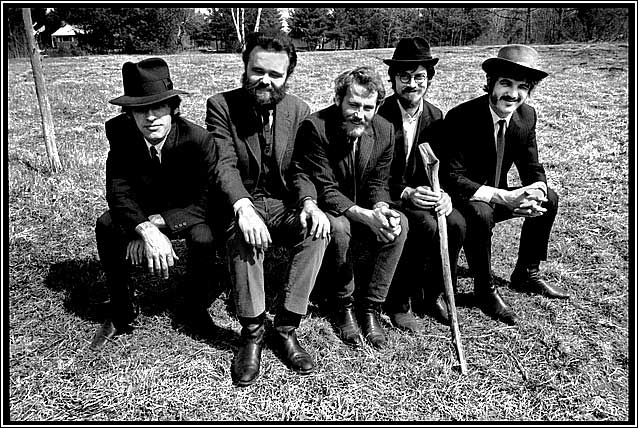
The Band was the first rock group I paid any close attention to. While growing up in the 1960s I was as obsessed with AM radio as any other white suburban American kid was; or maybe even more so. At the time music wasn’t really something that boys my age and in my socioeconomic milieu were supposed to be focused on. Most of them were more into baseball. I liked the Mets, but I loved the Supremes. In fact, I pretty much loved anything on Motown, having been mesmerized by the older black kids who hung out in front of my elementary school in the morning before class started, dancing to 45s. I would go to sleep at night with my transistor radio under my pillow, just loud enough to hear but low enough so my parents didn’t know. I would slowly turn the dial through the AM spectrum searching for Motown songs. I liked the Beatles, too, but by the time I was old enough to appreciate music on a visceral level they were ubiquitous. I couldn’t tell you why I preferred Motown. I just did. When Aretha Franklin’s “Respect” came out, I widened my obsession to soul music in general. Continue reading

Posted in Me, Music | Tagged , , , | 1 Comment

Media Mix, Apr. 8, 2012

If you don't pass it, I'll shoot myself

Here’s this week’s Media Mix, which is about the mainstream media’s general support for the government’s plan to double the consumption tax. I should point out that while this support is editorially pervasive it is not complete. The article I cite at the end, written by Masato Hara, adheres to the Asahi Shimbun’s stance but the paper will offer differing opinions depending on the writer and the subject. One recent essay, in fact, seems to challenge Hara’s position, pointing out that Minna no To (Your Party) has been publicly skeptical about the consumption tax plan simply because of Prime Minister Yoshihiko Noda’s avid declaration that his administration should work with the Ministry of Finance after the Democratic Party of Japan had pledged for years that it would not countenance an increase. Such a bold turnabout, without proper explanation, is suspicious, and the essay suggested that Noda had cut some sort of deal with the finance ministry before he became prime minister to push for the increase in exchange for support for the child allowance. If that’s true then the ministry seems to have reneged on its part of the deal. But the essay also expanded on Hara’s assertion that the finance ministry is the “guardian” of Japan’s economic well-being by saying that it, in fact, is the guardian of the whole central government bureaucracy, and thus their ultimate purpose is to pursue their own interests, presumably over those of the country as a whole. Of course, the DPJ’s main election promise was that the party would take control of the country away from the bureaucracy, which is why Minna no To, which has made the same pledge, is so critical of Noda’s intentions.

This morning, Gucci-san, who I also mentioned in the column, weighed in again on the consumption tax issue in his Aera column, saying he was “surprised” when he read Noda’s assertion in a published interview that the consumption tax was the “fairest” means of raising revenues. This is sarcasm. Gucci was not surprised at all, since Noda has been saying that for a while now. What he meant to drive home was the inherent unreliability of Noda’s logic. If Noda were completely honest, he would have said that the consumption tax is the “easiest” means of raising revenue, because the burden falls on those with less power to object, namely the young and the economically marginalized. That, Gucci says, is “clear.” Holding that the consumption tax is “fair” is like saying that “the earth is the center of the universe,” meaning it’s been empirically proved to be false for so long that saying it out loud is bound to evoke the surprise he felt when he read it the first time. More significantly, the nature of a consumption tax contradicts one of Noda’s justifications for it. The prime minister constantly says that we need a consumption tax to pay down the national debt because it’s irresponsible to leave such a debt to future generations. But since the tax penalizes young people now (no assets) more than older people (with savings), it’s already placing a burden on them, even before they “inherit” the debt. There have been a number of articles, especially in the U.S., that have argued whether the current recession exposes a class war or an inter-generational one. In Japan, the two are almost indistinguishable, but anyone, young or old, who is finding it difficult to make ends meet now will find it even more difficult when the consumption tax goes up. It’s the only thing that’s inherently “clear” about the issue.

Posted in Media | Tagged , , , , | Leave a comment

Media Mix, Apr. 1, 2012

Where's Matsui?

Here’s this week’s Media Mix, which is about the war of words going on between the Shimbuns Asahi and Yomiuri over a “scoop” Asahi ran in February concerning the Yomiuri Giants’ baseball team paying huge amounts of money for contract signing bonuses in violation of an agreement with other teams. The point is that all the other major media have decided to let these two heavyweights battle it out on their own and haven’t made as much of a peep either way, editorially speaking. Maybe it’s not worth it. I, for one, think that the Japanese media spends way too much time and resources on baseball, but that fact alone makes it strange that no one else has commented on the contretemps.

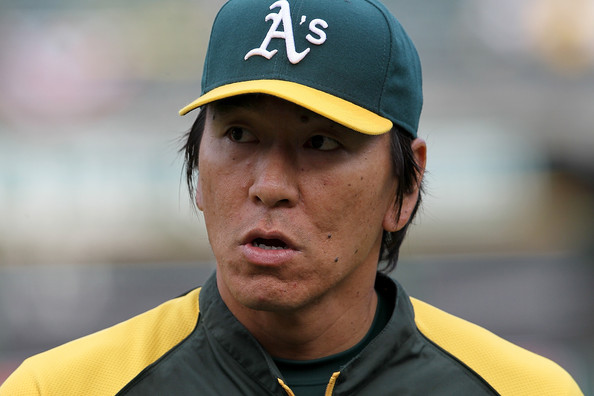
Another baseball-related matter that seems to have gone unremarked in the major media–or even in the minor media, for that matter–is Hideki Matsui’s disappearance. Of course, Matsui hasn’t literally disappeared, but ever since the Oakland Athletics dropped him at the end of last season he’s been conspicuously missing from the Japanese sports pages. From what I understand he’s waiting at his home in the U.S. for some team to call him up and offer him a place in their roster, a possibility that becomes slimmer the closer we get to opening day. Matsui’s a nice guy and has always cooperated with the Japanese media (certainly more so than Ichiro), so the only conceivable reason for the absence of Matsui-related news is that reporters don’t want to embarrass him. Though last week’s visit to Japan of the Seattle Mariners and the Athletics to open the MLB season officially was a huge p.r. success for everyone involved, one couldn’t help but think of Matsui. I don’t have any proof, but I’m pretty sure that when the deal was made to bring those two particular teams to Japan, they were chosen because they contained the two most famous active Japanese players in the majors (the two teams played each other for opening day 2011–does that normally happen two years in a row?); but since that deal was made the Athletics cut Matsui loose, which, of course, is their prerogative. I’m sure it was the dream of the Japanese side of the deal to see Matsui bat against his old team, the Giants. I wonder what his old boss, Tsuneo Watanabe, thought about this development. He’s not the kind of man who tends to stay silent when he doesn’t get his way, but this was something that was totally beyond his control.

Posted in Media | Tagged , , , , , | 1 Comment

Fountains of Wayne play to the choir

Yesterday I attended the first of Fountains of Wayne’s two-night stand at Ebisu Liquid Room in Tokyo. Though not sold out, the show was suitably packed to provide the sort of sweaty love-in the group tends to enjoy from its fans whenever they roll into town. Their species of power pop speaks to a slightly brainier, and, I imagine, older cohort in their native United States, which may explain why they didn’t become as popular a group as many people once expected them to be. But even in Japan, where this sort of music is catnip to a wider cross section of rock enthusiasts, FOW has never managed to attract anything beyond their core cult. I mean, this same week, My Morning Jacket, to me the very definition of a cult band, played up the road at the much larger Shibuya AX.

Still, what you get at an FOW concert here is a very intense sort of appreciation. It’s not just that everyone knows the songs backwards and forwards. They also have the choreography down, choreography that seems specific to Japan, since the band doesn’t partake or necessarily encourage it. The syncopated hand-clapping was particularly effective and may have encouraged Adam Schlesinger to invite three members of the audience to play percussion instruments with the band on “Hey Julie,” a gambit that was first met with strange reluctance: they practically had to drag the three volunteers on stage. If American FOW fans seems over-intellectual, Japanese FOW fans are shy by definition? I’d buy that but would need to see more empirical evidence.

So what does that make me? I’m American, and, to a certain extent, brainy. I mean, I’ve written about Fountains of Wayne many times in the past, usually from the standpoint of their tri-state world vision, which happens to dovetail with my own even if the two principal songwriters are 10-15 years my junior. I enjoy their shows because their tunes seem custom made for singalongs and just sound plain good in a live setting. They aren’t particularly avid showmen, unless you count guitarist Jody Porter’s stock of ax-wielding cliches and Keef-styled tobacco-puffing. Chris Collingwood remains an affable and even adorable frontman who, nevertheless, still isn’t completely comfortable with an audience he knows doesn’t understand English as well as they should to appreciate his lyrics. But they understand enough, and, in any case, the words mean a lot less in concert than the band’s patented “do-ya” and “uh-uhh-uh-uh” choruses, which everyone can sing.

So there’s no particular reason why the group has to play pretty much the same set list it has for the last decade. I admit my tastes are rarefied even within the FOW cult, but I think they’ve actually gotten better, material-wise, with each successive album; meaning their latest, Sky Full of Holes, is their best, as far as I’m concerned. Last summer, when I saw them at Fuji Rock, I was disappointed that they only played three songs from the record, but figured, well, it’s a festival and, besides, the record had only been out a week at the time. But they played almost the same set that they did at Fuji, and with only one other song from Sky. They didn’t even play my two favorite songs from the album.

I had thought such disappointments would fade as I became older, but I guess they don’t. In a sense, I think the group takes its position as entertainers a bit too seriously; not so much because they played their obvious “hits,” but because they believe that people like the older songs better. I don’t have much desire to hear “Survival Car” or “Leave the Biker” or “Radiation Vibe,” all from the first album and which the band treats as canonical material, the latter invariably the set closer, augmented by cleverly tossed-off snippets of influential power pop. (“Jet,” “Mad World,” etc.) When the band came back for the encore and played “Cemetery Guns” from Sky, which Collingwood described as a “sad song,” followed by the equally poignant “I95,” I was thrilled, because it promised something more deeply felt. One of the virtues of FOW’s songs, and one they rarely get credit for, is just how honest they come across emotionally. But it was a short-lived thrill, because they had to play “Stacy’s Mom.” I don’t want to second guess Collingwood and Schlesinger’s reasoning for choosing these songs, but cult bands should understand that anything they do is going to be acceptable, and obscure stuff may be even more appreciated. I just wish they had approached their excitable Tokyo fans as real friends rather than just another audience. They don’t need to be won over.

Posted in Me, Music | Tagged , , | Leave a comment

April 2012 albums

Here are the album reviews I wrote for the April 2012 issue of EL Magazine, which was distributed in Tokyo last weekend.

Wrecking Ball
-Bruce Springsteen (Sony)
Voice of Ages
-The Chieftains (Hear/Universal)
That Bruce Springsteen would make his latest claim for immortality with an album of songs addressing the current social atmosphere of gross economic inequality and cultural chauvinism seems hardly a reason for so many to pay such niggling close attention to the message on Wrecking Ball. We’ve been here many times before, and one could make a solid case that his entire reputation post-Born to Run has been built on his defense of the working-man ethic and ethos. What has changed over the past decade is Springsteen’s musical approach, which has moved away from the urban stylings of the radio pop he grew up on—let’s call it the Italian side of his heritage—toward the folkier stylings of the artists who had a more profound effect on his development as a political animal—let’s call it the Irish side of his heritage. So much of the material here has more in common with the boisterous instrumental power of The Seeger Sessions than anything he’s done with the E Street Band. Flogging Molly could cover “Easy Money” or “Death to My Hometown” without having to cut down on the beer. It fits the intellectual and emotional tenor of the songs, too, which splits the difference between hopelessness and an attitude that says you party til you drop, regardless of why you’re partying. Maybe this is an Irish stereotype, but Springsteen’s never been averse to using truisms or cliches to get his admirable points across. It’s what makes him both approachable and sturdy as an artist, if not as a superstar. Still, as powerful as these songs are sonically we’ve heard them before, even by others. We’ve also heard most of the songs on The Chieftains’ new material before, but that’s sort of their mission in life. As the most famous trad Irish group in the world, Paddy Moloney and Co. get away with rerecording a repertoire that’s been canonized to the point of religious piety because in many ways they’re the reason most non-Irish people know these songs at all. As with many of their albums, Voice of Ages is mostly the Cheiftains backing up a roster of well-known acts, which in this case represents the alternative indie crowd: Bon Iver, Pistol Annies, The Low Anthem, The Civil Wars. And while most of these artists avail themselves of the usual Irish airs and ballads, a few take the opportunity to stretch the theme. The Decemberists tackle Dylan’s “When the Ship Comes In” and the Carolina Chocolate Drops allow the Chieftains to enter their stylistic sanctum on “Pretty Little Girl.” The result is even more dilute than the usual Chieftains production, since they don’t sound like themselves on the non-Irish tunes and sound familiarly safe on the Irish ones. You have to wait until the closing 10-minute-plus “Chieftains Reunion” for their patented pub freakout. The only question is: Why didn’t Bruce get a shot at “The Banks of the Quay”? Continue reading

Posted in Music | Tagged , , , , , , , , , , , | Leave a comment

Media Mix, Mar. 25, 2012

"onee" talent Mitsu Mangrove

Here’s this week’s Media Mix, which is yet another discussion of how LGBT issues and people are covered in the media, TV in particular. My use of the American TV drama series Glee and a Japanese variety show featuring “onee talent” could be seen by some as comparing apples to oranges. On Glee, the gay character, Kurt, is bullied at school because of his sexual orientation and the fact that he doesn’t hide it. For dramatic purposes, Kurt’s homosexuality is his most salient characteristic, but the incorporation of Kurt’s gayness into the stories has to do less with how he handles it than with how others do. It places his situation in a social context, but as a character he is fully formed. Onee talent, on the other hand, only seem to exist in the rarefied world of show business. In other words, what makes them special as TV talent is never given a social context. Moreover, their appeal is based on a perception of incongruity, the fact that they were born male but act female; which isn’t to say their individual personalities don’t reveal themselves on television, but that isn’t why they’re there. (And explains why there are no female-to-male cognates for onee talent.)

The lesbian couple profiled on the NHK show, Heart TV, provides the social contrast to the article’s discussion of LGBT issues in Japanese media. The most immediate contrast is in visibility: onee talent are popular because they are highly noticeable. They want to be since they are, by definition, flamboyant, thus making them natural subjects for entertainment shows. But the vast majority of LGBT individuals are not entertainers, as Kanae Doi, the Japan representative of Human Rights Watch, recently wrote in an Asahi Shimbun editorial. Though viewers like onee talent, the average person sees them as something that only exists on TV, and Doi makes the assertion that the media in general avoids discussing LGBT issues unless they have something to do with a special event, such as a lesbian-gay film festival. Consequently, lesbians, gays, bisexuals, and transgenders will always be characterized in people’s minds as being outside of society, when in fact they are everywhere living lives that are the same as the “heterosexual majority.” Doi argues that social discrimination against LGBT people, as opposed to institutional discrimination, is similar in character to social discrimination against the poor, shut-ins, the disabled, and “foreigners” who were born and raised in Japan, since, like LGBT, these “minorities” are seen as existing on the margins of “normal society.” She believes the solution is for the media to address the “real lives” of LGBT, and I imagine she would approve of the NHK documentary. That said, it should also be noted that “the poor” are no longer (if, in fact, they ever were) a minority, but that may be something the media isn’t comfortable with covering either.

Posted in Media | Tagged , , , | 1 Comment

April 2012 movies

Here are the movie reviews I wrote for the April issue of EL Magazine, which will be distributed in Tokyo tomorrow.

The Artist
The general opinion about this Oscar-winning, French-produced homage to Hollywood is that it gets by on sincerity. Having barely survived the post-modern era of all-irony-all-the-time, the folks in Tinseltown were more than ready to embrace an entertainment that not only paid tribute to all those values they had forgotten, but did it in a way that didn’t make them feel cheap or put-upon. All this implies that The Artist has no substance, and while it’s true that everything it has to offer is on the surface, it’s a pretty crowded surface, especially when you’ve got a lead like Jean Dujardin, whose mugging as a Bond manque in director Michel Hazanavicius’s previous spy parodies turned out to be perfect training for his turn as silent movie star George Valentin, who wakes up every morning in his Beverly Hills mansion with a smile on his face, a spring in his step, and a nod of thanks to the huge portrait of himself in the hallway. Valentin’s self-regard isn’t offensive, though. He knows he’s lucky, but his talent is also apparent—the title is even less ironic than the movie. Dujardin plays this affable fellow with all the melodrama Valentin brings to his adventure films, and Berenice Bejo does the same as the chorus girl Peppy, whom Valentin impulsively kisses as she waits along the red carpet at one of his premieres, getting her picture in the paper. The next day, as she’s trying out for a job as an extra on Valentin’s new movie, he recognizes her, and they do a delightful dance that not only makes the scene but explicates the entertainer ethos of the day. Hazanavicius elaborates on this idea as he shows Valentin and Peppy doing multiple takes of a scene, each one unique, and instrumental in not only demonstrating the methodology of silent filmmaking, but developing the relationship between the two central characters. To make a long story short, when talkies arrive, Valentin can’t adapt and Peppy becomes a star in her own right. The actor’s downfall is not presented as his just desserts. He’s proud, but not heartless, and as he falls into destitution and depression, the melodrama is no less effective for being melodramatic—and silent. If only everybody else involved were as dedicated to the form as Dujardin and Bejo. The Americans—Penelope Ann Miller as Valentin’s icy wife, John Goodman as the practical-minded studio head, James Cromwell as Valentin’s faithful chauffeur—don’t go far enough with the caricature, and seem out-of-sync when they share the screen with the two French actors, or for that matter with Valentin’s hyperactive terrier. The hallmark of silent film technique was the way it exaggerated real life to make up for the lack of spoken dialogue, and when Dujardin flashes that incredible smile, you know he understands exactly what’s needed. (photo: La Petite Reine, Studio 37, La Classe Americaine, JD Prod., France 3 Cinema, Jurour Prod.) Continue reading

Posted in Movies | Tagged , , , , , , , , , , , , , , , , , | Leave a comment