Review: Four Daughters

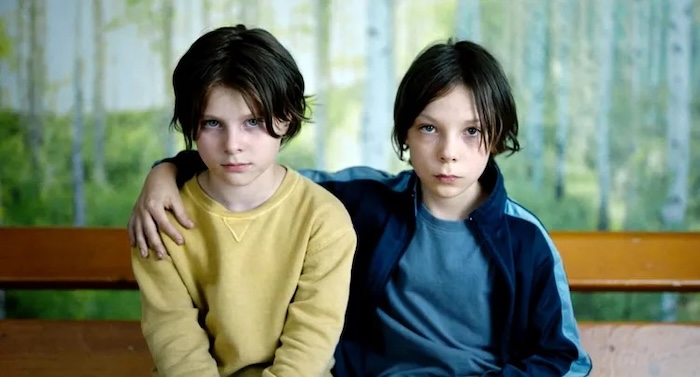
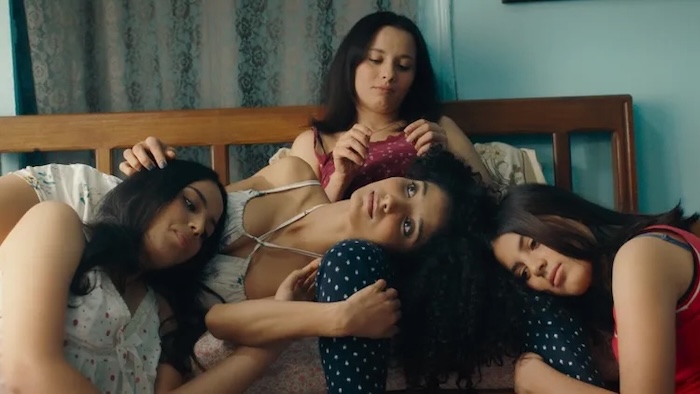
Because of its unconventional methodology, Tunisian director Kaouther Ben Hania’s movie about a family torn apart by religion, which won the best documentary prize at Cannes in 2023, doesn’t scan as a regular documentary, meaning one that’s chiefly invested in relating narrative truths about its subject. Ben Hania decided to use actors to play principals who were no longer available to contribute directly to the story she wants to tell. Specifically, two of the titular daughters of a woman named Olfa were “devoured by the wolf” about ten years ago, and in order to recreate scenes that are important to the story, Ben Hania hired actors to play their parts. In addition, she also hired an actor to play Olfa, who was very much involved in the production, during those times when the material became too emotionally overwhelming for her to play herself. But what ensues is not what you would call a “docudrama.” It’s more like an open-ended, ongoing therapy session that uses theatrical tools to explore how the toxic elements of a specific culture affects the psychology of some of its members, in this case women in the politically volatile environment of Tunisia during and after the Arab Spring, which started in Tunisia.

Even without the historical component, Olfa’s tale is worth hearing. As a Muslim woman and the daughter of a single mother, she was forced into an arranged marriage with an older man whose approach to sex was self-serving, to put it lightly. In the film’s reenactment of their wedding night, Olfa doubles as herself and her older sister, who intervenes to make Olfa understand that it is her duty to allow her new husband to rape her while relatives wait outside the bedroom for proof that she lost her virginity. Olfa resists in a way that is both horrifying and amusing. In fact, as the production progresses, much of the content that, on paper, comes across as tragic or appalling is accompanied by laughter when it is explained or recreated, because that is the only way for Olfa, her two younger daughters, Eya and Tayssir, and the actors playing her two older daughters, Rahma and Ghofrane, can get through events that were traumatizing. After the revolution that overthrew the secular, oppressive government in 2011, Tunisia was thrown into political turmoil while Rahma and Ghofrane traversed their adolescence, which was as fraught as it is for teenage girls anywhere in the world. They flirted with transgressive foreign fashion and music, and coarsened their language before embracing fundamental Islam. There’s a particularly intriguing sequence where the actors playing the two girls explore the style advantages of hijab and then niqab. Under the secular government, head coverings were banned, so in a sense Rahma’s and Ghofrane’s adoption of complete body coverings was as rebellious as were their passing infatuations with goth and punk. But through it all, Olfa, who had since divorced their father and discovered her latent sexuality with a former political prisoner-turned-carpenter, was at a loss as to how to raise her daughters and often resorted to violence out of frustration, even when it became apparent that her new boyfriend was coming on to them. The most powerful scene is probably the one where the actor playing the carpenter calls “cut” and walks off the set because he can’t countenance recreating an attempted rape of one of the daughters.

When the truth about what happened to Rhama and Ghofrane is revealed, it’s accompanied by Olfa, Eya, and Tayssir discussing how the shock of what the two older girls decided forced them to confront their own misguided decisions, as well as the culture that put them in these situations. It’s perhaps overstating one’s reaction to say that Four Daughters is, more than anything, an exploration of female enlightenment, but, to use a cliche, the journey of all the women on screen and, by implication, those behind the camera (men are obviously in the crew, but their insignificance in relation to the import of the tale is indicated by how openly the women talk about sex and bodily functions) during the recording, is manifestly obvious in how much it helps Olfa and her daughters understand what they went through thanks mainly to Ben Hania’s novel technique. That technique may only make sense as applied to these special circumstances, but it makes the movie equally enlightening for the viewer. 

In Arabic. Opens March 14 in Tokyo at Shinjuku Cinema Qualite (03-3352-5645), Human Trust Cinema Shibuya (03-5468-5551). 

Four Daughters home page in Japanese

photo (c) 2023 TANIT FILMS, CINETELEFILMS, TWENTY TWENTY VISION, RED SEA FILM FESTIVAL FOUNDATION, ZDF, JOUR2FÊTE

Posted in Movies | Tagged , | Leave a comment

Media watch: Does cancelled concert indicate Japan’s real intentions toward Kurdish refugees?

Saitama Kaikan

On Feb. 24, the Japan Kurdish Cultural Association (JKCA) was scheduled to hold a concert with a Kurdish singer at the Saitama Kaikan in Saitama Prefecture, but it was cancelled the day before. According to the Saitama Shimbun, the reason for the cancellation was that the singer, Seyda Perinçek, was refused entry to Japan at Narita Airport and had to fly back to Germany, where he lives. The immigration officer who dealt with the matter said that Perinçek did not have the proper visa. According to the JKCA, Perinçek and his entourage had gone to the Japanese embassy in Germany before leaving Germany and were told that he didn’t need a visa since he was a legal resident of Germany and anyone with German travel documents did not need a visa to enter Japan. 

The likely reason for the Narita immigration officer’s refusal to allow Perinçek entry is that, since he was coming to Japan in order to perform, he would have needed a special work visa, but the JKCA told the newspaper that Perinçek had been told by the Japanese embassy in Germany that he could travel to Japan for the purpose of singing at a concert, so it’s not clear what the problem was and who could be blamed for it. The association said it would look into the matter more fully.

The Perinçek affair was also covered in the Feb. 28 edition of the Sankei Shimbun, the conservative daily that has made a point of covering the “Kurdish problem” more thoroughly than other newspapers, usually in a way that looks negatively upon the Kurdish presence in Japan. Sankei said that the Perinçek matter was discussed during a lower house budget committee meeting the previous day, when the justice minister, Keisuke Suzuki, was asked by a lawmaker whose constituency is Kawaguchi in Saitama Prefecture, a city that contains a lot of Kurdish immigrants, if Perinçek had been refused entry because he didn’t have the proper visa. Suzuki said that was indeed the case, and the lawmaker then asked if some mistake had been made. Suzuki denied that there was anything improper about the immigration process for Perinçek. 

The lawmaker, Hideaki Takahashi of the Nippon Ishin Party, was not trying to put the ministry on the spot. On the contrary, he appeared to be fishing for an excuse to complain about the Kurds in his bailiwick, and used the occasion of the Perinçek matter to comment that the singer was a “member of the PKK, the Kurdish Labor Party,” which has been designated as a terrorist organization in Turkey. That’s why Perinçek defected to Germany. Takahashi said that Japan has good relations with Turkey, so is that the reason why Perinçek was denied entry? Suzuki replied that he was not at liberty to comment on “an individual case.” Takahashi later said that he hoped there would be “more questions about Kurds in Japan” during this Diet session, thus implying that more should be done about the so-called Kurdish problem. 

Continue reading
Posted in Media | Tagged | Leave a comment

Review: Wicked and Presence

In the end, any review of a movie adaptation of a popular Broadway musical must contend with diehard fans of the stage version, who will invariably love the film because it was most likely made with them in mind. Any reservations I might have about Wicked‘s basic story and the songs themselves are irrelevant, because I’ve never seen the musical performed on stage and, in fact, know almost nothing about it except that it is based on a novel that purports to be the origin story of the Wicked Witch of the West, and that at one time it was the longest running musical on Broadway. Some critics who are already fanboys or fangirls have griped about the length—the movie will be in two two-and-a-half hour parts, while the complete stage version is a little over two hours—without actually condemning it for it. I confess to having been swept up in the spectacle of it all without necessarily gaining a clear understanding of what it all means, but that may have less to do with the musical elements than with the fantasy ones, which more formally resemble Harry Potter than anything I took away from watching the original Wizard of Oz on TV every spring as a child.

The Potter affinity is right there in the setting, which for most of the action is Shiz University in the land of Oz, to which Elphaba (Cynthia Erivo), a social outcast as an adolescent due to the green hue of her skin, has matriculated in order to major in sorcery thanks to exceptional academic abilities, thus making all sorts of DEI connections in the minds of viewers who lived through the civil rights years. Naturally, she’s ostracized in her new surroundings, a situation she defies with admirable grit, and yet becomes friends with the most popular young woman on campus, Galinda (Ariana Grande), after an initial barrage of cold shoulders. Galinda is already a member of the elite, and comes with her own entourage (Bowen Yang, Bronwyn James), who provide much of the movie’s comic component with their effete fawning over this delicately wrought idol. Director John Chu, who also helmed the effective film adaptation of another Broadway musical, In the Heights, does a great job with the humor and the musical numbers—especially the choreography—but allows the plot development to bog down with sluggish pacing that, I assume, is a function of stretching the material into two parts. Nevertheless, the story gains traction on its overall anti-authoritarian theme by doubling down on a subplot having to do with disenfranchising the four-legged citizens of Oz through the systematic removal of their ability to speak, a cruel campaign that Elphaba, being an outsider as well as the sister of a disabled student, fights against. When she enlists Galinda in her crusade, the two become soulmates of a sort that will make their inevitable break all the more dramatic and heartbreaking. After all, we have to reach the point where the intelligent, righteous Elphaba becomes wicked and the comedy turns to tragedy.

In this context, much of the meta-material that refers to the lore of the stage version feels like so much padding to a neophyte like me, but I got the appeal, which feels almost bedrock, as if Chu and company decided that they didn’t need to pander to those of us who weren’t hip to the original’s charms because those charms were self-evident. I grew up attending Broadway musicals and listening to original cast albums of the classics, so it’s not as if I’m immune to those charms, but while I liked Stephen Schwartz’s and John Powell’s songs more than much of the post-Andrew Lloyd Webber stuff that’s dominated musicals in the past forty years, I didn’t leave the theater humming any tunes. But that may have more to do with lost youth than with the inherent quality of the songwriting or presentation. 

Steven Soderbergh’s latest indie curiosity is a fantasy of an entirely different stripe—a ghost story, but one that, initially, at least, pretends to be unconventional. Soderbergh dons his cinematographer hat in a big way by not only shooting the movie himself—something he often does anyway—but making the camera the central character, the ghost, as it were. And this ghost, or “presence,” as the title describes it so aptly, does manage to evoke a personality through the director’s imaginative use of space, movement, and, most interestingly, framing, which adopts a slightly skewed wide angle. 

The atmospheric effects of Soderbergh’s camera work are so intriguing, in fact, that the plot feels as if it’s just getting in the way. Veteran Hollywood screenwriter and sometime director David Koepp wrote the script, which demands attention. The haunted house is a beautiful old pile in a New Jersey suburb that is bought by a family of four, and much of the movie is given over to the Presence eavesdropping on blackout-structured conversations between various family members, the go-getting, ethically compromised executive career-track mother (Lucy Liu), the more laid-back and morally stringent father (Chris Sullivan), the bully-jock older son (Eddy Maday), and the sensitive, traumatized younger teenage daughter (Callina Liang). We quickly determine that the household is of two camps—mother-son versus father-daughter—and the conceit of observing these interactions from the POV of the Presence lends the storytelling an otherworldly quality that intensifies the drama. 

Things become more involving but less interesting when the story takes on the trappings of a thriller, as the son invites a friend into the home who soon has designs on the daughter. The girl, who is still recovering from the mysterious death of a friend, is the only person in the house who senses the Presence, thinking it may be the spirit of her friend, and in that state she’s susceptible to this adolescent intruder’s serpentine appeal. I thought the movie would explore more incisively the breakdown of a nuclear family, but it ends up as a mild horror story whose plot logic doesn’t stand up to close scrutiny. I liked it better when it was simply an exercise in creepy atmospherics. 

Wicked now playing in Tokyo at Toho Cinemas Nihonbashi (050-6868-5060), Toho Cinemas Hibiya (050-6868-5068), 109 Cinemas Premium Shinjuku (0570-060-109), Shinjuku Wald 9 (03-5369-4955), Shinjuku Piccadilly (050-6861-3011), Toho Cinemas Shinjuku (050-6868-5063), Toho Cinemas Shibuya (050-6868-5002), Toho Cinemas Roppongi Hills (050-6868-5024).

Presence now playing in Tokyo at Toho Cinemas Hibiya (050-6868-5068), Toho Cinemas Shinjuku (050-6868-5063), Human Trust Cinema Shibuya (03-5468-5551), Toho Cinemas Nihonbashi (050-6868-5060), Toho Cinemas Roppongi Hills (050-6868-5024).

Wicked home page in Japanese

Presence home page in Japanese

Wicked photo (c) Universal Studios

Presence photo (c) 2024 The Spectral Spirit Company

Posted in Movies | Tagged , , , , | Leave a comment

Review: Playground

Stories about bullying normally address the power dynamics that develop among children in a closed environment, with adults being out-of-the-loop because victimized children, by nature, resist exposing themselves as being seen as either weak or duplicitous toward their peers. In the Belgian film Playground (the French title translates as “A World,” which is more to the point), the adults get involved, complicating matters in ways that are predictable but no less disheartening, despite whatever good intentions they have. Since the director, Laura Wandel, keeps the POV at the level of her child actors, the adults are forever stooping to address them, and the effect is disorienting, because we see as a matter of course how the grownups don’t realize that their concern is making things worse, even though they surely would have understood it when they were children.

The protagonist is seven-year-old Nora (Maya Vanderbeque), who is tearfully starting her first year of elementary school and clinging to her slightly older brother, Abel (Günter Duret). Nora is awkward and easily intimidated. Socializing with her classmates becomes a painful process, even though most seem friendly enough. One even tries to teach her how to tie her shoelaces properly, a skill that her stay-at-home father apparently neglected to impart to her. Nora’s adjustment, however, is complicated by her observations of Abel’s social interactions in the titular recreational space, where he hangs out with older boys, some of whom abuse him verbally and physically. When she tries to find out why, he’s standoffish and defiant. Then one day, in a scene that Wandel shoots for maximum discomfort, Nora sees the boys dunking Abel’s head in a toilet, and later asks him why they are doing it. All he can say is, “Don’t tell anyone,” but, of course, she does, because her demeanor is immediately affected by the horror she felt, something her teacher has been trained to pick up on. Then her father is informed and he confronts the bullies, which makes matters even worse, not only for Abel, but for Nora, who is now labeled a snitch and ostracized by whatever friends she’s managed to make so far. (She’s also teased for having a dad who doesn’t seem to work) Nora’s and Abel’s studies suffer, and the attention just compounds their pain and confusion. “”What can we do to help you?” one teacher asks Nora, and the answer seems to be: Nothing, because the damage is already done. Abel himself is already turning into a bully.

Playground‘s fatalistic plot development may feel over-determined, as if Wandel wanted to make a point and then steered the story straight toward it; but her naturalistic tone, which mimics the up-close methodology of fellow Belgians, the Dardennes, brings the emotional pain these children feel right up to your face. It’s a confrontational approach that highlights the dead end a bullied child faces: Your mates are cruel and the adults who supposedly protect you can’t. The only solution is to somehow survive it, and the most hopeful sign—maybe the only hopeful sign—in this severely troubling movie is when Nora actively stops Abel from meting out his own cruelty. That takes courage and a rare kind of instinctive drive that you may find more in narrative fiction than in real life.

In French. Opens March 7 in Tokyo at Shinjuku Cinema Qualite (03-3352-5645), Cine Switch Ginza (03-3561-0707).

Playground home page in Japanese

photo (c) 2021 Dragons Films/Lunanime 

Posted in Music | Tagged | Leave a comment

Review: Devils and Because I Hate Korea

Oh Dae-hwan has attracted a huge fan base with his TV shows, in which he usually plays romantic leads. One especially popular historical drama presents him as a man masquerading convincingly as a woman. Given the protocols of Korean show biz, it’s difficult to say whose decision it was that he play a sadistic serial killer in this twisty police thriller, his or his agency’s, but if he doesn’t seem up to the task it may have more to do with the problems in the script than with his range as an actor. Jin-hyuk (Oh) leads a quartet of sickies who kidnap women and then record themselves torturing and killing their captives to post on the internet. Police detective Jae-hwan (Jang Dong-yoon) is desperately pursuing the case, as much out of revenge as out of justice, since his former partner and brother-in-law was savagely killed by Jin-hyuk. After an anonymous tip, Jae-hwan and his new partner, Min-sung (Jang Jae-ho), corner Jin-hyuk and engage in hot pursuit, with cop and criminal vanishing into a gorge on a forested mountain, leaving Min-sung alone. A concerted police search uncovers nothing, and then a month later a car crashes into police HG with Jae-hwan and Jin-hyuk inside.

When Jin-hyuk regains consciousness, he confides in Min-sung that he is really Jae-hwan in Jin-hyuk’s body, a farfetched claim that Min-sung partially confirms by observing Jae-hwan’s behavior, which is abnormal. The point from here on is: Who is who? In the larger scheme of things, the two men’s actions almost become interchangeable, since both resort to extreme violence to get what they want—Jin-hyuk the ineffable kicks of sadism, and Jae-hwan the justice that he believes can only be achieved through extralegal brutality, a trope that’s like mother’s milk to Korean crime-action films. Director Kim Jae-hoon fails to keep the wildness of the story within credible narrative bounds, and by the end motive and action have become more and more out of sync. Better acting might have helped here, since there is nothing distinctive in Oh’s performance as either Jin-hyuk or Jae-hwan that feels organic. And while the logic behind the body-swap plot point is clever, it isn’t sustainable once the two principals start revealing who they really are. The only consistency is the nastiness of the violence, with each torture scene becoming more and more outlandish. It goes without saying that the original victims, all young women, have no identity whatsoever and thus are impossible to get upset about. Devils is simply an exercise in visceral disgust at both gratuitous carnage and the kind of attitude that justifies it, and one that has absolutely no redeeming qualities. 

The disgust one feels toward the situation of protagonist Gye-na (Go Ah-sung) in the indie comedy Because I Hate Korea is of an entirely different strain. As the title suggests, Gye-na is getting out of Dodge because she’s tired of having to compromise her social and financial security for the sake of the general citizenry’s cultural stability. Already in her late 20s at the beginning of the film’s timeframe, Gye-na decides to leave Korea for New Zealand, where she hopes to reestablish herself as an expat, and from the get-go the viewer understands that she has no particular interest in New Zealand or its own culture (“Is that some kind of Maori thing?” she asks a native at one point regarding something she doesn’t get), but is simply reacting to her disappointment with life so far. The director, Jang Kun-jae, working from a novel by Chang Kang-myoung, clearly shows that much of Gye-na’s problem is personal, in that she’s bored with the full-time job she has in Korea, not to mention disillusioned with her boyfriend who, despite what looks like best intentions, isn’t what she considers life partner material. It’s a matter of temperament as well as temper, which she loses on a regular basis. 

The thing is, these emotional drawbacks cause similar problems in NZ, where she has to contend with the usual difficulties of expat life, such as securing decent housing, maintaining proper immigration status, and making sure you aren’t getting ripped off by racist employers. Inevitably, the only person she makes real friends with in the country is a fellow Korean who acts as if he’s embarrassed just knowing her. And when a native person betrays her big time the affront cuts especially deep, since it gets her into trouble with the law. Gye-na is not just cynical. She’s naive. 

All of this ironic melodrama is supposed to illustrate the current dilemma of aimlessness faced by young people in Korea, but the characters are so underdeveloped and the story so poorly constructed that you easily lose track of Gye-na’s trajectory of growth or lack thereof. The meandering quality of the movie, if anything, seems to mirror the protagonist’s own indecisiveness. Korean youth deserve better.

Devils, in Korean, opens March 7 in Tokyo at Shinjuku Piccadilly (050-6861-3011).

Because I Hate Korea, in Korean and English, opens March 7 in Tokyo at Human Trust Cinema Yurakucho (03-6259-8608), Shinjuku Musashinokan (03-3354-5670).

Devils home page in Japanese

Because I Hate Korea home page in Japanese

Devils photo (c) 2023 The Contents ON & Contents G

Because I Hate Korea photo (c) 2024 NK Contents and Mocushura Inc.

Posted in Movies | Leave a comment

Review: Music for Black Pigeons and The Gesuidouz

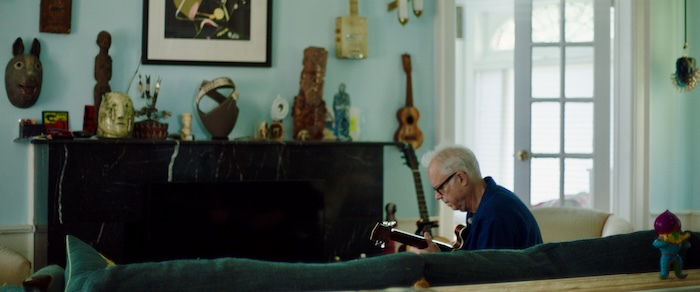
The weird thing about a lot of documentaries about musicians is that they tend to short change the music itself in that, unless they are actual concert films, they rarely showcase full songs. Jazz documentaries tend to be different since there is a feeling that you can’t possibly understand the players unless you understand what and how they play. This Danish documentary is loosely built around the community that has worked with jazz guitarist Jacob Bro over the past 15 years or so, mainly for the Scandinavian label ECM, whose purview extends beyond modern jazz to encompass contemporary classical, experimental, and so-called new age music. Essentially, the directors, Andreas Koefoed and Jorgen Leth, interview the various modern masters with whom Bro has played and have them describe their approach to improvising and composing, though what often emerges is their approach to life in general.

The late saxophone genius, Lee Konitz, for instance, sits in his Brooklyn apartment griping about how age has taken a toll on his reed work, conveying an irascible temperament that’s reflected in his playing. Guitarist Bill Frisell gives off a professorial vibe as he explains how he entered the jazz field through folk music. Though there are a few Black musicians interviewed, like saxophonist Mark Turner and drummer Andrew Cyrille, the lineup is mostly white male Americans and Europeans who approach jazz, as Turner puts it, “as a game.” Compositions are “puzzles” to be solved. In that regard, probably the most representative interviewee is bassist Thomas Morgan who refers to himself as a “nerd” and is meticulous about describing what he does though also quite incoherent. At one point, while trying to come up with an answer to a question, he falls silent for a full minute or two, a pregnant pause that Koefoed and Leth present in its entirety. Cyrille, fellow drummer Paul Motian (deceased), and saxophonist Joe Lovano testify for the old school jazz cat contingent with a jokey, in-crowd demeanor that basically says they just want to have a good time in the studio, an attitude that Mannfred Eicher, the owner of ECM, contradicts with his super-serious explanation of what exactly European jazz stands for. Like Morgan, he finds it almost impossible to put it into words, or, at least, English words. “I get too emotional,” he apologizes.

Jazz non-aficionados may glean little from Music for Black Pigeons (the title is a Konitz epigram and has no racial connotations), and even fans of this particular style of music may desire more. Bro, who is supposed to be the central personality of the film, commands less screen time than experimental Japanese percussionist Midori Takada. But the loose, carefree structure matches the music well. In the end, you may not have a deeper appreciation of European jazz, but you’ll feel you know these people pretty well.

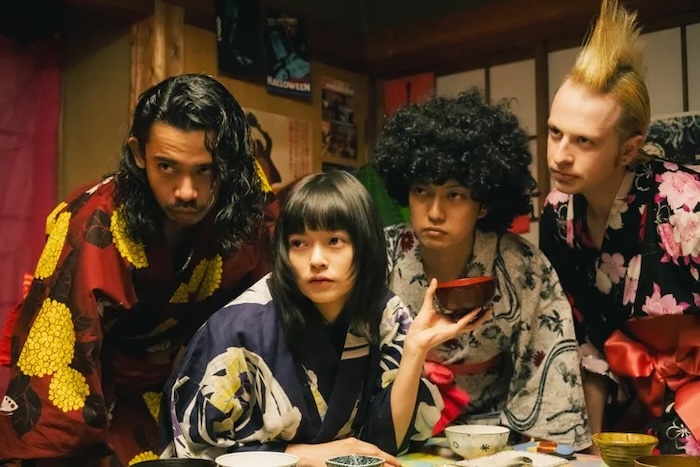
At the end of The Gesuidouz you may feel you know more than you’d like about the titular punk band, who, by definition of the genre, are terrible musicians and even worse social interacters. The lead singer and founder, Hanako (Natsuko), sums up the quartet’s mission by declaring she will be dead by the age of 27, “just like Jim Morrison and Kurt Cobain,” so she only has a year to whip her motley crew into a viable rock unit, which turns out to be more work than it’s worth—for the audience, that is.

Managed by a jerk (Yuya Endo) who is totally dismissive of their intentions, the Gesuidouz—whose name could translate as “The Sewage Systems,” though it seems to mean something else here—leave Tokyo and hole themselves up in a country farm house where they get their agriculture mojo working at the expense of any sort of musical cohesiveness. Obsessed with horror movie themes, they end up with songs that resonate internationally, though director Kenichi Ugana isn’t enough of a storyteller to put across exactly how that feat is accomplished. Similarly, there is much discussion about founding the Japanese equivalent of Glastonbury without explaining the point of such an ambition. 

Sentimental by fiat and incomprehensible by design, The Gesuidouz is slight to the point of insignificance, which, given Hanako’s death wish and punk’s general purport, feels almost like a betrayal. 

Music for Black Pigeons, in English, Danish and Japanese, now playing in Tokyo at Human Trust Cinema Shibuya (03-5468-5551).

The Gesuidouz, in Japanese, now playing in Tokyo at Theatre Shinjuku (03-3352-1846), Human Trust Cinema Shibuya (03-5468-5551).

Music for Black Pigeons home page in Japanese

The Gesuidouz home page in Japanese

Music for Black Pigeons photo (c) 2022 Rise and Shine World Sales UG/Disk Union Co., Ltd. 

The Gesuidouz photo (c) 2024 The Gesuidouz Seisaku Iinkai

Posted in Movies | Tagged , | Leave a comment

Review: Anora

What’s refreshing about Sean Baker’s movies isn’t so much their realistic take on the lives of sex workers and others who survive outside of what could be called polite society, but rather how those characters’ status informs their outlook in ways you wouldn’t expect. The contradictions are always compelling, whether it’s Red Rocket‘s former porn star protagonist’s reductive and self-serving sexism or The Florida Project‘s apartment building manager who looks out more for his tenants than he does for the interests of his boss. The titular character of Anora is a 23-year-old New York stripper (Mikey Madison) whose spiky self-confidence is exemplified by her relatively gung-ho approach to sleeping with customers for cash. She isn’t naive, as evidenced by how cavalierly she gets away with defying her employer, but she isn’t jaded either, and when she’s swept off her feet by Ivan (Mark Eydelshteyn), the even younger son of a wealthy Russian oligarch, she can tell where this sort of fling might end up. She wants to improve her life, and marrying this heavily accented puppy would do the trick. Besides, she likes the guy, though God knows why.

As it happens, Ani, as she’s known to her friends, speaks Russian, so she already has a pretty good cultural inkling of what Ivan’s father will think when he finds out his son has eloped with a person he is likely to assume is a gold digger. By that time, Ani is already installed in Ivan’s palatial Brooklyn digs, living the life of Riley. It makes perfect sense that the wedding, in fact, takes place in Vegas during a whirlwind weekend courtesy of dad’s private jet. At one point the audience is clued in that maybe Ivan is simply after a green card, but he’s such an effusive child that you can’t believe he’s capable of such subtle subterfuge and, besides, if the marriage is transactional at all, Ani’s the one who’s got the better end of the deal. On the other hand, Ivan is pretty immature, and his resolve seems less than solid, so when dad sends a team to annul the match it’s Ani who has to stand up for her and Ivan’s connubial rights. In fact, she has to do it alone, because Ivan chickens out and disappears, leaving Ani in the clutches of Dad’s fixer (Karren Karagulian) and two ineffectual goons, Igor (Yura Borisov) and Garnick (Vache Tovmasyan). 

Though all of Baker’s movies could be called comedies, Anora is the only one that evinces actual belly laughs, as the Russian contingent confronts wild cat Ani and finds that cancelling the marriage isn’t going to be that easy. While Igor and Garnick search for Ivan with the resistant Ani in tow, the three form a kind of triumvirate of outsider sensibility, with Igor falling hard for his feisty charge while she makes his life hell in return. This is classic screwball romantic comedy fare with a vibe that’s up-to-the-minute, and if it doesn’t quite hit as powerfully as The Florida Project or Tangerine, it’s fully entertaining without being pandering. Baker seems to be going a bit lite here, but Anora nevertheless adheres to his usual ethical priorities. 

In English and Russian. Now playing in Tokyo at Shinjuku Piccadilly (050-6861-3011), Toho Cinemas Chanter Hibiya (050-6868-5001), Shibuya Cine Quinto (03-3477-5905), Toho Cinemas Roppongi Hills (050-6868-5024).

Anora home page in Japanese

photo (c) 2024 Focus Features LLC

Posted in Movies | Tagged , , | Leave a comment

Review: Revolver and Project Silence

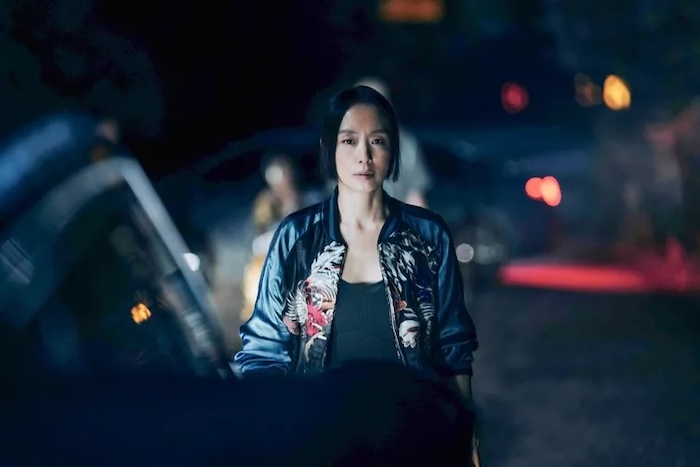
Korean cinema’s special facility with genre movies has allowed it to veer from reliable formulas even while exploiting those formulas to the max. Revolver is a shakily plotted crime noir that sticks so resolutely to a single idea that it’s almost a parody of a crime noir, though not quite up to the Coens in terms of wry bite. The great Jeon Do-yeon, who won a Best Actor prize at Cannes for the stultifyingly depressing Secret Sunshine, seemingly works against type as Soo-yeong, a former police detective who is just finishing a 2-year prison term for bribery. We soon learn that Soo-yeong wasn’t the only cop involved in the corruption, but she’s the only one who got time, having taken the fall for her colleagues with the assurance that she’d be compensated for her sacrifice in the end. Once she’s out she expects to get paid, not only in large amounts of cash, but a nice apartment in Seoul. Consistent with the formula, she gets stiffed: No one meets her at the prison gate; no one contacts her later; and the person who was supposed to arrange all these things, she soon learns, has been killed under suspicious circumstances.

A good portion of director Oh Seung-wook’s film is spent renavigating the original crime that sent Soo-yeong up the river, an approach that often makes it difficult to follow the story, but in a sense that isn’t Oh’s purpose. He’s more interested in the mood and atmosphere of the various set pieces, which eschew flashy action for ironic, clever dialogue and head-spinning reversals of expectations. Jeon brings a deliciously dry fatalism to the proceedings. Soo-yeong is damaged goods right from the beginning, and she doesn’t pretend to have been rehabiliated by her stretch in the slammer. If anything, she’s more determined than ever to get what she believes she deserves, and doesn’t mind risking her life for it because, in this world of everyday treachery, she knows she’s right and knows her enemies know she’s right. So even if you don’t always get the motivation behind specific actions and how certain characters fit into the puzzle, the main impetus—Soo-yeong’s single-minded determination to get what’s owed her—keeps things interesting. 

It helps enormously that the jerks she’s up against are a peculiarly depraved lot, and when she dispatches them (or, just as often, they end up dispatching themselves) the satisfaction factor is more thrilling than it usually is in these situations. And while Jeon’s predecessors in this kind of comic noir exercise are invariably male, she pulls off the stunt without sacrificing any of Soo-yeong’s feminine wiles. She even seems to be an inspiration for the other damaged goods that populate the movie, an exemplary model of female self-possession.

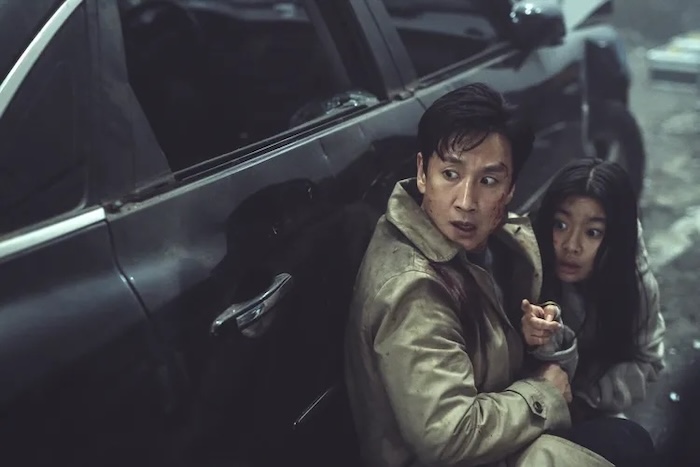
The box office hit Project Silence is a disaster flick, a genre that Korean cinema has been poking at for a good while with limited success. Usually, Korean disaster movies go long on the special effects, and here they don’t always work visually, though viscerally they bring the noise, mainly because Korea is excellent when it comes to vehicular mayhem and the disaster depicted is a huge fog-generated pileup on a long, high suspension bridge that starts to buckle from a perfect combination of fiery conflagration and mass overload. The scene where cars carom into one another and tractor trailers jackknife and slide along the pavement is a terrifying wonder to behold, but as Daffy Duck once said about a neat bit of gasoline-fueled stage entertainment he could perform, you can only do it once. Here, you also have to deal with the story.

Which in the case of Project Silence is way too busy. The late Lee Sun-kyun plays Jung-won, a factotum for the South Korean security minister, who happens to be running for president. Jung-won is also a single father, who is driving his reluctant daughter to the airport to study overseas when the above-mentioned pileup occurs. At the same time, a pack of mutant dogs is being transported across the bridge in order to be disposed of, and they get loose and start terrorizing the survivors of the accident, trapped between the burning tractor trailer at one end and the part of the bridge that threatens to fall into the sea at the other. As with all disaster flicks, the survivors represent a cross-section of hoi polloi, and several get picked off as they act either valiantly or selfishly. Adding to the suspense, it turns out the dogs are part of some kind of government anti-terrorism project that went awry and which Jung-won’s boss approved, so he has to keep a lid on the matter to avoid it leaking to the press.

Plausability is not a requirement for disaster movies, but character motivation needs to be a lot sharper than it is here. Popular leading man Ju Ji-hoon plays way against type as the film’s comic relief, a long-haired, disoriented tow truck driver with a proclivity for larceny that seems to be incited by the mayhem. The only characters who make consistent sense are the dogs, but that’s probably because they’re 100% computer-generated.

Revolver, in Korean, opens Feb. 28 in Tokyo at Toho Cinemas Nihonbashi (050-6868-5060), Toho Cinemas Hibiya (050-6868-5068), Toho Cinemas Shinjuku (050-6868-5063).

Project Silence, in Korean, opens Feb. 28 in Tokyo at Kadokawa Cinema Yurakucho (03-6268-0015), Shinjuku Wald 9 (03-5369-4955), Human Trust Cinema Shibuya (03-5468-5551).

Revolver home page in Japanese

Project Silence home page in Japanese

Revolver photo (c) 2024 Plus M Entertainment, Sanai Pictures and Story Rooftop

Project Silence photo (c) 2024 CJ ENM Co., Ltd., CJ ENM Studios Blaad Studios

Posted in Movies | Tagged , | Leave a comment

Review: Tatami

As political thrillers go, Tatami represents for multiple national purviews just as a film project. It’s a U.S.-Georgia co-production because most of the money was raised by Americans (one of whom is Israeli-American) and the movie was shot and set in Georgia; and it’s co-directed by an Israeli, Guy Nattiv, and an Iranian, Zar Amir-Ebrahimi, who is also one of the main actors. Given that Israel and Iran are well-known nemeses on the world stage, one might be surprised, but the purport of the film is solidly critical of the current Iranian regime (its take on Israeli government belligerence is harder to suss). Amir-Ebrahimi, it should be noted, doesn’t live in Iran any more. Still, what the various sides bring to the production, in addition to a grounded American cinematic sensibility, is invaluable because of the dynamics on display. Genre-wise, Tatami is as much a sports movie as it is a political thriller, but transcends cliches endemic to both. More importantly, it’s relentlessly gripping, and the directors and the actors know exactly how to ratchet up the tension when the script calls for it.

Set at the World Judo Championships in Tbilisi, the movie zeroes in on the great female hope of Iran, Leila Hosseini (Arienne Mandi), who is competing in the 60-kg weight class. Headstrong and totally committed, Leila at first comes across as the stereotypical athletic obsessive. When she weighs in and is found to be 0.3 kg over she sweats it off in 20 minutes. Leila methodically works her way up in the preliminaries to cheers back home from family and fellow countrymen with the help of her coach, Maryam (Amir-Ebrahimi), a former judoka herself whose career was ended by a mysterious injury. During these opening scenes, the directors, with the help of real professional judo announcers, keep the sports movie prerogatives central with closeups of the action on the mats, but once Leila reaches a certain level it becomes apparent that she will likely have to face an Israeli rival—who happens to be her friend—something the government back in Iran does not want to happen. And so, through Maryam, they order Leila to feign an injury or throw any of her bouts before the Israeli one. She refuses, risking retribution against her family and her coach, who tries to forestall retribution by threatening to disown her. Though the standoff is mainly depicted as being between Leila and Maryam, the various layers of interested persons are handled with an almost ferocious attention to detail, as the story shifts among Leila’s husband and child in Iran, the various under-table negotiations Leila conducts with competition officials, and Maryam’s complex coming-to-terms with her own sad history, which we soon find out mirrors Leila’s current dilemma.

Even as the drama flags a bit just before the big finish, it’s still heart-pounding stuff thanks to a welcome avoidance of emotional distractions and an unobstructed view of the consciences of everyone involved. We’ve had plenty of movies that effectively stick it to the Islamic Republic of Iran, and this one is not designed to change anyone’s mind in a political sense. It’s just an exciting movie that uses politics as a big spoon to stir the pot so that its contents boil even more furiously. 

In Persian and English. Opens Feb. 28 in Tokyo at Shinjuku Piccadilly (050-6861-3011), Human Trust Cinema Yurakucho (03-6259-8608), Theater Image Forum Aoyama (03-5766-0114).

Tatami home page in Japanese

photo (c) 2023 Judo Production LLC

Posted in Movies | Tagged | Leave a comment

Media watch: All public toilets are not created equal

Inbound tourists invariably rave about Japan’s superior security and hospitality, and while you often hear them comment positively about smart toilets, it’s usually in the context of how surprisingly common they are. However, we’ve almost never heard anyone talk about public restrooms, which are convenient, clean, and plentiful in Japan, unlike in, say, the U.S., where they are almost impossible to find—and when you do they’re probably filthy.  We’ve known Japanese people who say they don’t like to visit the U.S. any more because relieving oneself when out and about is such a desperate chore. That’s never a problem in Japan.

But that doesn’t mean Japanese public toilets are perfect; or, at least, they’re not perfect for half the population. If you’re female, often you will have to stand in line for an empty stall in a public restroom if you’re in a busy place, and women and girls seem to take this inconvenience in stride. But if you think carefully about it, why is it that women have to wait and men usually don’t? 

A recent two-part feature in the Asahi Shimbun addressed this problem through the experience of a Tokyo notary public, Manami Momose, who researched the matter on her own. Several years ago, Momose was in JR Kurashiki Station when she desperately needed to relieve herself, and had to wait 5 minutes for a ladies room stall. When she emerged, she checked the floor plan diagram, which many public facilities post on the wall outside their rest rooms, and compared the gentlemen’s to the ladies’. She was shocked to find that the men’s room had 4 urinals and 3 stalls, while the women’s room had 4 stalls, a 7:4 ratio. Given the difference between male and female physiologies, not to mention gender-specific grooming habits and apparel choice—for the most part, women have more arranging to do before and after using the toilet—it’s easy to see why women might take more time in the rest room than men do, but why the discrepancy in facilities? Sure, women can’t use urinals, which take up less space than stalls, but why do men get more places to pee than women do?

With these questions in mind, Momose carried out a survey of public toilets throughout Japan, visiting railway stations, subways, airports, concert halls, retail spaces, parks, what have you, and what she found was startling. Of the 706 places she studied, 90 percent had more toilets in the men’s rest room—meaning urinals and stalls—than the women’s room did. And it was pretty consistent regardless of the type of place. For instance, Momose thought that in retail spaces like department stores there would be more toilets for women, since she imagines there are more female patrons, but, no: men still had access to more devices for relieving themselves. In fact, in many places men even had access to more stalls than women did, a situation she found “perverse.” 

She started publicizing her findings on social media, and received a lot of feedback from women who shared her outrage. She posted diagrams of rest room floor plans on X, pointing out that in almost all cases the floor area was the same for women’s rest rooms as it was for men’s. As already mentioned, urinals take up less space than stalls, so of course the people who designed these rest rooms could fit more toilet devices in the men’s room, but why didn’t they just make the women’s room larger? It’s a classic case of equality-versus-equity: same space for men and women, but not the same accessibility.

Continue reading
Posted in Media | Tagged , | Leave a comment