Japanese filmmaker Akane Yamada makes movies about domestic animals, often those caught up in disaster situations. She did one about the pets that were abandoned or otherwise unhoused following the Tohoku earthquake of 2011, and apparently received pushback from people who thought that she should be focusing on the human victims of the tragedy. Some will undoubtedly say the same thing about her latest doc, which uses the Russian invasion of Ukraine as a jumping off point to talk about animals during wartime. The point would seem to be that there is really no shortage of movies, especially documentaries, that follow the sufferings of people caught up in war and disasters, but many domesticated animals, as well as wild animals, suffer as well under such circumstances, and if we, as humans, value our humanity, then that suffering should be addressed as well.
Yamada has spent time on-and-off in Ukraine and Poland for the last three years covering how various groups and individuals have tried to help “dogs on the battlefield.” Many are pets whose owners have been displaced or even killed. Some are in shelters that already existed when the war started. But quite a few are strays that are, nevertheless, members of the communities where they live, fed and cared for by people who just think of them as neighbors. This aspect is cultural, and not necessarily strictly Ukrainian, but it does point up how broad the relationship between domesticated animals and humans can be. At one point she observes Ukrainian soldiers recovering from their wounds in a facility. They are visited by so-called therapy dogs, which they play with in an unself-conscious way. One soldier says that even when they are on the front lines, they encounter stray dogs that befriend them, because, in a very real way, they are all in this together and can actually comfort each other. A former British soldier who suffers from PTSD is profiled. He found that his interactions with dogs and cats after he came back from Aghanistan helped him to recover his mental equilibrium, and now he goes to war-torn areas to help save animals. He was in Ukraine and now, apparently, he is in Gaza.
Much of Yamada’s footage seems to have been shot by other people—members of NGOs and private citizens in Ukraine and Poland who care about animals and are trying to do something. She collects this footage and some, such as cell phone recordings of two animal shelter operators who are cut off from their shelter due to war-related destruction, is very disturbing. It takes nothing away from the human suffering in war to look at the suffering of animals, which are just as innocent as civilians; more so, if you think they don’t have the capacity to wage war.
In Japanese, Ukrainian, Russian and English. Now playing in Tokyo at Shinjuku Piccadilly (050-6861-3011).
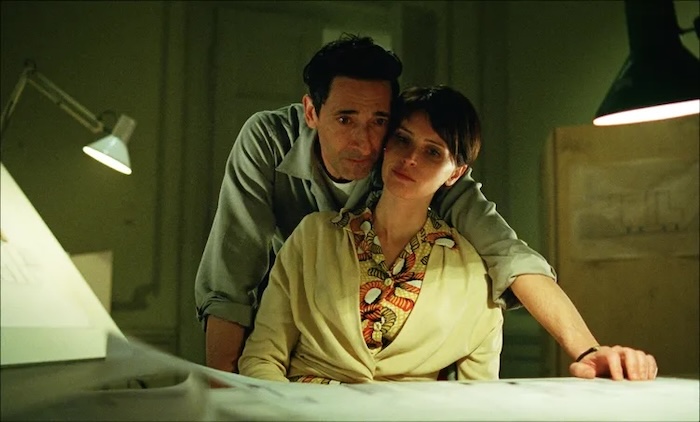
The title of Brady Corbet’s movie about the hopes and dreams of a Hungarian immigrant to mid-20th century America refers to the contemporary architectural movement that the protagonist, László Toth (Adrien Brody), follows, but it also may describe Corbet’s own take on the monumental Hollywood epics that were popular during that time, and if it seems to copy the kind of big themes redolent in another movie about an arrogant architect, King Vidor’s The Fountainhead, released in 1949, based on the controversial novel by Ayn Rand, it certainly isn’t a coincidence. But Corbet stands Rand’s concept of the great man who transcends history on its head, because Toth ends up defeated by his time and the cultural forces that guide it, partially due to his arrogance. The main difference is that Toth is not only an immigrant, but a Jew who survived the death camps. His arrogance is born of anger and frustration rather than the superior mien of someone who naturally aspires to greatness, like the Gary Cooper character in Fountainhead.
Toth’s strong suit is his stubbornness of vision. Having arrived at Ellis Island with nothing, he stays with his cousin, Attila (Allessandro Nivola), who has informally renounced his Jewishness after settling in Pennsylvania with a Catholic wife and a family furniture business. Attila has learned that Toth’s wife, Erzsébet, and niece, who were imprisoned in a different camp, are alive in Europe, and Toth is determined to bring them to America. Though Attila condescends to Toth for his purity of purpose, he brings him in on a job offered by a local rich kid named Harry Lee Van Buren (Joe Alwyn), who wants to build a home library for his industrialist father, Harrison (Guy Pearce), as a birthday present. Toth throws himself into the project with more enthusiasm than it’s worth, working his Bauhaus training into the design, which involves louvers and hidden panels. The older Van Buren is scandalized, thinking the minimalist style stupid, even insulting. Equally enraged, Attila kicks Toth out into the street, where he makes a living as a construction worker, a vocation that exiles him to the margins. He hangs with lower working class Black men, patronizes prostitutes, and parlays a taste for morphine that was once medicinal into a full-blown heroin addiction. Reduced to designing bowling alleys to keep his architectural chops up to snuff, Toth is eventually sought out by Van Buren, who in the meantime has researched Toth’s illustrious prewar career in Europe and decides he is just the man to manifest his vision for a community center that will celebrate his own greatness as a philanthropist for all eternity. It’s a commission Toth only too eagerly believes he was made for.
The surface conflict of the movie is between the idealist Toth and the man-of-means Van Buren, but the real battle is within Toth for a soul that will never forgive the world for making him suffer, and if the great project he designs is a testament to ego, that ego is as much his as it is Van Buren’s, and this 3-and-a-half-hour tale still isn’t big enough for two; or three, for that matter. Once Van Buren’s lawyers secure a visa for the wheelchair-bound Erzsébet (Felicity Jones) and her niece, Zsófia (Raffey Cassidy), Erzsébet’s own demands force the issue of Toth’s relative inferior status compared to the men he is working for, not only because he’s a Jew and an immigrant, but because he’s an intellectual with an intellectual’s temperament, no matter how hackneyed that concept comes across. For sure, Toth’s ideals continuously run up against the prerogatives of big “C” capitalism, but the main hurdle is American exceptionalism that’s bred in the bone. Toth can’t win on that front, but he refuses to acknowledge that he can be beaten by philistines whose only source of power is money. What he can’t grasp is that their real power is their investment in the belief that America is the savior of the world, a belief Toth will never understand having lived through hell. The brutality of The Brutalist is in the cruel outcome of that basic misunderstanding.
In English and Hungarian. Now playing in Tokyo at Toho Cinemas Nihonbashi (050-6868-5060), Toho Cinemas Hibiya (050-6868-5068), Toho Cinemas Shinjuku (050-6868-5063), Kino Cinema Shinjuku (03-5315-0978), Shibuya Parco White Cine Quinto (03-6712-7225), Bunkamura Le Cinema Shibuya Miyashita (050-6875-5280), Toho Cinemas Roppongi Hills (050-6868-5024).
This Oscar-nominated feature documentary, directed by two Israelis and two Palestinians, did not start out as a documentary. Since 2019, the directors have jointly and sometimes separately recorded the actions of the Israeli military, as well as Israeli settlers, in the occupied West Bank, specifically an area called Masafer Yatta, which is made up of 19 Palestinian villages that have been gradually decimated, ostensibly to make room for a “military training zone.” Many of the people who reside in the area, farmers, goat herders, etc., have lived there all their lives. Some say their families have been there since the 19th century, but for decades the Israelis have been seizing their land, saying that the people who live there don’t have any claim to it, which is a Catch-22 situation. Since the occupation, anyone who builds on land in the West Bank must receive a permit to do so from the military, and, according to the film, 99 percent of permits requested by Palestinians are denied, so the military has the right to tear down anything the villagers set up.
The filmmakers record a lot of demolition, as well as the frantic reaction of the people whose homes are being destroyed. They also record peaceful Palestinian demonstrations, which the Israelis say are illegal and are often met with violence. We see several unarmed people shot simply for not doing what they are told. Two of the directors, Yuval Abraham, an Israeli journalist who speaks fluent Arabic, and Basel Adra, a Palestinian activist with a law degree who grew up in Masafer Yatta, often appear on screen discussing the Israeli tactics, whose purpose is clearly to erase the Palestinian presence in the West Bank. They talk to the displaced, many of whom had to move into the caves in the vicinity because every time they try to rebuild their homes in the middle of the night the Israelis come back and tear them down. The two men and their co-directors, who do most of the filming, originally started the project to inform the world on a day-by-day basis of what is going on in the West Bank, but except for a few independent media like Democracy Now, they’ve drawn little attention. Then they hit on the idea of assembling and editing all the video into an integrated documentary, and the result has been a lot more attention, not to mention an Academy Award nomination.
It’s a grueling 90 minutes to sit through. In addition to the exhaustion and despair of the Palestinian residents on display, the friendship of Adra and Abraham is always being tested, mainly because at the end of every day Abraham can go back to Israel, back to a comfortable home; while Adra is forbidden to travel out of the occupied West Bank. This dynamic is as infuriating as anything in the movie because it exemplifies the apartheid system that Israel refuses to acknowledge. Certainly, the smug oppression of the settlers (“Go ahead, write your little articles,” one taunts Adra) speaks volumes about the blatant racism at the heart of the issue. No Other Land doesn’t have to explain anything. All the filmmakers had to do was just stand there and record. The cruelty and hatred is there for anyone to see.
In Arabic, Hebrew and English. Opens Feb. 21 in Tokyo at Toho Cinemas Chanter Hibiya (050-6868-5001).
I’ve only seen two films by the Mexican director Michel Franco, one in Spanish set in Mexico and the other in English set in Southern California; and while I can see why one critic calls him a “shock auteur,” the kind of fatal characters he favors strike me as being conventional in terms of sensibility. It’s the circumstances in his stories that are extraordinary, not necessarily the people themselves. His latest is set in Brooklyn among white people who cover a wide range of middle-class experience, and everyone has a trauma to deal with, so their responses to everyday stimuli must be measured accordingly.
We understand that Sylvia (Jessica Chastain) is a recovering alcoholic from the first scene, in which she is attending not her first AA meeting, but this time with her teenage daughter, Anna (Brooke Timer), in tow. Franco doesn’t give us much more to work with right away—nothing at all about the girl’s father or what may have been at the root of Sylvia’s addiction. She works at an adult day care center tending to people with developmental disabilities, and her daughter seems to spend a lot of time away from their apartment in a seedy neighborhood and at the nicer brownstone of Sylvia’s sister, Olivia (Merritt Wever), and her large family. Olivia is constantly trying to get Sylvia to be more social, and talks her into attending her high school reunion, which she isn’t too crazy about doing; and, sure enough, she spends most of her time alone in a corner while her former classmates party away. And then a bearded fellow, Saul (Peter Sarsgaard), seemingly materializes out of nowhere and sits beside her saying nothing. Spooked, Sylvia leaves and Saul follows her, still silent, all the way home, then sits in the rain outside her apartment all night. Franco continues to provide intelligence in a frustratingly elliptical fashion, but we eventually learn that Saul did go to the same high school as Sylvia and that he is now suffering from early onset dementia. At first, Sylvia thinks he is one of the boys who raped her when she was a teen—the trauma that drove her to drink?—and he claims to not remember anything about that, even though it’s his short-term memory that’s mainly affected by his condition. Further research concludes that he couldn’t have been a party to these assaults because he didn’t attend the high school at the same time Sylvia did, so now it’s Sylvia’s memory that is being challenged, mainly by her mother, Samantha (Jessica Harper), from whom Sylvia has been estranged since she became an adult but who is still close to Olivia.
Ostensibly, Memory traces the relationship between Sylvia and Saul to its uncomfortable but inevitable ends, which raises alarms not only among Sylvia’s family but among Saul’s, since he lives with an over-bearing brother (Josh Charles) who is taking care of him. However, Franco’s dramatic intentions are much wider, encompassing the class distinctions that this relationship implies, the ways that trauma colors not only the victim’s behavior but that of the people in their orbit, and how mental illness cannot be addressed without taking into consideration the mentally ill person’s hopes and desires. Much of the careful, complex plotting is contrived, but Memory boasts some of the most believably compelling characterizations I’ve seen in a movie that’s all about white Americans, which is saying a lot these days.
Opens Feb. 21 in Tokyo at Shinjuku Piccadilly (050-6861-3011), Bunkamura Le Cinema Shibuya Miyashita (050-6875-5280).
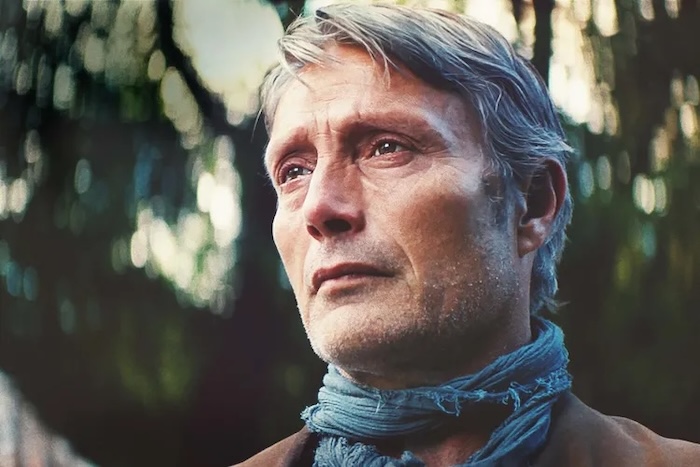
Historical epics have not gone out of style, but the prerogatives of big, crowd-pleasing stories set in the past have become less refined in the era of the MCU blockbuster, which makes this Danish movie all the more remarkable for how effectively it sells its old-fashioned dramatic ideas. Mads Mikkelsen is the primary salesman, with his preternaturally stoical visage, a seeming mask of imperturbability confronting the most scathing injustices and insults, carrying a movie that is essentially about how class can define a culture. Mikkelsen plays Ludvig Kahlen, a minor figure in Danish history who is here elevated to heroic proportions despite the man’s insufferable pride. Born a bastard to a nobleman and one of his servants in the 18th century, he grew up in poverty but achieved a level of distinction by joining the German army and rising to the rank of captain. However, upon retirement he receives only a meager pension and as the movie opens is living in a veterans poor house in Copenhagen. He decides to take up the king’s offer to help settle a blasted heath in Jutland and applies to the treasury, whose various bureaucrats mock his intentions, presuming that the moors are uninhabitable.
The premise is thus established: One stubborn man pits himself against not only impassive nature, but the layer of society that would keep him forever in his place. In addition to the bureaucrats he has to contend with a local magistrate, de Schinkle (Simon Bennebjerg), a sadistic monster who believes the moors belong to him regardless of the king’s edict. In fact, Kahlen’s first two hires, Johannes (Morten Hee Andersen) and his wife, Ann Barbara (Amanda Collin), have escaped indentured servitude to de Schinkle, thus branding them fugitives. He also takes in an orphaned “black” child traveling with the dangerous “vagabonds” who roam the area. Kahlen is not kind to any of them because he sees life as harsh and his first obligation is to his mission to make this land arable and, thus, livable. As gravy, he will be given a title if he succeeds. Fortunately, he is introducing a crop that is still new to Europe—potatoes—which can grow under even the worst conditions.
The Promised Land has been called a Western. Formally and spiritually it has more in common with the melodramas of Thomas Hardy, but with a blunter edge and much more violence. Once de Schinkle realizes that Kahlen isn’t going to move easily, he doubles down, indiscriminately slaughtering Kahlen’s growing workforce of vagabonds and German immigrants, thus forcing Kahlen to strike back with similarly brutal means. The director, Nikolaj Arcel, working from a script he co-wrote with Anders Thomas Jensen, revels in the unsubtlety, making his villains cartoonishly evil and Kahlen’s imperious nature unreadable at times—that is, until the other shoe drops and the man’s humanity breaks through in ways that are no less than stirring. If The Promised Land hearkens back to the great historical epics of directors like David Lean, it’s because it isn’t afraid to use gross spectacle and big fat emotions to get your heart pumping.
In Danish, German, Swedish and Norwegian. Now playing in Tokyo at Cine Switch Ginza (03-3561-0707), Shinjuku Piccadilly (050-6861-3011), Yebisu Garden Cinema (0570-783-715).
Having watched the ABC Sports coverage of the hostage ordeal at the 1972 Munich Olympic Games live while I was in high school, I am surprised after seeing this recreation of the event that the entire thing lasted only 17 hours. In retrospect it felt much longer. Tim Fehlbaum’s movie has to focus on something more direct than the situation in the Olympic Village, since that has already been thoroughly covered by Kevin Macdonald’s Oscar-winning documentary, One Day in September, so he keeps the action limited to the on-site ABC Sports control room. At only 90 minutes, the movie maintains tension easily, though often the drama has more to do with the journalistic decisions being made than with the hostage ordeal. For those who might have forgotten, a Palestinian organization, Black September, invades the Olympic Village and takes the Israeli wrestling team hostage, demanding the release of imprisoned compatriots in return for the athletes’ freedom, with one athlete being killed every hour until these demands are met. There were no US network news crews at the Games, so it was up to the ABC Sports team to cover the standoff as it happened, a task for which it received ample praise, though Feldbaum’s film shows what they were up against, and not just in terms of staying on top of the story as it unfolded.
In fact, much of the challenge was technical. The broadcast link is via satellite, which ABC can only access during predetermined time periods, so the on-site producer, Roone Arledge (Peter Sarsgaard), has to do some serious voodoo to keep the link valid. Meanwhile, the assistant producer, Geoffrey Mason (John Magaro), has to direct the operation in real time, and he has absolutely no news experience. There is a great deal of back-and-forth between the crew and ABC honchos back in New York, who aren’t convinced these sports guys are up to the task, and one of the film’s most pertinent points is that the crew doesn’t really think they’re up to it either, but they’re the only people available who have the means to cover the action. It quickly becomes clear that Mason is more resourceful than he appears, but he is helped considerably by operations manager Marvin Bader (Ben Chaplin) and the crew’s German translator, Marianne (Leonie Benesch), who has to multitask to beat the band. The need to uphold trite journalistic standards (a lot of precious time is spent discussing whether they can call Black September “terrorists”) gets the better of the hostage story, which can sometimes fall by the wayside, and the viewer might wonder where the priorities lie.
As Macdonald so convincingly showed, the terrible outcome was significantly a result of the German authorities’ inexperience and fear of being seen as not properly cognizant of the Jewish hostages’ safety. This Olympics was, after all, the first real international event held in Germany since the Holocaust. If that aspect of Feldbaum’s recreation seems insufficiently addressed, it’s because the people involved thought they were on top of the story, but the information kept changing and a worst-case scenario played out in front of their eyes (or, in this case, ears). Feldbaum does a good job of conveying the horror the ABC Sports team felt as they realized what was really going on.
While September 5 works from the DNA of a journalism thriller, the new Captain American movie, Brave New World, is being touted as some kind of political thriller. Having not kept up with the MCU for the past several years, I couldn’t see where the story was going since I didn’t really know where it was coming from. I knew that Steve Rogers had passed the Captain America title on to the Falcon, Sam Wilson (Anthony Mackie), but wasn’t sure what that entailed other than the iconic shield. So there’s a new Falcon (Danny Ramirez), an Hispanic dude who is basically Robin to Wilson’s Black Batman, thus giving this pair some DEI cred that would seem to be out-of-favor at the moment. Still, I couldn’t quite figure out what their take on world-saving was without the Avengers in tow for context.
But there’s this new super mineral that was discovered by the Japanese navy and the American president (Harrison Ford) wants to finalize a treaty that would guarantee all the world access to it, but then some super gangster (Giancarlo Esposito) steals it and Cap has to get it back. So far, so predictable, but then there’s an assassination attempt on the president, and it seems that somebody is manipulating minds remotely for ends that are never clarified except to say that that’s what evil people do. According to background I read, the script, written by five guys, has gone through a number of heavy changes in the past two years owing to certain real world events, and the only halfway compelling element I could find in the story is Shira Haas as an intelligence aide to the president who seems to be on loan from Mossad. But even she sounds confused as to who exactly she’s supposed to be fighting against.
Of course, it wouldn’t be an MCU movie without a bid to end the world, so Cap and his new Falcon sidekick get to prevent the Japanese navy from starting war with the U.S., a hilarious idea if you know anything at all about Japan’s Maritime Self-Defense Forces. And then there’s the Red Hulk, which is exactly what you think he is except that he isn’t who you think he is. If I found the action set pieces less than exciting it’s because they seem divorced from the general import of the story, as it were. It makes you sort of miss the Avengers, and I don’t even like the Avengers.
September 5 now playing in Tokyo at Toho Cinemas Nihonbashi (050-6868-5060), Toho Cinemas Hibiya (050-6868-5068), Toho Cinemas Shinjuku (050-6868-5063), Toho Cinemas Roppongi Hills (050-6868-5024).
Captain America: Brave New World now playing in Tokyo at Toho Cinemas Nihonbashi (050-6868-5060), Toho Cinemas Hibiya (050-6868-5068), Marunouchi Piccadilly (050-6875-0075), 109 Cinemas Premium Shinjuku (0570-060-109), Shinjuku Wald 9 (03-5369-4955), Shinjuku Piccadilly (050-6861-3011), Toho Cinemas Shinjuku (050-6868-5063), Toho Cinemas Shibuya (050-6868-5002), Toho Cinemas Roppongi Hills (050-6868-5024).
The Iranian government issued a warrant for the arrest of filmmaker Mohammad Rasoulof while he was at Cannes last year, effectively making him another exiled Iranian director, and I imagine he expected such a reaction considering the purport of his latest film. The Seed of the Sacred Fig, which screened at Cannes, addresses the recent protest movement in Iran sparked by the death of a woman in police custody for violating the head-covering law with actual footage of police violence. But that element is basically a subplot. The main action centers on Iman (Missagh Zareh), a civil servant who has gotten a dream promotion to Judicial Investigator, the step right before becoming a full-fledged judge. However, Iman quickly learns that he is expected to do little investigating and just rubber stamp the prosecutors’ indictments, including those for capital crimes. When the hijab protests explode, he is swamped by cases, a situation that complicates his home life, since he has two daughters, university student Rezvan (Mahsa Rostami) and high schooler Sana (Setareh Maleki), who get caught up in the protests, mostly as sympathetic bystanders, but it makes them wonder about their father’s role in these horrors.
The Maguffin is a pistol that Iman has been given by the court for protection, since judges are often the targets of public enmity. One day, the gun goes missing, and Iman, who has become increasingly paranoid, believes Rezvan has stolen it. It’s an extremely serious problem, because the gun’s disapperance will not only destroy Iman’s career, but could land him in jail, and so he’s determined to get to the bottom of things. His means of doing so is to treat Rezvan as just another suspect of a state crime, with all the unpleasantries such a situation brings with it. And he becomes increasingly less hesitant to resort to Draconian measures, since Rezvan, with the help of her sister and even her mother, Najmeh (Soheila Golestani), has aided a friend who was injured by police during the demonstrations, an act that itself could be considered a crime. So what at first seems like good fortune—Iman’s promotion—unleashes a crossfire of conflicting moral reckonings that tear the family apart.
The premise is brilliant, but Rasoulof gets carried away with it. The film works itself into a thick lather over the course of its nearly 3-hour runtime, and the final section, which some say mimics the dynamic overdrive of The Shining, is extreme in a pulpy sort of way. Still, Rasoulof’s rage is both genuine and comprehensible, and his willingness to hold nothing back in his indictment of the Iranian judiciary is what gives the movie its power. Normally, intentions aren’t enough to make a movie great, but I might make an exception with this one, because Rasoulof had to know that once they realized what he had created, those in charge would never be satisfied until he was buried.
In the Korean movie Troll Factory, the overarching authoritarianism is not public, as in The Seed of the Sacred Fig, but private, which makes it feel even more insidious, since it isn’t readily apparent as being purposely oppressive. A newspaper reporter, Im Sang-jin (Kim Dong-hwi), has written a story about a tech company that invented a new transponder whose test goes awry in ways that can’t be explained, and the company loses out on market penetration to a competitor. The CEO thinks the competitor sabotaged the test, and Im writes a story that is later blasted as fake news by the internet. Suspecting he’s the target of a concerted effort by the same corporation that ruined the tech company, Im investigates further and comes in contact with a trio of young gamers who are experts in manipulating comments on social media, and one of them tells him how they came to be recruited by the biggest corporation in Korea to help that corporation stave off competition and nosy reporters like Im.
Supposedly based on a true story (the big corporation in the film, Manjun, is based on Samsung), Troll Factory is densely plotted by director Ahn Gooc-jin, and while a lot of the computerese is left untranslated for the layman, he makes it easy to follow the intrigues to their natural ends. However, the nature of the danger being posed by these large, invincible conglomerates is that they can effectively render any negative intelligence as mere hearsay or worse, so the viewer is constantly bombarded with plot developments that they can’t really trust, and by the time you get to what could be understood as the denouement, you wonder if you’re headed for a Usual Suspects kind of twist ending. It’s not that pat, but because it’s a true story the screenplay is open-ended, which can be frustrating for people who demand that the forces of evil receive their just due. Unlike the Iranian government, Manjun/Samsung doesn’t really have a human dimension, which makes the conflict even more frustrating, but Troll Factory is engrossingly tense and believable.
The Seed of the Sacred Fig, in Persian, opens Feb. 14 in Tokyo at Toho Cinemas Chanter Hibiya (050-6868-5001), Human Trust Cinema Shibuya (03-5468-5551), Kino Cinema Shinjuku (03-5315-0978).
Troll Factory, in Korean, opens Feb. 14 in Tokyo at Cinemart Shinjuku (03-5369-2831).
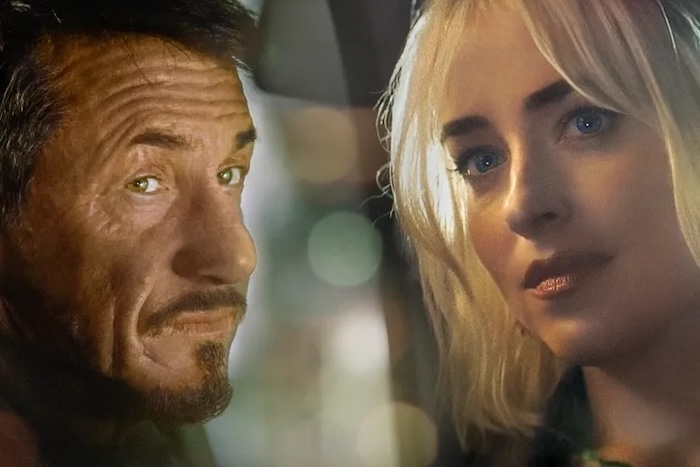
Not sure about what this title refers to. The formal premise is more theatrical than cinematic, but all indications are that the writer-director, Christy Hall, made it expressly for the screen, which means she has to be creative with her camerawork in order to counteract the static action, all of which takes place within a taxi cab. There are only two characters. One is a young woman (Dakota Johnson) who is not given a name, and the other a late middle-aged, dyed-in-the-wool New York working class cab driver named Clark (Sean Penn). The title could refer to him, but the arcane term Hall uses doesn’t really describe the dynamic between the two. Is he supposed to be a beatnik or something? And while the two actors do a fairly good job of fleshing out the often risible dialogue with verbal/gestural insights into their respective personalities, the road to mandatory epiphanies, for both, is paved with over-determined cliches.
The woman, a successful IT professional who lives in midtown Manhattan, is returning from Oklahoma where, we eventually learn, she was visiting a half-sister from whom she’s been estranged since they were teens. She gets into Clark’s cab at JFK. He’s a voluble soul, but at first his attempts at conversation hit a wall as the woman assumes a perplexed, downcast mien. Clark is assertive with his Boomer or Gen X druthers (“It’s nice that you aren’t on your phone”), and his natural charm eventually breaks through as they feel each other out in a playful kind of way. It becomes apparent that she actually is on her phone, receiving provocative sexts from her boyfriend that she is reluctant to respond to—at first. Picking up on her distracted air, Clark fearlessly probes her personal life, and, being in a vulnerable place after her journey, she slowly opens up and Clark guesses right: She’s having an affair with an older, married man that she’s thinking of ending. And while this guy could conceivably be the “Daddio” of the title, that explanation doesn’t jibe with the thrust of their ongoing conversation, which becomes extended due to an accident-related traffic jam. But she demands satisfaction, and Clark is forced to dredge up his own romantic history, which is more jaded. “I used to be that guy,” he admits, referring, presumably, to her lover.
The gamesmanship of the conversation is cleverly developed but goes nowhere in the end because both parties have to learn something from their interaction, and it’s difficult for the viewer to make an emotional connection to whatever lessons are being imparted. The only credible aspect to the story is the notion that these two are being candid because they know they will never see each other again. I was glad that, while some of the dialogue was suggestive, there was never a chance that they would end up romantically involved. Sometimes being predictable is a blessing.
Opens Feb. 14 in Tokyo at Cine Switch Ginza (03-3561-0707), Human Trust Cinema Shibuya (03-5468-5552).
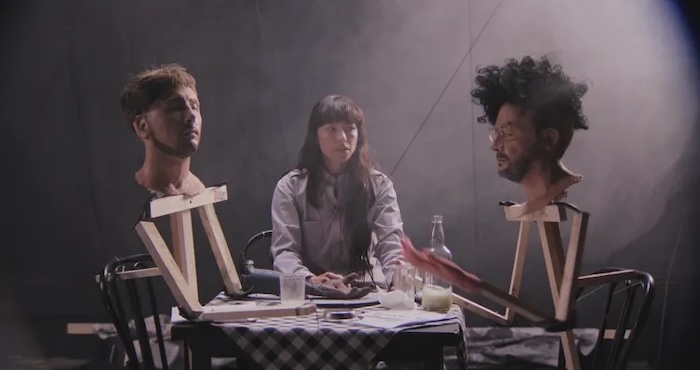
The Chilean filmmaking team of Cristóbal León and Joaquin Cociña is probably better known outside of Chile for the animated sequences they made for Ari Aster’s Beau Is Afraid than they are for their brilliant 2018 debut animated feature The Wolf House, but that isn’t saying much since not as many people saw Beau as Aster probably hoped. The duo’s second feature, The Hyperboreans, will likely win them even fewer fans due to its convoluted narrative and often confounding mixture of media, but it’s still fascinating in its own rarefied way. The title refers to beings of the “extreme north” that the Nazis glorified as a master race, a theme that only really gets going about halfway through this movie. Ostensibly, it’s about a youngish woman (Antonia Giesen) who is trying to recover a movie that she made ten years earlier and in the process ends up investigating the life of Miguel Serrano, a Chilean diplomat and philosopher who admired Hitler while he was in power and believed the führer had survived the war and was hiding out in Antarctica. As ridiculous as this premise sounds, Serrano drew a considerable following, and was said to be intimate with Carl Jung and Hermann Hesse. He was also big on Hinduism after he was posted to India in the 1950s. His pertinence to modern Chile is that following Pinochet’s coup he headed the country’s neo-Nazi faction. Giesen relates all this in a swift, almost comical fashion using lots of papier mache objects and stop-motion animation on a constantly evolving sound stage as she relates Chile’s late 20th century history as it applies to her own life, the movie she never finished, and her subsequent career as a psychoanalyst.
It’s a lot to cover in a movie that’s just barely over an hour long, but León and Cociña, whose own mannequin-like avatars act as the villains in the sci-fi adventure that Giesen’s story turns into, are as interested in the comic aspects of Chile’s political tribulations as they are in the tragic impact those politics had on the people. Though the pair’s visuals often evoke the textural weirdness of Jan Svankmajer, the overall thrust is overtly political without necessarily making the movie dramatically coherent. The development mimics that of a 1950s William Castle potboiler, an approach that often works against the duo’s thematic goals. The Wolf House trod the same territory, but was more narratively concise—and scarier. The Hyperboreans is all over the place, and ends up nowhere definite.
In Spanish and German. Now playing in Tokyo at Theater Image Forum Aoyama (03-5776-0114) along with the short subject Notebook of Names.
Chris Sanders has become the default American animated filmmaker of our present age, and not just because he’s made movies for both Disney and Dreamworks. His themes are generically wholesome while his means of storytelling feels ever more fantastical with each production. His latest is another robot story, meaning it’s about how a programmed entity “learns” to be human, and while it works well enough on that level, it doesn’t always reach beyond its own contrived purview toward something sublime. It’s enough just to be touching.
Based on a book series, the movie distinguishes itself as a Sanders project with its humor. The titular android is a disarmingly commercial thing, a robot made by a big company to be sold as a consumer good, an all-purpose helpmate that is nothing without someone to serve. During an ocean-set typhoon, a cargo ship loses the container in which ROZZUM 7134 is packed, and the box washes ashore on an uninhabited island in the Pacific Northwest; uninhabited, that is, by humans. There is plenty of wildlife, perhaps too much, in fact, and all manner of species interact with the suddenly operational Roz, as “she” is called (voiced by Lupita Nyong’o), whose first “impulse” is to find something to help, but, of course, none of these animals—though anthropomorphized to within an inch of their instinctual existence in the American animated manner—need help, but Roz herself has no existence otherwise. Certainly the cleverest thing Sanders does to get past this problem is to have Roz’s A.I. function process the sounds the animals make to interpret them as English speech, so we’ve got the expected menagerie of cutups, including a cynical fox, Fink (Pedro Pascal), whose predatory proclivities extract the most jokes; a mother possum who seems to have the strongest grasp of the island’s zoology; and a gosling whose natural need for imprinting provides Roz, who inadvertently has killed his mother and siblings, with the “customer” she needs for self-actualization. In other words, Roz herself must become a mother, and Brightbill, as the gosling is named, eventually grows up and has to be a goose (Kit Connor) who migrates, a learning curve that Roz, which is programmed to “complete tasks,” and Fink attempt to facilitate in what turns into a very interesting partnership.
The goal, as it is for every animated robot character from Wall-E to the smiling tin can in last year’s Robot Dreams, is for Roz to override her programming, and in the end she is called upon not only to let Brightbill be the goose he is, but to protect herself and the island that has become her “home” from the automated outside world whose own impulse is total control. Though I’m sure the source material is where the idea of instinct versus artificially bred values comes from, Sanders has become nothing if not adept at wrangling this sort of conflict into a workable story that’s exciting for kids and edifying for adults. The central irony is that these animals and this robot convey more humanity than the nominally “human” beings who run the world outside—and whom we never really see—even if it’s not an irony that feels at all distinctive.
Now playing in Japanese dubbed and Japanese subtitled versions in Tokyo at Toho Cinemas Nihonbashi (050-6868-5060), Toho Cinemas Hibiya (050-6868-5068), 109 Cinemas Premium Shinjuku (0570-060-109), Shinjuku Wald 9 (03-5369-4955), Shinjuku Piccadilly (050-6861-3011), Toho Cinemas Shinjuku (050-6868-5063), Toho Cinemas Shibuya (050-6868-5002), Toho Cinemas Roppongi Hills (050-6868-5024).









 philipbrasor.com