Review: Squaring the Circle (The Story of Hipgnosis)

Occasionally film projects come together where the director and the subject are so perfectly matched as to have been designed by God. This documentary about the graphic design house Hipgnosis was made by Anton Corbijn, who has already directed many well-regarded music videos as well as narrative features about British musicians like Ian Curtis, but he started as a still photographer who specialized in pop music artists, and Hipgnosis is by far the most influential album cover creator in the history of British rock, having created iconic graphics for Led Zeppelin, 10cc, Peter Gabriel, and, most relevantly, Pink Floyd, who gave them their start. Corbijn honors the company’s legacy by serving up a visually lush presentation in silvery black-and-white. 

The Hipgnosis story is told on film by Aubrey “Po” Powell, who founded the company with his partner, the late Storm Thorgeson, in the late 1960s, mostly be accident. Involved in the London acid scene as students, they lived for a while in a kind of “colony” with friends, some of whom would go on to form Pink Floyd, including Syd Barrett, who famously flamed out on LSD and quit the band after its second album, A Saucerful of Secrets, whose cover was Hipgnosis’s first commission, and a startlingly famous one. Thorgeson was the arrogant brains of the outfit (one substantial montage features famous people going on about how difficult he was to work with) while Powell, who studied photography at Thorgeson’s insistence, was its creative facilitator, and after the pair started getting more work that challenged the very idea of album art (Pink Floyd’s Atom Heart Mother is touted as the first major album that included no mention of the band or title on the cover, an idea that scandalized the record company) they kept going further and further, an artistic trajectory that would mirror the capitalist triumph of major label rock in the 70s. Consequently, Hipgnosis’s ideas became ridiculously expensive, as Powell admits several times. Those were the days, as it were.

Corbijn knows what the audience for this type of film demands, and it’s chock full of anecdotes of how some famous covers came together, told not only by Powell and Thorgeson, who died in 2013, but by big names like Jimmy Page, Paul McCartney, and Roger Waters, the kinds of stars who know that Corbijn can be relied upon to make them look very good, regardless of what they say. As counterpoint, there are occasional insert comments by Noel Gallagher, who mourns the loss of the striking album cover with the demise of the LP, complaining pointedly that the artwork for Oasis’s biggest selling album is a piece of crap that can never be redeemed. For once, Noel’s honesty shines through in a correctly self-deprecating manner.

Opens Feb. 7 in Tokyo at Yebisu Garden Cinema (0570-783-715), Cinemart Shinjuku (03-5369-2831). 

Squaring the Circle home page in Japanese

photo (c) Cavalier Films Ltd. 

Posted in Movies | Tagged , | 2 Comments

Media watch: Government refuses to remove names of Korean soldiers from war shrine because that’s just the way it is

Yasukuni Shrine

In the middle of January, Japan’s Supreme Court decided against a lawsuit brought by a Korean family against the Japanese government for refusing to remove the name of their deceased relative, who died in the service of Japan’s emperor during the Pacific War, from Tokyo’s Yasukuni Shrine. The family resented the fact that the government had given their relative’s name to Yasukuni for enshrinment without notifying them, insisting that they would have refused enshrinement because they believe that the existence of Yasukuni, which honors Japan’s war dead as a representative of prewar state Shintoism, “justifies” Japan’s colonization of the Korean peninsula from 1910 to 1945. Their relative was pressed into service to fight for Japan because he was a Japanese subject at the time, meaning he had no choice. However, after the war, Korean veterans of the Japanese Imperial Army did not receive pensions the way Japanese soldiers did, and the surviving families of Korean soldiers who died during their service did not receive compensation, though families of Japanese soldiers who died did. Many still do, in fact. 

The Supreme Court’s rejection of the suit was based on its interpretation of the statute of limitations. The Koreans in question were enshrined in 1959, and the statute of limitations to bring such a lawsuit is 20 years, which expired a long time ago, thus voiding the suit. But since the family did not learn that their relative were enshrined until the late 1990s, they contend that the statute of limitations does not apply in this case. To confuse the matter even further, the original district court finding against the bereaved family did not cite the statute of limitations but rather judged that the government had not infringed on the rights and benefits of the plaintiff. According to Mainichi Shimbun, in the original 2013 suit, lawyers for the family argued that the enshrinement violated the Constitution’s prescribed separation of religion and state. This was not the first suit brought by a Korean family against the government for the enshrinement of a relative at Yasukuni. A similar suit was also rejected by the Supreme Court in 2011.

The decisions of the District Court and the Supreme Court in this case differ, and in the end they imply pretty much the same thing, which is that no one can remove a name from Yasukuni once it’s been enshrined, though no one has ever convincingly explained why that is. The District Court did not elaborate on its reasons for rejecting the suit, but the Supreme Court said it was because of the statute of limitations, which would seem to be a means of shutting down the matter once and for all. But as Mainichi pointed out, according to the Civil Code, the statute of limitations, at least when applied to a civil suit, does not begin until the party that brings the suit, in this case the bereaved family, is made aware of the “harm” they say has been caused by the defendant, which, in this case, is the Japanese government. As a matter of fact, in appeals last year by the government against a number of successful suits brought by citizens who say they underwent forced sterilization many years ago, the government based its defense on the statute of limitations, which all the courts except one judged did not apply for the same reason that the Yasukuni suit shouldn’t apply: The plaintiffs were not made aware that they’d been sterilized until much later than when the actual sterilization took place.

Continue reading
Posted in Media | Tagged | Leave a comment

Media watch: Government to punish UN office for having opinion similar to that of Japanese citizenry

Princess Aiko, daughter of the present Emperor

On Wednesday, Japan’s Ministry of Foreign Affairs (MOFA) held a press conference to announce it would freeze funding for the Committee on the Elimination of Discrimination Against Women (CEDAW), which is managed by the United Nations’ Office of the High Commissioner for Human Rights (HCHR), in response to the committee’s report, issued last October, saying that Japan must end its male-only imperial succession policy. The MOFA spokesperson, Toshihiro Kitamura, said that the Japanese government every year grants funding to HCHR to the tune of ¥20-30 million that is earmarked for CEDAW, but it has informed the CEDAW that, according to an AP report, “it will be excluded from a list of [Japan’s] annual voluntary contributions” from now on. In addition, Japan is suspending a visit to Japan by CEDAW members this spring. 

Thursday’s print edition of the Asahi Shimbun said that the CEDAW’s opinion in its October report recommended that Japan “amend the Imperial Household Law,” which specifies that only males from the imperial line on the male side can become emperor, saying that it violates the spirit of the CEDAW treaty, which Japan ratified in 1985. Kitamura said that if the CEDAW does not remove the part of the report citing the male succession matter Japan will withhold its funding, but MOFA also admitted that since 2005 none of the grant money that goes to HCHR has actually made its way to CEDAW, so, for the most part, the threat is only symbolic. Nevertheless, Kitamura insisted that the government wants to make sure none of the money is used to fund CEDAW “so as to clearly express the government’s position.” 

The reason given for the government’s displeasure is that the concept of human rights cannot be applied to the Imperial Household and imperial succession, so, according to government logic, by definition the Imperial Household Law does not discriminate against women. To put a finer point on it, members of the imperial family do not possess basic human rights, so the law cannot be prejudicial against female members. In addition, imperial succession is “fundamental” to Japan as a state, so it is inappropriate for CEDAW to involve itself with the issue, meaning the treaty does not apply. 

It should be noted that CEDAW has been badgering Japan for years over the status of women, and that in the most recent report male-only imperial succession was just one of several concerns. Others had to do with the unfairness of requiring married couples to adopt the same name, which the CEDAW has cited five times already. Previously, the Japanese government never threatened to withhold funds with regard to the same name matter and didn’t condemn the CEDAW’s recommendation, but merely repeated that it was still under study, which is the exact same thing they say to the Japanese public. Other issues the CEDAW wants Japan to address is the relative paucity of women in elected office and the law that requires spousal approval for a woman’s abortion. 

Continue reading
Posted in Media | Tagged , , | 1 Comment

Review: A Real Pain and Dreamin’ Wild

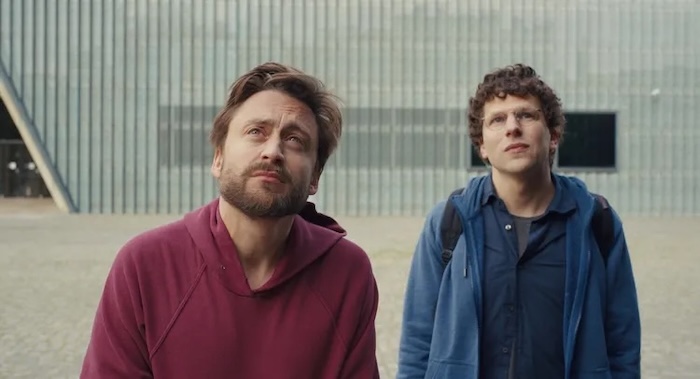
Though Jesse Eisenberg taps every anxiety joke in his second directorial feature and does nothing particularly fresh with them, A Real Pain is quite funny in the way some of Woody Allen’s post-Annie Hall comedies were funny. Characters you’re familiar with act out in ways that highlight life’s essential unfairness, and the ironies hit home via the chuckle reflex. As with much comedy, whether narrative or standup, it seems easier to mine this vein of suffering if you’re Jewish, and Eisenberg’s premise is both a gold mine of comic possibility and inherently tragic. Two cousins who were once very close embark on a Holocaust tour of Poland in the twilight of their youth in order to honor their beloved grandmother, who recently died and was a survivor of the camps. The emotional friction between David (Eisenberg) and Benjy (Kieran Culkin) was abraded by various individual adult choices, David’s being a life as a salaried employee and responsible husband and father and Benjy’s being the kind of dedicated cynic who doesn’t take to gainful employment and conventional civic uprightness. The first joke after the two land in Poland and check into their hotel room sets the stakes: Benjy has airmailed himself a bag of weed, which scandalizes David to no end, though he eventually partakes.

Nevertheless, Benjy is more proactive about the organized tour than David is, meaning that Benjy sees it as a way to discuss the Holocaust in all its dimensions. Eisenberg has concocted a brilliant set of tour mates, including Eloge (Kurt Egyiawan), a survivor of the Rwandan genocide who has converted to Judaism, and Marcia (Jennifer Grey), a single middle-aged American who finds in Benjy the perfect vessel into which she can pour her personal disappointments. The tour guide is a non-Jewish Brit named James (Will Sharpe) whose grasp of tempestuous Jewish temperaments isn’t as impeccable as his understanding of history, and whenever Benji hijacks the itinerary—such as staging an irreverent photo tableau at the Ghetto Uprising Memorial, or refusing to ride in the first class train car in principle on the way to the next stop of the tour—James is forced, on the fly, to readjust his bedside manner in accordance with the members’ various insecurities. No one, of course, is as insecure as David, whose adherence to propriety is checked by Benjy every step of the way, causing more than a few dustups between the cousins, especially once they leave the tour to find their grandmother’s childhood home. The bottom line, however, is that for all of Benjy’s instinctual desire to upset whatever equilibrium David would prefer to maintain, his presence is undeniably stimulating and not just provocative. It surfaces that Benjy attempted suicide not long ago, and this added intelligence, already known by David but not by the viewer, doesn’t dampen the laughs at all, but nevertheless adds the bittersweetest subtext to the cousins’ roiling camaraderie. It’s the greatest joke Woody Allen never had the guts to explore fully.

A brotherly love equally fraught forms the dramatic lynchpin of the biographical Dreamin’ Wild, which attempts to come to grips with a nominally feel-good story that, in fact, is shot through with regret and resentment. Based on the lives of Donnie (Casey Affleck) and Joe Emerson (Walton Goggins), two Oregon brothers who grew up on an orchard and recorded, with the help of their father, Don Sr. (Beau Bridges), an album of pop songs that did nothing when it was released in the late 70s but was rediscovered by the internet in the mid-2010s, the movie, written and directed by Bill Pohlad, does a capable job of showing how late success is not necessarily better than no success at all. 

Eschewing the music biopic template of rise-and-fall-and-rise, Dreamin’ Wild (the title of the phantom album) is mostly about the way Donnie’s ambitions as a singer and songwriter outstripped both his brother’s merely passing interest in music and his father’s more potent desire to see Donnie excel at what he loved. What makes the story different is that Don Sr. never discouraged Donnie’s dream of musical fame and, in fact, was so charged by what he rightly understood to be exceptional talent that he mortgaged his farm in order to build a studio to properly record Donnie’s music when no label seemed interested, a decision that placed an incredibly heavy emotional burden on Donnie over the course of his life when the gambit didn’t pan out financially. Joe was the good-time sideman who never felt sufficiently appreciated or acknowledged, and while Donnie remained a demanding taskmaster both in the studio when they were teenagers and later in life after the brothers’ names were being shouted from indie music’s rooftops, their differing sensibilities could never be joined in common cause, thus extending their intramural bitterness into middle age. 

As with his biopic about Brian Wilson, Pohlad tells the story through a carefully schematicized script that goes back-and-forth in time, an approach that sometimes works against the tale’s naturalistic drama. Though sad in the final analysis, there’s also a certain ecstatic undercurrent to the brothers’ relationship, which is just as subtle and poignant as that of David and Benjy—the enigma of male bonding through blood. 

A Real Pain now playing in Tokyo at Toho Cinemas Chanter Hibiya (050-6868-5001), Toho Cinemas Shinjuku (050-6868-5063), Shibuya Parco White Cine Quinto (03-6712-7225), Toho Cinemas Roppongi Hills (050-6868-5024).

Dreamin’ Wild now playing in Tokyo at Toho Cinemas Chanter Hibiya (050-6868-5001), Toho Cinemas Nihonbashi (050-6868-5060), Kino Cinema Shinjuku (03-5315-0978).

A Real Pain home page in Japanese

Dreamin’ Wild home page in Japanese

A Real Pain photo (c) 2024 Searchlight Pictures

Dreamin’ Wild photo (c) 2022 Fruitland, LLC

Posted in Movies | Tagged , , , , | Leave a comment

Review: The Room Next Door

As with two of his previous short subjects, The Human Voice and Strange Way of Life, Pedro Almodóvar’s use of the English language in the feature-length The Room Next Door has a stilted, scripted quality that doesn’t necessarily indicate the pitfalls of second-language skills. Even the dialogue in his Spanish language films, as rendered in subtitles at least, has a theatrical cadence that betrays a distinct authorial voice. In this particular case, that voice feels even more artificial due to the subject matter and the refined sensibilities of the people through which it’s channeled. Ingrid (Julianne Moore) is a successful writer of what what sounds like auto-fiction, though her latest work is a book-long essay on the topic of “sudden deaths,” which she approaches with sensitivity but at an intellectual remove. The subject of death is more immediate, though anything but “sudden,” to an old friend, Martha (Tilda Swinton), who reconnects with Ingrid seemingly by accident and eventually informs her that she has cancer. As the two reacquaint themselves after years of not being in touch (they had the same lover, but not as the same time), Martha is undergoing an experimental treatment that fails, and is thus understandably devastated. She then asks Ingrid to be with her when she commits suicide.

As already implied, there’s nothing in the script that feels spontaneous. If anything, Almodóvar is one of our most deliberate directors, and it follows that, just as Ingrid’s latest work is about death in the literal sense, Martha’s profession is that of war correspondent, a vocation that Almodóvar is keen to show has not really prepared her for the end, no matter how much she was forced to confront it in her work. The two women’s conversations continually circle this dialectic while constantly alluding to relevant works of art and social issues that have always concerned them, meaning that the desperation of Martha’s situation is constantly mediated by an overarching mindfulness, which the director tries to pass off as a means of putting off the inevitable. This distraction is intensified by the material comforts that Almodóvar is so famously fond of. The two women’s Manhattan abodes are designer perfect and look way too expensive for the kind of writers they profess to be. When Martha bows to her fate and rents an upstate vacation property where she will take an illegally acquired pill to put an end to her misery once the pain becomes too much, the idyllic apartment is like something out of a Frank Lloyd Wright catalogue. But the loaded conversations continue, because Martha asks Ingrid to be there until the end.

Almodóvar obviously knows how much the viewer can tolerate and ties his philosophical musings to a real plot that can be disarmingly natural at times. Ingrid’s clandestine meetings with their mutual old flame, Damian (John Turturro), a stuffy, ineffectual professor, work to fill in a lot of the backstory that’s necessary to understand the two women’s relationship and Martha’s domestic difficulties in the meantime; and the entrance of Martha’s adult daughter in the final scenes provides the emotional ballast that had mostly been missing while Martha was merely fading. And I didn’t expect the harsh legal confrontation that Ingrid has to deal with in the end. As is often the case with Almodóvar, the braininess of his stories almost always gives way to urgent melodrama of the most elemental kind. He always knows what movie lovers want.

Opens Jan. 31 in Tokyo at Human Trust Cinema Yurakucho (03-6259-8608), Shinjuku Piccadilly (050-6861-3011), Bunkamura Le Cinema Shibuya Miyashita (050-6875-5280), Toho Cinemas Roppongi Hills (050-6868-5024).

The Room Next Door home page in Japanese

photo (c) 2024 Warner Bros. Entertainment (c) 2025 El Deseo, Iglesias Más

Posted in Movies | Tagged , , , | Leave a comment

Review: Filmlovers!

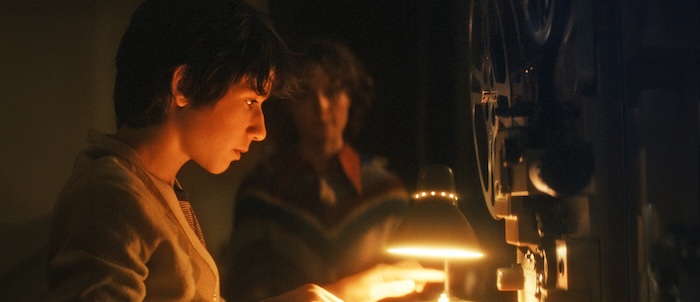
At some point in a serious filmmaker’s career they tackle the subject of cinema itself. Usually, it’s in the form of a narrative love letter to the art, such as Truffaut’s Day For Night or Spielberg’s The Fabelmans, but sometimes a director goes the more direct route, and in many cases the resulting documentary is more circumscribed, like Scorsese’s film about Italian cinema. French director Arnaud Desplechin goes whole hog with Filmlovers!, that exclamation point lending full expression to his enthusiasm. Part narrated treatise, part re-creation of Desplechin’s own cinematic education, the movie sometimes reaches too far into the esoteric meaning of movies, and the English language narration by Mathieu Amalric can get a bit overwrought (“What happens to reality when it is projected on to the screen?!” he hisses through clenched teeth), but the enthusiasm is infectious and the concepts relatable. 

Amalric takes on the persona of Paul Dedalus, the character he played in Desplechin’s 1996 movie My Sex Life…, which was a gloss on Desplechin’s own life. Since the director himself shows up in the latter part of Filmlovers! to interview several people, the conceit seems hardly necessary, and the staged scenes of Dedalus/Desplechin’s evolution as a movie nerd aren’t always compelling dramatically. Much more interesting are the philosophical points that the dramatic scenes illustrate without always explaining, such as the involving nature of watching a film in a theater with an audience (“I was smaller than the images”). In a wonderful montage of average movie fans relating their most memorable experiences in a cinema, many cite horror movies or scenes that made them uncomfortable, and to his credit, Desplechin samples a wide range of films to prove his points, from well-known art house fare and experimental films to the most conventional Hollywood potboilers. He also sidetracks onto seemingly random tangents that nevertheless convey a sensitivity to what moves an audience elementally. In one section subtitled “Humiliated and Offended,” he explains how film is the most powerful artistic expression for “the underprivileged and children,” meaning viewers who can’t read (yet) and thus are denied entry to most narrative art forms. Movies help these individuals learn about the world and see themselves, often as victims of the powerful. From there Desplechin examines the Native American face in classic Westerns and extends the notion to a reverie on the late Native American actor Misty Upham. 

In the end, Desplechin’s real subject is truth and how cinema refracts and reflects it, which is probably why he includes an extended discussion, with the Israeli film critic Shoshana Felman, about Claude Lanzmann’s nine-and-a-half hour Holocaust documentary Shoah, a movie that places the past in the present by focusing exclusively on first-person accounts of death camp survivors who “witnessed the inconceivable.” Film, to quote Proust about a different idea, is a “search for lost time,” regardless of what the filmmaker purports to accomplish. Even fantasy is presented as something that must be made real in order for the viewer to be swept up in its made-up world. It might have been interesting to hear Desplechin’s opinions on our current obsession with streaming and portable screens (he does tackle television and seems to be for it), but maybe it would have impinged on the movie’s ecstatic mood.

In French and English. Opens Jan. 31 in Tokyo at Shinjuku Cinema Qualite (03-3352-5645), Human Trust Cinema Shibuya (03-5468-5551).

Filmlovers! home page in Japanese

photo (c) 2024 CG Cinema/Scala Films/Arte France Cinema/Hill Valle

Posted in Movies | Tagged , | Leave a comment

Hiroshima in context

This coming August will mark the 80th anniversary of the atomic bombing of Hiroshima, and at this point in time the ramifications of the act itself remain fairly circumscribed. People still argue as to whether it brought an end to the Pacific War and thus made wholesale slaughter of civilians during wartime an acceptable concept. At least 140,000 human beings died as a result of the bombing, some instantly, others after prolonged agony. There is, of course, something to be said about condemning the very idea of the bomb and its use against living things, given that many countries possess nuclear weapons and could conceivably use them under certain circumstances, but Hiroshima is part of history, something that cannot be undone. The impulse to lay blame or justify the bomb’s use cannot change what has already happened. It remains in memory as an epic tragedy.

But epic tragedies are stories, and stories are the most edifying tools we’ve got. That most people in the West were first made aware of the scope of the bombing with the publication of John Hersey’s book-long report in the New Yorker in 1946 counts as a significant part of the overall Hiroshima story. Hersey’s article did not explicitly contemplate the morality of the bomb or its role in ending the war, but conveyed its physical and psychological effects on six survivors. Readers had to decide for themselves the attendant morality based on what they knew about how the U.S. and Japan fought the Pacific War, and that knowledge may not have been extensive. The stories Hersey told after interviewing firsthand witnesses were harrowing and direct. He did not delve into the matter beyond what happened to the individuals he talked to and what they saw, but he made a huge difference by showing what the bomb did that made it unique as a weapon, and many readers were not only shocked by what he revealed but also disgusted by it, regardless of what it may or may not have accomplished with regard to Japan’s surrender.

M.G. Sheftall’s Hiroshima: The Last Witnesses doesn’t necessarily expand on Hersey’s report, and despite its subtitle, the book isn’t strictly an oral history, though much of the narrative portion is based on interviews with surviving hibakusha (persons exposed to the bomb). If anything, it’s an attempt to come to terms as thoroughly as possible with what actually happened on that day by extending the stories told by Sheftall’s interlocutors in both temporal directions and then adding relevant cultural and historical context. Sheftall, a longtime professor at Shizuoka University, keeps it all local. Except for the opening chapters, which describe in detail the execution of the bombing from the U.S. military’s standpoint, the nearly 500-page book is focused on the city of HIroshima, its residents, and, to a certain extent, Japan as a nation. In that regard, it’s almost a shame that the Nobel Peace Prize given last fall to the hibakusha organization Hidankyo wasn’t announced before the publication of the book, which mentions the group, and not just because the publisher could have used the PR to its advantage. The prize and its international press coverage provides meaning that gives the reader a wider understanding of the bombing’s, and thus the book’s, implications. 

Continue reading
Posted in Media | Tagged | 1 Comment

Review: The Goldfinger

Based on a true story, this thriller set in Hong Kong during the 70s and 80s stars Tony Leung and Andy Lau, together for the first time since the popular early-aughts Infernal Affairs trilogy, and was written and directed by Felix Chong, who wrote Infernal Affairs. However, the new movie has nothing much in common with the earlier project and comes off more as a gloss on Michael Mann’s Heat but set in the world of high-stakes finance. Leung plays engineer-businessman Henry Ching, who flees Singapore in the mid-70s when a housing scheme goes belly up. After failing to land a legitimate job amidst Hong Kong’s burgeoning real estate boom, Ching teams with budding developer KK (Simon Yam) to create a business empire based on stock fraud and market manipulation. Ching is good at it and eventually attracts the attention of the Independent Commission Against Corruption (ICAC), which already has its hands full investigating routine police malfeasance. However, the chief investigator, Lau Kai-yuen (Lau), understands that Ching’s illegal activities have much bigger ramifications for average Hong Kongers who might invest in stocks, and, of course, the market crashes, ruining thousands while hardly touching Ching’s own worth.

Most of the thriller aspects spring from Lau’s frustration in getting anything on Ching. Every time he arrests someone or serves an indictment, Ching uses his business connections to either quash evidence or influence judges, many of whom are still attached to the British government, which wants Hong Kong to attract international business interests. Ching’s main means of staying solvent is borrowing money from shady Southeast Asian institutions, and not just private ones but also government-run as well. In fact, it’s often hinted that Ching himself is not really running the operation, but that it is somehow being stage-managed by a higher-plane Asian cabal. The movie covers some 15 years, during which inside players are detained, interrogated, and released without incident, only to be subsequently murdered when Ching and/or his betters decide they’re too dangerous to have around any more.

In theory, the movie shows promise in the vein of movies like The Wolf of Wall Street, but as a director Chong can’t maintain a straight storyline. He keeps moving backwards and forwards in time, the result being that there’s no accumulation of tension. We never get a clear feeling for the the Ching-Lau rivalry or the touted negative effects that Ching’s business is having on Hong Kong in general aside from the stock market. All we see is excess, as indicated in the misleading movie title. In addition, the CG is pretty cheesy and the acting showy without having any grounding in believable behavior. It’s quite a mess, which is baffling since The Goldfinger seems part of a recent trend to revisit pre-handover Hong Kong, a trend that has revitalized the local film industry (see Twilight of the Warriors), and is apparently one of the most expensive movies ever made in the territory. 

In Cantonese and English. Now playing in Tokyo at Toho Cinemas Hibiya (050-6868-5068), Toho Cinemas Nihonbashi (050-6868-5060), Toho Cinemas Shinjuku (050-6868-5063), Toho Cinemas Roppongi Hills (050-6868-5024).

The Goldfinger home page in Japanese

photo (c) 2023 Emperor Film Production Company Limited

Posted in Movies | Tagged , , | Leave a comment

Review: The Apprentice

The Japanese distributor of Ali Abassi’s origin story of Donald Trump The Monster probably thinks they’ve scored a coup by releasing it the weekend before Trump’s second term as POTUS begins (it opened in the U.S. about a month before the election last fall), but I would argue that such timing is fraught. Obviously, releasing it after Trump reascends Olympus would be even dodgier, box office-wise, but at this point in the ever-expanding Trump news cycle the public, even non-Americans (especially non-Americans?), are already sick of the guy. It’s just as well that the movie comes across as a comedy, a kind of exploitation flick that’s as crass and crude as its protagonist. The difficulty is not that the truth about Trump’s subsequent success in the clear light of his perfidy makes all the jokes pointless, but that the man himself has no depths to plumb. It’s all there on the surface, which means the movie’s humor is stretched paper-thin from the get go.

The title, of course, does not refer to the reality show that revived Trump’s celebrity, but rather to his status vis-a-vis the ultra-aggressive lawyer Roy Cohn (Jeremy Strong), who in the 50s coordinated Sen. Joe McCarthy’s red-baiting escapades and sent the Rosenbergs to the electric chair, a feat that he, at one point, cites as his greatest achievement. (to paraphrase: “They said spare her, she’s a mother. I said, fry her, she’s a traitor.”) When they meet, Donald Trump (Sebastian Stan) is a relatively naive but ambitious real estate developer still under the thumb of his emotionally abusive slumlord father, Fred (Martin Donovan), going door-to-door to collect rent payments from struggling tenants. Donald enlists the blustery Cohn to quash a federal civil rights lawsuit against the Trump organization for housing discrimination. Cohn takes the challenge and effectively blackmails a DOJ official into settling the suit without any penalty. Recognizing that young Donald has the potential to be a shark just as lethal as he is, Cohn endeavors to groom the kid into the narcissistic bloviator we know and hate today, though the script by Gabriel Sherman focuses on two circumscribed time periods—the mid-70s, when Trump was just building his business empire, and the mid-80s when he was a qualified (all that debt!) success and Cohn had withdrawn from the picture because of AIDS—without giving much of a sense of how Trump developed in the meantime. Essentially, Cohn teaches him the ropes in the first half (Attack! Deny! Never admit defeat!) and we see him utilize those teachings in the second, though, in fact, as Trump himself confesses at one point, this ruthless, immoral attitude seems to have been part of his nature from the start. Along the way, Sherman and Stan drop all the cues that have come to define Trump, especially in his behavior toward his first wife, Ivana (Maria Bakalova), whom he starts to resent once she proves to be as effectively ambitious as he is; and his cruel dismissal of his loser older brother, who dies an alcoholic. 

That said, Stan’s performance is more than a good impersonation, and it’s easy to wonder how much better the movie could have been were the script as inventive and insightful as the actor. Strong is even better as Cohn, but only in the first half, poisonously combative and predatory, whether it’s in the courtroom or the bedroom. He tends to fall into Kendall Roy habits in the latter part of the film, when Cohn is weakened considerably by his illness. Too much of the dialogue is geared toward confirming what we already know about the two men and doesn’t really add anything useful, which isn’t to say Donald Trump is unknowable. If anything, he’s too knowable, which is the problem. As funny as the movie can be, in the end it’s just way too depressing. 

Now playing in Tokyo at Toho Cinemas Nihonbashi (050-6868-5060), Toho Cinemas Hibiya (050-6868-5068), Kino Cinema Shinjuku (03-5315-0978).

The Apprentice home page in Japanese

photo (c) 2024 Apprentic Productions Ontario Inc./Profile Productions 2 APS/Tailored Films Ltd.

Posted in Movies | Tagged , , | Leave a comment

Review: Twilight of the Warriors: Walled In

Though I don’t normally look to Hong Kong kung-fu epics for political meaning, I was puzzled by a central plot point in this 1980s-set action movie directed by Soi Cheang, which reportedly is the first of a series. Raymond Lam plays the main protagonist, Chan Lok-Kwan, who is described as a refugee in Hong Kong, and I kept wondering: A refugee from where? Since he speaks fluent Cantonese and has wicked fighting and mahjong skills, I assume he grew up either on the mainland or in a Chinese-speaking expat community in another country. Malaysia perhaps? Vietnam? The furiously paced plot has no real need to explain such things—though we do eventually learn that, as a baby, Chan, along with his mother, was “exiled” from Hong Kong—but there is something essential about the matter given that the historical thrust of the story eventually leads to the British handover of the territory to China in 1997, and so the historical background is important to the theme, if not necessarily vital for the action set pieces, which are numerous, densely choreographed, and viscerally mind-blowing.

Walled In is already being boosted as a full-on return to the great traditions of pre-millennial HK action, and in terms of plotting and character development, it may even surpass those traditions. Though Chan is a cliche, a poor migrant who is cheated by one triad and chased into the arms of a second, to which he then swears allegiance out of a sense of gratitude and fraternal belonging, there’s a richness to his development as a pauper-hero that’s mainly provided by the superior production values. The walled city of Kowloon—a real place—is so vividly tactile that overcoming its maze-like structure is an enormous feat, and the denizens of this demimonde are themselves vivid relics of a lost era in their own right. After escaping the clutches of the greedy triad boss Mr. Big (Sammo Hung), Chan is taken in by Cyclone (Louis Koo), the “head of security” for Kowloon, who protects its ragtag inhabitants for the main landlord (Richie Ren), a former triad honcho who lives off-site in palatial digs that are basically a shrine to the wife and daughter murdered by a rival triad boss (Aaron Kwon). His appetite for revenge is whetted by Chan’s “return” to Hong Kong, thus reigniting a new inter-gang war goosed by the ultimate prize: Title over Kowloon, whose properties are already skyrocketing in value following the announcement of the future handover.

None of this context adds anything to the excitement, but it does provide a thick dramatic texture to the action, which is designed to take up a maximum volume of space. More significantly, the supporting characters are carefully conceived as charismatic individuals and performed by a stellar cast, and I would venture that the only serious miscalculation was endowing Mr. Big’s sergeant-at-arms, King (Philip Ng), with supernatural powers that require an extra helping of ingenuity on the part of Chan and his newly adopted crew to defeat. If it sounds like a sop to the worldwide audience’s MCU proclivities, it seems hardly necessary. The abilities of these guys to take a licking and keep on ass-kicking transcend superhero formulas. The only question is: How do they possibly top this? Two sequels? Bring ’em on.

In Cantonese. Now playing in Tokyo at Shinjuku Wald 9 (03-5369-4955).

Twilight of the Warriors: Walled In home page in Japanese

Posted in Movies | Tagged , , , , | Leave a comment