Review: Vision of Makhmalbaf

Mohsen Makhmalbaf left his native Iran in 2005 and has since established the Makhmalbaf Film House in London, where he produces his own movies and those of his wife, Marziyeh Meshkini, his daughters, Samira and Hana, and his son, Maysam. Many of these films have addressed the situation in the Middle East, mainly Afghanistan, to which the family has always professed an affinity due to the country’s cultural and linguistic associations with Iran. Two of the production house’s more recent films in this vein will be screened as a double feature starting December 28.

The List is officially credited to Hana Makhmalbaf as director, though Mohsen is its star in every way. It’s a harrowing, real-time recording of the effort made by Mohsen and his family to extract some 800 artists from Kabul at the end of August 2021 before the Taliban take full control and arrest them—or worse. Most of it takes place in the offices of Makhmalbaf Film House as Mohsen argues over the phone and via email with officials from France and the UK for help in getting the artists out. The US, which controls almost all of the flights out of Kabul, is uncooperative from the beginning. These scenes are skillfully interspersed with cell phone recordings of the chaotic situation in Afghanistan shot mainly by the persons in Kabul who are trying to escape. The tension never lets up and the weeping and gnashing of teeth that attends every heartbreaking development is presented without comment or embellishment. It may very well be the last word on this tragedy, which has since become mired in political gamesmanship, and while the 67-minute document is pure seat-of-the-pants filmmaking without the aesthetic conceits that Makhmalbaf usually brings to his films, it’s more artfully put together than anything he’s been involved in since living in exile. 

The other film on the bill, the 62-minute Here Children Do Not Play Together, also eschews the “poetry” that has typified Makhmalbaf’s style in the last two decades. In voiceover he says the footage constitutes “research” he carried out in Jerusalem regarding the Palestinian-Israeli question, which, to him means, Why don’t they get along, especially since the Hamas attack on Oct. 7, 2023? He interviews several people, mainly a voluble Afro-Palestinian “alternative tour guide” who was once jailed by the Israelis for planting a bomb, and a younger Israeli man who is trying to bridge the considerable gap of understanding between the two sides, though in exactly what capacity it’s difficult to determine. The movie is thoughtful and tasteful in the Makhmalbaf style, but not nearly as informed as his work on Afghanistan. He concludes that when children of different cultures grow up together (i.e., go to the same schools), they rarely hold grudges, regardless of what baggage their respective cultures carry; which is hardly a novel theory.

Both films in English and Farsi. Now playing in Tokyo at Theater Image Forum Aoyama (03-5766-0114).

Home page in Japanese
Posted in Movies | Tagged , , | Leave a comment

Review: Occupied City

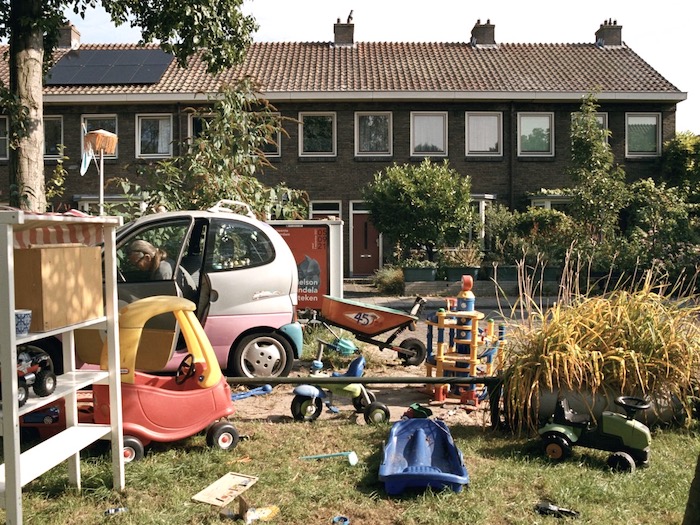
Award-winning filmmaker and visual artist Steve McQueen interweaves a variety of cinematic approaches into his documentary tapestry of Amsterdam during the Nazi occupation of 1940-45. Based on the book Atlas of an Occupied City by Bianca Stigter, who is married to McQueen, the movie maps the German occupation through carefully edited anecdotes attached to specific addresses, but not in chronoligical order. In fact, the movie’s structure is willfully free and random, which may be why McQueen elected to leave its running time at four-and-a-half hours, including intermission. Though the stories, as narrated in English by Melanie Hyams with an almost deadbeat intensity (her mixture of British accented English and proper Dutch pronunciation of local names and places is expressive enough), are fascinating in and of themselves, it’s their cumulative power as acts of individual purpose that gives the movie its unique dramatic dimension. Concepts like bureaucratized Nazi antisemitism and gratuitous cruelty; resistance bravery and resourcefulness; and victim dehumanization are all addressed at the micro level, and while certain repeated themes have an almost numbing effect the oppressive atmosphere of the era is acutely felt. 

However, McQueen’s visual methodology often distracts from the narrative precision. All his images are of Amsterdam now; or, more exactly Amsterdam in 2021-22. He attempts to show those addresses described in the narration as they appear today and invariably catches modern people doing 21st century things that have no relationship to the tales being told. In many cases, the buildings described no longer exist, so Hyams concludes those stories with the word, “demolished.” As already mentioned, McQueen started as a visual artist, and many of his images are aesthetically striking, thus prompting the viewer to wonder if a connection is being made between the narration and the image. As a number of critics have already pointed out, the pandemic was at its peak during much of the shooting, and it’s difficult to avoid the feeling that McQueen may be forging thematic connections between the Nazi crackdown on freedoms and the official public response to the COVID crisis. I don’t see that myself, but the contrasts are often more confusing than illustrative.

It should be noted that McQueen, a British national, lives in Amsterdam, and his familiarity with the landscape comes through clearly in how he has chosen to shoot various locations. His use of overhead shots is particularly impressive, especially at night as his camera darts down narrow, empty streets. I’m tempted the say that he could have made two (much shorter) movies—one about the Nazi occupation as a standard historical documentary, and another about Amsterdam as a special environment whose urban situation is keenly reflected in its social sensibility. But both those projects would have been conventional, and it’s clear that McQueen isn’t interested in making conventional films, be they fiction or non-fiction.

In English, Dutch and Arabic. Opens Dec. 27 in Tokyo at Human Trust Cinema Yurakucho (03-6259-8608), Human Trust Cinema Shibuya (03-5468-5551).

Occupied City home page in Japanese

photo (c) 2023 De Bezette Stad BV and Occupied City Ltd.

Posted in Movies | Tagged , | Leave a comment

Media watch: SAS response to flight attendant’s plea transcends “customer service”

(Asahi Shimbun)

‘Tis the season, as they say, and in that light we thought we’d offer something positive in this space for a change, and where better to look in the Japanese media than Asahi Shimbun’s Mado column, which usually covers heartwarming human interest stories. This one happened December 13 on an SAS aircraft that had just arrived at Haneda from an unnamed “Scandinavian country,” though it was definitely Denmark, since all SAS flights that go from Japan to Scandinavia transfer at Copenhagen.

After the flight touched down, one of the flight attendants made an announcement in Japanese expressing appreciation to three of the passengers for “dedicating your lives to the cause of a peaceful world without nuclear weapons and war.” She was referring, of course, to the three main delegates of Hidankyo, the association of victims of the atomic bombings of Hiroshima and Nagasaki whose work to abolish nuclear weapons won them the 2024 Nobel Peace Prize. On the morning of Dec. 13, they were returning from Oslo, where they had attended the Peace Prize ceremony. 

The flight attendant who made the announcement was Keiko Watanabe, an SAS veteran who was in charge of this particular flight, probably because the three delegates would be on it. However, when preparations were being made in Copenhagen prior to boarding, Watanabe realized that the three delegates are in their 80s and 90s, and that they were booked in coach. She knew that their itinerary had been full. In addition to attending the ceremony, the three delegates had many meetings with VIPs, not to mention press conferences and interviews with reporters from all over the world. Watanabe knew that after such a schedule, a ten-hour flight in coach could be a burden for an elderly person and checked the business class section. There were several vacant seats, so she took a chance and sent a DM to the CEO of SAS—the first time she had ever done that—and asked, “Can’t we do something for them? They are quite elderly.”

It was a last minute plea, right before the flight was to take off, and she didn’t think the CEO would actually read the message and thus wasn’t expecting him to reply. But he did. “That’s a good idea,” said the message. “We would be happy to help. Please send me the names of the passengers.” So the three delegates were bumped up to business.

Watanabe told Asahi that her own mother had lived through the war as a girl, and while she wasn’t in Hiroshima or Nagasaki, she did have to evacuate to the countryside. Watanabe herself had visited Nagasaki where she learned about the atomic bombing, and felt that she wanted to express her personal appreciation for the work that Hidankyo was doing, so she made the specially improvised announcement herself: “Please continue to support the cause of world peace,” she said at the end. “Our staff extends its sincerest wishes for your continuing health and happiness.” The entire plane burst into applause.

It should be noted that the Nobel Committee covered the three delegates’ airfare, but apparently they only booked coach and Hidankyo didn’t have the resources for an upgrade. Actually, the entire delegation numbered some 30 people, but the rest of the group took a different flight for logistical reasons and had to resort to crowdfunding to pay for their airfare. We wonder why the group couldn’t have asked for an advance on their prize, but, in any case, it sounds as if it was easy to raise the money. Obviously, the Japanese government wasn’t going to step in. Though they’ve congratulated the organization, their enthusiasm hasn’t been what you might expect for a Nobel prize winner, probably because, officially, Japan has not signed the Treaty on the Prohibition of Nuclear Weapons, despite the fact that it is the only country in the world that has been a target of nuclear attacks. Anyway, thanks to a thoughtful flight attendant, this particular story had an even happier ending.

Posted in Media | Tagged , , | Leave a comment

Review: Between the Temples

As a comedy, Nathan Silver’s chamber piece about two grieving people finding each other when they weren’t particularly looking for anyone gets off on misplaced expectations. In the opening scene, sullen Ben Gottlieb (Jason Schwartzman), a cantor who is taking a “sabbatical” from the upstate New York temple where he works, is told by his two mothers, Meira (Caroline Aaron) and Judith (Dolly De Leon), that they are about to receive a visit from a doctor, intelligence that Ben receives with a mixture of fear and curiosity. He knows his Jewish mothers (even if one was born in Manila and converted just prior to marrying the other) and believes they are trying to rope him into therapy because of his depressed mood of late, wondering if they aren’t right to do so, but when the doctor shows up and turns out to be a female plastic surgeon who the moms think might make a nice mate for their son, Ben initially misunderstands: Do his mothers want him to get a nose job?

One might think that Silver takes the joke too far, because Ben’s extended reaction is to walk out and lay down in the street in front of a truck, whose driver doesn’t grant his death wish. We eventually learn that Ben is still mourning his wife, an alcoholic novelist who died as the result of a drunken fall, and you get the feeling Silver would like nothing better than showing that accident in a humorous light, but, fortunately, he resists. Ben’s return to work also doesn’t go well. The temple’s rabbi, whom everybody calls Rabbi Bruce (Robert Smigel), has to take over the singing when Ben loses his voice right away and flees the building in humiliation. It’s easy for Rabbi Bruce to forgive Ben, and not because he’s a man of God, but because he’s constantly distracted by money and golf (which he cheats at), and Ben’s moms are major donors. The only thing that Ben can do to make himself useful is tutor children in Hebrew, mainly in preparation for their bar or bat mitzvahs, and one day the class is visited by an older woman (Carol Kane) whom Ben previously met at a bar and who saved him after he picked a fight with another customer. She turns out not be not a stranger but rather Mrs. O’Connor, Ben’s grade school music teacher, who wants to regain the Jewish heritage she never celebrated—her parents were card-carrying communists who abhorred religion and she married an Irish atheist—by having her own bat mitzvah, which is, to say the least, highly unusual for a woman her age. After some initial confusion, Ben agrees to prepare her and the two become an item of the sort that, at first, his mothers and Rabbi Bruce approve of, but once Ben’s true intentions emerge everybody wonders if he at last hasn’t gone off the deep end.

Though many of the comic set pieces are cringey in the worst way, there’s an inventiveness to the script’s acerbic take on social mores that recalls the 70s films of Hal Ashby and Bob Rafelson, which means Silver isn’t afraid of resorting to psychedelic slapstick and childishly dirty dialogue. And while he takes full advantage of Kane’s image as a goofball, Carla Kessler O’Connor is clearly the deepest character in the movie, even deeper than Ben, whose pain is mostly a function of his immaturity. Carla’s is borne of being a woman who has always known her worth and was denied the chance to prove it by the people who supposedly loved her, including her dead husband. When her psychiatrist son curtly dismisses her desire to achieve some cultural grounding in Judaism, his love is revealed as being selfishly conditional, and yet she can’t help but love him back. That’s probably what attracts Ben to her, and if you want to call that a mommy complex—Jeez, doesn’t he already have enough mommies?—you can’t argue that Carla isn’t exactly what he needs. 

Now playing in Tokyo at Yebisu Garden Cinema (0570-783-715), Cinemart Shinjuku (03-5369-2831).

Between the Temples home page in Japanese

photo (c) 2024 Between The Temples, LLC

Posted in Movies | Tagged , , | Leave a comment

Review: My Imaginary Country

Patricio Guzmán’s three-part The Battle of Chile is not only the definitive visual history of the coup that overthrew Chile’s elected president, Salvador Allende, in 1973 and installed the dictator Augusto Pinochet (though, as Pauline Kael once pointed out, the “facts” presented are open to debate), but one of the greatest documentary films of all time if only because of its dogged dedication to telling the tale chronologically and from an intimate perspective. Three generations after that film was completed in 1978, he now presents My Imaginary Country, a more concise, less diligent overview of the people’s protests that broke out in October 2019, initially as a reaction to a steep subway fare increase, and soon consumed the country. Guzmán was not on site in 2019, and didn’t arrive to record the ensuing street unrest until the following year, but he manages to cover what he missed with available footage, most of which is very harrowing for the violence that the police, bolstered by the military, inflicted on the protesters. Though Guzmán talks about the Allende coup in passing all through My Imaginary Country and forges a connection between the aftermath of the Pinochet dictatorship and the uprising in Santiago, he focuses on the front lines, interviewing dozens of people who were involved, as well as intellectuals who had a stake in the protests, especially afterwards, when the people actually won the right to refigure Chile’s constitution and install a democracy that, so far, at least, is the first one since Allende’s election that has supplanted the sclerotic political guard. What’s intriguing about Guzmán’s approach is that he only interviews women, because, in the end, the protests were against “exploitation and oppression” by men, and women were the first and foremost victims of that oppression. 

And whereas The Battle of Chile was a Marxist document, My Imaginary Country eschews dialectics for a discussion of resistance as common cause. “We just wanted basic living standards,” says one young woman who lived on the street with her husband and children before and during the protests. “I was fighting for the Chile I wanted to live in,” says another. One statistic stands out: 73 percent of the children born in Chile are out of wedlock, meaning that women cannot work and raise children at the same time, and thus one of the conditions that they were fighting for was a childcare system that addressed their reality. But while the protests were often violent, the credo that emerged was “creative resistance,” which incorporated methods that would not only unite the protesters but symbolize their feelings in vivid but easy-to-comprehend ways. A group of poets came up with a song that the women chanted during the protests and whose chorus declared, “The rapist is you,” as they pointed in unison toward the police who were representing all the men who keep them under foot. One journalist made a clear distinction of this strategy: “Making love is a human right,” meaning that women were denied this right by men who demanded submission. In order for Chilean women to reclaim their humanity they needed to own their sexual agency before anything else. 

As Guzmán shows, the economic stagnation and political paralysis that had gripped Chile for decades and prevented even the middle class from earning a living wage was a hangover of the Pinochet era, which normalized the kleptocracy that kept the country depressed. The government was “extractionist” as one pundit puts it, taking from the people even when they had nothing left to give. Eventually, the authorities gave in because they were exhausted—old regimes usually are, regardless of how young their leaders are—and the people buckled down and formed a constituent assembly, headed by a Mapuche woman, in order to write a new constitution, which was followed by a free election that chose a young, socialist from the countryside to set a course in accordance with the people’s hopes and desires. Obviously, the story has just started, unlike the one told in The Battle of Chile, which recounted the coup as a done deal. Will “the country we once imagined,” meaning the country that was supposed to materialize after Allende’s election, finally become a reality after all this time? asks Guzmán. That could be the topic of his next film, if he’s still around to make it.

In Spanish. Opens Dec. 20 in Tokyo at Uplink Kichijoji (0422-66-5042), K’s Cinema Shinjuku (03-3352-2471). 

My Imaginary Country home page in Japanese

photo (c) Atacama Productions-ARTE France Cinema-Market Chile/2022/

Posted in Movies | Tagged , | Leave a comment

Review: The Making of a Japanese

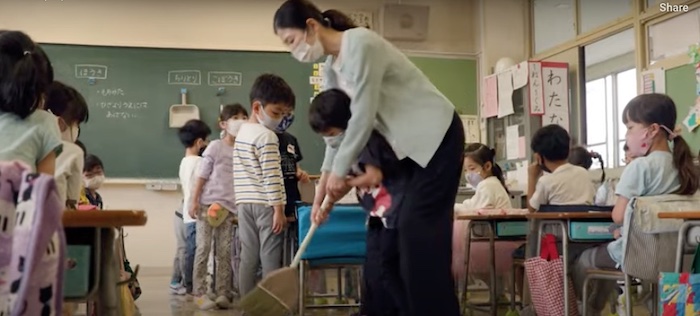
Those of us who were educated in a Western school system may balk at the title of Ema Ryan Yamazaki’s documentary about what goes on at a Japanese public elementary school. It suggests that public education’s goal is indoctrination rather than edification, and when you really think about it, maybe it isn’t so different from a Western liberal arts education, which, at bottom, prepares children for a life of employment, even if it ideally is supposed to make young minds more worldly. Perhaps the Japanese title of Yamazaki’s film is more revealing: “Elementary School is a Small Society.” The director focuses on first graders and sixth graders in order to contrast and gauge the changes that Japanese children undergo as they grow toward adolescence through the guidance of the school system. And true to the Japanese title, Yamazaki concentrates on those aspects of school policy that have to do with shaping young minds to accept their responsibilities as members of a community. It’s not just that the kids help serve food during meal times or clean their rooms and hallways, tasks that they seem to enjoy. It’s also instructors and administrators holding the children to account for how they think about themselves and act toward others. 

One of the more interesting sequences in the film centers on a first-grade girl who is preparing for a musical performance in which she will play the crash cymbals. When she makes a mistake, the teacher scolds her in a seemingly gratuitous fashion. She is devastated, but eventually buckles down and learns her part. The film implies that she is a better person for this travail, and there’s no reason to doubt it. Stripped of her agency by the cold attention of authority, she will undoubtedly strive to please not only that authority, but the people with whom she spends her time. Similarly, the primacy of the “undokai” (sports meet day) in Japanese schools reinforces in children the joy of working toward a goal but also shows them the cost of losing. Though all children have to experience such things, the structured nature of the competitions, at least as it’s presented here, tends to stress the success-failure dichotomy. For sure, it’s not enough just to show up and participate. You have to prove your worth. Even when the kids are drilled in disaster preparedness, the emphasis is on strict adherence to protocols regardless of their understanding of the reason for those protocols. 

Yamazaki says in the production notes that this methodology is “a double-edged sword” and acknowledges that some people may find it problematic, but it’s obvious she thinks it’s necessary and valuable. If the viewer is less sure of that pronouncement, it has less to do with cultural signifiers and more to do with lack of balance. The movie contains almost no scenes of or reflections on the children’s scholastic development. It’s all about their social conditioning, and thus it seems as if Japanese schools are all about indoctrination. For those of us who have had exposure to the Japanese education system there are other omissions. Corporal punishment, once a staple of early education in Japan and still exercised, reportedly, in some schools, isn’t mentioned at all. The problem of bullying, which is endemic in Japanese schools (all schools everywhere, for that matter) and could be thought of as a by-product of the push to conform, also gets little attention. And because the movie was shot at a school in Setagaya, one of Tokyo’s more affluent areas, something needs to be said about the academic competition that will soon ensue for entrance to prestigious junior high schools and how that pressure will come to bear on not only the students but their parents. The teachers who testify to how hard they work and their initial doubts with regard to the methods they must use have to contend with their supervisors, but also the parents who may think they aren’t treating their kids as well as they are treating other students. Being a responsible member of society, even a small one, is an admirable goal, but sometimes society doesn’t repay the effort as much as you hoped it would. 

In Japanese. Now playing in Tokyo at Cine Switch Ginza (03-3561-0707). (Some screenings will have English subtitles.)

The Making of a Japanese home page in Japanese

photo (c) Cineric Creative/NHK/PYSTYMETSĀ/Point du Jour

Posted in Movies | Tagged | Leave a comment

Review: Alcarràs

Winner of the Golden Bear at the 2022 Berlin Film Festival, Carla Simón’s second feature is, like her first, set in the Spanish countryside, this time in the agricultural region of Catalonia, which is undergoing huge changes due to real estate investments. The property in question is a peach orchard run by three generations of a family that doesn’t actually own the land they work. It was granted to them by the landowner following the Spanish Civil War, when the farmers hid the landowner and his family from the Republican army, and the landowner told the farmers they could use the land in perpetuity, but no deed was signed. It was essentially a gentlemen’s agreement, and the current heir to the landowner has given in to financial pressure from an interested corporation and sold the land for a solar farm. The farmers have until the end of the summer to harvest what will be their last crop. 

This crisis only serves to exacerbate the kind of intra-family frictions that are common when so many members depend on one source of income for their livelihoods. At the center is Quimet (Jordi Pujol Dolcet), the short-fused, de facto head of the household now that his father, Rogelio (Josep Abad), the son of the man who made the handshake deal for the land, is old and effectively retired. Quimet’s three children vary greatly in age, from teenage Roger, a burgeoning marijuana cultivator, to preschooler Iris (Ainet Jounou), who loves nothing better than to playact war games and sci-fi scenarios with her young twin cousins in the fields and forests surrounding their house. Simón presents their life as an idyll that’s being destroyed by modern technology whose large-scale benefits are good for people in general but whose short-term effects upend and supplant traditions that have sustained this region for centuries. Though the director is careful to provide background as to how other farmers are being driven off their land by speculators and produce wholesalers who purposely keep prices low, she’s mostly interested in how these dynamics affect families at the micro level. So Quimet quickly finds himself at odds with his brother-in-law Cisco (Carles Cabós), who decides to take the landowner’s offer of employment with the company that will manage the solar farm. Since Cisco is clandestinely working with Roger on his pot plants, his enmity with Quimet infects the son, and all these various conflicts incite the stereotypical male Mediterranean hormones, thus alienating the females in the family, in particular the middle daughter, Mariona (Xènia Roset), whose resentment of macho attitudes intensifies accordingly. As the summer stretches on and the family struggles to meet their goals before the trees are removed, the bonds that have kept the family together slacken, but the unit doesn’t disintegrate. Whatever else Simón’s dramatic mission is, she seems intent on the idea that while a farming family is nothing without the soil, they remain family even when the land is taken from them.

At slightly over two hours, Alcarràs‘s tension occasionally slackens as well, but in a way that’s how real life works—even as one’s external situation becomes increasingly desperate, the instinct to live in the moment persists, so the violent outbursts and episodes of heartbreak seem almost random, as they merely puncuate broader scenes of everyday existence. If it all works as well as it does it’s because the actors work as well as they do. Though all are local people who have never acted before and are not related to one another, they come across as a real family fully invested in one another’s well-being. I suppose they all know what to do because they come from similar families. There are some things you just can’t “perform.”

In Catalan and Spanish. Now playing in Tokyo at Toho Cinemas Chanter Hibiya (050-6868-5001), Kino Cinema Shinjuku (03-5315-0978), Human Trust Cinema Shibuya (03-5468-5551).

Alcarràs home page in Japanese

photo (c) 2022 Avalon PC/Elastica Films/Vilaut Films/Kino Produzioni/Alcarras Film AI

Posted in Movies | Tagged | Leave a comment

Review: Kraven the Hunter

The Sony wing of the MCU—the Spider-verse, to be more precise—continues its trudge toward the next blockbuster Spidey installment with the origin story of one of Peter Parker’s nemeses, who is positioned here as a hero in his own right; and that makes sense within the purview of the classic Marvel m.o. One thing that early fans of the comic books appreciated about Stan Lee’s vision was that both heroes and villains operated within complicated personality paradigms, unlike DC Comics characters, who lived in a decidedly Manichean world. Kraven is Sergei Kravinoff (Aaron Taylor-Johnson), the son of Russian crime boss Nikolai Kravinoff (Russell Crowe), who teaches both Sergei and his other son by a different mother, Dmitri (Fred Hechinger), how to hunt big game, skills that, in Sergei’s case, are enhanced to super powers after he is attacked by a lion in Africa and treated with a special potion by a local woman named Calypso (Ariana DeBose), who later becomes a high-powered London-based lawyer. As a source idea it isn’t much more imaginative than being bitten by a radioactive spider, but what’s really risible is that these super powers are never delineated beyond the usual bulging muscles and ability to run very fast without getting worn out. 

Kraven, the moniker Sergei adopts to carry out various special ops for whomever wants to hire him, is this shady character who lives off the grid and establishes a worldwide reputation as a badass, and true to the Marvel ethos his sore spot is his relations to his family, especially his father, who has become one of the biggest corporate criminals in the world, and Dmitri, who is trying to make a career as a musician under his father’s guidance and possesses a striking talent for mimicry. Nikolai’s own worst enemy is another Russian mafia boss who wants his “territory,” Aleksei Sytsevich (Alessandro Nivola), whose moral compass is even more haywire than Nikolai’s, owing mainly to the fact that he himself has been dosed with another potion, one that turns him into a two-legged rhinoceros under stressful circumstances. He’s like the Hulk’s evil cognate. The Rhino, as he’s called, kidnaps Dmitri, thus drawing Sergei back into the family orbit, despite his hatred of his father, in order to save his brother, a task that leads to a lot of mass destruction in both town and country. 

At no point does Spider-man show up amidst this mayhem. He isn’t even mentioned, and the ending predictably keeps things open-ended so that a sequel is anticipated. Though better than the Venom series and light years ahead of Madame Web and Morbius, Kraven the Hunter is similarly coy about its place in the Spider-verse and thus feels even more like a (very expensive) holding gambit, but I really wonder if the next Spider-man movie will have room for all these other superhero-villains. I like the Spider-man movies fine, especially the animated ones, but I can’t see the series gaining anything compelling by incorporating these characters, who can’t even hold their own in movies that are only about them. 

Now playing in Tokyo at Toho Cinemas Nihonbashi (050-6868-5060), Marunouchi Piccadilly (050-6875-0075), Toho Cinemas Hibiya (050-6868-5068), 109 Cinemas Premium Shinjuku (0570-060-109), Shinjuku Wald 9 (03-5369-4955), Shinjuku Piccadilly (95906861-3011), Toho Cinemas Shinjuku (050-6868-5063), Shibuya Cine Quinto (03-3477-5905), Toho Cinemas Roppongi Hills (050-6868-5024).

Kraven the Hunter home page in Japanese

Posted in Movies | Tagged , , | Leave a comment

Review: The Monk and the Gun

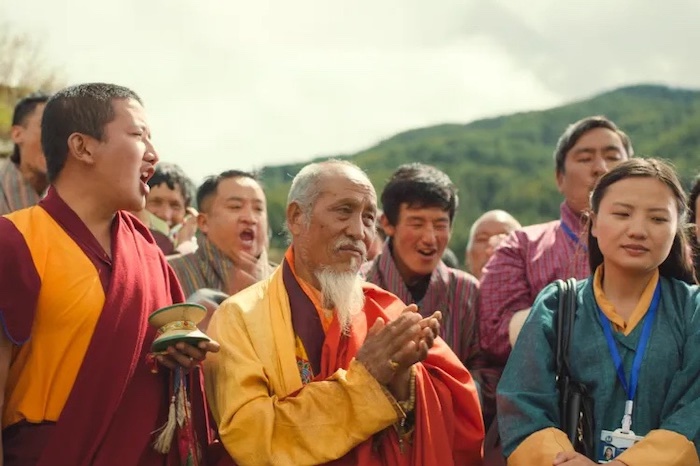
There’s a naive charm to this second feature by Bhutanese director Pawo Choyning Dorji that initially might be misconstrued as patronizing in nature, but Dorji obviously knows whereof he writes and the wit and warmth of the presentation are so effective that the movie, regardless of how reductive it may seem, wins you over. Like It’s a Mad, Mad, Mad, Mad World without the slapstick, The Monk and the Gun follows half a dozen comic plotlines in parallel until all converge in the end, and each story is so carefully measured against the principal theme—how difficult it is to “learn” democracy—that the conclusion has the force of an epiphany, even though it’s more of a joke. 

Set in 2006, when the king of Bhutan abdicated so that his nation could adopt a republican-style system and become “a truly modern country,” the central event is a mock election that is meant to teach democratic principles to a skeptical populace, most of which loved their monarch and thought the old system was just fine as it was. We see election workers preparing citizens for the vote, potential candidates already gearing up for future campaigns, and the hoi polloi discussing whether all the fuss is really worth it. Amidst all this business two lines of intrigue are introduced. In the first, an elderly Buddhist lama (Kelsang Choejay) in a mountain monastery, after hearing that the king is stepping down, orders one of his monks, Tashi (Tandin Wangchuk), to acquire two guns without stating why he needs them. In the second, an English interpreter, Benji (Tandin Sonam), meets an antique gun collector, Ron (Harry Einhorn), at the airport to help him track down a rare American Civil War-era rifle that was one of many imported to Bhutan during its own war with Tibet in the 19th century. You don’t need to be Stanley Kramer to predict that the pahts of these two firearms seekers will cross, but while we understand Ron’s reason for wanting the gun, the lama’s remains unknown. Tashi is just doing what he’s told, and not only doesn’t know his master’s purposes, but he has never seen a gun before. It isn’t until he stops at a way station for refreshment (“black water” = Coke) and sees 007 on TV in the anteroom brandishing a machine gun that he understands the purpose of the thing he seeks. Meanwhile, the election officials are becoming increasingly frustrated with the attitudes of the king’s subjects, who either believe that voting is inherently divisive (“You aren’t supposed to like the other side”) or are already cultivating a cynical attitude toward political gamesmanship. 

Dorji masterfully orchestrates these different vectors with dialogue that is comically precise and revelatory. When Tashi manages to snag the prize gun before Benji and Ron can get the money they promised to the owner (who first refuses their offer of $75,000, thinking it “too much,” and finally gives in to $32,000) he is puzzled when the pair offers him the same amount for the gun. “I don’t need money,” he says. “I just need the gun.” Though this kind of cultural dysphoria is common in such movies, Dorji delivers it without the condescending baggage that usually comes with it. In fact, the encounter says more about America’s, not to mention the West’s, attitude toward tools of destruction than it does about any perceived backwardness on the part of the Bhutanese. If anything, The Monk and the Gun is as much about the primacy of common sense as it is about the pitfalls of politics. 

In Dzongkha and English. Opens Dec. 13 in Tokyo at Human Trust Cinema Yurakucho (03-6259-8608), Shinjuku Musashinokan (03-3354-5670). 

The Monk and the Gun home page in Japanese

photo (c) 2023 Dangphu Dingphu: A 3 Pigs Production & Journey to the East Films Ltd. 

Posted in Movies | Leave a comment

Review: Sidonie in Japan

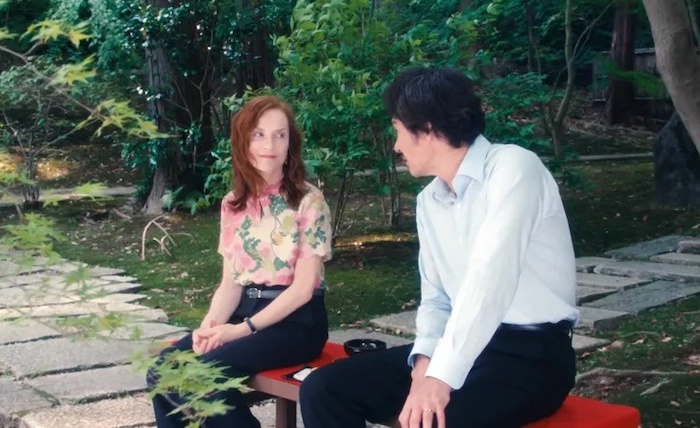
Since Isabelle Huppert has done so many movies for Korea it seems only fair she’d do one for Japan, but I would hardly call Sidonie in Japan parity. The ones she did for Korea were directed by Hong Sangsoo, who is hardly a typical Korean director and, while the two she did that were set in Korea (the third one was set in Cannes) certainly addressed Korean life to a certain extent, they avoided the usual cliches because Hong, as iconoclastic a director as they come, obviously wouldn’t stand for that. Sidonie, however, was directed by a French person, Elise Girard, who seems to have fallen for the usual “enigmatic East” nonsense and litters her screenplay with familiar Japanese images and ideas that land with a thud: the mannered stillness, the well-meaning but misconstrued gestures of omotenashi, the sense of romantic love as a tragic inevitability, not to mention copious references to exotic food and art. 

Huppert’s Sidonie is an author who comes to Japan to promote her first book, an auto-novel written when she was much younger and which has recently been translated. Her glum demeanor was precipitated by the death of her husband, Antoine (August Diehl), a year earlier, a tragedy from which she still hasn’t recovered. It’s often suggested that she expects the trip to take her mind off her mourning, but for some reason Antoine’s ghost haunts her even more as she goes about her business. Her Japanese publisher, Mizoguchi (Tsuyoshi Ihara), is an even more sullen customer while being “much younger” than Sidonie expected, a man who utters declamatory platitudes in French for no discernible reason (“I find the world absurd”) and who readily confesses to being in an unhappy marriage. For some reason the book tour skips Tokyo and mostly darts around the Kansai region, hitting Kyoto, naturally, where Sidonie gets an earful of Tanizaki and his shadows, not to mention the usual temples and rock gardens. Every so often Sidonie sees or senses Antoine’s presence, phenomena that Mizoguchi, being Japanese, understands instinctively. The two eventually fall into a brief affair that feels like an expression of survivor’s guilt on both sides (Mizoguchi’s father’s family died in Hiroshima), and then part amiably, the better for having embarked on a sexual dalliance in the tasteful Japanese manner.

Apart from the familiar stranger-in-a-strange-land elements, the movie’s most distracting quality is the clash of acting styles. Huppert is typically naturalistic, letting her character develop through the accommodation stages of being in a foreign country, from veiled suspicion to genuine curiosity, in a steady manner; while Ihara continually broadcasts the doom-and-gloom in his character’s soul as if trying to impress Girard. In the end, the director finally allows a joke to slip through and the relief is so palpable as to be shocking.

In French, English and Japanese. Opens Dec. 13 in Tokyo at Cine Switch Ginza (03-3561-0707).

Sidonie in Japan home page in Japanese

photo (c) 2023 10:15! Productions/Lupa Film/Box Productions/Film-in-Evolution/Fourier Films/Mikino/Les Films du Camelia

Posted in Movies | Tagged , | Leave a comment