Review: Despicable Me 4 and Fly Me to the Moon

The Despicable Me franchise just became the most successful animation series ever, box office-wise, which is only believable given inflation and the fact that I assume the franchise includes the Minions-focused films. In any case, resistance is futile, and the fourth installment has several moments of inspired lunacy that should appeal across the age spectrum, even if it’s very young children who are essentially keeping the series at the top of the heap. By now I would think the idea of a dedicated villain being turned around to become a villain-fighting hero would have outstayed its welcome, but there’s no accounting for thematic success when it comes to the financial calculations of Hollywood. In this one, the dagger-nosed Gru (Steve Carell) is beset by a former classmate at the school for villains, Lycée Pas Bon, he attended as a child, a literally cartoon Frenchman named Maxime Le Mal (Will Ferrell) who has invented something that turns him into a big bug commanding the cockroach hoards to do his bidding. After Le Mal is thrown in jail and escapes with the aid of his six-legged army, vowing revenge against his fellow alumnus, the deep state villain-fighting agency that employs Gru puts him into witness protection in an upscale suburban neighborhood with his wife, Lucy (Kristen Wiig), his three adopted daughters, and his new infant son, Gru Jr., who doesn’t seem to like him. However, the adolescent girl next door, Poppy (Joey King), recognizes the ex-baddie and blackmails him into helping her pull off a heist that Gru reluctantly, but ably, carries out.

That is essentially the plot, but the script by Ken Daurio and Mike White serves the humor, which has privilege over anything smacking of continuity or structure, so, of course, there’s a substantial Minion subplot that has several of the yellow pill-heads transforming into “mega-superheroes” who can’t quite get their super powers to work for them they way they should. Since most of the Minions’ staying comedic power is of the extreme slapstick variety, they don’t need verbal jokes and thus director Chris Renaud has a free hand to crank up the pratfalls and humiliations that kids love to see. 

When this stuff works, at least for me, it’s because of what’s made fun of. Gru’s bumbling attempt to be an all-American suburban dad (who sells solar panels for a living), especially with that Boris Badunov accent, is a pretty good antidote to current MAGA culture, especially when Gru and Lucy are contrasted with Poppy’s snooty country club-attending parents, who are a hoot-and-a-half but that’s only because I don’t have to live next door to them. Most of the rest of the attempts at levity had me checking my watch.

Speaking of watches, the big budget Fly Me to the Moon clocks in at 132 minutes, which is way too long for a romantic comedy, though selling it as a romantic comedy may be false advertising. All the elements are there—the monumental meet-cute, the initial enmity between the two romantic leads, the subset of supporting players who provide most of the comedy—but the framing story is flimsily constructed, and since that story is based on a real historical event, the Apollo 11 moon landing, the wobbly plot is even less engaging despite its breezy ridiculousness.

The leads seem to have been born to play these roles. Scarlett Johansson is Kelly Jones, the go-getting freelance advertising agent whose forceful personality in a world of Mad Men attracts the attention of the shadowy intelligence operative Moe Berkus (Woody Harrelson), who knows that Kelly is a professional con artist and blackmails her into doing PR strategy for NASA so that the project won’t have its funding pulled and the U.S. can get to the moon by the end of 1969, just as JFK promised. Though Berkus’s stated reason is beating the Soviets, the story positions him as an independent operator with a God complex. Kelly’s chief obstacle in getting the astronauts and various NASA honchos on board with product endorsements and CMs is Cole Davis (Channing Tatum), the mission director whose impressive upper body and collection of vintage crew-neck shirts make him the perfect foil for Kelly’s curve-enhancing outfits and very red lipstick. 

Conflict blooms when Berkus insists on there being a backup plan, because the U.S. cannot afford to blow the mission. He gets Kelly to rig a fake moon landing on a soundstage that will be used in case the real one fails, and while, at first, with its fey, Kubrick-jealous director and team of loutish actors, the secret project brims with comic potential, in the end it can’t help but come across as ludicrous in a completely unintended way—how could anybody, even within the fantasy milieu concocted for the movie, think that they would ever be able to pull this scheme off while the actual mission was taking place? And in a way, I think the filmmakers figured this out, too, but way too late. Like Berkus’s stupid notion, they just had to go through with it once they started, and the whole process drains the ending of both romance and comedy. 

Despicable Me 4, in subtitled and dubbed versions, now playing in Tokyo at Toho Cinemas Nihonbashi (050-6868-5060), Toho Cinemas Hibiya (050-6868-5068), 109 Cinemas Premium Shinjuku (0570-060-109), Shinjuku Wald 9 (03-5369-4955), Shinjuku Piccadilly (050-6861-3011), Toho Cinemas Shinjuku (050-6868-5063), Kino Cinema Shinjuku (03-5315-0978), Toho Cinemas Shibuya (050-6868-5002), Toho Cinemas Roppongi Hills (050-6868-5024).

Fly Me to the Moon now playing in Tokyo at Toho Cinemas Nihonbashi (050-6868-5060), Toho Cinemas Hibiya (050-6868-5068), 109 Cinemas Premium Shinjuku (0570-060-109), Shinjuku Wald 9 (03-5369-4955), Shinjuku Piccadilly (050-6861-3011), Toho Cinemas Shinjuku (050-6868-5063), Shibuya Cine Quinto (03-3477-5905), Toho Cinemas Roppongi Hills (050-6868-5024).

Despicable Me 4 home page in Japanese

Fly Me to the Moon home page in Japanese

Despicable Me 4 photo (c) Illumination Entertainment and Universal Studios

Posted in Movies | Tagged , , , , | 1 Comment

Review: How to Have Sex

The provocative title could be taken two ways, as either a manual or a philosophical contemplation, but the purport of Molly Manning Walker’s script suggests neither. Despite the manic energy displayed by the three British teens as they arrive at a cheap resort in Crete for a holiday that promises 24/7 partying, the cinematic mood is ominous, forcing the viewer to wonder: Do I have automatic prejudices against this situation, or is Manning Walker manipulating my feelings? As the women giggle and start pumping as much alcohol into their systems as they can get their hands on, the prejudices seem well-founded, and then, once they check into their room and announce that whoever gets laid gets the master bedroom, you sort of know where the movie is headed.

And you wouldn’t be wrong, but you’d be right in ways you won’t expect. The dynamic among the three BFFs is seasoned by their carefully wrought personalities, which are informed as much by their appearance as they are by their respective temperaments. Tara (Mia McKenna-Bruce), the nominal protagonist of the film, is small and bubbly, “cute” in a classic way and, most significantly, an admitted virgin who means to get past that presumed humiliation while on this vacation. Skye (Lara Peake) acts all experienced and everything, but it’s mostly a function of assertiveness. Em (Enva Lewis) seems the most level-headed by standards that parents would appreciate, and while she can’t hold her liquor very well she tests her limits often enough to make you believe her relative temperance isn’t worth a whole lot in a clinch. In essence, while the three pledge to have one another’s backs, they aren’t much good at looking out for themselves. They start hanging out with the trio next door: a guy called Badger with dyed highlights (Shaun Thomas) who isn’t as dumb or feral as his first impression might suggest; Paddy (Samuel Bottomley), a more subtle joker who turns out to be plenty feral; and their female pal, Paige (Laura Ambler), whom Manning Walker mostly ignores because, being a lesbian, she doesn’t pose a danger to anyone. 

Though there isn’t much of a story, there is a continuum of reckoning on Tara’s part. It’s not enough to say that her sexual awakening is a disappointment—it almost always is in the movies—but Manning Walker’s cautionary impulses vivify her rapid descent into disillusionment. Even before she’s taken advantage of, she burns out on the constant interaction with strangers that this kind of party atmosphere demands. The public drinking and debauchery is depicted in documentary detail—when the kids are hungover their nausea is contagious. Manning Walker, who got her start as a cinematographer, knows what it takes to isolate emotional states on a crowded screen. Her movie taught me nothing about how to have sex, but quite a bit about how difficult it is to feed your appetites without losing your soul. 

Opens July 19 in Tokyo at Human Trust Cinema Shibuya (03-5468-5551), Cinemart Shinjuku (03-5369-2831). 

How to Have Sex home page in Japanese

photo (c) Balloonheaven, Channel Four Television Corporation, The British Film Institute 2023

Posted in Movies | Leave a comment

Review: La Chimera

Josh O’Connor’s most characteristic facial expression is the sheepish grin, a look he made his own when he played the young Prince of Wales in the third season of The Crown, which is odd because Charles in real life never came across as anything but self-confident and O’Connor seemed to be implying that he was grievously intimidated by the even younger Diana Spencer, a reading of the situation that probably changed a lot of people’s thinking about that relationship. Whether it was based on anything other than O’Connor’s peculiar acting style, the expression has also been dominant in subsequent roles with characters who don’t always seem as shy as O’Connor interprets them. In Alice Rohrwacher’s quite original quasi-fantasy, he plays a lapsed archaeologist with a huge chip on his shoulder slumming it in a rural Italian town as the mystic-leader of a ragtag band of tomb-robbers, or tambaroli, in the local parlance. His British expat, Arthur, is dour to the point of surliness, but can still eke out a shy smile when he needs to charm the audience—though never, it would seem, his on-screen interlocutors. I like O’Connor, but I wish he’d cut it out.

The reason for Arthur’s chronic glumness and dishevelment is never explicitly explained, though it probably has something to do with the absence of the love of his life, Beniamina (Yile Vianello), who is only shown in what I assume are memories that flit through Arthur’s brain when prompted by some outside stimulus. Though the viewer eventually gleans that the girl is dead, she is never declared as such by Arthur, at least not in front of her mother, Flora (Isabella Rossellini), a wheelchair-bound singing instructor living in a broken-down villa who stares down her gaggle of daughters and grand-daughters, all of whom do think Beniamina is dead and want Flora to move into a nursing home. Just as Rohrwacher never lets on what it was that led to Arthur’s rupture with the academic discipline he once pursued, there’s no mention of how Beniamina came into his life, and at various junctures there are hints that everything is a figment of his imagination. The exception is the milieu, which is not the usual sun-kissed, leafy tourist paradise we expect from movies set in the Italian countryside, but basically a despoiled landscape filled with crumbling shacks, unkempt forests, and toxic industrial wastelands. Here, Arthur and his merry troupe look for underground grave cavities containing Etruscan pottery and sculptures, which Arthur locates using a dowsing rod until he becomes sick to his stomach, thus indicating that the dead dwell just below his feet. The group then clandestinely sells the contraband—all relics in Italy belong to the state, and the police are constantly on the lookout for poachers—to a mysterious rich person named Spartico (Alba Rohrwacher), but Arthur is not interested in money. He’s still hung up on beauty, which is why his impulses tend to run opposite to the aims of his accomplices. The only person who seems to understand him is Italia (Carol Duarte), Flora’s tone-deaf student and reluctant servant, who objects to the raiding of the deceased, no matter how many centuries they’ve been gone. It’s perhaps this doctrinaire moral stance that attracts Arthur, but he’s such a cipher that it becomes a chore just trying to make sense of his behavior. 

The same goes for Rohrwacher’s magical realist-style direction, which flips the camera every which way in order to keep the viewer off balance and jumbles the development into a collage of often counteractive intentions. Which isn’t to say La Chimera is frustrating or annoying. It works well as a comedy of errors with its colorful, intriguing characters, including Arthur, whose sourness never tips so far over as to fall into despair. Whatever the purpose of that enigmatic grin, it helps alleviate the movie’s latent sense of misery. 

In Italian and English. Opens July 19 in Tokyo at Bunkamura Le Cinema Shibuya Miyashita (050-675-5280), Cine Switch Ginza (03-3561-0707).

La Chimera home page in Japanese

photo (c) 2023 tempestra srl, Ad Vitam Production, Amka Films Productions, Arte France Cinema

Posted in Movies | Tagged | Leave a comment

Media watch: Ministry throws cold water on local government’s registration of same sex couple

In May, a same sex couple made news when the city of Omura in Nagasaki Prefecture allowed them to be indicated as the equivalent of a common law couple in their resident certificate, or juminhyo. It is the first time a same sex couple has received the indication in a juminhyo. Since then, at least two other cities, Kanuma in Tochigi Prefecture and Mitoyo in Kagawa Prefecture, as well as Setagaya Ward in Tokyo, have said they are considering making the same indications if a same sex couple want to do so on their juminhyo. 

But not so fast, said the central government. According to the Asahi Shimbun, the Minister of Internal Affairs and Communications (MIC), Takeaki Matsumoto, held a press conference on July 9 saying that there is a “possibility” that such an indication would cause “practical problems.” Apparently, the ministry had already contacted the mayor of Omura, Hiroshi Sonoda, in writing, telling him that juminhyo are official documents under national law, which Omura “did not follow” when it made the indication for the unnamed same sex couple in their household juminhyo. Sonoda replied that he had no intention of changing the indication and requested that the ministry clarify what it meant by “practical problems.” It is the mayor’s understanding that local governments administer resident certificates at their own discretion, since juminhyo are necessary for managing social security and social welfare matters at the local level. By extension, they can also be used to grant power of attorney. However, in many cases, such matters involve the central government, as well, so the MIC feels it has some say on how resident certificates should be administered. The MIC’s thinking is that if same sex couples are treated the same as common law couples in the document, social welfare officials will have a difficult time judging if an applicant is eligible for certain social services, even though an official at Omura City Hall told Asahi that the office received a call from an MIC official on July 8 who admitted that the indication in the juminhyo “should be decided by the local government.”

But the MIC didn’t stop there. A later Asahi article said that on July 9, the ministry sent notifications to all prefectures saying pretty much what Matsumoto said at the press conference. While Matsumoto’s statement about the matter was vague, its intention seemed to be to tell local governments that they can’t make such indications in the juminhyo, though, as Sonoda pointed out, it isn’t clear if the ministry can force the issue.

Omura’s move was inevitable. In recent years, some local governments have passed ordinances that recognize same sex couples as couples, but these ordinances do not give same sex couples the same rights as legally married couples. However, in March the Supreme Court decided that someone in a same sex relationship is eligible for compensation provided by the government to victims of crimes or victims’ families if that person’s same sex partner was the victim of a crime. The court’s rationale was that since common law heterosexual couples qualified for such compensation, same sex couples should as well.

In the Asahi article, a Nihon University professor disputed the MIC’s position, saying that the administration of resident certificates is not work that has been “entrusted” to local governments by the central government, so it is, indeed, completely up to the local government how they carry out the process. In addition, he doesn’t see how there would be a “problem” in indicating a same sex couple on the juminhyo, since on the document there are boxes for gender and relationships, so, as in the case of the Omura couple, one partner would be the head of household (setainushi, a problematic word for many since it literally means “owner of the household”) and the other would be indicated by their relationship to the head of household (HOH), in this case “husband,” and since both partners would have the “male” gender box checked, it would be easy to tell that this was a same sex couple. The professor says that Omura recognized, in accordance with the Supreme Court decision, that allowing heterosexual common law couples to register as partnerships without allowing same sex couples the same thing is discrimination. 

Continue reading
Posted in Media | Tagged , , , , | Leave a comment

Review: May December

Todd Haynes’ latest study of the undercurrents of American notoriety is his most willfully complicated work. It’s based on the 90s scandal involving the late Mary Kay Letourneau, an elementary school teacher who at the age of 34 had sex with one of her students and went to jail, where she gave birth to the boy’s child. Upon release, she married the boy and they raised a family before separating some 15 years later. Haynes and his screenwriter, Samy Burch, have changed the particulars of the case and added a fictional character who means to probe the relationship for personal profit. Though the themes are not particularly difficult to grasp, the plot tries to answer every possible question an observer might ask themself about what such a relationship entails, and, for the most part, the two filmmakers succeed. In fact, they answer a few questions we may not even have thought of.

Gracie (Julianne Moore) and Joe (Charles Melton) Yoo live in a fine home in upscale Savannah, Georgia, where both have lived all their lives, meaning they remain in the town where the scandal unfolded, among the people they scandalized most directly, including Gracie’s first husband and their children. In addition to the daughter, Honor (Piper Curda), that Gracie bore in prison and who is now in college, the couple have twins, Mary (Elizabeth Yu) and Charlie (Gabriel Chung), who are about to graduate high school. Joe is only 36. Into this fertile milieu comes Elizabeth (Natalie Portman), a famous TV actress trying for some much desired prestige by playing Gracie in an independent film directed by a hot shot veteran with whom she is having an affair. Gracie has granted Elizabeth a few weeks of her time so that the actress can do research on the part, a task that Gracie obviously doesn’t like but, as she says, if they’re going to make such a movie any influence on her part is better than nothing. At first, Elizabeth tries to be the consummate professional, promising Gracie that the movie will be a “complex and human story,” an explanation that doesn’t exactly put Gracie at ease, but the die has already been cast, and as Elizabeth spends her days in the finely appointed household she, and we, observe Gracie’s domineering passive-aggressive relationship with Joe, a medical technician whose hobby is raising butterflies. As Elizabeth gets closer to a conception of Gracie that she can use, she inserts herself into the life of the family and the community in such a way that, purposely or not, she undermines the various relationships she encounters by reflecting them back on the principals. Moreover, by interviewing the peripheral personalities, such as Gracie’s ex-husband, Tom (D.W. Moffett), and their emotionally wayward son, Georgie (Cory Michael Smith), she manifests an array of self-doubts and recriminations that have been simmering for years. Joe, in particular, finally admits to himself that, as much as he loves his children, he resents Gracie for forcing him onto a path he was too young to navigate with a clear mind. 

Fundamentally, the story is about sex and maturity, and in that regard Haynes can’t resist making it into a broad entertainment—a mystery and a comedy, often at the same time. The dramatic thrust of the scandal is that Gracie impulsively stepped over a line and refuses to regret it, which means Elizabeth feels she has the license to do the same, and while the actions on screen are bound to shock certain sensibilities, they do so in the spirit of how tragically ridiculous the whole enterprise is. In the film’s most hilariously cringe-inducing scene, Elizabeth takes questions from a high school theater class whose main interest is how she handles sex scenes, for which she is famous. As with almost every encounter in the movie, Elizabeth plays it like a pro, meaning she not only gets in the last word, but keeps her interlocutors wanting more. In that regard, she’s Gracie’s worst nightmare. 

Now playing in Tokyo at Toho Cinemas Nihonbashi (050-6868-5060), Toho Cinemas Hibiya (050-6868-5068), Toho Cinemas Shinjuku (050-6868-5063), Toho Cinemas Roppongi Hills (050-6868-5024).

May December home page in Japanese

photo (c) 2023. May December 2022 Investors LLC

Posted in Movies | Tagged , , | Leave a comment

Review: Àma Gloria and Strange Way of Life

The process of parental imprinting is an easy to comprehend miracle, but it’s rarely been explicated as effortlessly as it is in Marie Amachoukeli-Garsacq’s second feature, Àma Gloria. The parent, in this case, is not biological, but rather a nanny for a little girl she has essentially raised since infancy. Six-year-old Cléo (Louise Mauroy-Panzani) lost her mother to cancer when she was a baby, and her father, though loving and thoughtful, is a busy man, and so he hired Gloria (Ilça Moreno Zego), a middle aged immigrant from Cabo Verde, to take care of her in their Paris home. Cléo’s adoration of Gloria is so impeccable that you wonder if the child has appropriated the older woman’s hairstyle (minus the dashing shock of yellow) in order to make the identification more material. And being a six-year-old, Cléo cannot really fathom that Gloria might have a life away from her. One day, Gloria receives a phone call saying that her mother in Cabo Verde has died, and so she must go back permanently to be with her own two children, the older of which is pregnant. Cléo refuses to understand the situation so Gloria sets up a compromise with the permission of her father: Cléo can come to Cabo Verde to visit during summer break and get to know Gloria’s children.

As could be expected, the visit is awkward in more ways than one. Cléo, who has been somewhat spoiled by Gloria, demands her time, but this isn’t Paris, where Cléo was her only responsibility. In addition to taking care of her two children and spending time with their father, Gloria is using the money she made in France to build a hotel. Since much of the movie is told through the POV of Cléo, many of these scenes are purposely vague, but the idea gets through that Cléo’s confusion masks resentment, especially toward Cesar (Fredy Gomes Tavares), Gloria’s adolescent son who mutually resents Cléo for having monopolized his mother’s life while he himself was a child. Amachoukeli-Garsacq attempts to put across these inchoate feelings with colorful animated sequences that illustrate certain points in the relationships being presented, and while they sometimes make matters more confusing, they also prepare us for the coming-to-terms that all parties, especially Cléo, must navigate before proceeding with their lives. Obviously, Cléo is incapable of articulating these matters, but the director makes us understand not only how Cléo’s mind works, but how she comes to see that growing up is painful.

Most importantly, Amachoukeli-Garsacq grounds us in the culture of Cabo Verde in order to imprint on the audience the sense of Gloria having a settled, permanent life there. If anything, Paris was the anomaly, and while Gloria loves Cléo just as much as she does her own flesh-and-blood, there’s not much in the former Portuguese colony that Cléo can identify with. Inevitably, it will require a crisis or two—at one point Cléo invokes “spirits” to kill Gloria’s new grandchild—in order to make her realize that other people, like Gloria, have their own unique existence apart from herself. Amachoukeli-Garsacq seems to be telling us that this realization is the most monumental one we will ever experience. 

The coming-to-terms in Pedro Almodóvar’s 31-minute English-language western, Strange Way of Life, happens much later in the central characters’ lives, and involves both sex and violence, in that order. Pedro Pascal and Ethan Hawke play two former ranch hands who reunite many years later to consummate, probably not for the first time, the love they felt for each other when they were young bucks. The difference now is that Jake (Hawke) is the sheriff of an unnamed town and Silva (Pascal) is the father of a fugitive wanted for murdering Jake’s widowed sister-in-law, so the tumble in the hay immediately takes on the cast of an ulterior motive, at least on Silva’s part. But as in all things Almodóvar, it’s never that simple.

Apparently, Almodóvar was initially given the chance to direct Brokeback Mountain and passed on it, thinking that Hollywood would not really go for what he wanted to do with Annie Proulx’s short story. Years later, this is basically what he had in mind; or, if it isn’t, it’s what he thinks a story about two cowboys in love could lead to. And while his idea of the lives these two could have led is compelling and his visual and aural choices are, as always, superb, his treatment of western cliches is half-baked if not downright condescending. Reportedly, he greatly respects what Ang Lee did with Brokeback even if he doesn’t necessarily agree with it. This short exercise in what might have been indicates that Lee was probably the better choice.

Àma Gloria, in French and Portuguese, opens July 12 in Tokyo at Human Trust Cinema Yurakucho (03-6259-8608), Bunkamura Le Cinema Shibuya Miyashita (050-6875-5280).

Strange Way of Life, in English and Spanish, opens July 12 in Tokyo at Human Trust Cinema Yurakucho (03-6259-8608), Human Trust Cinema Shibuya (03-5468-5551), Cinema Qualite Shinjuku (03-3352-5645).

Àma Gloria home page in Japanese

Strange Way of Life home page in Japanese

Àma Gloria photo (c) 2023 Lilies Films

Strange Way of Life photo (c) 2024 El Deseo D.A. S.L.U.

Posted in Movies | Tagged , , | Leave a comment

Review: Smugglers

It’s easy to see why Kim Hye-su is the most popular female actor in Korea. In a culture where a certain beauty standard dictates how women who spend their time in the public eye (not to mention men) are supposed to look, Kim’s distinctive, almost theatrical features—a full mouth and large, wide-set eyes—allow her to take on a broader range of parts, and she always puts them across. She can portray a professional woman of high position or a poverty-stricken object of abuse with equal credibility. In this lively action entertainment she plays a woman who has had to fend for herself since she was 14 and thus acquires a set of survival skills that are often identified with shysters and con men, attaching those skills to conventional feminine wiles. Since the movie takes place in the 70s, political correctness is not a problem (though it rarely is in Korean productions), and the director, veteran blockbuster master Ryoo Seung-wan, exaggerates the fashions and colloquialisms of the time to bring out the comic and ironic elements in the story. Kim, augmented with an array of flamboyantly coiffed wigs, just runs away with them.

Genre-wise, Smugglers is a crime caper, though one in which the central female characters are both perpetrators and victims. Kim plays Chun-ja, a woman who dives for abalone and sea urchin off the coast of a fictional town with half a dozen other women. In recent years, a chemical plant has started operating nearby, polluting the water and ruining the catch, so an enterprising truck driver suggests they dive for contraband. Ships pass through the area and often dump crates into the sea containing imported goods subject to customs tax. The women haul these crates up and the driver brings them to Seoul where the goods enter the black market. As with many period genre films, this one teaches you something about Korean history, namely how average people, especially merchants, relied on the black market in the 60s and 70s just to get by. Chun-ja and her best friend, fellow diver Jin-sook (Jung-Ah), whose father owns the boat they use, rake in the cash and, for a short while, at least, enjoy the related perks, but someone tips off the custom authorities, and the crew is busted in the act at sea. Even worse, Jin-sook’s father and brother are killed during the raid, while Chun-ja escapes into the sea, trailing rumors behind her that she was the one who squealed. Obviously, you can’t keep a woman like Chun-ja down, and she eventually becomes an independent black marketeer in Seoul, only to tread on the territory of the infamous smuggler Sergeant Kwon (Zo In-sung), who threatens to disfigure Chun-ja with the huge Bowie knife he once used to kill Vietnamese. Chun-ja convinces him that she can help him sidestep Busan, where much of his merchandise is confiscated by customs, by diverting it through her home town, but that means she has to go back and face the music orchestrated by Jin-sook, who still thinks she betrayed the divers. 

The script, by Ryoo and Kim Jeong-yeon, twists and turns without straining the viewer’s ability to suspend disbelief, and mostly rides on Chun-ja’s ability to the play the various bad guys—in addition to Kwon there’s a young deckhand-turned-punk-gangster and the avaricious head of local customs—against one another while trying to keep herself from being killed by Jin-sook and the other female divers. It doesn’t take too much imagination to figure out that comeuppance is the main purpose of the dramatic development, and it works, climaxing in an action set piece at sea that includes guns, sharp objects, and sharks. You’ll never have a better time watching male assholes get theirs. 

In Korean. Opens July 12 in Tokyo at Kadokawa Cinema Yurakucho (03-6268-0015), Shinjuku Piccadilly (050-6861-3011).

Smugglers home page in Japanese

photo (c) 2023 Next Entertainment World & Filmmakers R&K

Posted in Movies | Tagged , | Leave a comment

Review: Richland

For those who found Oppenheimer less than forthcoming about its subject’s real feelings toward the use of his terrifying invention at the end of World War II, this documentary on the town created by the U.S. government to produce the plutonium used in the device that destroyed Nagasaki may suffice as a thematic antidote, though I also found it to be oddly complementary in tone and style. Richland was established by the U.S. Department of Energy in 1943 to house the men and women who worked at the Hanford nuclear reactor, which was located on a vast Indian reservation on the plains of Washington state. Even after the war was over it was maintained to provide fuel for America’s nuclear arsenal, producing over time some 17 metric tons of weapons grade plutonium. Director Irene Lusztig strikes out on two paths. The first profiles Richland’s distinctive image of itself as a pioneering “home town” of the nuclear age, with a high school sports team called the Bombers (B-52s figure prominently on the uniforms), a town logo that utilizes a mushroom cloud, and a general attitude, at least among its older residents, that very important work goes on here. The second path explores what the town’s industry has wrought, including the largest environmental cleanup project in the world, an epidemic of cancers that most people are reluctant to talk about, and a world reputation as a place that stands for horrible, violent death.

Lusztig cleverly uses a published book of poems by local writer Kathleen Flennikin, read by various residents throughout the film, to comment on the schizophrenic nature of the town, since Flennikin clearly feels warmly about her upbringing while harboring fear and loathing for what the homey facade hides. The authorities who built the fine ranch houses and excellent infrastructure saw it as representing the fulfillment of the American Dream that the nuclear age implied—JFK visited Richland only weeks before he died—and people were grateful even while they were being tested on an almost daily basis, because, in the end, they were all willing guinea pigs. At one point a local woman shows Lusztig a graveyard filled with babies born in the late 40s and early 50s, a testament to how the people who managed the project were learning as they went along. Lusztig also spends time listening to the Native Americans whose land was taken and then poisoned, and which they are now reclaiming inch-by-inch as engineers and technicians go through the back-breaking labor of testing and removing thousands of tons of soil. “Actually, all they can do is move it,” says one elder about the task. Another goes as far as to identify with the Japanese victims of the initial product of Hanford, though he admits that the Japanese “got the worst of it.” 

Richland eschews an onslaught of statistics and hardcore facts for an impressionistic overview of an American mindset that will be perfectly recognizable to viewers who aren’t Americans. Old-timers, including one Black man who worked his whole life at the plant, speak in frankly racist terms about how the victims of the bomb got what they deserved but that it is all now just water under the bridge. (“If not, we’d all be speaking Japanese”) One former school teacher who campaigned to remove the mushroom cloud logo from the town’s iconography and was ostracized for doing so nevertheless vehemently justifies the use of the bomb on camera. As a corrective, Lusztig has a group of multi-ethnic high school students sit in a circle and discuss their own feelings on the subject. They invariably mock the attitudes of their parents, with one girl saying that the only people who discuss the issue of the town’s problematic legacy are those who have no power to do anything about it, but Lusztig does manage to find one voice that cuts through the fog of curated nostalgia. Yukiyo Kawano, a Japanese artist whose family is from Hiroshima and who now lives in Portland, has fabricated an installation in the shape of the atomic bomb made from the hair and kimonos of her grandmother. During a public presentation in Richland she says that “reconciliation is essential,” but is also quick to express her discomfort with the way the town still glorifies its being and purpose, and there is nothing that anyone present can say to refute her. 

Now playing in Tokyo at Theater Image Forum Aoyama (03-5766-0114).

Richland home page in Japanese

photo (c) 2023 Komsomol Films LLC

Posted in Movies | Tagged | Leave a comment

Review: Bleeding Love and Scrapper

Someday, maybe soon, there is bound to be a special section on Prime Video or even the Criterion Channel dedicated to movies starring real-life parent-offspring acting teams ideally playing parents and offspring. Though Ethan Hawke has directed his daughter Maya, I await the day they appear on screen together the way that Sean Penn and Dylan Penn acted as father and daughter in Flag Day, which Penn pere also directed. Included in this special section will surely be Bleeding Love, which stars Ewan McGregor and his daughter Clara McGregor playing an estranged father and daughter on a road trip through the American Southwest. Movie fans looking for subtext will certainly latch on to the intelligence that Ewan and Clara’s mother separated some time ago and in the meantime Ewan remarried and started a new family, so there is a certain amount of added value frisson to the plot, which has the unnamed father, a recovering alcoholic who left his wife and daughter some years ago to start a new family, showing up suddenly at the hospital where the daughter herself is recovering from an overdose, and then deciding to take her to Santa Fe to visit an artist friend on the spur of the moment in order to rekindle her creative mojo as a means of steering her away from drugs, since she was once an aspiring painter. Perceptive viewers will find this m.o. suspicious and quickly figure out the father’s real intentions, but until that point we are treated to some fairly intense sequences of awkward silences and even more awkward attempts by the father to recapture the intimacy these two felt when he was a happy drunk and she was a little kid.

The McGregors are totally dedicated to and credible in the roles they assume, but the dialogue and the situations written by Clara, Ruby Caster, and Vera Bulder does them no favors. Aside from the hackneyed addict cliches that the script ticks off like items on a shopping list, the whole road trip structure reveals a lack of imagination. There’s the detour to the trailer park full of poor folk with their own substance (and gun) problems, a big dustup in a motel room that results in Clara hitting up a creep at a liquor store for a free high, and lots of flashbacks showing seemingly better times that feel fake, if only because McGregor’s Scottish accent makes it difficult for us to believe he’s an All-American blue collar type obsessed with baseball. Even the running joke of the daughter’s constant need to urinate at the side of the truck loses steam and meaning early on. Director Emma Westenberg’s attempts at impressionism, as when a sex worker does an interpretive dance in the headlights of the father’s pickup truck, come across as non sequiturs rather than instances of shared purpose among characters whose most pertinent trait is desperation in the face of shattered dreams.

Another estranged father-daughter duo is at the center of the British indie Scrapper, but the actors who play 12-year-old Georgie (Lola Campbell) and her ne-er-do-well father, Jason (Harris Dickinson), are not related, and Jason has had nothing to do with Georgie’s life since Georgie’s mother pushed him away before she was born. After the mother dies, Georgie, as headstrong a kid as you’re likely to meet in any movie, endeavors to live by herself by making up an uncle-guardian named Winston Churchill to stave off social services and selling boosted bicycle parts for cash. When Jason hears of the mother’s death he shows up on Georgie’s doorstep—or, more precisely, climbing over her back fence—but Georgie won’t have him. So he has to blackmail her into letting him stay, which is, frankly, pretty easy to do given her circumstances

Since there never seems to be a lot at stake, the relationship is free to make its way to the inevitable coming-to-terms, and director-writer Charlotte Regan is hard put to create believable conflicts, which means she has to fall back on her characters, who are appealing in that they know how to get around the system and even the law without actually making anyone suffer. It’s implied strongly that Jason’s past is checkered and that he’s somehow turned himself around, but Regan is reluctant to go into details, as if finding out, say, that Jason might be a felon would darken the viewer’s opinion of him. Georgie, of course, has an excuse for her larcenous, dissembling ways—she’s a kid, and we accept the precociousness because she’s got to survive. But everything is on the surface with these two as far as emotional maturity goes, which means they end up bonding over practical matters: Jason agrees to help Georgie steal a bicycle, seemingly because he really wants to prove he loves her in his own weird way. It’s an angle that Regan should have explored more boldly. 

Bleeding Love now playing in Tokyo at Shinjuku Piccadilly (050-6861-3011), Yebisu Garden Cinema (0570-783-715).

Scrapper now playing in Tokyo at Shinjuku Musashinokan (03-3354-5670), Human Trust Cinema Shibuya (03-5468-5551), Human Trust Cinema Yurakucho (03-6259-8608).

Bleeding Love home page in Japanese

Scrapper home page in Japanese

Bleeding Love photo (c) 2024 Sobini Films, Inc.

Scrapper photo (c) Scrapper Films Limited, British Broadcasting Corporation and the British Film Institute 2022

Posted in Movies | Tagged | Leave a comment

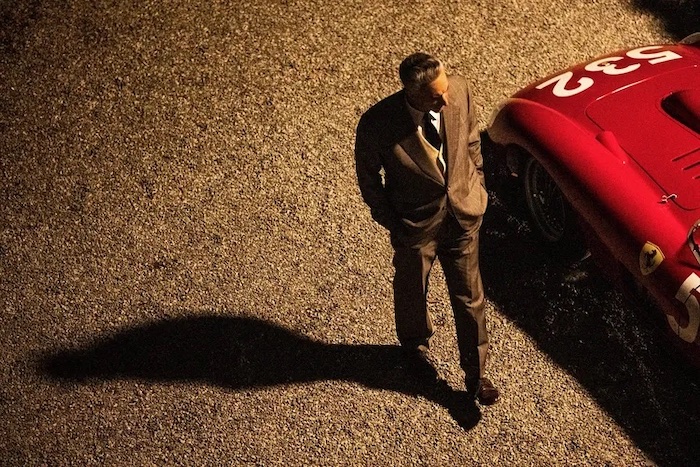
Review: Ferrari

No pun intended, but Michael Mann has always been a man’s director. His protagonists deal in conflicts that seem particularly masculine in nature, which is why, I suspect, he likes stories set in a past where gender distinctions were more obvious and acceptable. This mini-biopic (it only covers three months) of the auto entrepreneur Enzo Ferrari (Adam Driver) almost seems to exaggerate its mileu with stereotypical macho flourishes often associated with Italy. Ferrari is terse in speech, succinct in manner, and severe in appearance—his fine suits and heavy sunglasses making more of an initial impression than his actual behavior. Driver’s Italian accent, the only one that wasn’t derided in House of Gucci if only because his co-stars sounded like Chico Marx in comparison, is subtle but forceful, effectively conveying Ferrari’s single-mindedness. The businessman-engineer-driver’s attention is laser-focused on racing, as he points out in the film’s most trailer-ready quote: “Most manufacturers race to sell cars; I sell cars to race.” Mann makes the most of montages showing Ferrari worrying over technical and mechanical details of his cars, like the suburban dad on a Sunday afternoon changing the oil or adjusting the carburetor on the family station wagon.

Mann fortifies this image by juxtaposing Ferrari’s automotive concerns with his domestic situation, which is complicated as only a southern European could make it. Ferrari is raising a young son, Piero, with his mistress (Shailene Woodley), while remaining married to his business partner, Laura Ferrari (Penélope Cruz). Moreover, the film is set in 1957, only a year after the couple’s son, Dino, died from a rare disease, and Ferrari still mourns him deeply. The matter of succession for a proudly patriarchal type like Ferrari is almost obsessive, and a good deal of the drama centers on Laura’s objection to Piero as the natural heir to the Ferrari name and business, which isn’t assured since, as the story opens, the company is close to bankruptcy, and—another nod to the different sensibilities that ruled the past—the only hope is for Ferrari to boost his brand by winning the Mille Miglia, a famously dangerous, multi-day road race across Italy. So stitched into the family melodrama and business-oriented intrigue is a pulse-quickening motor sports epic for which Mann seems to have been preparing his whole life. And even within that sub-plot there are layers of emotional resonance in Ferrari’s interactions with his drivers, the high-born, impulsive Spaniard, Alfonso de Portagol (Gabriel Leone), and Ferrari’s veteran pain-in-the-neck, Piero Taruffi (Patrick Dempsey). The dance that these three men’s men carry out in trying to prove their worth in a highly competitive and deadly sport should have been the subject of its own movie.

Which isn’t to say Ferrari is stretched thin by its overlapping thematic tensions. Mann’s dedication to the whole idea of Enzo Ferrari, which he’s supposedly been working on for 20 years, is easy to parse given his past thematic interests, and Mann is nothing if not a self-consciously careful filmmaker, so he understands the pitfalls of taking on too much. For sure, some of the more important plot details are ground up in the gears of the action prerogatives, but as an immersive cinematic experience Ferrari holds its own very well. 

Opens July 5 in Tokyo at Toho Cinemas Nihonbashi (050-6868-5060), Toho Cinemas Hibiya (050-6868-5068), Toho Cinemas Shinjuku (050-6868-5063), Kino Cinema Shinjuku (03-5315-0978), Toho Cinemas Shibuya (050-6868-5002), Toho Cinemas Roppongi Hills (050-6868-5024).

Ferrari home page in Japanese

photo (c) 2023 Moto Pictures, LLC. STX Financing, LLC.

Posted in Movies | Tagged , , | Leave a comment