Fuji Rock ’24: July 28, second half

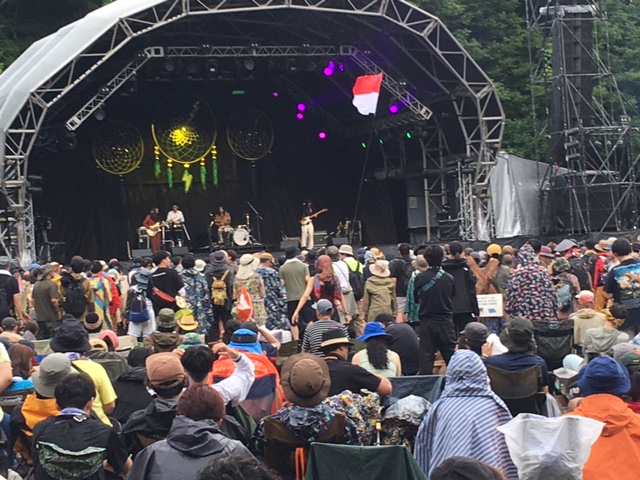
Further on from my train of thought in the previous post, I saw Ali, a guitar band from Indonesia at the Field of Heaven in the late afternoon. Apropos that stage, their music is spacey and ethnic, a kind of repetitive drone pattern that instills itself in the spine. The venue was quite crowded with dancing bodies, thus proving that Asian acts can attract sizable crowds. Moreover, the connection is vital. The bassist/spokesperson for the band said it was a “miracle” they had been asked to play in Japan, and before the last song, explained that the Indonesian title translated as “The Sun,” and, I kid you not, when they reached the chorus of the song, the sun actually burst out through the clouds.

Nothing quite as transcendent happened at the White Stage during the Jesus and Mary Chain’s set. When they emerged in the mid-90s, I thought their appeal was that distorted guitar sound, which supposedly launched the shoegaze genre. At the White Stage, the sound was crisp and clear, thus making their songs less distinctive. Distinction was the order of the day for the British pop singer Raye, who was slated just before twilight at the Green Stage. It was a full production, with her fairly large band decked out in black tie and white tuxes. She got the set moving in an agreeable direction and a good portion of the audience was dancing happily. The middle section was given over to her more serious material dealing with abuse and whatnot, which required explanations that I don’t think most of the audience could follow.

The rain abated for a while, so the crowd at the Red Marquee for Fontaines D.C. wasn’t as big as I’d expected, at least not initially. But those who were there seemed to be stone fans. They knew all the songs and reacted wildly to the raw music, the loudest I heard all weekend. 

The rest of the evening I spent at the far end of the festival, which wasn’t so crowded since I assume most people were preparing themselves for Noel Gallagher at the Green Stage. I caught the end portion of the Meters tribute band at Heaven, which brought the funk they promised. Kim Gordon did a blazing show at the White Stage with a band that could have been her grandchildren. They had to do all they could to keep up with her. Speaking of grandchildren, or just children, the famous progeny of the Allman-Betts Band, which followed back at Heaven, pretty much stuck to the country rock of their famous parents, and they came across as a generic jam band rather than the blues-rock powerhouse that made the Allman Brothers so iconic. I mean, there wasn’t even a slide guitarist.

I ended the fest with Turnstile, whose progressive punk just did me in. It was a great four days, but I think it will take longer to recover this year. 

Posted in Uncategorized | Leave a comment

Fuji Rock ’24: July 28, first half

They keep saying this is the 25th anniversary of FRF’s move to Naeba, which is technically true, but I prefer to think 2024 is the 26th year the festival has been in Naeba. Yeah, a trivial distinction, but just saying. During that time the festival has always seemed to be on the verge of becoming a truly Asian rock festival. After all, it’s the biggest and most well-known one in Asia, but for the most part there’s usually only one or two non-Japanese Asian acts every year. I’m not saying Fuji should bring K-pop acts—except for Babymetal, I’ve never seen an idol act here—but they’ve invited Korean indie bands in the past, just not that many. This year, Peggy Gou, a Korean DJ, is headlining the White Stage, though she works out of Berlin.  

Which is important because more and more Asian tourists have money to spend on travel and rock festivals are the perfect way to make them part with it. I’ve seen and heard plenty of Southeast Asians during the past three days, and many have brought their families. The biggest Asian contingent is Taiwanese, mainly due to efforts of some FRF fans in Taipei who work with Smash to spread the word and put tours together. Whether a consequence of this development or not, the main Asian act this year is No Party for Cai Dong, a Taiwanese guitar band that appeals to headbangers and rock aesthetes alike. (There’s also an Indonesian band called Ali that plays this afternoon.) They were extremely well-liked; even a mosh pit formed in their honor. How many of the people in the front were from Taiwan, I don’t know, but the whole field was feeling it.

Speaking of international, the Basque collective, Esne Beltza opened the White Stage. Because Koichi Hanafusa of fujirockers.org has close connections to that part of the world, he often brings bands from the region to Fuji, and Esne Beltza has been here several times, and they always seem to play Sunday morning, when people need a charge, which is what they give them. So what Smash needs is a booker who knows Asia as well as Koichi knows the Basque country.

But I could only stay for two songs because I wanted to see Rufus Wainwright at the Green Stage. He didn’t have a band, which means he didn’t play his new album, which is about the Laurel Canyon music scene of the early 70s, which I like and had wanted to hear, but no matter. Quite dashing in his brocade jacket and grey sideburns and mustache (when did Rufus Is a Tit Man Wainwright become middle aged?!), he held forth solo on grand piano and acoustic guitar more than ably and played a section from his Requiem, a song from his new musical that has already opened in London (“a major artistic success, but a financial failure”), and two-count-em-two Leonard Cohen songs. But don’t think he’s suddenly feeling his Canadian roots. He dedicated “I’m So Tired of America” to Kamala Harris (“you can do it, Kamala”). And if you think Rufus’s kind of songs might make people sleepy in the early afternoon, you’d be wrong. The crowd loved him for his showmanship and grace, and hardly even noticed when it started to rain…finally.

Posted in Uncategorized | Leave a comment

Fuji Rock ’24: July 27, second half

Another crucial time is between 3 and 5 in the afternoon, since that’s when the audience starts flagging. The general energy level drops precipitously, and you tend to see a lot of people nodding out on the ground in weird positions, or sleeping comfortably in their camp chairs. Speaking of which, when I first started coming to Fuji after it moved permanently to Naeba, nobody brought camp chairs, which were, and still are, nominally prohibited. Then, around 2010, people started bringing them in increasing numbers, causing problems for crowd control purposes. Now they are ubiquitous, and while the organizers say please don’t, they’ve caved and now pretty much allow camp chairs in designated areas, but nobody pays attention. 

Eyedress, a Filipino-American bedroom artist, came smack up against this issue with his 3 pm set at the Red Marquee. When I arrived I expected to see him with a guitar and a drum machine, but he had a full group—two extra guitarists, in fact. Since he’s shy and self-conscious, the sleepiness of the set was only exacerbated. I mean, every single song sounded exactly the same, which is not necessarily true of his recordings. His prominence at festivals is somewhat of a mystery, since he’s probably the indie artist with the most tracks released who has never been reviewed by Pitchfork. Unlike with Glass Beams, there was plenty of room to move at the Red Marquee, but no reason to. 

While waiting for Noname on the same stage, I sauntered over to the Naeba Shokudo stage where a ragtag collective of local musicians were holding forth for nostalgia. I had to admit, it was a wide ranging selection, from the Doors to the Undertones. The only consistent quality was a dedication to hardness. When they did the requisite Beatles song, it was “Helter Skelter.” 

As opposed to both Glass Beams and Eyedress, the audience for Noname was both hip to the artist’s oeuvre and discerning with regard to her presentation. Though she’s been to Japan before, she seemed rather shocked/thrilled at the reaction, which was keyed to her socially conscious lyrics and pronouncements. The audience participated enthusiastically in a singalong that was not easy and chanted along with the artist when she started shouting “Free Palestine!” When she exited the stage after 50 minutes to a huge ovation, she quickly returned, saying “They told me to get my ass back out here,” referring, of course, to her contract, which obviously stated she would play a full hour. I’m sure no one said to her, “Get your ass back out there,” so I wonder what the actual words were.

Noname might have been the highlight of the day, but Beth Gibbons beckoned in a way I couldn’t have imagined. Much of it had to do with something that she had no control over: the weather. Her set started at 7 pm, and the sun had just set. The sky was filled with the kind of roiling clouds you get up here in the mountains, but between them was the deepest blue sky, which set off Gibbons’ mournful, soulful songs so exquisitely. This is the kind of juxtaposition I always long for at Fuji, but it depends on a difficult confluence. Some years ago, I saw Juana Molina perform at the tiny Gypsy Avalon stage during twilight and her special solo music was enhanced immeasurably by a golden sunset behind the mountain. I’ve longed for that combination ever since, and tonight I got it.

When Gibbons, a shy, self-conscious performer who sputtered uncontrollably in her appreciation of the Japanese reaction, finally finished, I dashed off to the White Stage, which, according to an urgent message I received from the promoter, had closed off during the previous performance of Quruli, obviously because too many people showed up. The situation had righted itself by the time I arrived for Sampha, though the field was still packed. It was a great show, but since I had decided to take in the whole of Kraftwerk’s headlining show, I left early in the opposite direction, arriving out of breath but in time for the show, which was, of course, planned and choreographed to the last detail. Sitting on the rise to the south, I couldn’t actually make out the four members of the band, so as far as I was concerned they could have been created by A.I., which sort of makes sense for a band like Kraftwerk, whose celebration of computers is almost old-fashioned by now, but still relevant in a significant way. To show that they weren’t completely man-machines they offered a tribute to Ryuichi Sakamoto, a musician who popularized their aesthetic perhaps more than anyone. 

Nevertheless, Kraftwerk’s brand of utopian techno-pop wasn’t as danceable as it could have been, and so I rushed over to the Red Marquee for 2manydjs, who, in a way, are almost a nostalgia act at this point.  And they delivered, with one insatiable break beat after another, driving the crowd to a frenzy of limbless ecstasy. It’s always the best way to top off your night.

Posted in Music | Tagged , , , , | Leave a comment

Fuji Rock ’24: July 27, first half

Saturday morning is an important time for the festival. A good portion of the people who attend arrive either late Friday night or early Saturday morning, so it’s vital they get into the swing of things as soon as possible. On the other hand, those who were on hand for the Friday activities are likely hungover, having overdone it the night before. That’s why the festival almost always schedules the Tokyo Paradise Ska Orchestra as the lead-off act on the Green Stage. They like to think that they can raise the dead with their dance music, and while it’s corny as hell it mostly succeeds in that mission. Before that I was in the Red Marquee, where Billyrrom opened at 10:30. They were obviously charged with the same task as Tokyo Ska, and did a better job, I’d say. The group shades toward the disco side of city pop, though with a harder guitar edge, and the lead singer, a rail thin gentleman in belted snow white slacks and a colorful shirt straight out of Saturday Night Fever was a grand master of ceremonies; a better dancer than he was a singer, and he was a good singer. He said they played at the Naeba Shokudo stage last year, which didn’t make any sense to me. Given the guy’s sly moves and ability to use all the real estate available to him, I can’t imagine that tiny stage could hold him. In any case, this morning everyone danced without being told to. 

For something completely different I trucked over to the Field of Heaven to see Shugo Tokumaru. He’s played at Fuji a number of times in the past and the last time I saw him he was on the White Stage in the late afternoon and drew quite a crowd. It wasn’t yet noon when he and his band started their set, and the audience was pretty small, but his music fits the Heaven vibe better. Granted, his high voice and quirky instrumentations can get precious really fast, but his musicianship, both as a tunemaker and a guitarist, sort of justifies it. He’s also got a weirder sense of humor than most indie musicians. Some people might label The Last Dinner Party “precious,” with their funny getups and theatrical rock songs. They’re supposedly the new big thing in the UK, and their 1 pm slot on the Green Stage gave them the kind of exposure they’d need in Japan to make an impression, and as far as I could discern from the crowd, the reaction was: What’s not to like? Five talented young women who don’t take themselves half as seriously as the critics imply, making fun of feminine stereotypes and whipping up a racket as they do it. I think they made a lot of fans, but not with that Blondie cover, which was pretty awful.

Though I’d heard that ticket sales this year have been underwhelming, it’s been pretty crowded today and much more difficult to get around compared to yesterday. It took me twice as long to march the hundred or so meters from the Green Stage to the Red Marquee to see Glass Beams and the shed was already packed. Inauspiciously or not, as soon as the band took the stage a squall materialized and dumped a considerable amount of water outside, thus causing even more people to push inside. I maintained a standing position near the back exit. Glass Beams are from Australia and play a kind of Indian-flavored psychedelia. They supposedly hide their identities behind masks but I couldn’t see them from where I was standing, mainly because the stage was dark. Why they didn’t play Field of Heaven, like Khruangbin, whom they sonically resemble, I don’t know. It was groove-heavy and intense, and I can imagine getting deeply into it with a pair of headphones, but I found it mostly repetitious and all I could think about was having an anxiety attack as the shed filled up with more and more people. Thirty minutes in I slowly, painfully made my way to the exit. It was a relief to get out of there.

Posted in Music | Tagged , , | Leave a comment

Fuji Rock ’24: July 26, second half

People started arriving in significantly larger numbers as the afternoon wore on, but not enough to provide Omar Apollo with the kind of crowd he deserved at the Green Stage. Wearing powder blue pajamas and lady shoes, he was in complete control and seemed unfazed by the cautious response to his poppish R&B. I think he might have done better reaction-wise if he’d been booked at the White Stage, but in any case I thought he was magnificent. “Is there a lot of gay people here?” he asked before launching into “Three Boys,” and I’m not sure it wasn’t a joke. He said this was his second time playing Japan, so he probably knows something about the country, and expressed appreciation that someone was waving the Mexican flag. “Thank you for sticking around,” he said with all sincerity before leaving the stage. 

The response was totally the opposite for King Krule over at the Red Marquee. Looking pretty dangerous for the full hour he was on, KK pretty much eschewed his quieter material and just got louder and angrier, and the crowd absolutely loved it. I stayed for the whole set, so I arrived at Awich after she’d already started. What a difference a year makes! The last time I saw her (Here? Summer Sonic?) her show was fairly lean, but this was quite a production, with costume changes, guest rappers (none of whom I knew by sight), and a contingent of Okinawan singers who were given plenty of latitude to move the audience, which they did. Is this the show she did for Coachella? In any case, Universal is spending their money well.

I was bummed that Remi Wolf cancelled, but it did allow me to see Floating Points, who mostly did a dance set. I hung outside the Red Marquee, which was packed so I didn’t actually see the stage or what was happening on it, but I assume it was the usual DJ setup. Someone said there was a rumor that Utada might show up because Floating Points had worked with them on a track, but I split before the end of the set to get something to eat before the Killers, or, more precisely, Brandon Flowers and his motley Vegas crew. Though I would have rather seen SZA, who was originally slated for this slot, the crowd was definitely into it, and they put on a righteous rock show. They were the perfect Green Stage headliner. The last time they were scheduled to play Fuji, more than 10 years ago, they cancelled for some reason, so I suppose this makes up for it. Flowers was genuinely happy to be here. For me, it started becoming redundant after about 45 minutes so I rushed over to the White Stage to watch Peggy Gou, whose music is boilerplate DJ dance stuff but her sound is so huge that she can make more out of a break beat than most of her ilk. I was pretty exhausted by that point and went back to my room to clean up with the intention of catching Christone Kingfish Ingram at the Crystal Palace at 1:30 am, but I ended up crashing and didn’t wake up until 5:30. The old stamina ain’t what it used to be.

Posted in Music | Tagged , , , , , | Leave a comment

Fuji Rock ’24: July 26, first half

Walked around the grounds this morning before the music started. The festival has definitely downsized since I was last here in 2019. The World Food Court is essentially gone. Field of Heaven only had six vendors, whereas five years ago there were more than a dozen. I was told that a Singapore company had bought up most of the property attached to the ski resort from Seibu, including the Prince Hotel. I can attest that the prices are pretty ridiculous at the hotel for the same old shitty rooms, but I wonder if they’re charging vendors more, too. That might explain the relative lack of retail options, but, then again, the festival has been slowly losing dedicated fans, so maybe the vendors aren’t convinced they can make as much money as they used to. 

Friday is always the least attended day of the fest, for obvious reasons. I’m not sure how the SZA cancellation at the end of May affected things, but I’ve seen a lot of Killer t-shirts today, so maybe they were able to get a few more people when they came on board. Still, when the fest opened on the Green Stage at 11 there was hardly anybody in front of it. The silver lining was that the usual insufferable rap that the two comics lay on the audience about what not to do at the festival (“Don’t feed the wild animals” was a new one, though) was briefer than normal. The weather forecast in the morning said it would start raining at 11 and continue through the afternoon, but by 3:30 there was not a drop; in fact, it’s been pretty hot, especially when the sun breaks through the clouds. The one nice thing about being in building 6 of the Prince is that it’s the closest to the festival grounds, so I’m able to duck back in for a quick shower, which makes all the difference, believe me. 

So far I haven’t heard anything that’s knocked my socks off, which is par for Fridays. Three of the Japanese acts I saw, indigo la End, Shintokyo, and Ruka (or Rushika? Not sure how she reads that kanji) trade in what an old college pal of mine derisively calls “limp dick jazz,” and though he used it to describe what by the 90s was called “yacht rock,” in this case it’s lite jazz with a bit of funk or, in the case of Ru(shi)ka, a kind of quiet, exotic Joni Mitchell vibe. Yellow Days, a British bloke with a serious hard-on for reverb, didn’t make much of an impression on the early afternoon crowd at the Red Marquee, probably because, try as he might, he could never get a groove going. I was curious about the Chicago duo Friko because I wanted to see how two people could make as much of a racket as they do on their debut album, and, of course, they aren’t a duo but a quartet. Their super dramatic distorto-guitar rock really connected with the people in the closed off section in front of the Green Stage, but most everyone else in the vicinity were sitting on their camp chairs checking their phones. I probably would have thought they were good if I had gotten up the energy to move closer to the stage. (Side note, the minute the set ended, Smash sent out a press release announcing the group’s tour of Japan in November.) The highlight of the first half for me was Erika De Casier, the Danish R&B artist whose soft-spoken approach is like catnip to a Japanese audience who probably didn’t know anything about her beforehand. Like Sade, she’s cool but intense with a melody, and her hip-hop bona fides are convincing. Moreover, her visuals are a crack-up. In one of her songs she’s putting it to her lover in no uncertain terms and behind her there was this collection of brothers refuting her testimony. Shit, girl, y’all are cold!

Posted in Uncategorized | Leave a comment

Fuji Rock Festival ’24: Prefest

This is my first time back at Fuji since 2019. It’s also the first time I’ve taken the train up to Naeba. I’d been to every edition that’s been held here since it started at Naeba in 1999, except for 2014, and I’ve either ridden the Smash staff bus or driven with a friend. The train is the best way, I found, which shouldn’t be surprising: faster, more relaxing, not particularly expensive. Even the shuttle bus from the station to the festival grounds was painless and quick.

The pre-festival party, which is free and open to anyone who happens to be here, starts at 7 pm the night before the festival proper, and features bon odori, a raffle, fireworks, magic shows, etc. It had rained in the area during the day, so the ground was wet, but there was no precipitation during the party. Nevertheless, the air was still pretty humid, so the fireworks weren’t as exciting as usual, being mostly blurred out by the mist. As usual, there was a sizable crowd making enough of a racket to give the impression that the fireworks were hot shit. 

Most of the grounds are closed during the prefest party; the only stage open is the Red Marquee, and a bunch of bands who agree to play for free do short sets to warm up the crowd for the weekend. Between sets DJ Mamezuka, who’s been playing this gig as long as i can remember, spins familiar tunes. He opened the night with Led Zep’s “Rock and Roll,” and while it was hardly an inspired selection it did draw people into the shed in large numbers. The first band was the Finnish blues garage outfit Us (“We’re Us,” they kept yelling, as if it needed to be pointed out), which was a good choice since they were raunchy, fast, and as eager as a golden retriever. The crowd ate it up despite their tendency to flag halfway through a song. They only played a half hour, but seemed worn out about 15 minutes into the set. Or was it me? I’m not as indefatigable as I used to be. 

As always, Koichi Hanafusa, the head of Fujirockers.org, got the evening rolling with a photo of the people in the Red Marquee. He also briefly mentioned John Mayall in passing, mainly because Mayall’s son, Jason, works for Smash UK and is a fixture at Fuji Rock. For that matter, so is his brother, Gaz, who leads the ska revival band The Trojans. Both are here for the festival doing several DJ stints, which would seem to mean they are not mourning their father’s passing in the traditional way, by laying low. I think that makes sense. John Mayall would probably want to be remembered with music. As it happened, after the Us set, I strolled over to the Blue Galaxy DJ tent and Jason happened to be holding forth in front of an adoring, heavily dancing crowd. Sporting his typical painted straw hat and facial hair I’d never seen before, he was burning through his collection of vintage R&B 45s that emphasized the funk, and everybody was feeling fine. If his Dad was looking down, I’m sure he approved.

Posted in Music | Tagged , | Leave a comment

Review: Blind Willow, Sleeping Woman

Having only read a handful of short stories by Haruki Murakami, I don’t feel I’m in a position to make informed pronouncements about how faithfully filmmakers have adapted his work. I liked Lee Chang-dong’s Burning and Ryusuke Hamaguchi’s Drive My Car, but from what I understand they mostly used basic plot points from their source material and liberally extrapolated on the themes. I also liked Jun Ichikawa’s Tony Takitani and had read the original short story in the New Yorker. It was quite faithful, but I liked the short story and the film for completely different reasons. Director Pierre Foldes’ take on six Murakami stories exists on a whole other level, and not just because it is animated. I’ve only read one of the stories adapted, but it seems more purposefully faithful to the original tone and meaning of the source material. What sets it apart as an adaptation is that Foldes has carefully and, for the most part, successfully combined the stories in such away as to create an integrated feature film rather than the collection of shorts that such an undertaking would normally produce. And by doing so, he more readily abides by Murakami’s appeal as a storyteller. Of course, the problem with such an approach is that it may only appeal to those who are already taken by Murakami’s peculiar literary traits. The rest of us might not be so disposed toward them.

There are two overarching plots in the film. In one, an indecisive, preternaturally uninteresting young man named Komura is taken aback when his wife, Kyoko, leaves their Tokyo home following the Great East Japan Earthquake of 2011, saying she will never return. In the bluntest terms, she adds she has no desire to live with Komura any more, since she finds him to be nothing more than “a chunk of air.” Though Komura is depressed by this development, he basically proves her right by going about his business, interpreting his abandonment as more of an inconvenience than anything else. As the story progresses, we learn how he and Kyoko met and came together as a couple under circumstances that seem hardly ideal, which to me is a hallmark of Murakami’s stories, especially those concerning romantic love. At one point, the POV turns to Kyoko herself as she relates a story to a friend (much of the development is presented as characters telling stories to other characters) that, at first, seems to have nothing to do with Komura but, in the end, actually does. The second plotline focuses on another loser, Katagiri, who might be Komura twenty years on. In fact, they work for the same bank. Katagiri is a loan officer in charge of an account with a company that is behind in its payments and may have associations with underworld figures. As his boss is putting the screws on him to get the company to pay up, Katagiri is visited by a giant talking frog in his messy apartment. The frog says that Tokyo will be hit by a massive earthquake on a certain day and it will be caused by a giant worm. The frog plans to fight the worm and requires Katagiri’s assistance. Murakami’s naturalist style here translates as magic realist comedy, since Katagiri has no idea why a zhlub like him would be chosen to assist in what comes down in movie terms as saving the world, and it’s difficult to get a handle on whether this is an allegory for something deeper. In any case, it’s more affecting the Komura tale in that Katagiri at least is given a chance to rise above his miserable station.

Foldes reproduces Murakami’s pointedly banal dialogue effectively, matching it to a flat drawing style that makes the characters look disembodied from their surroundings. The mood is downbeat throughout, a quality that emphasizes Murakami’s sometimes off-putting approach to women’s bodies and sexual attraction. When Komura ends up sleeping with a woman he just met on an inadvertent trip to Sapporo, the encounter feels all the more surreal because Komura is such a nonentity as a fictional presence. It’s as if Murakami, and Foldes, just wanted to give the guy a break by offering him sex without the emotional work sex usually requires. Maybe that’s what Kyoko was talking about.

In English dialogue and Japanese dialogue versions. Opens July 26 in Tokyo at Euro Space Shibuya (03-3461-0211), Cinema Qualite Shinjuku (03-3352-5645), Kadokawa Cinema Yurakucho (03-6268-0015).

Blind Willow, Sleeping Woman home page in Japanese

photo (c) 2022 Cinema DeFacto-Miyu Productions-Doghouse Films-9402-9238 Quebec Inc. (micro scope Productions l’unite centrale)-An Origami Pictures-Studio Ma-Arte France Cinema-Auvergne-Rhone-Alpes Cinema

Posted in Movies | Tagged | Leave a comment

Review: The Royal Hotel

The last time director Kitty Green and actor Julia Garner entertained us, it was with a clammy study of malevolent male power in the entertainment industry. In The Assistant, Garner played the titular factotum to a faceless Weinsteinian indie producer whose proclivity for ingenues wasn’t very secret. Garner’s assistant wasn’t subjected to her boss’s attentions, but the guilt she felt being a party to his debauched appetites undermined everything about her relationship to a job she once thought was a godsend. In Green’s latest film, Garner plays Hannah, a young Canadian woman vacationing in Australia with her BF Liv (Jessica Henwick). When they run out of money, seemingly unexpectedly, they are partying as heartily as the trio of girls in the similarly-themed How to Have Sex, and one gets the impression that Hannah and Liv are just having too good a time to pay enough attention to their credit limit. They are reduced to applying for jobs with the holiday work exchange program and are assigned to an Outback hotel where the same kind of male-dominant assholery prevails as it did in the NYC office of The Assistant, only that nobody at the Royal Hotel keeps their assholery a secret.

Though the idea is just to make enough money to get back to Sydney and resume partying, circumstances, not to mention the debased clientele of the Royal, conspire to make it difficult for the two women to get out, and as in a classic horror film, the development focuses on an ever-burgeoning dread of violence that each protagonist faces differently. Liv seems to be the kind of employee who takes her work at face value, and since most of this work involves serving drinks to lower caste laborers whose attitude is that the customer is always right, she has to put up with a lot of coarse sexual innuendo and unmediated drunken behavior. Hannah, on the other hand, won’t have any of it, and while she’s fairly good at keeping her head, she won’t hesitate to tell off a gob who suggests that what she really needs is a good shag. Though the pair were warned even by their work consultant about the behavior in this stretch of desert, they really don’t understand the extent of the depravity until they arrive and find one of the English women they’re replacing being done doggystyle in their bedroom by a patron. They laugh at the sight but it’s clear they have been warned what they’re in for.

Green is thorough enough to show us why the guys act the way they do, and while the socioeconomic exploitation of these uneducated slobs is handled as boilerplate conflict-creation by the director, she gets sufficient emotional mileage out of the contrasts she sets up, especially with Matty (Toby Wallace), a customer whose attraction to Hannah is reciprocated with halting sympathy; Dolly (Daniel Henshall), a true menace whose sense of grievous resentment of his bosses and betters translates as misogyny of the purest kind; and Billy (Hugo Weaving), the alcoholic owner of the hotel who hates that he has something temperamentally in common with the men he serves. As terrible as these and other men can be in the movie, they, as well as the few women on the scene, don’t necessarily deserve the fate to which Hannah and Liv subject them in the end. They can always go back to Canada. These poor sods are lifers. 

Opens July 26 in Tokyo at Human Trust Cinema Yurakucho (03-6259-8608), Shinjuku Musashinokan (03-3354-5670).

The Royal Hotel home page in Japanese

photo (c) 2022 Hannah & Liv Holdings Pty., Ltd., Screen Australia, and Create NSW

Posted in Movies | Tagged , | Leave a comment

Media watch: Korean and Japanese groups set to excavate disaster site with or without the government’s permission

Remains of pier for the Chosei coal mine (Choshu Shimbun)

In February 2022, we posted a piece about the 1942 Chosei coal mine disaster in Ube, Yamaguchi Prefecture, which killed 183 workers, 136 of them Koreans who had been brought to Japan. A local group was formed in 1991 and have been holding annual memorial services for the dead ever since. A parallel group in South Korea was established the following year and the two groups have worked together and separately to lobby the Korean and Japanese governments to undertake an excavation of the disaster site in order to recover the remains of the victims. Since the mine collapsed during the war, the Japanese government did not have the available resources to recover the bodies, and after the war subsequent governments have claimed that the logistics of the proposed recovery operation would be too difficult, because the mine was located under the seabed off the coast of Ube. However, certain independent media have said that another reason the Japanese government has ignored the groups’ entreaties is that the Koreans who died in the accident were laborers brought to Japan against their will, an assertion the government has always refuted, and thus opening the Chosei mine would in turn open a can of worms. One aspect of the dispute that the government sidesteps is that during the colonial period, land, including farmland, on the peninsula was appropriated by the Imperial authorities without compensating the owners, thus forcing the owners and others who made their living off the land to secure work elsewhere, and in many cases the only work they could find was in Japan laboring for the war effort.

Apparently, the two memorial groups have decided they are no longer going to try to get any government involved in the project and will just carry out the excavation themselves. According the Choshu Shimbun, during the February 2024 memorial service, the groups declared that they would “open the hatch” by the end of the year, “the hatch” being the ingress point into the tunnel that connects to the collapsed mine. On July 15, the groups organized a meeting attended by 107 Japanese people and 30 Koreans that officially launched the recovery effort. Since the groups cannot count on the Japanese government for help, they are also launching a crowdfunding page to raise money on their own to finance the excavation. A Korean lawyer who has been instrumental in the negotiations with both governments since 2005 told the group during the meeting that without recovering the remains of the victims of the Chosei mine disaster, “we cannot solve any serious human rights issues [between our two countries], and therefore cannot even talk about Japan-Korea friendship.” If there is a will to recover the remains of the victims, then the groups should just go ahead and do it on their own, he added. 

Apparently, the groups were spurred to action in April, when one lawmaker in the Japanese Diet asked welfare minister Keizo Takemi why the government has “never tried to open the hatch.” Takemi answered that the site of the disaster is underwater, “so we don’t know where the remains are or how deep [the site] is.” The memorial groups responsed by saying that of course Takemi would say such a thing because the government has never even tried to carry out a field survey of the disaster site to determine the feasability of a recovery effort, so they realized that if the work was going to be done, they would have to do it themselves. Through crowdfunding, the groups plan to raise ¥8 million with the intention of starting the excavation work this fall. 

They know what they are up against. Even the location of the hatch is not known, so the first action on the agenda is to find it, and in recent weeks, volunteers have been cleaning the suspected area of vegetation. They don’t even know who owns the land they are searching, but are nevertheless undeterred. They have not sought permission for the ecavation work from either the central government of the relevant local government, but will simply go ahead and face such an issue only after someone in authority complains. But that doesn’t mean they will stop. 

For crowdfunding site (in Japanese) click here.

Posted in Media | Tagged , , | Leave a comment