Review: Menus-Plaisirs Les Troisgros

It’s safe to say that the overarching interest of the 93-year-old master documentarian Frederick Wiseman is how people work. He plants his camera in a work environment and just records people fulfilling their tasks. In many cases, the environment is publicly operated and open—a city hall, a court, a library—but occasionally he inserts himself into a private enterprise whose history and culture is circumscribed. His latest epic focuses on La Maison Troisgros, a 3-star restaurant, located in the countryside of Roanne, France, that has been run by the same family for three generations. In fact, the provenance of the establishment may go back further, but Wiseman is somewhat stingy with the particulars of its biography, saving them for the very end of his four-hour film, at which point the viewer may have gotten past any desire for background, having been so totally submerged in the business’s rarefied ethic. It’s an odd way of structuring a portrait of what amounts to an idiosyncratic operation based on artistic and culinary whim rather than on economic prerogatives. 

And that’s not the only aspect of the production that distinguishes it from previous Wiseman works. Because the place where the hotel-restaurant complex is located is so gorgeous, Wiseman luxuriates in connecting shots of quite stunning beauty, thus making the overall film as aesthetically purposeful as the elaborate dishes whose preparation he so lovingly chronicles. I would estimate that a good half to two-thirds of the running time is devoted either to discussions of how meals should be constructed, or the actual construction itself. Because of the high prices the customers pay at the restaurant, the owner-chef, Michel Troisgros, feels it is beholden on him to open the process of the food preparation up to his patrons, and so there are long scenes of him standing at tables in front of rapt epicures explaining how this dish came about, along with a spicy anecdote that explains something of its centrality in his own life. When he and his heir, César, sit down and go over how to improve a certain dish, Wiseman doesn’t give us the gist of their discussion, he gives us the whole thing, including those bits about “reductions” and “umami” that the layman will not comprehend without additional voiceover, which, of course, Wiseman never indulges in. Being the true democratic completist he is, Wiseman doesn’t ignore the rest of the crew—the sous chefs, the wait staff, the accountants, the housekeepers, the suppliers (almost all ingredients are locally produced), the dishwashers. Everyone gets their due, as well as the opportunity to prove once again that there is no such thing as an insignificant job, especially in a restaurant.

The issue some may take is that the fareon offer is out of their league financially and otherwise, and there is something occasionally off-putting about the satisfied expressions on the faces of the privileged who can afford to dine at La Maison Troisgros. Personally, I am enormously happy whenever someone endeavors to feed me, whatever it is and however it is compensated for, and thus could never be a food critic because I could never criticize food, so while the dishes will likely send some viewers into fits of rapture, others may simply wonder what the big deal is. But I do like The Bear, and Wiseman’s presentation of the mechanics of a big kitchen has the same appeal, only without the high drama. These people seem to get along unusually well, even when they mess something up big time.

In French and English. Opens Aug. 23 in Tokyo at Bunkamura Le Cinema Shibuya Miyashita (050-6875-5280), Cine Switch Ginza (03-3561-0707).

Menus-Plaisirs Les Troisgros home page in Japanese

photo (c) 2023 3 Star LLC
Posted in Movies | Tagged | Leave a comment

Review: 12.12: The Day

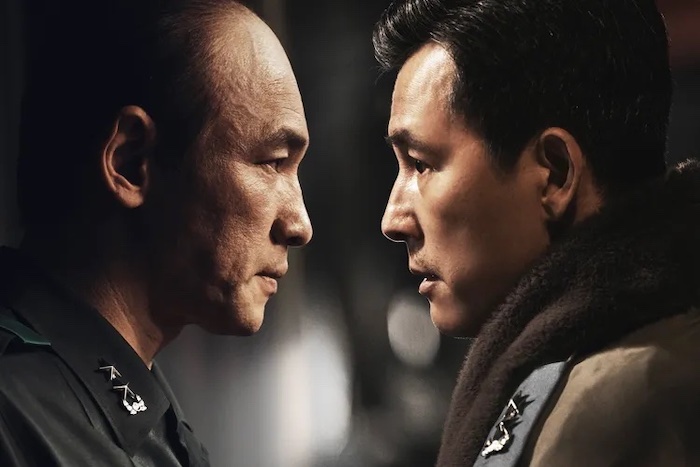
The portentous English title of Kim Sung-soo’s box office hit about the 1979 coup that replaced one South Korean dictatorship with an even worse one could have been convincingly changed to Amateurs, a more accurate description of the action that ensues in this very action-packed movie. Since there still isn’t a definitive history of what actually happened on that day, and this is the first cinematic treatment of the affair, the filmmakers take certain dramatic liberties that play up the venality of the instigators of the coup under the megalomaniac General Chun Doo-hwan (Hwang Jung-min) while inflating the heroism of the commander of the Seoul garrison, General Lee Tae-shin (Jung Woo-sung), who endeavored to stop Chun. And while Hwang has great fun portraying that cartoony, outsized venality, the movie as a whole isn’t as entertaining or even as provocative as Im Sang-soo’s The President’s Last Bang, which frames the assassination of President Park Chung-hee that precipitated the coup as basically a war between rival yakuza organizations. Many have taken issue with that facetious interpretation, but since even the assassination is open to debate, I have always liked to think that Im’s movie provided more thematic verisimilitude than did, say, The Man Who Stood Next, which was more conventional in its approach to the killing. 

Despite the fact that Kim has changed the names of many of the principals because of Korea’s strict libel laws, anyone with any elementary knowledge of Korean history knows who these people are, but the way they’re presented has more to do with Korean movie entertainment than historical edification. To his credit, Kim and his writers keep the action comprehensible, expertly juggling multiple plotlines to show how Chun’s make-or-break scheme to usurp government control for his secret military society, the Hanahoe, could defeat anyone who opposed him following proper military protocols because Chun would do anything to achieve his goals, including the killing of fellow soldiers. Kim makes no plausible political case for Chun’s ambitions. The general gives lip service to warding off North Korean infiltrations, but for the most part it’s clear that his ego is running the show. Because no one on either side of the conflict is emotionally or psychologically prepared to stand up to such a person, they can’t handle it in the long run, but Kim sets up plenty of scenarios that pull the advantage back-and-forth between the two factions until full-out combat ensues in the middle of the night, while the citizenry sleeps unaware that they will wake up to a government they didn’t expect or want. 

The Korean and Japanese title of the film is Seoul Spring, because following the death of Park, people expected a real democracy to bloom, and it would have been interesting to watch 12.12 with a Korean audience to witness their reaction to a film that depicts, however fantastically, one of the most infamous days in their annals. Even I felt a creeping sense of existential despair throughout the exposition, knowing what the final outcome would be, so while I think that Im’s somewhat mischievous treatment of this kind of material has more cinematic potential, in the end it probably would have put off those whose lives were actually affected by these events. But one thing’s for sure, Hwang’s borderline comic portrayal of a military maniac operating on pure grievance and self-interest is one for the ages. 

In Korean and English. Opens Aug. 23 in Tokyo at Kadokawa Cinema Yurakucho (03-6268-0015), Shinjuku Wald 9 (03-5369-4955), Human Trust Cinema Shibuya (03-5468-5551).

12.12: The Day home page in Japanese

photo (c) 2023 Plus M Entertainment & Hive Media Corp.

Posted in Movies | Tagged | Leave a comment

Review: The Fall Guy and The Garfield Movie

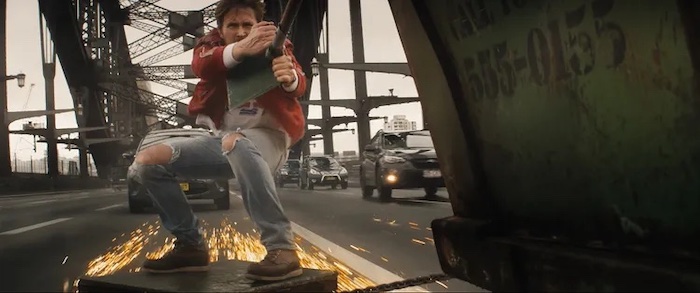
The stated goal of this action comedy, based loosely on a 1980s TV series, is to get the Motion Picture Academy to inaugurate an Oscar for stunt people, and given that the Academy recently announced it will do such a thing (though not for a while), the movie is clearly a success. As to its success as an entertainment product, it works hard for the viewer’s good favor, but I’ve felt for a while now that Ryan Gosling, the titular character, has been over-exending himself as a movie star ever since La La Land. Directed by David Leitch, a former stunt coordinator who’s seen success on his own with high-concept actioners (John Wick, Bullet Train), The Fall Guy positions Gosling as the kind of stone professional who may be too good at his job, which sort of describes Gosling as film icon. He’s not as insufferable as Tom Cruise, but you can tell his approach to leading man-ism is mostly about how well he sells a film’s overall gestalt, and not just his own performance.

Gosling’s character, Colt Seavers, is a highly touted stuntman whose own self-regard is severely tested by a horrific on-set accident that puts him in the hospital and then out of action for months, though the long recovery period seems to have more to do with his hurt pride than his physical well-being. Meanwhile, the stunt coordinator in charge of that shoot, Jody Moreno (Emily Blunt), has, like Leitch, graduated to the director’s chair and is now making a sci-fi epic called MetalStorm. The producer (Hannah Waddingham) tricks Colt into visiting the set so that he can be recruited to stunt double for the conceited star, Tom Ryder (Aaron Taylor-Johnson), for whom Colt has doubled before, but mainly it’s to force Colt and Jody to make nice again since Colt obviously blames her for his almost getting killed. For the most part, the give-and-take between director and stuntman, which glides on an unsubtle romantic undercurrent, is the best part of the movie because Gosling and Blunt excel at this kind of comedy, but then the screenwriter throws the whole thing out the window by revving up the plot with Ryder’s sudden disappearance and Colt’s search for him, which forces him into a whole new universe of action-packed intrigue that gets out of hand. Where did all these cartoon villains come from, and why?

It’s a question that the movie answers in time, but not necessarily in a satisfactory way. It should be said that the reason you go to see a movie like The Fall Guy is to find out exactly how they pull off some of those stunts, and Leitch delivers in that department. The screwball love stuff is just gravy, but the bada-bing action set pieces that line up like dominoes in the second half never cohere into anything more than pointless, deafening mayhem. 

The mayhem in The Garfield Movie is not as loud, but even more pointless when you consider the IP. I don’t know how many movies have been made so far about the lasagna-scarfing orange tabby—and that’s not to mention the TV show—but this is clearly one too many since it doesn’t even tap into the character’s most well-established traits. It’s really just a lame caper film that happens to trade on Garfield’s cynical sense of humor. 

First of all, Garfield (voiced with a bit too much enthusiasm by Chris Pratt) is not as annoying as he is in the comic strip, and his constantly pulling the rug out from under his “owner” Jon and persecuting the intellectually challenged dog Odie are toned down as if dictated by some kind of PC killjoy. In fact, the whole emotional atmosphere is stacked against that kind of cruel humor by positioning Garfield as a poster cat for neglected felines. We learn that Garfield was abandoned by his father as a kitten at an Italian restaurant, where he was adopted by Jon after eating his entire pizza. Years later, after becoming the cat we love to roll our eyes at, Garfield’s father, Vic (Samuel L. Jackson), reenters his life and then quickly pulls Garfield and Odie into a criminal scheme to help a sad bull (Ving Rhames) rescue the love of his life. 

None of this plays to Garfield the cat’s strengths as a character and so the movie has nothing particularly distinctive to offer as entertainment. It’s simply another mediocre heist flick with a couple of colorful characters. Even the main through line of Garfield’s resentment toward his father’s betrayal isn’t sustained for anything more than a few beats, and the big bad business subtheme is gratuitous at best. It’s hard to figure out just why this movie was made.

The Fall Guy is now playing in Tokyo at Toho Cinemas Nihonbashi (050-6868-5060), Toho Cinemas Hibiya (050-6868-5068), 109 Cinemas Premium Shinjuku (0570-060-109), Shinjuku Wald 9 (03-5369-4955), Shinjuku Piccadilly (050-6861-3011), Toho Cinemas Shinjuku (050-6868-5063), Toho Cinemas Shibuya (050-6868-5002), Toho Cinemas Roppongi Hills (050-6868-5024).

The Garfield Movie, in subtitled and dubbed versions, is now playing in Tokyo at Toho Cinemas Nihonbashi (050-6868-5060), Toho Cinemas Hibiya (050-6868-5068), Toho Cinemas Shinjuku (050-6868-5063), Toho Cinemas Roppongi Hills (050-6868-5024).

The Fall Guy home page in Japanese

The Garfield Movie home page in Japanese

The Fall Guy photo (c) 2024 Universal Studios

Posted in Movies | Tagged , , , | 1 Comment

Review: New Normal

The framing story of Jung Bum-shik’s omnibus slasher flick is difficult to parse at first. The various stories spool out in Seoul over a four-day period in May after it snows unseasonally, and for some reason an element of “chaos” is injected into the populace, but since Jung sticks to the specific, meaning isolated characters, some of whom appear in more than one story, the impression isn’t so much arbitrary madness as it is unfortunate confluences of character that lead to murder and mayhem. Fortunately, Jung has a sense of humor, and while it may not be to everyone’s taste the ironies are sharp enough to make the horrors more interesting, if not necessarily more unsettling. And like any good fiction filmmaker who works better in shorter formats, he knows how to plant a twist where it’s most effective. 

The order of the stories is non-linear, and as in Pulp Fiction, a movie that New Normal resembles structurally, characters who die in one episode may pop up in a later one. The opening tale, “M” (the titles are all taken from existing movies), is the simplest and least original. A single woman (soap opera queen Choi Ji-woo, working decidedly against type) is visited by a fire alarm inspector whose rapid fire double entendres and overly intrusive manner raises red flags in the mind of the viewer because the TV keeps mentioning a serial killer at large. Choi shows up later in another story, “Dressed to Kill,” about several young people trading profiles on a dating app in a dangerously reckless manner. The protagonists of the stories are hardly sympathetic, except for the put-upon female convenience store clerk (Ha Da-in) in “My Life as a Dog,” whose dreams of musical glory are dashed by the demands of capitalism, thus driving her to websites where feral people trade tips on how to kill those they hate. Jung gets a lot of mileage out of digital media, but it would be overly reductive to say that he’s targeting modern technology as the root of all the evil he depicts. In the best segment, “Be With You,” a lovelorn young man follows a very analog series of valentines stuck in vending machines to a possible date with a fetching young woman, whose plans for him turn out to be anything but romantic. 

Jung doesn’t connect the evils on display to some kind of overarching social malignancy. They seem organic and pegged to the usual deviant personalities, though I suppose you can infer that such deviancies have been exacerbated by the social fabric becoming less tightly woven. As such, New Normal comes across as yet another film about the horrors of everyday life in post-millennial South Korea. It’s a thrilling place to visit cinematically, but you wouldn’t want to live anywhere near there.

In Korean. Opens Aug. 16 in Tokyo at Shinjuku Piccadilly (050-6861-3011). 

New Normal home page in Japanese

photo (c) 2023 Unpa Studios

Posted in Movies | Leave a comment

Review: Sages-femmes (Midwives)

“Labor” in all meanings of the word is the subject of this medical movie. Ostensibly centered on the horrifically hectic first weeks of two new midwives at a public hospital in the French city of Toulouse, Léa Fehner’s film, which splices in footage of actual births to provide realistic counterpoint, is really about the exploitation of these staff by a system that is sorely under-funded. Sofia (Khadija Kouyaté) and Louise (Héloïse Janjaud) are roommates and friends as well as novice midwives, and when they start their first day together they’re separated in a cruelly arbitrary way: Though Sofia at first blush seems like the more capable of the two, she’s assigned to birthing-class duty, while Louise, who has just broken up with her boyfriend in a rather loud way right there in the hospital, is plugged directly into service assisting deliveries that she can’t quite handle. “We get the worse cases,” says her senior, Bénédicte (Myriem Akheddiou), “so level up.” We soon understand that the midwives normally handle two or three or even four patients at the same time, and it’s imperative that the lower ranking medical personnel know what they need and when they need it. 

Sages-femmes takes the notion that childbirth is an inherently dangerous process at face value, but goes a bit further in framing it as the kind of emotional event that can break a person’s will, and not just that of the parent. For every woman who welcomes her baby with tears of joy, there’s one who resents the pain and loss of privacy so much that she can’t be bothered even looking at the child. And then, of course, there are the medical emergencies that, in this movie, at least, seem to happen more often than not. Fehner does an excellent job of juxtaposing the technical aspects with the dramatic elements, even if the dialogue is often a bit theatrical (“it requires more than adrenalin”). She also manages to touch every socioeconomic base in making her point about understaffing and general apathy on the part of the authorities toward upholding minimum standards. The most effective subplot focuses on an undocumented woman who gives birth under dire circumstances and then abandons the baby—only to show up later to claim it, professing that she already has too many mouths to feed. Louise naively lets the woman stay in her and Sofia’s flat, which is also hosting the even more naive intern Valentin (Quentin Vernede) on a temporary basis. Though the subplot strains with all these shifts in dramatic direction, it neatly shows the vagaries of a medical condition—pregnancy—that is subject to so much more than just therapeutic attention. All women do not have babies for the same reasons or with the same outlooks and approaches. 

And while much of the action is strong meat—a particularly upsetting medical abortion is depicted—it’s nothing compared to the humiliations imposed by the hospital heirarchy, which only makes the job that much more intolerable. Fehner shows how these pressures get to everyone, forcing them to push through their feelings of rage and incompetence in order to fulfill their assigned tasks. Some quit in a huff, but most have come to the job with a sense of mission that the actors convey convincingly. It helps that all the principal players are women. Men in this world are almost a deadly distraction, and I don’t mean romantically. 

In French. Opens Aug. 16 in Tokyo at Human Trust Cinema Yurakucho. 

Sages-femmes home page in Japanese

Posted in Movies | Leave a comment

Review: Tótem

Though the Mexican director Lila Avilés has a way of withholding information that gives her domestic drama a touch of mystery, she reveals her thematic hand very early on. The protagonist of Tótem, seven-year-old Sol (Naíma Sentíes), is driving with her mother, Lucia (Lazua Larios), in a car filled with party balloons. The mood is buoyant and mother and daughter are playing a game that hinges on a secret wish. Sol reveals hers, which is that her father wouldn’t die. As the movie quickly informs us, the party to which the pair (or, actually, just Sol, since Lucia then disappears with no explanation for a good portion of the film) are traveling is for Sol’s father, a painter named Tona (Mareo García Elizondo), who is dying of cancer. His family, meaning his brothers and sisters, are throwing a birthday party for him at the home of their father, Roberto (Alberto Amador), a somewhat intimidating psychiatrist who consults with patients while his children prepare the festivities. Sol observes it all, sometimes as a participant, other times as a fly on the wall, and receives a crash course in adult deflection. Why are they celebrating her father’s oncoming demise? More incisively, why can’t she be with her father when she demands to be with him, a question that even Avilés seems reluctant to answer. 

While the POV is mostly that of the girl, the scenes of her relatives and their friends trying to make the best out of a desperately sad situation is presented unfiltered, so if Sol often seems confused by the behavior of the grownups, the viewer knows what’s going on but shares in Sol’s frustration. Along the way, Tona’s sister, Nuria (Montserrat Marañon), struggles to bake a birthday cake while taking care of her precocious toddler daughter, who nevertheless isn’t old enough to appreciate the gravity/ridiculousness of the situation. An exorcist, invited by another sibling against their father’s wishes, walks about the house as if she owned the place, ridding it of bad spirits. Tona’s nurse, Cruz (Teresita Sánchez), mostly stays with her charge, cleaning him up when he shits himself just before making his very reluctant entrance (he clearly doesn’t want a birthday party) and reminding the siblings that she hasn’t been paid yet. Eventually, Lucia returns and the small nuclear family is reunited for a short interlude that overflows with love and stinging regret, only to be interrupted by the consequence of the party that was planned and cannot be denied, and which Tona pretends to enjoy.

Sol’s outlook becomes ours: Why can’t we have more joy, as when she, Nuria, and Tona are alone together within the carapace of their affection? Why do family and friends insist on perpetutating the pain by reminding everyone, not least of all Tona, of his impending mortality with a celebration that is mostly carried out to make them feel better? Avilés’ particular genius is elucidating these points through the eyes of a child who barely comprehends them but is still wise enough to understand that she is losing something more precious than anything she will ever know—not just her father, but time itself.  

In Spanish. Now playing in Tokyo at Human Trust Cinema Yurakucho (03-6259-8608), Shinjuku Musashinokan (03-3354-5670).

Tótem home page in Japanese

photo (c) 2023 Limerenciafilms S.A.P.I. de C.V. Laterna Film, Paloma Productions, Alphaviolet Production

Posted in Movies | Leave a comment

Review: Exterior Night

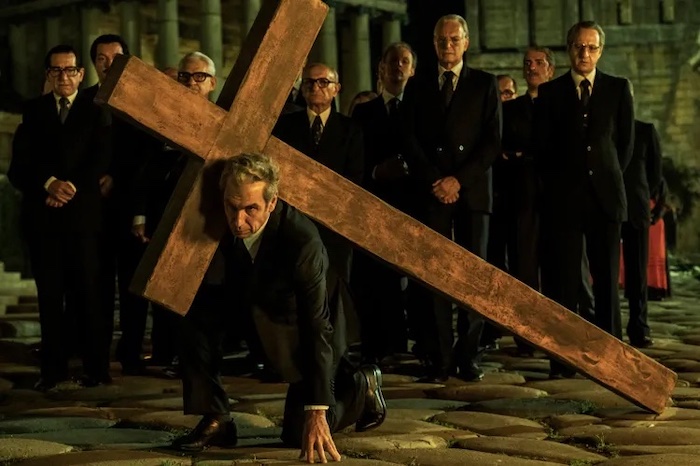
Though Marco Bellocchio’s second film about the kidnap/murder of former prime minister Aldo Moro by radical leftists in 1978 was obviously intended as a six-part TV series, it premiered at Cannes and was featured at other international film festivals before it was aired or streamed in Europe. Japan has also decided to release it in theaters (I have no idea if there are plans to broadcast it here as a series), and while six hours is a lot to sit through and the structure is definitely that of a multi-part work, the film builds a relentless momentum that carries the viewer without much drag time, even if the outcome is known to anyone familiar with its famous story. Bellocchio, often cited as the last great Marxist filmmaker, already addressed this material in his standard-length 2003 film, Good Morning, Night, but obviously wasn’t through with it; or maybe he wasn’t satisfied with what he had made. (I haven’t seen it.) The mini-series format allows him to delve deeper into the various personalities involved in the tragedy to show how and why events turned out the way they did, suggesting that they could have turned out differently if only certain political sensibilities weren’t so entrenched. Each episode of the series focuses on one person—Moro (Fabrizio Gifuni); the newly installed minister of the interior, Francisco Cossiga (Fausto Russo Alesi); Pope Paul VI (Toni Servillo); a female “terrorist” who starts to have second thoughts (Daniela Marra); Moro’s wife, Eleonoro (Margherita Buy)—except for the last, which sums up the story in the bleakest way possible. As a portrait of European volatility in the 70s, it rivals Olivier Assayas’s Carlos (2010) as the most informative and gripping study of how perceived political and personal necessity inevitably conquers social ideals. 

The one established concept that holds throughout the series is that Moro was a decent man. Though he was president of the conservative Christian Democratic Party at the time of his abduction, his values were more ecumenical. In fact, he was causing great consternation not only within his party but in Washington for his willingness to work with Italy’s Communist Party in forming a government. It should be emphasized that the communists were not any kind of ally of the Red Brigades, who carried out the kidnapping (or, at least, one faction of it did). If anything the radicals held the Communists in even more contempt than they held the CDP or even the avowedly fascist Italian military. And it seems also clear from the beginning that while the kidnapping was ostensibly carried out to force the CDP’s hand, there was never any intention on the part of the Brigade to release Moro. As one member admits, no one within the group really believes that those in power would ever “negotiate” with them, so the only thing they can do is “make life miserable for those with authority,” thus perpetuating the Red Brigade’s image as a bunch of “heroic losers.” Similarly, the CDP’s leadership, especially Prime Minister Giulio Adreotti (Fabrizio Contri), fear what kind of sentimental reaction Moro’s release would trigger in the citizenry and, while they don’t wish for his death, use every excuse at their disposal to put off talking with the Red Brigade. Meanwhile, the pope, sensing his powerlessness as a force for “good,” flails about trying to make the terrorists, as well as the world, see him as doing something

Bellocchio orchestrates these various lines by adding fugue notes on the news media, American pressure, Catholic dogma, radical chic, and, perhaps most cleverly, the creeping influence of psychological newspeak, especially in the treatment of Cossiga’s approach to the investigation, which is hampered by his nascent bipolar condition. Bellocchio even teases an alternate happy ending to the story as a means of showing what the CDP would have been up against if Moro survived his ordeal. In the end, of course, Italian society was upended—but only for a short period. The players who had to leave the stage in disgrace eventually made their way back onto it, and the people punished for the crime weren’t necessarily those who actually carried it out. Of course, the biggest tragedy is that Italy was deprived of Moro’s intelligence and moral certitude at a time when it needed him the most. I’ve never been a big fan of Bellocchio’s work—though a master craftsman, his themes are too operatic for my taste—but Exterior Night is compelling as a historical document, regardless of how much “license” its makers took with the actual facts. 

In Italian and English. Opens Aug. 9 in Tokyo at Bunkamura Le Cinema Shibuya Miyashita (050-6875-5280).

Exterior Night home page in Japanese

photo (c) 2022 The Apartment-Kavac Film-Arte France

Posted in Movies | Tagged , | Leave a comment

Fuji Rock Festival 1998

I wrote an overview for the Japan Times of the history of the Fuji Rock Festival to commemorate its 25th anniversary at the Naeba ski resort. In it I mentioned the second edition of the festival, which was held in Tokyo. I wrote a review of that event for the JT but it is not available on the JT website so I’m posting it here, warts and all. I’ve already posted my review of Fuji Rock 1999, the first one to be held at Naeba, here, which I also mentioned in the article.

Continue reading
Posted in Music | Leave a comment

Media watch: Japan’s selective history on display again with new UNESCO World Heritage site

On July 27, the UNESCO World Heritage Committee agreed to register the Sado Island Gold Mines off the coast of Niigata Prefecture as a World Heritage Site, the 26th for Japan. Sado was at one time the largest gold mine in the world, and the Japanese government wants to promote its history as a pioneering enterprise in manual mining technology. 

As with other similar World Heritage industrial sites, such as Hachima Island off the coast of Kyushu, South Korea, a member of the UNESCO committee, initially questioned the intentions of the site’s boosters, saying that any exhibits would need to mention the use of Korean forced laborers in the mine during the period when Korea was a Japanese colony. Japan had dismissed these concerns by focusing on Sado’s history during the Edo period, meaning before Koreans worked in Japan and when the valued technologies were developed. The UNESCO committee, in response, asked Japan to create “facilities that comprehensively address, at the site level, the whole history of the nominated property throughout all periods of mining exploitation,” according to the Jiji Press

Japan agreed to these conditions and set up an exhibit at the Aikawa History Museum on the island explaining the harsh working conditions of the mine complex, which covered some 400 kilometers of underground tunnels. Consequently, the current Korean administration approved the registration in the belief that Japan would carry out its promises with regard to its promotion of the site for historical purposes. However, the Korean media outlet, Hangyoreh, found the Korean government’s agreement to the registration unacceptable, since the exhibit’s acknowledgement of the harsh working conditions did not include an admission that the Koreans who worked under those conditions had been forced to do so by Japan’s colonial administration. In essence, Japan’s UNESCO representative had simply said that all workers had labored under “severe conditions,” meaning Japanese and Korean alike. “‘All workers’ erases the specific nature of the cruel discrimination that only Korean slave laborers were subject to,” wrote Hangyoreh in its editorial. The current South Korean administration was ignoring this aspect of the registration, thus allowing the Japanese government once again to “sweep” its history of forced mobilization of Korean workers “under the rug.” Consequently, the exhibit will not fully address the whole history of the mine, which is what the committee supposedly demanded.

But it isn’t just the matter of forced Korean labor that is being left out of the annals of the Sado mine. Another editorial, this one in the Asahi Shimbun, pointed out that other aspects of the mine related more directly to Japanese workers may be excised. The editorial mentions a 76-year-old woman named Noriko Yanagidaira, who used to be the chief archivist of the Aikawa History Museum. Yanagidaira has mine administrative documents dating from the Meiji Era showing how the prostitution quarters were managed by the local mine authorities. Any woman who worked as a prostitute was confined to these quarters and needed permission from the local police to leave them to visit relatives or even go to the doctor. There are also documents showing how these women sought employment, with one typical application stating that the applicant needed the work to alleviate her impoverished situation. Yanagidaira found most of these documents in the trash (they had been used as paper to repair fusuma sliding doors), meaning that the relevant officials after the war—the brothels on Sado operated until the war ended—didn’t think they should be kept for posterity. 

Yanagidaira insists that no history of the mines is complete without mention of the prostitution quarters, which contained as many as 10 brothels at any given time. These quarters were originally authorized by the Edo government, whose bureaucrats were transferred to Sado from the capital to oversee the enterprise. The brothels were considered essential to the success of the mining operations. Yanagidaira, who has been collecting these documents and studying them for the last 50 years, has many of the records committed to memory, such as the common saying among officials on Sado that the “cheapest things” on the island were “women and fish.” She is also haunted by one police report about a 13-year-old prostitute who was killed by a client. 

What concerns Yanagidaira is that when the museum reopened in May, after renovations were carried out ostensibly to accommodate the history requirements for the World Heritage registration, anything having to do with the prostitution quarters had been removed. Moreover, any mention of the 2,000 or so workers referred to as mushukunin had also been taken out of the exhibits. These workers were exiles; not necessarily criminals (Sado was once a penal colony), but men who had been, for one reason or another, renounced by their families, removed from their family registers, and handed over to the Edo authorities, who treated them as property of the state. They were sent to Sado to do the worst work in the mines, such as bailing water from the deepest recesses of the tunnels. They lived within the mines and were often forced to work 24-hour shifts. They had no freedom, no sanitation, no clean air. Most died within 10 years of arriving. According to Yanagidaira, the Shogunate actually devised this system to deal with “cumbersome citizens” in the cities, which were considered “safer without them.” Famed historical writer Ryotaro Shiba once said that the Edo government did many praiseworthy things compared to other contemporary world governments, but its greatest crime was hunting down “undesirable” young men and shipping them off to Sado as mushukunin. Asahi points out that a silver mine in Bolivia was designated a World Heritage asset in 1987, and its official history explains in detail how indigenous people were forced to work there under terrible conditions and how that work was the reason for the mine’s prosperity.

So it isn’t just forced Korean laborers that the Japanese government wants to selectively eliminate from the history of the Sado mines. Anything that suggests calculated cruelty on the part of the authorities, even at the time, will not be discussed. Prostitution is not a cruel commercial practice in and of itself, but any mention of the brothels would need to be supplemented with explanations of how the women were recruited and the conditions under which they worked, so it’s better just to not mention them at all. This is the same rationale behind the government’s position on the so-called comfort women of the Pacific War. Though there is plenty of evidence and testimony showing how women were forced, one way or another, to become prostitutes at front-line “comfort stations” for Japanese soldiers, the official line is that they were all professionals and, thus, free and willing to serve the needs of the military. Anyone who has any knowledge about the use of sexual power during wartime will see this as a specious argument at best, but basically the conservative elements who wish to whitewash the history of comfort women as well as ignore the presence of prostitutes at the Sado mine simply find prostitution distasteful and sex workers, regardless of how they came to the occupation, not worthy of attention. Which is why their argument that “those were different times” doesn’t wash. They themselves find the idea of the male appetite, especially under extremely stressful circumstances, too disgusting to even ponder, much less talk about.

Posted in Media | Tagged , , , | Leave a comment

Fuji Rock ’24: July 28, second half

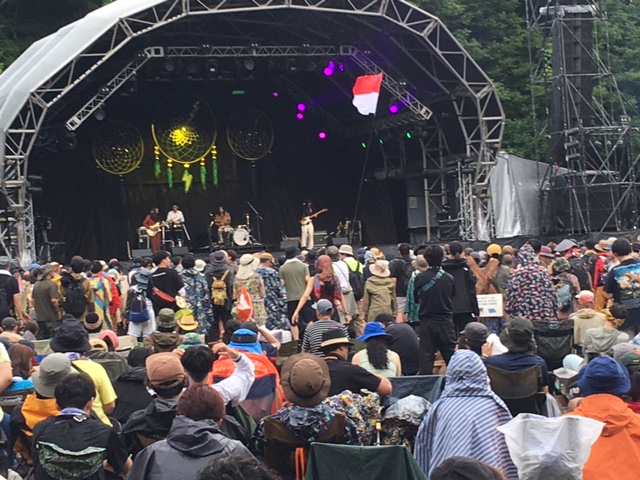
Further on from my train of thought in the previous post, I saw Ali, a guitar band from Indonesia at the Field of Heaven in the late afternoon. Apropos that stage, their music is spacey and ethnic, a kind of repetitive drone pattern that instills itself in the spine. The venue was quite crowded with dancing bodies, thus proving that Asian acts can attract sizable crowds. Moreover, the connection is vital. The bassist/spokesperson for the band said it was a “miracle” they had been asked to play in Japan, and before the last song, explained that the Indonesian title translated as “The Sun,” and, I kid you not, when they reached the chorus of the song, the sun actually burst out through the clouds.

Nothing quite as transcendent happened at the White Stage during the Jesus and Mary Chain’s set. When they emerged in the mid-90s, I thought their appeal was that distorted guitar sound, which supposedly launched the shoegaze genre. At the White Stage, the sound was crisp and clear, thus making their songs less distinctive. Distinction was the order of the day for the British pop singer Raye, who was slated just before twilight at the Green Stage. It was a full production, with her fairly large band decked out in black tie and white tuxes. She got the set moving in an agreeable direction and a good portion of the audience was dancing happily. The middle section was given over to her more serious material dealing with abuse and whatnot, which required explanations that I don’t think most of the audience could follow.

The rain abated for a while, so the crowd at the Red Marquee for Fontaines D.C. wasn’t as big as I’d expected, at least not initially. But those who were there seemed to be stone fans. They knew all the songs and reacted wildly to the raw music, the loudest I heard all weekend. 

The rest of the evening I spent at the far end of the festival, which wasn’t so crowded since I assume most people were preparing themselves for Noel Gallagher at the Green Stage. I caught the end portion of the Meters tribute band at Heaven, which brought the funk they promised. Kim Gordon did a blazing show at the White Stage with a band that could have been her grandchildren. They had to do all they could to keep up with her. Speaking of grandchildren, or just children, the famous progeny of the Allman-Betts Band, which followed back at Heaven, pretty much stuck to the country rock of their famous parents, and they came across as a generic jam band rather than the blues-rock powerhouse that made the Allman Brothers so iconic. I mean, there wasn’t even a slide guitarist.

I ended the fest with Turnstile, whose progressive punk just did me in. It was a great four days, but I think it will take longer to recover this year. 

Posted in Uncategorized | Leave a comment