Review: Love Reset

It’s been said by wiser cinema-heads than I that the romcom is dead, killed off by a post-modern critical attitude that doesn’t appreciate the irony that once made the genre appealing. My own take is that the classic trappings of romantic comedies—middle class, middle-brow aesthetics tied to a belief in the transcendant values of monogamous heterosexual love—no longer apply in a world where constant connectivity breeds cynicism toward human relationships. And I’d say that was a shame if I believed in middle class, middle-brow aesthetics in the first place, but the romcoms I’ve always liked—Preston Sturges’ work, Shampoo come to mind—are already cynical, so maybe I was never the target. At the moment, Korean cinema and TV series are thriving on romcom stories, and for the most part they blend the kind of snark I appreciate with the wettest sentimentality you could possibly stand, an often toxic combination that nevertheless keeps you awake to the possibilities of a particular story.

Love Reset is what used to be called high concept, meaning it was pitched for its gimmick—married couple about to get divorced are in an accident that leaves them with amnesia and thus open to the possibility of falling in love all over again—and, as is often the case with any Korean romcom, the story is so unwieldy and imprecise that there’s bound to be something there you like, if only for a minute or two. The introduction is promising: Perpetual law student Jeong-yeol (Kan Ha-neul) is drinking himself into a stupor because the love of his life, Na-ra (Jung So-min), is getting married to somebody else. Though the two have dated for some time, Na-ra, from a well-to-do family, doesn’t think Jeong-yeol, who is going for his fourth or fifth run at the bar exam, is ever going to amount to much, but at the altar she has a Graduate moment and bolts the ceremony, arriving at the bar where Jeong-yeol is blotto to declare her intentions. From here, the movie veers widely away from the path a Western romcom would take, with Na-ra’s family, understanding there’s no point in fighting it, offers to support Jeong-yeol while he studies again for the test, a development that makes Na-ra question her own future with him, and after they marry she finds she can’t stand his spendthrift ways (he’s determined to pay back his in-laws) and purity of purpose. She goes the opposite way by drinking constantly and leaving a mess wherever she goes, and her freelance movie production work suffers for it.

What’s promising about the setup is that after the two lose their memories their families and friends reverse course and endeavor to make sure they don’t get back together again, thus creating a tension between the different intentions at play. A lot of the comedy is self-referential (“this is like something out of a movie”) and the scatological humor might be a bit too ripe for some tastes, but as a sour look at the state of matrimony in Korea and the class pressures that work to its disadvantage it’s often amusing in a broad, slapstick way. In any case, I can’t see how anyone would want to marry either of these clowns.

In Korean. Opens March 29 in Tokyo at Marunouchi Piccadilly (050-675-0075), Shinjuku Piccadilly (050-6861-3011).

Love Reset home page in Japanese

photo (c) Cinema Woollim, TH Story and Mindmark
Posted in Movies | Leave a comment

Review: Rheingold

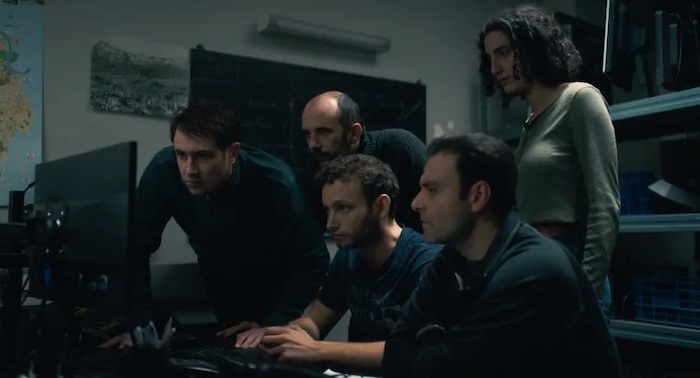
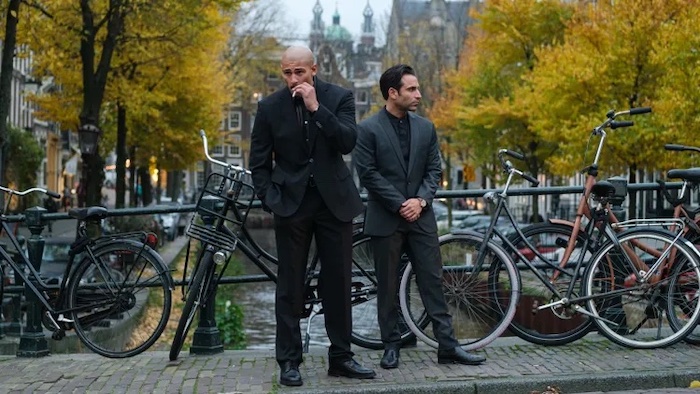
One of the few intriguing elements of Fatih Akin’s biopic of the Kurdish-German rapper and media star Giwar Hajabi (professional moniker Xatar) is the title. The composite word comes up when Hajabi, as a child, accompanies his composer-conductor father to a performance of the similarly named opera in Bonn, shortly after his refugee family has arrived from Iran via Iraq and Paris. Das Rheingold is the first of Wagner’s four works addressing German culture’s mythological origin story, and the scene sets the stage for Hajabi’s own self-mythologizing impulses (the Rheingold, after all, makes you immortal) as a foreigner gangster who survives by his wits and outsized personality. It also gives Hajabi a credible grounding in both music and outlaw attitude, the former of which is only latently realized.

Moving back-and-forth through Hajabi’s life, the storyline focuses on hard responses to hardship, with the family suffering mightily in exile following the Iranian Revolution before the elder Hajabi secures work in Germany as a musician—and then promptly abandons his wife and children when he meets another woman. Bullied and vilified by other immigrants and ignored by the natives, Giwar (Emilio Sakraya as an adult, Ilyes Moutaoukkil as a teen) sells porn videos in school to augment household finances and becomes a street fighter who can give as good as he gets when he turns to dealing drugs. Akin doesn’t do much to distinguish the various facets of young Hajabi’s life as he falls headlong into a life of crime that leads him to an expat mob headquartered in Amsterdam who sees his potential and puts him to work. One botched job leads to another and Giwar goes on the lam for stealing a shipment of gold (Aha!), forcing him to hide out in Syria where he’s picked up by local military who torture him to find out where the precious metal is stashed. Because Akin doesn’t follow this portion of Hajabi’s life in a linear fashion it lacks the urgency you expect from stories about criminals caught up in their own miscalculations, and it’s difficult to understand exactly how Hajabi ends up back in Germany in prison. But that’s where he takes up hip-hop as a vocation after having only dabbled in it previously.

Akin borrows what he needs from the canon—a bit of Scarface here, some Tupac music video style there; a lot of Scorsese—but the total package never finds a purchase on the imagination and feels generic as a tale of personal triumph. It doesn’t even register as being particularly dangerous, which is odd since Xatar is a very controversial artist in Germany. In the movie, he’s just another flattened-out example immigrant success. 

In German, Kurdish, English, Dutch, Turkish and Arabic. Opens March 29 in Tokyo at Human Trust Cinema Yurakucho (03-6259-8608), Cinemart Shinjuku (03-5369-2831), Bunkamura Le Cinema Shibuya Miyashita (0570-6875-5280).

Rheingold home page in Japanese

photo (c) 2022 bombero International GmbH & Co. KG/Palosanto Films Srl/Rai Cinema S.p.A./Lemming Film/corazon international GmbH & Co. KG/Warner Bros. Entertainment GmbH

Posted in Movies | Tagged | Leave a comment

Media watch: Local governments finance potential future mothers as marriages decline

Nippon TV report on freezing eggs

Though the dwindling birth rate continues to be an important media topic, two recent news items, taken together, highlight one of the less remarked upon reasons for the lack of babies in Japan. At the end of February, the welfare ministry revealed not only the number of births in 2023, but also the number of marriages, which fell below the 500,000 line for the first time in 90 years. In the last few years there have been many news reports about how young Japanese people have shown little if no interest in getting married, mainly for financial reasons, meaning that they tend to think of matrimony as an economic undertaking. Consequently, the government tends to throw money at the issue of shoshika (declining birth rate), thinking that’s the only thing they can do. Another news item, which has been less prominent, may, in fact, prove that the government is right, though it also suggests that, in the end, there’s nothing anyone can do.

A Jan. 18 report on NHK’s morning variety show, Ohayo Nippon, covered the topic of women freezing their eggs, a procedure that the Tokyo Metropolitan Government will subsidize as a countermeasure to the falling birth rate. The idea is that young women who have embarked on careers but haven’t gotten married or even found a suitable partner yet still plan to have children sometime in the future, so while they are young and relatively fertile, they harvest their eggs and store them for later in vitro fertilization (IVF), presumably after they get married. 

Depending on the medical institution, harvesting eggs costs between ¥300,000 and ¥600,000, and that doesn’t count storage fees. As with prenatal care, childbirth, abortion, and fertility treatments, harvesting eggs is not covered by national insurance, so Tokyo is offering to pay up to ¥300,000 for the procedure and for storage fees up to 5 years to women who want to undergo the process. Last September, Tokyo started offering explanation sessions for the program, and the number of women who applied was much larger than they expected. In the last three months of 2023, 7,000 women applied for the sessions. A Nihon Keizai Shimbun article published Feb. 16 says that Tokyo will increase the number of women who can receive the subsidy since so many seem to be interested. In 2023, there was only enough money prepared for 200 women, but in 2024 that number will be increased to 2,000. The main conditions for elegibility are age—between 18 and 39—and the applicants must be residents of Tokyo. In addition, they have to attend an explanation session and agree to take part in a survey. 

One 31-year-old woman interviewed by NHK who attended a session and has decided to freeze her eggs said that she recently changed jobs and enjoys her work. She doesn’t want to take two or three years off in order to have a child right now, though she does want to be a mother someday. Her main hurdle about freezing eggs so far was worry about “safety and effectiveness,” and apparently one of the aspects of the Tokyo program that spurred her decision was that a local government body is subsidizing the procedure, so it must be reliable. The woman makes no mention of whether she is married now, but the fact that she says she doesn’t want to have a baby right now would seem to suggest she is. 

Another woman who has already made the plunge and who works for a “major company” told NHK that in the past she didn’t think seriously about getting married and having children, but as she approached her present age of 39 she felt more desperate about her future, and so decided to freeze her eggs just in case. The woman understood beforehand how difficult it could be, considering her age. A female human being is born with all the eggs she will ever produce in her life, and that number steadily decreases as she gets older, so by the time a woman is 39, it becomes more difficult to harvest a sufficient number of viable eggs for IVF. Two weeks prior to harvesting, the woman had to receive hormone injections to promote ovulation and it caused depression and sluggishness. She told NHK that she did not tell her superiors or colleagues at work because she is afraid of “how they would look at me.” After the procedure, her gynecologist told her that the number of eggs they harvested was lower than the ideal, which would make it more difficult to achieve conception, so she underwent a second round of harvesting. Tokyo gave her a subsidy for the first harvest, but she had to pay herself for the second round. She is understandably anxious, because the subsidy will be revoked if the eggs don’t undergo IVF by the time she turns 43. 

Continue reading
Posted in Media | Tagged , | Leave a comment

Review: Penalty Loop

As long as everyone is talking about Christopher Nolan, let’s look back at Memento, still my favorite movie by him because it’s such pure cinema, and not just in terms of what you see on the screen. The story is utterly cinematic as it deals with linearity in a way that wouldn’t make sense in any other medium, including the written word. After all, it’s about a guy who can’t remember more than a few minutes into the past and thus has to record and edit experience and save it for later reference. What makes Memento unique is that this looping of time moves backward. Shinji Araki’s similarly schematic Penalty Loop is more conventional, in that the repetitive time loops have a forward momentum, as they do in Groundhog Day. Araki’s protagonist, Jun (Ryuya Wakaba), keeps reliving the same day but changes up the key experience of that day with each successive repeat. If it’s closer in feeling to Nolan’s movie that’s because it’s about revenge, though with Penalty Loop the viewer has to decide in the end if the event that prompted the retribution actually happened.

Also like Groundhog the tone is essentially irreverent. Jun wakes up one day and goes to work where he kills a colleague named Mizoguchi (Yusuke Iseya), who he believes drowned his girlfriend. After disposing of the body and thinking he’s gotten away with the crime he returns home, only to wake up and discover it’s the same day and Mizoguchi is still alive—so he does it again. This scenario replays every time he wakes up, with Jun changing the m.o. in order to achieve closure, but the same day dawns and he has to take an entirely new tack. Eventually, like Bill Murray in Groundhog, he gets to the point where he realizes nothing he does will change matters and becomes almost casual in his approach to homicide. Moreover, his victim comes to expect the violence and even encourages it, adding a layer of comic absurdity that Araki doesn’t always know how to handle. 

Loop movies have a built-in hazard, which is that repetition can quickly become…well, repetitious. Araki keeps the action fresh, but the other shoe has to drop at some point, and while the rationale behind Jun’s seeming predicament is clever, Araki seems reluctant to spell it out in terms that would trace a clear through-line from Jun’s girlfriend’s death to Jun’s murderous intent, a process that, along the way, has been affected by technology and commercial protocols. Though not particularly deep, Penalty Loop is one of those movies that encourages post-viewing discussions to help the viewer reach some understanding of what it’s supposed to mean (spoiler: the flyer provides a strong clue), so I would suggest that you see it with someone who likes to talk about movies.

In Japanese. Now playing in Tokyo at Shinjuku Musashinokan (03-3354-5670), Ikebukuro Cinema Rosa (03-3986-3713).

Penalty Loop home page in Japanese

photo (c) 2023 Penalty Loop Film Partners

Posted in Movies | Leave a comment

Review: Paragraph 175

Originally released in 1999, Rob Epstein’s and Jeffrey Friedman’s documentary was another in the directors’ explorations of gay history and themes, with The Times of Harvey Milk (1984), The Celluloid Closet (1995), and the Oscar-winning Common Threads (1989) being their best known works. The title, Paragraph 175, refers to the German penal code that forbade homosexuality, though as the script, soberly narrated by Rupert Everett, points out, the law almost exclusively targeted gay men, as they tended to represent everything the Nazi sensibility seemed to abhor by “depriving Germany of the children they need.” (Lesbians were considered “curable” in that they were capable of giving birth.) 

As someone whose adolescent eyes were opened to the wider possibilities of sexual freedom by Cabaret, I found it fascinating to learn how vibrant the gay community was in Berlin between the wars. “So much joy!” as one witness remembers it. For the most part, the gay denizens of Berlin waved off anti-sodomy laws and the authorities tolerated their free spirits. There was a campaign to abolish paragraph 175 that seemed destined to succeed until the 30s rolled around and Hitler took over. Aryan purity became the thing. Abstinence was a virtue, and the new order looked askance at trendy youth movements that advocated for nudism (“nature and friendship”) and Zionism. Ironically, one of Hitler’s right-hand men was a well-known homosexual who actually organized the Storm Troopers. Hitler ignored his sexual predilection while he was useful and then arrested him when that usefulness ended, and he was put to death. The regime destroyed one of the most advanced research centers for sexual studies after the Reichstag fire and then the SS targeted every gay meeting place in the country, rounding up all the men they found and sending them off to the newly established archipelago of concentration camps. Because homosexuals weren’t always labeled as such, statistics were difficult to nail down, but it’s estimated that 100,000 were arrested and up to 15,000 were locked up in camps, where many perished. 

The story is mostly explicated by the dozen survivors that the directors located. Almost all are men who don’t necessarily trust their interlocutors. “You have to see this romantically,” one insists, and goes on to describe how the terrors of Nazism and the war in general brought these men (and boys—the movie isn’t squeamish about the love between minors and adult men) together. “We had sex on the train,” another says forcefully when the interviewer fails to get his drift. A French nonagenarian reveals he still can’t talk to anyone with a German background. The archival footage is extensive and remarkably evocative, but it’s the descriptions that carry the film. One man recalls the “singing forest” where Nazis captured gay men and tied them to trees, torturing them to death. Another admits to enlisting in the German Army because that’s where all the men were. Many survived the war only to end up in prison for violating paragraph 175, which wasn’t rescinded until 1969. (For a more dramatic recreation of that postwar milieu, see the Austrian film, Great Freedom.) There is even one woman who tells the heartbreaking story of receiving a precious travel permit to England from her lover, a woman who “looked like Marlene Dietrich.” Though the witnesses are probably dead by now, this topic can never be exhausted. 

In English, German and French. Now playing in Tokyo until March 29 at Shinjuku K’s Cinema.

Paragraph 175 home page in Japanese

Posted in Movies | Leave a comment

Review: Call Jane

In 2024, almost two years after the U.S. Supreme Court overturned Roe v. Wade and sent the question of abortion back to the states, a movie about how women accessed the procedure before it became constitutionally protected in 1973 will have to tread lightly, but this peculiarly conventional indie feature was made before that momentous decision while seeming to presage it. The oddness of tone, however, has less to do with political realities now than with how the filmmakers (mostly women) use watered-down emotional cues and even comedy to score political points. Hindsight has much to do with it, but so does a cinema culture that tries to be even-handed at all costs, even when the material begs for something more contentious. 

Joy (Elizabeth Banks) is a homemaker living in the suburbs of Chicago in the late 60s. Though she studied to be a lawyer, she has settled into domesticity with her fair-minded but patriarchy-enjoying husband Will (Chris Messina), who is a full-time lawyer. The subtle assault to Joy’s status is that she works pro bono for Will by writing his briefs. She’s introduced to the counter-culture by way of Yippies being beaten up by cops outside the Democratic Convention, but the real challenge to her privilege, not to mention her gender, is more personal. After discovering she is pregnant, a development that is unplanned, she also learns that the pregnancy is possibly life-threatening, but her hospital, or, more precisely, the male physicians who run it, decide they can’t approve a therapeutic abortion, which was the only legal kind there was at the time. After a bit of drama that involves Joy going to the seedy side of town to obtain a back alley abortion and chickening out, she calls a number she finds on a phone booth window for “Jane” and becomes acquainted with an underground operation run by a woman, Virginia (Sigourney Weaver), who understands the environment and guarantees safety, if not necessarily affordability. Joy undergoes the “service” blindfolded, though she doesn’t have to see the young white doctor (Cory Michael Smith) to understand he’s in it more for the money than for the principle. Eventually, Joy becomes a factotum for Jane (who is not a person but rather a collective of card-carrying and nascent feminists), first as a driver and eventually as an abortionist herself, thus sending her into streams of illegality that become more perilous to navigate. The subterfuge of attending art classes when husband and adolescent daughter (Grace Edwards) ask why she spends so much time out of the house seems mainly incorporated to emphasize how much society expects her to adhere to middle class roles, but in the end it is just a lazy plot device that can easily be tooled for laughs. 

Given all the wrong things that can happen under these circumstances—which include payoffs to the mob and the service’s ambitions toward actual expansion—the movie should evince a palpable sense of anxiety, but for the most part the movie putters along with only the slightest bumps of unease due to the producers’ insistence that the abortion movement embodied by Jane is just one element of the revolutionary spirit of the time. Undergoing a prohibited procedure outside of a medical facility is certainly more fraught than smoking pot and digging the Velvet Underground, but the movie places all these activities along a continuum of implied righteous transgression. If the movie gets anything very right, it’s the way it portrays how women, whatever their background or economic wherewithal, could only count on one another for help with matters that the aforementioned patriarchy would prefer to not even think about. In that regard, Call Jane definitely still has something to say about our current situation. 

Now playing in Tokyo at Toho Cinemas Chanter Hibiya (050-6868-5001), Shinjuku Piccadilly (050-6861-3011).

Call Jane home page in Japanese

photo (c) 2022 Vintage Park, Inc. 

Posted in Movies | Tagged , | Leave a comment

Review: Count Me In

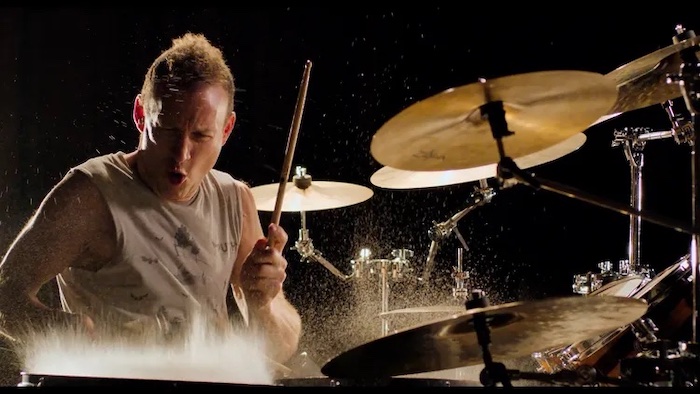
As James Brown would always say to his audience at a show, “Give the drummer some,” and this documentary attempts to do just that, though its range of appreciation is fairly narrow. For one thing, none of JB’s drummers, who practically invented modern funk, are even mentioned in the film. In fact, the only Black drummers cited are jazz innovators like Art Blakey and Max Roach, which means no Clyde Stubblefield, no Benny Benjamin, no Bernard Purdie (and his seminal “Purdie shuffle”), no Questlove. Props to the producers for highlighting currently active female drummers like Jess Bowen and Cindy Blackman, but even in those cases the focus is on rock, and rock of a certain type. This focus makes sense when you check out the provenance of the film, which is the UK. Though lots of famous drummers are interviewed and each offers insight into the profession and musical interpretation in general, the core through-line is the history of rock drumming from Ringo to Watts to Baker to Moon to Bonham. Except for a few detours by way of people like the Clash’s Topper Headon, who ably describes punk’s reduction of everything to rhythm, it’s mostly the 1960s British male rock drummer who is considered the template for an entire industry.

A lot of lip service is given to gear, which isn’t to imply that the producers have something to sell, but rather that in the movie’s chosen context drummers are more associated with their instruments and their technical skills than with their inventiveness and, dare I say, soul. Even more lip service is lent to concepts like groove and swing, but it’s Bonham who epitomizes the film’s purview since, as more than one drum-head here comments, he was the master of “power and speed.” At one point, when the history lesson veers into new wave and post-punk, Stewart Copeland, probably the most articulate practitioner on display, avers that pop and rock drumming “became more African,” though the movie doesn’t really take that cue to the next logical level (or, for that matter, the previous logical level). Instead, it goes into the realm of drum machines, a technology that the film suggests set drumming as a vocation back ten years; that is, until Dave Grohl recaptured the mojo with his monk-like mindset about always being in the hard rock zone with Nirvana, which looked particularly dynamic on MTV. 

The most derided cliche in classic rock is the 10-minute drum solo, which the people who put together Count Me In probably think of as the ultimate test of skill and showmanship. To those of us who dig songs over everything else, long rock drum solos are a distraction that only make sense when you’re in a large venue and high on drugs, an insight the movie overlooks in favor of other cliches, like driving your parents and neighbors crazy after you get your first kit for Christmas and later achieving success through “conviction and hard work,” which in the end make it a typically didactic American documentary.

Now playing in Tokyo at Human Trust Cinema Shibuya (03-5468-5551), Shinjuku Cinema Qualite (03-3352-5645), Human Trust Cinema Yurakucho (03-6259-8608).

Count Me In home page in Japanese

photo (c) 2020 Split Prism Media Ltd. 

Posted in Movies | Leave a comment

Review: Greenhouse

Lee Sol-hui’s impressive debut feature is formally characterized by ellipses. Though initially presented as a psychological drama about the fragile bonds of family, Lee’s concerted habit of leaving out crucial plot information has the effect of turning the story into a thriller, and while this device in the end gets away from the director, the movie does accumulate a potent mood of comic dread. In fact, it might have been more effective had Lee played up those elements that come across as cosmic jokes and made them into real jokes, but I imagine she thought of the story from the beginning as a thriller, with every decision turning on the notion of intensifying the creep factor.

The overarching joke may be the best: Life has dealt our protagonist, Moon-jung (Kim Seo-hyung), a truly miserable hand. Kim is squatting alone in an agricultural greenhouse until she can get enough money together to rent an apartment for her and her teenage son, who is about to be released from a juvenile detention center where he is confined for an unnamed offense. The boy, Jung-woo (Kim Geon), initially seems ambivalent about living with his mother, who suffers from occasional emotional flare-ups that manifest as self-harming behavior. Unable to afford the one-on-one psychiatric care she needs, she joins a free therapy group for similarly afflicted people whose weirdly upbeat leader treats each meeting as if it were a personal accomplishment, and against her better judgement Moon-jung befriends another member, a young deluded woman named Soon-nam (Ahn So-yo), who turns out to be a bit too clingy and is in an abusive relationship with her former doctor. In order to earn money to rent an apartment, Moon-jung works as a caregiver for an elderly, well-off couple—near-blind Tae-kang (Yang Jae-sung) and his senile and paranoid wife Hwa-ok (Shin Yun-sook). Moon-jung becomes a kind of daughter to Tae-kang, who, understanding that he’s entered the early stages of Alzheimer’s, offers to help her with the money needed for the deposit on the apartment. As it stands, his own son, Kyu-sang (Seo Hong-seok), seems indifferent to his worsening condition and Moon-jung’s mother, Choon-hwa (Won Mi-won), is herself confined to a facility for people with severe cognitive dysfunction. 

The movie’s strong suit is how it supplies credible emotional connections among these various disparate characters, but, as already pointed out, Lee doesn’t give the viewer much basic background on the actual physical connections among them, which means situations play out in ways that require us to draw our own conclusions about how those connections came about without much in the way of clues. As Moon-jung’s plans fall apart and she exacerbates her problems with a subterfuge that is too laughably foolish to take seriously—not a cosmic joke, but one she inadvertently plays on herself—the viewer has to trust to inertia to get to the shocking climax in one piece. It’s still an impressive feat, because at any given moment the movie’s train of thought seems as if it’s about to run off the rails, and I suppose in the end it does, but by then the big crash is Moon-jung’s already volatile state of mind. 

In Korean. Now playing in Tokyo at Cinemart Shinjuku (03-5369-2831), Human Trust Cinema Shibuya (03-5468-5551), Human Trust Cinema Yurakucho (03-6259-8608).

Greenhouse home page in Japanese

photo (c) 2022 Korean Film Council

Posted in Movies | Leave a comment

Review: Migration

Since the whole point of talking animals in animated films is to anthropomorphize typical critter behavior, children who view such films form the opinion that animals are just like us and probably are taken aback when they eventually discover they aren’t. The latest offering from Illumination Studios is quite bold in this regard. Its center of attention is a family of mallards named the Mallards who live in a pond in New England the year round because the paterfamilias, Mack (Kumail Nanjani), is too paranoid to leave familiar environs to migrate south, which is what mallards do in the winter. Not much mention is made of what the Mallards do in the winter, though I imagine they get very cold; but such a supposition already accepts the logic of the natural world posited by the movie, which means I’m already being sucked into that world against my better judgement. If I, a bona fide senior citizen, can fall for such subterfuge, what chance does an 8-year-old have?

Maybe more than I would normally give an 8-year-old credit for. The adventure that ensues when the rest of the Mallards—wife Pam (Elizabeth Banks), Uncle Dan (Danny DeVito), teenager Dax (Caspar Jennings), and little Gwen (Tresi Gazal)—convinces Mack to grow a pair and start flapping those wings south, may not be exciting enough to stimulate an imagination already conditioned by Pixar and Disney, not to mention some of Illumination’s more inventive films. First of all, the duck family ends up lost due to inexperience in bird navigation and find themselves in New York, where they get bullied by a bunch of pigeons (or “vermin” as Mack calls them, already showing the prejudice born of a parochial life) and turned on to a parrot from Jamaica (Keegan-Michael Key) who endeavors to tell them how to get to his native island. Unfortunately, the parrot is imprisoned in a cage in an upscale restaurant whose specialty is Duck L’Orange, so freeing the parrot comes with a certain measure of danger that the filmmakers fail to capitalize on. 

That lack of tension may come with the brand. Illumination, whose trademark is the yellow, pill-shaped Minions, mainly trades in broad slapstick-oriented comedy, of which there is much in Migration, though none of it connects as easily as it does in the Despicable Me franchise—or even as easily as it did in last year’s The Super Mario Bros. Movie, the studio’s biggest hit to date. Migration is a relatively minor effort, and I imagine my hypothetical 8-year-old would prefer a documentary about migration. Give credit where credit’s likely due. 

In Japanese subtitled and dubbed versions. Opens March 15 in Tokyo at Toho Cinemas Nihonbashi (050-6868-5060), Toho Cinemas Hibiya (050-6868-5068), 109 Cinemas Premium Shinjuku (0570-060-109), Shinjuku Wald 9 (03-5369-4955), Shinjuku Piccadilly (050-6861-3011), Toho Cinemas Shinjuku (050-6868-5002), Toho Cinemas Roppongi Hills (050-6868-5024).

Migration home page in Japanese

photo (c) 2023 Universal Studios

Posted in Movies | Tagged | Leave a comment

Review: The Night of the 12th

With a title that calls to mind the intense streaming drama, The Night of…, which has conquered three different markets (UK, US, Korea), Dominik Moll’s award-winning French police procedural suggests a ripped-from-actual-headlines thriller. Inspired by a true story, Moll refuses to allow the usual detective cliches to steer the plot into realms that might appear over-determined, a consideration that makes for a frustrating balance, because as consumers of fiction we’ve become conditioned to expect closure in crime stories, and Moll seems adamant that he isn’t going to provide that. In fact, you can almost sense it early on in this story about the murder of a young woman late at night in the town of Grenoble. Police investigators from outside are brought in to solve the crime and are almost immediately met with a surfeit of possible suspects that complicates the job in ways they can’t overcome.

Part of the problem is that the head of the investigation, Yohan (Bastien Bouillon), is new to the position, having just replaced the recently retired chief of detectives. He needs time to bring the rest of the investigative team into his confidence, and suddenly this maze of a case is dropped in his lap. His only confidante is the veteran policeman Marceau (Bouli Lanners), a gruff, emotional man who happens to be going through a difficult divorce at the time. Though the two professionals form a bond of mutual intent, their temperaments are too different, and in eventual frustration at how the investigation keeps running into dead ends, Marceau quits the force and practically disappears from the movie. Given how Moll has presented the murder in an almost clinical way—the girl is approached by a masked man who douses her with a flammable liquid and sets her on fire—he instills in the viewer the same level of outrage that impels the investigative team. As it turns out, the victim was sexually profligate and her assorted lovers have some reason to resent her, though all have alibis that, taken as a whole, constitute a refutation of Yohan’s approach to the criminal mindset. All the evidence he compiles is circumstantial, and he can’t bring himself to apply it to some sort of prosecution. 

At the heart of Moll’s own intentions is that something is broken between men and women, a simplistic treatment of the case that he nevertheless explores with cunning conviction. It’s obvious that the victim was killed because she was a woman, and everyone who is involved with the matter realizes this without actually confronting it; except for Yohan, who, due to lack of funds or human resources, can’t pursue the matter in the way it should be pursued, i.e., as a hate crime. Even when a female judge, understanding what he’s up against after two years of fruitless work, offers to support whatever he wants to do, he has no way of satisfying her because he is a moral man who sticks to the letter of the law, which does not account for misogyny. Though on the surface, The Night of the 12th feels like the anti-Dirty Harry, its cinematic conceits are every bit as contrived. Some cases, Moll implies, are not meant to be solved. 

In French. Opens March 15 in Tokyo at Shinjuku Musashinokan (03-3354-5670), Human Trust Cinema Yurakucho (03-6259-8608). 

The Night of the 12th home page in Japanese

photo (c) 2022 – Haut et Court – Versus Production -Auvergne-Rhone-Alpes Cinema

Posted in Movies | Tagged | Leave a comment