Media watch: Tamori edges closer to full retirement

On Feb. 14, NHK announced that its regular program, “Buratamori,” would end in April. The official explanation is that Tamori, the show’s star, who is now 78 and reportedly still in good shape, feels the format of the show is too much of a strain, since it requires him to walk around outdoor locations for long periods of time, as the title suggests (bura is a morpheme that means “walking here and there”). The weekly magazine Flash ran an article on Feb. 20 saying that NHK is quite disappointed since the show is popular. It still commands a 10 percent share, which is very good for NHK shows that aren’t the Sunday night historical drama. The public broacaster will replace it with “New Project X: Challengers,” a spin on another old favorite, “Project X,” which celebrated Japanese ingenuity and entrepreneurship, but Flash insists that NHK would prefer Tamori stay, and not just because of the show’s ratings. “Buratamori” is fairly inexpensive to make (Tamori’s own guarantee isn’t revealed, but everyone knows that NHK is pretty cheap when it comes to talent), since it simply places Tamori, a female staff announcer, and that week’s “expert” in a neighborhood, usually in Tokyo, and has them walk around and talk about the sights. Unlike other travel shows of this ilk, what they look at and talk about is the geological/geographical makeup of the neighborhoods, which tend to be off the beaten tourist paths. Tamori loves that kind of stuff and, even more, he loves showing off his knowledge of that kind of stuff, be it secret streams that still run below the pavement or archeologically significant sites that exist in broad daylight. One of the show’s beaten-to-death cliches is the moment or moments when Tamori is asked a question by the expert and he has the answer ready, thus evoking shock and a comment along the lines of, “Wow, you really know a lot!”

Kazuyoshi Morita, better known by his stage name, Tamori, has come one step closer to calling it a career. Tamori used to be one of the most ubiquitous personalities on Japanese television. With his trademark shades, sharp wit, and genuine appetite for intellectual stimulation, he often rose above the basic requirements of a TV host, though unlike the other two male TV personalities who dominated screens over the last 40 years, “Beat” Takeshi Kitano and Sanma Akashiya, he was not a comedian in the strictest sense. He was more of a raconteur who comes across as a libidinous salaryman with an id that’s been set free, but he could talk openly and with considerable authority about everything from American jazz to the natural sciences when the occasion called for it. 

Flash assumes that Tamori’s reasoning for ending the show is bogus. The writer of the article says he saw with his own eyes Tamori walking around Tokyo the day after the announcement in a jaunty mood, as if such actions put the lie to his statement that he was tired of walking around; but, in any case, his decision is hardly surprising. He doesn’t need the work and likely his interest in the show has cooled over time—”Buratamori” became a regular program in 2015 after being an occasional special since 2008. Flash says that, in fact, he wanted to end it earlier, but may have put it off as a favor to former SMAP member Tsuyoshi Kusanagi, who does the voiceover narration for the show. When SMAP broke up in 2016 and Kusanagi left his agency, Johnny & Associates, “Buratamori” became his only regular TV gig for a while. The two had been close since Kusanagi was a regular on Tamori’s most popular venture, the Fuji TV daytime variety show “Morita Kazuyoshi Hour: Waratte Iitomo!”, which went off the air in 2014. Johnny’s is no longer breathing down Kusanagi’s neck due to the big sexual abuse scandal, and the former idol has recovered fully as an in-demand actor (in fact, he’s one of the stars of NHK’s current morning drama), so he doesn’t need the “Buratamori” job either. After “Waratte” ended and another Tamori perennial, TV Asahi’s late night variety show, “Tamori Club,” called it a day last year, it appears Mr. Morita is winding down his career in anticipation of turning 80. The only regular show he still helms is TV Asahi’s “Music Station,” which will celebrate its 40th anniversary in 2026. TV Asahi has indicated it would like for Tamori to stay until then, but he said he wants to be out of the business by next year. 

Continue reading
Posted in Media | Tagged | Leave a comment

Review: Dogman

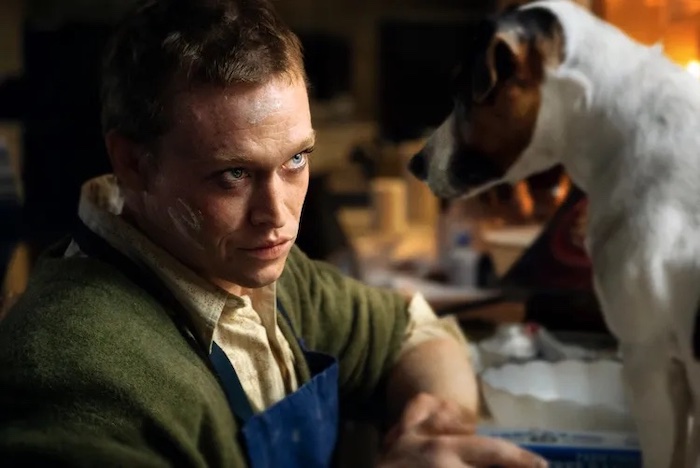
Having been hypnotized by Caleb Landry Jones as a mass murderer in the 2021 Australian feature Nitram, I passed over the fact that this similarly themed movie was written and directed by Luc Besson and gave it a whirl since Jones played the lead character, a disabled, gender-fluid individual who communes with dogs on an almost telepathic level for gore and profit. And, yes, Jones is worth seeing in a role that was obviously inspired by Joaquin Phoenix’s Joker, but Besson can’t help being Besson and the overall story and vibe are such a mishmash of twisted-talent cliches and calculated self-pity that it makes Joker look like the highbrow character study it thought it was. Whatever one thinks of early hits like Leon and The Fifth Element, Besson’s misguided attempts to appropriate Hollywood excess to further the cause of Euro-pop cinema has always felt immature and crass.

Jones’s character, Doug, is an emotionally damaged autodidact who survived a horrible childhood in a New Jersey home full of Bible-thumping fanatics with a paterfamilias who trains fighting dogs. Having lived in a cage with the animals for much of his boyhood, Doug lost the use of his legs but got the bloody revenge he needed and in the process became man’s best friend’s best friend. His adolescence is spent in a juvenile facility where he forms a crush on a theater teacher (Grace Palma) who turns him on to Shakespeare and provokes an interest in cross-dressing, a predilection that later helps him secure the only work that will have him, lip-syncing to Piaf and Dietrich recordings in a drag club. Meanwhile, Doug uses his canine gang to filch jewelry and other valuables from rich bastards’ and bitches’ homes and occasionally disembowel bullies.

The entire movie is told in episodic flashback mode after Doug, dressed in a bloody shift and wig, is picked up by the police with dozens of dogs in a van. His languorous confession is eventually taken by a psychiatric case worker (Jojo T. Gibbs) brought in to make some sense of this uncooperative mope, and he obliges her by relating the aforementioned big fish tale. Though the climax, which involves Doug’s maze-like, makeshift kennel being invaded by a gang of thugs with a bone to pick, shows a certain flair for choreographed retribution mayhem, it’s as silly as the rest of the movie to no great purpose except to make the audience think they didn’t waste all their money. I might be tempted to see the movie again just to concentrate on Jones’s fully inhabited Kier/Kinski-esque performance. He makes the most of those closeups.

Now playing in Tokyo at Marunouchi Piccadilly (050-6875-0075), Shinjuku Wald 9 (03-5369-4955).

Dogman home page in Japanese

photo (c) 2023 – LBP – EuropaCorp – TF1 Films Production

Posted in Movies | Tagged , | Leave a comment

Review: Maybe I Do

Despite certain heated discussions to the contrary, boomer movie stars, including women, continue to show up in leading roles as they enter their respective eighth or ninth decades on the planet; which isn’t to say they’re getting the quality of work that made their names back in the day, but producers obviously believe they still have something audiences want. I tend to think this kind of dynamic is the reason for so many romantic comedies these days—mostly British in provenance—involving senior citizens. Maybe I Do is strictly American and something of a predictable lemon, but not necessarily because it seems to waste its famous cast. Based on a play by the man who directs it, Michael Jacobs, the movie feels totally derivative in a way that’s almost offensive. 

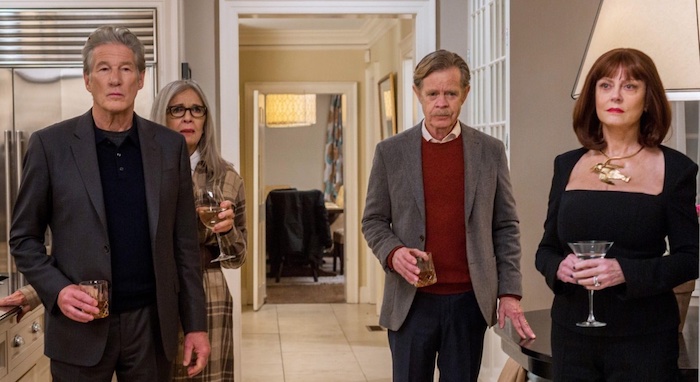
We have two couples who are supposed to be in what I assume to be late middle age—Grace and Howard (Diane Keaton, Richard Gere) and Monica and Sam (Susan Sarandon, William H. Macy). As with most late middle age couples, the spark has gone out of their relationships, and as the movie opens we learn that Howard has been having an affair for about 6 months with Monica and is thinking of breaking it off. Meanwhile, Grace and Sam meet cute in a revival art house cinema where they sometimes go by themselves in the afternoon. Though nothing physical happens between them, the thought is there and it definitely counts. Jacobs’ dialogue is so stage-bound the screen practically reeks of sawdust, but besides being weighted down with the kind of diction no one uses in real life, the lines are meant to convey certain philosophical truths that might have been provocative had they been in service to a more interesting story. Naturally, both couples are well-off and (spoiler alert—though reportedly the following intelligence is revealed in the trailer) as it turns out their adult children, Grace and Howard’s Michelle (Emma Roberts) and Monica and Sam’s Allen (Luke Bracey), are planning on getting engaged, and it isn’t until the two sets of parents meet for the first time that they realize they’ve been dallying with future possible in-laws. Emotional chaos ensues but not hilarity. 

As it turns out, the main complication is not these couples’ infidelities but rather Michelle’s cold feet. She’s already having second thoughts about jumping into matrimony and the old folks’ somehow conclude that they’re to blame for that by having set poor examples, and they do have a point in that regard. But a more serious problem than the paucity of chuckles is that Jacobs’ view of love, be it young or mature, seems culled from romantic movies and not from life, which isn’t necessarily a bad thing but romantic comedies are sold on fantasies that at least bring the viewer out of their own world. Maybe I Do wants its half-baked squirm comedy and its supposedly gimlet-eyed view of marriage in equal measure, and ends up delivering neither. 

Opens March 8 in Tokyo at Shinjuku Musashinokan (03-3354-5670), Human Trust Cinema Yurakucho (03-6259-8608), Yebisu Garden Cinema (0570-7830715).

Maybe I Do home page in Japanese

photo (c) 2023. Fifth Season, LLC

Posted in Movies | Tagged , , , , | Leave a comment

Review: Argylle

It wasn’t until after I had seen Matthew Vaughn’s star-studded secret agent parody that I read the New Yorker feature explaining its premise and how it was conceived as the launch of a franchise—the creation of a hopefully lucrative IP. The article explained a lot of points in the story that made no sense to me while I was watching it, but I didn’t find the movie exciting or even funny enough to want to revisit it in order to understand what the producers were really trying to do. An entertainment such as this that can’t exist on its own as an integrated work—meaning it needs to be considered within some kind of imaginary context to be fully appreciated—doesn’t really stand a chance.

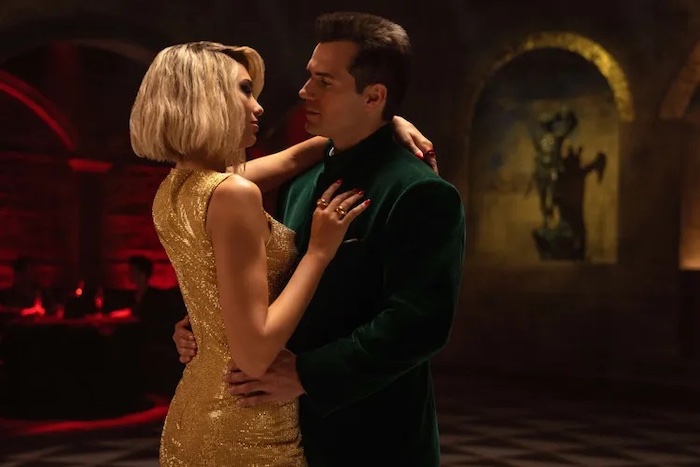
Ostensibly, the story is about a successful but cripplingly neurotic pulp spy novelist named Elly Conway (Bryce Dallas Howard), who eventually comes to realize that the plots of her books follow actual events in the real world. The upshot is that a villainous organization helmed by a man named Ritter (Bryan Cranston) has decided that Elly has to be assasinated, but just as that plan is being carried out she is saved by a good guy spy with a disarmingly breezy attitude named Aidan (Sam Rockwell). As Aidan and Elly fall deeper into the intrigue of the chase, the fictional hero of Elly’s series, a Bond-type mannequin with an exaggerated buzz-cut and widow’s peak named Argylle (Henry Cavill) occasionally shows up in parallel universe mode to illustrate how his predicament mirrors Elly’s, but the script is so poorly structured that it’s often impossible to distinguish between what’s real—at least within the universe of the “movie”—and what’s the product of Elly’s imagination. As it turns out, this lack of differentiation is the core of the film’s high concept, but its immediate effect is total confusion, which makes everything around it a chore to keep up with. Argylle is a movie that constantly detours into new realities that have no coherence, even in relation to one another.

It also means the action, of which is there is plenty, has no real coherence either. Shoot-outs start and stop without reason; vehicular mayhem has no purchase on the viewer’s anxiety (Elly’s portable, mostly CGI cat, always contained in a bubble-backpack, is subjected to the most peril); and new characters working at cross-purposes through hackneyed double-crosses and playing both sides against each other keep popping up to further confound your grasp of what’s supposed to be going on. Since nothing is as it seems, there is no danger to get worried about—or involved in. Unlike me, moviegoers with a more acute sense of the logic that fuels most IP franchises may know what this is all leading to well before the so-called climactic reveal, but I wonder if they will feel compelled to follow it any further. 

Now playing in Tokyo at Toho Cinemas Nihonbashi (050-6868-5060), Toho Cinemas Hibiya (050-6868-5068), 109 Cinemas Premium Shinjuku (0570-060-109), Shinjuku Wald 9 (03-5369-4955), Toho Cinemas Shinjuku (050-6868-5063), Shibuya Cine Quinto (03-3477-5905), Toho Cinemas Roppongi Hills (050-6868-5024).

Argylle home page in Japanese

photo (c) Universal Pictures

Posted in Movies | Tagged , , , | Leave a comment

Review: Cottontail

Like the proverbial broken clock that’s right twice a day, as an actor Lily Franky tends to work best when he happens to inhabit a character whose attitude aligns with his hangdog appearance. He’s not much on interpretation, and so there has to be a Franky-ness in the role’s construction for him to succeed in it. In his debut feature, British director Patrick Dickinson, who studied Japanese film at Oxford and Waseda, was wise to solicit Franky’s services for his protagonist, Kenzaburo Oshima, a Tokyo writer who is quietly devastated by the untimely death of his wife, Akiko (Tae Kimura). Kenzaburo is the kind of husband and father who prefers to keep misfortune and bad feelings at arm’s length by not acknowledging them fully, and thus comes across as insufficiently caring. When Akiko tells him that she has been diagnosed with early onset dementia, he waves it away, saying that things will be OK, and, of course, they aren’t, and by the time things turn really bad he is unprepared for his responsibilities, not only in caring for Akiko, but also in being there for his adult son, Toshi (Ryo Nishikido). It’s obvious that Toshi and Akiko have a much closer relationship than the ones that Kenzaburo has with either, and all he can do is look on and wallow in self-pity.

It’s a potent enough theme to carry a film, and Franky does most of the heavy lifting without breaking a sweat, but Dickinson undermines the drama by framing it as a road movie of redemption. Akiko once visited England’s Lake District with her parents when she was a young child and enamored of the writer and illustrator Beatrix Potter, who is from the area. In a will she wrote before she lost all cognitive function, she asks Kenzaburo to scatter her ashes at Lake Windermere, and the movie charts Kenzaburo’s tragicomically Sisyphean struggle to overcome his self-regard in order to carry out her last wish. Toshi, his wife Satsuki (Rin Takanashi), and their 4-year-old daughter accompany Kenzaburo to the UK, where his habit of closing himself off and getting drunk when faced with unpleasantness has an even more deleterious effect on their relationship. In a fit, Toshi practically disowns his father, and Kenzaburo lights out on his own with Akiko’s ashes to find the spot she memorialized in a single old photograph. Naturally, the endeavor is confounded by predictable language barriers and general ineptitude (he takes the wrong train). Thanks to a chance encounter with a local family (Ciaran Hinds, Aoife Hinds) that has also suffered a recent loss, he manages to get to where he wants to go.

If the climax doesn’t hit with as much force as it’s meant to, it’s because the framing story gets in the way. Dickinson never establishes an emotional connection between Akiko and Potter/Peter Rabbit. They’re presented as well-known images associated with Akiko’s childhood, but they were beloved by children the world over, and we never learn what it was about those books that appealed to Akiko in particular. Moreover, Kenzaburo, who is himself a writer (of what, exactly, isn’t revealed), appears to have no interest in Potter or her work beyond the task at hand. Dickinson demonstrates a genuine passion for the scenery that probably enchanted Akiko as a little girl, but the viewer has to draw their own conclusions to that end because he doesn’t want to intrude on the inner lives of his characters. In a tale about one man’s reckoning with lost opportunities, only Franky makes us feel anything. 

In Japanese and English. Now playing in Tokyo at Shinjuku Piccadilly (050-6861-3011), Marunouchi Piccadilly (050-6875-0075), Human Trust Cinema Yurakucho (03-6259-8608), Toho Cinemas Nihonbashi (050-6868-5060), Yebisu Garden Cinema (0570-783-715).

Cottontail home page in Japanese

photo (c) 2023 Magnolia Mae/Office Shirous

Posted in Movies | Tagged | Leave a comment

Review: Little Richard: I Am Everything

There’s no way that a documentary about Little Richard, the king, queen, and “architect” (his self-description) of rock and roll, was ever going to be dull, but Lisa Cortes’s study, completed three years after the singer’s death at age 87, is as deep as it is exciting. Anyone with any interest in popular music understands Richard Penniman’s contribution to 20th century culture and maybe even the contradictions within the man himself that fueled his art, but Cortes, with the help of some excellently curated talking heads, keeps her eye on the prize: the perspective of history on a grand scale to explain just how important Richard was to our sense of the way entertainment works on the soul and not just the eyes and the ears. He brought not only black music to millions of teenagers in the 1950s, but queer culture to an even larger audience who likely didn’t know what they were getting, but it wasn’t a stealth action. Richard was never coy about anything, not his talent, not his ribald sexuality, not his deepest fears and anxieties. It was all there in the music and in the public persona. He really was everything, as Mick Jagger says here.

The movie is especially instructive about the environment that produced Little Richard, the Baptist belt of Georgia where he started cross-dressing as a child, inviting derision and disgust from his own father, who eventually grew proud of his son when he showed promise as an entertainer just before he was shot to death in an altercation. Richard studied Sister Rosetta Tharpe for her gospel spirit and took style cues from the singer Billy Wright, not to mention piano lessons from the flamboyant R&B performer Esquerita. After hiring a band and touring the Chitlin’ circuit, he eventually came to the attention of white record companies, who initially thought he could be a blues artist simply because they hadn’t even conceived of rock and roll. It took a cleaned up version of “Tutti Frutti,” an original song originally about anal sex, to make them understand, and it not only turned out to be a crossover hit, but paved the way for every raveup that came barrelling down the pike, including those produced by white boys like Elvis and, the biggest insult, Pat Boone, who basically stole Richard’s repertoire while stripping it of everything that made it thrilling. Certainly the most indelible influence Richard had was on Paul McCartney, who not only learned Richard’s scream from the source, but whose band, the Beatles, received their rock education in the sinful port city of Hamburg, a gig that Richard was instrumental in setting up. But as the movie shows again and again and again, Richard never really benefited from his trailblazing idiosyncrasies except on a temporary, fleeting basis. He was constantly being cheated out of credit or royalties or both, and he knew it. It sparked his resentment and messed with his self-esteem, causing him to give up rock and roll several times in favor of Christian salvation—and then, either because he needed money or, as he once so famously sang, “the girl can’t help it,” he came back again randy and outspoken. 

He openly admitted to being gay and then denounced his homosexuality unequivocally. He gave up secular music and entered a seminary, only to return in the mid-60s as flashy and opinionated as ever. He married a good woman whom he always respected (even after the inevitable divorce) and yet adored queer acts like the trans performer Lady Java, a lifelong friend and confidante. Cortes examines these switch-ups with a clinical attention to detail that gets at the emotional extremes of Richard’s temperament, and interviews people who not only have things to say about his place in history and explain what he brought to the culture, but also how the experience affected him without fundamentally changing him. If the movie has a flaw it’s that the performances are taken for granted, but even in short clips they put paid to his boasts. He really was everything, and then some.

Opens March 1 in Tokyo at Cinemart Shinjuku (03-5369-2831), Human Trust Cinema Shibuya (03-5468-5551), Kadokawa Cinema Yurakucho (03-6268-0015).

Little Richard: I Am Everything home page in Japanese

photo (c) 2023 Cable News Network Inc. A Warner Bros. Discovery Company

Posted in Movies | Leave a comment

Review: Feast

Brillante Mendoza’s Feast, which was produced by a Hong Kong company, is one of his more conventional movies, and as such continuously perplexed me. Though it plays up the Philippine director’s normal strengths, it moves in a direction that I would never associate with him. It’s essentially about how a traffic accident affects two families, one very well-off, and the other poor. But it’s also about food and its preparation, and sometimes the two themes seem quite far apart from each other. I think Mendoza is more spiritual than I had previously thought, because the power of prayer and Biblical knowledge has a prominent position in the film’s dramatic development. I wasn’t expecting a tale of revenge or redemption, but I would never have predicted he’d make a movie that pities the rich.

The Tuazon family runs a successful restaurant and catering operation in a regional city, and as the movie opens, the son of the patriarch, Rafael (Coco Martin), is preparing for a big event, visiting markets and carefully selecting ingredients for the elaborate dishes that will be served at the feast. Driving home with his purchases, he’s distracted and collides with the three-wheeled vehicle of a man named Maitas (Carlos Canlas), who is seriously injured and eventually slips into a coma. Faced with impossible costs to keep Matias alive, his wife decides to pull the plug. As the investigation into the accident gears up, Rafael’s father, Alfredo (Lito Lapid), decides to take the blame in order to save his son’s future, more for the family than for Rafael. However, after Alfredo enters prison, the movie itself changes gears. The Tuazon family hires Matais’s family to work in their restaurant, and while at first it seems like an act of compensation, in the end the two families’ relative class distinctions are fortified rather than eliminated. The only real acknowledgement of the Tuazons’ culpability in Matias’s family’s situation is Rafael’s suffering, but it has more to do with his father’s sacrifice than the poorer family’s loss.

Mendoza has said in interviews that he shot an alternate ending that was much darker than the one in the released film. I’m not sure if that would have been a better movie, but I would definitely like to see it. As it stands, the latter third of Feast is mostly food porn–food porn of the highest quality, mind you, but food porn all the same.

In Filipino. Opens March 1 in Tokyo at Human Trust Cinema Shibuya (03-5468-5551), Kadokawa Cinema Yurakucho (03-6268-0015), Cinemart Shinjuku (03-5369-2831).

Feast home page in Japanese

photo (c) 2022 Hong Kong Pictures Heaven Culture & Media Company Limited

Posted in Movies | Tagged | Leave a comment

Media watch: Citizens group billed for destruction of memorial it didn’t want removed

Earlier this month, Gunma Prefecture removed a memorial monument in a park in the city of Takasaki. The monument had been erected in 2004 by a local citizens group to commemorate Korean laborers who had been brought to Japan during the Pacific War and died in Gunma Prefecture. In 2014, the prefectural government refused to renew the permit for the monument because it claimed the group had held a “political event,” which violated one of the conditions of the permit. Apparently, someone who attended one of the group’s public memorial ceremonies made a speech that used the phrase “forced mobilization,” meaning that some of the Korean laborers who worked in Gunma during the war did not come of their own free will. The group challenged the prefectural order and in 2022 the Supreme Court ruled in favor of the prefecture on appeal, thus setting the stage for what the governor of Gunma, Ichita Yamamoto, called “administrative subrogation,” an automatic bureaucratic action triggered by a violation of an agreement. According to the Mainichi Shimbun, in response to criticism that removing the monument might “encourage hate speech and historical revisionism,” Yamamoto said the matter was essentially out of his hands.

The irony, of course, is that if using the term “forced mobilization” to describe the situation of some Korean laborers during the war—a situation most historians say existed—is political, then it would follow that removing the monument because somehow those who decide such things deem it to be so is also political. There is no reference to forced mobilization on the monument itself. 

Yamamoto has said that he tried to negotiate with the group to have it moved to a “proposed” different location, but the group said there was no other suitable place, thus suggesting that the site offered by Yamamoto was in an out-of-the-way location, which would negate the entire meaning of a memorial. In any case, the prefecture’s offer of an alternative site would seem to imply that it is only following the subrogation condition and is not banning the monument per se, so why remove it in the first place? It’s obvious that Yamamoto and other parties simply don’t want the monument in the park where visitors might see it. (Reportedly, the spot in the park where the monument stood is off the beaten track) But what mainly scares the prefecture is people of a certain political orientation complaining of the very existence of the monument, whose main stated purpose is to foster friendship with the Korean people; and, as a matter of fact, when work to remove the monument started on January 29, right wing activists showed up to cheer the work and jeer at members of the citizens group and its supporters, who came to mourn the removal. Expecting that right wingers would show up, the prefecture itself mobilized police to make sure there was no violence, so there was another layer of irony underlying the subrogation order. If the condition that the monument have no “political” aspect was included to prevent friction between groups with different attitudes, than the subrogation order was achieving exactly that unwanted outcome.

The prefecture did say the citizens group could take possession of the monument, but while the group did receive the plaque with the friendship inscription, it could do nothing with the concrete and metal monument itself, which is quite large—7.2 meters in diameter with a golden column that’s 4 meters high.

Continue reading
Posted in Media | Tagged | Leave a comment

Review: Next Goal Wins

Of all the genres that beat the “inspired by true events” dead horse, sports movies are probably the most egregious in terms of making shit up. Taika Waititi, whose last film, Jojo Rabbit, even managed to perplex a lot of people about Nazism, approaches this true tale of the hapless American Samoa national soccer team with the notion of sending up the usual zero-to-hero sports movie trajectory, so already there’s going to be a fair amount of contrivance mixed in with the real stuff. But that notion also suggests it’s going to be funny, and as we saw with Jojo Rabbit, Waititi often has a hard time deciding what things are ripe for ridicule and what things are not. Though he trades rather freely in Pacific Islander stereotypes, he balances it with stereotypical white characters and their total lack of empathy toward non-whites, especially when money is involved. 

The soccer league under which Samoa plays wants the team to make an attempt to qualify for the FIFA World Cup 13 years after its most humiliating defeat against Australia by a score of 31-0. The organization doesn’t expect it to qualify, but it would like for Samoa to at least score a goal, which it has never done. None of the members have ever been anything other than weekend soccer players. In a last ditch effort, the league sends them the Dutch-American coach Thomas Rongen (Michael Fassbender), an alcoholic who everyone once believed was a promising star. Since the assignment was engineered by his ex-wife (Elisabeth Moss) and her cynical new boyfriend, the league president (Will Arnett), it’s easy to see why Rongen doesn’t appreciate the posting, and the friction between him and the team is thus played for uncomfortable laughs elicited by parodies of the kind of training montages sports movies incorporate as if by mandate. The sour attitudes of these white folks is compensated by the native optimism of the Samoans, represented foremost by the local federation head, Tavita (Oscar Knightley), who does his best to keep a positive attitude even in the face of Rongen’s booze-fueled abuse. If the setup has a saving grace it’s Jaiyah (Kaimana), a veteran player who, 13 years earlier, was a man and in the meantime has transitioned into a woman (or, as the Samoans see it, a “third gender”). Historically, Jaiyah was the first non-binary player to ever compete in a FIFA match, and Waititi allows the character a lot of leeway to navigate the tricky route they’ve been given to not only be accepted by the team (emotionally and rule-wise), but to help her teammates and their glum coach become better people. 

It’s a bit too much to ask, and in the end Next Goal Wins has to fall back on the cliches that prop up the sports movie genre, which means the athletes overcome their problems to work together toward some kind of triumph. No matter how much Waititi tries to take the piss, he can’t very well subvert the basic appeal of a sports movie, and thus it’s all a bit predictable, and not in a way that makes any meaningful difference.

Now playing in Tokyo at Toho Cinemas Nihonbashi (050-6868-5060), Toho Cinemas Hibiya (050-6868-5068), Toho Cinemas Shinjuku (050-6868-5063), Shibuya Cine Quinto (03-3477-5905), Toho Cinemas Roppongi Hills (050-6868-5024).

Next Goal Wins home page in Japanese

photo (c) 2023 20th Century Studios

Posted in Movies | Tagged , | Leave a comment

Review: Madame Web and The Roundup: No Way Out

Having had no emotional investment in Marvel Comics since I was 10 I have little to say about the Marvel Cinematic Universe that’s critically meaningful, since the whole point of the MCU is stoking established fans’ passions for the various characters and situations it embraces. But approaching this latest attempt to exploit the so-called Spider-verse I found myself at a loss to even understand what the appeal was supposed to be since the story was filled with shaded connections to other points of entry into the Spider-verse that I couldn’t figure out. For instance, the opening scene involves a pregnant entomologist (Kerry Bishé) visiting the jungles of Peru in 1973 to study a rare spider. So far, so good, because it’s obviously going to be about spiders. This sequence is followed by some fast-paced action centered on paramedic Cassie Webb (Dakota Johnson), who we eventually learn was the unborn child in the entomologist’s womb, involved in a treacherous rescue operation when she has a flash of the near future. Of course, the viewer is meant to make the connection that whatever the spider in the Amazon imparted to her mother is now being manifested in Cassie, but the director, S.J. Clarkson, and her writers don’t seem to know what to do with it, and end up traveling a conventional thriller route with off ramps to the Spider-verse that are too confusing to make an impression. 

The villain, Ezekiel (Tahar Rahim), who was also present during the Peru sequence, seems to be from another dimension in the Spider-verse and dresses like a wannabe Spider-man. He also possesses precognitive abilities and is after three young women (Celeste O’Connor, Syndney Sweeney, Isabela Merced) who will one day become Spider-women and presumably destroy him, so he’s trying to nip their Spideyness in the bud by killing them. But Cassie figures this out and endeavors to protect them after she sees their future when they occupy the same subway car. What ensues is a convoluted cat-and-mouse chase that needs either more explication or less, but in any case it never clarifies its relationship to the Spider-verse and its reason for existing as a movie, unless, of course, it all gets explained more thoroughly in a future sequel, which, I’m sure, has already been planned. But as I said earlier, I have no investment in the MCU so I can only enjoy the component films if they stand alone as integrated entertainments (FWIW, I thoroughly enjoyed the two animated Spider-verse films), and this one seems to require a leap of imagination that I can’t conjure. Even the action scenes, while less dependent on CGI than most movies of its ilk, contain too much incoherent pyrotechnic spectacle at the expense of mano-a-mano fighting. When I realized that the climactic free-for-all was taking place in front of a giant Pepsi sign, I finally understood what the film’s real priorities were.

The universe represented by the Korean cinematic crime series, The Roundup, is much less elaborate than the MCU, but it has its distinctions, which nevertheless remind the viewer that it isn’t the universe we live in. For one thing, there’s the cavalier attitude toward violence. Just as the proverbial narrative-based porn flick is required to have a sex scene every 5-10 minutes, in The Roundup films, police detective Ma Suk-do (Ma Dong-seok) is required to get into a fist fight with multiple bad guys every time he turns a corner, totally destroying his opponents in the process while suffering only the most superficial cuts and bruises. The fact that Ma never loses any of these fights (though, as the movies progress, he usually faces tougher opponents so that the fights last longer) would seem to work against the series as a whole, but The Roundup movies have been consistent winners in Korea during a post-pandemic box office slump. And that’s simply because Ma Dong-seok (or Don Lee, the name he uses for Western markets) is just too charming a bulked-up action star to resist.

Consequently, the best thing I can say about No Way Out, the third installment, is that it’s just more of the same, even if Ma’s usual goofball team of colleagues has been changed up owing to the fact that the action takes place 7 years after that of the last film for reasons I couldn’t care less about. The story is somewhat less compelling than the ones that anchored the first two. A loose federation of drug dealers handling Japanese product decide to double cross one another while also sticking it to a yakuza organization headed by Ichizo, played by Korea’s favorite movie Japanese bad guy, Jun Kunimura, but only in a few short scenes. Ichizo’s main operative on the peninsula is Ricky (Munetaka Aoki), whose brief is just to kill anyone he wants to, preferably with a sword. The ringer is a Seoul detective working for another precinct, Joo Seong-cheol (Lee Jun-hyuk), who heads one of the drug distribution organizations and means to corner the market on this particular synthetic narcotic, mainly by playing a possible Chinese connection against the other groups, including the Japanese.

The most refreshing thing about The Roundup is its relative paucity of guns, which I suppose means that it does have a connection to the universe we live in since Korean cops, like Japanese police officers, possess guns but are not encouraged to use them as much as their Western counterparts do. I know it’s a small thing, but when it comes to action movies that aspire to the kind of comic simplicity that Ma embodies, I take comfort in being able to understand everything that’s going on in a particular universe, where consistency counts for everything. I hear the next installment is out this summer. 

Madame Web now playing in Tokyo at Toho Cinemas Nihonbashi (050-6868-5060), Toho Cinemas Hibiya (050-6868-5068), Marunouchi Piccadilly (050-6875-0075), 109 Cinemas Premium Shinjuku (0570-060-109), Shinjuku Wald 9 (03-5369-4955), Shinjuku Piccadilly (050-6861-3011), Toho Cinemas Shinjuku (050-6868-5063), Toho Cinemas Shibuya (050-6868-5002), Toho Cinemas Roppongi Hills (050-6868-5024). 

The Roundup: No Way Out in Korean, Japanese and Mandarin. Now playing in Tokyo at Marunouchi Toei (03-3535-4741), Shinjuku Piccadilly (050-6861-3011).

Madame Web home page in Japanese

The Roundup: No Way Out home page in Japanese

Madame Web photo (c) 2024 Marvel

The Roundup: No Way Out photo (c) Bigpunch Pictures & Hong Kong Film & B.A. Entertainment

Posted in Uncategorized | Leave a comment