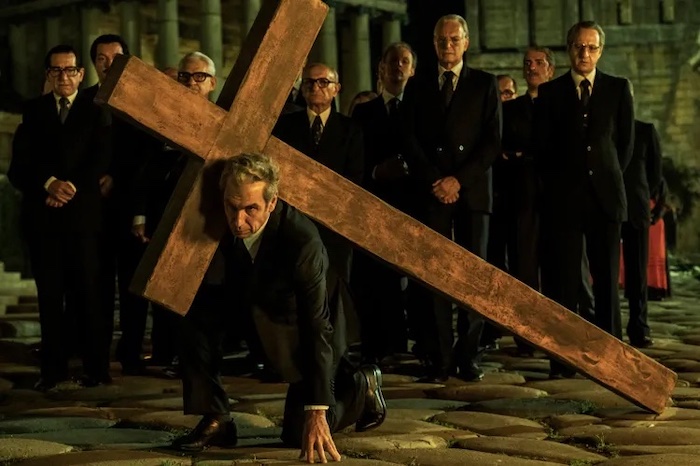
Review: Infinity Pool

As a chip off the old block, Brandon Cronenberg lacks his father’s ability to connect a viewer emotionally to the outrageous images he conjures up, unless you consider disgust an emotion. Whereas David Cronenberg’s patented body horror has something to do with the imagination, Brandon’s is wholly visceral in that he shows in almost loving detail how violence affects flesh and bone. In his first film, Possessor, various remotely controlled assassins find creative ways of killing that seem extreme compared to the usual cinematic hitman m.o., but I hesitate to call it gratuitous because the nature of a remotely controlled assassin, by definition, can’t be clearly understood. However, in Cronenberg fils’ new movie the violence, the sex, and particularly the cruelty are clearly gratuitous, because the story is so catastrophically ridiculous, even on an allegorical level. The movie doesn’t generate enough confidence in its premise to render the gross-out elements as anything but pointless provocations.

Since the subjects of the movie are rich white folk, the cruelty, wherever positioned and pointed, is taken for granted. The setting is a fictional tropical country where the resorts are separated from the poor inhabitants by barbed wire fences. James (Alexander Skarsgård), a blocked novelist, and his wealthy publishing heir wife, Em (Cleopatra Coleman), are vacationing here when they meet CM actress Gabi (Mia Goth) and her French architect husband Alban (Jalil Lespert). Gabi attaches herself to James because she loved his one novel, attention that flatters the monumentally insecure writer to no end. After the two couples borrow a car—a vintage Cadillac, no less—and take a forbidden drive off the resort compound to frolic on a deserted beach, James hits a local while driving drunk and kills the man. Though they try to sneak back into the compound the police catch up to them and the head detective (Thomas Kretschmann) informs them that the law of the country dictates that the son of someone killed by another person has the right to kill that person himself. But this country also has a loophole for those who can afford it: The authorities will produce a clone of the condemned and have that clone killed in the condemned’s place—while the condemned watches. Though stupid, this high concept is exactly the kind of thing that brings out the creative in Cronenberg, and the gory sequence that shows how it works reveals an original, if downright sick, imagination.

But that’s not the end of the silliness. James, forced to watch his own mutilation, gets turned on by it, and he is soon welcomed into a secret society of privileged seasonal regulars who’ve been through the same thing and now get their rocks off by throwing off all social and moral constraints and doing whatever they like, including killing and raping, because they can always pay for clones to receive the punishment. Though I can understand the message Cronenberg is pushing, the means of delivery make me wonder if he also doesn’t get off on it. The characters just fall deeper and deeper into depravity with no ethical or rational reckoning. Meanwhile, the director gooses the repellant images with odd camera angles and a slick electronic score from Tim Hecker in an attempt to turn it all into entertainment. It felt more like punishment.

Now playing in Tokyo at Shinjuku Piccadilly (050-6861-3011), Human Trust Cinema Shibuya (03-5468-5551).

Infinity Pool home page in Japanese

photo (c) 2022 Infinity (FFP) Movie Canada Inc., Infinity Squared KFT. Cetiri Film d.o.o.

Posted in Movies | Tagged , , | Leave a comment

Review: The Iron Claw

To those of us who do not follow professional wrestling, it’s often difficult to separate the athletics from the theatrics, and one of the strengths of Sean Durkin’s feature about the real-life Von Erich family, who were stars of the sport from the late 70s to the early 90s, is how it brings these two components together without making a big deal of it. Much of the movie’s drama is derived from one or another of the four Von Erich brothers striving for a championship title, and while my own understanding of what that entails has never been complete—If it’s mostly theater, who and what determines a champion?—the dedication and passion these brothers demonstrate in their quest for glory is impressive, though not necessarily inspiring. For one thing, they are constantly under the pummeling tutelage of their father, Fritz (Holt McCallany), a former wrestler whose own ambitions for the title were cut short. As in all great family sagas, the father channels his hopes and dreams into his sons, who not only honor those wishes but sacrifice themselves to a discipline they may not fully believe in. The reason has less to do with filial piety and more to do with fraternal love. These brawny men will do anything for each other.

The story’s parade of tragedy is truly cinematic in scope. The oldest brother, Kevin (Zach Efron), is the one who most eagerly pursues greatness as a wrestler. He truly loves being in the ring, but he’s willing to sacrifice his legacy if it means his brothers can have their shot. Kerry (Jeremy Allen White) is also into the sport, but he’s less sure of himself and clinically self-destructive. David (Harris Dickinson) is the family’s brain and clown, a born performer who gets off on the attention while not necessarily taking the sport seriously as a sport. And Mike (Stanley Simons) is the sensitive artist who isn’t interested in wrestling at all, but participates in order to prop up the family business—Fritz has his own company, which trains wrestlers and stages matches. (In reality, there was a fifth brother whom Durkin decided to elide from the family portrait.) Over the years, the four brothers are plagued by injury—some horrific—and psychological turmoil, mostly at the hands of their father, but they always have one another. At times, Durkin has trouble developing his story. It’s mostly one triumph or tragedy after another, though as a family saga it has depth thanks to the synergizing energy of the sport. Durkin attempts to do with wrestling what Scorsese did with boxing in Raging Bull—make the visceral aspect of the battles seem fantastical. The fact that the theatrical component is fantastical to begin with only heightens the spectacle on screen.

The real message of the film is that family ties, no matter how strong, can rarely remedy individual flaws. In that regard, the two principal female characters, Von Erich matron Doris (Maura Tierney) and Kevin’s wife, Pam (Lily James), have to shoulder the burden of that hoariest of family saga cliches, the sensible, practical, feminine counterbalance to the overriding male ego, but since the hyper-masculine temperament required by pro wrestlers is here extended by the peculiar macho aesthetic of Texas, the two women really have their work cut out for them. Durkin often gets carried away with the sweep of the saga, but along the way he supplies not only valuable instruction on how pro wrestling works, including the business side, but why so many people just can’t get enough of it. 

Now playing in Tokyo at Toho Cinemas Nihonbashi (050-6868-5060), Toho Cinemas Hibiya (050-6868-5068), Kino Cinema Shinjuku (03-5315-0978), Toho Cinemas Shibuya (050-6868-5002), Toho Cinemas Roppongi Hills (050-6868-5024).

The Iron Claw home page in Japanese

photo (c) 2023 House Claw Rights LLC; Claw Film LLC; British Broadcasting Corporation

Posted in Movies | Tagged , | Leave a comment

Review: She Came to Me

There’s an air of lofty criticism drifting through Rebecca Miller’s new film that feels at odds with its production design. Though the decor of the sunny, expansive Brooklyn flats where it’s set convey the kind of aspirational fantasy evident in all of Woody Allen’s work, it mainly seems to be a wry comment on what passes for intellectual bohemianism these days. The protagonist is, of all things, a blocked opera composer. Steven (Peter Dinklage) is obviously successful since he lives in these expensive digs with his wife, Patricia (Anne Hathaway), a therapist who met Steven when he was a patient, and Anne’s 18-year-old son, Julian (Evan Ellison), from a previous relationship. Given Steven’s present professional predicament, it would appear that Anne’s ministrations haven’t been successful, but now she seems to be his agent, an angle that Miller should have explored more thoroughly for its humorous potential. In fact, what this putative romantic comedy really lacks is comedy. Instead, it tries to deliver pointed irony, which isn’t the same thing. One of the running jokes is that Steven calls Anne “Doc.”

The romance component comes in the form of Katrina (Marisa Tomei), a barge pilot whom Steven meets while walking his French bulldog and stopping into a deserted bar for a pre-noon drink. They strike up a conversation and Katrina invites Steven back to her vessel, docked conveniently nearby, where they have sex after Katrina explains that she’s a “romance addict,” a condition that prods her to stalk men with whom she has casual dalliances. This intelligence spooks, intrigues, and inspires Steven all at once. As a result, he has the subject of his next opera. Again, the comic potential in the idea of a blocked creative type becoming newly provoked to make a great work isn’t fully exploited. You get the feel for the material’s potential when one of Steven’s financial patrons raves about the new work as “a female Sweeney Todd,” since Steven plays up the more troubling aspect of his one-afternoon stand with Katrina and blows it up into full-on murderous psychosis. But the element of the story that Miller seems more concerned with is the conventional one—how to keep this brief affair a secret from Anne, who, as it turns out, has her own psychological demons to deal with, not to mention Julian and his under-18 girlfriend, Tereza (Harlow Jane), whose immigrant mother (Joanna Kulig) is Anne and Steven’s housekeeper and whose step-father (Brian D’Arcy James) is a conservative firebrand who accuses Julian of statutory rape. In contrast to this subplot, Steven’s extramarital fling feels insubstantial, and yet Miller insists on elaborating it to lengths it doesn’t warrant. 

Even when Katrina finds out that she is not only the muse of Steven’s new opera but its lead character, things become really tricky, not just for Steven but for Miller, too. I can’t say I completely understood the point of where it all leads, but the final joke at Patricia’s expense—worthy of Allen in his pre-Annie Hall days—is the only one I laughed at. It’s easy to imagine Miller coming up with this joke first and then working backwards, which I would say is not the wisest strategy when writing a comedy.

Opens April 5 in Tokyo at Human Trust Cinema Yurakucho (03-6259-8608), Shinjuku Piccadilly (050-6861-3011).

She Came to Me home page in Japanese

photo (c) 2023 AI Film Entertainment LLC

Posted in Movies | Tagged , , | Leave a comment

Review: Past Lives

Celine Song’s debut feature, which didn’t win any Oscars despite being the most acclaimed indie movie of 2023 in the U.S., may be the purest cinematic distillation of the Korean emigrant experience, even more so than Minari. Centered on a woman whose family moved from Seoul to Canada when she was twelve, the film explores the sense of connection with the past that fades over time only to be pulled back into emotional purview when a figure from that past returns. Nora (Greta Lee), a playwright living in New York with her white novelist husband, stumbles upon her first girlhood crush from Seoul, Hae-Sung (Teo Yoo), as he seeks her out online, and they embark on a long-distance Skype relationship that eventually becomes overwhelming, at least for Nora. Years later, Hae-sung comes to visit her after breaking up with his girlfriend, and the encounter is as fraught as an overloaded container ship. I’ve seen the movie twice, the first time in South Korea with a Korean audience, which was educational. “There but for the grace of God,” everyone seemed to be moaning during the quiet, devastating climax.

The second time I concentrated more on the plotting and was perplexed by the details of the various interactions, which felt calculated without being complete. Nora’s parents are both artists, and their move to Toronto for professional reasons was never explained satisfactorily. (In interviews, Song admits that the story is based very much on her own history.) Consequently, Nora’s success as a writer, while hardly phenomenal, seems preordained, and when she meets her future husband, Arthur (John Magaro), at a writers’ workshop, it all comes down to chemistry. Song understands how such a marriage might appear to others, and makes it the point of the opening scene, which depicts Nora, Arthur, and Hae-sung in a bar together near the end of the story. Since Arthur doesn’t understand Korean and Hae-sung’s English is barely passable, Nora can control the separate conversations but is basically frank about her feelings when talking to either man. This is where Past Lives comes into its own as a study of intimate interaction. Though much has been made of the philosophical dimension of Nora’s approach to Hae-sung’s attentions, her marriage appears to fulfill her practical needs, something she doesn’t take for granted. Romantic love, in fact, isn’t a primary motivator, which may confuse viewers expecting a conventional melodrama; it’s more of a struggle between the unavoidable pull of nostalgia (or “inyun,” a very specific Buddhist term that describes how past lives affects one’s present one) and the more natural push of connubial comfort. What I wished Song had interrogated more closely was Nora’s and Arthur’s relationship as fellow writers, since they seem to be at least partly in competition with each other. (Arthur, upon hearing the background of his wife’s relationship to Hae-sung, remarks that it’s a “great story,” as if he wished he could write it himself.) As it stands, Nora skillfully keeps the two vectors running in parallel, so they never truly intersect, even in that very moving last scene.

Song keeps the tone melancholy and autumnal (even if it seems to take place in early summer), making Past Lives one of the best New York movies of recent memory: These conversations, these feelings could never have been generated in any other place. In comparison, the early scenes in Seoul feel tentative, as if the crew weren’t sure they were even allowed to film here. There’s a lot to appreciate, but I suspect there’s more to the story than meets the eye and ear.

In English and Korean. Opens April 5 in Tokyo at Toho Cinemas Nihonbashi (050-6868-5060), Toho Cinemas Hibiya (050-6868-5068), Toho Cinemas Shinjuku (050-6868-5063), Bunkamura Le Cinema Shibuya Miyashita (050-6875-5280), Toho Cinemas Roppongi Hills (050-6868-5024).

Past Lives home page in Japanese

photo (c) 2022 Twenty Years Rights LLC

Posted in Movies | Tagged | 1 Comment

Review: Godland

There’s a scene about halfway through this disturbing but frustrating Icelandic film that puts everything before and after in such plain perspective that it threatens to upend the whole meaning of the production. A young Danish clergyman, Lucas (Elliott Crosset Hove), charged with building a church in a remote village on the Iceland coast in the late 1800s, is talking to his host, Carl (Jacob Lohmann), a fellow Dane and the nominal leader of the village, about the arduous journey the priest and his entourage of locals experienced in order to reach the village, a journey that claimed the life of at least one man and several pack animals. Carl asks, with genuine curiosity, why Lucas chose to sail to the opposite end of the island country and then travel on foot and horseback for weeks through forbidding terrain when he could have more easily sailed directly from Denmark to the village. Though we already know Lucas’s answer (“I want to get to know the country,” is how he explained it to his superior back in Denmark), the stark logic of Carl’s question injects another one into the viewer’s head: Why did the movie’s director, Hylnur Pálmason, put his protagonist through such hell based on such a flimsy rationale? Obviously, because he wanted to test the man, and show off Iceland’s unique landscape in the process.

There’s no getting around the effectiveness of this plot device—much of the first half of Godland (a purposefully ironic title) is a cinematic essay in how a natural environment can be at once monumentally beautiful and mortally terrifying—but given how the trip changes Lucas, whose religious piety is a manifestation of his privileged arrogance, the calculation on Pálmason’s part feels equally arrogant. The director compounds this connection by affecting ethnographic documentary qualities, such as a 4:3 aspect ratio and occasional scratches on a non-existent film surface. The analog between Lucas and Pálmason is further enhanced by the former’s avocation, photography, which necessitates the portage of a huge box camera, not to mention a crate of glass plates, over mountains and through raging rivers, just so that he can record the virgin country, usually with a local stevedore hired for the journey adding the human dimension. But the first inkling of Jacob’s overall attitude toward his fellow humans is his petulant reluctance to learn Icelandic (there are apparently as many ways to say “shut up” as there are words for “rain”), a trait that annoys his guide, Ragnar (Ingvar Sigurdsson), a burly, older man of endless resource whose temperament is to question the existence of anything he can’t see, smell, touch, or hear—like God. Though Ragnar saves Jacob’s life, after they arrive at their destination and he supervises the building of a church he would never attend, the enmity between the two men only becomes more intense. 

Pálmason’s narrative style is elliptical, so when Carl’s two daughters show up on screen without introduction it takes a few scenes to establish not only their relationship to each other, but their meaning within the story. The younger girl, Ida (Ida Mekkin Hlynsdóttir, the director’s daughter), exudes a weirdly cosmopolitan sensibility in the way she addresses Jacob about the religious versus the secular life, and while she does it to gauge his compatibility as a mate for her older sister, Anna (Vic Carmen Sonne), it’s obvious that such a match would never go over with Carl, who tolerates Jacob’s seething resentment of everything this place represents simply because he has to keep the village together—religion is something the Danish expats feel they need. But none of this melodramatic business gets at the heart of the hatred between Jacob and Ragnar, which is elemental under such circumstances, and by the time their conflict reaches its violent resolution you may wonder why, just as with Jacob’s preferred sea route, the movie couldn’t have gotten to where it was going with less fuss. 

In Danish and Icelandic. Now playing in Tokyo at Theater Image Forum Aoyama (03-5766-0114).

Godland home page in Japanese

photo (c) 2023 Assemble Digital Ltd. 

Posted in Movies | Leave a comment

Review: Fanatic and All the Beauty and the Bloodshed

Fanatic

Oh Seyeon’s Fanatic is definitely a student project, since she was still studying film at university when it was first shown at Korean film festivals in 2021. As such it’s also a deeply personal film. Oh explores the mystery of fandom, especially the downside, and takes off from her own adolescent crush on a K-pop singer who was eventually arrested and tried for gang rape and distributing videos of his victims. An air of embarrassed amateurness pervades the documentary, even if Oh, having already tasted the limelight as a fan, seems confident in her ability to hold your attention. 

That literal 15 minutes of fame when she met her idol, Jung Joon-young, in person at a fan event broadcast on TV, is the centerpiece of the film since it not only describes the depth of her devotion, but made it possible for her later to reach out to other fans who came to know her by reputation. She interviews a dozen young women, both Jung fans and some who had crushes on other stars. What they all have in common is that their idols eventually disappointed them, either through criminal activity or scandal. Predictably, their enmity became as fierce as their adoration had been. “I want him to die in jail,” one woman, hiding beneath a hoodie, says of Jung after he was convicted and sentenced to five years in prison. Despite the fact that Oh herself professes to only being able to talk frankly about it while drunk, she’s philosophical about her feelings, as are almost all her interlocutors, who are self-aware enough to probe their own fanaticism. The defensiveness of hardcore K-pop fans is well-known, but for some reason Oh doesn’t go into that aspect of the matter, maybe because from her perspective defensiveness is more or less natural, but as a reformed seongdeok (fanatic) she certainly knows how it feels, and at one point makes the connection between rabid K-pop fandom and right wing politics by visiting a rally for the release of imprisoned former president Park Geun-hye, where one of the activities was writing fan letters to Park that the organizers would deliver to her. As someone who has had a lot of experience penning sweet meaningless love notes to someone she doesn’t know personally, Oh felt as if she were among comrades, despite the fact that most were old enough to be her grandparents and she didn’t have any particular feelings about Park.

She also avoids the elephant in the room, especially with regard to K-pop, which is that most stars are manufactured, their whole public existence built on cultivating devotees like Oh. One of the women Oh interviews had a crush not on a K-pop star but on an indie rock artist, which would seem to contradict Oh’s thesis, since indie artists are, by definition, self-made. But the woman didn’t sound any less disciplined in her devotion than the K-pop fans did, and was similarly destroyed when the artist she followed was brought down by scandal. It also would have been interesting had Oh interviewed some men, but maybe their own brand of fandom scans differently than women’s.

Thankfully, Oh doesn’t take herself seriously, even if her movie is formally meticulous. At least half her production budget was apparently spent on taking the train from Busan, where she’s from, to Seoul in order to attend Jung’s trial, which like any function related to K-pop “sold out” in 5 minutes. (It’s implied that she got into the courtroom by paying a scalper.) She also interviews her mother about her own feelings regarding an actor she idolized who similarly ended his career in disgrace. The parallels with her daughter’s situation are both sobering and hilarious, and when Oh asks her if she was worried about her daughter’s obsession with Jung, the mother says, “No. I thought it was good that you stuck to one thing for so long.” Let’s hope she sticks to filmmaking with the same dedication.

All the Beauty and the Bloodshed

Veteran documentarian Laura Poitras has years of experience on Oh, not to mention an Oscar, and her award-winning All the Beauty and Bloodshed traces a more nuanced look at obsession, specifically through the experiences of famed photographer Nan Goldin. Poitras’s film is more overtly political than Oh’s, but there’s a similar determination at play to get at the heart of the mystery of obsession, even if it leaves out the fanaticism part. The target of Goldin’s attention is the Sackler family, which owned Purdue Pharma, the company that made billions on the prescription opioid OxyContin and thus was eventually found responsible for the deaths of millions of Americans through addiction to the drug, which the company not only knew about but encouraged. Goldin was one of those addicts, though she survived her own overdose and afterwards made Sackler a project that required even more of her typically fierce concentration than her art did.

Since Poitras is an observer, she presents Goldin’s crusade as part of a feature-length biography that goes deep into the artist’s battles with mental illness, the history of her nominally transgressive art, and the carefully curated, years-long legal case she brought against the Sacklers. The early biographical material charts Goldin’s rise as a photographer on the east coast—chiefly the queer mecca, Provincetown—where she was a fixture of the demimonde who went from shoplifting and living in relative squalor to producing what is generally considered the most revolutionary photography exhibition of the 1980s, The Ballad of Sexual Dependency. In the end, she incorporates this theme of conquering the art world into her mission of taking down the Sacklers by destroying them as patrons of art. Over the years, the family has funded many museums, and Goldin is a powerful enough artist in her own right to influence these museums’ self-regard by refusing them to show her work as long as they take her nemeses’ money. It’s perhaps the most elemental depiction of the conflict between art and commerce I’ve ever seen on film, and the drama this conflict evokes is powerful. There’s even palpable intrigue when Goldin discovers she’s being stalked by agents of the Sacklers’ legal team.

It helps that Goldin is articulate about her anger, a quality that’s developed through countless encounters with lawyers and the public as she has beat the drum for greater accountability on the Sacklers’ part. Poitras gives her free rein, and while purists may question the film’s lack of objectivity, All the Beauty and the Bloodshed (the title comes from a medical report about the suicide of Goldin’s beloved sister at the age of 18) is meant to be an emotional journey. It is not journalism in the strict sense. It is a chronicle of rage that ends up being a work of art in its own right.

Fanatic, in Korean, is now playing in Tokyo at Theater Image Forum Aoyama (03-5766-0114).

Fanatic home page in Japanese

All the Beauty and the Bloodshed is now playing in Tokyo at Human Trust Cinema Yurakucho (03-6259-8608), Shinjuku Piccadilly (050-6861-3011).

All the Beauty and the Bloodshed home page in Japanese

All the Beautry and the Bloodshed photo (c) 2022 Participant Film, LLC

Posted in Movies | Tagged , | Leave a comment

Review: Ghostbusters: Frozen Empire

Having passed through the original Ghostbusters craze phase unscathed and unenlightened, I came to the fractured franchise late and never quite got its blend of winking gross-out humor and imaginative but tame scares. There was always something under-cooked about its premise of a professional squad of ectoplasm exterminators, as if all the ideas had been worked out in the kitchen. That’s why the characters themselves are so important to the series, and why the original crew still needs to show up, however peripherally, in the new incarnation—or, at least, until the characters in the new incarnation make as much of an impression. Paul Rudd, who plays Gary, the nominally male head of this new enterprise, which has moved from the Midwest to the old fire station in New York that housed the original Ghostbusters, has imprinted his patented awkward nice guy on too many decent comedies to make the proper impression here (most people who are into this kind of movie will likely look at him and think of Ant-man first), and the three actual blood family members of the crew, mom Callie (Carrie Coon), daughter Phoebe (McKenna Grace), and son Trevor (Finn Wolfhard), weren’t given enough distinctive dimensionality in Ghostbusters: Afterlife to carry over to the new movie. I feel I have to get to know them all over again.

The silver lining is that Phoebe gets to reboot her emotional affiliation with the audience by shouldering the one dramatic subplot of the movie. After a job in a sewer goes wrong, she strikes up a friendship with a ghost named Melody (Emily Alyn Lind), whose provenance is never completely clear, but the two bond over conversations about death and family that are surprisingly affecting. Whatever the purpose of this diversion, director Gil Kenan has other entertainment obligations to carry out, and the volume of plot elements he has to juggle overwhelms him in the end. The real “story,” as it were, starts when a slick scam artist (Kumail Nanjiani) tries to sell a family heirloom to original GBer Ray (Dan Aykroyd). It happens to contain an imprisoned ghost that is out for big time revenge in the form of icing over New York City (which, typically, takes the wintery attack in stride). The related action is sufficiently potent but keeps getting interrupted by business that stalls whatever momentum Kenan can muster. Major chunks of expostion are given over to another original GBer, Winston (Ernie Hudson), and the paranormal research center he has built in an abandoned aquarium; as well as Gary’s fanboy obsession with the original Ghostbustermobile, which is presented as a series of flat running jokes. Phoebe’s story doesn’t stand a chance.

So when Bill Murray shows up for his requisite nostalgia appearance in the loud climax, you can practically smell the calculation. Murray has always been good at counteracting his don’t-give-a-shit attitude with crack comic timing that saves even the lamest jokes from themselves, but here he just feels obligatory, especially when he gets frozen in place with nothing much to do. Now how much did he get paid for that?

Now playing in Tokyo at Toho Cinemas Nihonbashi (050-6868-5060), Toho Cinemas Hibiya (050-6868-5068), 109 Cinemas Premium Shinjuku (0570-060-109), Shinjuku Wald 9 (03-5369-4955), Shinjuku Piccadilly (050-6861-3011), Toho Cinemas Shinjuku (050-6868-5063), Toho Cinemas Shibuya (050-6868-5002), Toho Cinemas Roppongi Hills (050-6868-5024).

Ghostbusters: Frozen Empire home page in Japanese

Posted in Movies | Tagged , , , | Leave a comment

Review: Oppenheimer

It was inevitable that Christopher Nolan’s multiple Oscar-winning biopic of J. Robert Oppenheimer, the father of the atomic bomb, would play in Japan despite some earlier reports that no local distributor would touch it because of Hiroshima/Nagasaki; though it remains to be seen if it’s as much of a box office draw as it’s been in other markets. And, in fact, it does address the utter devastation the bomb inflicted on a human population, albeit in a scene where the titular scientist (Cillian Murphy) imagines that devastation as it affects people who don’t look particularly Asian. Nolan’s reason for not including what actually took place in Japan on August 6 and 9, 1945, is that he has made a movie about a man who was not there on those dates, and, in fact, there are very few sequences in the film that do not center directly on Oppenheimer the man. Moreover, half the script is about what happens to him when he publicly renounces his creation for the terrifyingly destructive thing it is and the uses to which it is being put, so it is hardly a celebration of that creation. Nevertheless, the scene where the news of the dropping of the bomb on Hiroshima is met by Americans with cheers and celebration will undoubtedly make many Japanese people uncomfortable. It made me, an American, very uncomfortable, and I assume that was Nolan’s aim.

Because if the movie is about any one thing it’s hubris—Oppenheimer’s, mainly, but also that of the American intellectual left, the U.S. military, and males in general (the women are treated as cavalierly by the movie as they were in real life). Nolan’s purpose is to get into Oppenheimer’s mind in such a way as to show how those who needed him to produce the bomb could manipulate it to their ends. Normally, such an approach is done with more intimate tools, but Nolan, being Nolan, can’t work intimately, and so he trains his IMAX cameras on easy metaphors—from raindrops in water puddles to explosions on the sun—that are meant to be visually overwhelming. Likewise, Oppenheimer’s ambitions, which take him to Europe to hobnob with intellects and egos as big as his (He learns Dutch in six weeks just to present a lecture!), to the greatest universities in the U.S., where he’s a despised superstar, and finally to the attention of the authorities who exploit that ego—and his Jewish identity—for the war effort, are treated with maximalist detail by populating the cast that revolves around the protagonist with Oscar-winners and other A-listers. At first, I thought this parade of well-known faces would be a distraction (Matt Damon! Emily Blunt!Josh Hartnett! Kenneth Branagh! Robert Downey Jr.! Florence Pugh! Casey Affleck! Rami Malek for two minutes only!) but in Murphy he has an actor who does more with his face than with his voice or his body, and when you see it perform on the huge screen there’s little else to think about. This prioritizing of images at the expense of everything else comes into its own in the middle portion at Los Alamos, where the terrible deed is prepared and demonstrated, and the force that Nolan subsequently unleashes reverberates for the rest of the movie, which deals granularly with Oppenheimer’s political persecution in the 1950s and 60s.

Which isn’t to say Oppenheimer is the usual linear historical epic. Nolan liberally switches time periods and color palette to get what he wants, and if the story’s development seems to defy logic—much in the same way that the theories of the universe Oppenheimer ascribes to do, at least at first—it arrives at its destination with a proper sense of who the man always was and how it destroyed him in the end. What’s revolutionary about Nolan’s movie is how it interrogates the inner life with cinematic devices normally reserved for recreating bombast. Nolan has already proven he can do both, but he’s never juxtaposed the elemental with the gargantuan in such an assured way. It does what blockbusters have always endeavored to do: Hold the audience spellbound for three hours with the biggest gestures money can buy. But rather than assault the senses, Oppenheimer wields these devices in order to force us to ponder the arrogance of human enterprise, which may be the most terrifying thing of all. 

Opens March 29 in Tokyo at Toho Cinemas Hibiya (IMAX 050-6868-5068), Marunouchi Piccadilly (050-6875-0075), Toho Cinemas Shinjuku (IMAX 050-6868-5063), Shinjuku Wald 9 (03-5369-4955), Shinjuku Piccadilly (050-6861-3011), 109 Cinemas Premium Shinjuku (03-6709-6410), Toho Cinemas Nihonbashi (050-6868-5060), Toho Cinemas Roppongi Hills (050-6868-5024), Toho Cinemas Shibuya (050-6868-5002).

Oppenheimer home page in Japanese

photo (c) Universal Pictures

Posted in Movies | Tagged , | Leave a comment

Review: Love Reset

It’s been said by wiser cinema-heads than I that the romcom is dead, killed off by a post-modern critical attitude that doesn’t appreciate the irony that once made the genre appealing. My own take is that the classic trappings of romantic comedies—middle class, middle-brow aesthetics tied to a belief in the transcendant values of monogamous heterosexual love—no longer apply in a world where constant connectivity breeds cynicism toward human relationships. And I’d say that was a shame if I believed in middle class, middle-brow aesthetics in the first place, but the romcoms I’ve always liked—Preston Sturges’ work, Shampoo come to mind—are already cynical, so maybe I was never the target. At the moment, Korean cinema and TV series are thriving on romcom stories, and for the most part they blend the kind of snark I appreciate with the wettest sentimentality you could possibly stand, an often toxic combination that nevertheless keeps you awake to the possibilities of a particular story.

Love Reset is what used to be called high concept, meaning it was pitched for its gimmick—married couple about to get divorced are in an accident that leaves them with amnesia and thus open to the possibility of falling in love all over again—and, as is often the case with any Korean romcom, the story is so unwieldy and imprecise that there’s bound to be something there you like, if only for a minute or two. The introduction is promising: Perpetual law student Jeong-yeol (Kan Ha-neul) is drinking himself into a stupor because the love of his life, Na-ra (Jung So-min), is getting married to somebody else. Though the two have dated for some time, Na-ra, from a well-to-do family, doesn’t think Jeong-yeol, who is going for his fourth or fifth run at the bar exam, is ever going to amount to much, but at the altar she has a Graduate moment and bolts the ceremony, arriving at the bar where Jeong-yeol is blotto to declare her intentions. From here, the movie veers widely away from the path a Western romcom would take, with Na-ra’s family, understanding there’s no point in fighting it, offers to support Jeong-yeol while he studies again for the test, a development that makes Na-ra question her own future with him, and after they marry she finds she can’t stand his spendthrift ways (he’s determined to pay back his in-laws) and purity of purpose. She goes the opposite way by drinking constantly and leaving a mess wherever she goes, and her freelance movie production work suffers for it.

What’s promising about the setup is that after the two lose their memories their families and friends reverse course and endeavor to make sure they don’t get back together again, thus creating a tension between the different intentions at play. A lot of the comedy is self-referential (“this is like something out of a movie”) and the scatological humor might be a bit too ripe for some tastes, but as a sour look at the state of matrimony in Korea and the class pressures that work to its disadvantage it’s often amusing in a broad, slapstick way. In any case, I can’t see how anyone would want to marry either of these clowns.

In Korean. Opens March 29 in Tokyo at Marunouchi Piccadilly (050-675-0075), Shinjuku Piccadilly (050-6861-3011).

Love Reset home page in Japanese

photo (c) Cinema Woollim, TH Story and Mindmark

Posted in Movies | Leave a comment

Review: Rheingold

One of the few intriguing elements of Fatih Akin’s biopic of the Kurdish-German rapper and media star Giwar Hajabi (professional moniker Xatar) is the title. The composite word comes up when Hajabi, as a child, accompanies his composer-conductor father to a performance of the similarly named opera in Bonn, shortly after his refugee family has arrived from Iran via Iraq and Paris. Das Rheingold is the first of Wagner’s four works addressing German culture’s mythological origin story, and the scene sets the stage for Hajabi’s own self-mythologizing impulses (the Rheingold, after all, makes you immortal) as a foreigner gangster who survives by his wits and outsized personality. It also gives Hajabi a credible grounding in both music and outlaw attitude, the former of which is only latently realized.

Moving back-and-forth through Hajabi’s life, the storyline focuses on hard responses to hardship, with the family suffering mightily in exile following the Iranian Revolution before the elder Hajabi secures work in Germany as a musician—and then promptly abandons his wife and children when he meets another woman. Bullied and vilified by other immigrants and ignored by the natives, Giwar (Emilio Sakraya as an adult, Ilyes Moutaoukkil as a teen) sells porn videos in school to augment household finances and becomes a street fighter who can give as good as he gets when he turns to dealing drugs. Akin doesn’t do much to distinguish the various facets of young Hajabi’s life as he falls headlong into a life of crime that leads him to an expat mob headquartered in Amsterdam who sees his potential and puts him to work. One botched job leads to another and Giwar goes on the lam for stealing a shipment of gold (Aha!), forcing him to hide out in Syria where he’s picked up by local military who torture him to find out where the precious metal is stashed. Because Akin doesn’t follow this portion of Hajabi’s life in a linear fashion it lacks the urgency you expect from stories about criminals caught up in their own miscalculations, and it’s difficult to understand exactly how Hajabi ends up back in Germany in prison. But that’s where he takes up hip-hop as a vocation after having only dabbled in it previously.

Akin borrows what he needs from the canon—a bit of Scarface here, some Tupac music video style there; a lot of Scorsese—but the total package never finds a purchase on the imagination and feels generic as a tale of personal triumph. It doesn’t even register as being particularly dangerous, which is odd since Xatar is a very controversial artist in Germany. In the movie, he’s just another flattened-out example immigrant success. 

In German, Kurdish, English, Dutch, Turkish and Arabic. Opens March 29 in Tokyo at Human Trust Cinema Yurakucho (03-6259-8608), Cinemart Shinjuku (03-5369-2831), Bunkamura Le Cinema Shibuya Miyashita (0570-6875-5280).

Rheingold home page in Japanese

photo (c) 2022 bombero International GmbH & Co. KG/Palosanto Films Srl/Rai Cinema S.p.A./Lemming Film/corazon international GmbH & Co. KG/Warner Bros. Entertainment GmbH

Posted in Movies | Tagged | Leave a comment