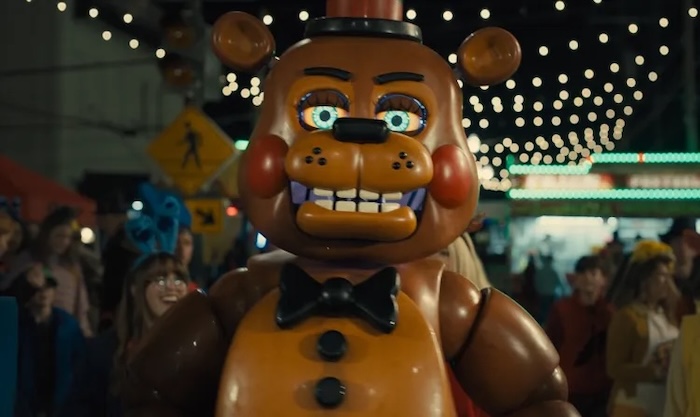
The inevitable sequel to the very successful 2023 movie adaptation of the equally popular video game slightly improves on its predecessor in that its storytelling is more abstract. The problem I had with the first movie was its byzantine plotting around a premise it couldn’t avoid, since the weird logic of the game had to be taken into consideration. Consequently, there was a lot of baffling stuff about the titular family-friendly pizza parlor’s back story and a bunch of kids who were somehow lured to their doom by the guy who designed the animatronic creatures that were the eatery’s main attraction. It didn’t have to make sense, but it sure needed to be easier to follow if it was going to be as scary as the game.
The main attraction of the sequel is that the animatronic killer monsters leave the confines of the abandoned pizzeria to terrorize the surrounding environs, but how that happens requires more than the suspension of disbelief usually required of these kinds of horror films. The central idea of the stolen children is repeated at the beginning of the film with a flashback to Freddy Fazbear’s heyday, when a little girl watches as a little boy is abducted right in front of a crowd of unaware restaurant patrons. Though she saves the boy she’s killed in the process and later her spirit enters the animatronic body of a marionette that didn’t appear in the first film. The marionette conveniently causes all the mischief in the sequel, presumably as a form of revenge. Abby (Piper Rubio), the girl who was the main person-in-danger in the first film, is back, slightly older, and still under the impression that she can connect with the possessed robots, much to the chagrin of her older brother, Mike (Josh Hutcherson), who used to be a security guard at Freddy’s after it closed for obvious reasons. Also returning is Mike’s romantic interest and action figure foil Vanessa (Elizabeth Lail), who is the daughter of the evil Freddy’s mastermind (Matthew Lillard, making a brief cameo here in nightmare mode because his character was killed in the previous movie) and so has dibs on some of the payback stuff that’s central to the movie’s mojo.
When I say that Freddy’s 2 is more abstract, what I mean is that all roads lead to the robots laying siege to the town, so story arcs are replaced with elliptical episodes that simply get us from here to there without a lot of narrative fuss. Unfortunately, the only really interesting thing that happens is the creatures interrupt a student science fair, severely trying the patience of the mean teacher (Wayne Knight) in charge. Since he gets what he deserves, you then understand who the target audience is: brainy junior high schoolers who think they’re smarter than their science teachers.
Opens Jan. 23 in Tokyo at Toho Cinemas Nihonbashi (050-6868-5060), Toho Cinemas Hibiya (050-6868-5068), Shinjuku Piccadilly (050-6861-3011), Toho Cinemas Shinjuku (050-6868-5063), Shibuya Humax Cinema (03-3462-2539), Toho Cinemas Roppongi Hills (050-6868-5024).
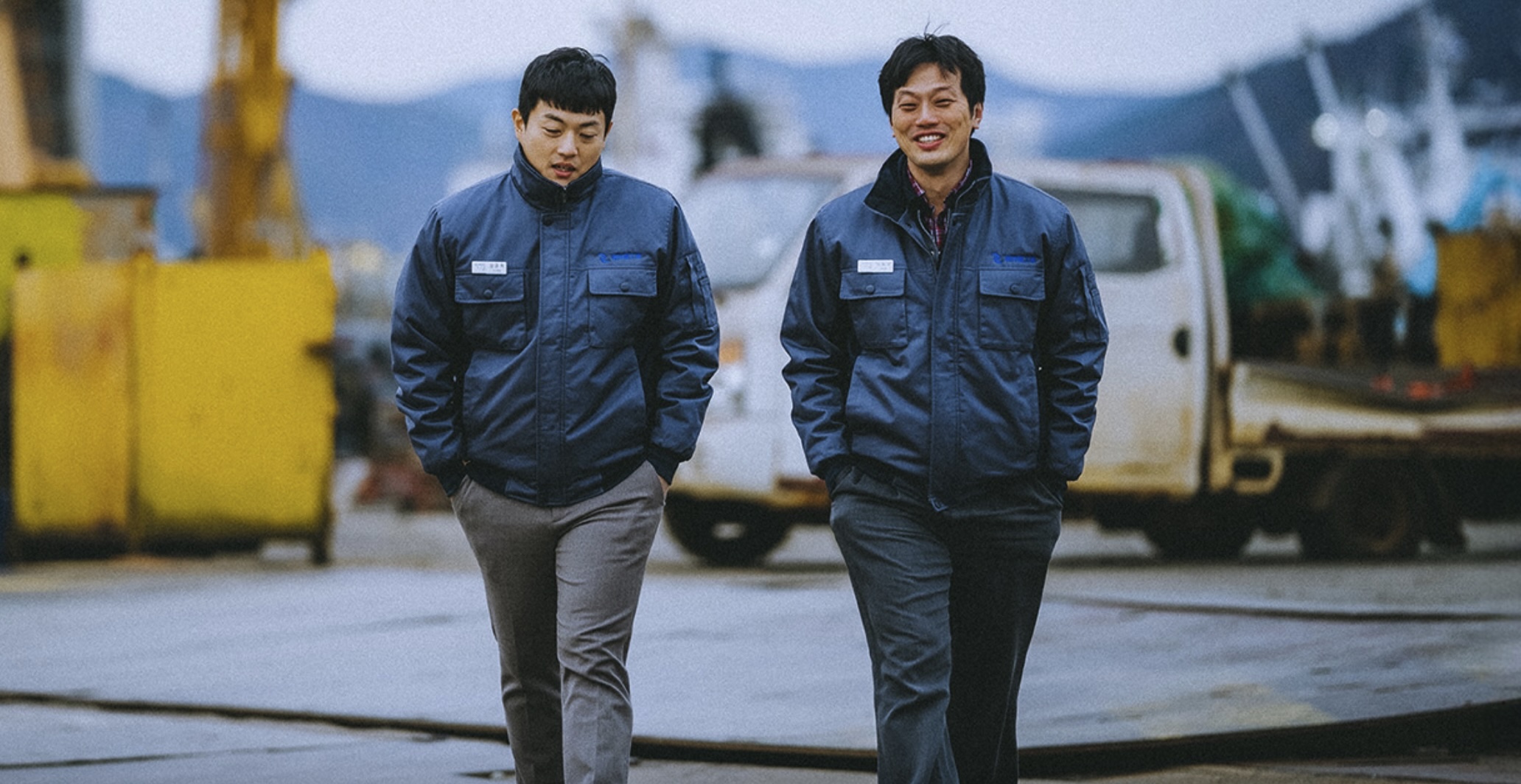
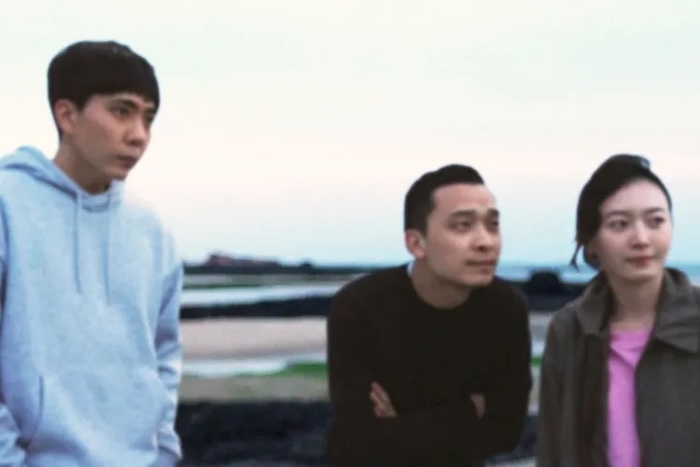
The dramatic tension generated in Park Hong-jun’s debut feature, Work to Do, comes from an unusual place. The time is 2016 and the protagonist is Kang Joon-hee (Jang Sung-bum), a young employee of a Korean shipbuilding company who has been transferred to human resources in a seasonal personnel reshuffle. The transfer is both good news and bad news for Kang, considering that the company is undergoing major restructuring in the face of dwindling orders and heated competition from China. Management wants to lay off about 150 people, and now that he’s in HR, Kang would seem to be safe from being downsized himself, but also because he’s in HR he’s one of the people who will be carrying out the actual cuts. (Interestingly, right now South Korea’s shipbuilding business is booming, so its problem right now is a labor shortage.)
The kernel of Park’s story, which is supposed to be autobiographical, is that Kang, thanks to his own native intelligence and facility with spreadsheets, figures out a way to make the cuts as painless and fair as possible. He rightly feels proud of his accomplishment and is commended by his superiors in HR, but the success proves to be double-edged. Once the union and certain division heads learn of the spreadsheet and Kang’s hand in it, they put pressure on the department directly to favor certain people over others, asking HR to manipulate the careful criteria Kang has devised to “evaluate” individuals. The breaking point comes when two workers close to Kang face possible dismissals that he senses have been predetermined, and the guilt that has been hanging over his head comes crashing down. His drinking becomes a problem and his relationship with his fiancee suffers for it. Since this is Korea, the employees most at risk talk strike, thus injecting latent anger into an already painful process.
Park navigates the various inter-departmental relationships with a detailed understanding of the political processes that rule an industrial organization like this; and if some of the corporate jargon and niceties of the shipbuilding trade seem a bit arcane, Park doesn’t insult his viewers by making them feel as if they can’t appreciate what these people are going through, and that goes for the nominally bad characters as well as the nominally good ones. In a later scene, Kang seeks advice from his mother, an author and former social activist, as if her counsel were a last resort, thus showing us just how much inchoate shame he bears in merely trying to do his job. In the end, it’s the scruples that matter. One can only do good by one’s fellow worker, regardless of the relative positions, if one is honest with oneself. Bosses can be ruthless when their positions are at risk, but those with a stable moral center will usually follow their conscience. Kang’s doesn’t, no matter how subtly Kang tries to steer him toward the light. I can’t think of an ethical conundrum that hits as hard as that.
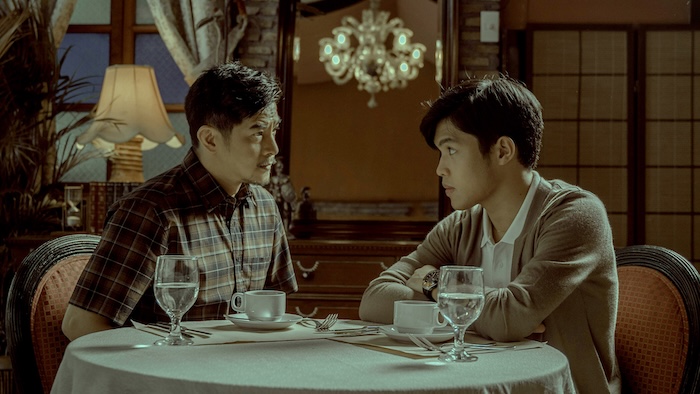
The Philippine two-hander About Us But Not About Us is also about work, or, more to the point, how one’s actions outside the workplace affect those within it. The entire movie takes place in a tastefully appointed Manila restaurant during the lunch hour and involves a conversation between a literature professor, Eric (Romnick Sarmenta), and a student named Lance (Elijah Canlas) who studied under Eric’s late lover, Marcus, one of the Philippines’ most acclaimed novelists. Marcus recently died of an overdose that we are led to believe was suicide. Ostensibly, the purpose of this luncheon rendezvous is for Lance to return a set of keys to Eric’s spare apartment, which he’s been using.
With this opening information, director Jun Robles Lana nudges the viewer into an acute state of suspicion. We’ve already seen Eric pull up to the restaurant in his vintage VW Beetle and apply some lightener to the bags under his 40-year-old eyes, thus implying a possible date in the works, and it isn’t long into their conversation that Lance comments it would not be good if any of Eric’s university colleagues or students learned that he was staying in Eric’s apartment, especially after Marcus’s death. As it turns out, Eric offered his place to Lance when he heard that the younger man was suffering abuse at the hands of his stepfather, but it also seems that he did this good deed without Marcus’s knowledge. Eric professes not to care about “false rumors” because nothing happened between them, but Lance sets him straight on how serious it would be if certain people believed a teacher was grooming one of his charges.
Since Eric is open about his homosexuality, he believes he is somewhat impervious to the kind of accusations Lance refers to, but the pandemic is still fresh in people’s minds and “inappropriateness” in the meantime has become a term that’s more loaded than it ever was. As the conversation develops in a disarmingly theatrical manner—Lana has both men “play” Marcus in imagined supplementary dialogue—it’s revealed that Eric isn’t as self-assured as he lets on and Lance isn’t as uninvolved in Marcus’s personal crisis as Eric initially thought. In fact, Lance has not only read Marcus’s first fictional foray into the Filipino language—all his previous work was in Engish—but he still has a copy of it, a revelation that shakes Eric to his core, since he was under the impression that Marcus had destroyed the manuscript. Who, we wonder, is controlling whom? There’s more, and it’s all perfectly scandalous without being entirely credible. All About Us seems like something that was written for the stage but then was somehow greenlit for a movie against the writer’s better judgment. It’s fun in that, like Eric with regard to his occupational image, it’s not as monumental as Lana thinks it is.
Work to Do, in Korean, now playing in Tokyo at Euro Space Shibuya (03-3461-0211).
About Us But Not About Us, in English and Filipino, now playing in Tokyo at Theater Image Forum Aoyama (03-5766-0114)
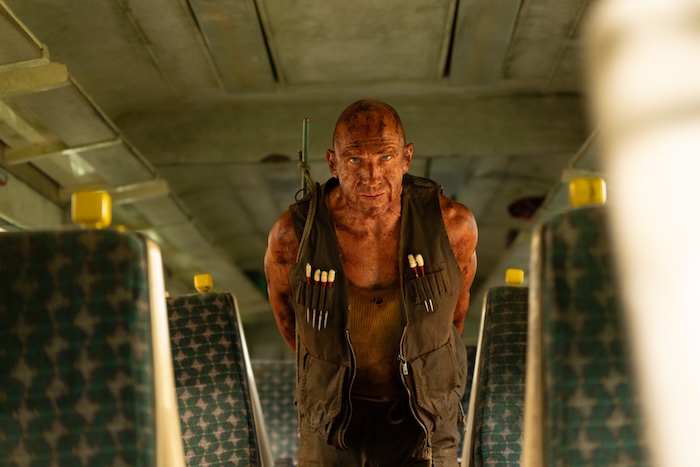
With Danny Boyle taking time out from the 28 Days Later series for the second time, it’s up to original screenwriter Alex Garland to provide thematic continuity with this fourth installment, and thus the third installment, which took place 28 years after the first movie did, has become a trilogy unto itself with its own internal plot structure. What’s fascinating about this decision is that it essentially does away with the original “zombie” hook that attracted viewers. The previous movie ended with the adolescent boy Spike (Alfie Williams) trying to return to the relative safety of his settlement of Uninfected after delivering his terminally ill mother to a doctor who would see she receives a proper sendoff. However, right before the end credits roll he is captured by a roving cult headed by a charismatic monster named Jimmy Crystal (Jack O’Connell). The new movie starts up where the previous one left off, with Spike being initiated into the cult’s horrific worship of Old Nick, meaning Satan, which entails not only slaughtering the supposedly mindless creatures infected with the Rage virus, but also torturing and killing uninfected people for the purpose of…well, Crystal’s reasons are never succinctly laid out, but it has something to do with watching his vicar father turn into a ravening devil by the virus and deciding he must serve his own Godless impulses.
Consequently, The Bone Temple is much less concerned with the Infected than the previous stories in the series, and for what it’s worth Jimmy Crystal and his “Fingers,” with their identical blonde wigs (fashioned after the coiffure of the BBC announcer Jimmy Savile, later revealed to be a serial pedophile) and gleeful habit of skinning people alive, are much scarier than the Infected since they aren’t propelled to violence by the virus’s need to propigate but rather by the human capacity for pure evil. Spike’s initiation into the cult, which he can’t refuse, is to kill another member in cold blood. Whatever Garland intended for the cult to represent in this land, which as we discovered in the last movie is the UK after a decades-long quarantine from the rest of the world has left it practically devoid of humankind, he obviously sees it as the natural product of the desperation borne of a nihilistically Manichean existence—chomp or be chomped. That’s where Dr. Ian Kelson (Ralph Fiennes) provides counter-balance. Kelson has maintained his medical ethics amid the Infected apocalypse by creating the titular memorial to all who have died as a result of the virus, be they infected or otherwise, and in the process has determined that the Infected have souls and are capable of rational thought, which he tries to cultivate in one particular “alpha” he names Samson (Chi Lewis-Parry), whom we first see ripping a soldier’s spine out of his body. The two plot threads are brought together when Crystal mistakenly concludes that Kelson is Old Nick, and Kelson allows him to believe that for reasons that are not clear until the two meet in an impossibly insane climax. Suffice to say that Kelson recognizes, at this stage, that the Jimmy Crystals of the world are worse for humanity than the Infected are.
Director Nia DaCosta distinguishes her style from Boyle’s usually manic technique by fixing the camera’s gaze on the most disturbing images. The Bone Temple is not only much gorier than the three previous movies, it’s more focused on the unadulterated cruelty that only sentient human beings are capable of. My main misgiving is that Boyle is slated to return for the third installment in the trilogy, and I don’t know if his methods are right for the way Garland has developed the story. As a work of cinematic horror, The Bone Temple may be the best of the batch, but it can’t be properly appreciated in isolation. The whole trilogy stands or falls as a unified epic.
Now playing in Tokyo at Toho Cinemas Nihonbashi (050-6868-5060), Toho Cinemas Hibiya (050-6868-5068), 109 Cinemas Premium Shinjuku (0570-060-109), Toho Cinemas Shinjuku (050-6868-5063), Toho Cinemas Shibuya (050-6868-5002), Toho Cinemas Roppongi Hills (050-6868-5024).
28 Years Later: The Bone Temple home page in Japanese
India Donaldson’s insightful debut feature, Good One, has been called a coming-of-age story, but given that the protagonist is a 17-year-old Brooklyn-bred girl who is about to go off to college, it seems more appropriate to call it a post-coming-of-age story. One of the primary points Donaldson is trying to make is that many young people, particularly girls, are more attuned to the vagaries of the human condition than their parents are if only because the latter have been beaten down by the so-called responsibilities of adulthood. Sam (Lily Collias) is the daughter of divorced parents. Her father, Chris (James Le Gros), who has remarried in late middle age to a much younger woman with whom he has a young child, is still on pretty good terms with Sam even if she looks upon his choices with a jaded eye. The movie depicts a camping trip that the two take in the Catskills with Chris’s best friend, Matt (Danny McCarthy), a failed actor who is also divorced and not taking the change as well as Chris took his. In fact, when we first meet Matt he is arguing in the doorway of his brownstone with his son, who was supposed to accompany the trio on their camping trip but now refuses to go for some reason, thus leaving Sam as the only young person with these two insecure men.
Amidst some gorgeous scenery of upstate New York, a clear dynamic is estabished. Sam and Chris are seasoned campers, while Matt is the awkward neophyte who wears jeans, packs too much unnecessary stuff, and forgets his sleeping bag. But even if Sam and Chris exude a certain air of expertise, the camaraderie that apparently highlighted their camping trips in the past has dissipated as Sam has grown more cynical and worldly and Chris less youthful in his enthusiasms. Consequently, the hike is characterized by sarcastic bickering between Chris and Matt as Sam suffers in silence with the onset of her period, which she hides from the two men as best she can. At every opportunity she takes out her cellphone and tries to communicate with her best friend back in the city, who seems to be having a better time than she is. Donaldson keeps matters fairly low key, though, with gentle background music courtesy Celia Hollander and lots of visual cutaways to forest critters. When a bunch of frat boys join them for a campfire meal, you expect something perhaps sinister, but except for the obligatory conversational sexism, Sam doesn’t have to put up with anything untoward. That will come later, when she finds herself alone with a drunken Matt who, you’ll remember, forgot his sleeping bag.
You don’t have to be Salinger to understand Sam’s position in all of this, and when the other shoe drops and she finally pushes back at Chris’s total lack of paternal concern the feeling of total rejection cuts like a knife. Sam is beyond her coming-of-age moment, even if her response is almost petulant. She realizes this in the end, but doesn’t stand down, even after her father moves quickly from anger to disappointment to a kind of grudging acceptance. She’s beyond his reach now, if, in fact, she was ever actually within it.
The father-daughter relationship in Treasure, directed by the German filmmaker Julia von Heinz, is much more settled in its dysfunction than the relationship in Good One. Thirty-six-year-old journalist Ruth (Lena Dunham) is traveling to Poland to visit Lodz, the home town of her mother, who died a year earlier, as well as Auschwitz, which her parents survived. She is accompanied by her father, Edek (Stephen Fry), though it’s apparent right from the start that she would have preferred he stayed back in New York. Edek, who doesn’t really think Ruth needs to take this trip (“What Jew goes to Poland as a tourist?”), is worried she might get taken advantage of in his native land and quickly attempts to commandeer all aspects of the journey, from accommodations to transportation to sightseeing choices, as Ruth resists mightily, determined to find out where her heroically stoical mother came from and why her father is so bent on preventing her from finding out.
The answer isn’t hard to guess for anyone familiar with the cinema of Holocaust remembrance. Since the movie takes place in 1991, Edek is still in his 60s and ebullient enough to fool you into believing that the camps weren’t a big deal for him, though his hesitation to expose his daughter to the kind of Polish social mores that made his Jewish childhood a parade of indignities still seems to be partly justified by what they encounter now that the communist system is kaput. Von Heinz and her production design staff do a creditable job of recreating the greyish feeling of a country that never had a chance to recover from the war, but her depiction of the people seems founded on Slavic stereotypes, none more striking that Edek himself, with his slouch, paunch, and witty disdain for self-seriousness. Ruth, on the other hand, is that hoary cliche, the neurotic New York Jew with an eating disorder, and it’s fascinating to watch Dunham and Fry interact until it in fact becomes a chore. It’s mainly the dynamic. Dunham seemes almost born to this kind of material, which is based on a novel that itself was “inspired by a real story,” meaning it’s auto-fiction. Dunham is as famous as a writer of barely veiled autobiographical teleplays as she is as an actor in those TV productions, and with her own well-documented problems with health and sexual relationships as subtext, she breaks through the cliches and makes Ruth a credible character. Fry, on the other hand, is known for his erudition, and his Slavic accent and purposely messy look come off as merely caricature, the performance instinctively theatrical. Playing against each other the two actors feel like oil and water.
Consequently, the big emotional payoff in the end, as Edek submits to his horrible experiences and Ruth tries to make peace with the memory of a mother who held her at arm’s length for the sake of her own peace of mind, doesn’t provide as many emotional dividends as von Heinz probably thinks it does. Treasure is a comedy at heart, and I wish the director had followed that path more closely.
Good One opens Jan. 16 in Tokyo at Human Trust Cinema Yurakucho (03-6259-8608), Human Trust Cinema Shibuya (03-5468-5551), Shinjuku Musashinokan (03-3354-5670).
Treasure, in English and Polish, opens Jan. 16 in Tokyo at Kadokawa Cinema Yurakucho (03-6268-0015), Kino Cinema Shinjuku (03-5315-0978).
For all its narrative shortcomings, Platoon remains a hallmark of warfare cinema in that it left little to the imagination. War movies have since become almost rote in their presentation of carnage to the point where if you don’t see at least one horribly destroyed human body it seems the filmmaker isn’t doing their job. Alex Garland and Ray Mendoza take this idea back a few steps by offering carnage as only one element in a larger, seemingly more realistic presentation of what it’s like to be in the midst of battle. That means you get not only the gunfire and horrific explosions, but the unbearably tense downtime in between such instances of mayhem.
The opening title cards of Warfare inform us that the movie we’re about to see is based solely on the memories of the men who experienced the depicted operation. Those men were Navy Seals assigned to surveil a neighborhood of Ramadi, Iraq in 2006 that was controlled by an Al Qaeda cell in order to secure the area so that a squad of marines could pass through. In other words, the assignment was not an offensive action, and so the battle that ensues is not central to any strategic aim in the larger war. This seems to be Garland’s and Mendoza’s point, that “warfare” is not just about gaining ground and killing the enemy but rather that much of the time it’s about laying the groundwork for those objectives. Mendoza, who was the technical advisor for Garland’s last film, Civil War, was part of this operation and he and his fellow survivors are played by young actors without providing any background intelligence or insight into their feelings. It’s all rather clinically depicted and so a lot of what these soldiers are doing, such as communicating with their superiors somewhere distant, may be lost on the lay-person viewer, but the purport is very much felt, and Garland the action director knows how to rachet up the suspense and desperation. The sound design is more important than the special effects in that it conveys how the fog of war is made murkier by silence. After the Seals commandeer a house from a civilian Iraqi family they are supposed to remain in hiding, but somehow the cell discovers where they are and attack. We don’t know how the cell found out or what their attack plan was or if it even existed because the only narrative source is the survivors’ recollections.
Almost all the action in the movie involves evacuating two badly wounded Seals, which means, in a real sense, that the “operation” was not a success. That outcome is obvious but somehow lost in the general chaos of the movie’s development. Also lost is the POV of anyone who isn’t a Seal, meaning the Iraqi family (though they are clearly terrified) and the nominal enemy, who are only shown in long shot or through the sight of a sniper’s rifle. Warfare makes no attempt to comment on the Iraq War or American war-making attitudes in general. It’s a technical explication of the mechanics of being a soldier among soldiers, and while it succeeds on that level in the end it feels more like an exercise than a movie.
Opens Jan. 16 in Tokyo at Toho Cinemas Nihonbashi (050-6868-5060), Toho Cinemas Hibiya (050-6868-5068), Marunouchi Piccadilly (050-6875-0075), 109 Cinemas Premium Shinjuku (0570-060-109), Shinjuku Wald 9 (03-5369-4955), Shinjuku Piccadilly (050-6861-3011), Toho Cinemas Shinjuku (050-6868-5063), Kino Cinema Shinjuku (03-5315-0978), Shibuya Cine Quinto (03-3477-5905), Toho Cinemas Roppongi Hills (050-6868-5024).
The spoiler about Hong Sangsoo’s In Water has nothing to do with anything in its meager plot. It has to do with the main formal decision to present almost the entire thing out-of-focus, so, from a critical viewpoint, revealing that aspect to readers is more of a caveat than a spoiler. Hong aficionados could be put off by this revelation because they will see the movie anyway, but everyone else may appreciate the intelligence because if they didn’t know what to expect and then sat down to a film that was blurry for almost its entire length, they very well might feel cheated. There are a number of possible reasons for this odd decision, but Hong is notoriously fickle about the Gestalt of his films. Everything is geared toward a certain outcome that he may not actually have figured out until the movie has already been shot, and I assume that’s what happened here. (During a Q&A following the festival screening I attended, the cast admitted that they didn’t know the film would be out-of-focus until they saw it in completed form at another, earlier festival screening) The story, as it were, is essentially about how he himself makes movies in his own peculiar way.
The protagonist, Seoung-mo (Shin Seok-ho), is a novice filmmaker who is planning a feature with his crew and cast in a location by the sea. It’s clear from the beginning that Seoung-mo has no script and not much of an idea about what kind of movie he wants to make. He wants the setting to dictate all that, and the tension generated during the film is based on how this lack of foresight and assertion affects those who have invested their time in an artistic vision that they soon realize doesn’t exist. The entire movie is about scouting the location, since almost no actual filming is done until the end. As is often the case in a Hong feature, there’s a lot of conversation over meals and drinks, and for once these epicurean episodes have consequences, since Seoung-mo has a very limited budget and the more he spends on non-filmic elements like food the less he will have to complete the project. Eventually, the director’s indecisiveness starts to irk his DP, Sang-guk (Ha Seong-guk), and sorely inconvenience his overly indulgent lead actor, Nam-hee (Kim Seung-yun), thus lending the whole movie an atmosphere of impatience and discomfort. When Seoung-mo finally gets around to shooting a scene, it’s based on something he just observed—a woman cleaning up trash on the beach—and whose meaning he doesn’t fully understand and thus can’t convey to his actors.
Close followers of Hong will understand that this amorphous storyline mimics Hong’s own methodology, in which he shows up with a coarse outline that is explained to his cast and crew right before shooting individual scenes and then later shaped into something like a narrative—or not. The out-of-focus gimmick seems to mirror Seoung-mo’s own opaqueness toward those he’s working with, with the blur getting denser as the project refuses to coalesce in his mind. The real problem here isn’t the overall concept, which is kind of brilliant on paper (though probably never actually written down), but rather the endgame of having a protagonist-artist who isn’t mature enough creatively to operate as a real artist. Hong gets away with a lot in his films because he is a real artist, so depicting himself as someone who shows no aptitude for the game has limited thematic resonance and almost no real appeal to anyone but completists.
In Korean. Now playing in Tokyo at Euro Space Shibuya (03-3461-0211).
The term “recovery drama” should induce winces and feelings of trepidation in serious moviegoers. Seeing yet another sad individual overcome the depredations of addiction and stand fully sober in the sun is meant to be soul-lifting but because the genre is loaded with cliches the thinking has become, you’ve see one you’ve seen ’em all. Nora Fingscheidt’s movie, The Outrun, based on a bestselling memoir, induces that feeling early on, mostly by reflex, but due to Saoirse Ronan’s deep sympathy of the complex protagonist, Rona, the movie quickly overcomes its unfortunate allusions to recovery dramas past and makes its own unique statement about what it means to truly get over a destructive, all-consuming habit.
This difficult feat is accomplished with the help of Fingscheidt’s novel structure, which drops us will-nilly into parts of Rona’s life in both London, where she is a graduate student in biology, and the rural, windswept Orkney Islands, where she grew up on a sheep farm. Fingscheidt doesn’t bother to prepare us with time stamps and indicates where we are in Rona’s development by the color of her hair, but we get the idea that, freed from the monotony of life on a farm, Rona overcompensates in the capital by partying a bit too hard, and soon progresses from sloppy drunk to full-bore alcoholic, one who endangers not only herself but her new friends, in particular her lover Daynin (Paapa Essiedu), whose feelings for her shift from tender sympathy to caustic repulsion. She eventually enters a rehab program that cleans her up and she decides that if she remains in London she’s likely to fall off the wagon, so she goes home, initially planning to stay only a few months before resuming her studies, but the Orkneys prove to be trying as well, what with her born again mother hosting Christian hootenanies and her bipolar father living separately on the farm barely keeping it together. Attempting to build a bridge between these two estranged parents, Rona does fall off the wagon with a huge crash, and thus realizes that her only solution is complete isolation, and so takes a job as a nature survey observer on Papay, one of the most desolate islands in the Orkney archipelago.
What Fingscheidt gets particularly right is that feeling of being totally alone with nothing but your thoughts. The last twenty minutes of The Outrun is almost impressionistic in its depiction of Rona’s life in a small house at the end of a dirt road, her days spent looking for evidence of an endangered bird called the corncrake and combing the beach for different species of seaweed. There’s a stillness and beauty to these scenes that convey Rona’s struggle to just be with herself as a huge achievement. Melodrama is unnecessary, as is any demonstrative acting out. After all she’s been through, you breathe her sigh of relief for her.
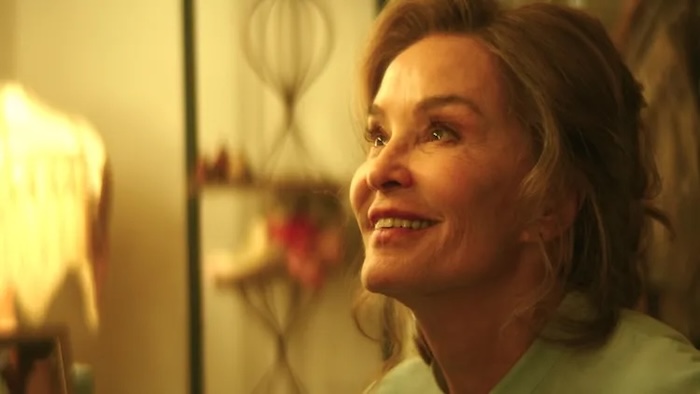
The Great Lillian Hall addresses an addiction of a completely different sort. The fictional title character, played by Jessica Lange, is a legend of the Broadway stage, a “serious” actor whose name seems to be known to everyone, or at least in Manhattan where she lives in a huge, luxurious East Side apartment. As the movie opens, Lillian is in rehearsals for a new staging of The Cherry Orchard directed by a young buck, David (Jesse Williams), as a way of forging the old and the new into something that generates big bucks, or that’s what the producer hopes. Unfortunately, rehearsals aren’t going that well, mainly owing to Lillian’s tendency to forget lines, a situation that’s concerning because she’s done this play many times before and should know it backwards and forwards. Eventually forced by the producer to see a doctor, Lillian discovers she has Lewy body dementia, a debilitating condition that not only makes it difficult for her to remember anything, but also causes hallucinations.
Lillian tries to hide her condition from the cast and crew, as well as from her daughter. The only person who knows is her feisty assistant, Edith (Kathy Bates), who saw her own father succumb to a similar condition and can recognize its effects on Lillian. Since Lange is still one of the best screen actors who can do BIG SCENES without making a fool of herself, the emotional payoffs are rich, but most of the surrounding business has a schematic feel to it. There’s the sexy neighbor (Pierce Brosnan), also an artist (a sculptor, which automatically makes you wonder how he can afford the upper West side), who draws out Lillian’s hopes and fears with witty banter. There’s the daughter (Lily Rabe) who felt neglected in childhood because her mother had no time for her. And there’s the constant visions of Lillian’s dead husband who, of course, was also her most celebrated director. In fact, the whole production may be too much of an inside job, since all the main actors have won or been nominated for Tonys and the director himself, Michael Cristofer, is a seasoned Broadway polymath. Using Chekhov’s play, which is about leaving your old life behind, is probably a bit too on-the-nose, but it’s mainly the dialogue, which is theatrical to a fault. Don’t theater people want to talk like normal human beings when they’re off stage?
The Outrun now playing in Tokyo at Cine Switch Ginza (03-3561-0707), Shinjuku Piccadilly (050-6861-3011), Shibuya Parco White Cine Quinto (03-6712-7225).
The Great Lillian Hall now playing in Tokyo at Toho Cinemas Chanter Hibiya (050-6868-5001), Kino Cinema Shinjuku (03-5315-0978).
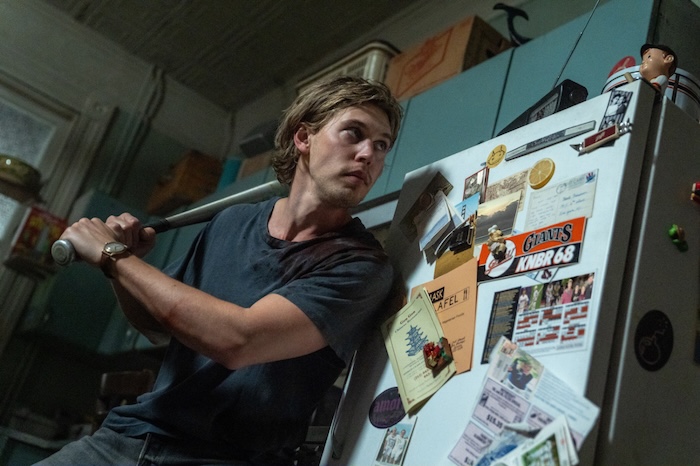
Production designers are the new superstars of the cinema; or, at least, they should be since so many mediocre American movies in recent years have been lifted to near-greatness by their sets and general ambience. Darren Aronofsky’s newest film veers off the well-worn path he’s beaten for himself as a director. Caught Stealing is a conventional crime comedy-of-errors that’s mostly elevated by its 90s NYC mise-en-scene courtesy of Mark Friedberg and a self-deprecating performance from Austin Butler as a former high school baseball star who loses out on a chance to go pro and now tends bar in the West Village. But the back story isn’t really so important since the movie has an irresistible forward momentum that just keeps accelerating, something Aronofsky is already famous for. The script by Charlie Huston, based on his own novel, relies on a lot of violence and threats of violence to get its plot points across, and while the development isn’t predictable it rarely rises above the usual. But it delivers style in spades.
The story launches late one night when Hank Thompson’s (Butler) wannabe punk-rocker neighbor, Russ (Matt Smith), asks Hank to cat-sit for him while he’s back in England for a few days to attend to a “family emergency.” However, as soon as Russ is gone, some gangsters show up looking for Russ and the money he owes them. Believing Hank knows where he is they put the squeeze on him. Hank manages to lose an actual kidney in the process, but that isn’t the end of his troubles. Even Russ’s cat, Bud, doesn’t really take to Hank and continually bites him. Aronofsky manages to distinguish each subsequent encounter in Hank’s misbegotten Odyssey across Downtown NYC by giving his persecutors vivid identifying qualities—two of the guys are Orthodox Jews (played by Vincent D’Onofrio and Liev Schreiber, no less), and another pair has thick Eastern European accents. As despicable as these people are they are played for laughs, as is the cynical female cop (Regina King) who is investigating Hank’s situation.
As Aronofsky showed so vividly in his last movie, The Whale, he can put his protagonists through a physical as well as emotional wringer, and Butler, for all the joshing that goes on around Hank, really does look like the constant punishment is taking a toll on him as an actor, and not just Hank as a character. So Aronofsky obviously gets what he wants—a violent crime comedy that looks as if it were filmed during the time period it depicts—but you may find the experience of watching it less amusing than he intended.
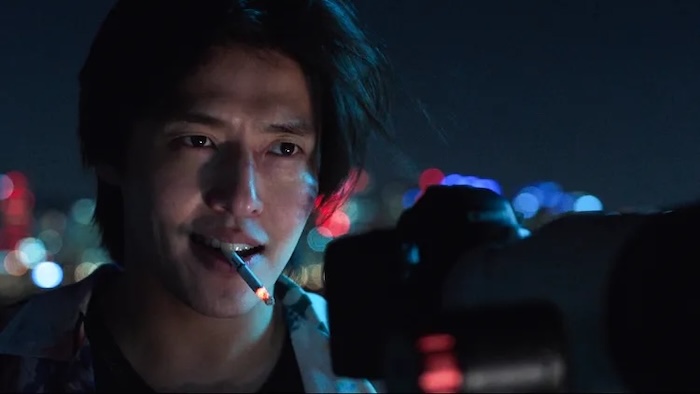
A lot of Korean crime movies are comedic by default, and Hwang Byeong-guk’s Yadang is no exception, though in the beginning you may not appreciate the laughs because of the way Hwang frames the action. The word “yadang” means “snitch,” and is used to describe Lee Kang-su (Kang Ha-neul), who is a self-styled professional snitch, though it took a while for me to understand exactly how he came to embody this lowly term. In actuality, Kang-su is a kind of liaison between people arrested for drug crimes and the police. He gets the former to give up names of associates and dealers to the latter and somehow profits mightily from this service, though exactly how isn’t made clear. So technically he’s really a “snitch facilitator,” but I’ll take the movie’s terminology at face value. However, the pacing and would-be whip-smart dialogue are so frantic it takes a good 30 minutes to get a handle on the plot.
I would assume Korean viewers have less trouble understanding the mechanics of the story, since it involves knowing how Korean prosecutors work. For all intents and purposes Kang-su works for Deputy Chief Prosecutor Koo Gwan-hee (Yoo Hae-jin), who, naturally, is gunning for the chief prosecutor job and uses Kang-su to steal high profile drug cases away from the police, in particular a captain named Oh Sang-jae (Park Hae-joon), who gets mightily pissed off when Kang-su and then Koo swoop in to arrest the principals of a bust that Oh had laboriously set up with the help of a cooperative meth junkie who also happens to be an up-and-coming starlet (Chae Won-bin). Making an enemy of Oh turns out to be not wise for Koo, but when Koo decides to use a particularly nasty drug dealer who owes him a favor to get Oh off his back, Kang-su gets swept up in the betrayal. The second half of this very brutal movie is mostly concerned with Kang-su, Oh, and the starlet teaming up to get revenge on Koo and his criminal minions.
Kang’s performance as Kang-su sets the overall mood: He’s flashy and hyper-active, whether he’s cajoling drug-addled snitches or going cold turkey himself, and thus provides high contrast with Yoo, who shunts aside his usual goofy comedic persona for something intense and sinister. Eventually, the muddled aspects of the first half congeal comprehensively in the second, but we’ve seen this kind of revenge plot a hundred times before, and no amount of gotcha table-turning can make it fresh.
Caught Stealing opens Jan. 9 in Tokyo at Toho Cinemas Nihonbashi (050-6868-5060), Toho Cinemas Hibiya (050-6868-5068), Toho Cinemas Shinjuku (050-6868-5063), Toho Cinemas Roppongi Hills (050-6868-5024).
Yadang, in Korean, opens Jan. 9 in Tokyo at Shinjuku Wald 9 (03-5369-4955).
Japan’s ruling Liberal Democratic Party continues to be plagued by associations with the former Unification Church (UC), which, of course, was the main source of the resentments that allegedly led a man to assassinate former LDP president and prime minister Shinzo Abe in 2022. The South Korea-based church is officially known as the Family Federation for World Peace and Unification (FFWPU), a name change implemented in 1994. The FFWPU no longer wields the power it once did in Korea and its leader, Han Hak-ja, the wife of the late founder of the UC, Moon Sun-myung, is something of a pariah there. In Japan, a country that Moon supposedly despised and exploited accordingly, the former UC has always been a political and social force to reckon with, mainly by getting close to the LDP. Abe, in fact, inherited the group’s grip on his party from his grandfather, former prime minister Shinsuke Kishi, who first made friends with the church back in the 1960s.
The latest revelations, while reported to a certain extent by the Japanese press, were broken by the Korean newspaper Hankyoreh, which came into possession of “reports” written by Eiji Tokuno, the head of Japan operations of the FFWPU. These regular and detailed reports were directly sent to Han, referred to in the missives as True Mother, and describe Tokuno’s meetings with various LDP leaders, including Abe, over the years in a bid to reinforce the organization’s influence over the party by lending the LDP “support” for candidates in various general elections. NHK and Asahi Shimbun have said that the FFWPU will not confirm whether such reports exist and thus have offered no comment on what Hankyoreh and another Korean media outlet, Yonhap News Service, revealed in their reporting.
According to Yonhap, Tokuno reported to Han 220 times between 2018 and 2022, laying out how he and the church “supported” 290 LDP members as candidates in the 2021 Lower House general election, support that he said was successful and which was greatly appreciated by Abe and the rest of the LDP leadership. (It should be noted that the UC and FFWPU have been known to support candidates from other Japanese parties as well, as long as those candidates align ideologically with UC’s anti-communist, pro-family agenda.)
According to psychologist Abraham Maslow, human behavior is motivated by a “hierarchy of needs” that start at the bottom with physiological needs and then proceeds up in pyramid fashion to “esteem” and “self-actualization,” meaning psychological needs that must be met in order for us to feel comfortable with ourselves. To an extent, these psychological needs are governed by social mores that help us create a place for ourselves within the larger society. One of the arguments about Maslov’s theory, which was formulated in the 1940s, is how much of one’s esteem and self-actualization is fortified by one’s own efforts. Good looks, for example, can do wonders for one’s ego but are dictated by luck as well as arbitrary social and cultural forces. One can, of course, actively adjust these determinants through efforts such as a strict exercise regimen and seeking plastic surgery, but it’s also a matter of genes
In modern capitalist society, the surest route to the top of the pyramid is wealth, which we are taught is earned through hard work; but not necessarily. Some people are born into wealth while others get there through good fortune and unique qualities (talent, intelligence, ambition) that obviate the need for hard work. Then there are people who self-actualize by simply taking on the trappings of wealth. It’s these people who are often the victims of other people who use that need to make money themselves.
A recent article in the Tokyo Shimbun described a special kind of “sharing service” where companies connect people with expensive watch collections to people who need expensive watches for some kind of function, be it a specific occasion or something more long-term. The service pays a kind of rental fee for the use of the owner’s expensive watch and in turn rents it out to users while taking a cut for itself.
The former president of a company that runs one such service called Toke Match—”toke,” pronounced “toh-keh,” being a shortened form of the Japanese word “tokei,” meaning clock or watch—was arrested by Tokyo police for fraud on Dec. 26 after being extradited from Dubai. The suspect, Takazumi Fukuhara, is charged with defrauding 650 owners comprising 1,700 luxury watches valued at ¥2.8 billion by allegedly selling 1,300 of these watches to dealers, thus violating the agreements he had with the owners. Reportedly, he used the money from the sale to gamble online and buy crypto assets.
Fukuhara’s company, Neo Reverse, launched Toke Match in March 2021 by soliciting owners of collections of expensive watches—Rolex, Omega, what have you—to entrust New Reverse with their property so that the company could rent them out to people who might need those time pieces in order to meet their own esteem and self-actualization needs. Neo Reverse even took out print and broadcast ads to not only solicit owners but attract users. And while the company did well in getting owners to lend them their valuables, there weren’t quite as many users as they needed. The police told the media that they suspect it was always Fukuhara’s intention to sell the watches and take off with the money, and one former employee of New Reverse told Tokyo Shimbun that Fukuhara and an associate who was also arrested “fooled owners” by promising limitless returns for the rental of their watches.







 philipbrasor.com