Review: The Point Men

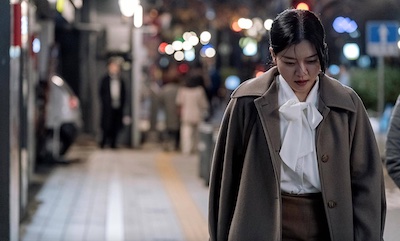
One of three mainstream Korean blockbusters released recently that take place in a war-torn country—the other two being Escape from Mogadishu and Ransomed—and one of two based on a true incident, The Point Men, like Ransomed, deals with a hostage crisis in the Middle East and for reasons that aren’t too difficult to figure out, their structures and overall dramatic arc are almost identical. There’s an initially self-serving but eventually self-sacrificing diplomat who takes it upon himself to go over the heads of his superiors and negotiate with the kidnappers on his own terms. More significantly, there is a Korean national-gone-native in the respective countries where the movies are set who acts as the interlocutor with the foreign adversaries—in either case a totally fictional character and one who provides the comic relief that almost all Korean action films require, though, to me, the main utility of these characters is that they obviate the necessity for other Korean characters to speak English at length. Veteran star Hwang Jung-min, an actor I usually like, has already proved himself a terrible English speaker, and here, as the foreign ministry negotiator, he’s forced to use the language a little too much, so the relief provided by the interpreter is more than just comic.

Also like Ransomed, The Point Men is pitched as a kind of contentious buddy flick, though in the former the combo was the civil servant and the comic relief guy. Here, it’s the civil servant and a rogue Korean intelligence agent who wanders the Middle East doing God knows what in order to redeem himself for the death of a colleague at the hands of the Islamic State. (We first meet him getting sprung from prison for counterfeiting.) As played by the hunky-by-edict Hyun Bin, an actor who is guaranteed to boost box office outside of Korea (maybe inside as well, but these days those bets are off), this character, Park Dae-sik, really has nothing to do except bounce insults off of Jung Jae-ho (Kwang) in his attempt to save the day himself by rescuing 23 Korean missionaries who’ve been kidnapped by the Taliban in Aghanistan in 2007. This setup is one of the clearest examples ever of the cliche “based on a true incident” being deflective bullshit, because while a group of missionaries really was kidnapped by the Taliban in 2007, they certainly weren’t rescued by these two clowns in this way. Firstly, by all reports, the Korean people were quite pissed off about the missionaries, who used a loophole to sneak into a Muslim-majority country to proselytize and then cost the government a lot of money to secure their release—an aspect that is hardly discussed in the film. Secondly, Jung’s go-it-alone methodology when his superiors opt to try and rescue the hostages by force seems patently unreasonable, and was obviously contrived to inject dramatic tension into a story that didn’t really need it had it been told straight. And thirdly, Park’s existence is never less than superfluous, except for the mandatory car chase in which, riding a pilfered motorcycle, he endeavors to retrieve a couple million dollars in cash from some scammers in a GMC truck. 

The script occasionally shows signs of intelligence, especially with regard to how difficult it is for diplomats with no practical on-site experience to predict how representatives of different cultures are going to react to their overtures; but by the same token, the make-or-break final negotiation is so tortuously constructed for the sake of suspense that it inadvertently takes on a comic tone, as if Jung, who initially was more worried about PR than saving lives, turns into Super Negotiator simply and suddenly by force of will, rendering his Taliban counterpart a receding puddle in the face of his formidable intellect. The heroics in The Point Men is the whole point, but who really believes government factotums think or act this way? Certainly not the normally, and rightly, cynical South Korean public. 

In Korean, English, Pashtun and Arabic. Now playing in Tokyo at Toho Cinemas Hibiya (050-6868-5068), Toho Cinemas Shinjuku (050-6868-5063). 

The Point Men home page in Japanese

photo (c) 2023 Plus M Entertainment, Watermelon Pictures

Posted in Movies | Tagged , | Leave a comment

Review: La syndicaliste

I normally use the chosen English title for non-English language films in this space, but the one the producers hit upon for this French thriller, The Sitting Duck, sounded too much like something Jerry Lewis would have directed, and though I’m aware French cinephiles adore Lewis, it seems highly inappropriate in this case, so I’m sticking with the original French title, which translates as “The Trade Unionist.” That’s more fitting, if perhaps a bit too generic for the sexual politics on display, since the protagonist is the union representative for the employees of Areva, the huge French engineering company that builds nuclear power plants, mostly in Europe, though they did have something to do with the Fukushima Daiichi Plant that melted down in 2011. In fact, the movie opens that same year—not in Japan, but rather in Hungary, where female workers at an Areva plant are demanding better pay and benefits and their French representative, Maureen Kearney (Isabelle Huppert), is staunchly defending them against their staunchly sexist boss. Kearney is an actual person, and she is able to stand up to these chauvinists because the president of Areva, Anne Lauvergeon (Marina Foïs), is a woman who made it to the top the hard way. Unfortunately, the disaster in Fukushima and other matters conspire to unseat her at the next board election and she is replaced by the less sympathetic Luc Oursel (Yvan Attal), who, it turns out, is in the pocket of a wealthy investor trying to steer Areva’s Chinese connections to a rival company, which would mean a huge loss of jobs for Areva. Kearney gets wind of this via a whistleblower and contacts the government minister in charge of such matters, and then all hell breaks loose.

The thing is, these political intrigues aren’t really the subject of the film, which is just as well since the director, Jean-Paul Salomé, sucks at pacing. It’s difficult to get a handle on the real-life ramifications, be they legal or ethical, of Oursel’s machinations when the facts are rammed up against one another. All we know is that they’ll be bad for the people Kearney represents. The only thing these scenes succeed in doing is present her as a middle-aged, upper middle class woman with a thing for heavy makeup, high heels, and hairstyles better suited for someone 15 years younger who is also fiercely dedicated to doing the right thing, regardless of personal cost. Her pursuit of her boss in the media and the courts results in phone threats and stalking that finally culminate in a home invasion-cum-sexual attack that leaves her wounded and traumatized. And that’s where the movie literally begins (and begins twice more during the film’s two-hour run time). As it turns out, the police don’t really buy the story, and it’s revealed that Kearney has been raped in the past and is under the care of a psychiatrist. They say her testimony about the attack doesn’t add up, and she is eventually labeled a “madwoman” in the press. 

Though the investigation into the attack and the subsequent did-she-or-didn’t-she implications create tensions that draw the viewer into the story, there’s still a lot that gets in the way. Salomé’s already established habit of making it difficult to follow the line of intent sometimes results in mixed signals: Are we supposed to agree with the police and think Kearney made it all up? Though her husband, Gilles (Grégory Gadebois), stands by his wife, it sometimes seems like he doesn’t, which isn’t Gadebois’ fault but rather the way Salomé jerks the story around in an attempt to manipulate the viewer’s expectations, and that’s unfair in a movie which purports to be based on a true story. What Kearney goes through is horrific—she is basically raped three times, once in actuality, and twice psychologically by the justice system. It’s a classic tale of the victim being blamed for her victimization, and while I was totally fascinated with the way it played out, I myself felt played out after it was all over. 

In French and English. Opens Oct. 20 in Tokyo at Bunkamura Le Cinema Shibuya Miyashita (0570-6875-5280).

La syndicaliste home page in Japanese

photo (c) 2022 le Bureau Films-Heimatfilm GmbH + CO KG-France 2 Cinema

Posted in Movies | Tagged | Leave a comment

BIFF 2023: Interview with Khozy Rizal

photo (c) BIFF

Khozy Rizal served double duty at the 28th Busan International Film Festival. On the one hand, his short film, Basri & Salma in a Never-ending Comedy, was part of the special program Renaissance of Indonesian Cinema. But he was also one of the fellows at this year’s Chanel X BIFF Asian Film Academy, an exclusive program that brings young Asia Filmmakers to Busan during the festival for several weeks to actually produce a short film. I was introduced to Rizal casually by the press office as a means of explaining the Academy, which they obviously wanted to promote, but the particular circumstances that brought him to Busan were so fascinating that we talked for the better part of 45 minutes. I learned a lot, not only about Indonesian cinema, but about the process of becoming a filmmaker when you essentially have nothing but your wits.

How did you get into the Academy?

I submitted a questionnaire along with my work, two short films. But I didn’t go to film school. I learned filmmaking by watching lots of movies. 

Is that the same with the other fellows?

I think most of them went to film school. During the motivational night I told them I’ve made 3 short films so far, but I don’t know the real work of filmmaking from the conventional filmmaking perspective, so I think I need to learn it from actual filmmakers. That’s why I wanted to be in the program.

Have you always been a film buff?

Yeah, since I was 5 years old. When I was a kid in the early 2000s, the DVD era, I lived right next to a rental shop so if I had any money I would rent a DVD. It became a habit with me. Even when I grew up, when I was in junior high I would always watch films. 

What kind of movies did you like?

I would say it shifted from time to time. When I was a kid I didn’t speak English at all, and watching films with subtitles was hard, so I always watched Indonesian films, usually horror movies. They used to have sex horror films, and lots of them. [laughs] And then when I was in high school, I became aware of several films that won Oscars, and my English skills improved and I started watching lots of films from America. And it shifted again when I was in college, so I moved out of my small city to study and watched more films and became aware of film festivals like Cannes. I later found out about non-Hollywood films and films from other foreign countries, so I started watching French films and became aware that there were so many great films in the world. 

It’s always a very eye-opening realization.

I discovered all of these movies, and some of them were really connected to me in terms of issues that we dealt with in my country, and I thought, if I were a filmmaker I could make films that would attract the same kind of attention, but I wanted to direct it the way some directors I admired would direct it. When I graduated from college, I worked in an office from 9 to 5, and at night would go to cinemas. And I thought to myself, it would be great if I could direct a film talking about queer themes, but they would be characters from my home town and speak the same language. That would be really cool, but I didn’t have the chance to make it because I’m not in the film industry and didn’t know anybody in the film industry. Finally, I had the audacity to make something on my own. I made my first film with a smart phone. It was a short film about two young girls who happened to be in love and were attending an Islam boarding school. And I submitted it to a festival in Paris and it won.

That’s great.

Yeah, I couldn’t believe it. It’s a secret film that I can’t really expose, but it’s called Anisap. And the award came with a money prize, which was really big—20,000 euros. I could make another short with it, but I didn’t know what to do with it. I don’t know anyone in the industry and I don’t know how to make films. So I texted or DMed every producer in Indonesia, and they either refused or didn’t even respond. Then I met with this scriptwriter who had encouraged me to make Anisap. He used to be my mentor. I had joined a master class with him and he encouraged me to make it. He thought I was a good storyteller. So I went back to him and said, “Maybe you’ve forgotten me, but you encouraged me to make a film and I did and it won. Do you know any producer that’s willing to make my film? I have money but no producer.” He introduced me to a producer in Indonesia and we made [my next film] together. It’s called Makassar, the City for Football Fans, and it went to Sundance in 2022. It’s a pretty rough title, 20 minutes long. At Sundance everybody was like, Who is this person? And I made another short film right after.

Still on a smart phone?

No, but I might do that again in the future. 

Continue reading
Posted in Uncategorized | Leave a comment

BIFF 2023: Interview with Nam Dong-chul

photo (c) BIFF

As preparation for my coverage of the 28th Busan International Film Festival, which took place Oct. 4-13, I talked via Zoom to the interim festival director, Nam Dong-chul, who is also the chief programmer for the festival. Nam sort of made it clear that he was not gunning for the permanent title of festival director, and that he was simply filling in so that this year’s event could take place on time. In fact, he was surprisingly frank during our conversation, though perhaps not as frank as he was during the online press conference in early September to announce the selections. In response to a reporter’s question of why BIFF had given the Filmmaker of the Year award to Chow Yun-fat, thus making it two years in a row that a Chinese person was the recipient, Nam said, “Well, he was going to receive it eventually.”

What’s been the biggest challenge so far this year?

After I took over, I found out we have some problems with the budget and I had to cut funding for almost everything in order to keep the budget in check. It was a big decision. So this year, we have 209 official selections, compared to last year’s 243 films.

In 2019 it was around 300.

Yes. During the pandemic the official number of selections was less than 200, and then it came back to around 240, but this year around 210. Because it’s a bit late in the process it was not easy to convince the programmers that they had to minimize their selections. It was tough. Also, I had to review all the other programs, like forums and conferences.

Well, the Forum is gone.

Yes. Also I had to check the invitation list and decide what we could provide to our international guests. I was surprised at how expensive air tickets are. Everything became related to the budget.

Is it due to lack of sponsorship, or lack of government support?

The funding from the city government was smaller compared to last year. Sponsorship from the private sector was also lower than last year. 

Is that a reflection of the economic situation?

Yes, it’s related to Korea’s general economic situation. This year, especially, prices have been going  up and private companies are having difficulties with their own finances.

What about your relationship with Busan? Or even the national government?

The relationship with Busan city is quite good now. They want to support us. However, the economic situation in Busan itself is not so good and that has an effect. It’s the same for the central government. The problem is that after this year, meaning next year, the Korean Film Council says its total budget for international film festivals [in Korea} will be cut by 50 percent.

That affects all film festivals in Korea.

Yes, they are all in the same situation.

Continue reading
Posted in Media, Movies | Leave a comment

Review: Aalto

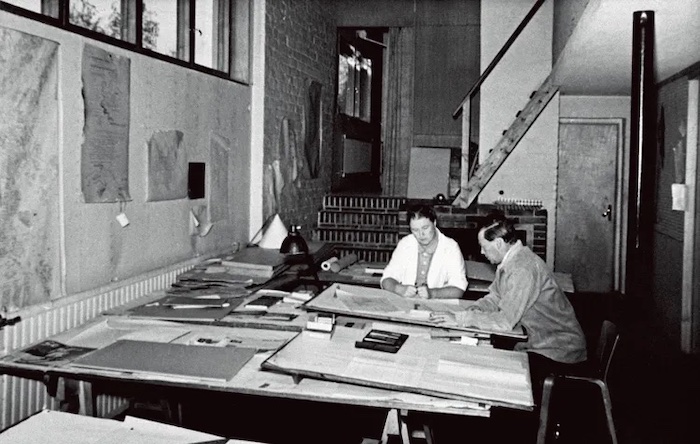
Though Alvar Aalto is considered not only one of the greatest architects of the 20th century but a central figure of the modernist movement, many people outside of Scandinavia are probably unfamiliar with his name. This probably has less to do with the fact that Aalto was Finnish than with the eventual impact of his work over the years. Though Aalto did see himself as an artist, with the stereotypical free-ranging behavior to prove it, he saw his mission as a designer in humanist terms, an attitude that’s most apparent in the furniture he made. In that regard, it’s important to mention his first wife, Aino, who was also a trained architect (and a trained carpenter to boot, which her husband wasn’t) with a more patient approach to commerce. One thing that this documentary by Virpi Suutari gets very right is the way it presents the title as a kind of brand made up of both Alvar and Aino. If Alvar still gets the lion’s share of the credit for the enduring utility and beauty of the things they created together, it’s mainly because he was good at promoting those things in the world, while Aino mostly stayed at home and ran the day-to-day business. He never denied her her rightful share of the glory.

As a movie, Aalto is endlessly involving but also frustrating in its inability to really convey the Aaltos’ mission of making things that were, first and foremost, human scale. Apparently, “aalto” in Finnish also means “wave,” and what most people notice first of all about the designs, whether applied to buildings or furniture, is their curvilinear aspect. The chairs that the couple made for their company Artek in the 1930s and 40s originated that now common look of one piece of wood steam-bent into a form that fits the body, but the curve is also what makes the famous Baker House at MIT so striking. And while Suutari does take us into the buildings, we rarely get a sense of how they are used since the people inhabiting them on screen seem more decorative than anything else. Still, the sheer volume of work that Alvar accomplished even after Aino died in 1949 and he took on a new wife/work partner, Elissa, several years later is astounding: 300 finished projects and 200 unrealized ones. And while Aalto did do the occasional design for private residences—the homes he made for himself and others in Finland achieve the near impossible feat of looking minimal on the outside while providing maximum space on the inside—his strong suit was public buildings that are marvels of light and form. His one seeming failure was also his most ambitious, the Helsinki City Center, which some felt was so grandiose as to be uninviting, though to me it looks fabulous.

As for Aalto’s personality, Suutari uses the architect’s own words, mainly in the many letters he wrote to Aino while travelling to America and Europe for commissions. Though I’m not sure if the infidelities he so boldly alluded to in these epistles (“you need to commit a whole lot of sin before we’re even”), or the drinking that Aino constantly chides him about best reveal his bohemian temperament, as Suutari seems to imply, they do reveal his own humanity. What interested me more was his approach to work, especially work with others. By all accounts he was a good boss, encouraging his employees to think for themselves even if, in the end, he had the last say. He even had great respect for the tradesmen who carried out his projects and worked closely with them, which was not something that most of his peers did. On the other hand, he was highly impressionable, and would easily lift ideas from others without acknowledgement. Upon meeting the dapper Frank Lloyd Wright, he even started dressing like him. Genius comes in many forms, but Aalto makes the case that ideally it has room for a democratic, inclusive spirit. 

In Finnish, English, German, Italian and French. Now playing in Tokyo at Human Trust Cinema Yurakucho (03-6259-8608), and from Oct. 28 at Tokyo Photographic Art Museum Ebisu (03-3280-0099).

Aalto home page in Japanese

photo (c) FI 2020 – Euphoria Film

Posted in Movies | Tagged , | Leave a comment

Review: R.M.N.

In his previous movies, Cristian Mungiu has interrogated Romanian society by focusing on specific aspects. In 4 Months, 3 Weeks and 2 Days it was the health care system via a woman seeking an abortion. In Graduation it was official corruption as seen through the education establishment. In his latest work, whose title essentially stands for the name of his country (as well as a medical procedure), he uses a wider lens to take in the meaning of Romania as a relatively new member of the EU and by extension its place in the larger world. He does it literally, by setting the movie in a rural village that itself is half populated by Hungarians who settled there years ago and which many residents have left in order to work abroad for better wages and benefits. We are introduced to our protagonist, Matthias (Marin Grigore), as he angrily quits his job at a slaughterhouse in Germany after being insulted and then hitchhiking his way back to the village. His wife, Ana (Macrina Barladeanu), is not happy to see him, even though their 8-year-old son, Rudi (Mark Edward Blenyesi), has been traumatized by something he saw in the woods on his way to school. Since then he has refused to talk, and Matthias takes it upon himself to try and invest some masculine qualities in the boy, since he thinks Rudi has become too feminized.

Though the mystery of what Rudi saw lingers in the background of this tense, moody drama, it is overshadowed by more immediate concerns. The local bread factory is desperately short of workers, and because they pay so poorly no locals answer their want ads, so they have engaged a broker to bring in labor from abroad (“Asians are better than Africans…”). Eventually, they hire two Sri Lankans, and the factory manager, Csilla (Judith State), finds them lodgings in a small apartment owned by the village’s self-proclaimed polymath. As the movie progresses, Mungiu slowly describes the interrelationships within the village, and the other shoe drops. The factory starts receiving threats against the foreign workers, who are accused of everything from stealing jobs to contaminating the bread they make with “pathogens.” When one of the Sri Lankans shows up at the village church—he is a Catholic, after all, though everybody assumes he’s Muslim—he is summarily walked out. Meanwhile, Matthias resumes his sex-only affair with Csilla (the main reason for Ana’s enmity toward him), who becomes the de facto defender of the foreigners, and not just because it’s her job. 

Throughout this thorny tale, Mungiu drop factoids about the Romanian situation vis-a-vis the EU, which has effectively closed the main employer in the village, an open strip mine, because of its environmental impact and hindered the lumber business by making large tracts of forest sanctuaries. (There is another foreign invader in town: a French biologist who is there to count the bears.) All these elements add to the villagers’ sense of aggrievement, and in a startlingly fluid, action-packed town hall meeting the parochial concerns of the various ethnic interests come to the surface, revealing not just the blatant xenophobia at large (it comes out that they’ve already, proudly, eliminated the “gypsy” population), but a shocking lack of understanding of how the world works. These are not uneducated people. They simply need someone to blame for things they don’t like and can’t do anything about. And while the movie’s ending takes a sudden dramatic turn, it’s not a development designed to provide closure. Though more than two hours long, R.M.N. feels as if it’s just getting around to addressing the problems it brings up when the end credits appear. 

In Romanian, Hungarian, German, English, French, Sinhala. Now playing in Tokyo at Euro Space Shibuya (03-3461-0211).

R.M.N. home page in Japanese

photo (c) Mobra Films-Why Not Productions-FilmGate Films-Film I Vest-France 3 Cinema 2022

Posted in Movies | Tagged | Leave a comment

Review: The Burden of the Past

Atsushi Funahashi describes his movie as a “docudrama,” which usually means a blend of documentary and staged scenes. In actuality, everything here is staged, with real actors. The subject is ex-convicts who find it very difficult to reintegrate into Japanese society after they’re released from prison. The recidivism rate in Japan is 50 percent, and the main problem is employment, since many businesses will not hire convicted felons. Moreover, people don’t even want them living in their neighborhoods, thinking that once a criminal always a criminal. Consequently, many ex-convicts’ lives enter into a kind of vicious cycle of offense-incarceration-release-unemployment-reoffense, almost by necessity. We’ve covered this issue in our media reports, and often these people see no alternative but prison, where they at least know they will have a roof over their heads and three meals a day. Outside, they just can’t make it work, and Funahashi’s movie shows us in brutal detail why that is.

The focus is on a publication by an NGO called Change that assists ex-cons in finding employment. The NGO has cultivated a network of businesses that agree to take on recently released felons as employees. The cases covered represent a cross-section. There’s an angry man who spent 10 years in prison for killing a teenage boy in a hit-and-run accident. There’s a young woman sent away for two years due to her addiction to crystal meth. Another woman spent ten years in prison for setting her boyfriend’s house on fire in what sounds like an act of lovelorn desperation. A former elementary school teacher received two years for molesting a student. All of these individuals are placed in jobs that are low-paying: food service, cleaning. At least two of the ex-cons work in a Chinese restaurant for a man who himself did time for extortion and attempted murder. In addition, the NGO conducts sessions with a professional therapist who uses role-playing games and “drama therapy” to help the ex-cons express their feelings about what they are going through now and how they got to this stage in their lives. 

It’s obvious that Funahashi would have had a very hard time making a straight documentary about this topic, because none of the subjects want to talk about their crimes or how their convictions basically destroyed whatever lives they have left. He needs proxies and has developed an acting style that is meant to allow the players to express their feelings honestly without having to resort to the usual dramatic devices. At first, the dour and bitter attitudes we see on screen are a turn-off, and then you realize that society really would prefer these people either stay in prison or just crawl into a hole so as to not burden so-called law-abiding citizens with their presence. We see the former inmates struggle with their attempts to resocialize. In one powerful scene, the ex-addict is hit on by a young guy while she’s cleaning ashtrays in the place she works. Without knowing her past, he tells her he used to smoke pot, as if it might impress her. She mistakes his lecherous candor for kindness and lets down her guard, telling him how she was sent to prison for meth. He laughs, calls her a “piece of trash,” and walks away. The hit-and-run perpetrator exists with a constant chip on his shoulder, believing he’s the victim of bad luck, though he understands deep down his responsibility. His quick temper only reinforces people’s opinion that those convicted of crimes have “criminal natures,” and the notion that people believe this makes him even angrier and more self-pitying. 

The movie culminates in a harrowing discussion following a theater presentation where the ex-cons play analogues of themselves in a fantasy story. The audience is filled with neighbors of the NGO who wish it would move away as well as some victims of the ex-cons. It doesn’t end well, and the various members of the NGO, who truly believe in their cause, are forced to address the fact that they can do nothing without convincing people that those who have “crossed a line” deserve another chance. “Why do you protect criminals?” is what the NGO faces on a daily basis. It doesn’t matter that many of these criminals grew up in broken, abusive homes. It doesn’t matter that Japan’s prison system is designed to punish, not rehabilitate. It doesn’t matter that there is no public system in place to help ex-cons reintegrate. Once you have crossed that line, they won’t let you cross back. 

In Japanese. Now playing in Tokyo at Polepole Higashi Nakano (03-3371-0088).

The Burden of the Past home page in Japanese

Posted in Uncategorized | Leave a comment

Busan International Film Festival 2023

Because I Hate Korea

Due to computer troubles I didn’t post my usual diary while I attended the Busan International Film Festival, which ends today. It was a fairly low-key year, and as usual there were a number of movies I wanted to see but couldn’t due to scheduling conflicts and ticket availability. But I did attend the Opening Ceremony. Usually I don’t because the flight I normally take arrives in the late afternoon, but Air Busan changed its schedule this year so I was in Haeundae by mid-afternoon. The ceremony was appropriately flashy but unstimulating, even with Song Kang-ho acting as the official “host” of the festival, a job that usually goes to the festival director. However, because of the scandal that resulted in the previous director resigning, there is only an interim festival director, Nam Dong-chul, also the head programmer, who implied to me when I interviewed him last week that he doesn’t want the job. Song covers up for the break in protocol with star power.

He did what he was supposed to do, but since he’s also the most famous Korean actor in the world, it was easy to believe that his enthusiasm was forced. Certainly when he greeted Asian Filmmaker of the Year Chow Yun Fat on the red carpet, acting as if they were old pals, it felt phony, but appearances are everything in such matters. I was mostly hanging around to see the Opening Film, Because I Hate Korea, and felt like the only person who cared, since about 3/4 of the audience left after the Opening Ceremony was over. Maybe they knew something I didn’t. The film was earnest and well-made, but rather unoriginal in its portrait of a young woman who, already disillusioned with her job and what it pointed to for her future, decamps to New Zealand, hoping the change of scene will give her some kind of reason to appreciate life. Of course, it doesn’t, but the humor was colorless and the story never seemed to go anywhere. It’s based on a novel and felt like it.

Next Thursday The Japan Times will publish my formal coverage of the festival, which will discuss the scandal, the financial crises that impacted the festival, the changes that have been implemented since the end of the pandemic, and whether the festival still best represents the hopes and dreams of Asian cinema.

In the meantime, here’s a rundown of all the movies I saw in the order I saw them.

Continue reading
Posted in Movies | Leave a comment

Review: Operation Fortune: Ruse de Guerre

Though I sort of consider the movies in the Mission: Impossible series comedies, this Guy Ritchie frivolity is more serious about taking the piss since it comes across as a straight sendup of the current species of international espionage blockbuster. First of all, you’ve got Jason Statham in what would normally be the Tom Cruise role acting all Stathamy; meaning, more concerned with his own well-being than that the mission at hand, whose main worth to him is the cash it will put in his pocket. Cruise’s Ethan Hunt is all about altruism and saving the world, while Statham’s Orson Fortune is strictly mercenary—until, of course, other dramatic options come into play. 

Like Hunt, Fortune has a team of wildly capable experts who help him accomplish his assignments with winking acknowledgements of how farfetched they are. In fact, the setup in this case is dodgy from the get-go. A briefcase is stolen from some kind of laboratory in Odessa by a group of violent, black-clothed soldiers, and British intelligence gets wind of it. Though they have no idea what’s in the briefcase or even what’s going on in the lab, they contact Fortune to retrieve it. As it happens, he’s on holiday and can only be persuaded to take the job when informed that a competing team of operatives headed by a former acolyte is after the briefcase as well. His professional pride provoked, Fortune assembles his team and heads for the French Riviera, where billionaire arms dealer George Simonds (Hugh Grant, having a grand old time impersonating Michael Caine in bad-guy mode), seems to be trying to sell the thing. Fortune’s plan is to bring along dim movie star Danny Francesco (Josh Hartnett), of whom Simonds is a fan—shades of The Unbearable Weight of Massive Talent! The only member of Fortune’s team worth the trouble of mentioning is Sara Fidel, the tech expert who wields a laptop as if it were an AK-47 and is played by Aubrey Plaza, who manages to bring the requisite lightness to dialogue that doesn’t always deliver the laughs the writers think it does. 

Most of the action is predicated on Statham’s patented battering-ram fisticuffs skills, which means, unlike in the M:I movies, there doesn’t seem to be a lot at stake, because once Statham starts delivering blows you know he’s won. The super-yacht milieu of most of these set pieces guarantees the kind of high-gloss visual extravagance that characterized British spy movies of the 60s, but without the wit. That said, Ritchie keeps his head down enough to allow the mechanics of the silly plot to work with the humor, and it’s an enjoyable ride as far as that goes. In short, I liked it better than the most recent M:I installment, but only because I’ve become bored with Tom Cruise’s show-offy movie star persona. 

Opens Oct. 13 in Tokyo at Toho Cinemas Nihonbashi (050-6868-5060), Toho Cinemas Hibiya (050-6868-5068), Toho Cinemas Shinjuku (050-6868-5063), Shibuya Humax Cinema (03-3462-2539), Toho Cinemas Roppongi Hills (050-6868-5024).

Operation Fortune home page in Japanese

photo (c) 2021 Eros STX Global Corporation

Posted in Movies | Tagged , , , | Leave a comment

Review: Revival69: The Concert That Rocked the World

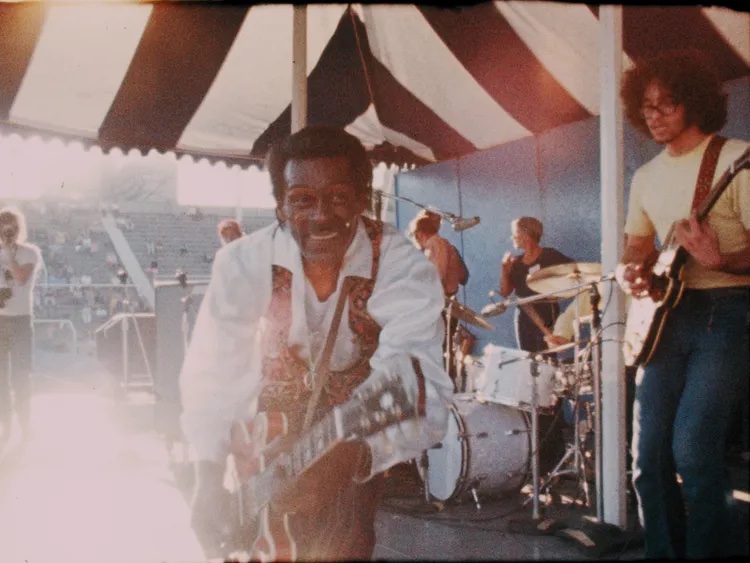
Whether because it took place in Canada or was overshadowed by the PR spectacle of Woodstock, which took place a little more than a month before, this ostensible rock and roll revival show has mostly been shunted aside in the annals of pop even if it marked the debut of John Lennon and Yoko Ono’s nascent Plastic Ono Band. In fact, Lennon’s participation, as this documentary so painstakingly points out, was mainly an afterthought instigated in order to sell tickets. The main idea of the concert, which took place at Varsity Stadium in Toronto, was to celebrate the work of the founders of rock—Chuck Berry, Little Richard, Jerry Lee Lewis, Bo Diddley, and Gene Vincent—but the success of a more contemporary pop-oriented festival at the same venue earlier that summer perhaps inflated the expectations of the two ambitious young promoters who put it on. Apparently, oldies show (and, mind you, this is only ten years out from these artists’ prime) just didn’t catch the youngsters’ attention as much. Before Lennon was tapped, they managed to snag The Doors, who were huge in 1969 but already bogged down in legal and image problems stemming from Jim Morrison’s notorious near-flashing episode in Miami earlier that year. The Toronto show was the only secure gig they could get.

What really makes the movie valuable as a document isn’t so much the concert footage, which, while intermittently exciting, rarely stays on any artist for an appreciable length of time, but the way it spotlights a particular instance in a very momentous year for pop. In September 1969, The Beatles were still together, though Lennon was seriously thinking of going solo, and the offer from the Revival69  promoters, originally asking him to emcee the event and maybe sit in with some of his heroes, hit him at the right time. Though he almost pulled out after he said “yes,” he quickly put together a group consisting of Eric Clapton, Alan White, and Klaus Voorman, and this truly motley crew didn’t rehearse anything until they were on the plane to Canada. Say what you will about the presumptuousness of rock stardom, but Lennon came up with two of his most indelible compositions for the gig: “Cold Turkey” and “Instant Karma.” A year late, of course, The Beatles would be no more and Lennon would have released his classic solo debut album, and it’s easy to hear the seeds of that work in what he was trying to accomplish in Toronto, even if he didn’t really know what he was doing.

The documentary has a lot of sideshow business that’s fascinating as well. Toronto, apparently, solidified Alice Cooper, who doubled as Gene Vincent’s backup band, as the force of avant garde rock vaudeville with their standalone performance, for what that’s worth. And Chuck Berry, as usual using a pickup band of teenagers who had to play everything by ear since Chuck never rehearsed, put on one of his greatest shows ever, according to no one less that the dean of rock critics Robert Christgau, who was there and provides one of the talking heads that gives the whole project credible context. For Christgau, a stone Berry freak, to say that actually means something, and made me wish Berry’s entire show was in the film, but you either get a thorough history lesson or you get kicks. You can’t expect both. 

Now playing in Tokyo at Human Trust Cinema Shibuya (03-5468-5551), Kadokawa Cinema Yurakucho (03-6268-0015).

Revival69 home page in Japanese

photo (c) Rock n’ Roll Documentary Productions Inc., Toronto RNR Revival Productions Inc., Capa Presse (Les Films a Cinque) 2022

Posted in Movies | Tagged , | Leave a comment