Review: Theater Camp

It was wise of directors Molly Gordon and Nick Lieberman to hire mostly unknown actors for their mockumentary about a summer camp for “theater brats” in the Adirondacks. Except for Amy Sedaris, who plays the founder of the camp but is only in the movie briefly, and Ayo Edebiri, who probably wasn’t famous yet for The Bear when she did this, the performers don’t carry with them any extraneous identifications for the audience, and thus their playacting of people who are smitten with the performance bug seems more natural than it would be otherwise, even if the broad comedy indicates that they are very much acting. Reportedly, much of the movie was improvised, and while the hit-and-miss nature of such a gambit results in a lot of uneven humor, it also keeps the viewer off balance. Maybe these people really are into Broadway that ridiculously.

The framing situation is that the camp, called AdirondACTS, is on the verge of bankruptcy, and when its CEO, Joan Rubinsky (Sedaris) suffers a seizure due to an errant strobe light, she is hospitalized and her business school-educated son, Troy (Jimmy Tatro), takes over, charged with learning the whole theater camp culture from scratch. Being a rational businessman, he lays off some of the instructors to balance the books and puts in their place one clearly unqualified instructor (Edebiri) who is quickly overwhelmed. This framework of desperation allows Gordon and Lieberman to study a rainbow of student types as they maneuver for choice parts in the big musical that the camp will present for their summer project. There are would-be divas and drama queens and macho pretenders and singers who can’t tell when they’re off-key, but for the most part the enthusiasm you would expect from theater brats—adolescents who already knew what Sondheim was about when they were in elementary school—is tempered with a sweetness that keeps any extreme snark at bay. On top of this cohort you have the camp’s staff—professionals who could not actually make it big in New York, and while the associated resentments linger just below the surface, they aren’t portrayed as being anything less than capable in their chosen field. 

There are so many examples of cliches that none of the characters except maybe Troy has a chance to develop into anything beyond their cliche. Tension is injected into the story when the owners of a neighboring camp for rich kids decides it wants to buy AdirondACTS for an expansion scheme, so the production—an original musical based on Joan’s life—has to be better than ever in order to fight off this threat from the evils of commerce, which Troy realizes he represents to many of his new employees. And if the ending is predictable, it makes up for the gentility of its early humor with a sufficiently squirm-inducing performance of the play-within-the-movie, which feels more realistic than most of what preceded it. You don’t need to be a theater brat to appreciate Theater Camp, but if you are one (or were one in the past) you’re likely to see yourself in someone up there on the stage. 

Opens Oct. 6 in Tokyo at Toho Cinemas Chanter Hibiya (050-6868-5001), Shinjuku Cinema Qualite (03-3352-5645), Shibuya Cine Quinto (03-3477-5905).

Theater Camp home page in Japanese

photo (c) 2023 20th Century Studios
Posted in Movies | Leave a comment

Review: The Equalizer 3

Though the latest John Wick installment included way too much plot for its own good, it still stuck to the tenet that has made it an enduring series: Everything serves the violent set pieces, which are long, abundant, and varied. The last movie in the Equalizer series suffers from the same problem and while the set pieces have the same nasty efficiency as those in the Wick flicks, the setups are convoluted and not entirely convincing. It would have been better, for example, to jettison the whole CIA subplot, which justifies much of the action but is poorly thought out.

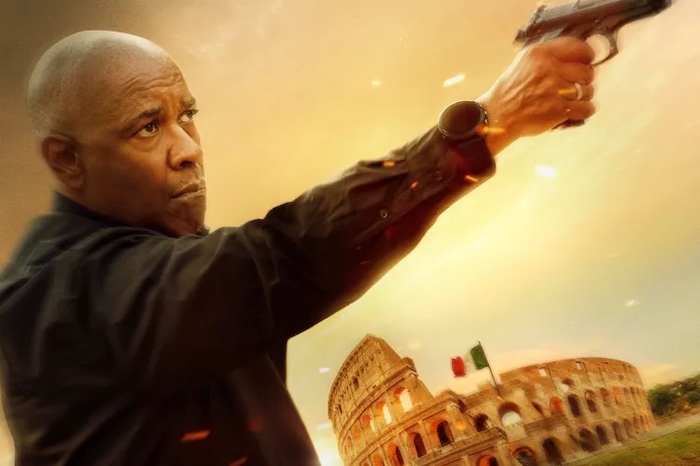
Our hero, Robert McCall (Denzel Washington), is out of Boston for once and in Italy for reasons that don’t become clear until well into the story (and even then I had big questions). He first appears at a Sicilian vineyard, surrounded by a dozen dead bodies when the proprietor shows up with a small boy. Apparently, the proprietor is the target, but since McCall’s brief as a former government operative turned vigilante requires he kills to even a score for a victimized innocent, we have to wonder what all this carnage is for, but in any case, after doing his job in the usual no-nonsense manner, McCall drops his guard and gets shot. Somehow, he makes it to the Amalfi coast where he’s rescued, unconscious, by a local policeman (Eugenio Mastrandrea), who has obviously encountered such matters before, and takes him to a local physician (Remo Girone), who patches him up without asking too many questions. The reason for this reticence becomes obvious once McCall undergoes his long rehabilitation in the scenic town of Altamonte, where the people are humble and kind and the Camorra lords it over them with a brutal protection racket that they plan to expand. Though not called upon to act, McCall takes it upon himself to become a one-man Seven Samurai and save the town from these devils, and he does it, per his titular moniker, with the same measure of brutality that the bad guys dish out to the people they exploit. Unlike in Wick, the killings have an emotional element owing to the fact that we get to know the assholes being dispatched and thus feel delight at their bloody demise. 

It’s worth mentioning Dakota Fanning as the local CIA agent who tracks down McCall after investigating the massacre at the vineyard, which turns out to be a front for terrorist financing, but for the most part she’s a distraction that doesn’t merit much attention, especially when the original reason for McCall’s “equalizing” is finally explained and feels like nothing more than an after-thought. Though director Antoine Fuqua has become adept at this kind of mayhem he can’t do much with a script so poorly structured that it renders the action set pieces as interchangeable, with no sense of buildup as the movie progresses. 

In English and Italian. Opens Oct. 6 in Tokyo at Toho Cinemas Nihonbashi (050-6868-5060), Toho Cinemas Hibiya (050-6868-5068), Marunouchi Piccadilly (050-6875-0075), Shinjuku Wald 9 (03-5369-4955), Toho Cinemas Shinjuku (050-6868-5063), Toho Cinemas Shibuya (050-6868-5002), Toho Cinemas Roppongi Hills (050-6868-5024). 

The Equalizer 3 home page in Japanese

Posted in Movies | Tagged , , | Leave a comment

Review: My Name Is Alfred Hitchcock

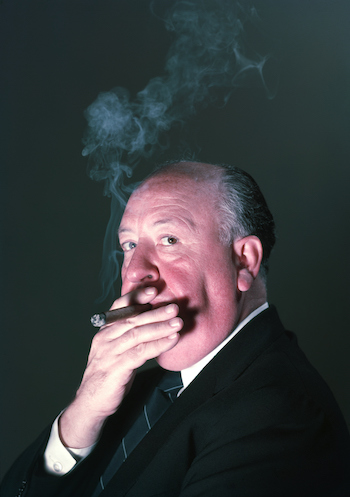
Fake spoiler alert: At the beginning of this documentary, a title card informs us that the narration is taken from actual recordings of Alfred Hitchcock, but at the end of the movie we learn it was a comedian (Alistair McGowan) impersonating the great director all along. Though other critics have said this imposture is director Mark Cousins’ best joke—it’s clear from the first lines that Hitchcock is supposed to be speaking from the afterlife, since he derides his viewers’ dependence on 5G technology—funnier is the way Cousins attributes to Hitchcock cinematic theories about his work that are obviously Cousins’ own, a conceit that may offend purists, but Cousins pulls it off through sheer arrogance, not to mention an intimate understanding of the master’s ouevre and a wicked wit. 

Divided into six sections based on themes that run through all of Hitchcock’s films, the movie has no chronological logic despite some early references to Hitchcock’s beginnings as a filmmaker, but the almost stream-of-consciousness way Cousins develops his thesis has a lulling, personal quality that conveys genuine character. Only someone who really knew him could tell whether the opinions presented are close to Hitchcock’s own thinking, but even if it’s a construct, it’s an extremely effective one for putting across Cousins’ ideas, which are so granular as to be borderline neurotic. He can get away with it because he knows the material so well. Each comment and hypothesis—presented as self-reflection by Hitchcock himself—is illustrated with a perfect scene from his films. More incisively, the comments play up the notion that Hitchcock was supremely self-aware, even if Cousins’ voice-from-the-grave device makes it all sound like hindsight. Hitchcock talks about his desire to “escape from tradition” and his strong aversion toward “photographing people talking,” thus naturally opening up a discussion about his technique, which he boastfully points out was “unconventional” for its time. He also addresses the accusation that he was too controlling as a director, but in a dismissive way, averring that such criticism is a “21st century projection.” Most essentially, he dives deep into those devices that he undeniably made his own, especially “time and fear,” which, of course, are the ingredients of suspense. 

The sheer volume of examples supplied by Cousins attests to Hitchcock’s dogged work ethic—9 movies made during World War II alone—and even stone fans will likely discover things they never thought or even knew about. Personally, I found the silent-era and early British films, few of which I’ve seen, more artfully conceived than his later, more famous work. At one point, Cousins/Hitchcock says that the purpose of film is “fulfillment”—for Hitchcock, fulfillment of his imagination; for the audience, fulfillment of their “desires.” Cousins’ movie takes this mission to heart, because, like a great Hitchcock movie, it’s not just enlightening. It’s fun to watch. 

Now playing in Tokyo at Kadokawa Cinema Yurakucho (03-6268-0015), Shinjuku Musashinokan (03-3354-5670), Yebisu Garden Cinema (0570-783-715).

My Name Is Alfred Hitchcock home page in Japanese

photo (c) Hitchcock Ltd. 2022

Posted in Movies | Leave a comment

Review: Hunt

Actor Lee Jung-jae exploits his rep as a second-wind Korean superstar as well as a bona fide global household name for Squid Game with a directoral debut that would be a challenge for even the most seasoned filmmaker. This espionage thriller, which takes place during one of the most politically fraught eras in postwar Korean history, is both narratively contorted and viscerally explosive, a combination that sometimes overshadows the subtler themes that would make it more interesting as a plot-driven puzzler. I emerged from it exhausted, though I’m not sure if it’s due to the excessively loud set pieces or the constant effort required to navigate the script’s twisty inertia. 

There are two protagonists, both of whom work for South Korean intelligence during its darkest days in 1983: Park Pyong-ho (Lee) who nominally handles domestic matters, and Kim Jung-do (Jung Woo-sung), whose brief is more international. During a visit to Washington, the South Korean president is targeted for assassination by a North Korean cell, and both Park and Kim get hell from their superiors for not being sufficiently prepared. During their dressing-down, we learn that the two have bad blood between them because Agent Park was suspected of being a party to the killing of President Park Chung-hee in 1979 and was subsequently tortured by Kim before being cleared. Water under the bridge in the always volatile world of Korean spycraft, but Park retains his resentment, which only intensifies, at least outwardly, when a North Korean would-be defector informs the South that the KCIA has a mole. The defector’s intelligence is confirmed when a covert operation goes sideways, since it’s obvious the North was tipped off. The viewer soon fixes on the idea that the mole is either Park or Kim, and as the movie moves fitfully from one shootout and/or knife fight to the next and bodies pile up the focus of suspicion shifts several times between the two men. What keeps the central story sharp is the notion that both men don’t really like what they’re doing, which is carry out the nefarious anti-democratic policies of the regime they serve, and after a while there’s a sense that there isn’t much difference between the North and the South in terms of maintaining ultimate power by using any means necessary. Though the “hunt” of the title refers to finding out who the mole is, it also pertains to the two men’s respective search for a way to make their actions morally and ethically right in their heads, a theme that becomes more compelling as the movie progresses but is nonetheless buried under the intensifying mayhem. 

Consequently, several interesting subplots—one about a shadowy manufacturer that deals in under-the-table weapons trades, another about a female student with anti-government leanings who seems to be Park’s ward—are rendered murky while the general image of the KCIA that develops is one of a self-important team of bullies who suck at their job. This latter aspect is best characterized by three-count-’em-three ultra-violent incidents that occur in foreign countries—the U.S., Japan, and Thailand—any one of which would have been as historically significant as 911 had they really happened. There is no title card saying that Hunt is based on a true story, but in any case even if you know how deadly and oppressive the South Korean dictatorship was in the 80s, it could never have been this bad.

In Korean, English, Japanese and Thai. Opens Sept. 29 in Tokyo at Shinjuku Wald 9 (03-5369-4955).

Hunt home page in Japanese

photo (c) 2022 Megabox Joongang Plus M, Artist Studio & Sanai Pictures

Posted in Movies | Tagged , | Leave a comment

Review: Cocaine Bear

Relying on an almost postmodern meathead premise, Cocaine Bear is mainly notable for how doggedly it tries to pass off patently ridiculous plot points as having enough credibility to survive 90 minutes of complicated exposition. We have cocaine, and we have a bear, the combination of which leads to the kind of bloody carnage that’s meant to tickle the funny bone as opposed to stimulating fright responses. The premise itself is reportedly based on a true story from 1985 about a bag of cocaine dropped from a plane into a Georgia forest that was eaten by what is believed to have been a bear. No one knows what happened to the bear, but rumors were inevitable (most likely it died from toxic shock), and now someone has decided to extrapolate on those rumors to their most ludicrous ends. In a nutshell, our ursine protagonist—a female, which itself becomes a vital plot point—goes ballistic and just has to have more, meaning: instant junkie. Anything between her and more blow gets mowed down with savage efficiency.

So the whole point is to provide human fodder for the bear, and screenwriter Jimmy Warden and director Elizabeth Banks do a respectable job of devising subplots that can be intertwined to that end. After introducing the bear by means of an unlucky couple hiking through the woods, we see, in flashback, the obviously stoned drug courier dumping the coke-filled duffel bags from the door of his small plane and inadvertently knocking himself unconscious. Then we’re presented with the most entertaining of the various subplots: two adolescents (Brooklyn Prince, Christian Convery) who skip school to visit some waterfalls in the woods where the cocaine has landed. On their journey, they happen upon one of the bags and make some pretty good jokes about either selling it or snorting it. Meanwhile, the girl’s single mother (Keri Russell) starts to get worried when she finds out her daughter’s playing hookie and goes looking for her. There’s also a park ranger (Margo Martindale) accompanying a wildlife expert (Jesse Tyler Ferguson) she has the hots for as the latter does some research. Of course, there’s the drug honcho (Ray Liotta, in his last movie appearance) who owns the product sending his dimwitted son (Alden Ehrenreich) and the son’s more sensible friend (O’Shea Jackson Jr.) to retrieve the drugs. Finally, there’s the inevitable police officer (Isiah Whitlock Jr.) who has been tasked with finding out about the plane crash. 

All these vectors eventually come together but not before crossing paths with the bear, who deserves to be called the protagonist even if she’s the creation of motion capture technology. There is a measure of desperation to the bear’s behavior that really does convey inebriated rage. The gore and severed limbs are served up al dente without a lot of sympathy—you actually end up rooting for the bear not because the humans are evil, but because they’re dumb—and on balance the gross stuff doesn’t make an impression either way, probably because Banks doesn’t provide much in the way of suspense. It works better as a comedy than as a horror movie, but one-joke features are really difficult to pull off. 

Opens Sept. 29 in Tokyo at Toho Cinemas Nihonbashi (050-6868-5060), Toho Cinemas Hibiya (050-6868-5068), Toho Cinemas Shinjuku (050-6868-5063), Shibuya Cine Quinto (03-3477-5905), Toho Cinemas Roppongi Hills (050-6868-5024).

Cocaine Bear home page in Japanese

photo (c) 2022 Universal Studios

Posted in Movies | Leave a comment

Review: Piggy

As do many new directors nowadays, Carlota Pereda expands on a previously made short subject for her feature debut. That short was also titled Piggy, and was about a teen living in a provincial Spanish town who is relentlessly teased and bullied by her peers because of her weight. The short focuses on an isolated incident. The girl goes to the public swimming pool during an hour when few people are using it. The only person there is a male stranger (Richard Holmes), who mostly ignores her. However, while she’s in the pool, some classmates sneak in and steal her clothes, forcing her to walk home only in her swimsuit. While escaping some male tormentors she comes across a white van on a side road. Her classmates are locked inside, screaming, the man from the pool at the wheel. He looks at her and gives her her clothes before driving away.

The feature makes a thriller out of this premise—the man in the van turns out to be a serial killer, but only our protagonist, Sara (Laura Galán), knows about this once bodies start turning up and the girls in the van are reported missing. There’s a kind of secret sharer quality to Sara’s behavior that’s a mixture of curiosity and gratitude, which only intensifies when other people in town suspect she knows something about the killings and disappearances but won’t say anything. As it turns out, Sara’s home life is no more tolerable than her so-called social life. Though her equally overweight father dotes on her to a certain extent, her mother is critical to a fault, thus providing a more accessible target for Sara’s incipient rage at the hand life has dealt her. Pereda teases the slasher possibilities of the story by making the family business a butcher shop (Sara always seems to have a bit of blood on her) and hinting that Sara is skilled with a hunting rifle. She also plays up the sexual angle by showing Sara indulging in porn, which seems more a reaction to loneliness than horniness. In the end, she can’t articulate her attraction to the deadly stranger because she’s so caught up in her own resentments, and as a result more people may die.

The local distributor is promoting Piggy as a kind of transgressive horror film, and I went into it thinking that Sara would turn out to be some kind of avenging psychopath, but it’s not that at all. On the other hand, it isn’t the off-beat psychological drama that Pereda obviously intended, and while I appreciated the occasional comic relief (Sara’s attempts to steal her father’s cell phone while he’s drinking beer and watching TV is pretty hilarious), the juxtaposition of the various set pieces is handled clumsily, and as a result the violent payoff, while clever, doesn’t provide much satisfaction. It’s an impressive first feature without being a very suspenseful thriller.

In Spanish. Now playing in Tokyo at Human Trust Cinema Shibuya (03-5468-5551), Shinjuku Musashinokan (03-3354-5670). 

Piggy home page in Japanese

photo (c) Morena Films-Backup Studio-Francesca

Posted in Movies | Leave a comment

Review: Travelin’ Band: Creedence Clearwater Revival at the Royal Albert Hall

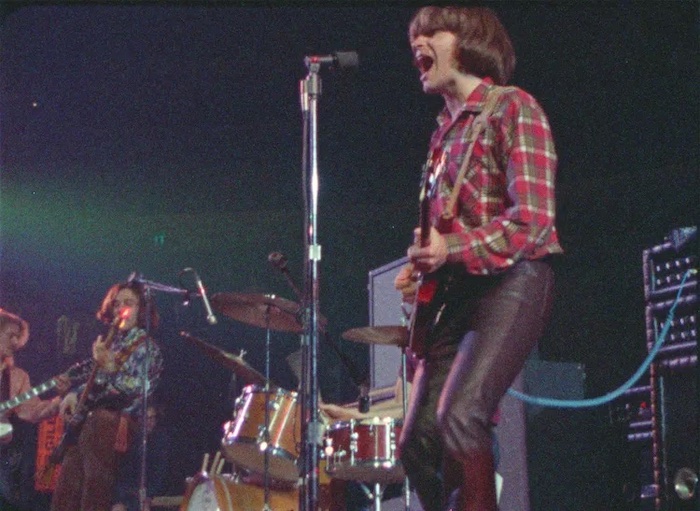
Basically a filmed concert augmented to feature length with a cobbled together bio of the band, this documentary delivers despite its modest ambitions, owing mainly to the fact that CCR was one of the few groups from the classic rock era who hasn’t been visually memorialized to within an inch of its reputation. I assume that’s because of leader John Fogerty’s decades-long refusal to do anything that would make money for his old label Fantasy, which screwed him out of his writing royalties, not to mention the enduring bad blood between him and the other surviving members. None of that enmity is apparent in the footage here, which was filmed in 1970 on the band’s first-ever European tour. As it happens, they played London’s Royal Albert Hall during the same week that the Beatles announced their breakup, a coincidence that prompts the director, Bob Smeaton, to insert comments that compare the two groups, which are not as farfetched as they might seem. Though CCR’s range was narrower than the Beatles and their tenure at the top of charts shorter, within their brief window of popularity at the turn of the decade they couldn’t be beat in terms of sales and quality of product. 

The interviews with the members, which mostly register their impressions of Europe, are perfunctory at best, but the mini group bio is enlightening in its simplicity and hind-sightedness. Some fans may be surprised to learn that three of the members had been playing together since 1959, and while I was aware that two were in the service at the height of the Vietnam War (John Fogerty had some kind of administrative stateside assignment), it didn’t occur to me that the band essentially remade themselves when they got back together after those tours-of-duty. As John says at one point, he wrote “Proud Mary” the day he was discharged. As related in the distinctive Dude-ish cadences of narrator Jeff Bridges, the information feels as authoritative (this is, to be sure, not a movie about the Eagles) as only a fan’s reminiscence could be. I’m also reminded of how ecumenical American TV was at the end of the 60s—one of the best clips is the band performing on “The Andy Williams Show”—because what their story makes clear is that CCR fell fully formed into a market that was perfectly primed for them. Timing was everything, which is why Fantasy could exploit them so mercilessly, though, at this point in their career, they seemed to be fine with that. Less than two years later it would all be over, amazingly enough. 

But the concert is the meat of the movie, and it’s more than satisfying—good sound, good camera placement and editing. The revelation is not so much John’s full-on professionalism and enthusiasm but Doug Clifford’s abandon behind the kit. He really was a great drummer, fluid and funky and minimal, and Smeaton (or whoever put together the concert footage) gives him plenty of exposure. Uncharacteristic for that time, the set is short and there’s no encore, but that, in a way, lends the performance the extra measure of authenticity the band was famous for. It’s no bullshit rock, which is why it remains timeless. 

Now playing in Tokyo at Human Trust Cinema Shibuya (03-5468-5551), Kadokawa Cinema Yurakucho (03-6268-0015).

Travelin’ Band home page in Japanese

photo (c) 2022 Concord Music Group, Inc.

Posted in Movies | Tagged , , | Leave a comment

Review: The Cord of Life

Chinese director Qiao Sixue has said that her debut feature is semi-autobiographical. Qiao studied film in France and intended to remain in Europe, but eventually returned to her childhood home in Inner Mongolia in order to make a movie about her mother, with whom she had always had a fraught relationship. In the movie, her avatar is Alus (Yider), a club musician who has achieved a level of success in Beijing by combining electronics with native Mongolian instruments he mastered as a child. In the big city he has essentially thrown off the trappings of his rural upbringing and remade himself as a vanguard artist, but then he hears from his brother that their mother, Naranzug (Badema), has descended into a state of dementia and has practically “destroyed” his urban household. Given that the brother has a family and Alus does not, Alus feels guilty and goes to his house to address his mother’s fervent desire to return to her real home, though it takes some time for him to determine exactly where this home is.

The film takes the form of a road movie, with the Mongolian steppe providing a dramatic background for Alus’s slow and painstaking reconsideration of his relationship with Naranzug, whose cognitive impairment becomes more acute along the way. The title refers obliquely to the colorful rope that Alus uses to connect him to Naranzug, who mostly doesn’t recognize him as her son, so as to prevent her from stumbling off into the vast, empty plains, but along the way it becomes a metaphor for the ties that bind him to his homeland as he discovers not only what it is about the place that made his mother the person she is, but also how much it has informed his own character. As Naranzug almost reverts to a feral state—at one point delivering a lost lamb back to the corral from which it wandered—Alus has to resort to a more primal form of care, playing his music in order to lure his mother back into his control. 

All the while, the idea of where Naranzug’s “home” is keeps shifting, and as the pair move further into the wilderness it becomes clear that home is more of an idea than a place. It’s the people they encounter, the smells and sounds that connect her with something she can still somehow recall; though in the end it’s a landmark she identifies from her childhood. Though the mysticism invoked by Qiao’s camerawork and sound design, not to mention the romance that Alus encounters along the way, occasionally trespasses into the realm of corn, Alus’s newly generated link to a culture he thought he knew but really didn’t is made palpable. When he joins in a grasslands festival by playing his own music, it doesn’t feel anachronistic or odd. His artistic sensibility has always been rooted in this place, and his mother reacts with pure joy, despite her affliction. The connection is complete, thus allowing them to let go of each other forever. 

In Mongolian and Mandarin. Now playing in Tokyo at Shinjuku K’s Cinema (03-3352-2471).

The Cord of Life home page in Japanese

Posted in Movies | Leave a comment

Review: John Wick: Chapter 4 and Confidential Assignment 2: International

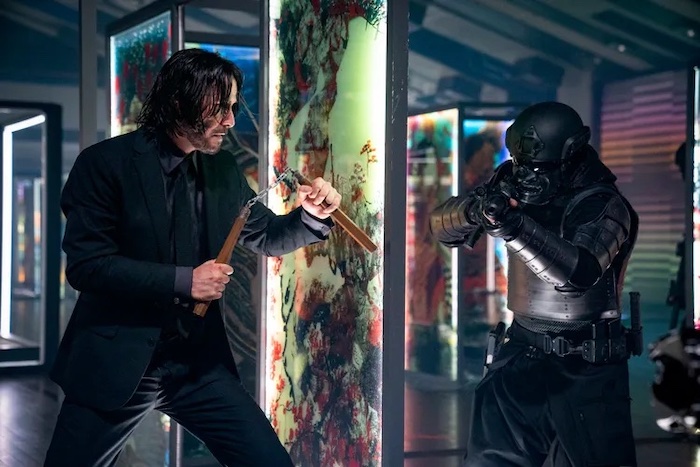
Having missed the third installment of the John Wick series I assumed I would have trouble getting up to speed with the fourth, but given the limited stylistic requirements that the series has set for itself I had no problems. I obviously missed the explication of the worldwide criminal underground cabal called the High Table for which our assassin hero toils, but anyone with any experience in the hit man sub-genre will immediately be able to suss the implications. This back story simply provides a bit more justification for the series’ meat-and-potatoes violent set pieces, each of which involves the slaughter of dozens if not hundreds of anonymous henchmen of whichever bad guy Wick is up against. Though I have my aesthetic-moral principles, I’m as much of a sucker for the old ultra-violence as the next hack, but at close to three hours, this kind of thing, regardless of how “balletically” it’s staged, can start to feel pretty redundant.

The travelogue quality of the series seems to have been prioritized. Wick (Keanu Reeves, more monosyllabic than ever before) has apparently pledged to destroy the Table once and for all in order to gain his freedom, and embarks to the Middle East to take out an “elder” who sits at it. This occasions yet another contract on Wick’s head that every assassin in the world aims to claim. Meanwhile the Continental Hotel in New York is punished because its proprietor, Winston (Ian McShane), helped Wick do something against the Table in the previous film. Winston is left homeless and directionless, while Wick journeys to another Continental franchise in Osaka whose proprietor (Hiroyuki Sanada) is an old friend. By any stretch of the imagination, this is a mistake, since a horde of assassins, most of them led by the blind Table factotum, Caine (Donnie Yen), descendd on the establishment to take him out. Hundreds die, including some characters sympathetic to Wick’s cause, thus making you wonder what Wick hoped to accomplish by traveling to Japan. It’s then off to Berlin, where Wick has to reestablish himself with the estranged “family” that can give him certification as a bona fide assassin (no ronin for the High Table). They require he kill a fat club owner with metal teeth. Then it’s on to Paris—where there are 3-count-em-3 set pieces, only one of which elicited an “ooh” from me—to fight an old-fashioned duel with the duplicitous Table placement, the Marquis (Bill Skarsgård).

Each set piece is characterized by a distinctive motif—in Berlin it’s the boogieing masses being oblivious to the carnage around them; in Paris it’s a car chase with guns on the roundabout surrounding the Arc de Triomphe and a long tumble down the steps leading up to the Sacre-couer. Despite the additions of ringers (Shamier Anderson as a lone-wolf-with-dog assassin who keeps complicating matters; rock star Rina Sawayama as the aggrieved daughter of Sanada’s character) it’s up to Reeves to keep things moving and the extended running time doesn’t help his dour demeanor at all. If the movie is saved by anyone it’s Yen, whose grace is not only economical but witty. It would be nice to see him return for what appears to be a fifth installment, but the requisite stinger seems to indicate otherwise. 

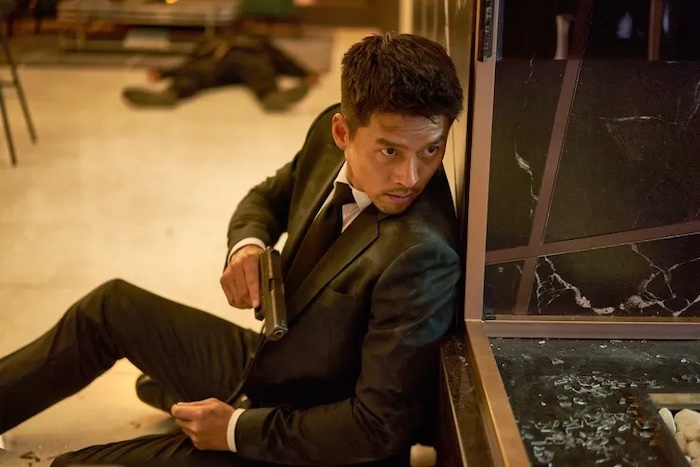
I also didn’t see the first Confidential Assignment movie, in which comic standby Yoo Hae-jin plays an everyman police detective who teams up with a North Korean agent played by Hyun Bin to do something. That movie was released in 2017, before Hyun became an international heartthrob by playing another North Korean in the Netflix hit Crash Landing on You. Consequently, this sequel seems to be targeted more toward a global audience, but the “International” in the title ostensibly refers to the notion that the pair’s action moves have more worldwide repercussions. Also, they are joined by a Korean-American FBI agent (Daniel Henney).

Unlike Wick 4, Confidential is purely plot-fueled: a rogue North Korean agent, Jang (Jin Seon-kyu), has taken his brief as a drug smuggler for the Hermit Kingdom into the US criminal underground, where he’s attracted the notice of the Feds, and after relocating to South Korea becomes the target of the Seoul police, the North Korean military, and the FBI. Hyun’s Im Chul-ryung is tasked with bringing Jang back with his ill-gotten gains, while Yoo’s Kang Jin-tae pushes back against the arrogant American interloper for dibs on Jang’s ass. The three end up working together, but not before a lot of mayhem entails of the John Wick variety, including a very well choreographed shoot-out on the streets of New York. 

This being a blockbuster South Korean actioner, it leaves plenty of room for broad comedy, which is mostly provided by Hyun’s fortified status as a hunk. In the first movie, apparently, Kang’s sister-in-law, Min-young (Im Hoon-ah) had the hots for Chul-ryung and anticipates his return with salacious abandon, but once she gets a gander at the Yank she shifts loyalties, though not really in a convincing way. Still, if I prefer the action set pieces here to those in Wick, it’s not so much because they’re original but because they’re distinct from one another, and the people who die have actual personalities—evil personalities, for sure, but that gives you something to root for. 

John Wick: Chapter 4 now playing in Tokyo at Toho Cinemas Nihonbashi (050-6868-5060), Toho Cinemas Hibiya (050-6868-5068), Shinjuku Wald 9 (03-5369-4955), Toho Cinemas Shinjuku (050-6868-5063), Toho Cinemas Shibuya (050-6868-5002), Toho Cinemas Roppongi Hills (050-6868-5024).

John Wick: Chapter 4 home page in Japanese

John Wick photo (c) 2023 Lions Gate Entertainment Inc.-Murray Close

Confidential Assignment 2: International, in Korean, now playing in Tokyo at Toho Cinemas Hibiya (050-6868-5068), Toho Cinemas Shinjuku (050-6868-5063), 109 Cinemas Premium Shinjuku (0570-060-109), Toho Cinemas Roppongi Hills (050-6868-5024.

Confidential Assignment 2 home page in Japanese

Confidential Assignment 2 photo (c) 2022 CJ ENM Co., Ltd., JK Film

Posted in Movies | Tagged , , | Leave a comment

Review: Teenage Mutant Ninja Turtles: Mutant Mayhem

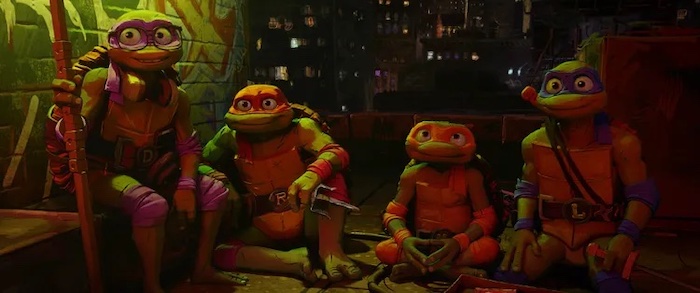
Like the Spider-verse reboot, this new animated take on the Teenage Mutant Ninja Turtles franchise completely reimagines the vibe for a more discerning target audience, namely young people who have a stake in the culture that the source material ostensibly addresses. By bringing in people who have proven ability to appeal to actual teenagers, from soundtrack composers Trent Reznor and Atticus Ross to co-screenwriters Seth Rogen and Evan Goldberg, the producers allow the characters’ adolescent freak flag to fly freely, with the result being a much more entertaining movie than any of the previous ones, which mostly tried to be something for everyone. Rightly, they also went back to the beginning, and the origin story is funnier for the kind of animation used, which looks like stop-motion but seems to be a synthesis of different styles. 

One thing’s for sure, the frantic pace likely matches the brain function of teens who play video games and surf the net at breakneck speeds. If I hadn’t seen the previous Turtle movies I might not have fully appreciated how adept director Jeff Rowe is at telling a story with such economy and precision. We get the weird scientist, Baxter Stockman (Giancarlo Esposito), losing a vial of his mutation agent down a New York City drain, where it gets into the sewage system and creates a whole menagerie of mutants. Our heroes are babies rescued from the sludge by the kung-fu practicing rat, Splinter (Jackie Chan), who has been traumatized by his ventures to the surface world and raises his four boys (voiced by non-famous actors) to shun that world. They do have to occasionally go up top to filch supplies, including their beloved pizza, and so Splinter teaches them Asian martial arts for self-defense purposes. As adolescent boys do, they long for connection to their own cohort and secretly aspire to going to school, things they know about because they spend so much time on the internet, but of course their “father” would forbid it. After they meet April (Ayo Edebiri), a nerdish girl with journalistic pretensions, they can’t get the idea of integrating out of their minds, and together the five take on Superfly (Ice Cube), a mutant fly that plans to use some kind of farout machine to turn all the inhabitants of NYC into mutants.

What’s particularly attractive about the production is how seamlessly it integrates the furious action elements into a typical goofy teen self-expression story. Rogen and Goldberg bring the same spirit of irreverent abandon to the presentation that they did to such classics as Superbad, and the humorous back-and-forth, not only among the Turtles but among the nominal villains, in imbued with a crackling, throwaway wit that never flags. Even the scatology and gross-out stuff (April tends to throw up without much warning) is done with a light touch. Let’s hope there’s more of this to come. 

Opens Sept. 22 in Tokyo at Toho Cinemas Nihonbashi (050-6868-5060), Toho Cinemas Hibiya (050-6868-5068), Shinjuku Wald 9 (03-5369-4955), Shinjuku PIccadilly (050-6861-3011), Toho Cinemas Shinjuku (050-6868-5063), Toho Cinemas Shibuya (050-6868-5002), Toho Cinemas Roppongi Hills (050-6868-5024).

Teenage Mutant Ninja Turtles: Mutant Mayhem home page in Japanese

photo (c) Paramount Pictures

Posted in Movies | Leave a comment