Media watch: U.S. draws Japan further into its militarist mindset, this time through history

USS Missouri

In a recent interview with Asahi Shimbun, Prof. Ritsu Yonekura, who teaches media history at Nihon University, talked about “August journalism,” a topic we’ve covered extensively since we first started writing about Japanese media in the mid-90s. August journalism refers to the preponderance of stories about World War II by Japanese publications and broadcasters that appear in August to commemorate the atomic bombings and the Emperor’s announcement to quit the war in 1945. Yonekura, who was once a director at NHK, has seen a marked change in this coverage over the years in terms of both quantity and quality. He claims that August journalism peaked in 1995, when, by his count, 294 articles and TV programs about the war appeared in major media in August. Since then the number has been steadily dropping, but, more significantly, the tone of the coverage has changed, too. After Shinzo Abe started his second stint as prime minister, the nature of the coverage has been uniform. In 2015, to mark the 70th anniversary of the end of the war, there were 45 TV programs, and none mentioned anything about Japan as an aggressor; nor did any express any sense of remorse over Japan’s role in carrying out the war. He pinpoints the beginning of this change in 2001, when NHK ran a special program about sexual violence during World War II on its educational channel that upset many people in the government. After that, NHK made a point of avoiding the so-called comfort women issue. 

In the interview, Yonekura says he first became interested in the subject of August journalism when he was working for NHK in Hiroshima during the 50th anniversary of the atomic bombing in 1995. He remembers the mayor at the time, a former journalist named Takashi Hiraoka, whose memorial speech that year mentioned Japanese aggression and how what Yonekura calls the “Hiroshima ideology”—the idea that such an act should never be repeated ever again—had never really spread outside of Japan. That’s because whenever people talked about the bombing in Japan, it was always from the position of “weakness,” meaning those who died and suffered were victims of war without actually explaining what had brought about this particular war. No one connected the bombing to Japan’s status as an aggressor. Hiraoka blamed poor journalism for this dereliction, which placed the bombing in the context of “hibaku [atomic bomb casualty] nationalism,” based on the idea that only Japan has been attacked with nuclear weapons and was therefore special. 

It was after the speech that Yonekura began studying in earnest how journalism explained the war in Japan, and he came to believe that future generations of Japanese will not fully appreciate the scope of the war, and thus their understanding of it will differ greatly from people in the rest of the world. Eighty-five percent of the current population was born after the war, and the cohort that remembers it firsthand has almost died out. It is the mission of journalists to preserve as much of the war’s history as possible, and the media is failing in that regard. What’s necessary is an “outsider’s viewpoint,” meaning Japanese journalists and opinion makers who have lived overseas and can see the larger picture, because the story of the war as it’s told in Japan is only how it affected Japanese people.

In particular, he sees a wide gap between U.S. and Japanese perspectives regarding the atomic bombings. Though the U.S. and Japan are now allies and have been working toward a more assertive, locked-in military relationship, there is no shared consensus about the atomic bombing, which in the U.S. is widely considered the act that ended the war (though that is debatable). In Japan, as already noted, it is more amorphously thought of as a horrible tragedy visited on the Japanese people, but the authorities are loath to blame the U.S. for using the bomb and, therefore, do not promote the abolition of nuclear weapons because of the U.S. policy of deterrence. 

Continue reading
Posted in Media | Tagged , | Leave a comment

Review: Hit the Road

When I think about Iranian cinema, certain adjectives immediately come to mind—allegorical, stark, allusive—but “breezy” isn’t one of them. In that regard, the offhanded narrative style of Pahan Panahi’s debut feature resembles that of no other Iranian director I can think of except his own father, Jafar Panahi, who often injects playful moments into his stories even if the overall stories aren’t playful at all. Hit the Road opens in broad comic mode, with a family-of-four-plus-dog traveling somewhere in rural Iran in a rented SUV, bickering among themselves about things that sound trivial. This setup has the makings of a classic road comedy: the six-year-old hyperactive “little brother” (Rayan Sarlak) constantly talking back to his middle-aged parents and demanding attention; the bearded father (Mohammad Hassan Madjooni), his leg in a cast, cursing good-naturedly at various sleights to his intelligence; and the grey-haired mother (Pantea Pananiha), riding shotgun, trying to hold everything together by keeping things light. The only person who isn’t party to this casual mood is the older twenty-something son (Amin Simiar), who drives with the sullen determination of someone who has more important things on his mind. Once in a while, during breaks in the action, a melancholy Schubert melody plays on the soundtrack.

This intermittent note of sobriety does not convey so much a sense of foreboding—though given where the story is going, it has every right to—but rather a wistfulness that’s meant to counterbalance the mild chaos of the journey, which will end with the older son being smuggled out of the country. True to the usual allusive purposes of issue-oriented Iranian cinema, the family’s mission, which is hidden from the younger son with a story about matrimony, is never spoken of directly, but Panahi nevertheless is open about what’s happening and that the authorities have something to do with it. While it’s sometimes difficult to square the jokey situations—which include a voluble, injured competitive bicyclist, an ongoing argument about contraband cell phones, and what to do with the dog, which is literally on his last legs—with the perilous nature of what the family is doing, Panahi orchestrates it in such a way as to show how the parents have made peace with a decision that has already ruined what appears to be a comfortable middle class life but will at least save their son’s. 

Inevitably, you have to wonder what the authorities think of Hit the Road, especially since Panahi pere has been jailed several times and banned from making films (which he continues to do anyway) because of his subject matter. For sure, there are allegorical touches, like a fantasy sequence in which the family flies out into the universe a la 2001, which the older son cites as his favorite movie. (Is he a filmmaker as well?) But Panahi fils isn’t trying to pull the wool over anyone’s eyes. It’s obvious how this journey will end and why it’s being taken, and what you bring away from it not so much the sadness that the family will live with, but the love that brought them here.

In Persian. Now playing in Tokyo at Human Trust Cinema Yurakucho (03-6259-8608), Shinjuku Musashinokan (03-3354-5670).

Hit the Road home page in Japanese

photo (c) JP Film Production 2021

Posted in Movies | Tagged , | Leave a comment

Review: Next Sohee

The second film by Korean director July Jung, a former assistant to Lee Chang-dong, is conventional in all but structure, but to discuss that structure in detail would give away too much. Nevertheless, Next Sohee continually surprised me, and several times I think I actually felt my jaw drop, while other times I became so anxious for the title character, a teenager who is selected by her high school to participate in an “extern” program that places her in a company where she works toward a full-time position, that I could hardly watch. Like her mentor, Jung takes a prominent social problem and studies how it affects individuals, and the plot of Next Sohee is based on a true story, one that has reportedly inspired two other narrative films. 

Sohee (Kim Si-eun) is first seen dancing by herself in a rented rehearsal room, struggling unsuccessfully to master a particularly tricky move. Though dance is obviously the thing she loves, she doesn’t seem ambitious enough to take it to the next level, even though it quickly becomes clear that she possesses the kind of personality that values her own worth and dignity. It is perhaps this quality that gets her into the extern program because her counselor makes a big deal of how special she should feel that she was selected, and she is happy if a little suspicious, since taking the job requires certain compromises, like wearing makeup and a nice dress to the initial interview. However, once she starts the job in earnest she is deflated. She works in a call center for a telecom company as a customer service rep. The work is punishingly awful as it requires her to listen to complaints and then try to make sure the caller not only doesn’t cancel their plan but extends that plan. She quickly realizes that the terms of her job constitute a scam—her “incentive” pay is put off for reasons of performance evaluation, but actually that condition is put in place to prevent her from quitting, since she soon learns that turnover is very common at the company. All her fellow reps are girls like her who entered the company, and they’re being hired through the program so that the company can pay below minimum wage. When her team leader, a nervous young man who tries to help Sohee adjust, commits suicide after a particularly humiliating episode, she is asked to cover up the reason for the suicide by signing a false statement. And quitting isn’t an option, since remaining with the company is a requirement for graduation.

The second half of the film centers on a police detective named Yoojin who is investigating the scam. She is played by Bae Doona, who also starred in Jung’s excellent first film, A Girl At My Door, as a cop, but a very different one. Yoojin is dour to a fault, seemingly defeated by the lack of any real difference she makes through her work, and the extern case is frustrating because the corruption endemic in the program seems to reach so deep into the system: Companies make deals with schools who work with local governments, all reaping some benefit through the exploitation of young people, usually from disadvantaged households, who have yet to understand the niceties of late-term capitalism. What’s special about Jung’s approach is how straightforward it is. Though unbearably heartbreaking at times, it’s never sentimental. Sohee’s proclivity for dancing is not presented as a dream deferred. It’s simply something that she loves to do, something that defines her in her own mind, and the hardest truth to take is how easy it is for the system to destroy that passion.

In Korean. Opens Aug. 25 in Tokyo at Cinemart Shinjuku (03-5369-2831).

Next Sohee home page in Japanese

photo (c) 2023 Twinplus Partners Inc. & Crankup Film

Posted in Movies | Tagged , | Leave a comment

Review: Meg 2: The Trench

The enduring commercial viability of shark movies, almost fifty years after Jaws, mirrors the enduring commercial viability of zombie flicks, though no one, as far as I know, has ever compared the two. As terrifying adversaries go, both sharks and zombies have no particular agency, meaning no evil designs beyond just wanting to eat you. There’s nothing you can do about them except try to kill them. The difference, or at least the difference as it’s developed over the years, is that sharks are still living things that have a place in the natural order, and therefore deserve the acknowledgement that they shouldn’t have to die just because evolution has rendered them, to paraphrase Richard Dreyfuss, the perfect swimming, eating machine. Zombies, however, are dead to begin with. They don’t even deserve to exist. That’s why this most expensive of shark movie franchises, premised on the idea of prehistoric megalodons that are fifty times bigger than conventional sharks still roaming the sea, has to depict a real enemy, usually humans doing bad things, because it’s not the shark’s fault that they eat people. But when they eat bad people, it’s more fulfilling.

In the case of this sequel, the bad guys are an illegal mining operation looking for rare earth minerals in a trench that just happens to be a portal to where megalodons make their home. These people are destroying the earth for money, it’s implied, so their comeuppance is interpreted as nature getting its due. Then again, the first half of the film has relatively little to do with megalodons except that the Chinese research company introduced in the first film (though the franchise is distributed by Warner Bros., the production is Chinese-funded) and headed by Zhang Jiuming (Wu Jing), has captured one and is trying to somehow train it. But first, we have to refind our bearings by introducing the other holdovers from the first installment, rescue diver Jonas Taylor (Jason Statham), who is now a kind of eco-warrior, his engineer friends Mac (Cliff Curtis) and DJ (Page Kennedy), and, most significantly, Zhang’s niece and Taylor’s step-daughter, Meiying (Shuya Sophia Cai), who is the film’s designated focal point in that Taylor is invested in saving her from any danger at any cost. 

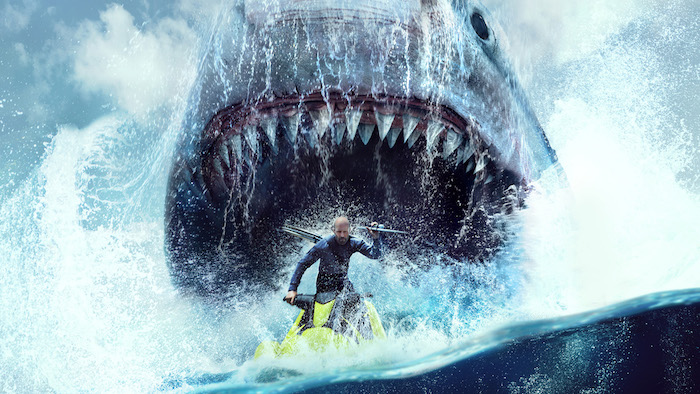
But the more immediate danger is that mining crew, upon whom Taylor and the others stumble while exploring the trench and Zhang’s meg escapes to pursue them. As it happens, the head of the crew holds a grudge against Taylor for an earlier ecological dustup, and once the two opposing parties interface, there’s lots of loss of equipment and life, resulting in a desperate effort to return to the surface just as a bunch of megalodons, not to mention a giant octopus and some weird lizard-like creatures (there will be dinosaurs), are let loose. The director, Ben Wheatley, who has been praised for his work in horror films that I haven’t seen, doesn’t really get his mojo working until this final battle between the good guys, the bad guys, and the escaped creatures, which is all staged within a hilariously isolated marine resort called Fun Island. Statham gets to go mano-a-fisho with one of the megs while riding a jet ski and using a destroyed helicopter rotor as a harpoon. I know I’m supposed to suspend disbelief, but give me the zombies any day. 

Opens Aug. 25 in Tokyo at Toho Cinemas Nihonbashi (050-6868-5060), Toho Cinemas Hibiya (050-6868-5068), Marunouchi Piccadilly (050-6875-0075), 109 Cinemas Premium Shinjuku (0570-060-109), Shinjuku Wald 9 (03-5369-4955), Shinjuku Piccadilly (050-6861-3011), Toho Cinemas Shinjuku (050-6868-5063), Human Trust Cinema Shibuya (03-5468-5551), Toho Cinemas Roppongi Hills (050-6868-5024).

Meg 2: The Trench home page in Japanese

photo (c) 2023 Warner Bros. Ent. 

Posted in Movies | Tagged | Leave a comment

Review: The Wolf House

Presented as an old film restored by the Chilean directors/animators Joaquin Cociña and Cristóbal León about a German colony with a very bad reputation, The Wolf House is a disarming excavation of proto-fascist tropes served up as surreal art. Based on the story of Colonia Dignidad, a real colony founded by a Nazi child molester that purported to achieve earthly happiness through the imposition of an iron fist (reportedly, the colony aided Pinochet in the persecution of his enemies), the movie, after a brief, almost comical précis about its own provenance, proceeds to tell the animated tale of Maria, a member of the colony who is punished for allowing three pigs in her care to escape, and who herself escapes confinement to the titular structure, which she finds abandoned in the woods as she flees what she believes is a wolf that means to devour her.

Cociñã and León shift between crude 2D animation painted on the walls of the house and 3D stop-motion animation using equally crude but nevertheless lifelike papier-mâché constructions, with the former morphing into the latter and vice versa. Most of the action takes place within Maria’s fevered mind, as she tries to keep the wolf at bay and protect her “children,” two pigs that shift into human form at Maria’s will. The house itself is depicted as a living thing, something that “promises to protect” Maria and her children while also occasionally betraying what trust the girl has invested in the place. Continually haunted by the voice of the invisible wolf, in both German and Spanish, she comes to accept the guilt of her betrayal of the colony and, in a sense, adopts its mindset in her approach to the children in her care. “Do you want to be something better?” she chides them in the tone of someone who is trying to put them in their places, and then forbidding them to leave, even after they’ve been maimed in a fire. Eventually, their own hunger sets them against Maria, who thus comes to empathize with the wolf. When she “feeds” some small animals to a tree, she feels a sense of accomplishment.

Cociñã and León’s style is grotesque and unsettling, but the development of The Wolf House makes good on its self-proclaimed purpose as a propaganda film to sell the virtues of the colony, and, of course, the effect on the viewer is the opposite. The overriding emotional parameters are fear and loathing, which are often inverted back on Maria as she loses her purchase on not just her common sense, but whatever moral foundation she may have once clung to. The need for sustenance and spiritual succor warps her perspective, a concept the filmmakers recreate with stunning imaginative assurance. It’s difficult to describe exactly what they pull off, since the visuals are in such a constant state of flux—mainly from integration to decay—that the viewer can’t keep track of where one image ends and another begins, even while it is happening. The production notes say the pair spent almost four years making this 75-minute film, which sounds too short to me. The Wolf House contains a lifetime’s worth of disturbing ideas. 

In Spanish and German. Now playing in Tokyo at Theater Image Forum Aoyama (03-5766-0114).

The Wolf House home page in Japanese

photo (c) Diluvio & Globo Rojo Films 2018

Posted in Movies | Leave a comment

Review: Crimes of the Future

David Cronenberg’s return to “body horror,” a genre he invented, after two decades of comparatively conventional, though by no means less disturbing, dramas has the same title as one of his earliest movies, so at first I wondered if he was remaking it. Though I haven’t seen that earlier movie, this apparently is nothing like it, so I have to assume he just likes the title and, perhaps, felt he wasted it on the other one. “Crimes” in this case are not necessarily the legal type, but rather the existential type. Taking place sometime in the future, the story centers on the idea of something called accelerated evolution syndrome, a biological condition in which humans develop new organs and systems to cope with the environmental degradation they’ve visited upon the natural world. In the opening scene, a depressed looking boy devours a trash can full of plastic, after which his mother kills him. Later, the boy’s father, an “anarchist” named Lang Dotrice (Scott Speedman), uses his son’s body in an attempt to show the world what humans have done to it. 

He accomplishes this by offering the corpse to a pair of performance artists, Saul (Viggo Mortensen) and Caprice (Lea Seydoux), whose mode of artistic expression is surgery. Saul has a knack for producing “novel organs,” which Caprice removes from him for paying audiences. Dotrice offers his son for an autopsy, presumably to see what makes his digestive tract receptive to polyethylene. But before this happens, the viewer is subjected to Cronenberg’s patented gruesome visual style, which has to contend with an over-complicated plot and characters whose purpose often seem at odds with the logic of that plot. The “performance” scenes are the most compelling, and not just because they’re gross, but rather due to Cronenberg’s insistence that such actions can be considered art. Saul, as it were, suffers for that art in more ways than one. The surgery is painless because Saul, as well as most humans, has evolved away from pain, but he suffers from countless maladies that require creative solutions, including bizarrely designed furniture that eases Saul’s unique forms of physical inconvenience. In this regard, Crimes of the Future improves thematically on that earlier, more controversial Cronenberg film, Crash, in that sex has no appeal unless it is tethered to something more visceral, in this case scalpels cutting into flesh. 

But where there’s art there has to be politics, and the introduction of something called the National Organ Registry confuses matters with its determination, through the agency of two factotums (Don McKellar, Kristen Stewart), to monitor Saul’s performances. This subplot has a direct connection to the one in which Dotrice seems to be concocting an aesthetic revolution, the idea being that humanity has adapted to a befouled biosphere much too readily and needs some sort of comeuppance, but the two bureaucrats often come off as hastily conceived comic relief (Stewart’s character is clearly turned on by the surgeries), thus blunting whatever message they are meant to deliver. Cronenberg’s ideas about evolution and adaptation are intriguing enough by themselves without all the subtext, but what is a Cronenberg movie without subtext? It’s simply a horror movie like no other. 

Now playing in Tokyo at Marunouchi Piccadilly (050-6875-0075), Shinjuku Wald 9 (03-5369-4955), Human Trust Cinema Shibuya (03-5468-5551).

Crimes of the Future home page in Japanese

photo (c) Serendipity Point Films 2021

Posted in Movies | Tagged , , | Leave a comment

Review: QT8-The First Eight

Though not strictly a hagiography, this thorough explication of the films that Quentin Tarantino made under the auspices of Harvey Weinstein presents America’s most celebrated auteur of the last three decades as a complete success on his own terms and anyone else’s. It also gathers enough famous talking heads to sing his praises that the director, Tara Wood, can talk about Tarantino’s relationship with the now-confirmed sexual abuser (“He was my best friend…”) in fairly frank terms without necessarily contradicting on-screen testimony to the notion that QT, as Jennifer Jason Leigh puts it, “wrote parts for women better than anyone.” To her credit, Wood doesn’t dance around the problem; but it does make the hero worship sound more forced than it’s probably meant to sound. 

What’s missing, of course, is QT’s own voice. The filmmaker seemingly contributes nothing personal to the documentary, even if his film geek persona permeates every frame. Consequently, the anecdotes and insights provided by his regular actors, collaborators, and hangers-on have a delicious insider quality to them that even non-QT enthusiasts should enjoy. There’s a running sub-theme about how all of Tarantino’s films comprise an alternate universe complete with its own unique commerce and human community, which, when understood properly, make the ultra-violence and the rarefied humor not only understandable, but acceptable. The actors who appear are self-aware enough that they’ve come to accept QT’s main working credo, which is that “you’re never cooler than the movies” themselves. Jamie Foxx is the only leading man movie star who talks to Ward, and he admits that Tarantino had to “bring me down” from his high perch to make him credibly convey a slave-like mentality in Django Unchained. And whereas he wasn’t always able to get the actors he wanted (Travolta, who definitely had his career revived by QT, wasn’t his first choice for Pulp Fiction), Tarantino knew more about the acting community in Hollywood than anyone in the history of the business, and once he blessed you with a role, you were kind of his. Tim Roth, Christoph Waltz, Michael Madsen, and Kurt Russell essentially say as much, pledging their allegiance not because of what he did for them financially, but how he guaranteed their street cred.

In amongst the delightful bits of trivia and heartfelt encomiums to loyal compadres (in particular, QT’s longtime editor, Sally Menke), Ward sometimes comes across as tone deaf in her presentations of those aspects of QT’s ouevre that rub people the wrong way. She actually handles the Weinstein connection fairly well, but despite Foxx’s and Samuel Jackson’s defense of QT’s love of the n-word (at the expense of Spike Lee and the more delicate sensibilities of Leonardo Dicaprio, who had to utter it multiple times in Django), the use of the word even in the documentary has a jarring effect that comes across as gratuitous. Uma Thurman’s permanent injury as a result of reckless practices during the making of Kill Bill is mentioned but not really explained. And while Ward’s description of the films as being both ground-breaking and highly influential is unimpeachable, her implication that they all were of the highest quality feels like a dodge. How anyone can sit through The Hateful Eight—70mm or no 70mm—with any sense of enjoyment is beyond me. The fact is, QT’s iconoclasm has helped him get movies made the way he believes they should be made, but much of the stuff he did after Jackie Brown was self-indulgent. That said, I still really like Death Proof

Now playing in Tokyo at Shinjuku Cinema Qualite (03-3352-5645), Human Trust Cinema Shibuya (03-5468-5551).

QT8-The First Eight home page in Japanese

photo (c) 2019 Wood Entertainment

Posted in Movies | Tagged , , | Leave a comment

Review: Barbie

Greta Gerwig’s very popular movie, written with her life partner and fellow filmmaker Noah Baumbach, isn’t the first one to center on a toy or, for that matter, a very recognizable toy. Usually, however, the toy is a brand name used to spice up an otherwise rote genre exercise, as with Hasbro’s Transformers or even the board game Clue. Barbie the film, as everyone knows by now, basically tries to comment on the accepted narrative about Mattel’s iconic female doll and the way it shapes girls’ attitudes toward feminine stereotypes without actually subverting that narrative. What it doesn’t do, despite a moving soliloquy by America Ferrera as a mother and Mattel employee near the middle of the film, is make an emotional case for toys as instructive tools about life and actual companions, the way the Toy Story movies did. Though it may seem farfetched to compare Gerwig’s very original and thoughtful approach to Pixar’s, Barbie can’t help but feel less immersive, and not because it isn’t entertaining. It’s very entertaining, but actually in a more conventional way. 

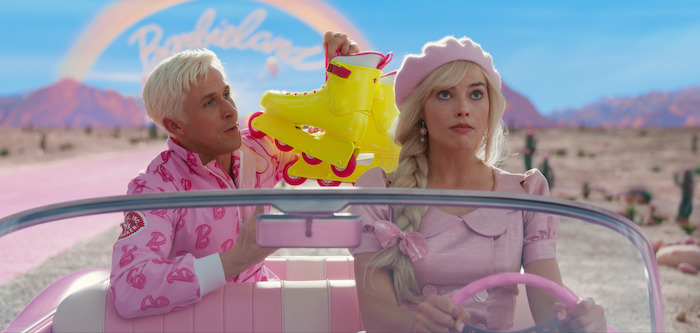
The crux, of course, is Mattel, which bankrolled the film and allowed Gerwig and Baumbach to make fun of its image as a big corporation. Toy Story also had a few famous brands in its toybox, but it didn’t try to contend with their image any more than using it to make clever plot points. (I’m thinkng Mr. Potato Head and his removable body parts.) For the most part, Barbie‘s most appealing trait is the way it reduces those aspects of the doll and its “world” that have been analyzed by feminists and sociologists to simple jokes: There’s a Barbie for every type and lifestyle but they’re still all named Barbie; nobody has any genitalia; and in a universe designed to make little girls aspire to greatness, the guys are relegated to the background as eye candy. Within this universe Margot Robbie plays “stereotypical Barbie” who lives at the top of a non-existent pecking order in Barbie Land, which is at once a figment of our imagination and the end result of whatever values and goals Mattel was pushing over the years with their doll series concept. Her neighbors include Physicist Barbie (Emma Mackey), Doctor Barbie (Hari Nef), Weird Barbie (Kate McKinnon, who prefers Birkenstocks to heels), and even President Barbie (Issa Rae), and they all live in perfect harmony, as the old Coke song went, presumably because they don’t have to worry about men lording over them. As it turns out, the Kens all live down at the beach and do little more than show off their bodies for no discernible purpose and compete with one another. That the main Ken (Ryan Gosling) is Sterotypical Barbie’s denoted boyfriend is the best joke of all since neither doll understands what that exactly entails, but in any case, Barbie Land is depicted as an idyll, and one that is eventually ruined by the premonition of death. (Actually, cellulite, but when cellulite appears death can’t be far behind.)

This realization leads to Barbie’s journey to the real world, with Ken in tow only because he feels some compulsion to join her as her designated male-identified companion. In the real world, which is Los Angeles, the pair get into a number of difficult situations that upset their decidedly narrow view of whatever they think existence means, with the result being that Barbie learns of her problematic role in the development of young girls’ self-image (via, mainly, Ferrera’s aforementioned soliloquy) and Ken learns about the patriarchy, which he is only too happy to export back to Barbie Land. But the most dramatic twist to their sojourn is Barbie’s encounters not only with older women—which, given her provenance as a plastic figure, she can never become—such as Ruth Handler (Rhea Perlman), the Mattel founder who invented Barbie to give girls something to play with other than babies, but also with the all-male board of directors of Mattel, including its CEO (Will Ferrell), who is desperate to get Barbie “back in the box” where she belongs. But as inventive and thought-provoking as this approach is, it is not as purely affecting as Gosling’s and the other Kens’ silly, self-important take on privilege, which is both hilarious and provocatively on-point. The all-male dance number is the high point of the movie, entertainment-wise. As a treatise on consumerism, sexism, and the commodification of girl power, Barbie is certainly smart, but it still has to contend with Mattel’s prerogatives. Ken comes out making the stronger impression in that regard not because he’s a guy, but because he’s funny. 

Now playing in Tokyo at Toho Cinemas Nihonbashi (050-6868-5060), Toho Cinemas Hibiya (050-6868-5068), Marunouchi Piccadilly (050-6875-0075), 109 Cinemas Premium Shinjuku (0570-060-109), Shinjuku Wald 9 (03-5369-4955), Shinjuku Piccadilly (050-6861-3011), Toho Cinemas Shinjuku (050-6868-5063), Toho Cinemas Shibuya (050-6868-5002), Toho Cinemas Roppongi Hills (050-6868-5024).

Barbie home page in Japanese

photo (c) Warner Bros. Entertainment Inc.

Posted in Movies | Tagged , , | Leave a comment

Review: Return to Seoul

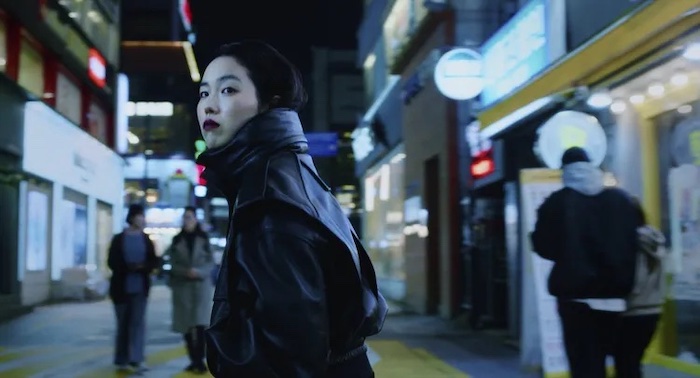
What makes Cambodian-French director Davy Chou’s movie about a young French woman recklessly discovering her Korean heritage compelling is how attuned it is to not only to the character’s foibles, but how those foibles determine the purpose of her quest, which is never fully apparent, even to her. Unlike other stories of personal discovery, there’s a clear sense of matters getting away from Freddie (Park Ji-min) as she visits the titular capital over a period of some ten years, continually drawn back out of some inchoate sense of belonging. Even her initial sojourn seems serendipitous—she was flying to Tokyo on her own when her flight was diverted to Seoul, and decided to get off—though given the character that Chou and his co-writers, not to mention Park herself, develop, there may have been more calculation in her decision than she lets on. In a phone conversation with her adoptive mother back in France who is concerned about her being in Korea, it’s revealed that the two had planned to someday visit the country of Freddie’s birth together, so it’s easy to question Freddie’s motivation.

At first, it doesn’t seem that Freddie even wants to find the parents who gave her up for adoption as an infant, but while drinking with a bunch of new Korean friends one suggests an easy way of looking for them, and the fuse is lit. On the surface, Freddie takes a somewhat dim view of the Korean sense of propriety, especially when it comes to family, but after she visits the adoption agency and learns about the process of contacting her birth parents—who separated some time ago—she puts that process in motion. With the help of Tena (Guka Han) the French-speaking clerk at the youth hostel where she’s staying, she eventually visits her father (Oh Kwang-rok), a working class breadwinner living in a fishing village who is so wracked with guilt at having abandoned Freddie years ago (and insists on calling her by her given Korean name) that he goes around the bend and insists she move back to Korea where she will learn the language and he will find her a good Korean husband. Freddie, who was reluctant to meet him in the first place, rebuffs his entreaties and eventually breaks with him violently after he shows up drunk at the youth hostel. As far as Freddie’s birth mother goes, she doesn’t respond to the adoption agency’s letter of inquiry.

Though fraught with meaning, the first section doesn’t properly prepare the viewer for Freddie’s subsequent returns to Seoul over the next decade. At one point, she has found a job working for a French consultant and picks up foreign Tinder dates while living a dissipated lifestyle in Itaewon’s demimonde. She revels in her foreignness even while her Korean comrades see her as one of them, which is the kind of attention she doesn’t seek and rejects if offered. Years later, on another return with her French boyfriend, she has actually reconnected with her father and seems to want to make a relationship, though it is now he who wants to maintain a distance. All the while she keeps trying to contact her birth mother, despite the agency’s insistence that they can’t force the issue. Freddie’s life is at the mercy of cultural forces she at one time refused to acknowledge but now understands intimately, even if they are a constant shock to her system. What Chou has done to make this dynamic so direct is put the viewer in Freddie’s position at all times, no matter how uncomfortable it might be. There’s so much in this story to understand that you can’t help but feel frustrated with the parts that you know can never be explained. 

In French, English and Korean. Opens Aug. 11 in Tokyo at Bunkamura Le Cinema Shibuya Miyashita (050-6875-5280).

Return to Seoul home page in Japanese

photo (c) Aurora Films/Vandertastic/Frakas Productions 2022

Posted in Movies | Tagged | Leave a comment

Review: The Survivor

Barry Levinson’s retelling of the story of Harry Haft (Ben Foster), a Polish Jew who survived Auschwitz by allowing himself to be used for entertainment purposes as a boxer, is a fairly conventional movie in that it plays on the viewer’s feelings about the idea of surviving. When Haft’s story was told in the media after the war, he was branded a traitor by fellow Jews for having beaten other Jews to death so that Nazi officers could bet on the outcome. Levinson goes deep into this story, both during Haft’s time in the camp (presented in black-and-white) and during his post-war career (in color) as a real competitive boxer, albeit one whose appeal was rather morbid due to the route he took to become a fighter. Though Haft, a brooding, thoughtful man, has plenty to feel guilty about, he keeps his eye on the prize, which isn’t money or fame, but the fiancee he lost when they were separated during the war. His search for her is the film’s through-line, and Levinson holds back on its melodramatic potential, keeping it at a safe distance so as to give the viewer something to look forward to in a life that seems pretty intolerable.

In Auschwitz, Haft’s “savior” is the opportunist Schneider (Billy Magnussen), a cynical officer who “doesn’t hate Jews” and gives Haft an offer he can’t refuse after Haft beats up a German guard. Rather than be killed right away, which is what happens to inmates who beat up guards, Dietrich represents him in boxing matches with other inmates—as long as he keeps winning, he’ll keep living. In New York after the war, Haft ekes out an existence as the “Pride of Poland,” and is being trained to fight heavyweight champion Rocky Marciano (Anthony Molinari), one of the most imposing fighters in the history of the sport. Feeling sorry for a fellow Jew, and a camp survivor to boot, Marciano’s trainer, Charlie Goldman (Danny DeVito), offers to coach Haft so he won’t be completely destroyed in the ring. The sequence where Haft, Goldman, and Haft’s own trainers (John Leguizamo, Paul Bates) go upstate for this secretive training session becomes more or less a treatise on how to survive in the white man’s USA, since non of the men there are WASPs. It also provides contrast to Haft’s troubled persona, since he can actually relax with these men—one Jew, one Puerto Rican, one Black man—and not feel that he’s a freak for what he went through in Auschwitz. In that regard, the New York cognate of Schneider is journalist Emory Anderson (Peter Sarsgaard), who pesters Haft to write his story for his own benefit and thus exposes him to the enmity of other Jews. Anderson is not a Nazi, but his opportunism isn’t that different from Schneider’s. 

As already mentioned, the film’s plot hook is Haft’s years-long search for his fiancee, which he carries out with the help of Miriam Wofsoniker (Vicky Krieps), an employee of the Jewish Center in Brooklyn whom he eventually marries. Though this line plays out as one would logically expect it to, it still leads to some surprising revelations, not only about the woman Haft left behind, but about what kind of man Haft really was. Levinson can only keep the melodrama at bay for so long, and once he lets it in, the film is very moving. Someone once said surviving is an art. In Haft’s case it is a constantly shifting process of self-renewal. 

Opens Aug. 11 in Tokyo at Shinjuku Musashinokan (03-3354-5670).

The Survivor home page in Japanese

photo (c) 2022 Heavyweight Holdings LLC

Posted in Movies | Tagged , | Leave a comment