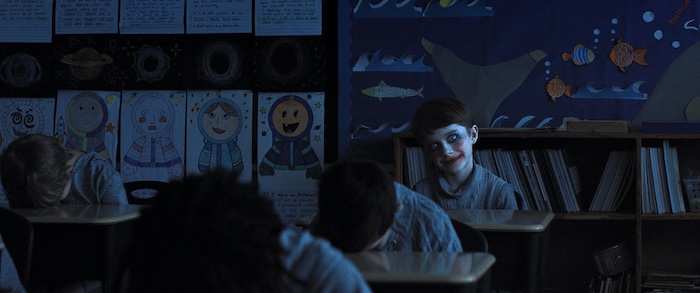
As the old truism goes, write what you know, advice that YouTube movie critic Chris Stuckmann follows for the opening 20 minutes or so of his debut horror feature. Making fairly good use of the found footage device that made The Blair Witch Project a phenomenon 25 years ago, he sets up a situation that immediately draws the audience in: A quartet of online ghostbusters who have garnered a loyal and growing following go missing while investigating an abandoned prison for evil spirits on the outskirts of the town of Shelby Oaks, which has also been abandoned. Eventually, the mutilated bodies of three of the members are found in a vacant house, and the search for the remaining member, Riley Brennan (Sarah Dunn), intensifies. All this background is presented in the form of mock footage of news reports, the final creepy tape the group shot at the prison, and a documentary about Riley’s older sister, Mia (Camille Sullivan), who, as the film opens, says she still believes her sister is alive twelve years after the disappearance. Then, in the movie’s only truly original scene, a guy comes to her door while the doc crew is there and blows his brains out, at which point the opening credits roll and the movie descends into total mediocrity.
The dead guy had come bearing further clues into Riley’s disappearance, clues that Mia hides from the police because, as she tells her skeptical husband (Brendan Sexton III), once the police get hold of this evidence they’ll close the case, and she intends to keep following it until she finds Riley herself. Though Stuckmann, with the help of his able cinematographer, Andrew Scott Baird, ramps up the suspense as Mia reexplores the decaying prison and overgrown amusement park that was once Shelby Oaks’ main attraction, the story gets way too literal with its boogeyman aspects, and once the reasons for Riley’s disappearance and related supernatural shenanigans are revealed in tortuous detail the whole movie becomes a parody of itself.
In the end, Stuckmann returns temporarily to the mock documentary style, and in doing so regains some of his atmospheric footing, thus proving that he knows how media works, having himself become a digital media star through careful exploitation of algorithms and clicks; but he didn’t learn as much as he thinks he did through his film review gig except how to stage a jump scare. Despite all the narrative huffing and puffing involved to create a twisty horror flick, the plot doesn’t make much sense under scrutiny and, despite the brief running time, it feels overextended, but that may have more to do with the end credits, which go on forever since Stuckmann has to mention all the people who contributed to the film’s Kickstarter crowdfunding campaign, something he obviously has more practical knowledge about than making horror movies.
Opens Dec. 12 in Tokyo at Shinjuku Piccadilly (050-6861-3011).
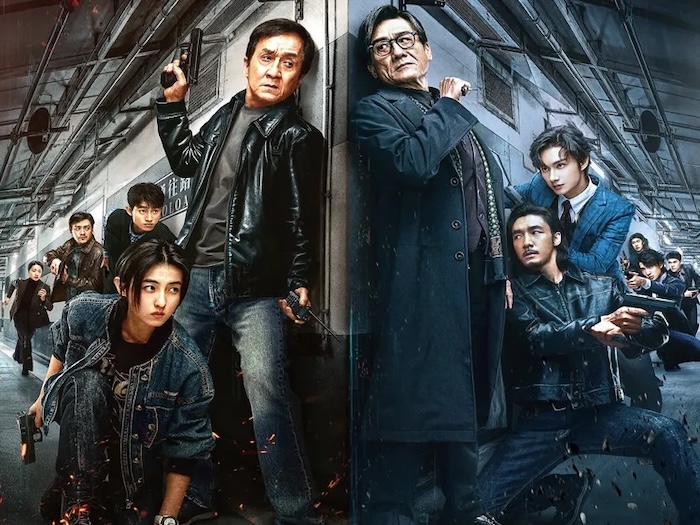
Though I wouldn’t take it as an accurate representation of the Chinese authorities’ feelings about the A.I. revolution, this expensive-looking Hong Kong actioner by Larry Yang, set in Macau and presented in Mandarin rather than Cantonese, does raise questions about how far you should trust the new technology with matters like law and order. The opening heist has more to do with hacking into the Macau police department’s CCTV system than with any analog skills such as safe-cracking or tunnel-digging. A lithe crew of young thieves steals a set of hard drives that contain data which could unlock a billion dollars’ worth of crypto currency by fooling the police surveillance software into thinking it is tracking their getaway when it isn’t. Obviously the new equipment doesn’t work as well as it’s been advertised to do so the old school police chief decides to bring in a retired cop who actually knows how to organize a stakeout. When we first meet Wong (Jackie Chan), he’s walking a kennel’s worth of dogs and seems keen to get back in the game.
There’s no use in trying to make Chan look less than his age, so Yang takes advantage of this fact by pitting him against an equally grizzled bad guy known as the Shadow (Tony Leung Ka-fai), who himself is not much on new tech, and thus relies on a bunch of orphans he raised from childhood to be his partners-in-crime. This heist is meant to be his career-defining magnum opus, and Yang stages it all with a pompous rigor, showing how the intricate plans, using Mission Impossible-grade disguises and aerial equipment, easily outfoxes the constabulary. Wong’s job is to retrain the departments younger recruits, including the pint-sized daughter (Zhang Zifeng) of his former partner, who was killed in the line of action while Wong was distracted, to rely on their smarts and senses rather than on their gadgets. Yang does a good job of showing this educational process with a surveillance detail that seems to take a couple of weeks before Wong and his team locate the Shadow, whom no one has ever actually identified.
While the dramatic components are as sentimentally shaped as you’d expect them to be—especially on the Shadow’s side where his charges have their doubts about his capacity to lead them effectively— and the shilling for the Wynn integrated resorts is a casino too far, the action is pretty cool. Obviously, neither Chan nor Leung can pull off the kinds of moves they performed with alacrity in their heyday, but thanks to some clever camera work and cutting their fights are still inventive, thrilling, and almost insanely witty, which, of course, is what Chan has always been about. Hardcore fans will probably prefer to savor the old movies, but if this is a swan song, it’s a pretty sweet one.
In Mandarin and English. Opens Dec. 12 in Tokyo at Marunouchi Piccadilly (050-6875-0075), Shinjuku Wald 9 (03-5369-4955).
Korean narrative entertainment, both movies and TV dramas, often exploits real world subtexts. Popular actors not only take roles that mirror some aspect of their private lives, but allude to those lives in their dialogue. The two lead actors in this impressionistic indie film play, at one point or another, popular TV drama actors and, in fact, both made their names in TV dramas. However, the director, Yun Su-ik, doesn’t take advantage of this idea the way a major studio production might. The gimmick is merely used to draw attention to the fact that these two characters, and thus the two actors playing them—who, coincidentally or not, share a surname—are spiritually connected in some way.
Soo-an (Han Hae-in) is a tomboyish student at a rural coed arts high school who is quite determined to become a professional actor despite periods of severe self-doubt. A transfer student named Seol (Han So-hee) admires her craft and Soo-an is quite flattered since Seol is already a professional actor and star, having entered show biz when she was 10 years old. The two quickly bond, more out of loneliness (their classmates are punishingly self-involved) than anything else, and it becomes evident during a spur-of-the-moment midnight sojourn to Seoul that Seol wants to be more than friends, but when they kiss in the vestibule of an apartment building Soo-an panics and the relationship grinds to a halt. Cut to some years later and the roles are reversed: Soo-an has made it as a TV star just as big as Seol once was, while Seol has mostly given up that life and hangs out near a beach where she spends her time surfing and getting drunk. The implication is that Soo-an’s rejection made her reevaluate her life. In the meantime, Soo-an’s nascent sexual attraction to Seol has blossomed in the sense that she is only drawn to other women, but at bottom she’s just as miserable as Seol is, resorting to drugs to alleviate her simmering regret.
Naturally, they reconnect and try to rekindle their mutual attraction, fueling it into something like real love, but Yun steers the story into fantasyland, with the two women paddling out to sea on their surfboards in the winter and getting stranded on a stretch of deserted coastline where, finally removed from society, they can consummate their feelings—or something like that. It’s not really clear what the last half hour means except that maybe you shouldn’t expect to win the love of someone else when you don’t know yourself first, which is a pretty bland theme. Yun takes a very promising story premise and turns it into a mediocre student art project.
In Korean. Now playing in Tokyo at White Cine Quinto Shibuya (03-6712-7225), Kino Cinema Shinjuku (03-5315-0978).
The word “documentary” only applies to Sepideh Farsi’s film in a generic way. Though it certainly is a document of the exiled Iranian director’s nine-month WhatsApp video relationship with the young Palestinian photographer Fatma Hassona, its focus on that relationship at the expense of understanding the Gaza genocide in full makes it come across as something that isn’t meant to edify people who know little about what’s really happening in Gaza. If anything, its appeal as a recording is the way it highlights Hassona as a unique representative of the struggle it’s supposed to be describing. Hassona isn’t a mouthpiece or professional raconteur. Her English is passable, her knowledge of the politics behind the war sketchy, and her ability to convey her own circumstances into something universal unformed. But she makes up for all those things with an exuberance and a love of creative endeavor that’s more than infectious. It’s the very definition of life itself. Just listening to her stumble through her reports on the horrors around her and her attempts to bring the truth of Gaza to the world with her photos feels like a privilege, because we on this side of the screen know we could never be in her position and remain that expressive, that excited about being given the chance to bring her experience to a larger audience.
At the beginning of the film, Farsi explains that when the Gaza crisis exploded following the Hamas massacre, she was thrown back to her own adolescence in Iran during the revolution that overthrew the Shah and wanted to talk to someone in the occupied territory to confirm her feelings. Unable to physically access Gaza or anyone face-to-face who had such access, she resorted to her iPhone and was introduced to Hassona through a journalist friend. On paper, the matchup must have looked merely preliminary since Hassona had no real practical experience as a photojournalist beyond her social media presence, but the chemistry is immediate and binding despite constant interruptions to the feed (Israel purposely limits cell coverage in Gaza to 2G), which Farsi does not edit out, and Hassona’s difficulties with English, which may have to do more with her bursting desire to communicate than with any purely linguistic limitations. As Farsi, who mostly speaks from her home in Paris, eventually characterizes their online relationship, each converstaion is “like a miracle,” and not just because they manage to get through to each other despite the technical issues. Hassona’s invariably beaming countenance keeps Farsi’s fears about her interlocutor’s safety at bay for as long as they talk, and the viewer gets caught up in their rapport even as Hassona discusses loved ones who’ve been killed and her own family’s constant moving around to stay alive amidst the pummeling Israeli violence, which is often audible in the background. Hassona sees her job as documenting how everyday life continues under these conditions, and her photos do exactly that with a matter-of-factness that reflects her own impossible optimism: children playing, women cooking and cleaning, families moving their belongings to somewhere that might be safer for a little while, all against a backdrop of total destruction. Behind the sunny disposition is, of course, anxiety about loved ones she sometimes shares the screen with, and while she occasionally mentions her own lack of material welfare—at one point Farsi calls her from a beach in Greece where she’s obviously taking a break and Hassona gleefully exclaims, “I want your life!”—she insists that Gaza is her home and that is where she wants to stay, even when Farsi floats the possibility that she might be able to get her out of there.
To her credit, Farsi maintains a journalistic objectivity throughout their conversations, evincing from Hassona a reaction to the Oct. 7 massacre that many viewers may not be comfortable with (“We showed the world we can fight”), and even sparring over whether Hassona’s attachment to her hijab is warranted (“I’m too embarrased to take it off in public,” i.e., on screen). But in the end, the director’s own emotional attachment to the subject of what she never expected to be a feature-length documentary is palpable and moving. At one point, she almost breaks down over her inability to do something for Hassona and her community except publicize their suffering, and Hassona comforts her in return, “You are listening to me,” she says with that irrepressible smile. “You are beside me right now and that’s enough.”
In English and Arabic. Now playing in Tokyo at Human Trust Cinema Yurakucho (03-6259-8608), Human Trust Cinema Shibuya (03-5468-5551).
Put Your Soul on Your Hand and Walk home page in Japanese
Anyone who has read this blog with any consistency will know my opinion of hit man (or woman) movies: There’s way too many considering the profession itself is essentially a fantasy. And because of the sheer volume of films represented by the genre, eventually filmmakers resort to narrative quirks to distinguish their product from everything that came before it. Michael Keaton’s aging assassin Knox has a unique background. He’s a double PhD who served not only in the military during the Gulf War but also a prison sentence for some kind of financial misadventure. But that impressive C.V. isn’t the quirk that sets Knox Goes Away from other hit man flicks. Right at the beginning, our hero is diagnosed with a form of dementia that will have him completely out-of-it in a matter of weeks, meaning he has to get his shit in order, which includes making amends with his estranged son Miles (James Marsden). Right on cue, Miles shows up at Knox’s door, all bloody and panicked, pleading for help because he just killed a man for raping his teenage daughter. It’s not only an assignment that’s right up Knox’s alley (he seems to only take jobs where the victim deserves it, though he professes not to care), but one that provides the requisite “work against time” premise, since his short-term memory is fading fast.
Regardless of the emotional contours, which are quite curvy in this movie, the crux of the story is the process and how it plays out. Knox has to cover up his son’s act, and the script by Gregory Poirier attractively streamlines the setup by pitching it against the subplot of a police detective (Suzy Namamura) investigating a recent hit where Knox’s partner (Ray McKinnon) was left dead due to a brain-added mistake on Knox’s part. Various distractions, which also include Knox reconnecting with his ex-wife (Marcia Gay Harden) and having occasional trysts with a young Eastern European hooker (Joanna Kulig), are smoothly integrated with his struggle to keep his mind ordered enough to save his son, accomplishments that are greatly aided by his mentor, who is played by Al Pacino with all the gravelly voiced aplomb he can muster; but in the end Poirier and Keaton, who also directs, require the audience to suspend a hefty amount of disbelief just in order to get them to the twisty conclusion.
The main appeal of Knox Goes Away is its utility as a vehicle for Keaton’s peculiar charms. Though Knox’s back story is overly convoluted, it seems specifically tooled to take advantage of Keaton’s native intelligence and readiness with a cutting quip. Only someone with advanced degrees in history and English could provide the kind of highfalutin banter that comes out of Knox’s mouth as a matter of course, regardless of his encroaching senility, but the main question remains: How did a guy like that end up as a professional hit man?
As cynical as Knox can be, he can’t hold a candle in that department to Steve Coogan’s Tom Michell, a peripatetic English teacher making his way south through the Americas in the late 1970s in a bid to escape a tragedy in his past. Michell is a real person who wrote a memoir about his adventures some 20 years ago, and The Penguin Lessons, directed by Peter Cattaneo, is supposed be based on it, though the dramatic elements feel tacked on. Very little that goes on in the movie is believable.
When it opens, Michell has arrived in Buenos Aires to teach at a private boys’ school just as the 1976 coup is taking place that will install a fascist government. With this turmoil in the background, Michell contends not only with a classroom full of privileged layabouts, but a head master (Jonathan Pryce) who prefers to remain oblivious to what’s going on in the wider world, even as it adversely affects his staff and students. Michell’s disaffection just grows worse, and during a weekend jaunt to Ecuador, where his aim is to get laid, a potential bedmate foists a stranded male penguin on him that he just can’t shake, forcing him to smuggle the bird back to Argentina with him.
As Cattaneo has shown in movies like The Full Monty, he knows his way around a reliable comic cliche, and The Penguin Lessons run the gamut, from mixed linguistic signals to corrupt but inept figures of authority. Eventually, the penguin comes to represent Michell’s throwing off his past and assuming in its place an actual conscience in the face of authoritarian terror, developments that feel so forced you are sometimes compelled to avert your eyes in fear that your intelligence will be overridden by the rank but effective sentimentality that Cattaneo wields at every meaningful plot juncture. As with Keaton, Coogan’s reliable screen image as a silver-tongued scamp goes far to make the movie endurable if not necessarily watchable. The penguin, though cute, is still just a bird.
Knox Goes Away opens Dec. 5 in Tokyo at Kino Cinema Shinjuku (03-5315-0978).
The Penguin Lessons, in English and Spanish, opens Dec. 5 in Tokyo at Shinjuku Piccadilly (050-6861-3011), Toho Cinemas Chanter Hibiya (050-6868-5001).
I almost missed Filmex this year. I received a message in my Gmail inbox while the Tokyo International Film Festival was going on, reminding me to apply for a press pass. I managed to submit the application just under the deadline, but I completely forgot about it until two weeks ago, just a couple of days before Filmex was supposed to start. I hadn’t received any confirmation for my application so I thought the festival had messed up or turned me down. I considered the latter possibility unlikely since they had approved me last year even though I hadn’t attended Filmex for many years. So I wrote them a note asking what was up and almost as soon as I hit the send button thought maybe I should check my Gmail spam folder, something I rarely do, and, sure enough, the approval notification was there. As with last year they didn’t accept me as a press person but gave me a general pass, for which I had to pay a fee of ¥3,000.
This year the festival returned proper to Asahi Hall on the 11th floor of what I still refer to as the Mullion Building in Ginza after spending last year mostly at the Toei Theater across the street, which has since been closed. My pass only allowed me to see films at Asahi and not at Human Trust Cinema Yurakucho, which means I only attended on opening day and the weekends, since those were the only times Asahi Hall was used. Asahi isn’t the best place to watch movies—the screen is set far back from the front of the stage and the sight lines aren’t the best, but the sound is good.
Because Shozo Ichiyama, the TIFF programmer who launched Filmex as a more Asia art house-oriented mini-fest, has since gone back to TIFF only one of the usual Filmex suspects had a movie screened this year: Tsai Ming-Liang’s latest docudrama, Back Home, which I didn’t see, even though I used to be a big fan of his work. His latest stuff just seems like variations on an inert theme—usually someone going about a tedious task. I had hoped Filmex would show Hong Sangsoo’s latest film, since he’s a festival fixture, like Amos Gitai (whose latest Ichiyama snagged for TIFF) and Jia Zhangke, that you can always count on, but not this year.
Still, the selection was compelling, and there were a few films that were at Busan that I wanted to see but didn’t get the chance to. One was the opening film, Cai Shangjun’s The Sun Rises On Us All, which won the Best Actress award at Venice for Xin Zhilei. I don’t know who she was up against, but she probably deserved it, considering what she had to work with. She plays Meiyun, a woman in her late 30s who is reluctantly pregnant since the father is a married man. While at the hospital, where she learns of the viability of the baby, she runs into her old lover, Baoshu (Zhang Songwen), who avoids her like the plague. Obviously shaken, Meiyun tries to forget the encounter but can’t and eventually goes back to the hospital where he’s being treated for stage four stomach cancer. Despite his obvious determination not to talk to her, she forces her way back into his life and even brings him back to her tiny apartment since he doesn’t have any money or support, having been recently released from prison after serving a sentence for manslaughter. Over the course of the movie we slowly learn that he went to jail for her and that she abandoned him in time. Now she hopes to make up for her actions, which she admits were callous and self-serving. Her affair with the married guy obviously can’t survive her bid at redemption, but while Xin and Zhang go full speed ahead into their respective turns at self-lacerating guilt and toxic resentment, Cai doesn’t seem to know where it’s all headed. When it’s emotionally hot it’s white hot, but it sort of fizzles out as the narrative conviction fades. What I found most interesting was the workings of the Chinese medical system, which are predictably Byzantine even though the people who operate it are quite empathetic. In other Chinese movies, doctors and nurses are usually presented as being hung up on procedure that has no room for a bedside manner.
The closing film was also Chinese: Huo Meng’s apparently autobiographical Living the Land, which premiered at Berlin. Set in 1991 in an agricultural region of China that most people would consider pre-modern, since all the farmwork is done by hand and there is absolutely no machinery, the film is told from the POV of 10-year-old Chuang (Wang Shang), whose parents have joined the rural exodus to the big cities of the south for factory work, leaving him in the care of his grandparents and other relatives. Though normally such abandonment would be treated melodramatically, Chuang adjusts quickly and naturally to his new surroundings, and Huo presents it all in with unhurried deference to the rhythms of the village. Though there are veiled and sometimes pointed allusions to the political eruptions of the past, including the unearthing of remains of people killed during the Great Leap Forward, for the most part time seems to have overlooked this corner of the continent, and the dramas are domestic and intermural: marriages, deaths, gossip, and neighborly bickerings. And, of course, there is always the battle with nature, which here is complicated near the end when the big bad world comes calling in the form of oil prospectors, meaning that the land will now have a completely different use that may obviate the need for people whose only life has been connecting with the soil. Though there’s nothing particularly novel about Living the Land, Huo’s own proximity to the material is economically conveyed and is thus deeply felt by the viewer, which makes it remarkable in its own way.
The theme of the cop or private eye whose approach to cases is obsessive to the point of psychosis is a potent one in that its subject is someone whose demand for justice goes beyond reasonable limits. The most obvious recent manifestation of this idea is the TV series Bosch, whose titular L.A. police detective is motivated in his job by the murder of his prostitute mother when he was a child. Every case he works is a veiled opportunity for payback, and, of course, the narrative subtext in the series is the possibility that he will someday get to the bottom of his mother’s killing. The protagonist of the Belgian film Maldoror comes from similar dramatic stock. The baby-faced Gendarmerie rookie Paul Chartier (Anthony Bajon) is the child of an alcoholic prostitute (Beatrice Dalle) who grew up in a brothel and ran with a bad bunch while harboring an ambition to become a policeman for the purpose of helping the kind of marginal folks who are victimized by the system rather than saved by it. The case at hand is based on a real one from the 90s that went unsolved for years due to competitive infighting among three branches of law enforcement—the Gendarmerie, the local constabulary, and the judicial police. In fact, one of the fallouts from the real-life case was the disbandment of the Gendarmerie. Director Fabrice Du Welz doesn’t bother explaining these distinctions to those of us who are tourists so, in the beginning at least, the conflicts come across as gratuitous, but it’s clear that Paul’s status is low in the scheme of things.
As the movie begins two little girls have already gone missing and Paul tries to convince his superior (Laurent Lucas) that the Gendarmerie should take the case, a suggestion that’s mostly resented by his colleagues. Eventually, his superior relents and Paul and a sympathetic confederate launch a stakeout of suspects that cut into their other duties and extends after hours. At several points, Paul trespasses into other law enforcement organizations’ operations, thus causing internecine strife that comes down hard on him. He responds by doubling down and continuing the investigation on his own, and in the process forms the suspicion that the disappearances of other girls are all linked to a shadowy figure with friends in high places and a connection to a European pedophile ring. In the meantime, Paul has married into a lively Sicilian family whose own emotional reaction to the case—one of the missing girls is the daughter of a friend of his in-laws—spur him further into extralegal actions that only make his situation worse, especially in relation to his new wife (Gaia Bellugi).
Since Du Welz is mainly known as a director of horror-adjacent cinema, some of the procedural stuff gets quite nasty. Sergi Lopez plays the nominal heavy with more subtlety than the role deserves, but he really comes into his own as a scary dude in the final half hour, when bodies show up and the stakes become extremely serious. Throughout, Du Welz makes often jokey references to famous crime movies and TV shows, and his somewhat lazy handling of development that could keep the viewer on edge tends to result in confusing plot points that are never cleared up. For sure, the movie is way too long and meanders aimlessly after the identity of the perpetrators is revealed, but Bajon is intense enough on his own to keep you watching because you know that Paul will get to the bottom of things. The question you need answered is: Will it be too far for him to come back?
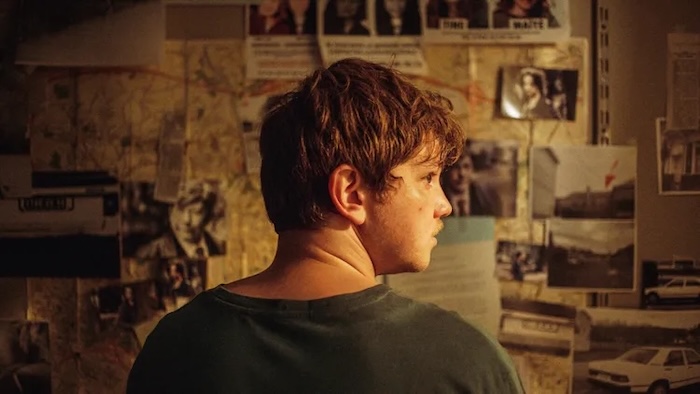
The missing children that form the crux of the mystery in the weirdly original thriller Weapons pose a completely different sort of challenge to the authorities. All the members of one third grade class in a leafy Pennsylvania suburb leave their homes at the exact same time in the middle of the night and just disappear. Well, all except one, a boy named Alex (Cary Christopher) who can’t answer police questions about why he was the only classmate who didn’t participate in the mass exodus. However, the individual who gets the most attention is the class’s teacher, Ms. Gandy (Julia Garner), who the parents of the missing kids believe knows more than she’s saying. Predictably, she becomes the community pariah and thus the object of ugly rumors and vandalism.
Director Zach Cregger, whose debut was the equally eccentric horror workout Barbarian, presents the development in chapter form, with the POV changing from one character to another, starting with the boozing Gandy and moving to her casual cop lover Paul (Alden Ehrenreich) and then to the father of one of the missing children, Graff (Josh Brolin), as well as a pilfering junkie (Austin Abrams), and finally the school principal (Benedict Wong) before settling into the story of what actually happened. Though the momentum of a compelling mystery is maintained through this round-robin structure, which is deepened by the well-plotted interrelationships among the main characters, Cregger mostly throws it away in the final act because, of course, the only way to explain what happened is with supernatural devices. And while normally such exigencies feel like cheating, Cregger is resourceful enough to make the connections not only meaningful but quite funny.
The plot’s linchpin is an older woman called Aunt Gladys (Amy Madigan), who is so imaginatively drawn and performed that you don’t mind that she herself is a device who’s been dropped into the story in order to make sense of it. Personally, I didn’t find Weapons as scary as many reviews have made it out to be, if only because the premise is so ridiculous, but the ending is a hoot, and does satisfactorily follow, in its own bizarre way, the intricate goings-on that came before. I hear there’s going to be a prequel. A sequel is out of the question.
Maldoror, in French and Italian, now playing in Tokyo at Shinjuku Musashinokan (03-3354-5670).
Weapons now playing in Tokyo at Shinjuku Piccadilly (050-6861-3011), Toho Cinemas Chanter Hibiya (050-6868-5001), Human Trust Cinema Shibuya (03-5468-5551).
Having not dived too deeply into recent B-movie extreme action cinema, I was not familiar with Ukrainian-American model-actor Oksana Orlan, but apparently she’s a formidable presence in that particular field. Here she fleshes out a role she originated in a 2015 action short by director Michael S. Ojeda about an assassin who survives an ambush that kills her boyfriend as they are trying to start a new life together. Ojeda continues the story with the woman, Dominique, flying a plane that is shot down over Colombia. She survives this ordeal, too (she’s already got a huge tattoo of a phoenix on her back), as well as being felt up by the nasty cartel factotums who did the shooting because they suspect—correctly—that the plane is transporting cash and weapons. Dominique makes short work of these goons, thus laying out for the audience her skills as a killing machine, not to mention a badass who doesn’t give a damn about anybody else.
Ojeda and Orlan pile on the devil-may-care attitude after Dominique finds a small town where she can lick her wounds. She drinks hard and beds a local police officer (Sebastian Carvajal) who seems to be the only public official around not beholden to the cartel, which is looking for her since, in addition to slaughtering their employees, she’s stashed the loot somewhere secret. She makes friends with the family of the officer, which include a father in a wheelchair and a pregnant sister and her two kids, and any astute action movie lover who’s seen this kind of setup before will know that these non-combatants are not safe any more, despite Dominique’s initial reluctance to get involved.
Fortunately, Orlan knows the assignment and maintains her character’s air of cool professional brutality until the end, even as the body count climbs into the stratosphere. What perhaps sets Dominique the movie apart from its ilk is its nihilism. Ojeda obviously feels his audience can take the kind of storytelling that leaves no one standing, regardless of their innocence in the scheme of things, except the person who is obviously slated to continue the story into a subsequent feature…and more, if the B-movie gods are willing. It’s probably an over-determined ambition on Ojeda’s part, but I can’t say I’m not curious to see how Dominique’s further adventures pan out.
In English and Spanish. Opens Nov. 21 in Tokyo at Toho Cinemas Hibiya (050-6868-5068).
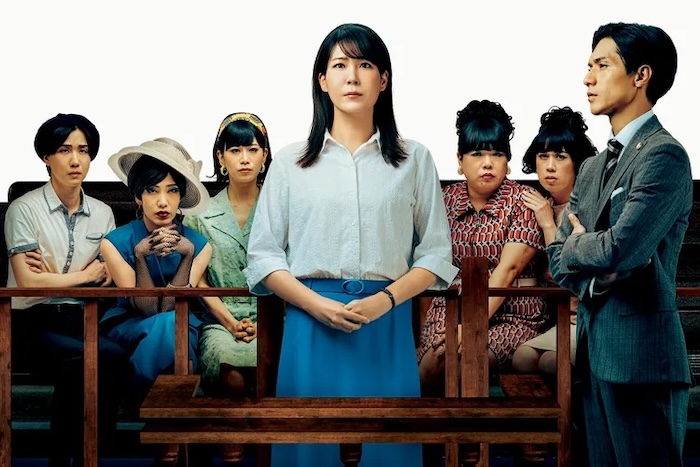
The Japanese constitution, like the American one on which it was modeled, guarantees the people the right to be happy, a rather amorphous concept that’s difficult to pin down legally, but usually it is interpreted to mean that everyone should be able to live their life the way they want to as long as it doesn’t violate another person’s right to live their life the way they want to. During the climactic courtroom scene in this feature film about the 1964 trial of a gynecologist for providing gender assignment surgery for trans women, the main witness, a trans woman who had been a patient of the defendant, was asked by the judge if she was “happy,” and she replies that she thinks she is, but that her idea of happiness may not be the same as another person’s.
Though the witness, whose name is Sachi and is played by the trans actor Miyu Nakagawa, isn’t saying anything particularly profound, in the context of the trial and, by extension, the movie itself, the remark’s ramifications are clear: Who exactly is Sachi hurting by wanting to live her life as a woman? And why should the doctor be punished by making her wish come true? That is, in fact, the kernel of the case, which takes place in 1964, since the police arrested Dr. Akagi (Takashi Yamanaka) not because he provided sex change operations, but because many of his patients were “blue boys,” the local slang for male prostitutes, some of whom were trans women. Prostitution was illegal, but since the law defined prostitution as a transaction between a man and a woman, male prostitutes who served men weren’t doing anything illegal. Even if the blue boys arrested had undergone gender assignment surgery, legally they were still considered men and couldn’t be prosecuted for prostitution, so the police targeted the doctor who made the changes possible, charging him with violating drug and eugenics laws. If that doesn’t make complete sense, it’s mainly because Japanese law is quite malleable in the hands of people who wield it, but that really isn’t the aim of the movie, which is to explore the lives of trans women at the time and how they coped with social oppression. In that regard, Sachi is a ringer, because she is not a prostitute, and though she works as a waitress, she is not in the “water trade,” meaning the night time entertainment business where most of the other trans women in the movie are employed. The infinitely patient and sympathetic defense lawyer, Inaya (Ryo Nishikido), badgers Sachi into testifying because she aspires to be a “normal woman” in that she favors most of the so-called feminine attributes that were considered wholesome during that time. And, in fact, she is living with a man, Iwamura (Ko Maehara), who knows she is trans but wants to settle down with her in a traditional marriage-like situation even if it is legally impossible.
Director Kasho Iizuka, who is a trans man, presents the case and the dramatic side stories in a straightforward way that highlights each character’s stake in the trial, which sometimes means the wider world gets shortchanged. We get a glance into Iwamura’s family life when his mother comes to visit and assumes Sachi is a woman, but the only real contrast to the demimonde depicted is Inaya’s home life, which is mainly provided to show how hard he’s working for his client. In fact, the hardest working people in the movie seem to be the tabloid reporters who sensationalize the trial in expected ways, drawing attention to the group of trans women (all of whom are played by trans actors) whose lives will be most affected by the outcome. That’s the focus of the drama, which entails tragedy and even some hilarity amid the persuasively staged sense of community.
In Japanese. Now playing in Tokyo at Toho Cinemas Nihonbashi (050-6868-5060), Toho Cinemas Hibiya (050-6868-5068), Toho Cinemas Chanter Hibiya (050-6868-5001), Toho Cinemas Shinjuku (050-6868-5063).
It’s interesting that 20th Century Fox has released two films within the last year each of which portrays one of Columbia/Sony Records’ biggest artists and only one of them has the artist’s name in the title. Is it because Bob Dylan is more historically iconic than Bruce Springsteen that there was no need to call the former’s movie Dylan: A Complete Unknown? It probably has more to do with each artist’s approach to his art and audience. Aficionados of both Dylan and Springsteen will certainly be aware of the films, but how about everyone else? In Dylan’s case, I would think it probably doesn’t matter, even to Dylan, who has always been confident enough in his notoriety to ignore such concerns, which is why the movie itself feels almost as if it could be about anybody. It comes across less as a document about Dylan the man and more as a witty and compelling story about a new kind of entertainer. Ostensibly, both films are about specific “stars” at important junctures in their careers, but only the Springsteen movie seems intent on that approach. As a public person, Springsteen has always been the more self-conscious performer, and a great one, which may be the point. He wants to show the world with this movie that he’s also a troubled creative type, something Dylan would never cop to, at least not publicly.
Like A Complete Unknown, Deliver Me from Nowhere covers a circumscribed period in its subject’s career, specifically the making of Springsteen’s sixth album, Nebraska, which was a complete departure from his previous work. Having finally established himself as someone who could not only sell out arenas but move substantial units after releasing his double-LP opus The River, Springsteeen (Jeremy Allen White) takes some well-deserved time off to reflect on his good fortune and think about the future, a prospect that doesn’t sit well with him due to certain inchoate feelings of inadequacy. He rents a house on a lake and spends much of his time alone with his acoustic guitar, venturing out once in a while to jam with a local band in a bar where, of course, everybody knows him. He starts a tentative romance with Faye (Odessa Young), a single mother and diner waitress who can only get so close owing to those inchoate feelings, which White telegraphs with all the distracted stares at his command. Meanwhile, he’s shielded from his record company’s ravenous demands for product “while the iron is hot” by his meticulously sympathetic manager (Jeremy Strong), who has his back, even when he decides to make that next album not the raver the company expects but a set of quiet demos he records in his bedroom about men living on the edge of their desperation.
Director Scott Cooper honors the hushed tone of the album by making the movie overcast and claustrophobic, inserting B&W episodes from Springsteen’s childhood in which he has to confront the troubled father (Stephen Graham) who was a distant but palpable presence in his life. Though some screen time is devoted to the actual making of Nebraska, the movie is essentially a mood piece about finally addressing the demons that drive a person to create in the first place, and as such it feels heavy-handed. You miss Springsteen’s down-to-earth humor, his mischievousness. The reason Dylan didn’t get a biopic like this is because he never seemed like the kind of artist who takes himself that seriously. He doesn’t demand you understand him. In Deliver Me from Nowhere, Springsteen practically begs for it.
Now playing in Tokyo at Toho Cinemas Nihonbashi (050-6868-5060), Toho Cinemas Hibiya (050-6868-5068), 109 Cinemas Premium Shinjuku (0570-060-109), Shinjuku Piccadilly (050-6861-3011), Toho Cinemas Shinjuku (050-6868-5063), Toho Cinemas Roppongi Hills (050-6868-5024).
Springsteen: Deliver Me from Nowhere home page in Japanese









 philipbrasor.com