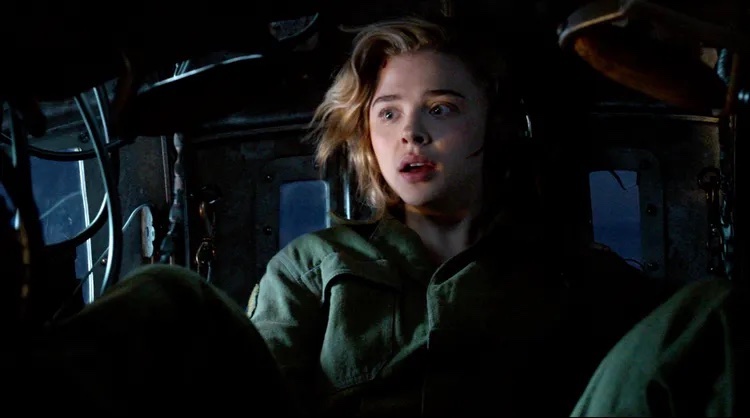
Though she’s done some nominally serious movies, Chloe Grace Moretz seems to be gunning for Milla Jovovich’s position as the premier female sci-fi-action hero of our age. Shadow in the Cloud has all the trappings of a project whipped up in an afternoon, but Moretz’s earnest performance and director Roseanne Liang’s willingness to tap any absurd narrative impulse make for a strangely thrilling piece of nonsense. The skinny is that the original script was reworked extensively after the writer, Max Landis, was accused of sexual abuse, and certain ideas clash obtrusively. If the movie succeeds on its own odd merits it’s because the people involved seem to believe to their souls that it works.
Moretz plays a flight officer during World War II who boards an allied bomber-supply plane in New Zealand with a box that she claims has to be delivered to the Philippines. Armed with papers that verify the package is “classified,” she gets on the flight at the last minute but the all-male crew doesn’t appreciate this extra body and play out their resentments with blatantly sexist banter, despite the fact that she outranks several of them. In any case, there’s no room for her in the hold, due to equipment they’re delivering, and she’s stuck in the lower gun turret, where most of the first half of the movie takes place as she listens to the guys’ offensive conversation through headphones. Though this setup necessarily limits the visual component, it manages to make for a lot of dramatic give-and-take thanks to Moretz’s command of her character, Maude, who is obviously hiding some kind of secret regarding the package and has to cover up her unease with a bluff assertiveness that doesn’t always convince her comrades.
But as this conceit plays out in an increasingly ridiculous manner the action prerogatives take over, first with an unexpected attack by Japanese zeros and then a totally batshit monster mash that was probably the original concept Landis was selling. I’m not certain how Liang changed the script, but, given the charge against Landis, I have a pretty good idea what it was and though it doesn’t work intellectually, much less logically, the resulting action is tightly packed and extremely well choreographed. By the mid-point, the sexual tensions that built up during the first half erupt into the most elemental expression of the survival instinct.
Now playing in Tokyo at Shinjuku Piccadilly (050-6861-3011), Shibuya Cine Quinto (03-3477-5905).
As everyone knows, movies are a collaborative art form, and while critics tend to judge their quality based on reductionist criteria concerning direction, writing, and acting, more often than not our opinions are shaped by more prosaic choices. As Martin Scorsese says near the beginning of this fascinating documentary, 90 percent of any film comes down to casting, a job we tend to think of as being purely administrative, though, as a parade of famous directors and actors attest in dozens of in-person interviews here, matching the right talent to a role is an art form in and of itself.
The doc’s director, Tom Donahue, centers his story on the woman who many believe invented the job, Marion Dougherty, who started out in the 1950s as an assistant to the person who basically found actors for Kraft Television Theater, one of the live dramatic TV shows that proliferated during the early days of the medium. At the time, TV was still mainly in New York, and thus the people who found actors had a whole city of them, thanks to the New York theater scene. When her boss quit, the job fell to Dougherty, who made a point of reading the scripts and then finding actors who she thought were right for the parts, rather than simply bodies to fill space. Though her creativity was not acknowledged by the larger artistic community, it was appreciated by those in the TV business, and eventually she went freelance and worked on pioneering shows like Naked City and Route 66, in the process discovering the likes of James Dean, Robert Duvall, Al Pacino, Dustin Hoffman, Gene Hackman, Jean Stapleton, Christopher Walken, and, most notoriously, Jon Voight, who so badly screwed up his debut chance on Naked City that he couldn’t find a job for years until Dougherty rediscovered him and suggested him for Joe Buck in Midnight Cowboy, a part for which the producers wanted Michael Sarazzin. But perhaps the most illustrative anecdote about the importance of Dougherty’s instinct was her advising Warren Beatty to lose his Brando affectations. And while it was west coast casting director (a professional term that had yet to be invented) Lyn Stalmaster who bucked the system by pushing the short, Jewish Hoffman for Benjamin Braddock, who in the novel of The Graduate was Waspy and athletic, it was Dougherty who got him the part of Ratso Rizzo, which may have been even more visionary given that Hoffman’s own manager thought the role would destroy his client’s momentum.
Donahue makes a convincing case that the advent of the New Hollywood of the late 60s and 70s was the result of creative casting choices, with Dougherty and her brownstone full of female acolytes handling the New York school and Stalmaster holding down Los Angeles. The common wisdom holds that during the Hollywood studio era, casting was pre-determined by acting types, but once the studios collapsed it became a free-for-all, and casting directors were extremely valuable, despite the somewhat pompous protestations of directors guild head Taylor Hackford, who has always lobbied against the term “casting director,” since, to him, only the person designated a film’s “director” deserves such a moniker because all decisions about a movie come down to that person. Almost every other director Donahue interviews disagrees, including Woody Allen, who confesses he is so intimidated by meeting new people that he couldn’t do the work he does without a casting director. Even Clint Eastwood admits that he finds casting the most confounding process in filmmaking since there is just so much talent out there and sifting through it all is impossible. The directors also despair that casting doesn’t have its own Oscar category given its importance in the process, but apparently the prejudice is stubborn. Despite a campaign to give Dougherty a special Oscar in the 90s that was endorsed by dozens of superstar directors she didn’t receive one.
Still, once the doc enters the 80s and the age of the blockbuster, the movie loses a certain amount of credibility and the important casting decisions that stand out, such as Dougherty pushing Danny Glover for the Lethal Weapon franchise despite the fact that the part wasn’t necessarily written with a Black man in mind, seem more like one-offs than trends that were maintained. Dougherty died in 2011 and the doc was first released the following year, so many of these interviews sound and look dated. Donahue doesn’t cover much in the way of post-millennial casting decisions, which seem to have reverted to a system where big names are the norm even if they don’t match the roles. Another topic missing from the story is how sex figured in casting decisions in the past. The #metoo movement wasn’t at large in 2012, and has since brought to light a problem that was always snickered about but relegated to the shadows. Donahue doesn’t address it at all, but so many of the younger casting directors (almost all women) he interviewed certainly must have worked with Harvey Weinstein at one time, and we now know what he thought about the casting process.
Now playing in Tokyo at Theater Image Forum, Aoyama (03-5766-0114).
Here is a link to our April media column for the Number 1 Shimbun, which is about the push in Japan for “nuclear sharing” and reopening nuclear power plants in the wake of Russia’s invasion of Ukraine.
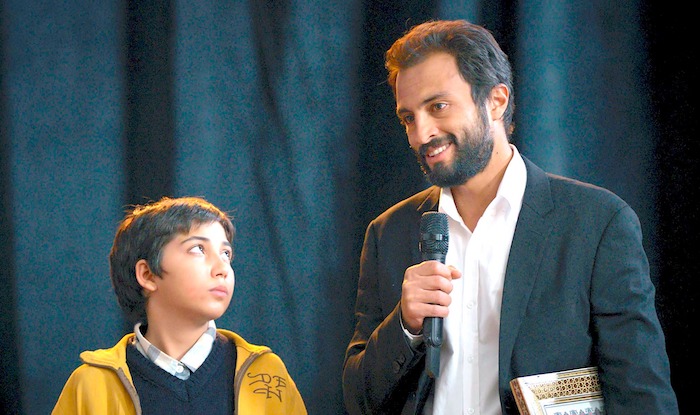
It’s interesting that Asghar Farhadi’s movies are appreciated by so many people from so many different countries since they address legal and cultural matters so specific to Iran. In fact, I’ve often had problems navigating his plots because I’ve missed the meaning of social niceties that Iranians likely take for granted, but in a way that’s also what makes his films so compelling. As you learn how these matters play out in Iranian society the dramatic contours of his stories make more sense. His latest work also focuses on a peculiarity of Iranian law, debtors prisons (which exists in other countries but probably in different ways), but for once the paradox is immediately understood. A creditor can demand that the person who owes them money be thrown in jail until they pay up, but, of course, how can the debtor come up with the cash while they’re locked up?
That’s exactly Rahim’s (Amir Jadidi) problem. He owes his ex-brother-in-law, Bahram (Mohsen Tanabandeh), a large sum, which he borrowed to pay off some loan sharks. For some reason, Bahram holds a grudge against Rahim and seems to prefer he stay in jail indefinitely. When Rahim is given a two-day provisional release to pay off at least some of the debt, Bahram is not happy. Rahim’s girlfriend, Farkhondeh (Sahar Goldust), has found a bag on the street with some gold coins in it, and she and Rahim think they can use the money for a down payment, but when they try to hock the coins they find they’re not worth as much as they thought, so Rahim endeavors to find the owner of the bag. His jailers, informed of this act of seeming selflessness, see some PR benefits and declare Rahim a hero on social media, but Bahram is suspicious. In any case, he rejects Rahim’s payback plan and demands he go back to prison.
As usual, Farhadi’s plotting sometimes gets away from him, but the subtle ways that Rahim’s reputation rises and then inevitably falls is carefully engineered so that his character flaws stand out. It’s not saying much that Rahim is not hero material to begin with, but his main problem is his lack of a forceful personality, and for much of the movie you wonder what Farkhondeh, who seems much more resourceful, sees in him. Similarly, though Bahram’s intransigence pegs him as the villain of this tale, his reasons eventually emerge. Like other Farhadi stories this one hinges on inter- and intra-family tensions, especially those brought about through marriage. I still don’t get a lot of the motivation that propels the plot, but I think I’m getting the hang of Iran’s social dynamics.
In Farsi. Now playing in Tokyo at Cine Switch Ginza (03-3561-0707), Bunkamura Le Cinema Shibuya (03-3477-9264), Shinjuku Cine Qualite (03-3352-5645).
If Cannes is, as its organizers claim, the greatest film festival in the world, it’s probably because the French film industry dutifully treats it as such. In fact, it’s impossible to distinguish the French film industry from the Cannes sensibility—just observe how the relationship is simultaneously honored and skewered throughout the French Netflix comedy Call My Agent. Consequently, you can get a good idea of the business’s self-importance by observing which French films qualify for prime exhibition. Last year’s partial return to normalcy, i.e., in-person audiences, was marked with an opening film by a director, Leos Carax, who puts out only one film a decade, an output that automatically attracts attention, especially given Carax’s reputation as being a creator of sui generis, confounding works. As it happened, he walked away with the director’s prize, even though the movie itself mostly perplexed people who were, by dint of where it was being shown, pre-disposed to appreciate it, if not necessarily like it.
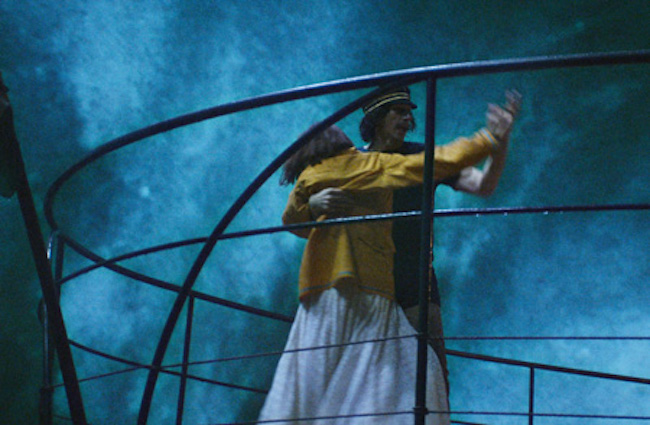
The fact that Annette is Carax’s first movie in English is less momentous than that it is a musical whose book and songs were written by the American brothers Russell and Ron Mael, better known as the rock band Sparks, who have been around screwing with people’s predilections since the early 1970s. Annette is a meta-film in that the music is often used as a comment on itself and the audience is constantly reminded that everyone on screen knows they’re out there. Genre-wise, it’s a romantic tragedy focusing on the marriage of two people who have similar vocations but are otherwise completely wrong for each other. Henry McHenry (Adam Driver) is a confrontational stand-up comedian, though technically he’s more of a monologuist with a chip on his shoulder: he struts the stage in his underwear and a hooded, open bathrobe as if looking for someone to box, insulting his audience or, at least, the idea of an audience that would deign pay money to see him. Naturally, he is a success, at least for a while. His better half is an opera singer, Ann Defrasnoux (Marion Cotillard), who sees her artistic mission as “saving” her listeners. Together, they have a child, the titular girl, who mocks her parents, especially her father, by simply existing. How could two people so obviously unsuited to connubial cohabitation produce and raise an offspring, which is probably why Annette is depicted as a literal puppet.
The above precis, however, is misleading in that the story as envisioned by the Maels and realized by Carax rarely follows anything like a line of development, and most of what’s afffecting about the film is invested in stylized tableaux and production numbers. In that sense the songs work exceptionally well because we can enjoy them as songs rather than as devices to advance the plot or feed into a theme. As the setting is Los Angeles, the Maels’ home town, and not Paris, this feeling of displacement is acute. It’s definitely a Carax film, and he seems to have no proper affinity for the city. It could be taking place anywhere and, thus, nowhere. So as the tragedy takes hold it fails to make an impression, and the only thing that lingers in the memory is Henry’s forceful personality, which is alternately terrifying and endearing. Annette is a hodgepodge of fascinating ideas that don’t add up to anything coherent. I wish I wanted to see it again, but I don’t.
Equally frustrating is the movie that won the Palme D’or at Cannes, Titane. Purposely provocative whereas Annette was pointlessly challenging, the movie was written and directed by Julia Ducournau, whose previous feature, Raw, was a slyly comic take on the vampire genre set in an impossibly competitive veterinary college. Though Titane doesn’t lack for humor, its shocks are all there on the surface, exerting much less power over the viewer’s imagination than Raw did.
Certainly, the plot is just plain pulp nonsense. Alexia (Agathe Rousselle), who has a metal plate in her head due to a horrible car accident she survived as a child, is a model-dancer in an automobile showroom who likes to get it on, literally, with the merchandise after hours. Ducournau doesn’t bother explaining the biology or, for that matter, the mechanics behind this interaction, but in any case Alexia’s sexual penchant for chrome results in her becoming pregnant with…something. In any case, the nature of her work, which is creating sexual tensions between potential customers and the motorized wares she pleasures, often stimulates those customers in more conventional ways, and one evening she murders a man who stalks her after she leaves work. As in Raw, once this kind of blood lust is activated it becomes uncontrollable, and Alexia embarks on an indiscriminate killing spree that’s as bloody as it is impossible to fathom. Sought by the police, she goes through an equally repulsive physical self-transformation and tries to pass herself off as a young man who has been missing for a number of years in order to reinvent herself. Ridiculously, Vincent (Vincent Lindon), the father of this boy, believes the impersonation and takes Alexia under his wing as his own flesh and blood and whatever. At that point, the story enters the realm of family melodrama, and, thanks almost entirely to Lindon’s performance, often works by the standards of family melodrama. By the time Alexia is about to deliver her baby, Vincent is there for her, and the child.
The entire appeal of Titane is its hallucinogenic persistence. Ducournau just keeps throwing weird ideas at the screen, hoping that some of them will stick, but as with Annette, what remains in the mind is isolated grotesqueries: Alexia leaking motor oil from various orifices, her brain peaking out from an opening above her ear, Vincent’s obsessive injections of steroids, which create their own kind of mechanized physique. The violence, though exceedingly gory, is so stylized as to be unreal, except for the scene where Alexia transforms her face by propelling the irresistible force of her nose toward the immovable object of a rest room sink. In moments like that, body horror doesn’t get any more tactile.
Annette opens April 1 in Tokyo at Shibuya Euro Space (03-3461-0211), Kadokawa Cinema Yurakucho (03-6268-0015), Shinjuku Piccadilly (050-6861-3011).
Annette photo (c) 2020CG Cinema Internationale/Theo Films/Tribus P Films International/Arte France Cinema/UGC Images/Detailfilm/Eurospace/Scope Pictures/Wrong Men/RTBF/Piano
Titane, in French, opens April 1 in Tokyo at Shinjuku Wald 9 (03-5369-4955), Human Trust Cinema Yurakucho (03-6259-8608), Shibuya Cine Quinto (03-3477-5905).
The Hollywood melodramas of the late 40s and early 50s had a discomfiting story-telling quality that seems exclusive to that particular era, meaning right after a war that many deemed “good” but which nevertheless haunted those who had seen it up close. Though we tend to associate this quality with the genre dubbed “noir,” it really permeated almost every script at the time that wasn’t a comedy. As a child I would watch these movies on TV and often became truly disgusted with the human behavior on display. It was much different than my reaction to prewar melodramas, which tended to sympathize with marginalized characters regardless of any extralegal activities they carried out, probably because of the Depression, which turned almost everyone into a victim of some kind.
Gullermo del Toro is obviously looking to recreate this disgust with Nightmare Alley, a remake of a 1947 melodrama that I haven’t seen but which I imagine delivered the queasiness very effectively. If del Toro’s version doesn’t make the same kind of impression, I suppose you could chalk it up to our 21st century jaded sensibility, not to mention a heightened degree of media literacy that allows us to evaluate texts as we absorb their stories. In any case, the main feeling I got while watching his version of Nightmare Alley wasn’t disgust at the antics on the screen but an impatience with the plot and characters, none of which were credible, and while we don’t demand movies to be realistic—for noirs, in particular, we demand the opposite—capable craft and attention to dramatic detail are necessary to make a fictional universe compelling, and the craft on display, while admirable, is only in the service of surfaces.
The story is a corker. Sometime in the 40s, a drifter named Stanton Carlisle (Bradley Cooper) gets hired as a laborer for a traveling carnival, and over time ingratiates himself with the troupe’s resident mentalist, Zeena (Toni Collette), learning the tricks of the trade through her retired, alcoholic husband, Pete (David Strathairn), plainly showing how Carlisle masters the psychological sleight-of-hand that’s vital to the illusion of claivoyance—more specifically, talking to dead people. After Pete dies under suspicious circumstances, Carlisle leaves the carnival with another, younger performer, Molly (Rooney Mara), who eventually becomes his assistant as he embarks on a successful career as a solo mentalist. However, being an in-demand entertainer isn’t enough, and when a glamorous psychologist, Dr. Ritter (Cate Blanchett), tries to expose his act and is foiled by Carlisle’s ingenuity, she offers to help him scam a millionaire (Richard Jenkins), whom Carlisle helps to communicate with his dead son, the aim being to make a killing off the millionaire. When this scheme is successful, the millionaire offers to introduce Carlisle to another rich individual who might require his services, and, working with Dr. Ritter again, the pair start a romantic relationship that seals Carlisle’s doom.
Since tragedy is built into these kinds of melodramas, the shock precipitated by the action has to be leveraged by the viewer’s identification with the protagonist, and Carlisle isn’t flamboyant enough in his expressiveness to find a purchase on our sympathies. The movie, in fact, has too many characters competing for the viewer’s emotional attention. Zeena and Molly essentially cancel each other out as love foils for Carlisle, and Dr. Ritter, as portrayed by Blanchett, is a stylized femme fatale whose personality is only as deep as her flawless complexion and immaculate coiffure. Most egregiously, the film’s thematic lynchpin, carnival owner Clem (Willem Dafoe), is such a cartoonish distillation of opportunistic evil that the movie’s implied moral lessons never have a chance to engage our understanding. In the end, I was neither disgusted by the behavior on the screen nor particularly moved by it. Just puzzled.
Now playing in Tokyo at Toho Cinemas Hibiya (050-6868-5068), Toho Cinemas Nihonbashi (050-6868-5060), Toho Cinemas Roppongi Hills (050-6868-5024), Toho Cinemas Shinjuku (050-6868-5063), Shinjuku Wald 9 (03-5369-4955), Shinjuku Piccadilly (050-6861-3011), Toho Cinemas Shibuya (050-6868-5002).
Kenneth Branagh’s semi-autobiographical feature isn’t the first movie to depict an historical tragedy through the filter of heartwarming nostalgia, but it definitely feels as if it sets out to be the standard for such depictions. Branagh’s avatar is Buddy (Jude Hill), a 9-year-old boy in short pants living his best life in 1969 Belfast just as the infamous Troubles descended on the city. In the opening scene, Buddy is playacting as some sort of medieval knight in the streets just as a fight breaks out between Catholic residents of the street where Buddy lives and a marauding band of Protestants who demand the Catholics vacate the neighborhood. Branagh skillfully juxtaposes the everyday “business” of a working class community with the intruding violence of interlopers to the point where the two almost seem complementary. Buddy’s playful antics only add to the dissonance.
Buddy’s family is Protestant, and thus Branagh has to present their even-handedness as citizens—they are proud of their heritage but are on good terms with their Catholic neighbors and resent the pressure to align with their tribe—without falling into the trap of seeming as if he’s working from hindsight. And though he manages to pull it off during most of the development, he overcompensates for the family’s good intentions by making all the members, except for Buddy, somewhat generic in niceness. Buddy’s Pa (Jamie Dornan), a tradesman whose main venue for work is booming England, not Northern Ireland, fends off the local Protestant thugs with boilerplate professions of why-can’t-we-all-get-along, but since he’s mostly “over there” working, it’s up to Ma (Caitriona Balfe) to make sure Buddy and his older brother, Will (Lewise McAskie), are not pulled into the conflict. And that proves to be more work than she’s capable of, not so much because the boys are susceptible to the hate-mongering around them, but because they’re boys whose outlook is still governed more by momentary impulses than by intellect. Consequently, much of the Buddy-level action revolves around him getting into trouble with his mates, and you aren’t always sure if he, or the viewer, is meant to glean the political ramifications of his shenanigans. Much clearer in intent is the actions of his grandmother (Judi Dench) and ex-coal miner grandfather (Ciaran Hinds), whose only real focus as far as the movie is concerned is Buddy and each other. Granny shares with Buddy a love of the movies, which is perfectly conveyed in several scenes of the two partaking of Hollywood classics at the local picture show. Less resonant are the lectures that Pop lays on Buddy in a bid to make him more morally resilient to the bad faith at large on the street. In a sense, Branagh is trying to say that Buddy can somehow separate that bad faith from his own life by staying indoors, which sounds rather simplistic. In the end, Buddy and his family, like Branagh, leave Belfast for London, obviating the need for Branagh to take on the Troubles at full force.
Which isn’t to say Branagh fully avoids the hindsight trap. His use of the songs of Van Morrison, also a Belfast native, that were recorded later than the Troubles and which convey a philosophical tone the movie is at pains to replicate, is a distraction; as is the opening and closing shots in color (the part of the movie that takes place in 1969 is black-and-white), which suggest that it’s all in the past and let bygones be bygones. People find Belfast emotionally effective as a product of personal remembrance, but it also feels like a cheat.
Now playing in Tokyo at Toho Cinemas Chanter Hibiya (050-6868-5001), Toho Cinemas Shinjuku (050-6868-5063), Shibuya Cine Quinto (03-3477-5905), Toho Cinemas Nihonbashi (050-6868-5060), Shibuya Parco White Cine Quinto (03-6712-7225), Toho Cinemas Roppongi Hills (050-6868-5024).
On March 14, the Mainichi Shimbun published an article about an ordinance proposed in the Okayama prefectural assembly to bolster so-called home education in order to “encourage children to become parents in the future.” The proposal received pushback from certain groups who felt that the ordinance promoted the idea that girls would be expected to have babies. The backers of the proposal said that they weren’t trying to impose any values on anyone. Instead, they simply want to assist parents in the raising of their children, and one of the elements of that education is teaching children how to become good parents themselves.
The ordinance, which has since been passed, brought more attention to the issue of “home education,” which is also being discussed right now at the national level, and just as contentiously. A Feb. 25 article in the Nihon Keizai Shimbun outlined the creation of a new government office that will ostensibly address children’s issues. The office, which is slated to open in April 2023, will have 300 employees and is now called Kodomo-Katei-cho, or, literally, Children-Family Agency. At present, there is a similarly named sub-bureau in the welfare ministry whose functions will all be transfered to the new agency, which will be in charge of welfare matters such as the children’s allowance and measures to reverse the sinking birthrate. It will also take on child abuse, children’s poverty, mother-child health issues, and support for single-parent households. Preschool education will remain the realm of the education ministry and daycare service regulations will continue to be handled by the health ministry. The overall purpose of the new agency, as stated by the Cabinet Office, is to make it easier to raise children with the help of comprehensive government support. Nikkei illustrated what the agency will be up against with statistics: 840,000 births in 2020, a new record low; and a child poverty rate of 13.5 percent as of 2018, which increases to 50 percent in single-parent households.
The Nikkei article, however, neglected to talk about the controversy surrounding the new agency. A March 7 post on the legal issues website bengoshi.com explains that the name of the agency has been changed twice due to objections from interested parties. It was originally dubbed Kodomo-Katei-cho, but representatives of groups who advocate for victims of child abuse objected, saying that including the world “family” in the name would dilute one of the office’s main purposes, which is to protect children, so the name was changed to simply Kodomo-cho, or Children’s Agency. However, other elements in the government, mostly aligned with the ruling Liberal Democratic Party, lobbied to have the original name restored, and so it was.
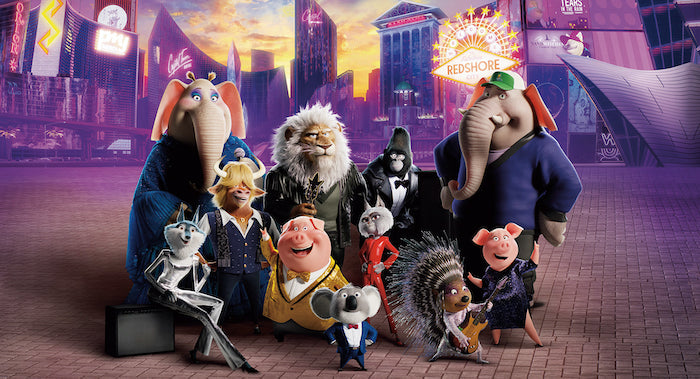
Talking animals have always been a staple—if not the default subjects—of cartoons, their appeal reduced to a confluence of familiar species behaviors and anthropomorphic acting out. This particular credo became even more pronounced as CGI made those behaviors more lifelike, thus throwing into greater comic relief the attributes associated with human emotional reaction, especially those that tend to be exaggerated on film. Animation studio Illumination’s 2016 box office hit Sing took this formula and pumped it up with popular songs that everyone knew and, presumably, loved, and then incorporated it all into a trite tale about a local theater impresario, a koala named Buster Moon, trying to save his dying venue by staging an amateur singing competition and, in the process, discovering all this local talent just bursting with latent star power. Which brings us to the last component of animal-oriented CGI animated features: A-listers doing the voices of these characters, which in this instance meant they also got to show off their singing chops.
Sing was fine in that it touched all the requisite comedy bases thanks to a screwball approach to dialogue, and while these elements are retained in Sing 2, the basic gimmick no longer has a purchase on the material. If anything, the sequel is even triter and less imaginative than the original. Having saved his theater and made local stars of some residents, Buster (Matthew McConaughey) sets his sights on bringing his show to the big time, which in this universe is a Vegasy metropolis called Red Shore. Being local stars means nothing in the naked city, and much of the movie is given over to contrasting the naive sensibility of Buster’s revue with the super sophisticated (read: utterly cynical) professionalism of the Red Shore stage aesthetic as epitomized by the sensibility of the Mafioso-wolf hotelier Jimmy Crystal (Bobby Cannavale). Desperate to get a chance at putting his group of misfits on Crystal’s stage, Buster desperately promises to secure the services of Clay Calloway, a legendary lion-singer-songwriter who has been MIA for at least a decade. Buster lies and says he knows Calloway and can get him in his show, and Crystal assents with hints of violence if Buster doesn’t come through. Consequently, the movie shuttles between the porcupine punk rocker Ash (Scarlett Johansson) hunting Calloway down and trying to persuade him to come out of retirement, and the antics of her fellow Buster-managed singers trying to get up the nerve and wherewithal to learn a new act (some weird sci-fi-themed musical) that will wow the Red Shore regulars. But whereas the cast of mammals (with a few reptiles and birds thrown in) was kinda cute the first time, here they’re just annoying. The only compelling character is Jimmy’s daughter Porsha, who is promised a central role in Buster’s production because daddy demands it and is talent-challenged though utterly game. As voiced by the pop star Halsey (meaning, not primarily an actor, like almost everyone else), Porsha is a millennial version of all those characters Judy Holliday played in the 1940s and 50s, and she’s a trip. However, this cognitive dissonance has the opposite effect when it comes to another cast member whose day job is singing. Once you realize that it’s Bono doing Clay Calloway, it’s all you can think of. Talk about being driven to distraction.
Now playing in Tokyo at Toho Cinemas Nihonbashi (050-6868-5060), Toho Cinemas Hibiya (050-6868-5068), Shinjuku Wald 9 (03-5369-4955), Shinjuku PIccadilly (050-6861-3011), Toho Cinemas Shinjuku (050-6868-5063), Toho Cinemas Shibuya (050-6868-5002), Toho Cinemas Roppongi Hills (050-6868-5024).
What is it about Istanbul and stray animals? In 2016 we had the documentary Kedi, which celebrated the famous stray cats of the city. Now, we have director Elizabeth Lo, who grew up in Hong Kong and studied film in the U.S., taking a knee-level view of stray dogs in the same city, and conveying something very different, something sadder and deeper. In a way, that makes sense, since we tend to think of cats as more independent-natured and thus more resilient to the environmental pressures of living on the streets of a major metropolis. Moreoever, stray cats, by their very nature and appearance, tend to receive more sympathy from the average human, whereas dogs, which are considered needier and more socially minded, evoke stronger emotions, both positive and negative. At the beginning of Lo’s documentary, we’re informed that at one time Istanbul had a policy of rounding up all stray dogs and putting them down, but public opinion was strongly against this policy and now they are allowed to roam free.
Lo’s main subject is the female mutt Zeytin, who acts the part almost too well: melancholy in demeanor, purposeful in behavior, physically robust. As befits such a subject, the narrative (without narration) is random and episodic, a series of encounters with inviduals both two-legged and four- that, in its own way, elucidates Zeytin’s personality, while at the same time through accumulation of detail conveys what life on the streets is like in Istanbul, which means hanging out not only with dogs but with street people, including children, who sniff glue or otherwise make life bearable under these circumstances. This is the film’s main stylistic and thematic difference with Kedi, which mostly focused on the emotional nexus between the city’s working population and its feline underground. In that regard, Lo gets the most dramatic mileage from how Zeytin and her ilk are adored and despised in equal measure, depending on whom the camera is depicting in reaction to the dogs’ various actions. If the denizens of Istanbul seem to like stray cats better than stray dogs it has less to do with these respective species’ appearance or appeal to human feelings than it does with what they do in public. It’s obvious that Lo means to hide nothing, and we see the dogs not only rutting and defecating and rummaging through garbage, but the humans observing these actions, usually in a state of appalled disgust. Consequently, when near the end of the movie Lo juxtaposes this sort or response to the situation regarding homeless immigrants, who are natural allies, as well as defenders, of the stray canines, a point is made that is both powerful and awkwardly exploitative. You can’t help but wonder what Lo’s purpose was at the outset.
No dialogue (though some Turkish background speaking). Now playing in Tokyo at Human Trust Cinema Shibuya (03-5468-5551).







 philipbrasor.com